


About this worksheet
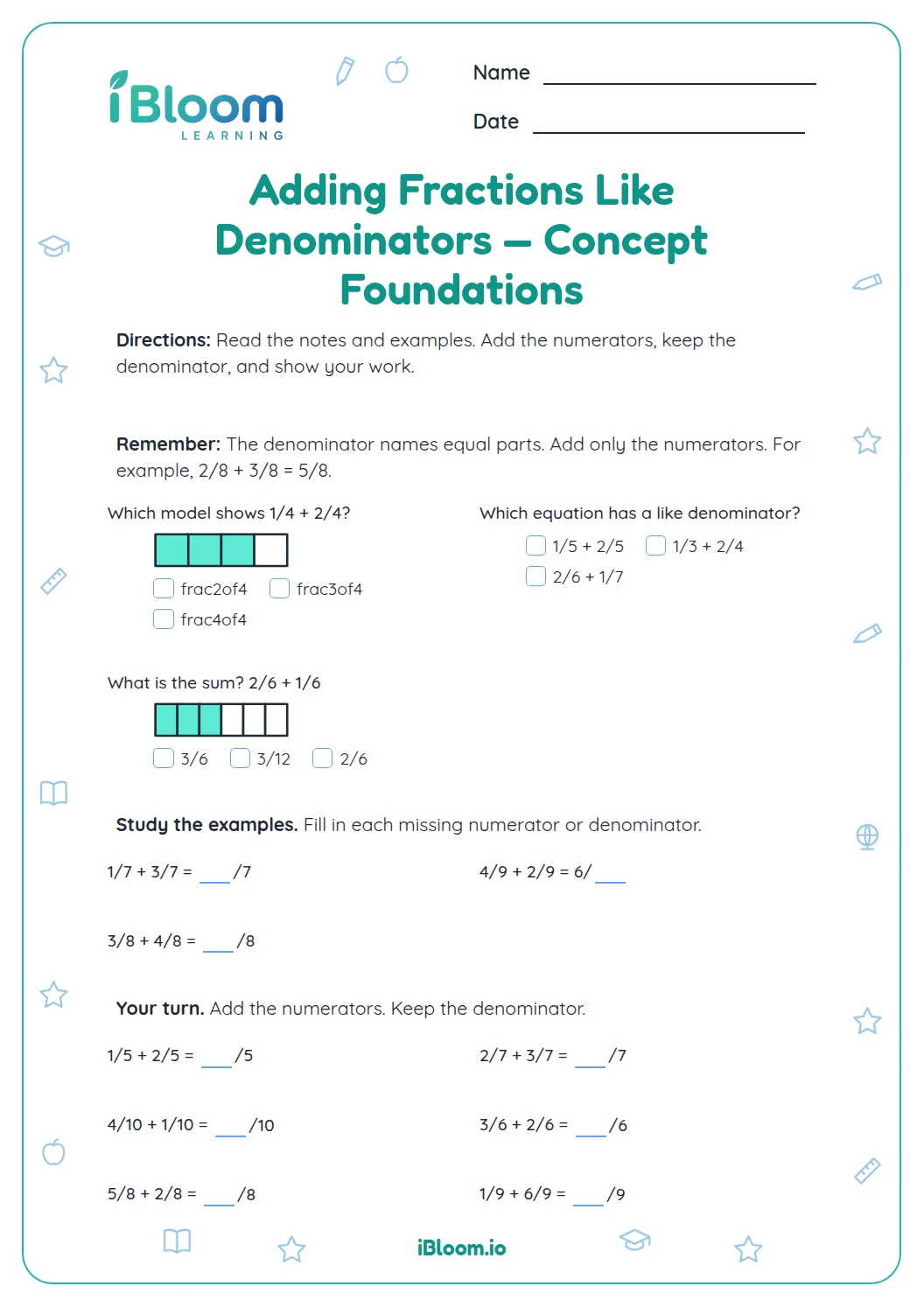
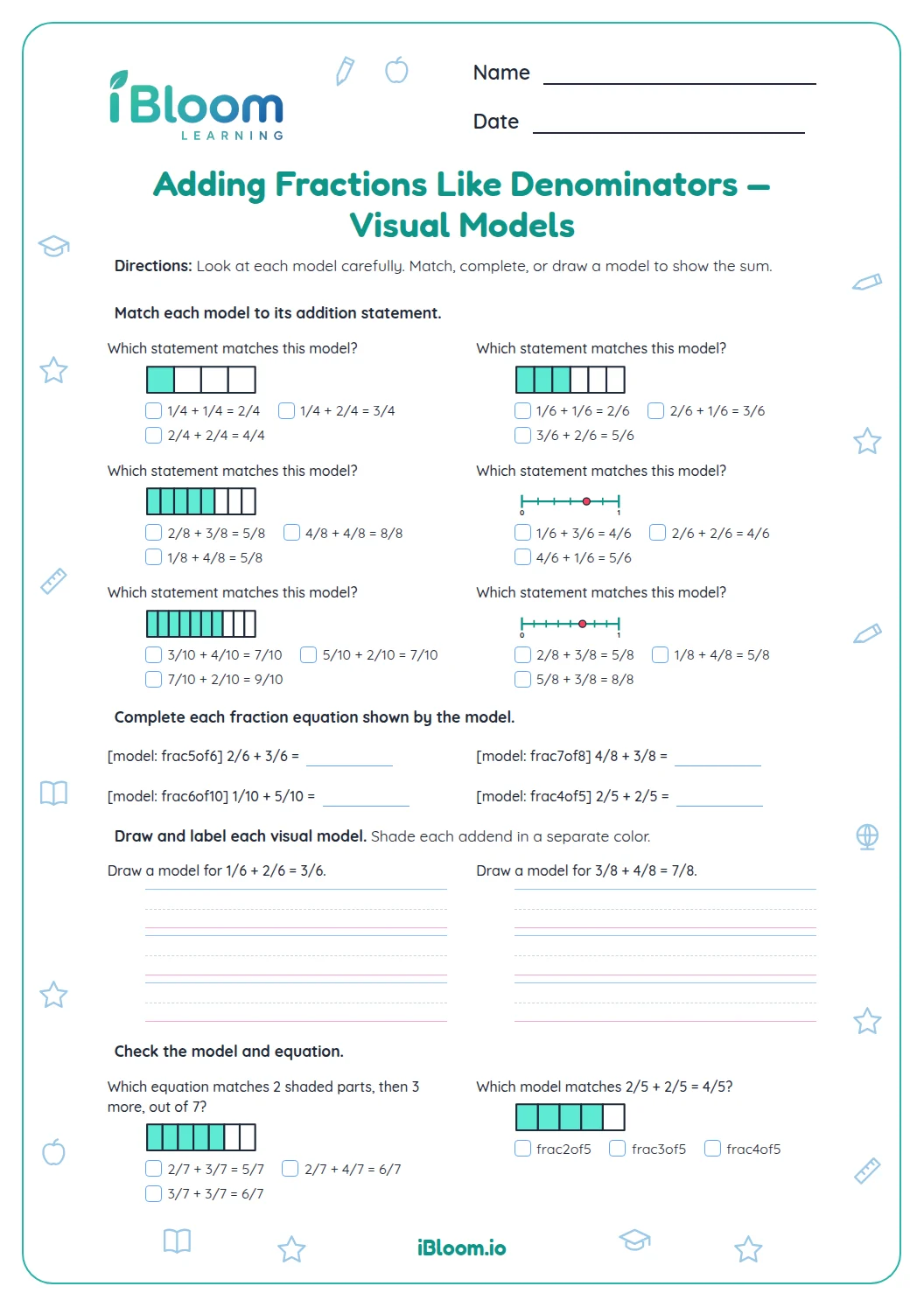
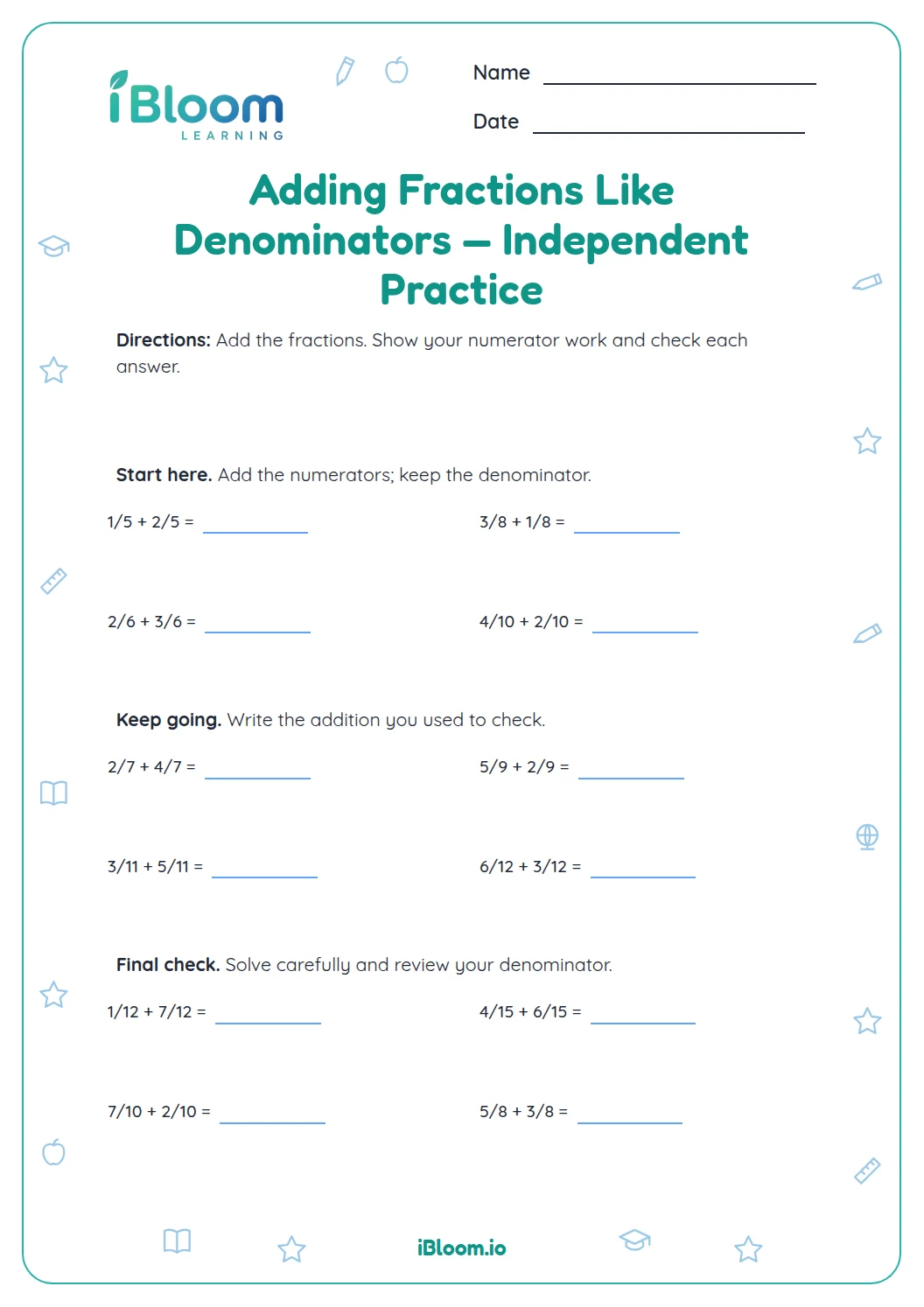
Add like-denominator fractions by joining the equal-sized parts. When the total passes one whole, use the denominator to rename the improper fraction.
Aligned to 4.NF.B.3.a
How do you add like-denominator fractions?
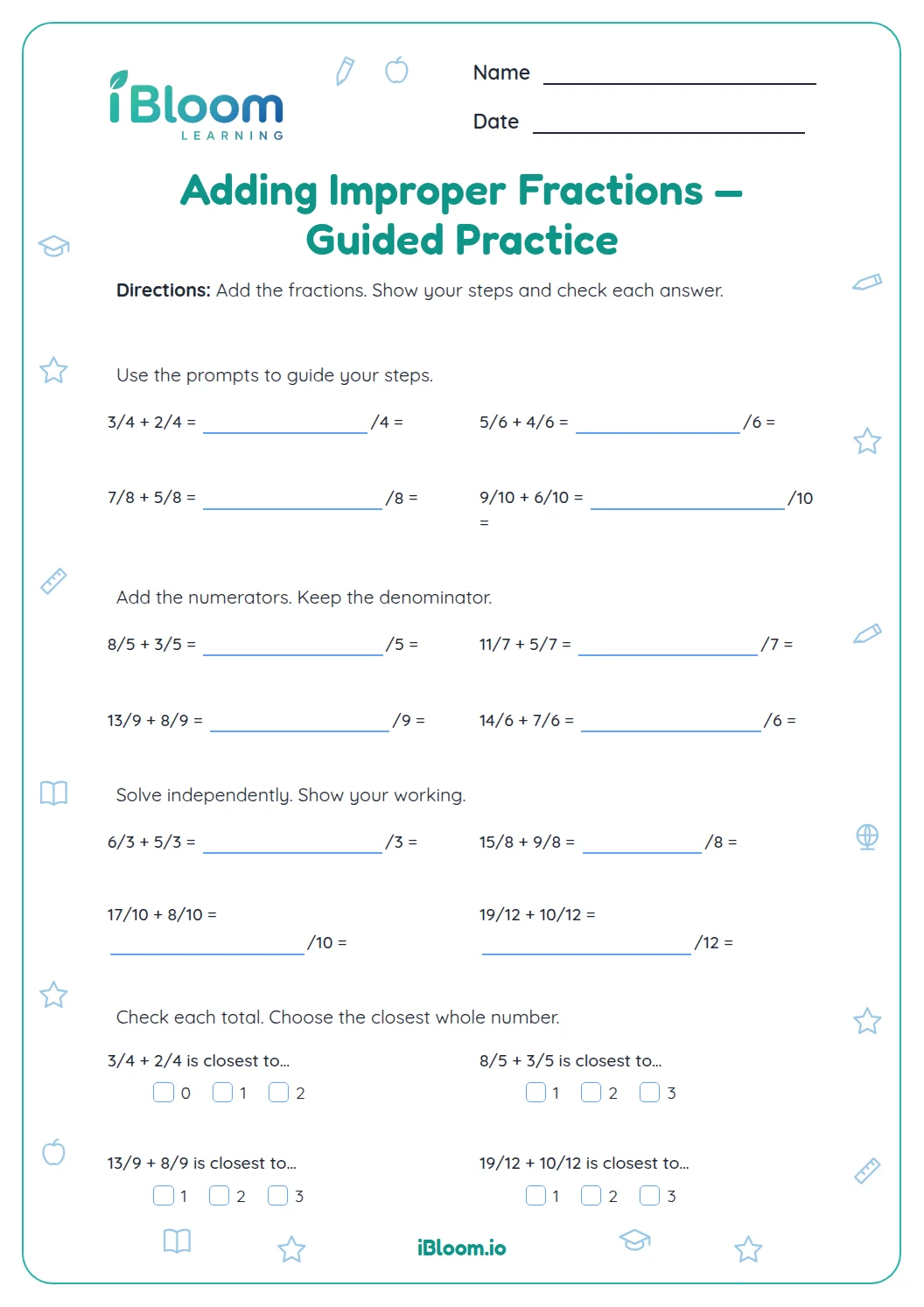
The denominator tells the size of each part. When the denominators match, add the numerators and keep the denominator. Question 1 is 3/4 + 2/4 = 5/4.
Since 4/4 makes one whole, 5/4 is 1 1/4. The sheet uses thirds, fourths, sixths, and eighths, with totals that can be renamed as mixed numbers.
- 13/4 + 2/4 = 5/4
- 24/4 is one whole
- 35/4 = 1 1/4
How does the worksheet build fraction reasoning?
Part A adds like-denominator fractions and renames two improper fractions. Part B compares two fractions and completes missing parts, including correcting a mistaken sum. Part C applies addition to walking, ribbon, and recipe amounts, then completes a statement about why 5/4 is more than one whole.
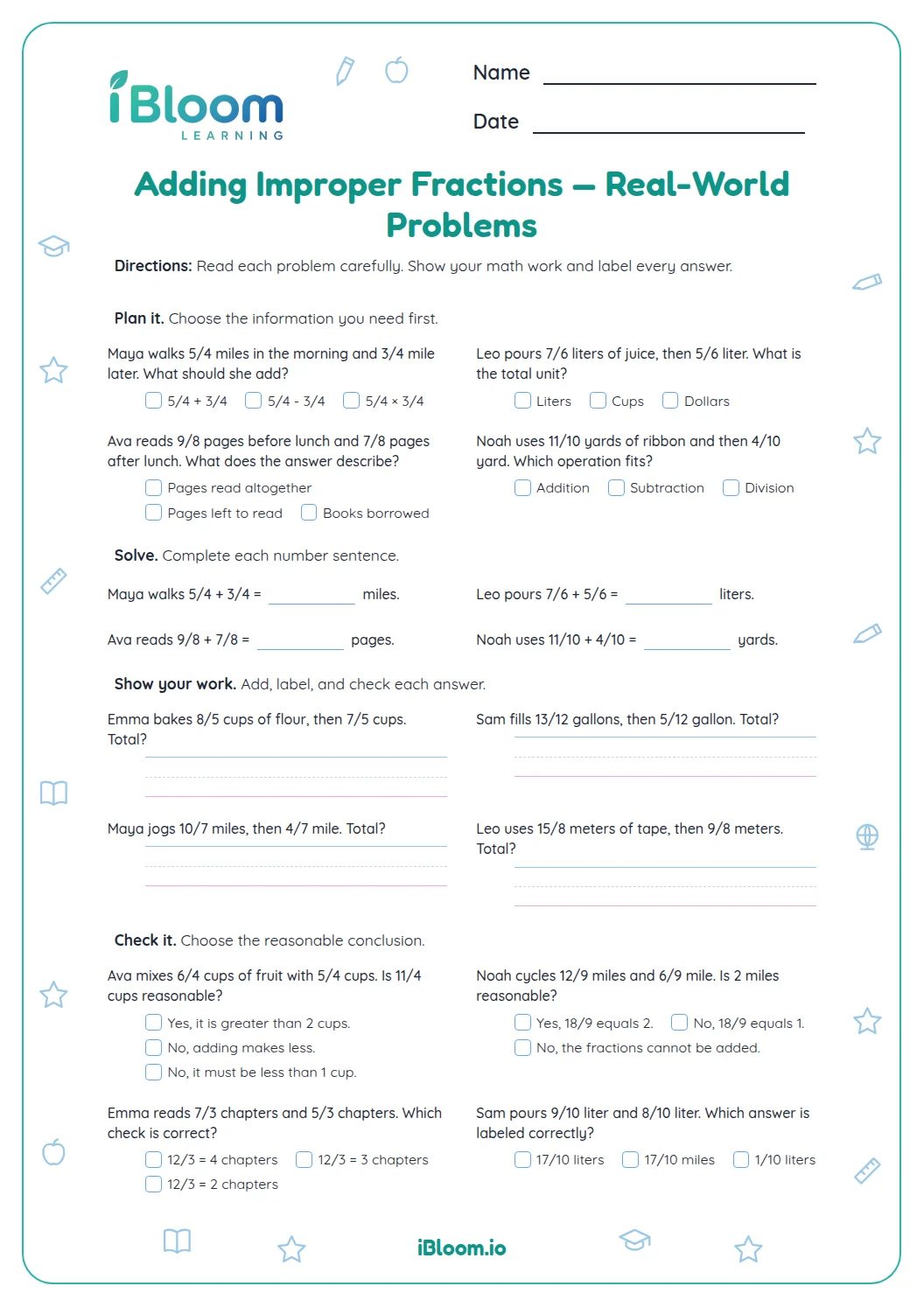
The word problems use like denominators, so the parts describe the same fractional unit. In the recipe question, 4/8 + 7/8 = 11/8 cups, or 1 3/8 cups.
How to use this worksheet
- 1Read the direction at the start of each part.
- 2Solve each item and use the space provided for your work.
- 3Check each response against the answer key and revisit any missed item.
Common fraction mistakes and fixes
The mistake
Adding the denominators as well as the numerators, such as 3/8 + 6/8 = 9/16.
The fix
Keep the denominator because the pieces have the same size; count 9 eighths to get 9/8.
The mistake
Stopping at an improper fraction when the prompt asks for a mixed number.
The fix
Group a full denominator of parts into one whole: 9/6 is 1 3/6.
The mistake
Forgetting that a fraction can be greater than one whole.
The fix
Compare the numerator and denominator. In 5/4, four fourths make one and a fourth remains.
Curriculum alignment
This worksheet practices the listed Common Core skill.
Add fractions with like denominators as parts of the same whole.
On this sheet: Every addition combines like-denominator fractional parts; some totals are renamed as mixed numbers.
Show the official wordingHide the official wording
Understand addition and subtraction of fractions as joining and separating parts referring to the same whole.
What to practice next
Make more practice
Further reading
Questions parents and teachers ask
Why does the denominator stay the same when adding like fractions?
The denominator names the size of each part. In 3/4 + 2/4, both amounts are fourths, so combine the numerators to get 5/4. The pieces stay fourths, and their total can be greater than one whole. The denominator stays 4 because both addends describe fourths. Five fourths can also be grouped as one whole and one fourth.
How do I rename 9/6 as a mixed number?
Six sixths make one whole. Use six of the nine sixths for 1, then three sixths remain, so 9/6 = 1 3/6. The addition section accepts the improper fraction and asks for mixed numbers when renaming. The answer can remain 9/6 in a sum, while the renaming prompt asks for its mixed-number form.
What does improper fraction mean?
An improper fraction has a numerator at least as large as its denominator. It names one whole or more: 5/4 is one whole and one fourth, while 8/4 is exactly two wholes. The numerator counts the equal-size parts.
How do I compare 7/4 and 6/4?
The denominators match, so compare numerators: seven fourths is one fourth more than six fourths. Therefore 7/4 is greater than 6/4, which is question 9. Write a comparison sign after checking that both fractions use fourths. The sign belongs in the blank between the two expressions.
What is the answer to the recipe question?
The recipe amounts combine to 4/8 + 7/8 = 11/8 cups. Eight eighths make one cup, leaving three eighths, so the total is 1 3/8 cups. This amount is more than a cup because eleven eighths include one full group of eight eighths.
Which fraction sizes appear on the worksheet?
The questions use thirds, fourths, sixths, and eighths. Matching denominators let students add numerators, then rename totals such as 9/8 or 11/8 as mixed numbers when asked. Only like denominators appear, so no fraction renaming to a new denominator is needed.