




About this worksheet
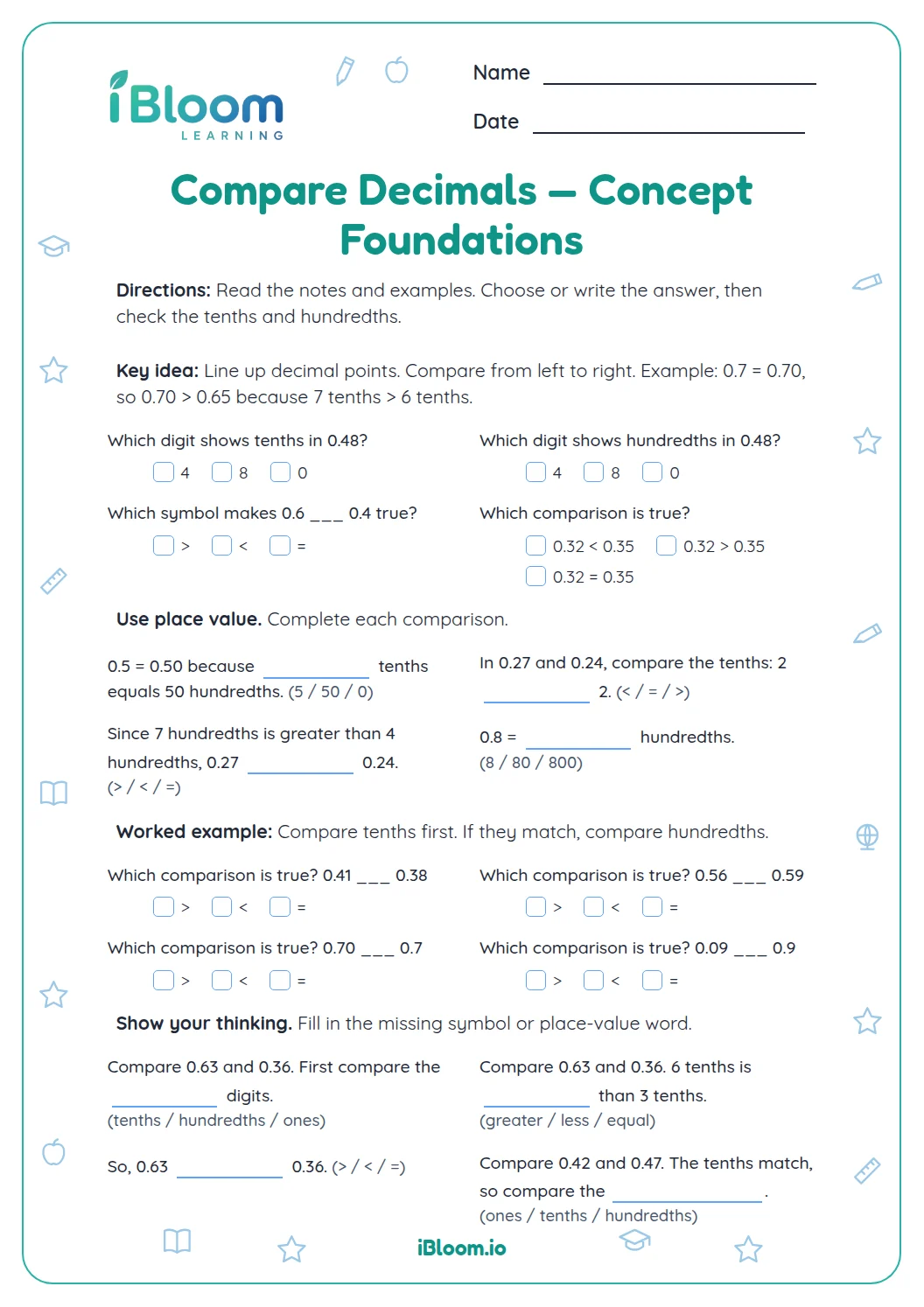
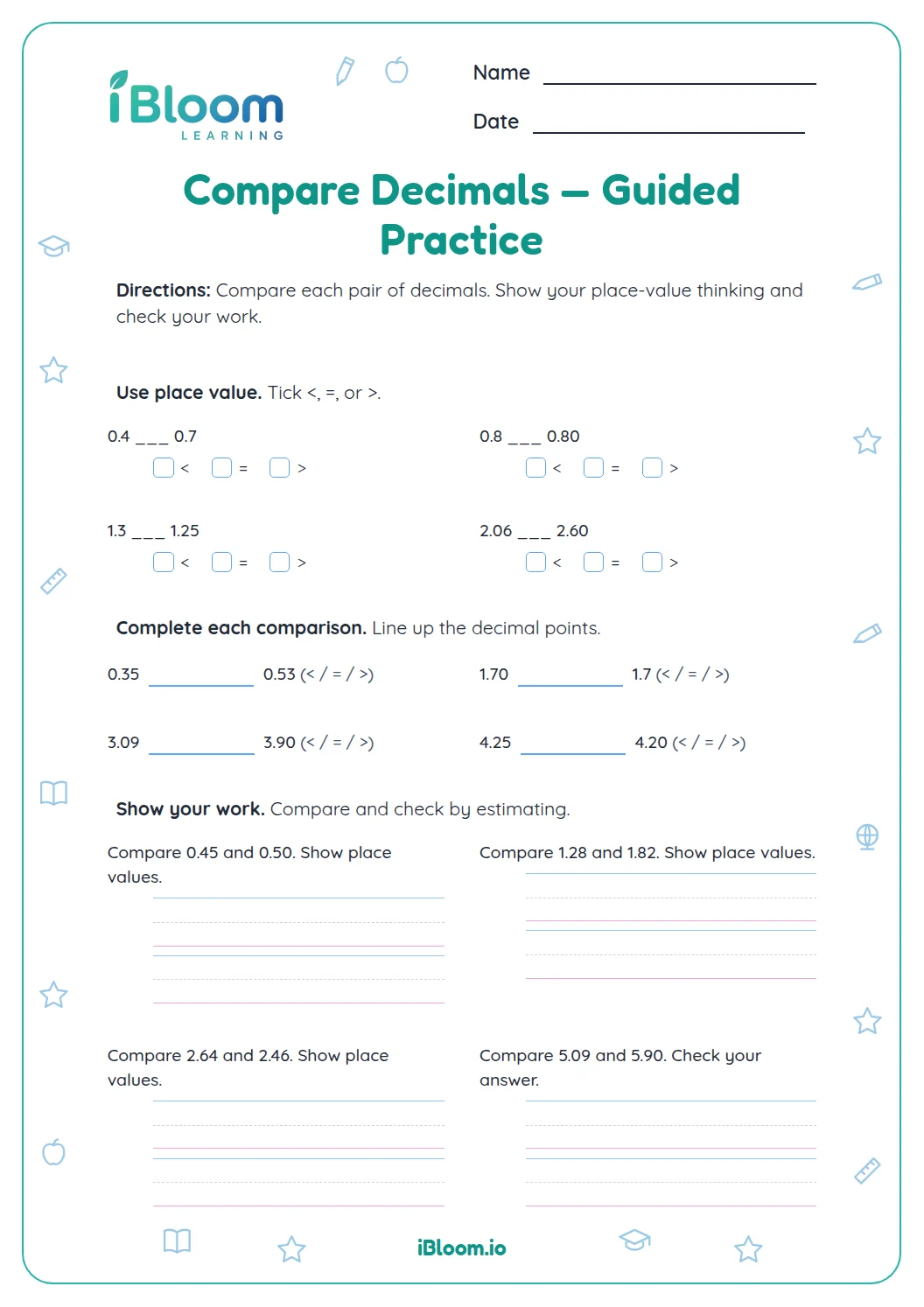
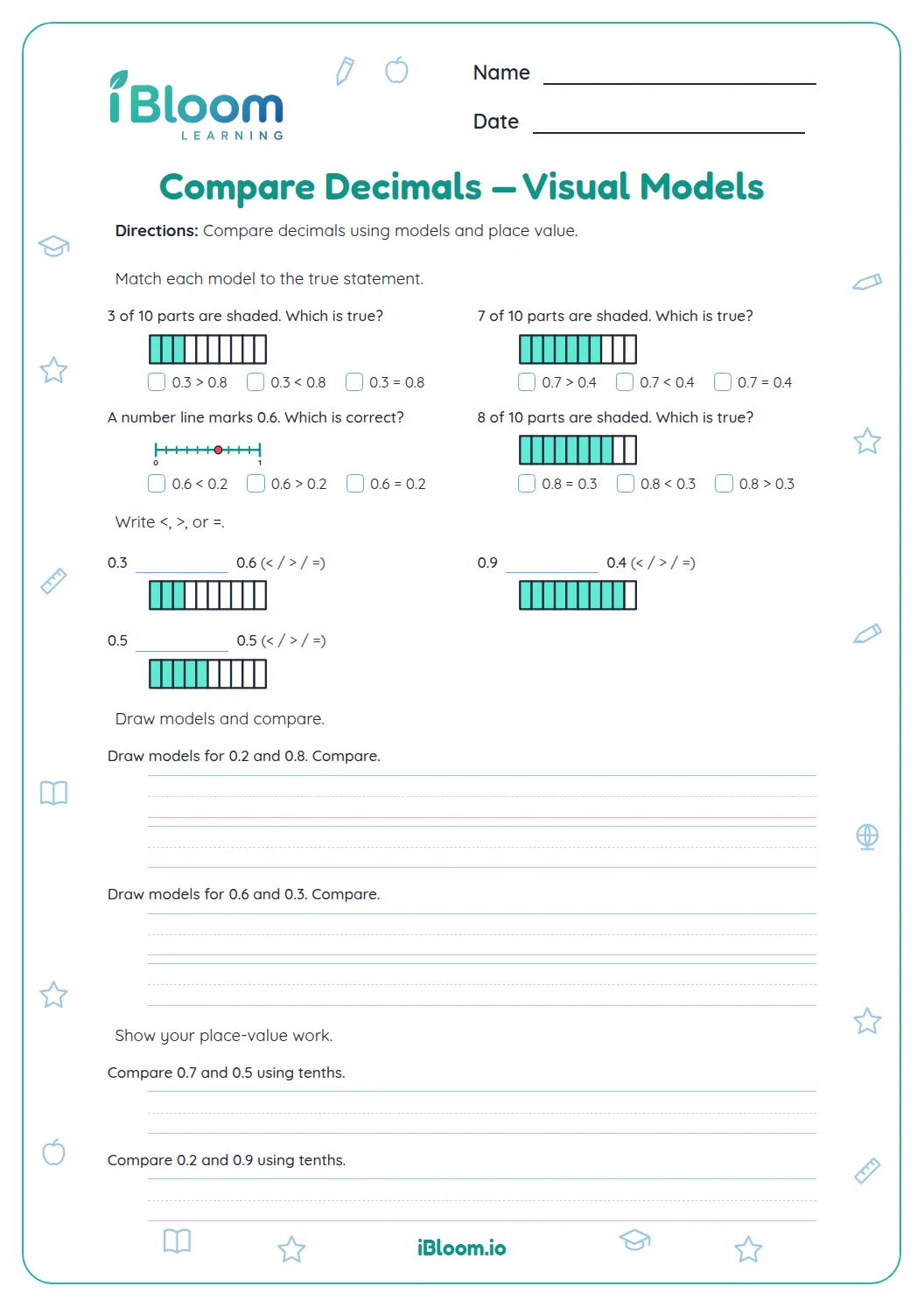
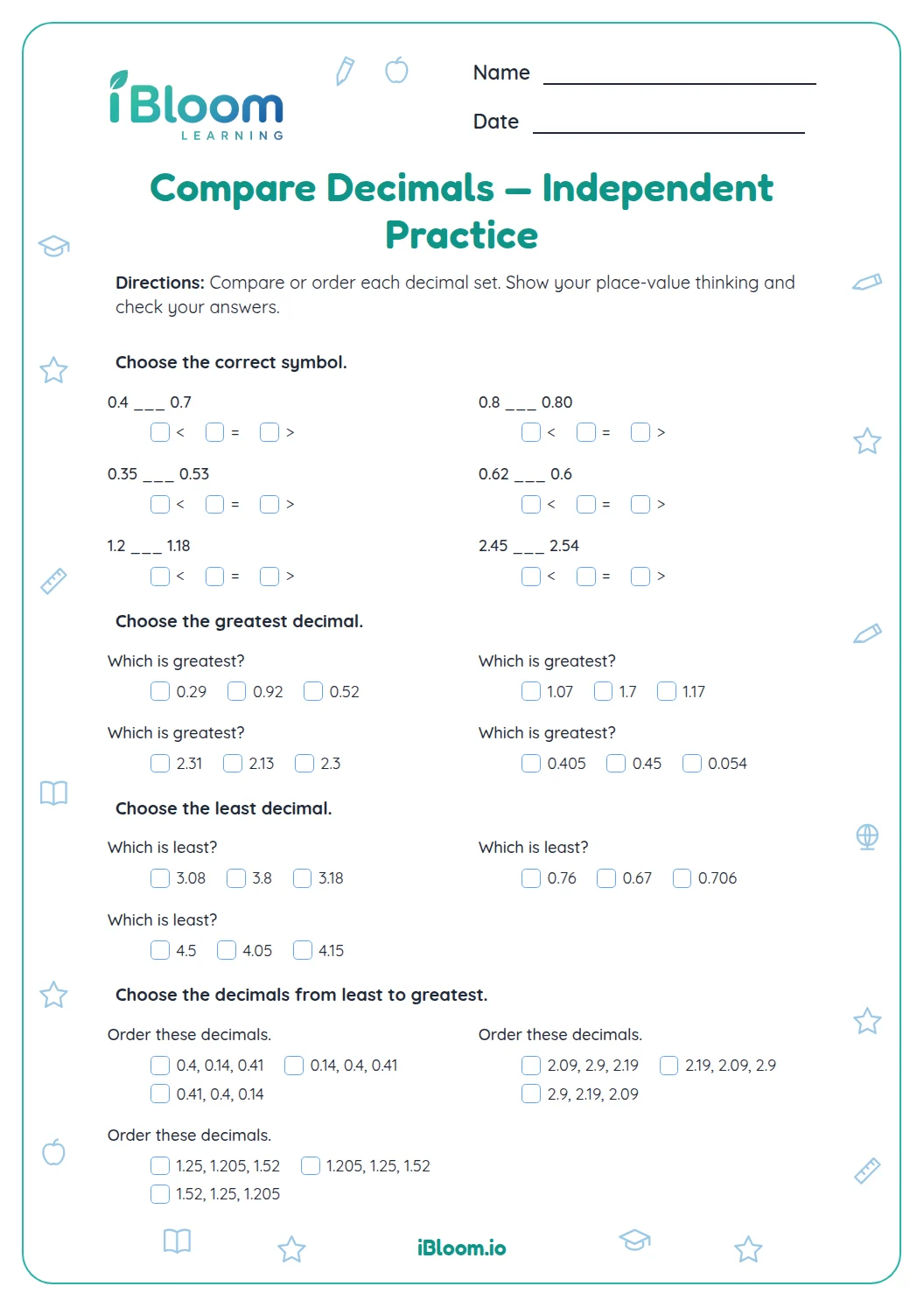
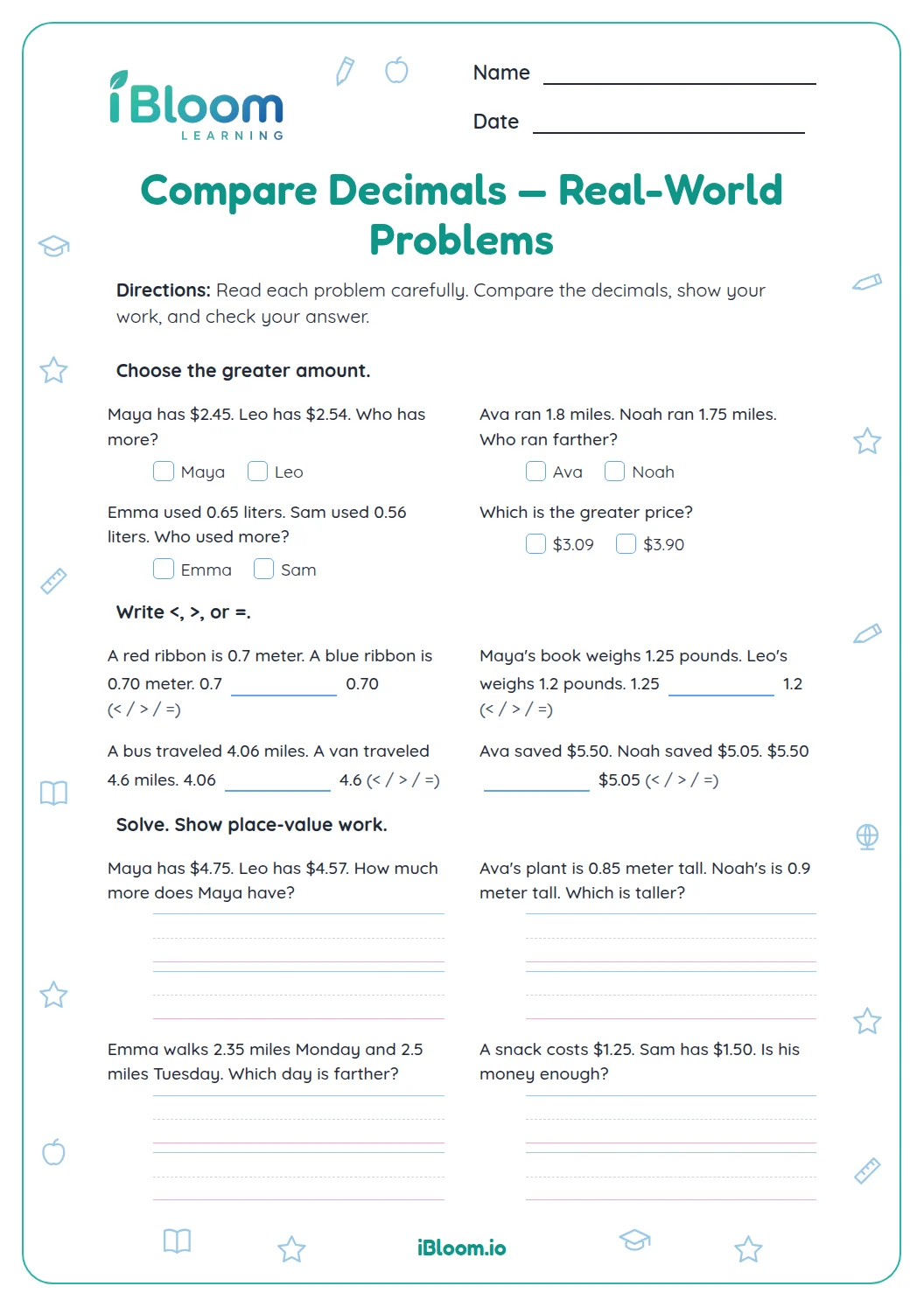
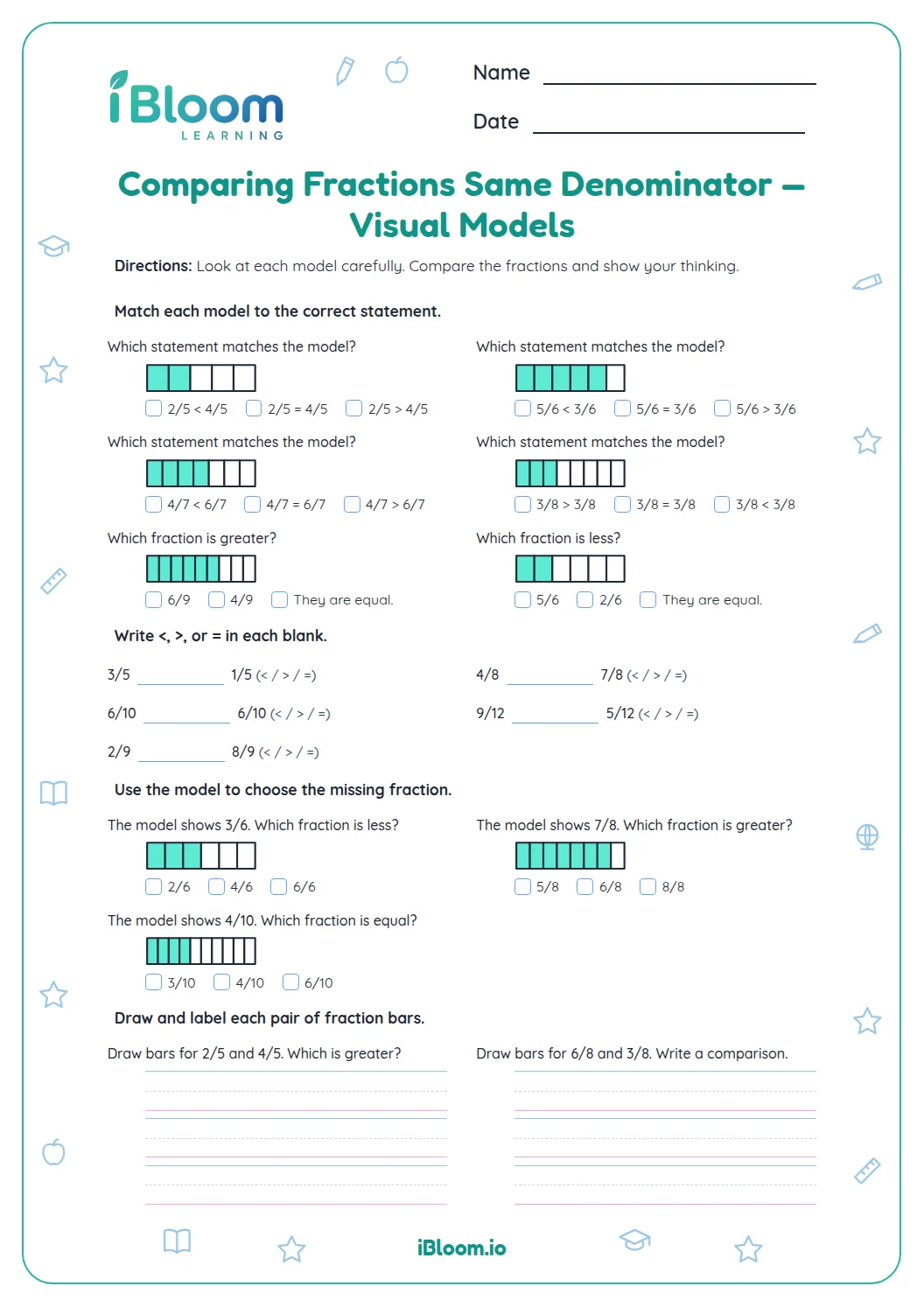
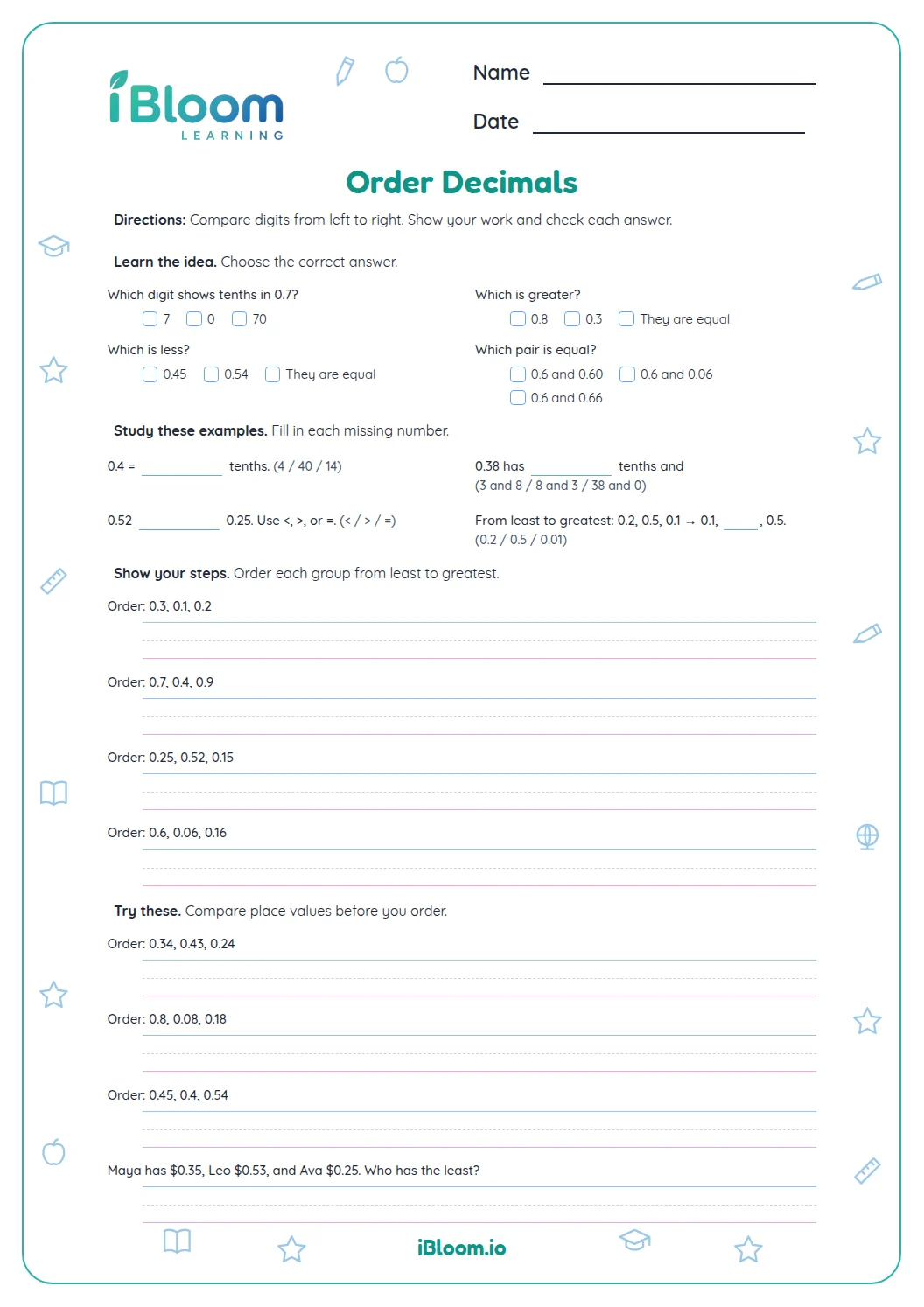
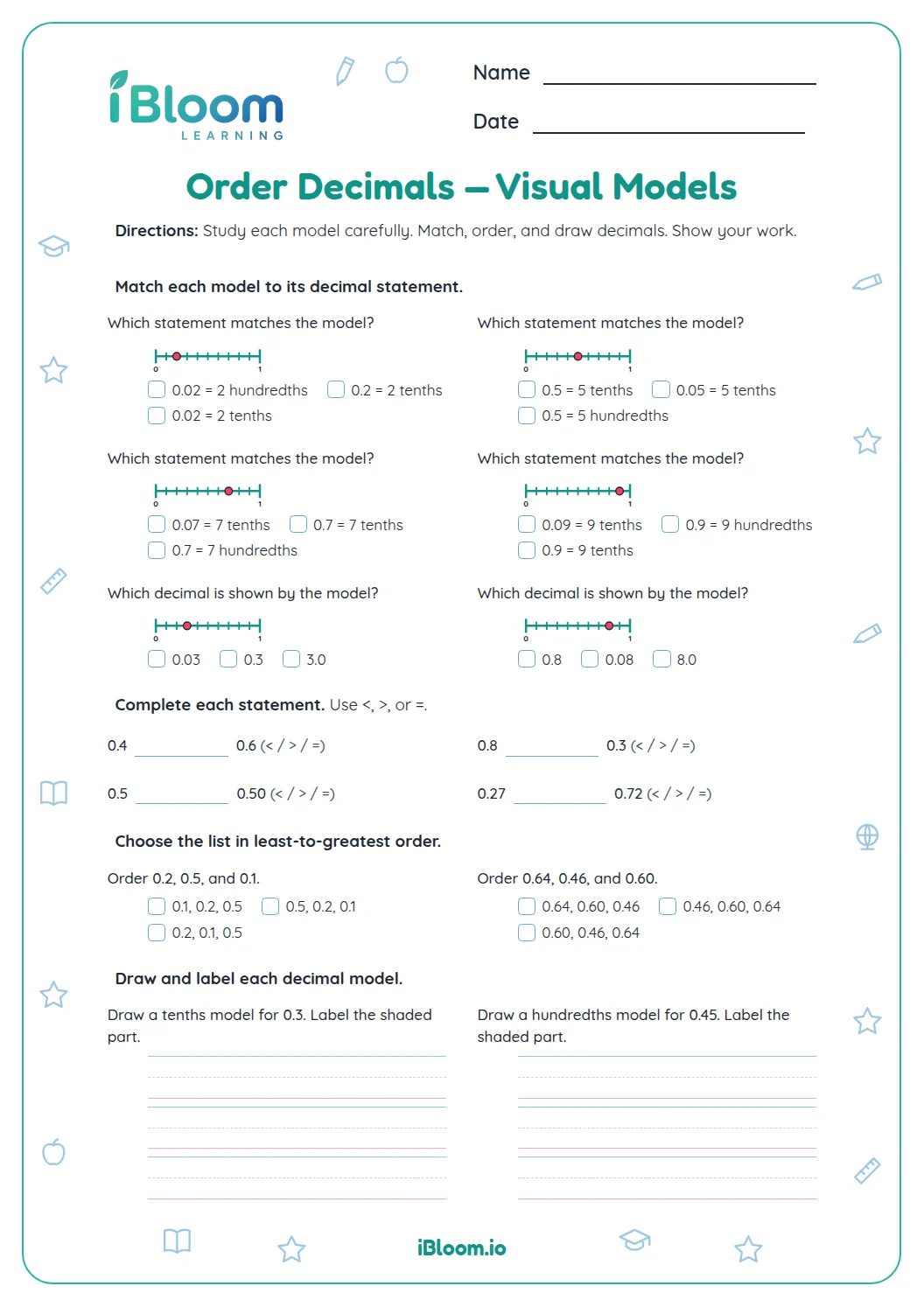
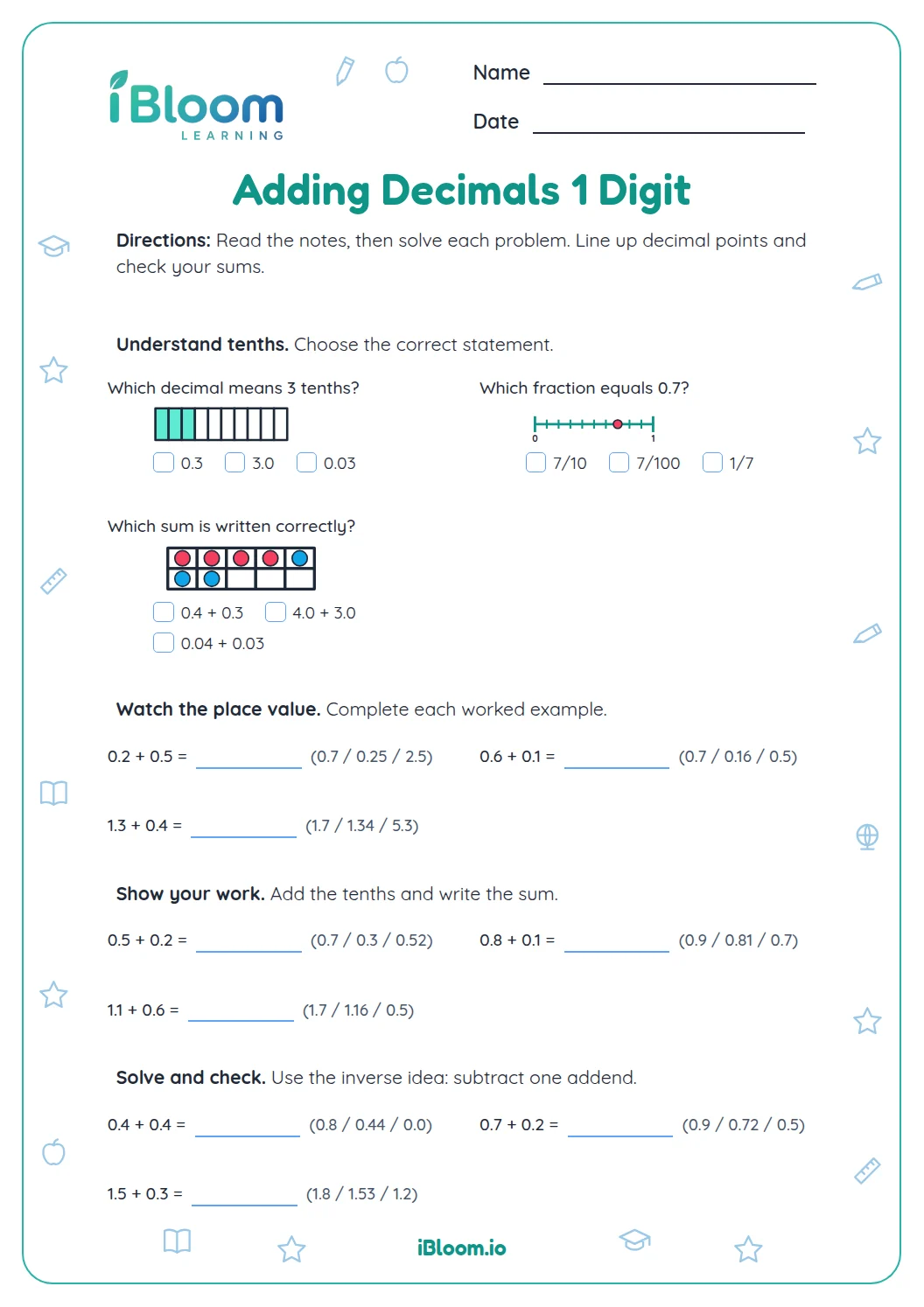
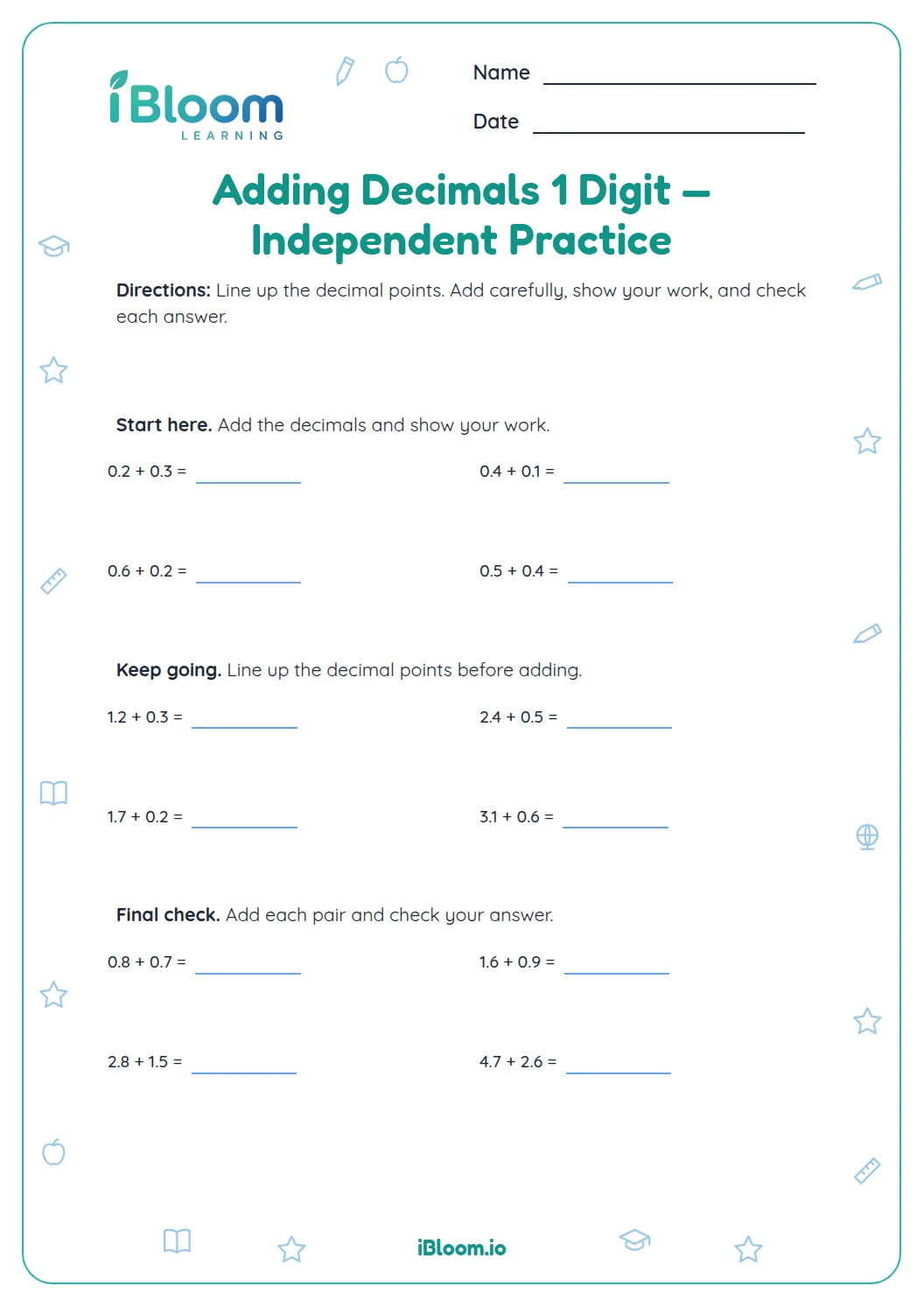
This printable practices the decimal comparisons shown on the original reasoning sheet, including tenths and hundredths. Children check claims, write comparison signs, compare values with different numbers of decimal places, and explain a choice. The separate key gives the signs and sample reasoning.
How do tenths help compare decimals?
Compare digits with the same place value. In 0.7 and 0.6, seven tenths is greater than six tenths, so 0.7 > 0.6. A zero at the end can show the same value: 0.4 and 0.40 both mean four tenths.
- 10.7 has 7 tenths.
- 20.6 has 6 tenths.
- 37 tenths is greater than 6 tenths.
- 4So 0.7 > 0.6.
How can you test a decimal claim?
Compare matching place values from left to right. For 0.8 and 0.80, the final zero adds no value. For 0.7 and 0.65, write 0.7 as 0.70 before comparing hundredths.
How can you explain a comparison?
Use place-value words to explain a comparison. “Seven tenths is greater than six tenths” names the values being compared. When one number has fewer decimal places, such as 0.7 and 0.65, write 0.70 to compare hundredths.
How to use this worksheet
- 1Read the digits from left to right by place value.
- 2Compare tenths first.
- 3Use a zero at the end when it helps line up places.
- 4Choose a sign that makes the full sentence true.
- 5Explain your choice with place-value words.
Common mistakes and quick fixes
The mistake
Comparing digits without checking their place.
The fix
Say “tenths” or “hundredths” as you compare each digit.
The mistake
Thinking 0.40 is greater than 0.4 because it has more digits.
The fix
Read both as four tenths; a final zero adds no value.
The mistake
Choosing a number outside a between range.
The fix
Check both sides: the value must be greater than the smaller number and less than the larger one.
What to practice next
Make more practice
Questions parents and teachers ask
How many questions are included?
There are 12 questions in three parts: decimal claims, comparison signs and reasoning. The answer key gives correct choices and signs, plus sample explanations. Children can explain each comparison by naming the tenths or hundredths place and telling which value is greater or equal.
Why does 0.4 equal 0.40?
Both decimals represent four tenths. In 0.40, the zero says there are no additional hundredths, so the value has not changed. Writing the zero can help line up places when comparing two decimals with different numbers of digits.
How do I compare 0.7 and 0.65?
Think of 0.7 as 0.70. Compare 70 hundredths with 65 hundredths. Since 70 is greater than 65, 0.70, and therefore 0.7, is greater than 0.65. Matching the number of decimal places makes the comparison easier to see. This method works for other tenths and hundredths comparisons too.
What does the number between 0.3 and 0.5 need to satisfy?
It must be greater than 0.3 and less than 0.5 at the same time. In this sheet, 0.4 fits because 0.3 < 0.4 and 0.4 < 0.5. Checking both comparisons prevents choosing a value outside the interval. Write the two inequalities to check the interval.
Is there an answer key?
Yes. A separate key gives comparison signs, correct choices and sample reasoning. For an explanation, accept a clear response that compares place values accurately, such as saying that seven tenths is greater than six tenths. The key is useful for checking each item together.
What should a child say when explaining a comparison?
A short place-value statement is enough: “Eight tenths is greater than three tenths.” For 0.7 and 0.65, lining up the values as 0.70 and 0.65 makes the hundredths comparison clear. The important part is explaining why the chosen sign is true.