
About this worksheet
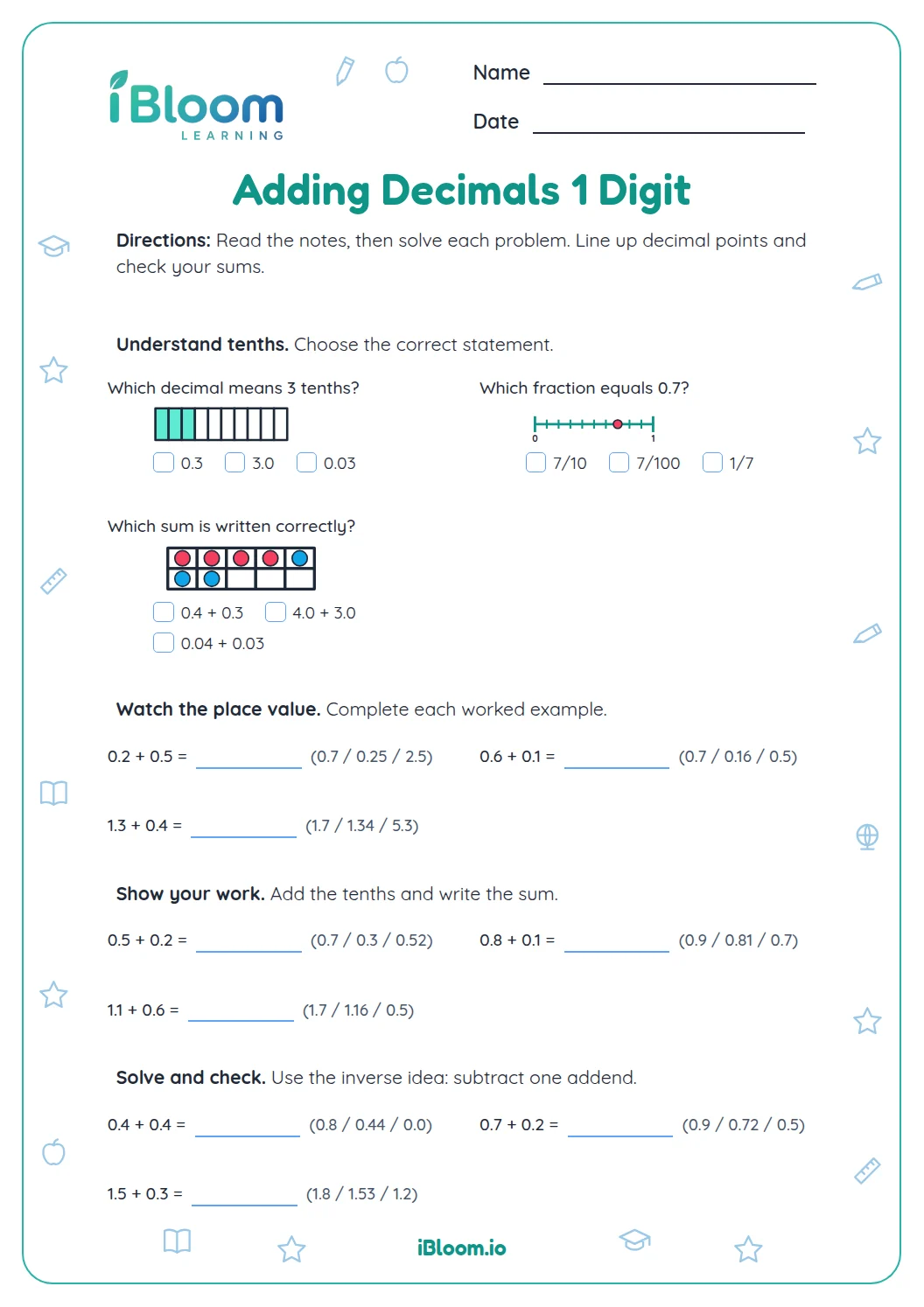
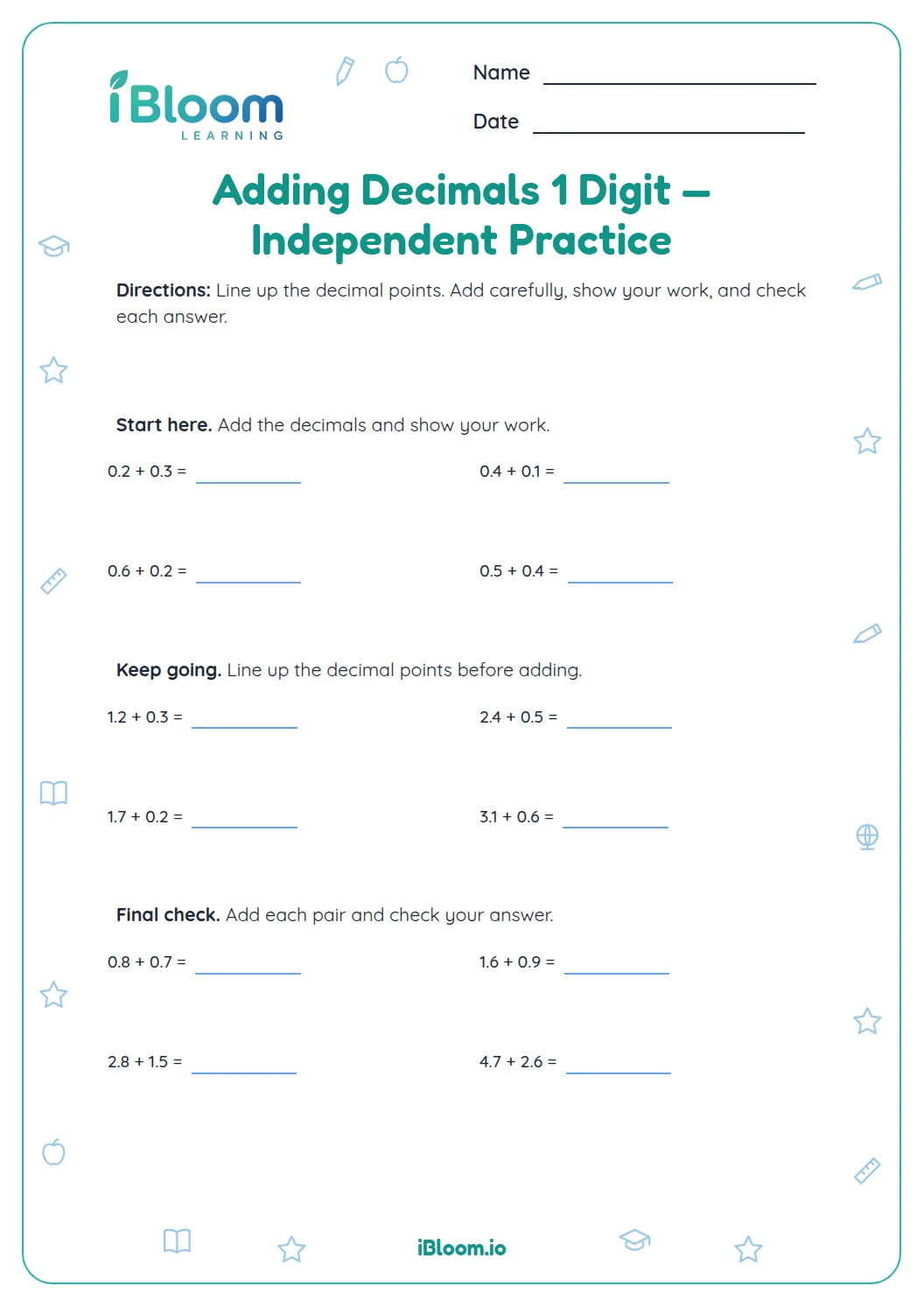
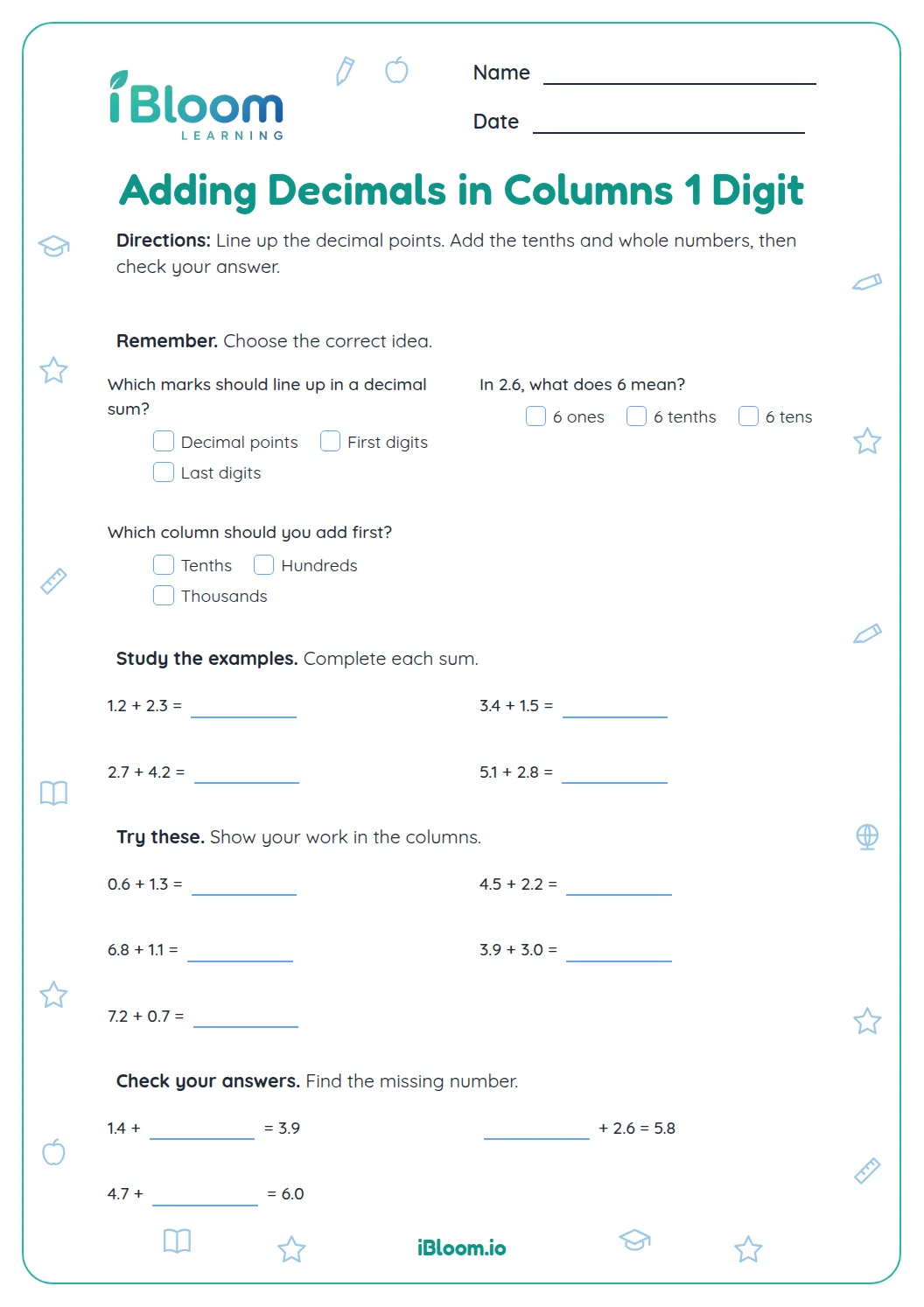
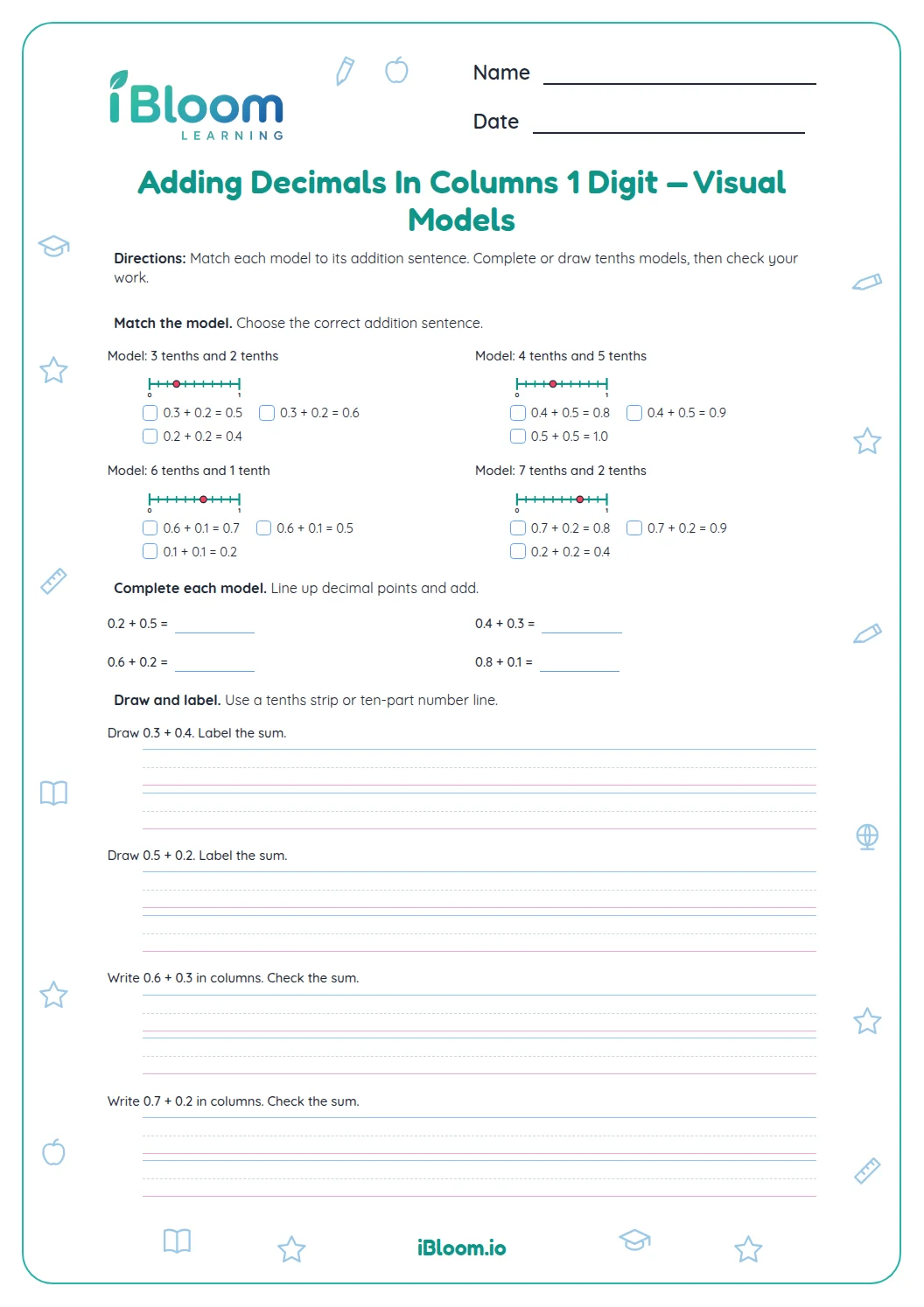
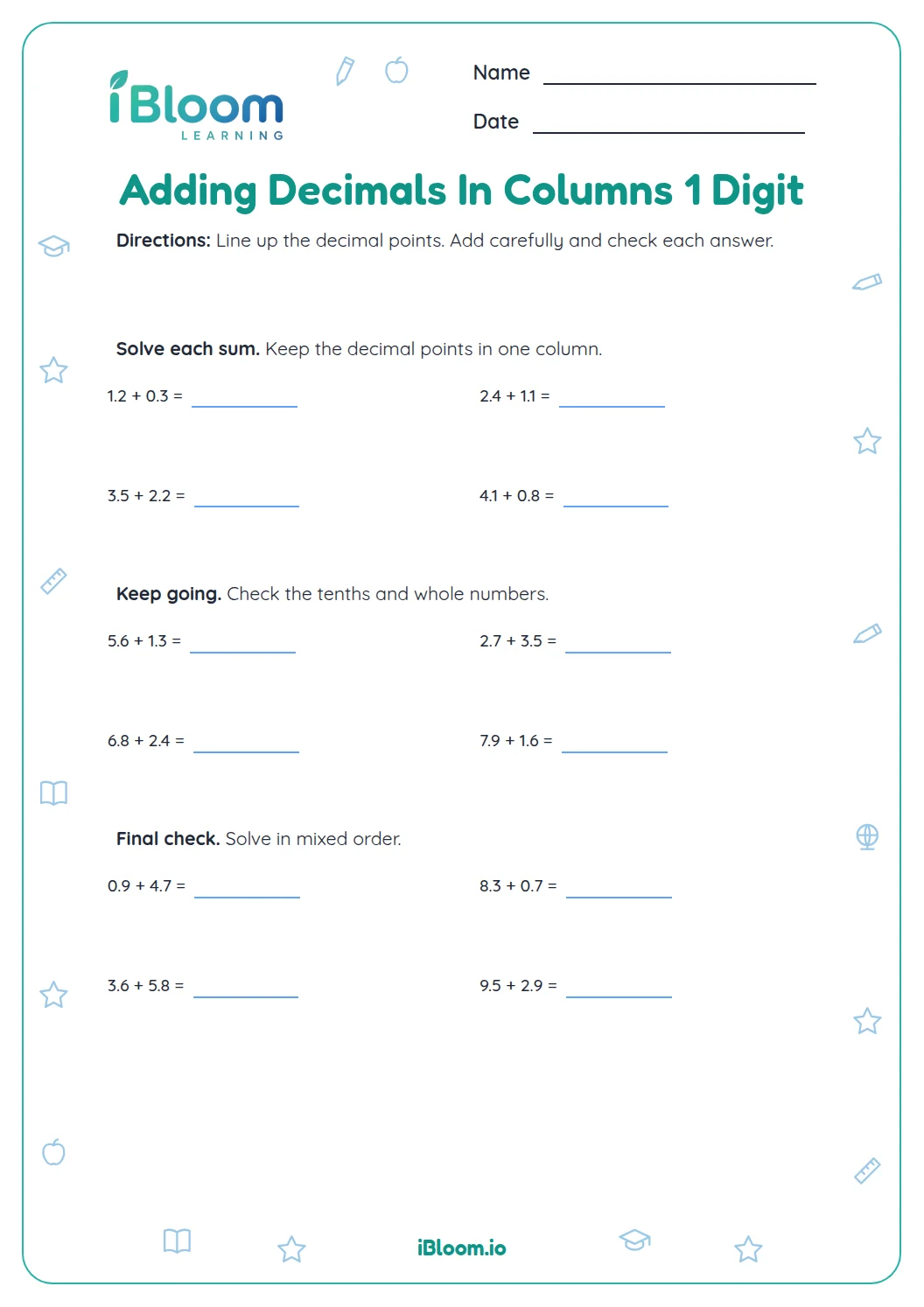
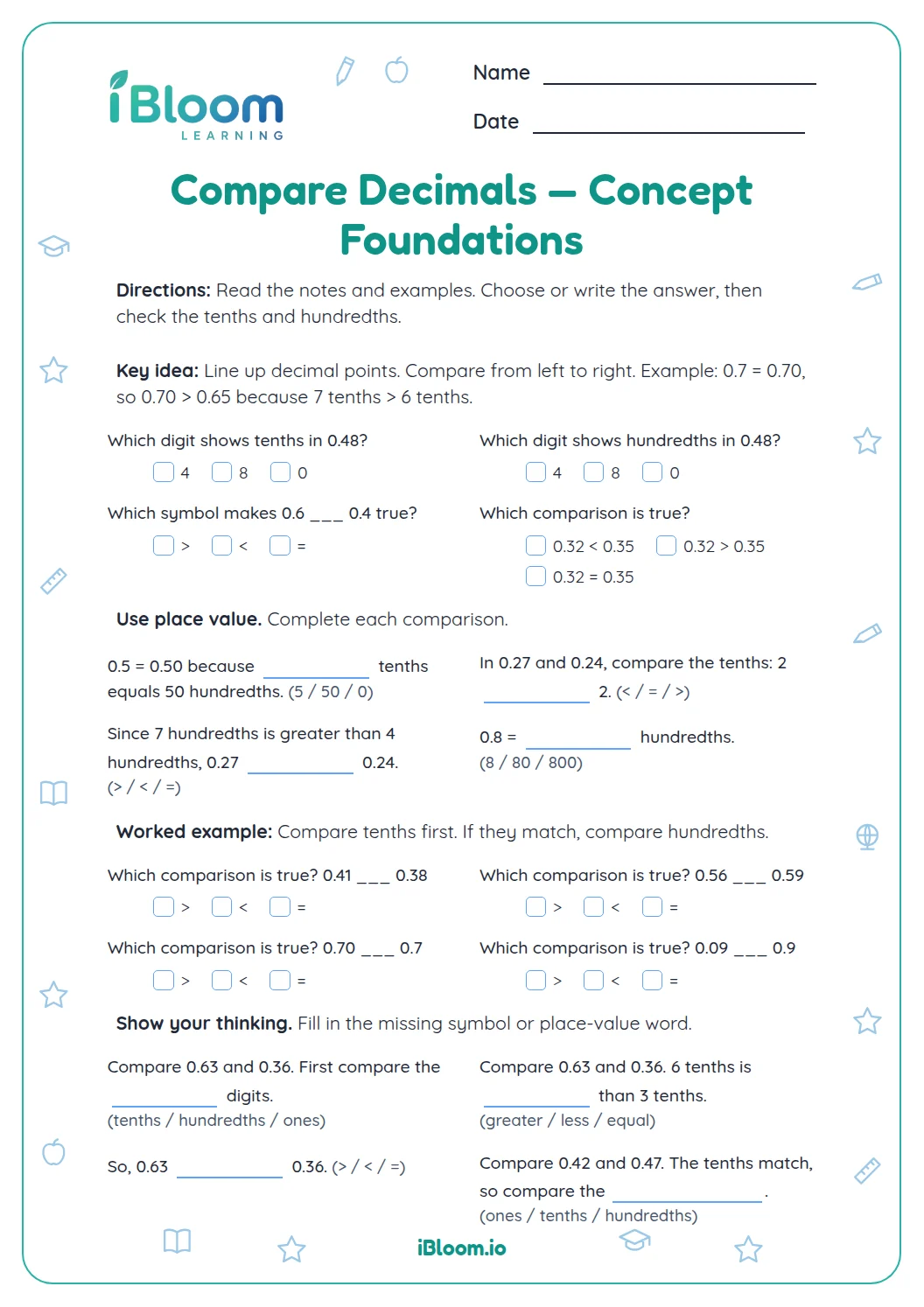
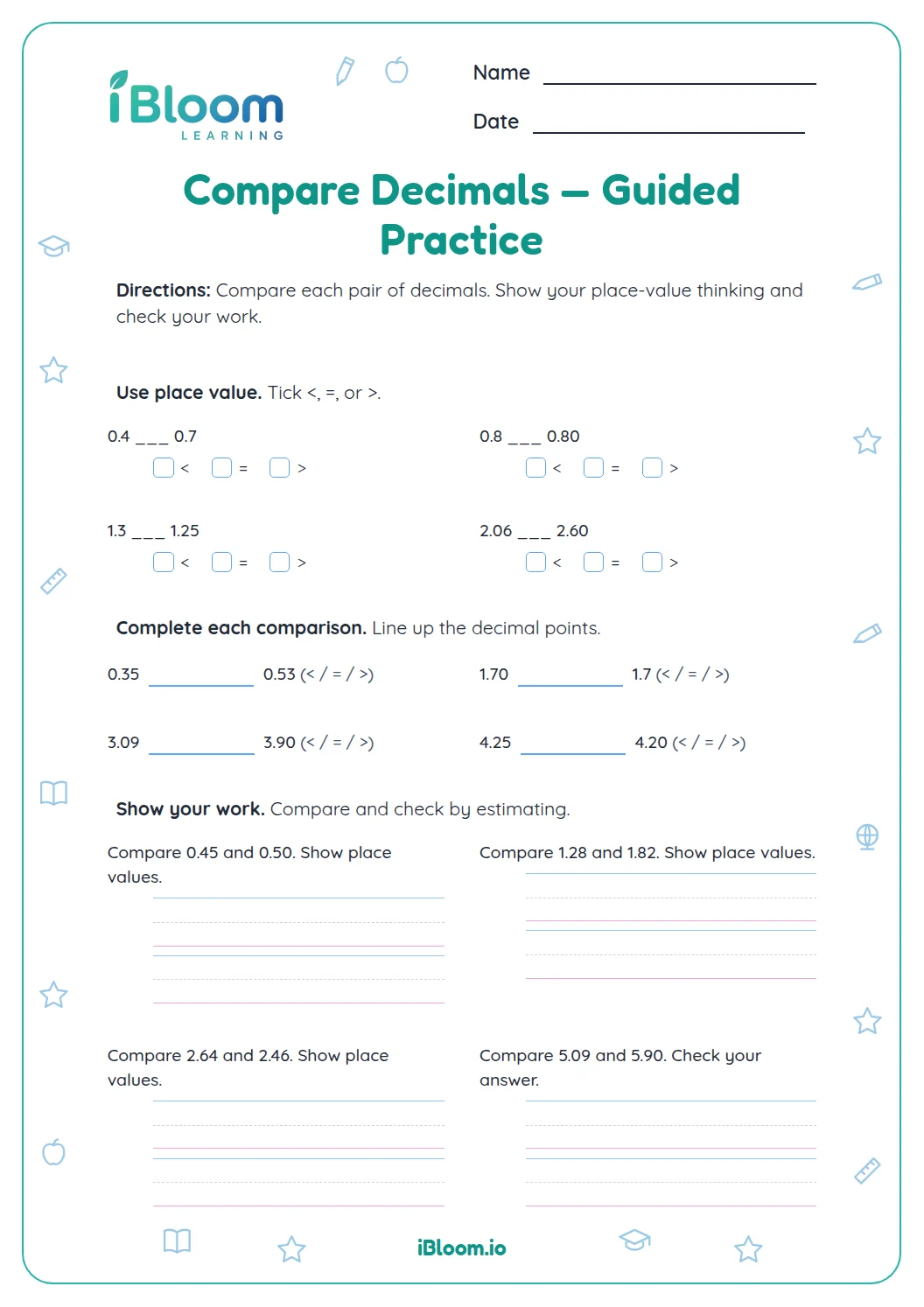
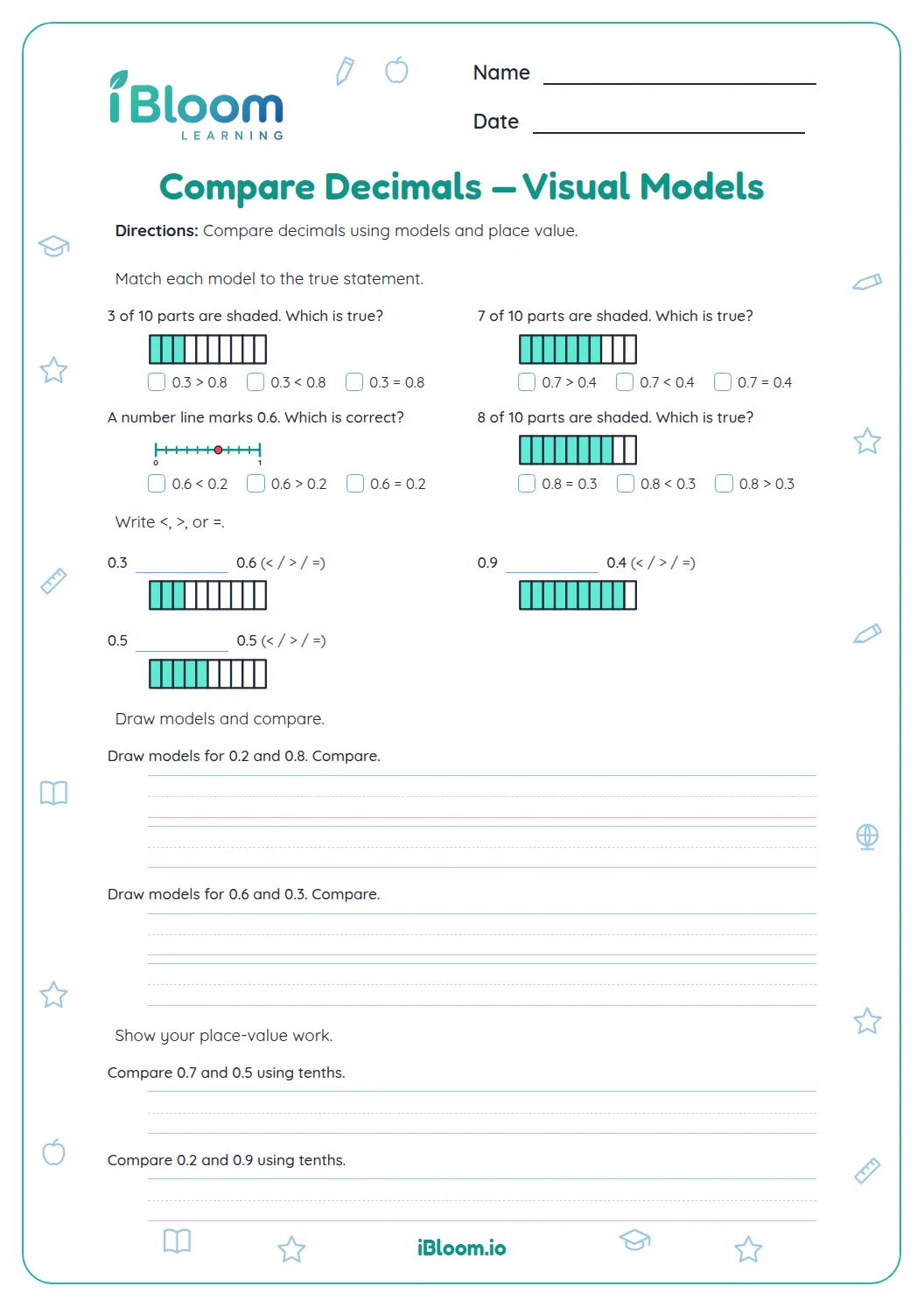
This free printable worksheet shows Grade 3 students how to add decimals with one digit, such as 0.3 + 0.4, by picturing tenths first. Strip models, number lines and plain number sentences all use one idea: 0.3 is three tenths of one whole. The twelve questions cover reading a model, shading more tenths, jumping along a number line, sums that pass 1 and two short word problems. It practices Common Core 4.NF.C.6, writing tenths as decimals and placing them on a number line, and a separate answer key is included.
Aligned to 4.NF.C.6
How does a tenths model help with adding decimals?
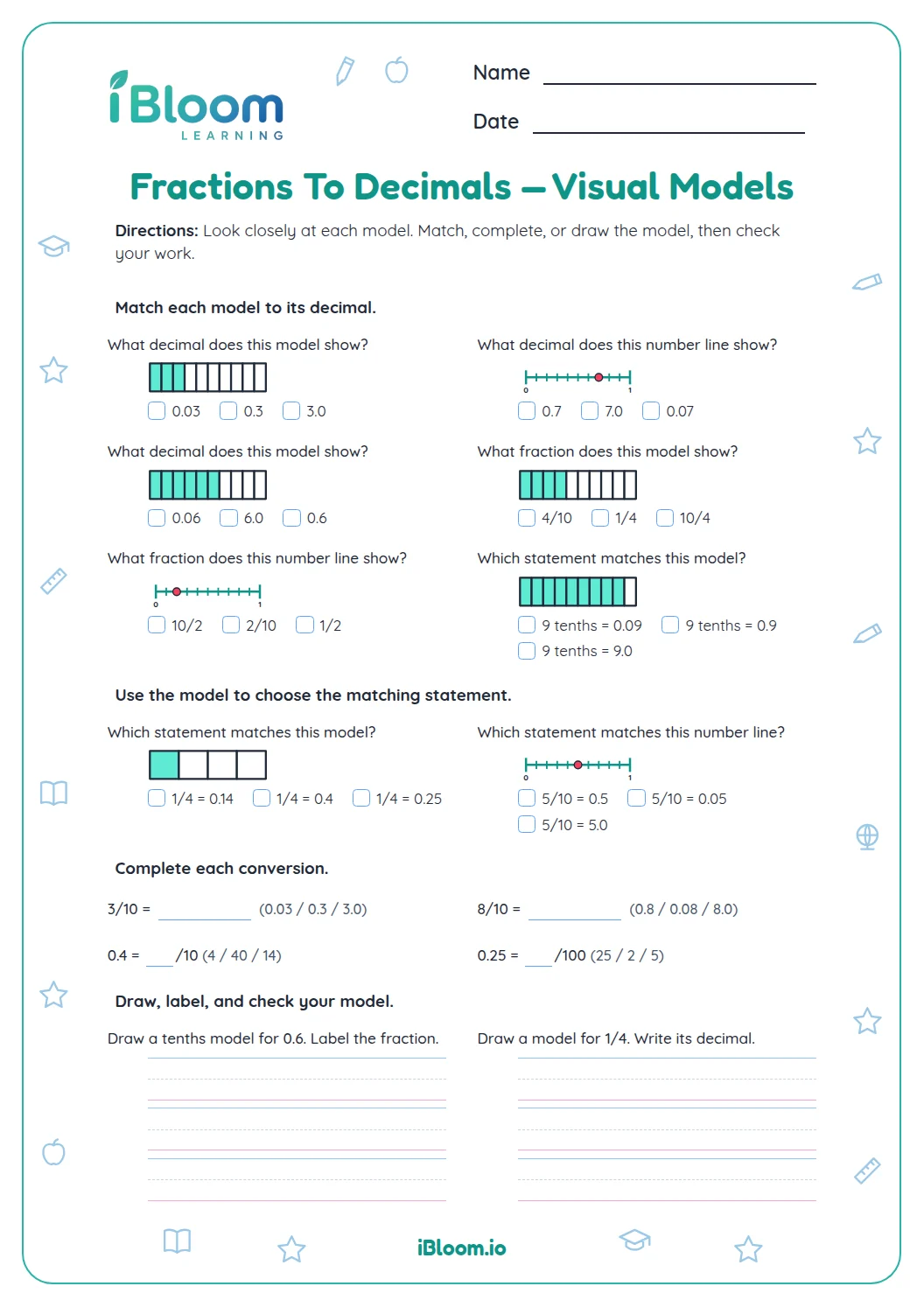
One strip is one whole cut into 10 equal parts, so each shaded part is 0.1. Six shaded parts show 0.6. To add, shade more parts: for 0.3 + 0.4, children shade four more parts on the strip and count seven parts in all.
When the parts reach ten, the strip is full and a second strip begins. Question 2 shows one full strip and three more parts. The full strip is 1 and the three parts are 0.3, so the model shows 1.3.
- 1Shade 5 more tenths. 0.5 + 0.5 = ___
- 25 tenths are shaded; shading 5 more makes 10 tenths
- 310 tenths fill the whole strip, and a full strip is 1
- 40.5 + 0.5 = 1
How do you add tenths on a number line?
The number line from 0 to 1 is cut into ten equal jumps of 0.1. Children put a finger on the dot and count jumps to the right. In question 5 the dot is at 0.2, and five jumps land on 0.7.
Question 6 uses a line from 0 to 2, so the jumps cross the 1. Counting jumps, rather than reading a label under the answer, shows children that 0.8 and six more tenths is 1.4.
Why do so many questions have sums greater than 1?
A common slip is to write 0.7 + 0.5 = 0.12, because 7 + 5 is 12. Seeing ten tenths fill a strip in question 4, then the jumps pass 1 on the number line in question 6, shows why the answer is 1.2. Questions 6, 8, 9, 10 and 12 all have sums greater than 1.
Part C removes the pictures. Children should now picture the strips themselves, or sketch them in the margin when a sum feels tricky.
What is on this worksheet?
Twelve questions in four parts, each one a little less supported by pictures than the one before.
- Part A, Read the model: four tenths strips, from reading 0.6 to shading 0.5 + 0.5 to fill a whole
- Part B, Jump on the number line: a 0 to 1 line and a 0 to 2 line
- Part C, Add the tenths: four number sentences, including one with a missing addend
- Part D, Word problems: miles walked and liters of juice, with working space
- Answer key on its own pages
How to use this worksheet at home or in class
- 1Warm up with a strip of paper: fold it into ten equal parts and call each part 0.1. Color three parts and ask what decimal that is.
- 2Do question 1 together, then let your child read question 2 alone. Ask where the second strip comes from.
- 3For questions 3 and 4, have your child shade the extra tenths on the strip and say it out loud: “three tenths plus four tenths.”
- 4On the number lines, put a finger on the dot and count the jumps aloud instead of reading labels.
- 5In Part C, ask your child to picture the strips, or sketch them in the margin if they need to.
- 6For the word problems, write the number sentence first, then solve and check with the answer key.
Common mistakes and quick fixes
The mistake
Adding the digits and ignoring the whole: 0.7 + 0.5 = 0.12.
The fix
Say the unit: 7 tenths + 5 tenths is 12 tenths. Ten tenths make 1 whole, so the sum is 1 whole and 2 tenths, which is 1.2.
The mistake
Counting the dot as the first jump on the number line and landing one tenth short: starting at 0.2, five jumps ending on 0.6.
The fix
Put a finger on the dot and say its number. The first jump is the first space to the right of the dot, not the dot itself.
The mistake
Reading the two-strip model in question 2 as 0.13 or 13.
The fix
Point out that the full strip is one whole, which is 1. The three extra parts are 0.3, so the model shows 1.3.
Common Core alignment
Most US states use the Common Core standards or a close state version. This sheet practices the standard below, writing tenths as decimals and finding them on a number line.
Write tenths as decimals, like 0.6, and find decimals on a number line.
On this sheet: Strip models name tenths as decimals like 0.6 and 1.3, and Part B finds sums on a 0 to 1 and a 0 to 2 number line.
Show the official wordingHide the official wording
Use decimal notation for fractions with denominators 10 or 100. For example, rewrite 0.62 as 62/100; describe a length as 0.62 meters; locate 0.62 on a number line diagram.
What to practice next
Make more practice
Further reading
Questions parents and teachers ask
What does 0.3 mean on a tenths model?
It means 3 of the 10 equal parts of one whole are shaded. Each part is one tenth, or 0.1, so three shaded parts are 0.3. Children who see 0.3 as three tenths can add 0.3 + 0.4 the same way they add 3 apples + 4 apples: three tenths and four tenths make seven tenths.
Why is 0.7 + 0.5 equal to 1.2 and not 0.12?
Seven tenths plus five tenths is twelve tenths. Ten tenths make one whole, so twelve tenths is one whole and two tenths, or 1.2. Writing 0.12 would mean twelve hundredths, which is much smaller. Question 4 shows ten tenths filling one strip, and question 8 asks for 0.7 + 0.5 directly.
How should my child use the number lines?
Have your child put a finger on the dot, say the starting number, and count each jump to the right out loud. Each jump is 0.1. The line only labels 0 and 1 (or 0, 1 and 2), so counting is how children find the answer, not reading it off the line.
What should my child know before this worksheet?
Your child should know that a fraction like 3/10 means three of ten equal parts, and that tenths can be written as decimals. They should also be comfortable adding single digits up to 18. The strip models in Part A let them practice reading decimals before adding any.
Do the word problems need a drawing?
A drawing is optional but helpful. Each word problem has squared paper for working. Children can sketch a strip, or a quick number line, or write the number sentence 0.4 + 0.5 = ___ directly. The goal is to choose addition, write the sentence and check that the answer makes sense.
Is there an answer key for this worksheet?
Yes. A separate two-page answer key shows every answer in green, including the decimal shown by each strip, the number line landing spots, the four sums and both word problems with their units. Print the two worksheet pages on their own and keep the key for checking together afterward.