
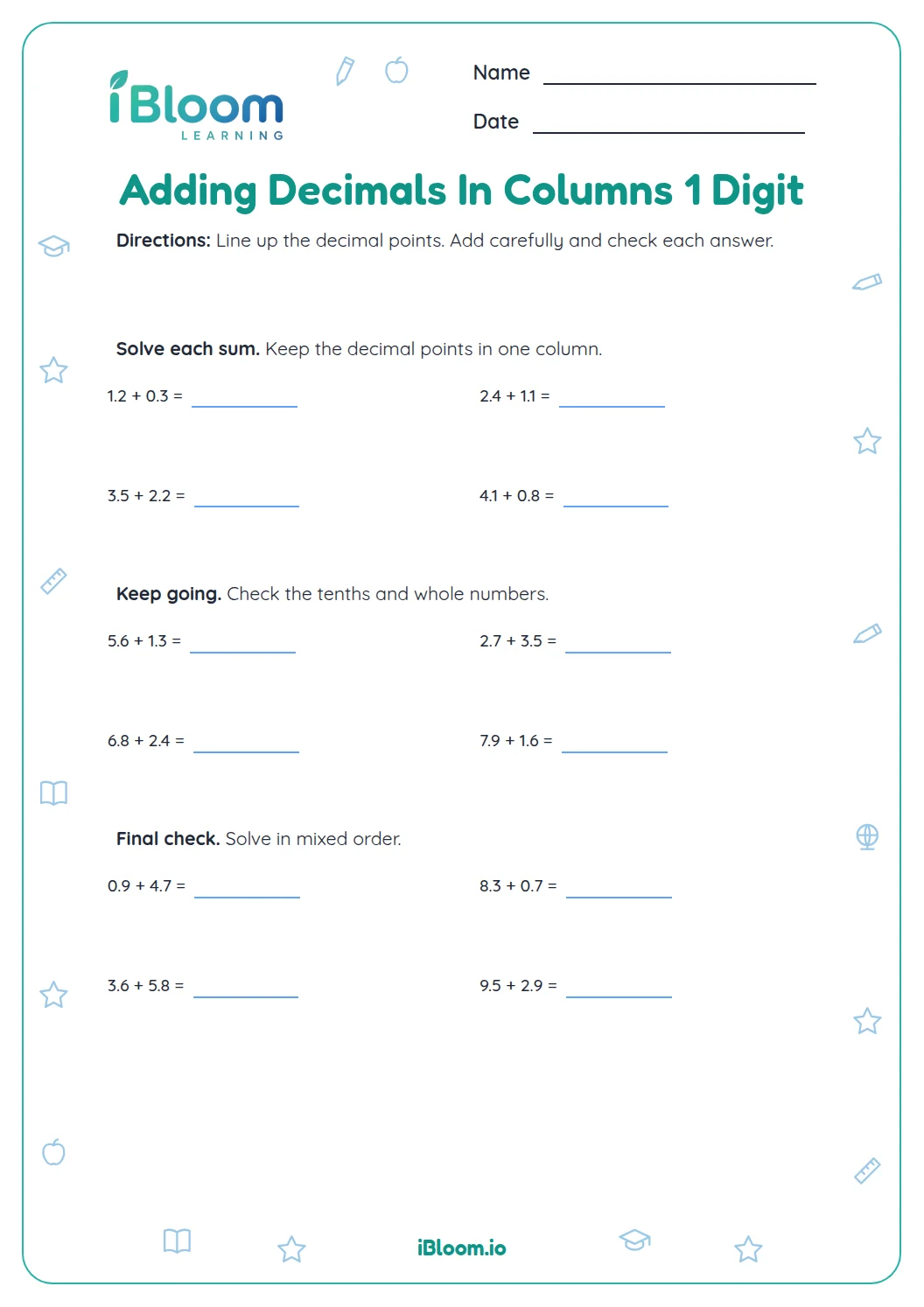
About this worksheet
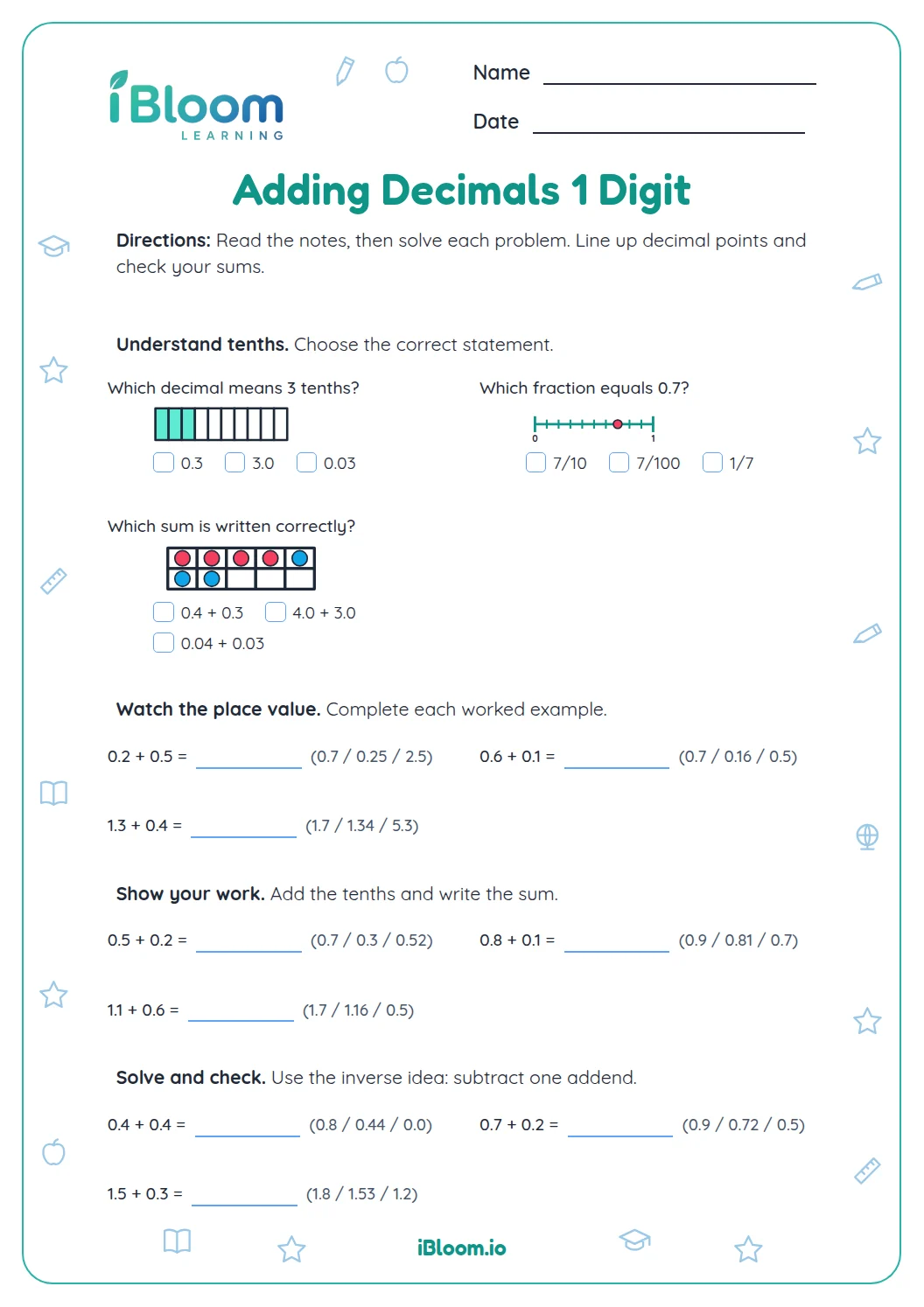
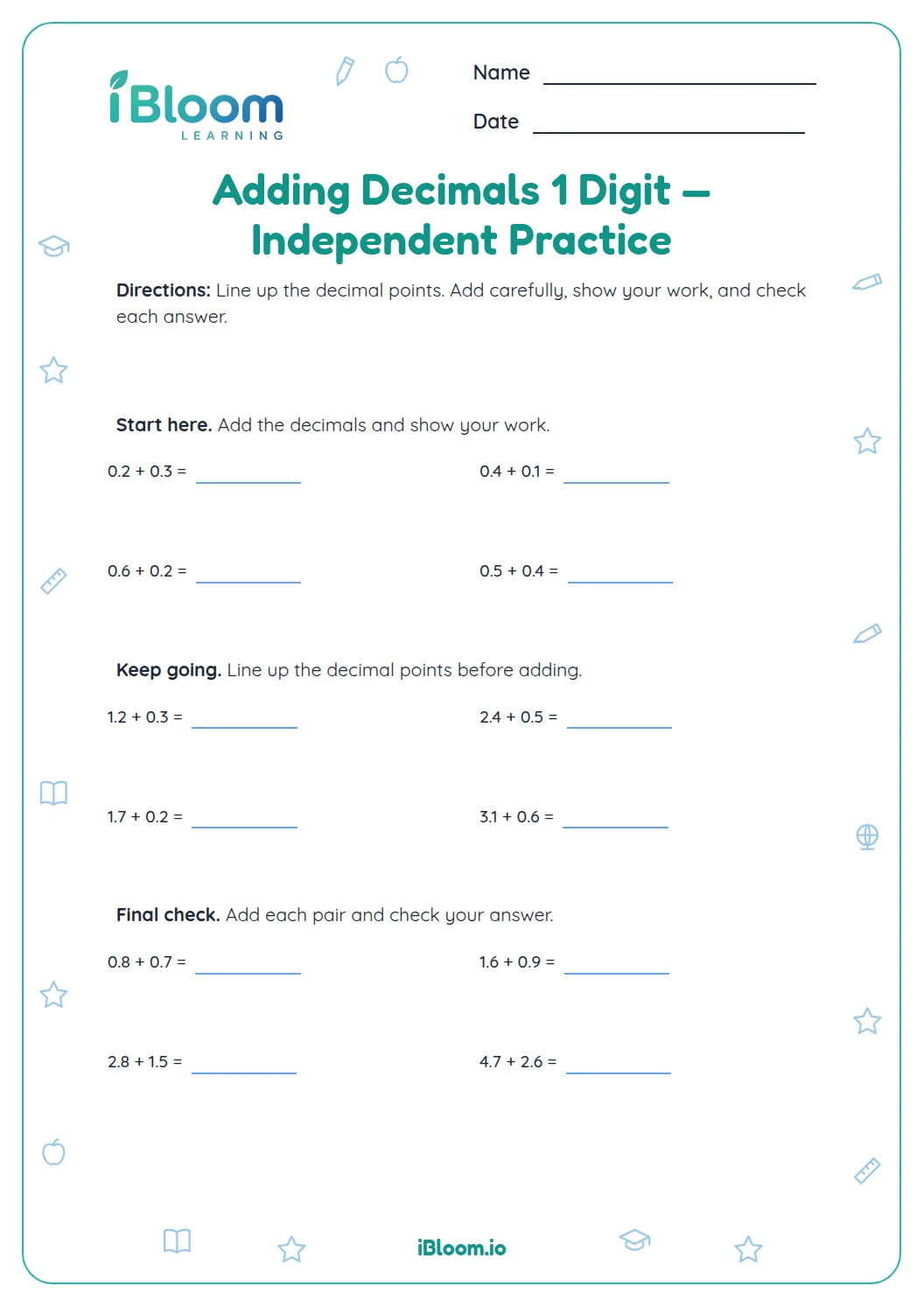
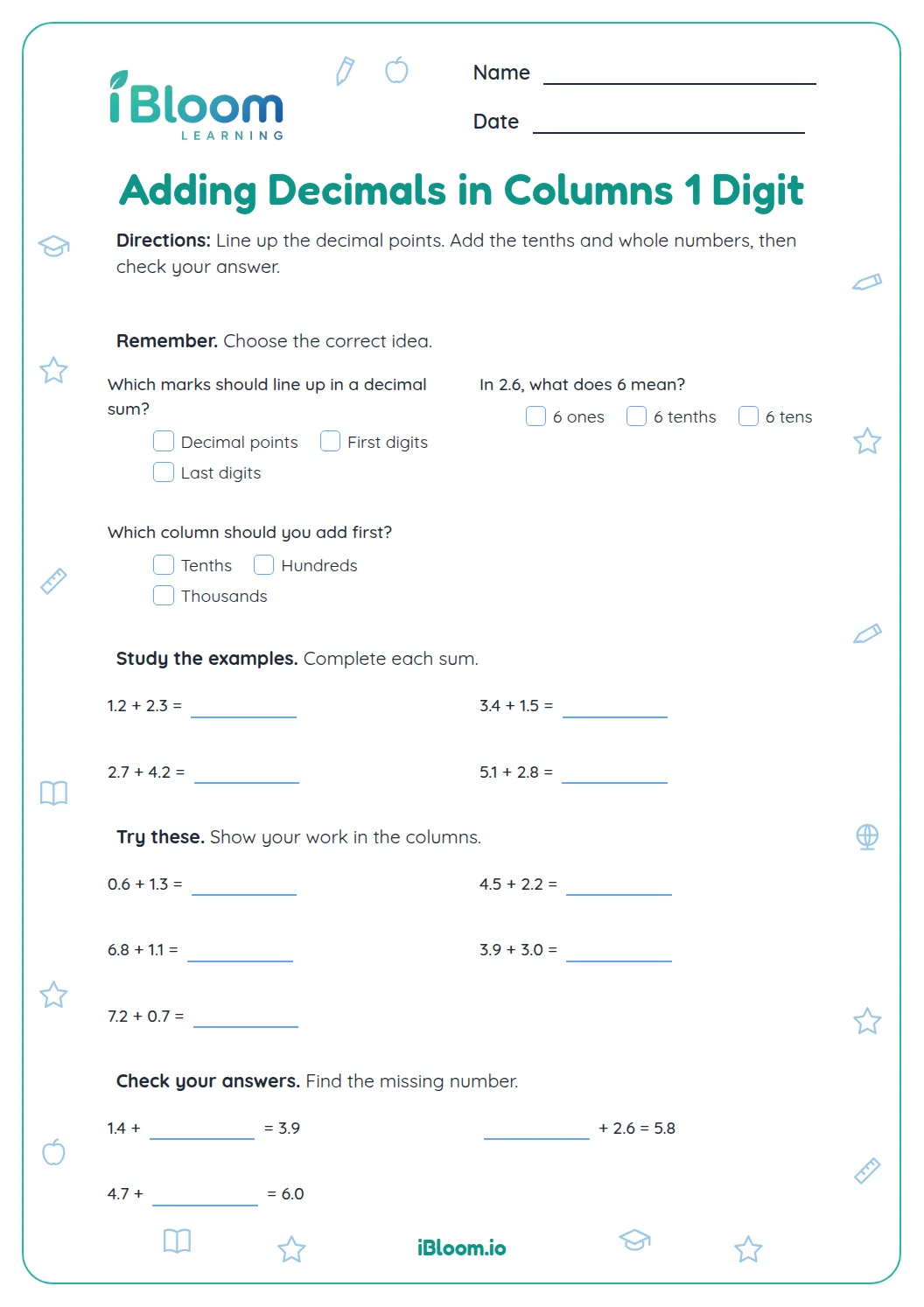
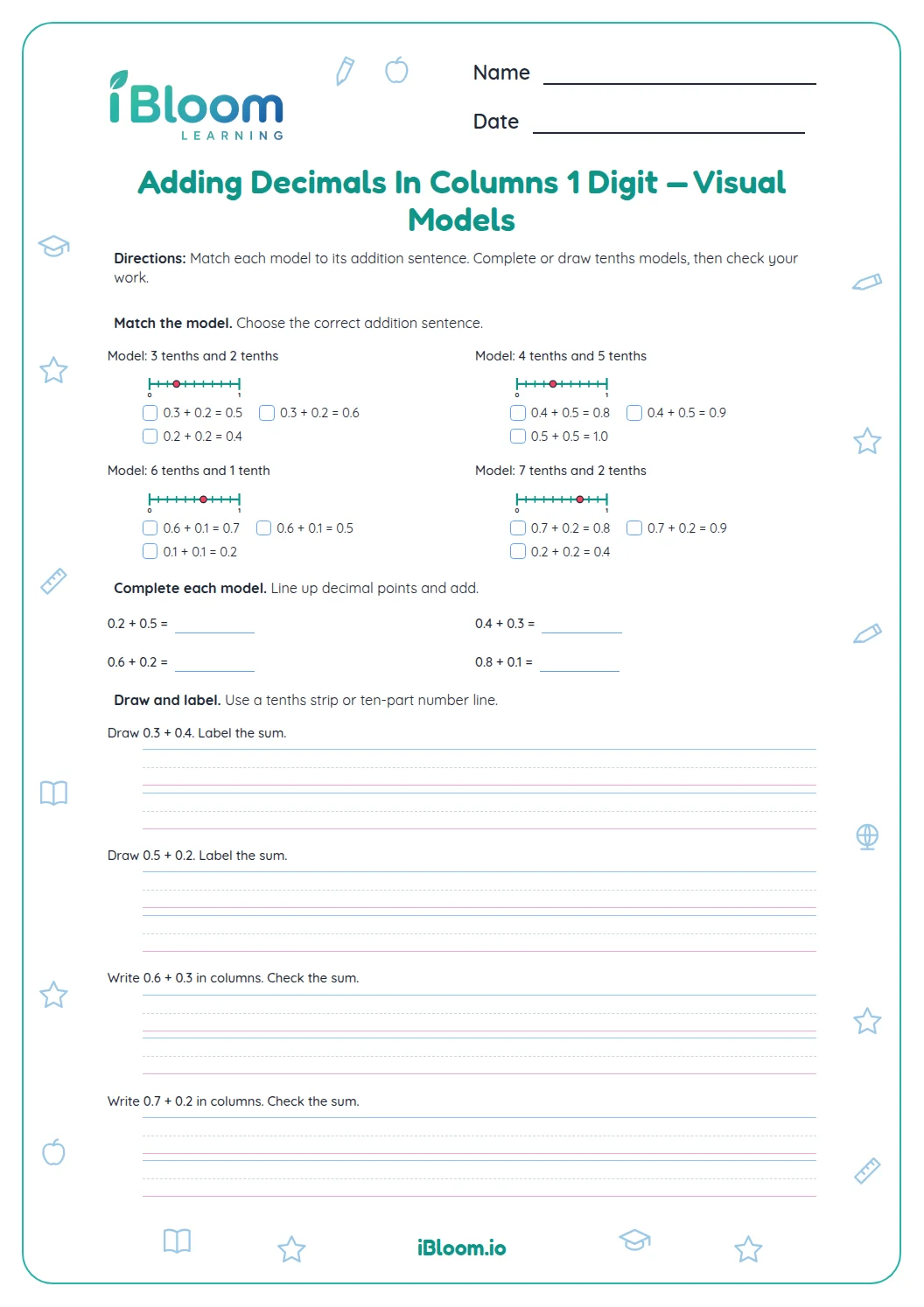
This printable gives Grade 3 students a reasoning-focused set of one-digit decimal addition questions. Students add tenths, regroup when tenths make a whole, compare sums and solve measurement situations. The final questions ask them to explain a place-value mistake and create a sum. The separate answer key includes sample responses for questions that can vary.
How do tenths combine when you add?
A digit in the tenths place counts parts of one whole. When tenths total 10 or more, regroup 10 tenths as 1 whole.
Question 2 is 0.8 + 0.5. Eight tenths plus five tenths is 13 tenths, so the sum is 1.3.
- 10.8 = 8 tenths; 0.5 = 5 tenths
- 28 tenths + 5 tenths = 13 tenths
- 313 tenths = 1 whole and 3 tenths
- 40.8 + 0.5 = 1.3
How can you check whether a sum makes sense?
Estimate using whole numbers, then add the tenths precisely. For 1.7 + 0.8, the answer should be between 2 and 3 because 1.7 is close to 2 and 0.8 is close to 1.
Question 8 targets a common place-value slip: 0.8 + 0.7 is 1.5, not 0.15. Fifteen tenths include one whole.
What kinds of problems are included?
Fourteen questions move from direct sums to comparisons and measurement stories. The last two ask students to explain and make an example.
- Part A finds sums and missing addends.
- Part B compares totals and corrects an error.
- Part C solves measurement problems.
- Part D explains an error and creates a sum.
How to use this worksheet
- 1Review that 0.1 means one tenth.
- 2Add tenths in the same place-value column.
- 3Trade 10 tenths for 1 whole when needed.
- 4Estimate the total before choosing or writing an answer.
- 5Use the key to discuss the two open-ended responses.
Common mistakes and quick fixes
The mistake
Writing 0.8 + 0.7 = 0.15.
The fix
Count 15 tenths, then regroup 10 tenths as 1 whole: 1.5.
The mistake
Adding 0.8 + 0.5 as 0.13.
The fix
The 13 tenths are more than one whole, so write 1.3.
The mistake
Forgetting units in a measurement answer.
The fix
Copy the unit from the question after the number.
What to practice next
Make more practice
Further reading
Questions parents and teachers ask
How do students add decimals with tenths?
Treat each digit after the decimal point as tenths. Add the tenths and regroup 10 tenths as 1 whole when needed. For example, 0.8 + 0.5 is 13 tenths, or 1.3. The worksheet asks students to use this idea in sums, comparisons and measurement stories.
What does regrouping mean in decimal addition?
Regrouping means trading ten tenths for one whole. In 0.8 + 0.7, the tenths make 15 tenths, which is 1 whole and 5 tenths, or 1.5. The decimal point stays in line because the tenths are being added to tenths.
What kinds of problems are on the worksheet?
The practice includes direct sums, missing addends, comparisons and short measurement situations using lengths, distance and liquid amounts. Students also correct a place-value error and write their own example. The key includes sample responses where more than one answer can work.
How can a student check a decimal sum?
Estimate first, then add tenths carefully. A sum such as 1.7 + 0.8 should be between 2 and 3, and the exact total is 2.5. Checking both the size of the answer and the tenths calculation can catch a result such as 0.15.
Why is 0.8 + 0.7 equal to 1.5?
The digits after the decimal are tenths, so the sum is 8 tenths plus 7 tenths, or 15 tenths. Ten tenths make 1 whole, leaving 5 tenths. That gives 1.5. Question 8 asks students to distinguish this regrouping from writing 0.15.