
About this worksheet
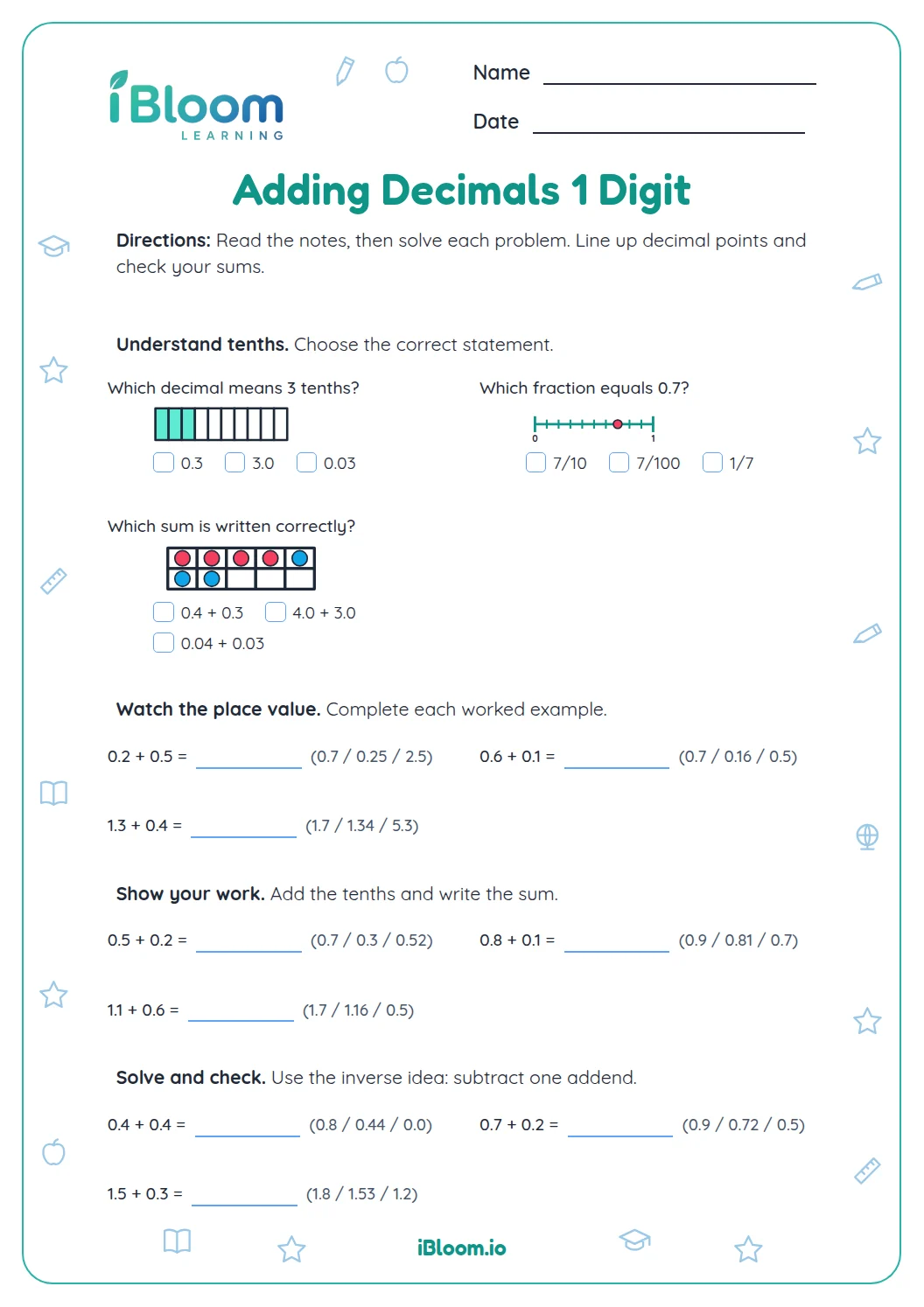
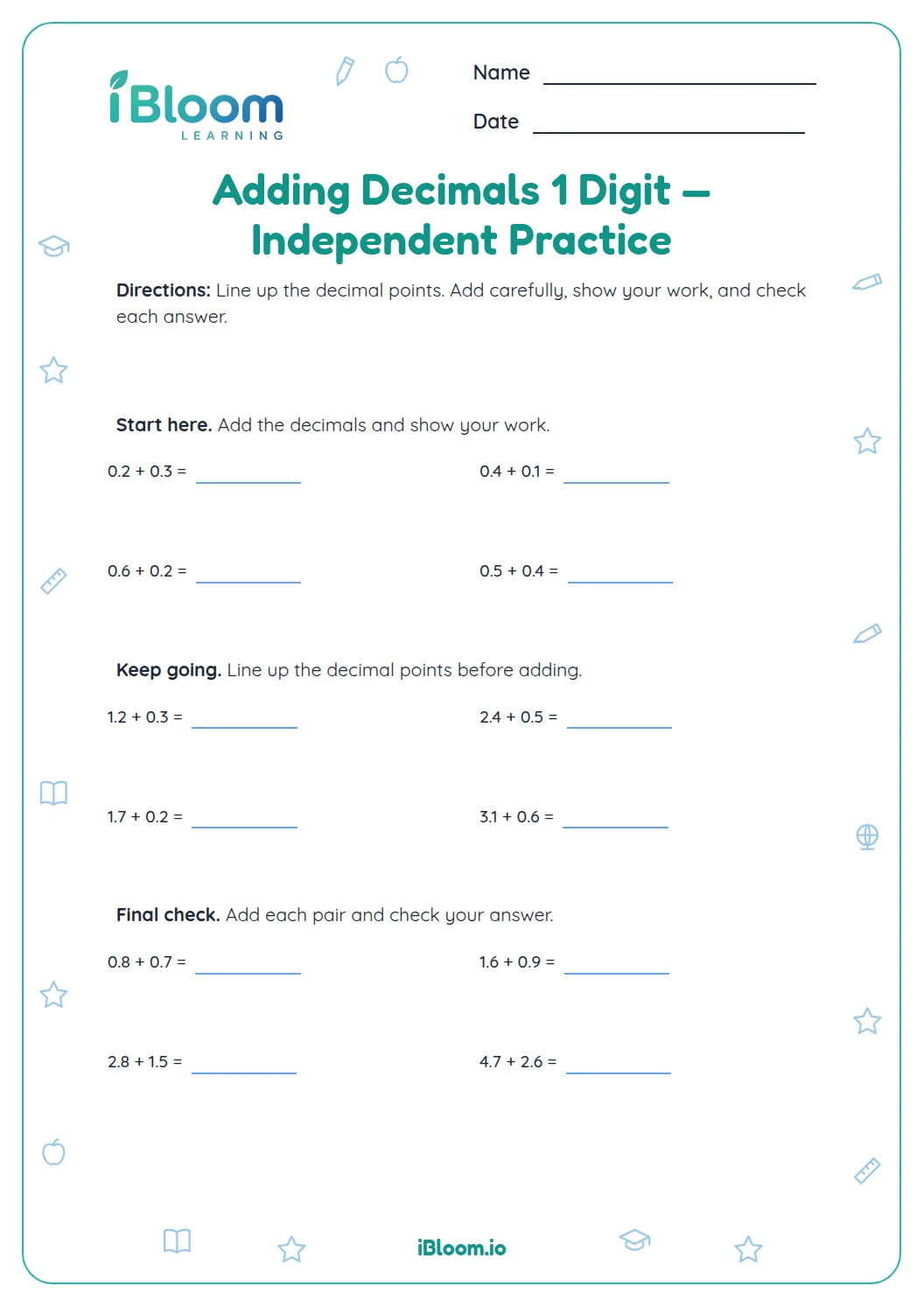
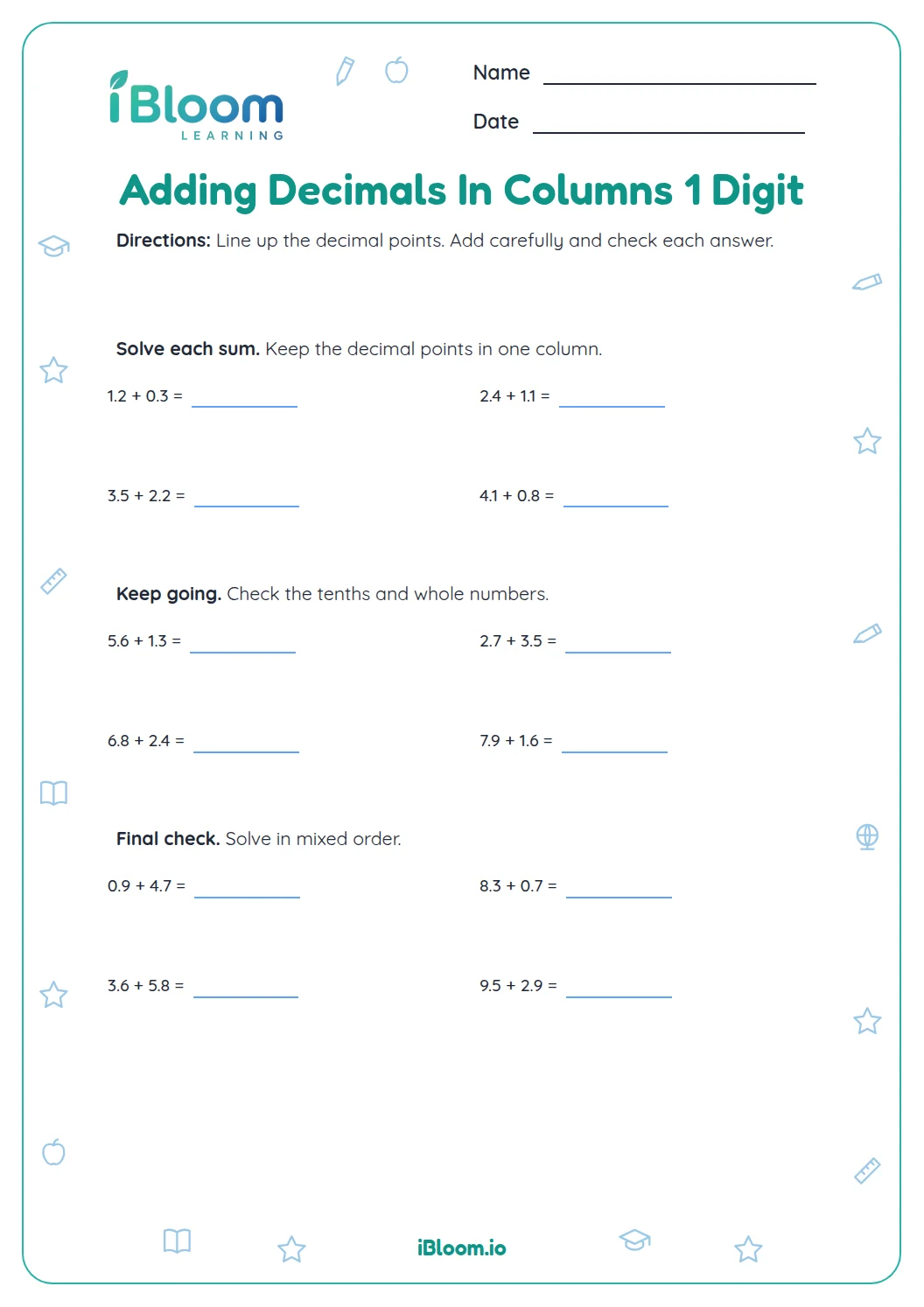
This printable practice page turns one-digit decimal addition into short everyday situations. Children add tenths in lengths, water amounts, growth, and distances, writing the total for each of 14 problems. Each sum uses tenths and gives a context for interpreting the unit. A separate answer key supports quick checking. The named decimal skill is kept to tenths, and the questions practice the decimal-operation language in CCSS 5.NBT.B.7.
Aligned to 5.NBT.B.7
How do you add tenths?
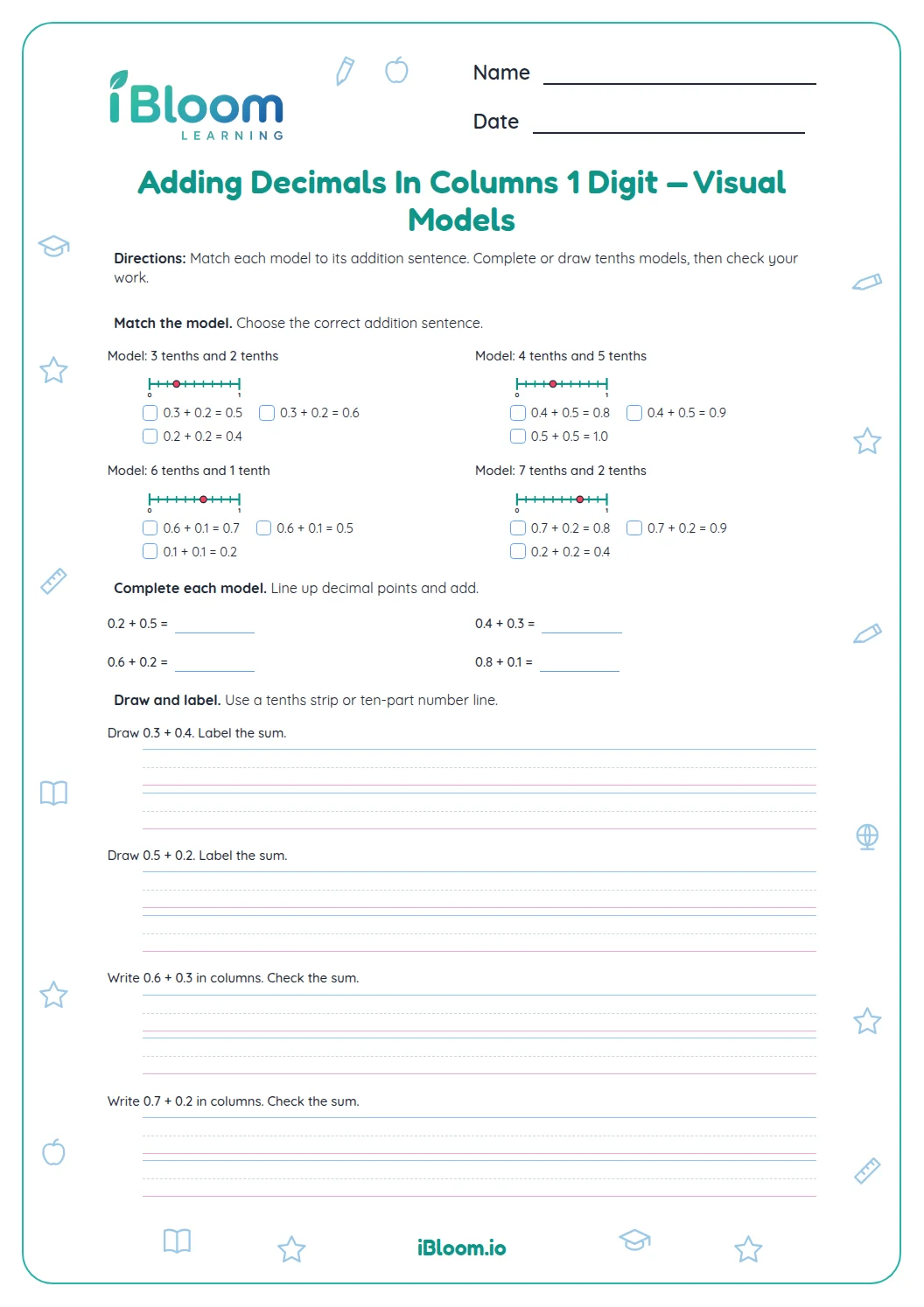
Treat each decimal digit by place value. For 1.2 + 0.5, add 2 tenths and 5 tenths to get 7 tenths, while the 1 whole remains. The total is 1.7.
- 1Ribbon lengths: 1.2 m and 0.5 m
- 21.2 + 0.5 = 1.7
- 3Total length: 1.7 m
What do the story problems ask?
The 14 contexts include lengths, water, distance, growth, and a recipe. Each asks for a combined total and space is provided for the answer.
How should answers be checked?
Check both the sum and the unit. Two positive amounts should produce a total greater than either amount, and the unit should come from the story.
How to use this worksheet
- 1Underline the two amounts in the story.
- 2Copy them into an addition equation.
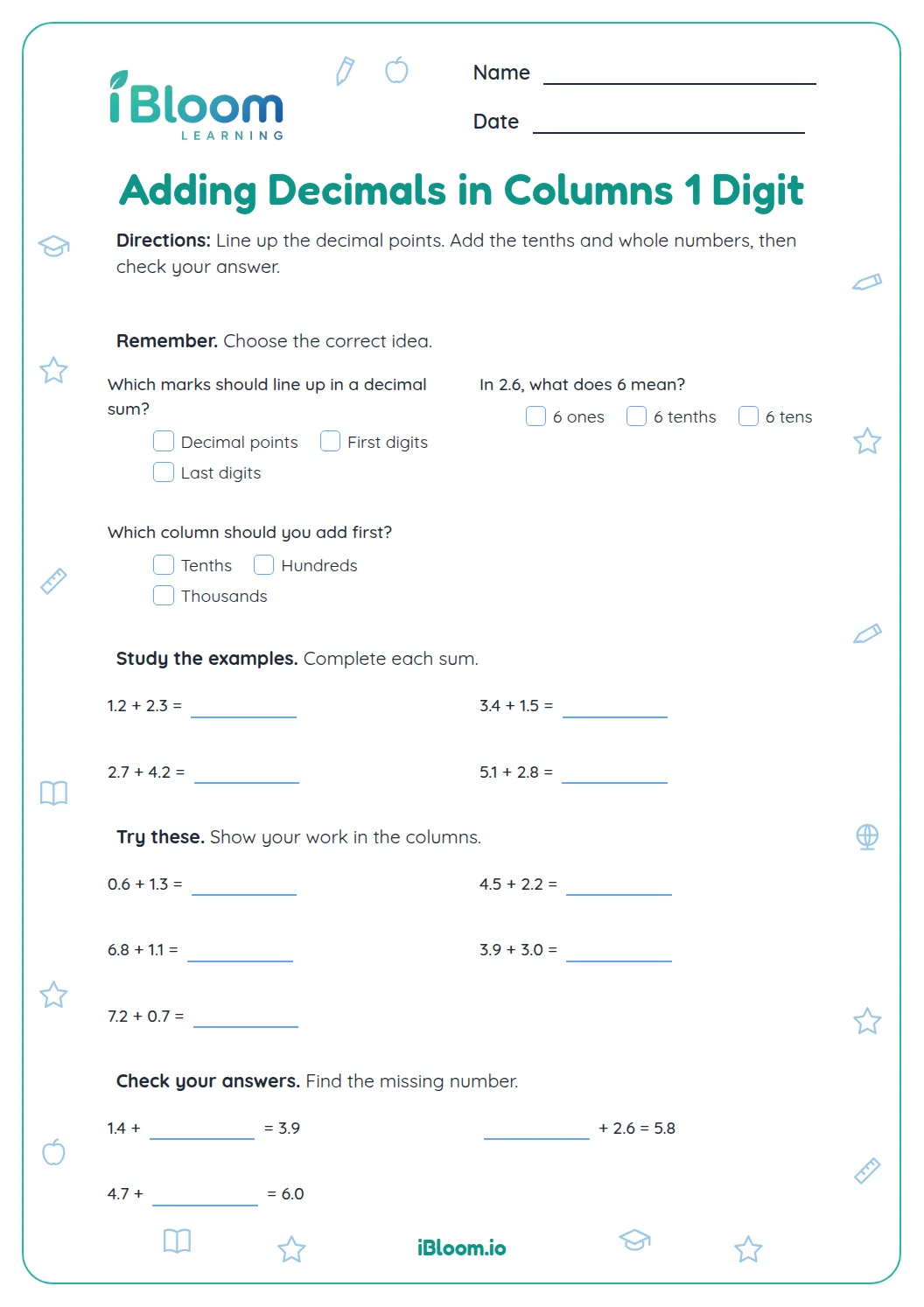
- 3Line up decimal points and combine tenths.
- 4Write the unit and check that the total is larger than either addend.
Common mistakes and quick fixes
The mistake
Adding the digits without matching place values.
The fix
Line up decimal points before combining tenths.
The mistake
Dropping the unit.
The fix
Copy the measurement unit from the story into the answer.
The mistake
Reporting a total smaller than an addend.
The fix
Estimate first: adding a positive amount makes the total larger.
Curriculum alignment
Add decimal amounts by lining up tenths and combining like place values.
On this sheet: The questions directly practice this skill.
Show the official wordingHide the official wording
Add, subtract, multiply, and divide decimals to hundredths, using concrete models or drawings and strategies based on place value, properties of operations, and/or the relationship between addition and subtraction; relate the strategy to a written method and explain the reasoning used.
What to practice next
Make more practice
Further reading
Questions parents and teachers ask
What does “1-digit decimals” mean here?
Each amount is written in tenths, with one digit after the decimal point. For example, 1.2 + 0.5 combines 12 tenths and 5 tenths to make 17 tenths, or 1.7. The story context tells children which unit belongs in the answer.
Should children write the unit in the answer?
Yes. The answer should match the context: meters for ribbon, liters for water, and kilometers for a walk. Naming the unit helps children connect the decimal sum to the quantity in the story. Invite your child to say how the quantities combine before writing the equation.
How can I help with lining up decimals?
Have your child place the decimal points directly below one another before adding. In tenths-only problems, the tenths digits stay in the same column. Then check that the total is larger than either positive amount and copy the correct unit from the story.
How many problems are included?
The sheet has 14 real-world addition questions. They use lengths, liquid amounts, growth, pages, and distances, with a line for each answer and its unit. A separate answer key lists each sum. Invite your child to explain how the quantities combine before writing the total.
Why use decimal addition in everyday contexts?
Contexts make the numbers meaningful. Children can interpret a total as a combined length, amount, or distance, then write a unit with the sum. This sheet uses short, varied situations so the operation is clear without repeating one story pattern.