

About this worksheet
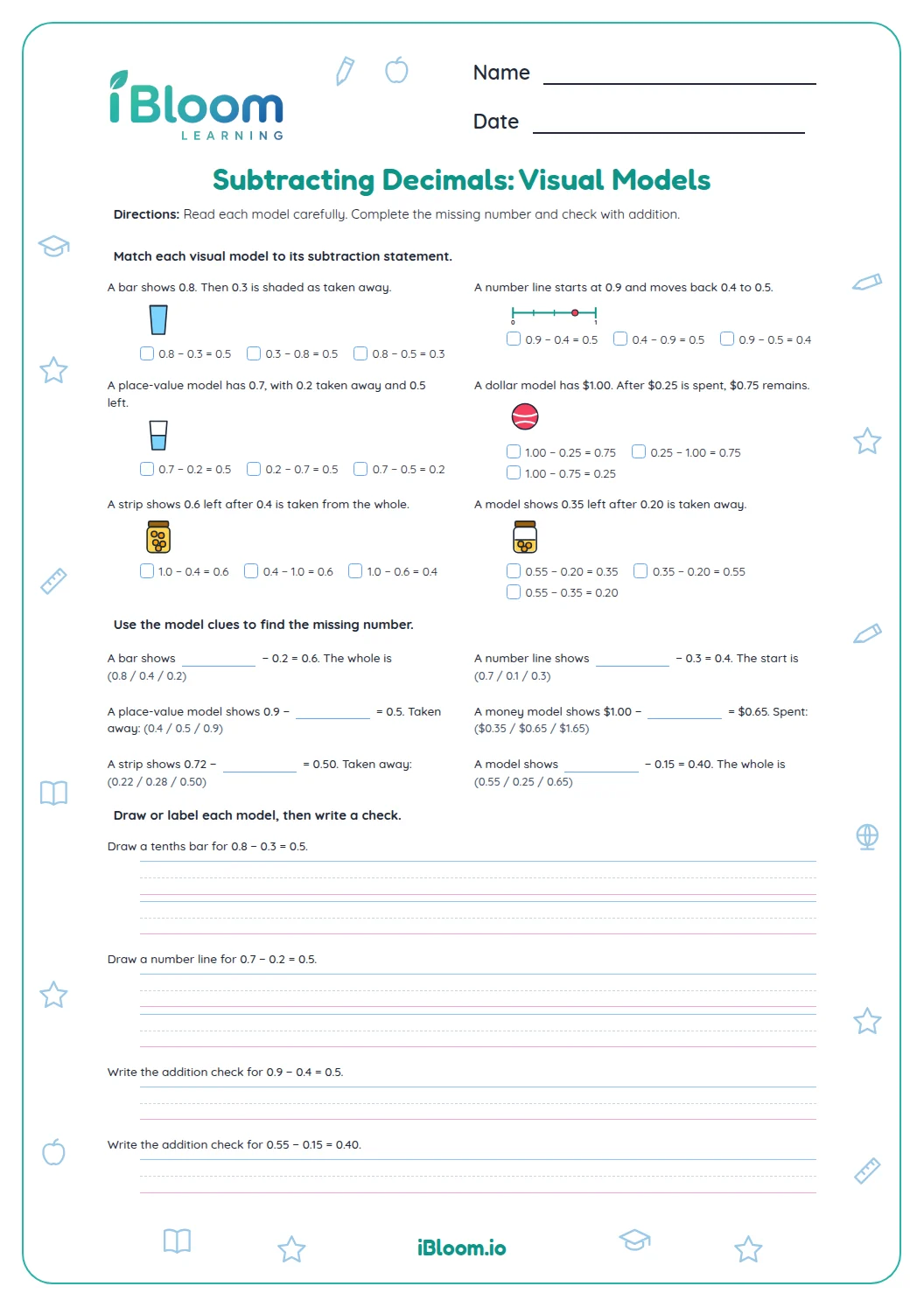
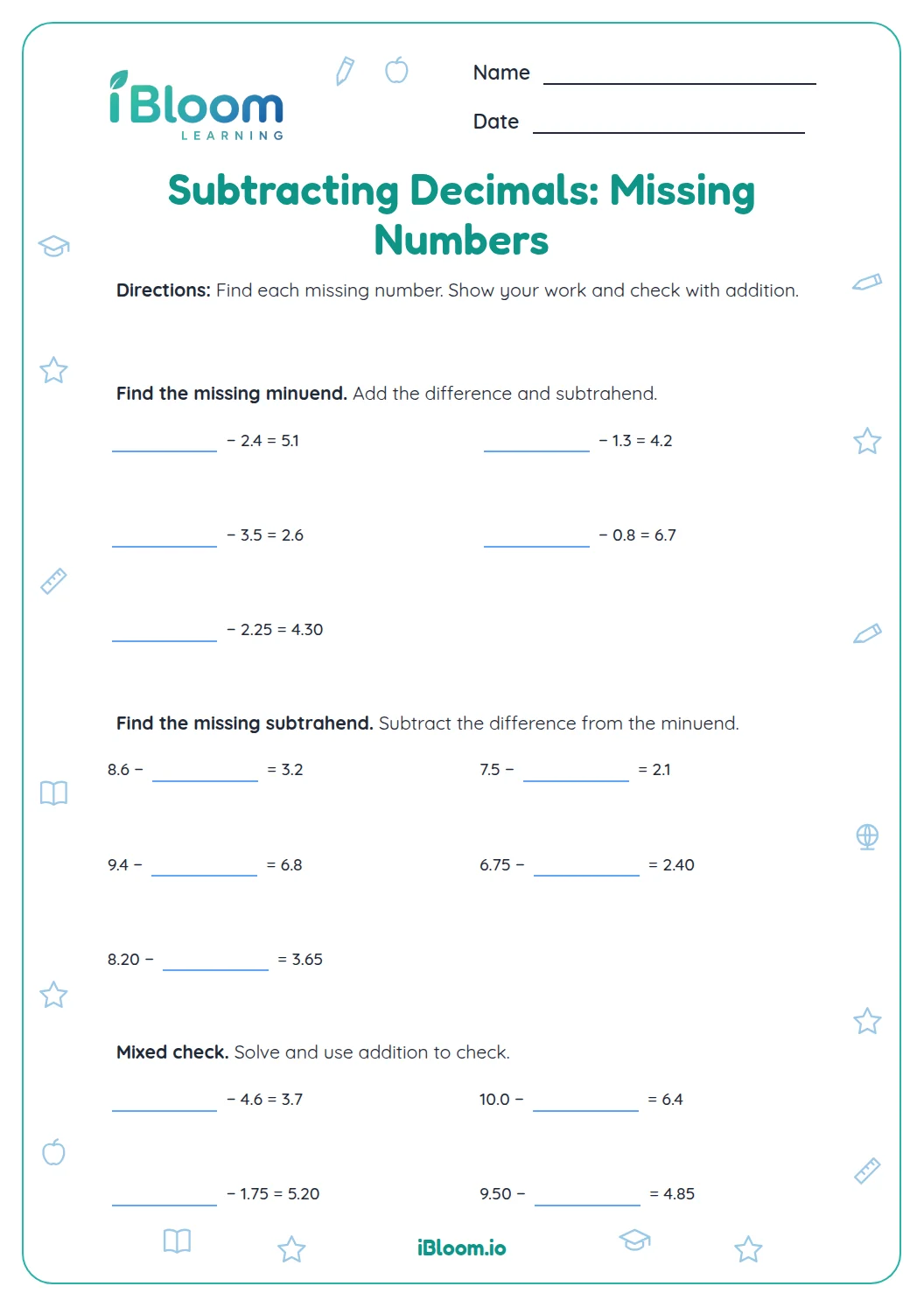
This free printable Grade 3 worksheet makes one-digit decimal subtraction visible. Part A uses six tenths strips: children shade the starting amount, cross out the amount taken away and write what remains. Part B has two model-choice questions. Part C uses four number lines with jumps of 0.1. Part D has two choices that connect models with subtraction. All starting amounts are between 0.5 and 1.0, so each model stays within one whole. This practice supports Common Core 5.NBT.B.7 through decimal subtraction with drawings and place-value reasoning. A separate key gives ten numerical differences and four model-check answers.
Aligned to 5.NBT.B.7
How do children subtract with a tenths strip?
A full strip represents 1 whole, split into ten equal parts. Children shade the starting amount, then cross out only the shaded parts being subtracted. For question 1, seven tenths minus two tenths leaves five tenths, or 0.5. The blank strips let children make the model themselves.
- 1Question 1: 0.7 − 0.2 = ___.
- 2Shade 7 tenths to show 0.7.
- 3Cross out 2 shaded tenths.
- 45 shaded tenths remain: 0.5.
How do the number lines show subtraction?
A number line shows subtraction as movement. Start at the first decimal and move left one interval for each tenth being taken away. Question 9 starts at 0.8 and moves left two tenths to 0.6.
Count jumps between tick marks, not the starting tick. Each interval represents 0.1, so children can connect the number of jumps with the amount being subtracted.
How do the model choices check understanding?
Two choices ask which strip action matches a subtraction sentence and how addition can check a difference. The final two questions connect a number-line landing point and a tenths statement with the subtraction model. For example, 0.6 − 0.4 removes four of six tenths, leaving two tenths.
How to use this worksheet
- 1Point to a full strip and identify ten equal tenths.
- 2Use a strip question to shade the starting amount, then cross out shaded parts only.
- 3Complete the six strip differences and count the tenths left.
- 4For the number lines, start at the first decimal and count each leftward jump.
- 5Use the model choices to connect the drawings with subtraction, then check the key.
Mistakes to notice and fix
The mistake
Writing 5 instead of 0.5 for five tenths left.
The fix
Say five tenths aloud and write the digit 5 in the tenths place.
The mistake
Crossing out unshaded cells.
The fix
Only shaded cells belong to the starting amount. Remove parts from that amount.
The mistake
Counting the starting tick as the first jump.
The fix
Put a finger on the start, then count one only after moving to the next tick on the left.
Common Core alignment
Subtract tenths using shaded strips and backward jumps on number lines.
On this sheet: Students connect model changes to decimal subtraction sentences and explain the count of remaining tenths.
Show the official wordingHide the official wording
Add, subtract, multiply, and divide decimals to hundredths, using concrete models or drawings and strategies based on place value, properties of operations, and/or the relationship between addition and subtraction; relate the strategy to a written method and explain the reasoning used.
What to practice next
Make more practice
Further reading
Questions parents and teachers ask
What does each shaded part stand for?
Each shaded part is one tenth of a whole strip, written 0.1. Seven shaded parts make 0.7, and two shaded parts make 0.2. When children cross out two of seven shaded parts, they can count five tenths left and record the difference as 0.5.
Are the strips already shaded?
No, the eight Part A strips are blank so children can show each starting decimal themselves. They shade the first amount, cross out the shaded tenths being subtracted, and write what remains. This connects each written decimal with a count of equal parts before subtraction.
How do children use the number lines?
Children start at the first decimal in the subtraction sentence and jump left by the amount being subtracted. Each interval represents 0.1. For 0.8 minus 0.2, two jumps left land at 0.6. Drawing small arcs above the line helps keep track of the jumps.
Why is one answer zero?
Taking away the entire starting amount leaves zero. In question 10, children start at 0.5 and move left five tenths to 0.0. Writing 0 or 0.0 is correct. Ask them to use the endpoint to explain why no tenths remain after the subtraction.
What is included in the answer key?
The separate key gives ten numerical differences and four model-check answers. The blank strips and number lines remain visible. Compare the child’s shading, cross-outs or jumps with each subtraction sentence, then review why adding the difference and the amount taken away rebuilds the starting decimal.