

About this worksheet
This free printable worksheet is guided practice in writing fractions as decimals for Grade 3 students who are learning tenths and hundredths. It opens with two shaded models, a strip of ten and a 10 by 10 grid. Children then rename tenths as hundredths, add pairs such as 3/10 + 25/100, write four fractions as decimals and finish with four multiple-choice checks, including a point on a number line. It practices Common Core 4.NF.C.5 and 4.NF.C.6. The 16 questions fill 2 pages, and a separate answer key is included.
Aligned to 4.NF.C.5 and 4.NF.C.6
What is on this worksheet?
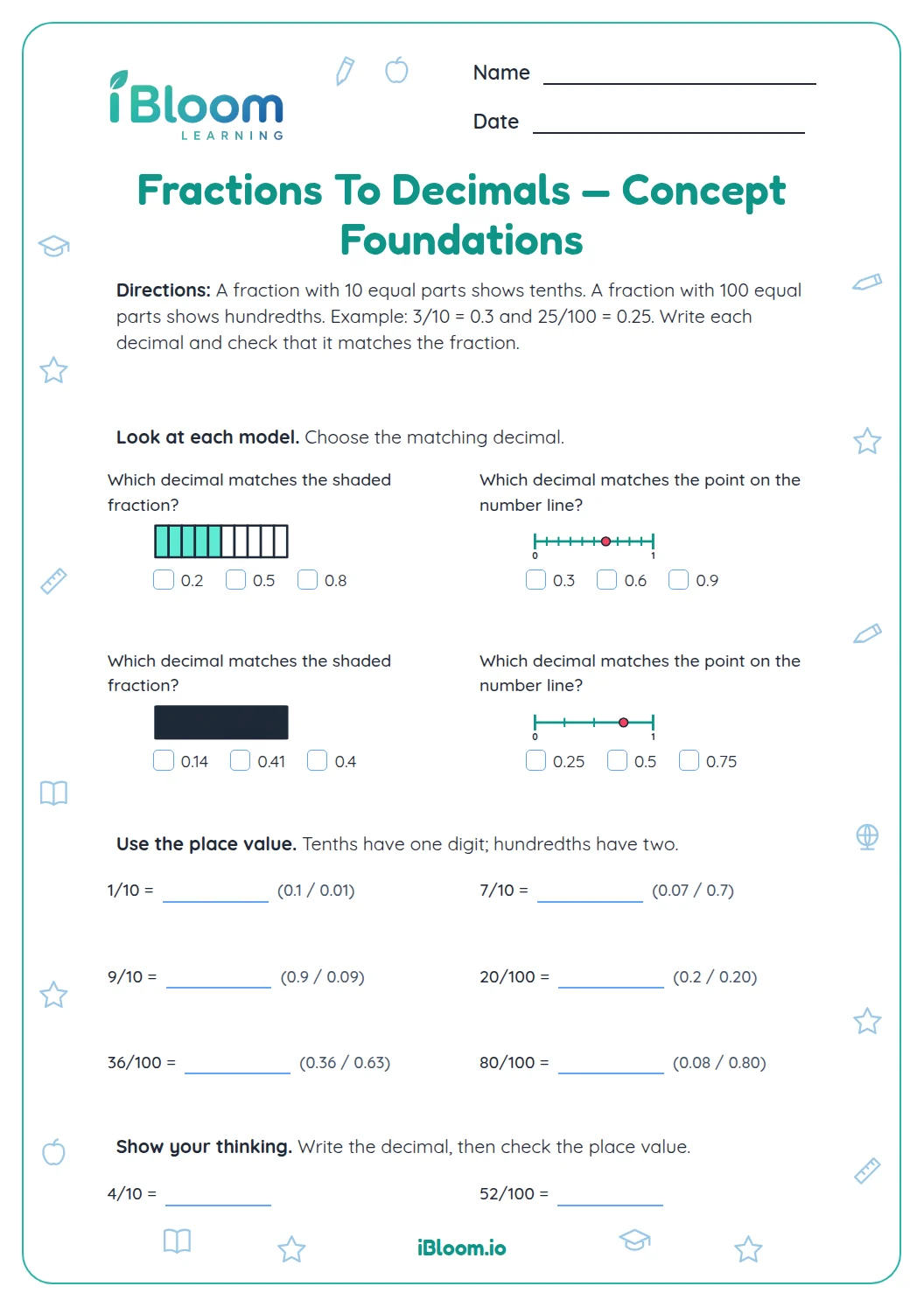
Four parts that move from pictures to symbols. Children begin with two shaded models, so the first decimals come from something they can see, and end with four quick checks that test where each digit belongs.
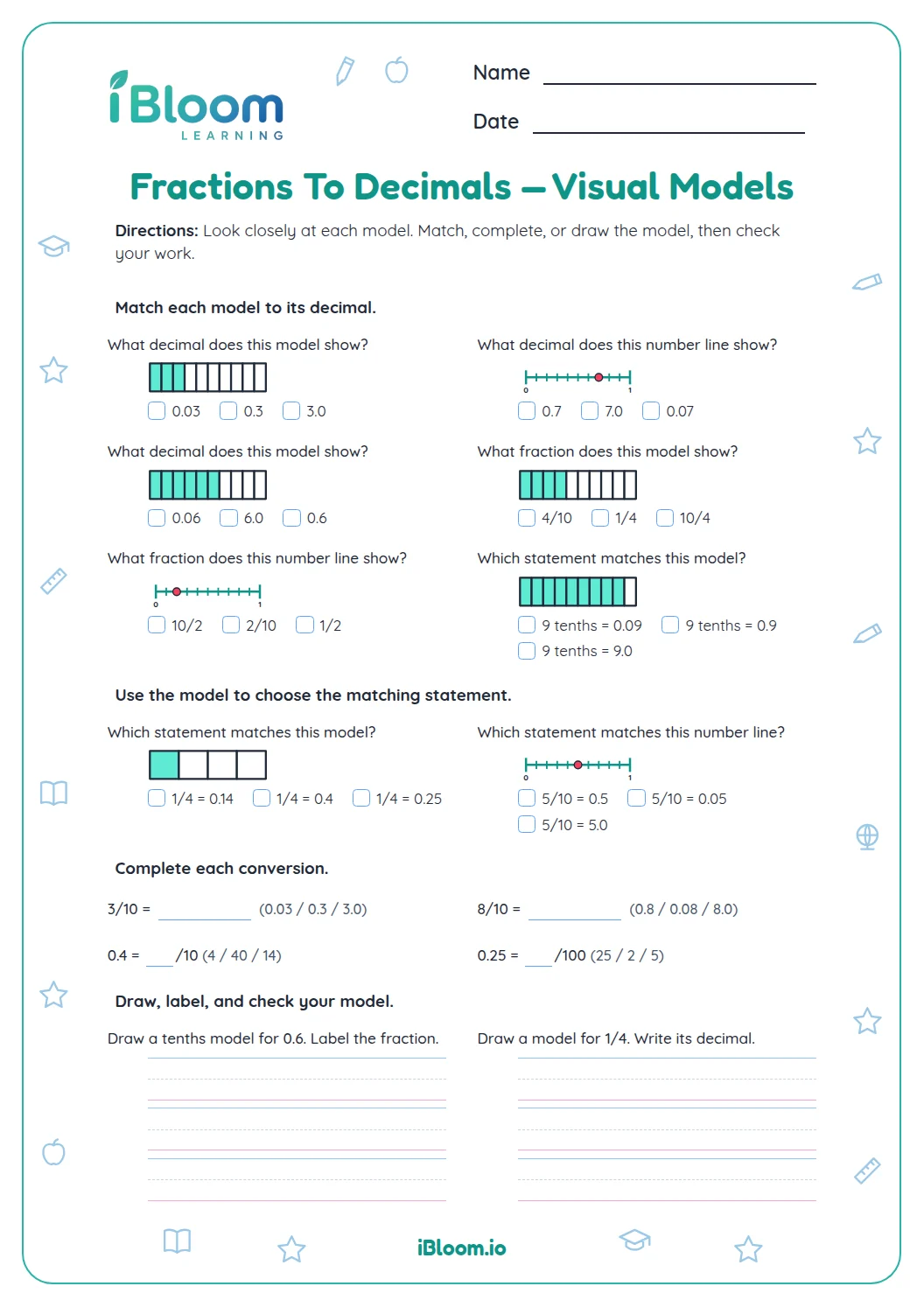
Part B is the bridge. Once children see that 3/10 and 30/100 name the same amount, they can add tenths to hundredths, and Part C asks them to write decimals with that idea in mind.
- Part A: write the decimal for a tenths strip and a hundredths grid (questions 1 and 2)
- Part B: rename tenths as hundredths, then add, such as 3/10 + 25/100 = ___/100 (questions 3 to 8)
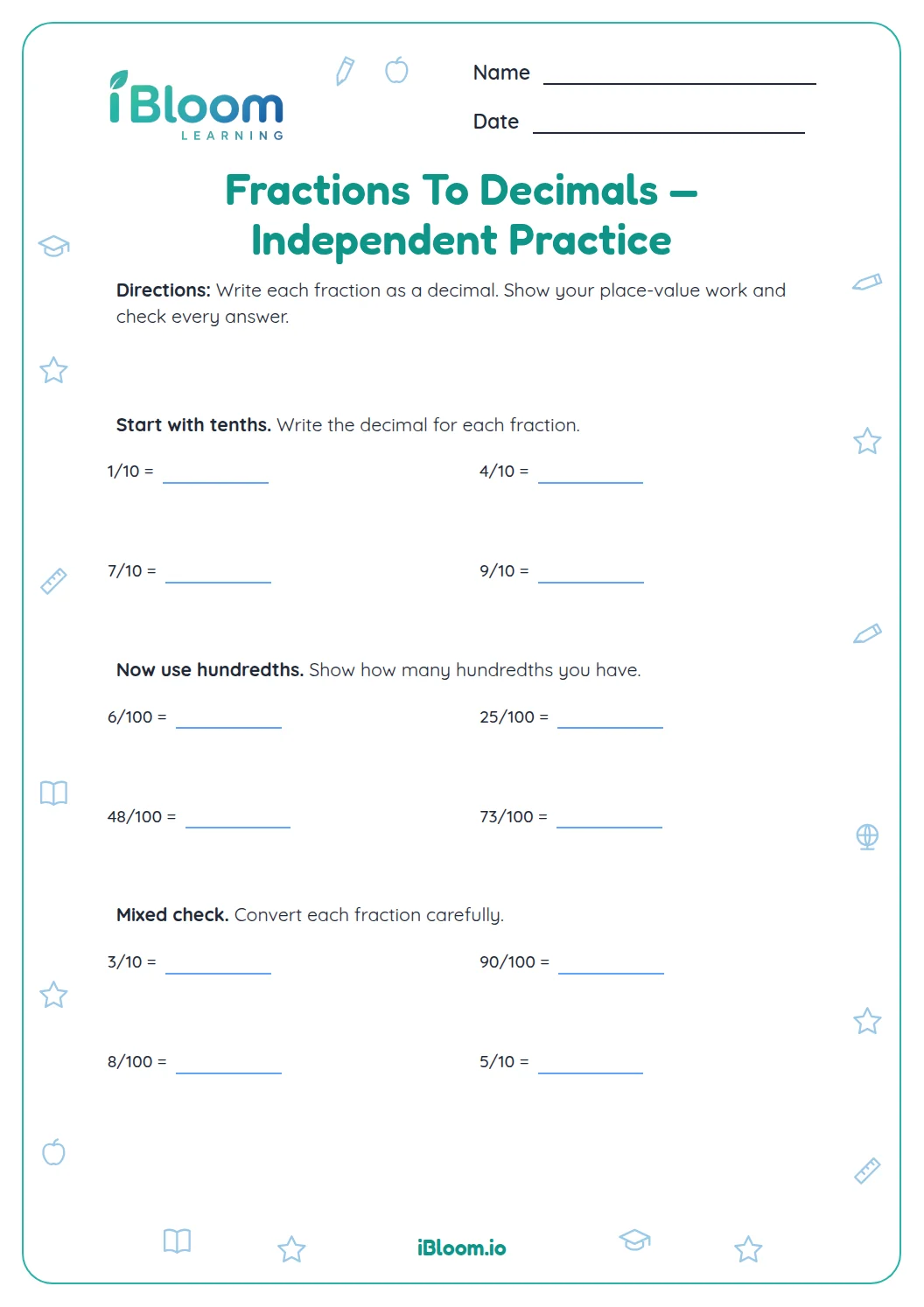
- Part C: write 8/10, 9/100, 45/100 and 6/100 as decimals (questions 9 to 12)
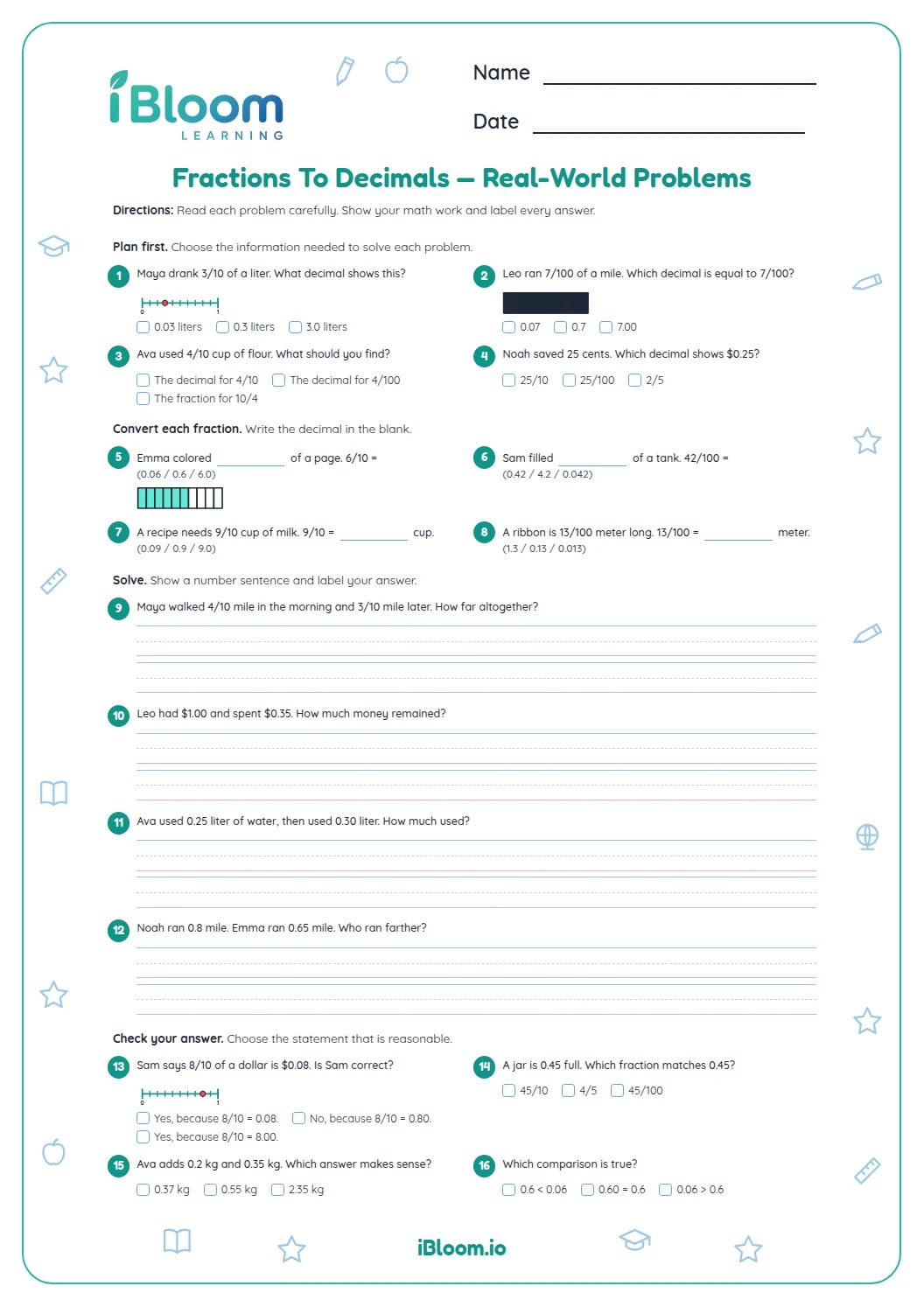
- Part D: choose the matching number for a point on a number line, 5/100, 30/100 and 0.6 (questions 13 to 16)
How do you turn a fraction into a decimal?
Look at the denominator. A denominator of 10 means tenths, and tenths take one digit after the decimal point. A denominator of 100 means hundredths, and hundredths take two digits.
The shaded models make this concrete. On the 10 by 10 grid, every full column is one tenth, which is 10 hundredths. Counting 63 shaded squares gives 6 columns and 3 extra squares, so 63/100 is 0.63.
- 1Question 2: 63 of 100 squares are shaded → 63/100 = 0.63
- 2Question 9: 8/10 = 0.8 (one digit for tenths)
- 3Question 10: 9/100 = 0.09 (two digits, with a zero in the tenths place)
Why rename tenths as hundredths before adding?
Cutting each tenth into 10 equal pieces turns tenths into hundredths. Because 10 × 10 = 100, the numerator and denominator both get multiplied by 10. That is why 3/10 becomes 30/100 and 7/10 becomes 70/100.
Fractions can only be added when the pieces are the same size, so questions 6 to 8 rename the tenths first. In question 6, 3/10 + 25/100 becomes 30/100 + 25/100, which is 55/100, or 0.55.
- 1Question 6: 3/10 + 25/100 = ___/100
- 2Rename: 3/10 = 30/100
- 3Add the hundredths: 30/100 + 25/100 = 55/100
Why is 5/100 equal to 0.05 and not 0.5?
The first digit after the decimal point counts tenths, and the second counts hundredths. Five hundredths is 0 tenths and 5 hundredths, so the 5 goes in the second place with a 0 before it. A 5 in the first place would mean 5 tenths, which is the same as 50/100.
Question 14 asks children to choose between 0.5, 0.05 and 5.0, and question 15 does the same for 30/100, where the answer, 0.3, has no zero after it at all.
How to use this worksheet at home or in class
- 1Start with the models in Part A. Ask your child to count the shaded parts and name the whole before writing the decimal.
- 2In Part B, remind your child that both numbers in the fraction get multiplied by 10, not just the denominator.
- 3For the adding questions, have your child write the renamed fraction above the tenths before adding, such as 30/100 over 3/10.
- 4For Part C, have your child say the fraction in words first, such as “nine hundredths,” then write it.
- 5On the number line in question 13, count the jumps from 0 out loud. Each jump is one tenth.
- 6Check the answers together using the key, and ask your child to explain question 14 in their own words.
Common mistakes and quick fixes
The mistake
Writing 9/100 as 0.9 in question 10, as if the 9 were in the tenths place.
The fix
Point to the grid in question 2. Nine shaded squares are less than one full column, so the answer must be less than 0.1. Putting a 0 in the tenths place gives 0.09.
The mistake
Adding the numerators straight away, so 3/10 + 25/100 becomes 28/100 in question 6.
The fix
Ask, “Are tenths and hundredths the same size?” They are not, so rename 3/10 as 30/100 first. Then 30 + 25 = 55, and the answer is 55/100.
The mistake
Counting the tick marks on the number line instead of the jumps, so point A in question 13 is read as 0.5.
The fix
Have your child touch 0 and count each jump to A. There are 4 jumps of one tenth each, so the point is at 0.4.
Common Core alignment
Most US states teach decimals with the Common Core standards or a close state version. The standards below are the ones this sheet practices.
Rename tenths as hundredths, then add tenths and hundredths, as in 3/10 + 25/100.
On this sheet: Part B renames 3/10, 7/10 and 9/10 as hundredths and adds three tenths-and-hundredths pairs.
Show the official wordingHide the official wording
Express a fraction with denominator 10 as an equivalent fraction with denominator 100, and use this technique to add two fractions with respective denominators 10 and 100.
Write fractions with denominators 10 or 100 as decimals.
On this sheet: Parts A, C and D write tenths and hundredths as decimals, including 0.4 on a number line.
Show the official wordingHide the official wording
Use decimal notation for fractions with denominators 10 or 100.
What to practice next
Make more practice
Further reading
Questions parents and teachers ask
What is the difference between tenths and hundredths?
A tenth is one of 10 equal parts of a whole, and a hundredth is one of 100 equal parts. Ten hundredths make one tenth. On the grid in question 2, each column is a tenth and each little square is a hundredth, so children can see both sizes in one picture.
Why does the sheet start with pictures?
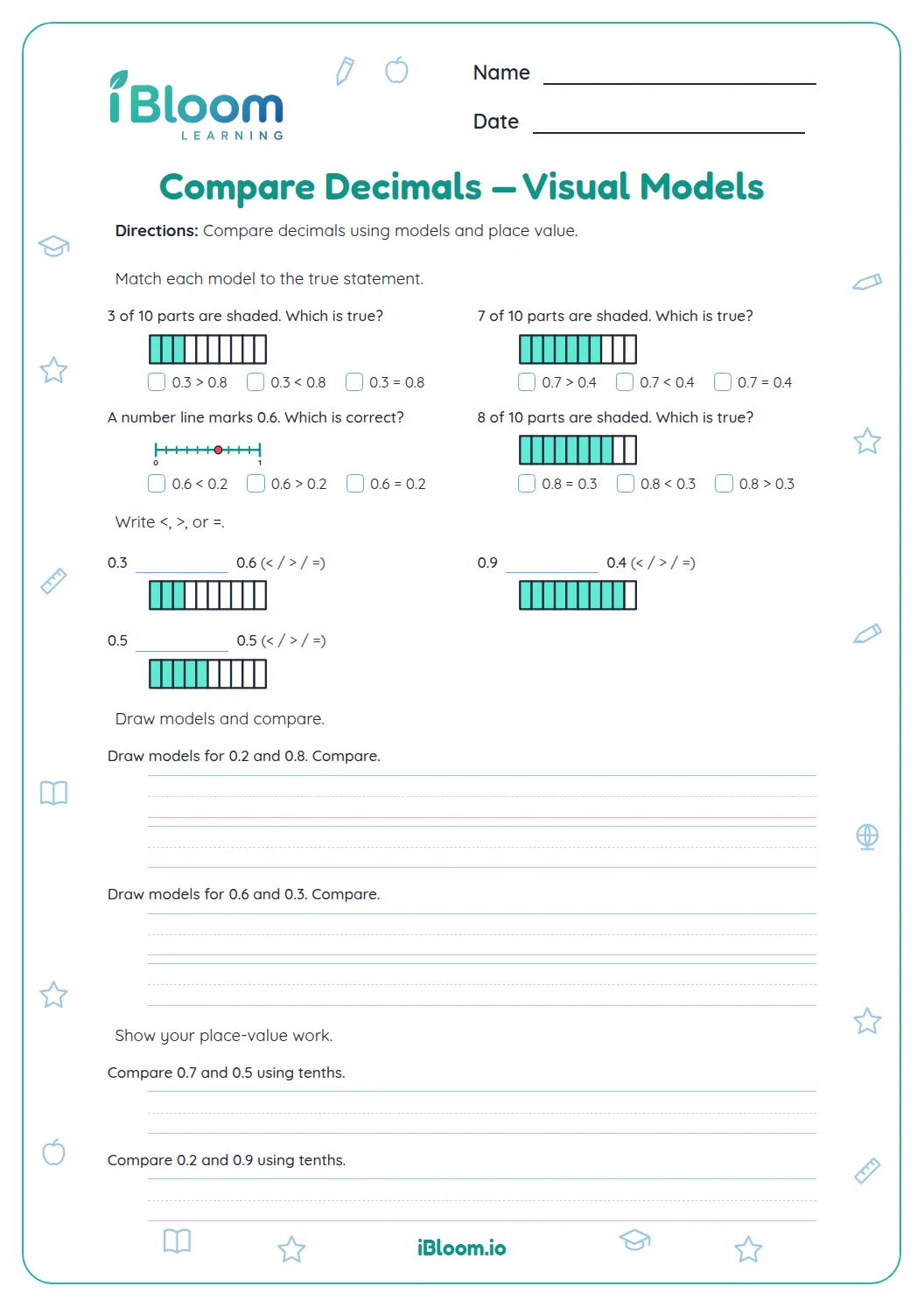
The models give children something to check their answer against. A strip with 7 of 10 parts shaded and a grid with 63 of 100 squares shaded both show how much is filled. Children then connect that count to the digits after the decimal point, which is easier than starting from symbols alone.
How do you add tenths and hundredths?
Rename the tenths as hundredths first, then add. In question 7, 6/10 + 4/100 becomes 60/100 + 4/100, which is 64/100. Adding the numerators straight away gives 10, which is wrong, because a tenth is ten times bigger than a hundredth. As a decimal, 64/100 is 0.64.
What does the zero in 0.09 do?
The zero holds the tenths place, so the 9 can sit in the hundredths place. Without it, 0.9 would mean nine tenths, which is ten times as much. Question 10 asks for 9/100, and question 12 asks for 6/100, so children practice that zero twice before the multiple-choice checks.
Does 0.30 equal 0.3?
Yes, 0.30 and 0.3 name the same amount, because 3/10 = 30/100. Question 15 asks which decimal matches 30/100, and the answer is 0.3, written with one digit. Question 16 turns it around and asks for the fraction that matches 0.6, which is 6/10 among the choices.
What should my child do after this worksheet?
Ask your child to shade a 10 by 10 grid for a decimal you name, such as 0.35 or 0.07, and write the matching fraction. Then try the compare decimals worksheet, where the same understanding of tenths and hundredths decides which of two numbers is greater.