

About this worksheet
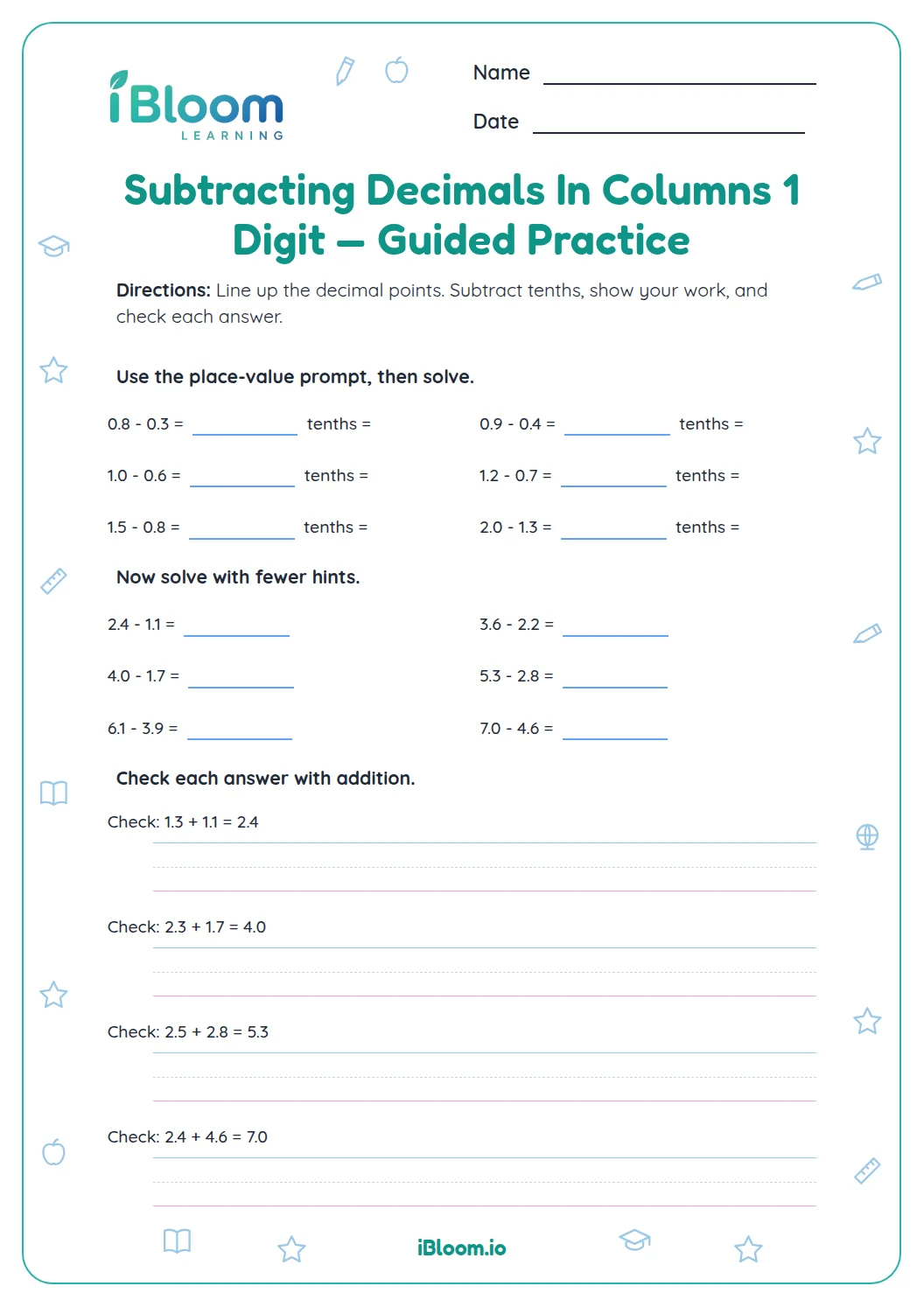
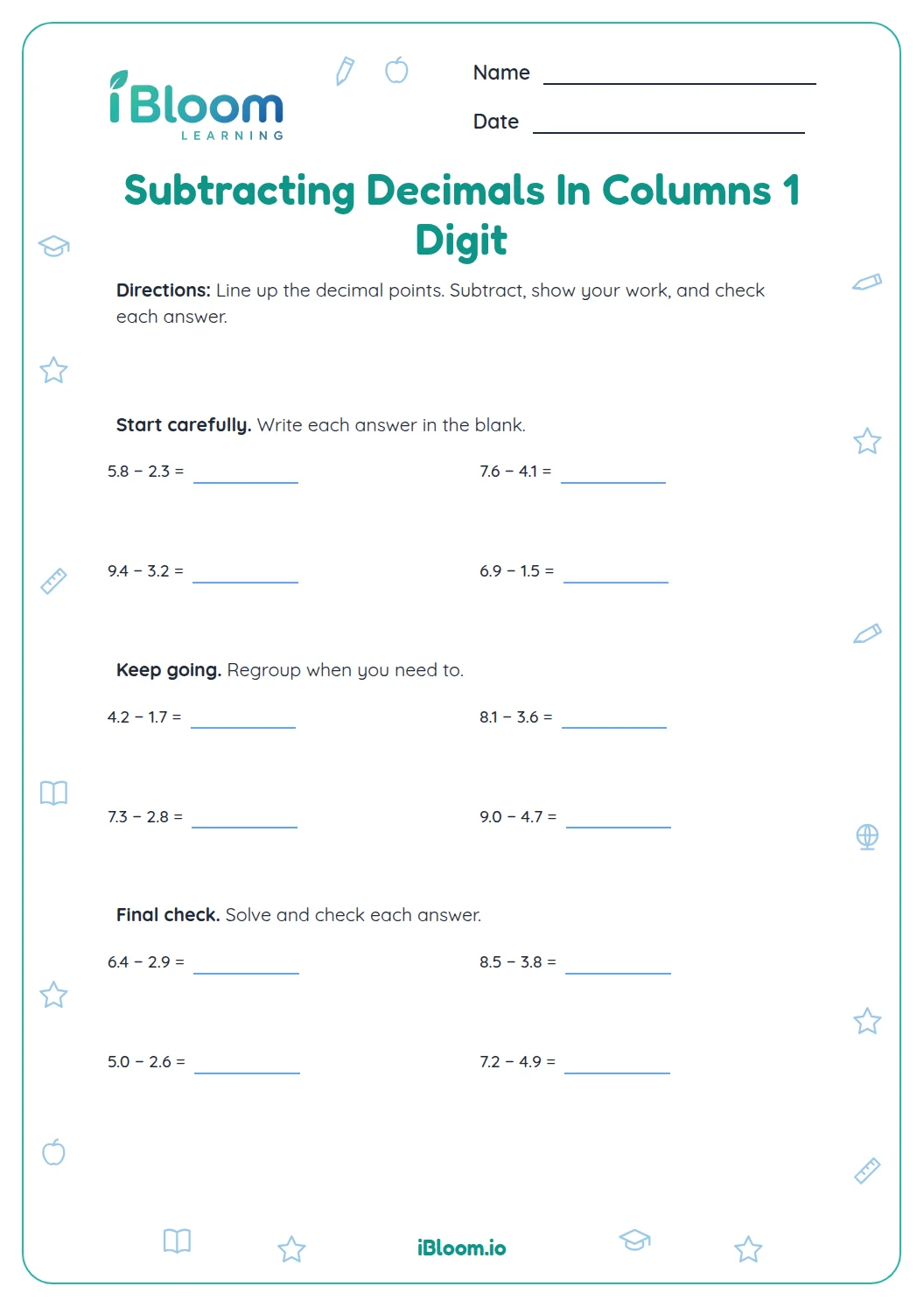
This Grade 3 guided practice uses tenths grids on the original sheet as a starting point, then builds fluency with decimal subtraction. Learners solve six subtraction facts, find missing values in five equations, and apply tenths in four short situations. It gives focused practice with CCSS 5.NBT.B.7.
Aligned to 5.NBT.B.7
How do you subtract tenths?
A decimal such as 0.8 names eight tenths. When both numbers have one digit after the decimal point, subtract the tenths and keep the decimal point in the same place.
For example, 0.8 − 0.3 means 8 tenths minus 3 tenths.
- 10.8 − 0.3 = 0.5
- 2Eight tenths minus three tenths is five tenths.
What will learners practice?
The first part reviews subtraction facts. The next part works backward to find an unknown amount, and the final part applies the same skill to familiar quantities.
- Part A: subtract tenths
- Part B: find a missing subtrahend or starting amount
- Part C: solve four one-step stories
How can a learner check an answer?
Add the amount taken away to the amount left. For 0.8 − 0.3 = 0.5, check that 0.5 + 0.3 returns to 0.8. This also helps confirm which number was the starting amount.
- 10.5 + 0.3 = 0.8
How to use this worksheet
- 1Read the subtraction sign and name both amounts in tenths.
- 2Solve each Part A fact in the order printed.
- 3For Part B, use addition to find a missing amount when helpful.
- 4Write a subtraction equation for each story in Part C.
- 5Check by adding the amount removed back to the result.
Common mistakes and quick fixes
The mistake
Subtracting the digits in reverse order
The fix
Keep the order in the equation: start amount minus amount removed.
The mistake
Writing 5 instead of 0.5 for five tenths
The fix
Keep one digit after the decimal point.
The mistake
Changing the starting amount in a missing-value equation
The fix
Substitute the answer and check that both sides match.
Curriculum alignment
This printable gives focused practice with the stated skill.
Use place-value strategies to subtract decimals in tenths.
On this sheet: The questions subtract decimals to tenths and use place value.
Show the official wordingHide the official wording
Add, subtract, multiply, and divide decimals to hundredths, using concrete models or drawings and strategies based on place value, properties of operations, and/or the relationship between addition and subtraction; relate the strategy to a written method and explain the reasoning used.
What to practice next
Make more practice
Further reading
Questions parents and teachers ask
How do you subtract tenths?
Treat each digit after the decimal point as tenths. Subtract in the order shown, then write one digit after the decimal point. For example, eight tenths minus three tenths leaves five tenths, or 0.5. Read the equation once more to check which amount is being taken away.
What does one digit after the decimal point show?
One digit after the decimal point names tenths. The number 0.6 means six tenths, while 0.2 means two tenths. This worksheet keeps each decimal to tenths so learners can focus on equal units and the subtraction relationship. Each answer stays in tenths too.
How can a learner check a subtraction answer?
Add the amount taken away back to the answer. For 0.8 − 0.3 = 0.5, check that 0.5 + 0.3 returns to 0.8. If the sum does not return to the starting amount, revisit the subtraction and carefully check the order.
How do the missing-value questions work?
Use the numbers you know to find the missing amount. For 0.8 − ___ = 0.3, ask what amount added to 0.3 makes 0.8; the missing amount is 0.5. Substitute it in the blank to check the subtraction sentence.
What does the answer key include?
The separate key gives the decimal answers and the remaining amounts for the four short situations. For a story, check both the subtraction and the unit, such as 0.5 liter or 0.5 meter. A learner can explain the equation aloud before checking the result.