


About this worksheet
This printable gives Grade 3 learners a first set of decimal subtraction practice using tenths. Four shaded models help check the difference; twelve more problems ask learners to set up subtraction vertically and align decimal points. The separate key lists all 16 answers. The decimal work aligns with Common Core 5.NBT.B.7.
Aligned to 5.NBT.B.7
How do the tenths models support subtraction?
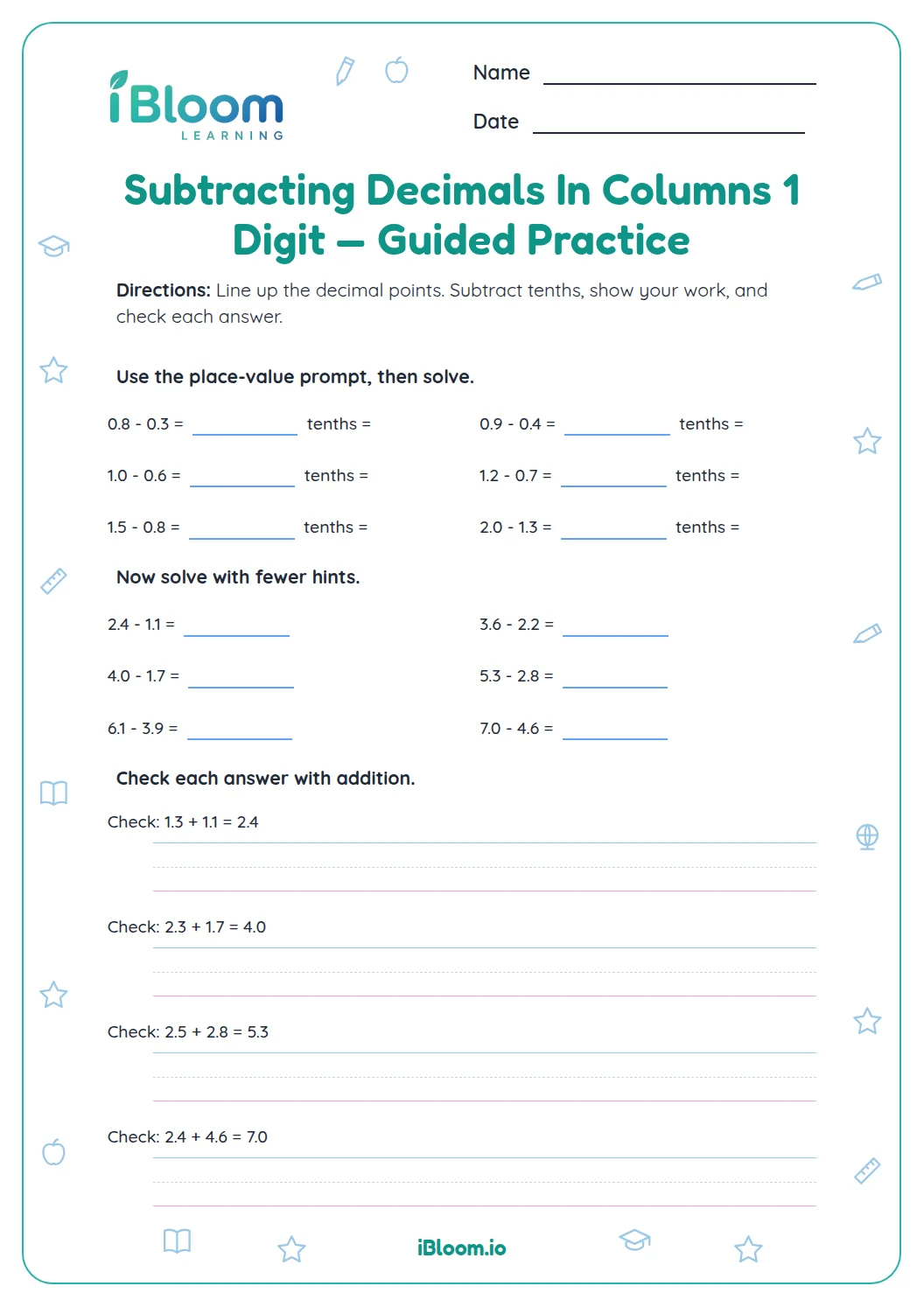
The first four items pair a subtraction equation with a shaded model of its difference. Solve the equation, then compare the result with the tenths shown. For example, 0.9 − 0.4 leaves 0.5, or five tenths.
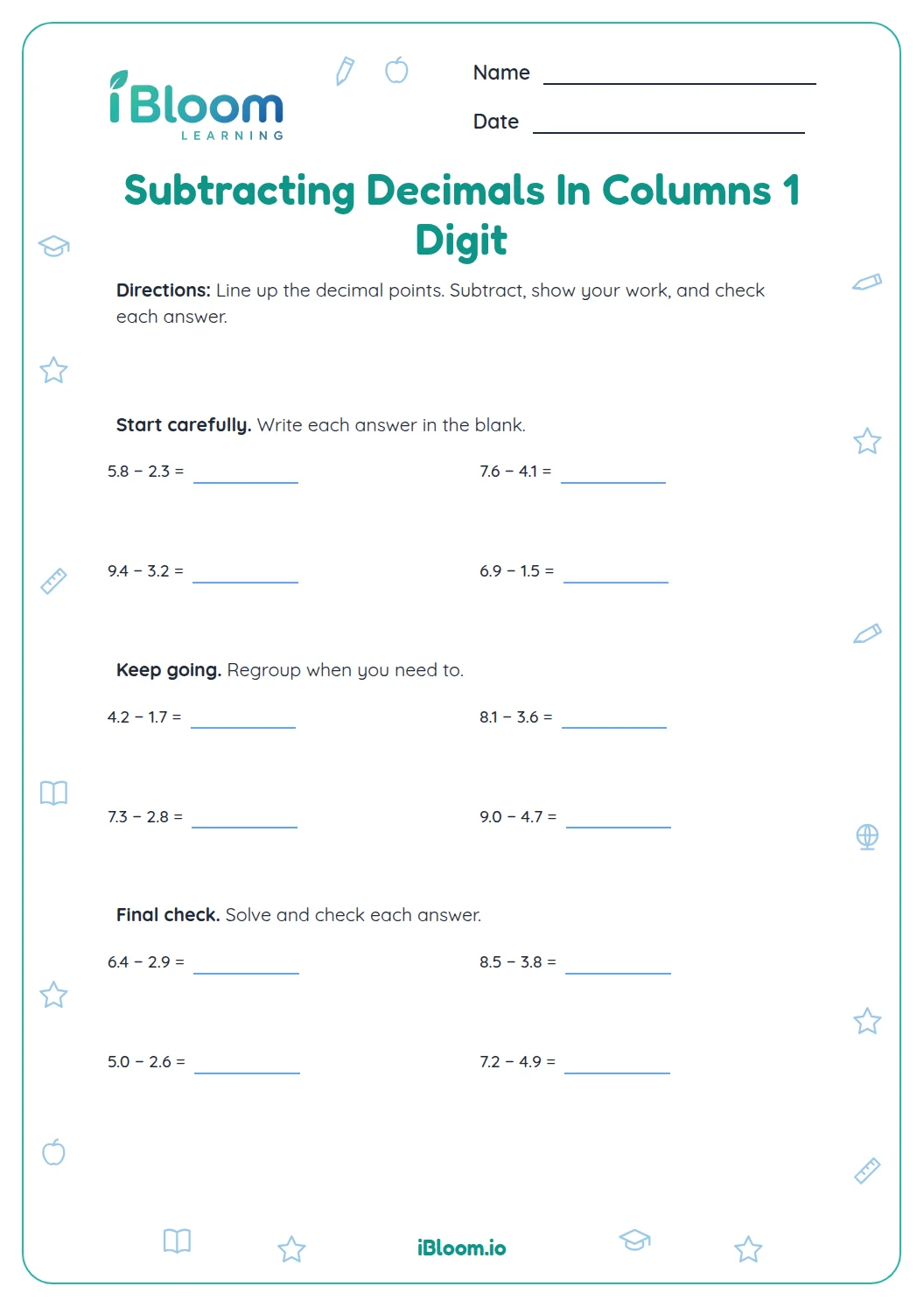
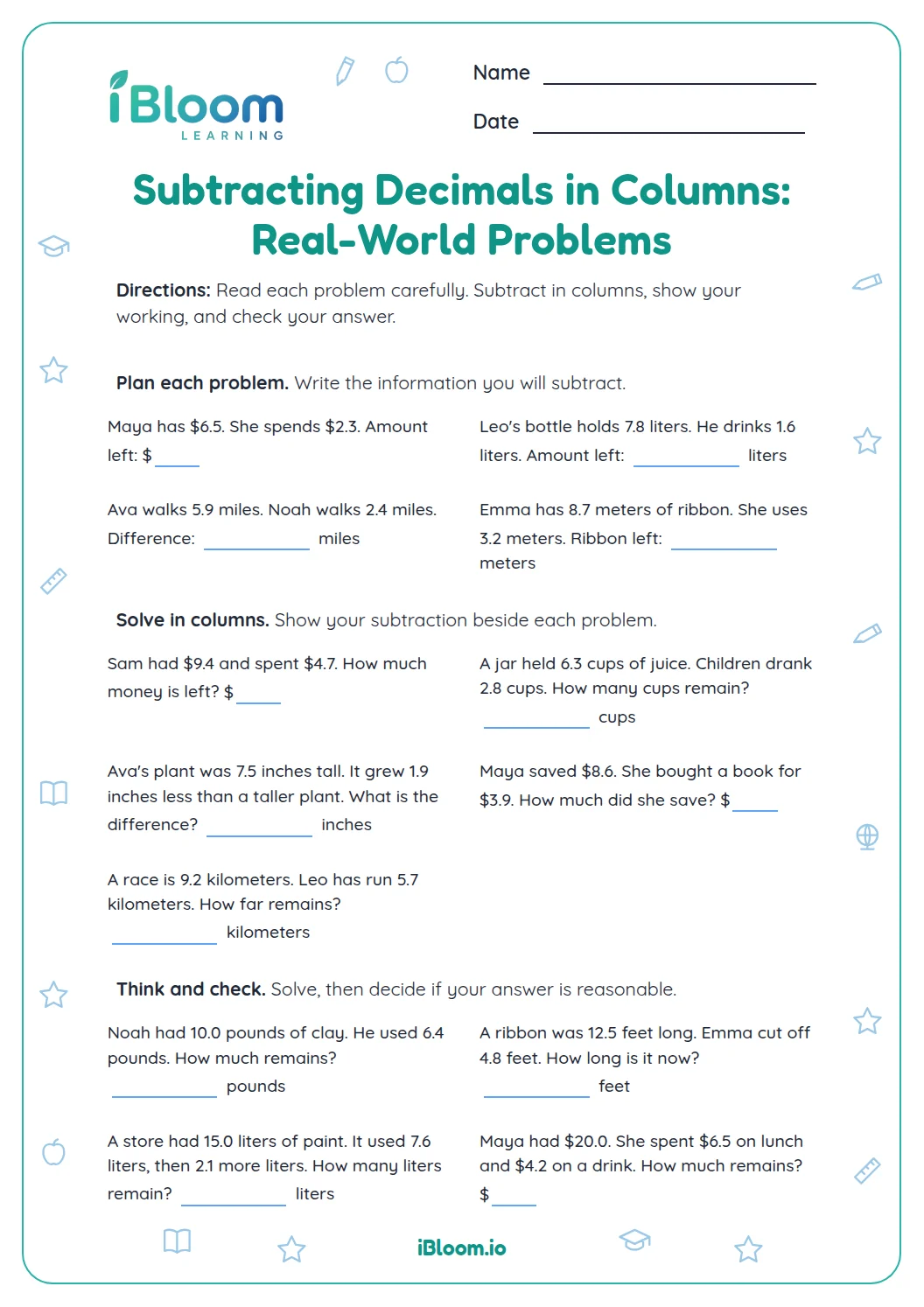
The remaining twelve items leave room to set up the decimals vertically so the tenths digits stay aligned.
- 1Solve 0.9 − 0.4, then check the tenths model.
- 2Nine tenths minus four tenths leaves five tenths, or 0.5.
How can a learner check the work?
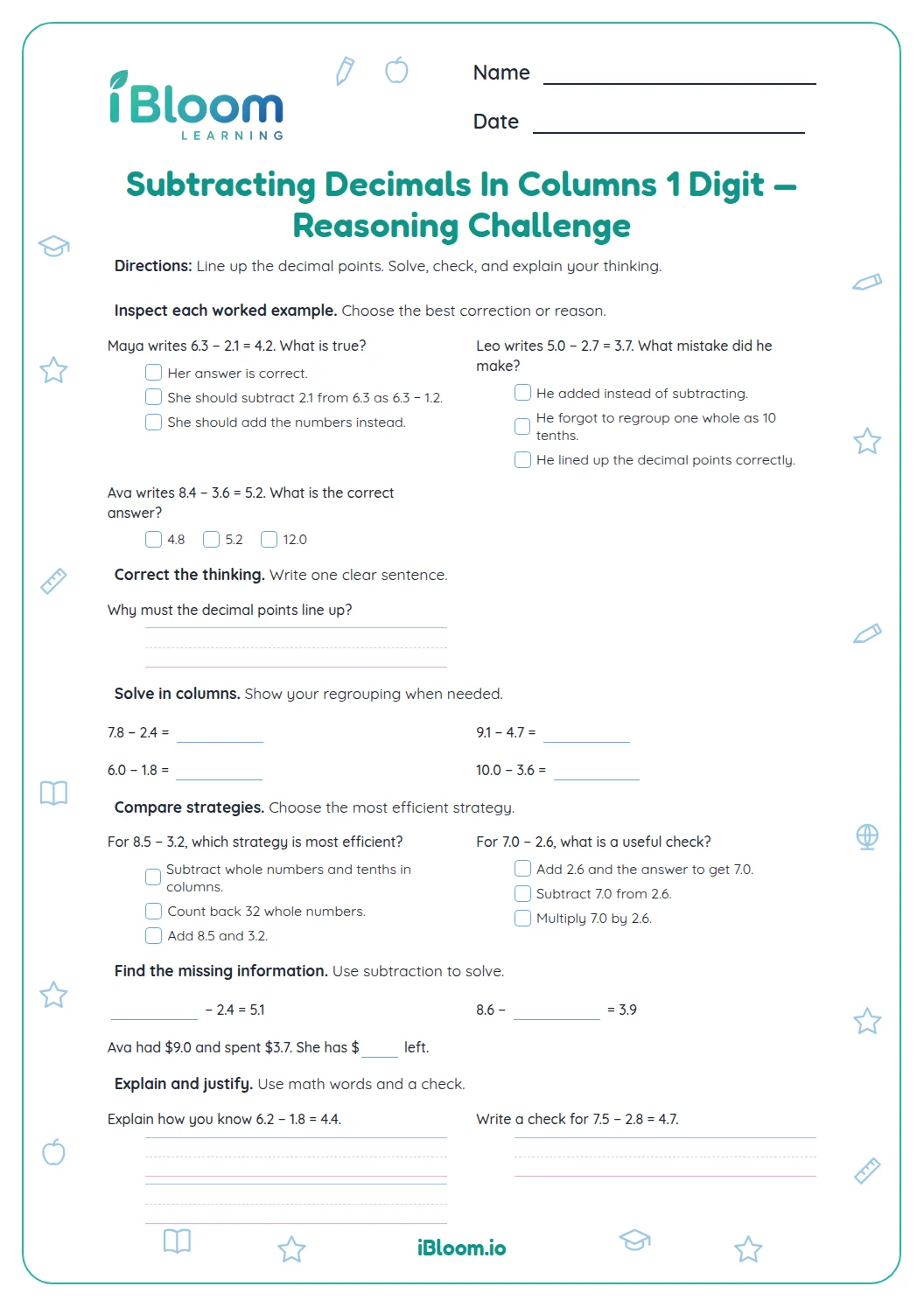
Set up each subtraction with decimal points in one vertical line. Subtract the tenths digits, then check that the result is less than the starting amount.
What is included on the printable?
The printable has four model questions, twelve column-practice questions, and a separate answer key.
How to use this worksheet
- 1Read the shaded amount as tenths.
- 2Subtract the tenths named in the prompt.
- 3For the written problems, stack the numbers with decimal points aligned.
- 4Subtract and write the decimal point in the result.
- 5Check each answer with the key after finishing.
Common mistakes and quick fixes
The mistake
Putting tenths digits in different columns.
The fix
Stack the decimals so their decimal points line up.
The mistake
Reading 5 tenths as 0.05.
The fix
Write five tenths as 0.5.
The mistake
Subtracting the smaller digit from the larger without checking place order.
The fix
Subtract the bottom tenths from the top tenths in each column.
Common Core alignment
This worksheet practices the standard below.
Subtract tenths with visual models and written methods.
On this sheet: Subtract tenths with visual models and written methods.
Show the official wordingHide the official wording
Add, subtract, multiply, and divide decimals to hundredths, using concrete models or drawings and strategies based on place value, properties of operations, and/or the relationship between addition and subtraction; relate the strategy to a written method and explain the reasoning used.
What to practice next
Make more practice
Further reading
Questions parents and teachers ask
What does a shaded grid mean?
The shaded strip represents the difference in tenths. Solve the subtraction first, then compare your result with the amount shown. For example, nine tenths minus four tenths leaves five tenths, written as 0.5. The model is a visual check for the calculation.
Why line up decimal points?
Stack the decimals so each decimal point sits directly below the other. This places tenths above tenths and keeps the subtraction organized. All numbers on this sheet have one digit after the decimal point, so the tenths digits are easy to compare.
How can I check a decimal difference?
Add the difference to the amount subtracted. If the sum returns to the starting amount, the subtraction is consistent. For example, 0.5 + 0.4 returns to 0.9, checking the first model problem. The key lists the result for every item.
How long should this practice take?
Plan for about 15 minutes, including time to study the four tenths models and complete the written problems. Learners can pause between the visual section and the column practice. The page is untimed, so children can focus on lining up place values and checking their differences.
What should my child do if the digits do not line up?
Rewrite the subtraction with the decimal points in one vertical line. Then check that the tenths digits are in the same column before subtracting. Since each problem uses tenths, no extra zero is needed to make the decimal places match.
Can we use the answer key for teaching?
Yes. Ask the learner to explain one model, solve the subtraction, and then compare the result with the shaded tenths. For the remaining problems, the key gives a quick check after the child has tried each calculation independently.