

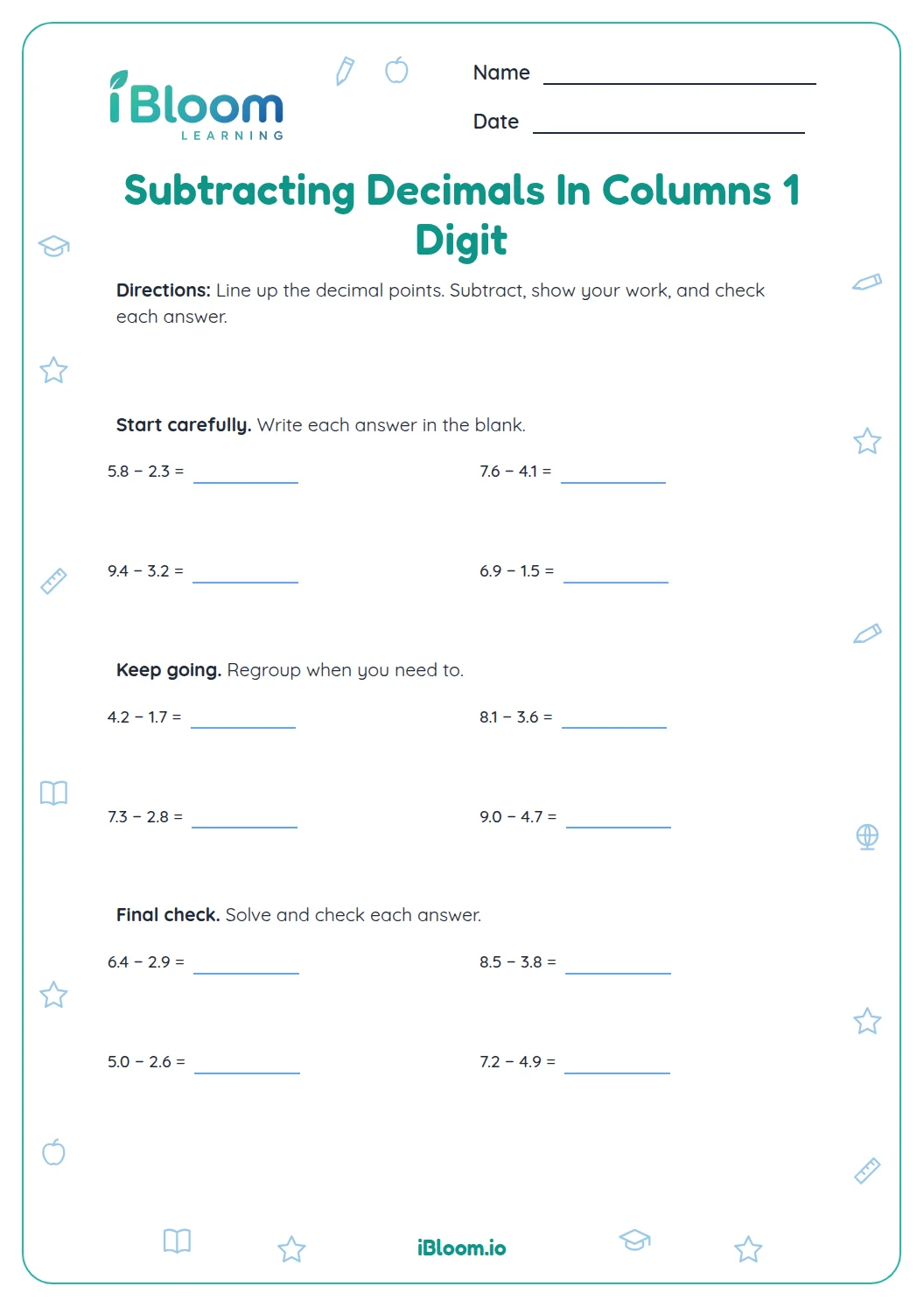
About this worksheet
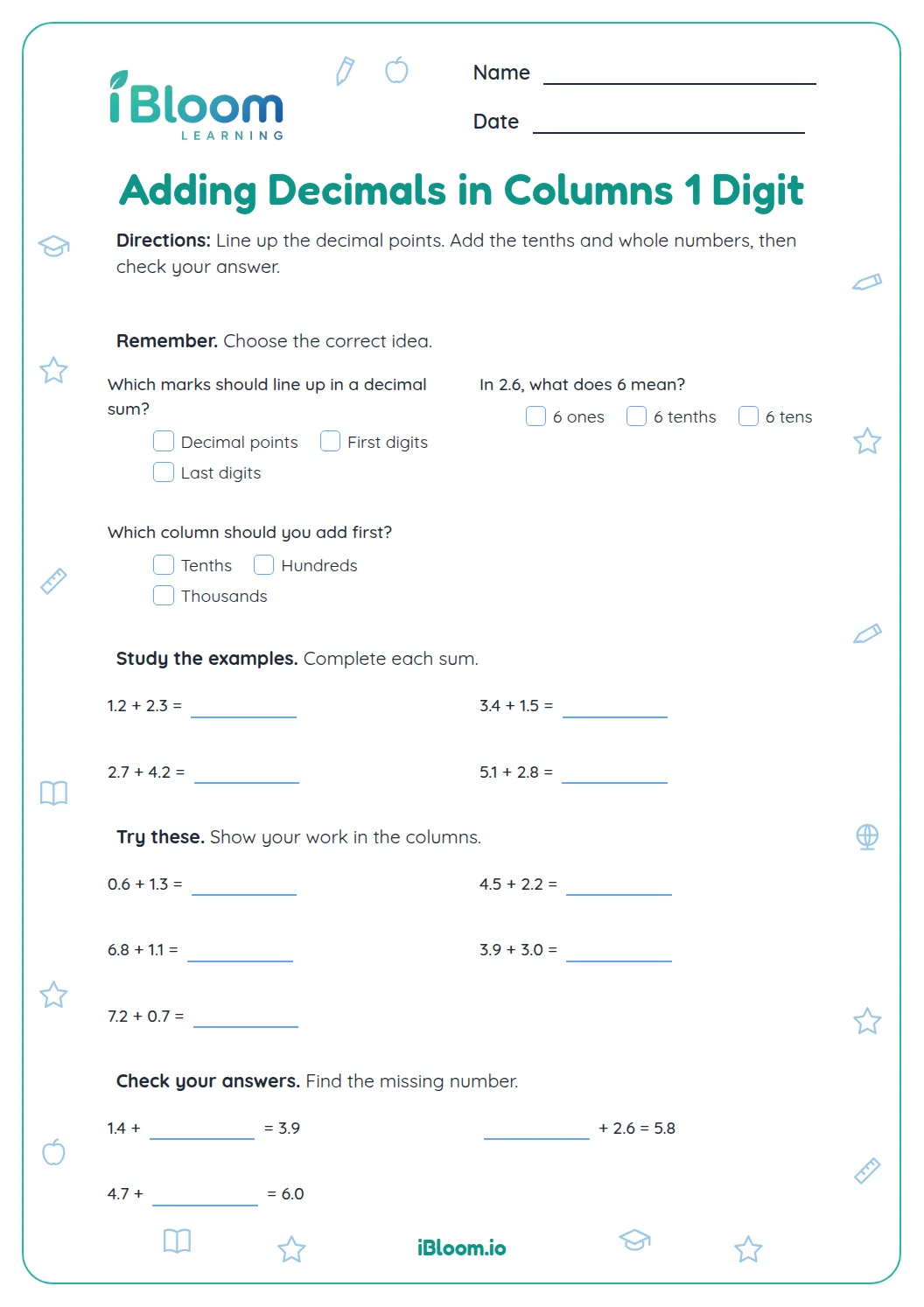
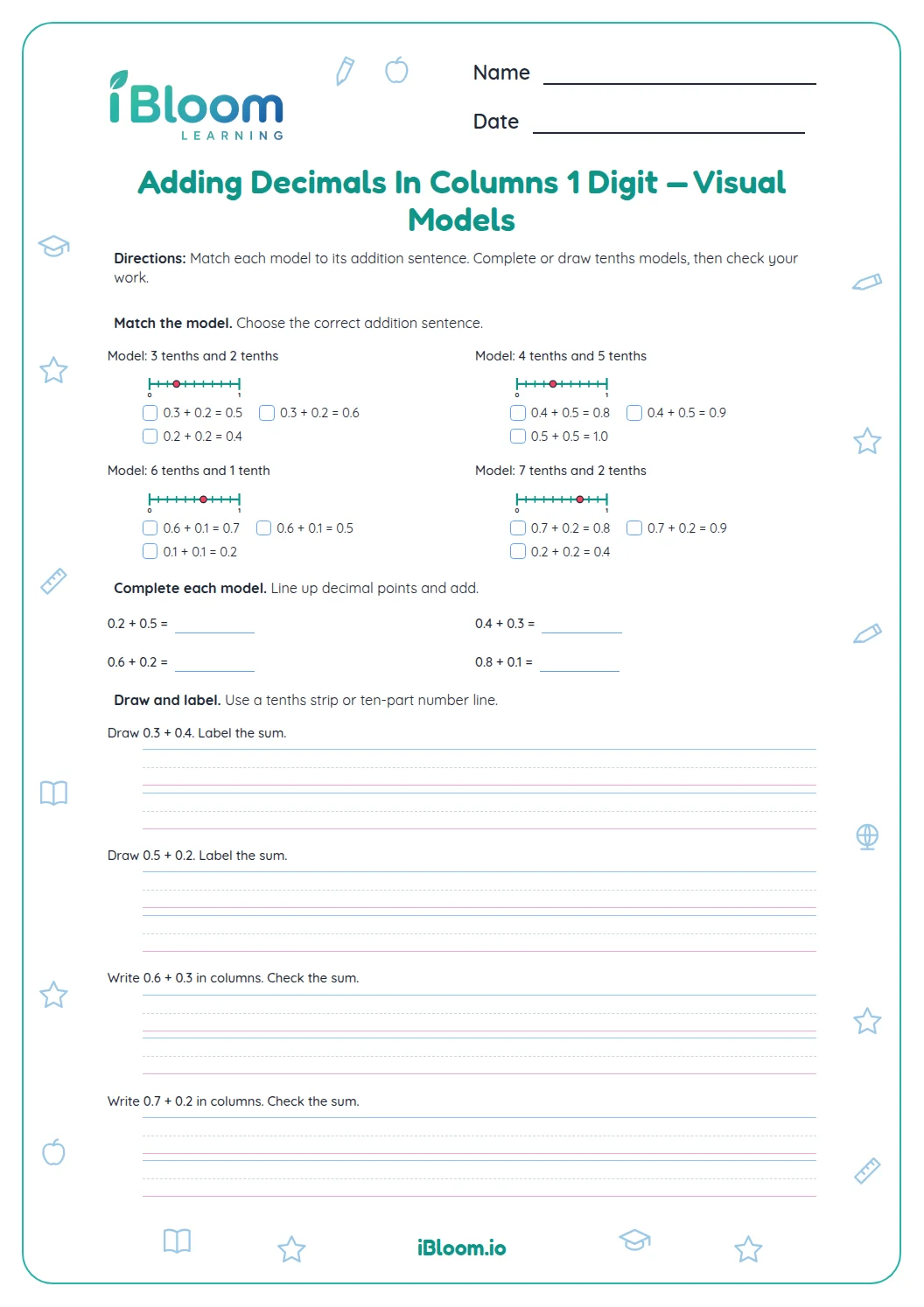
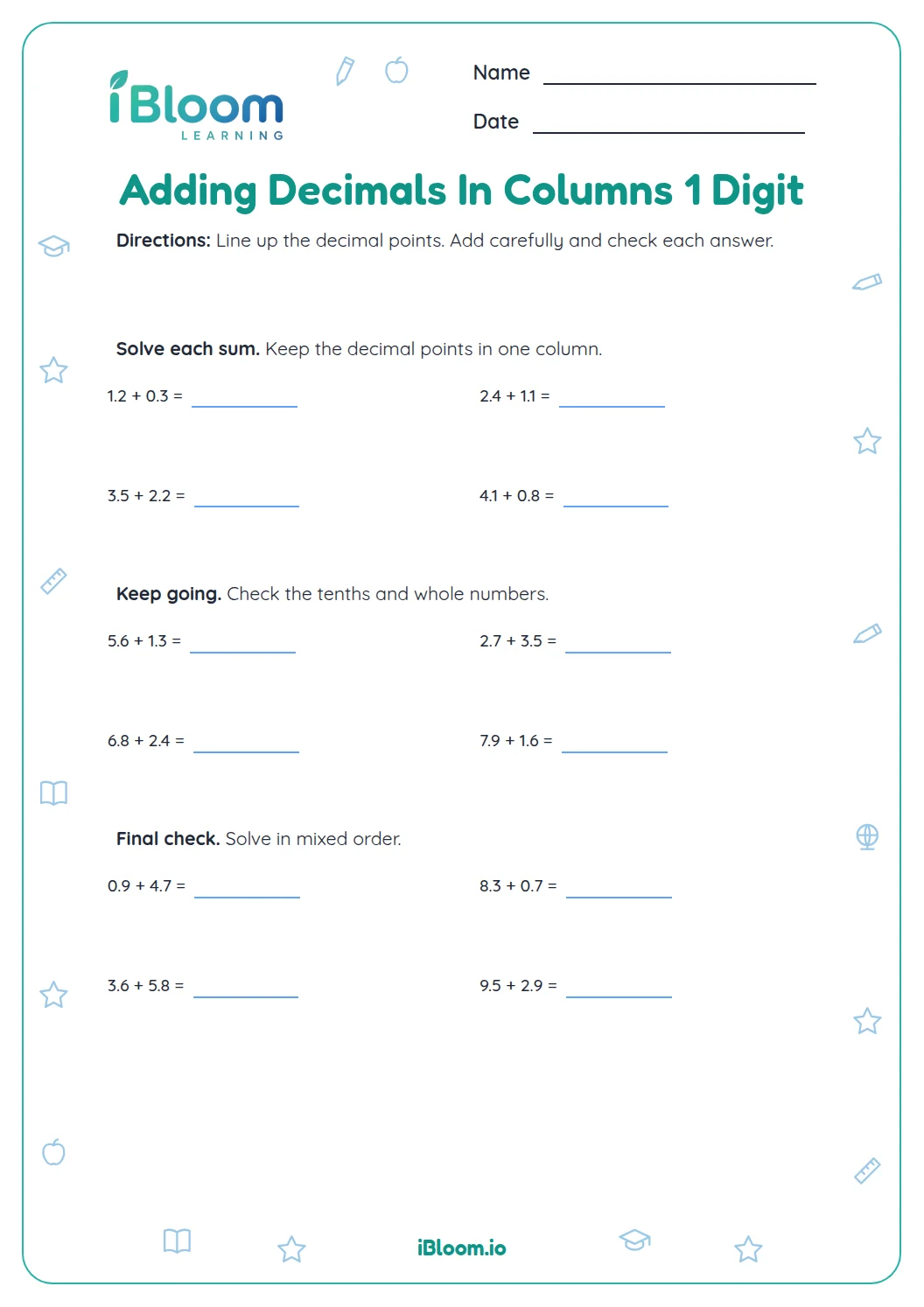
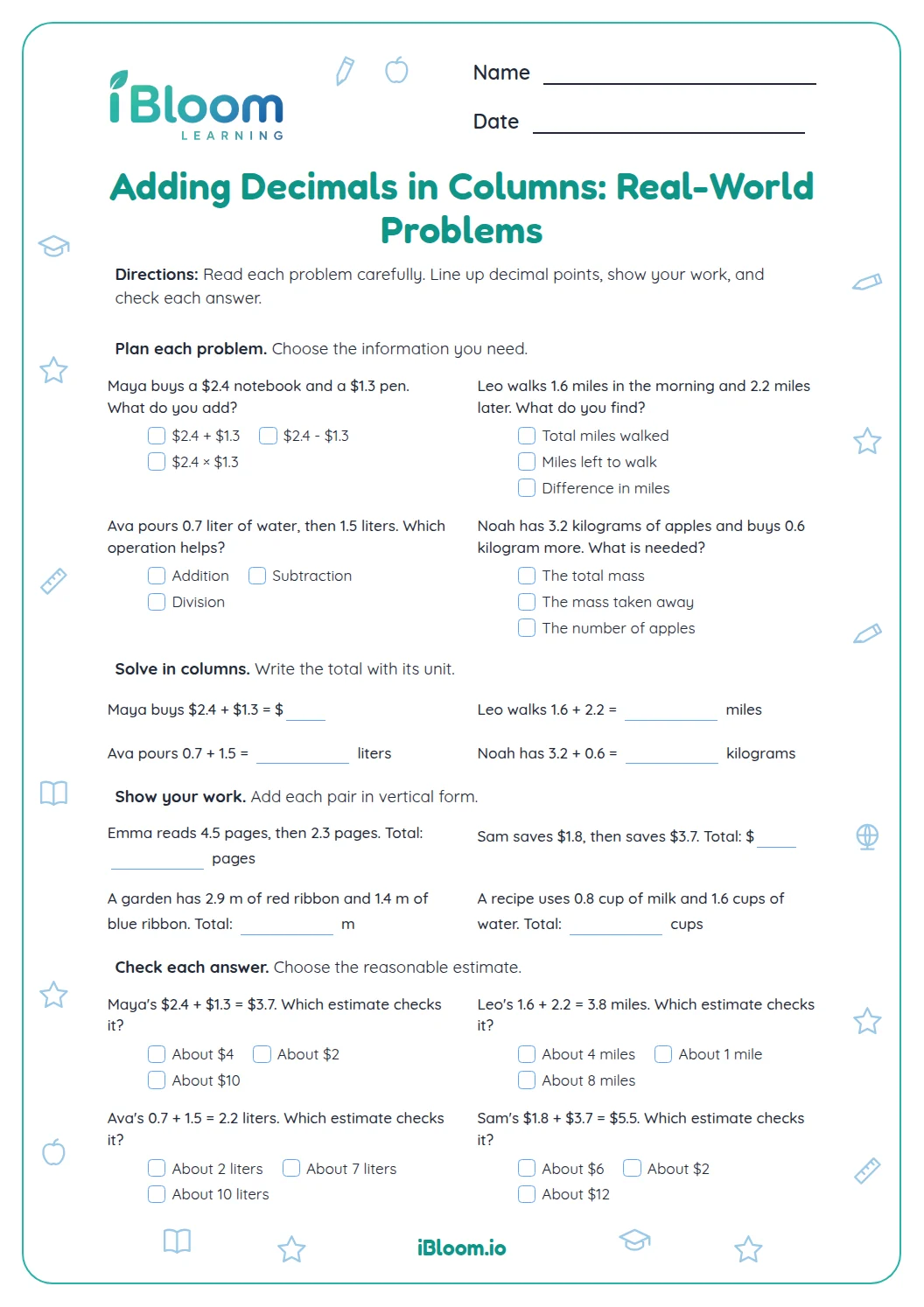
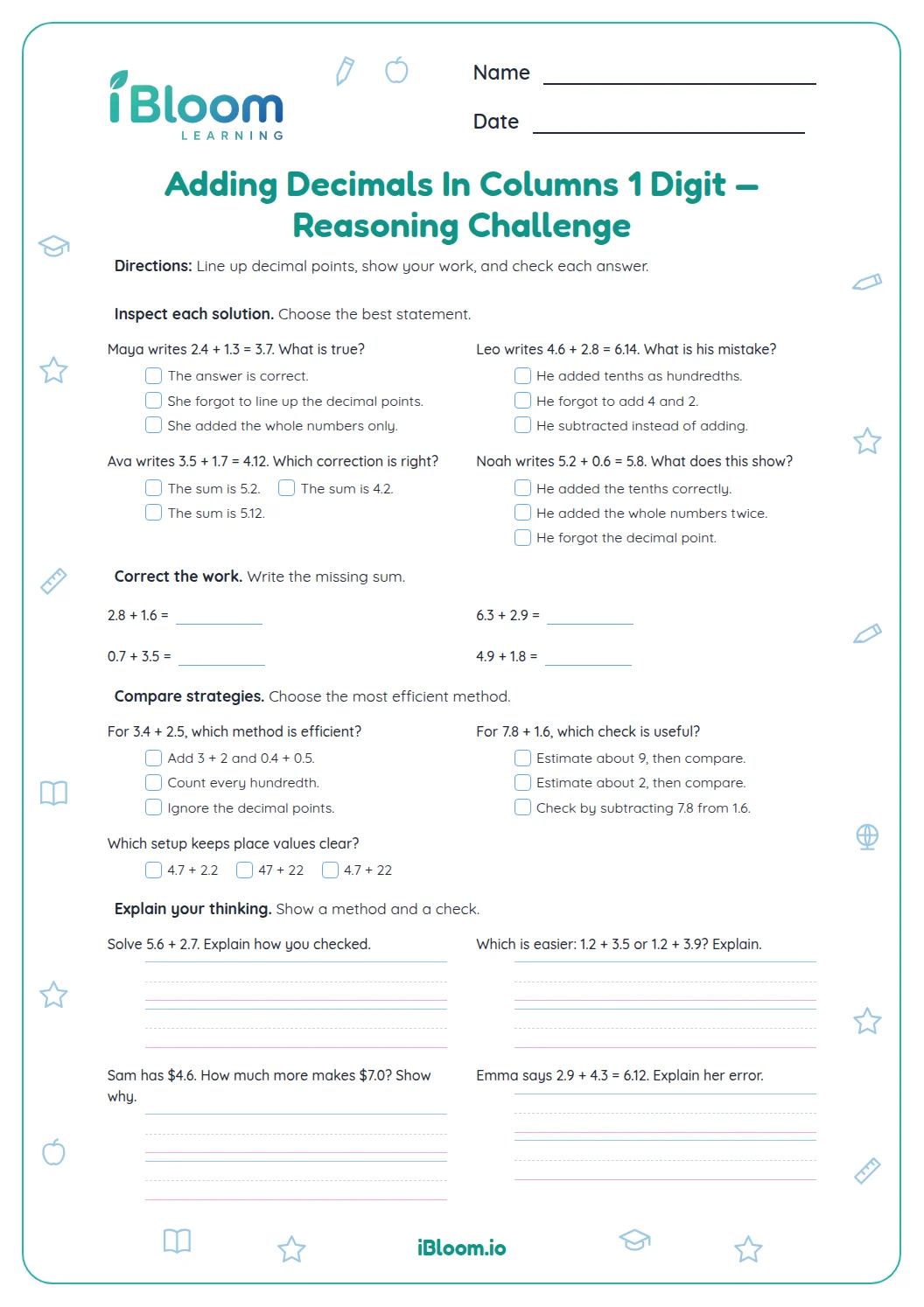
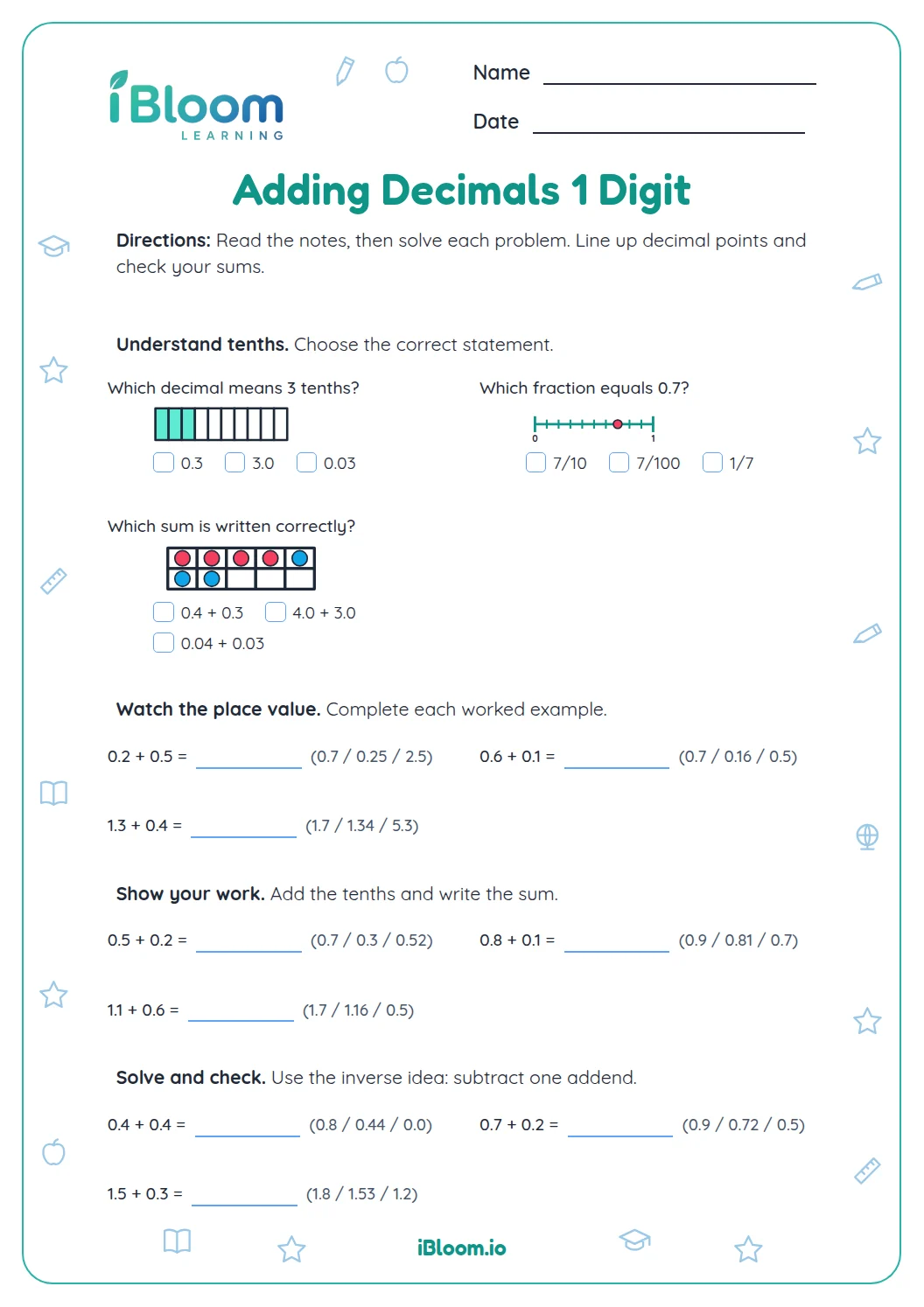
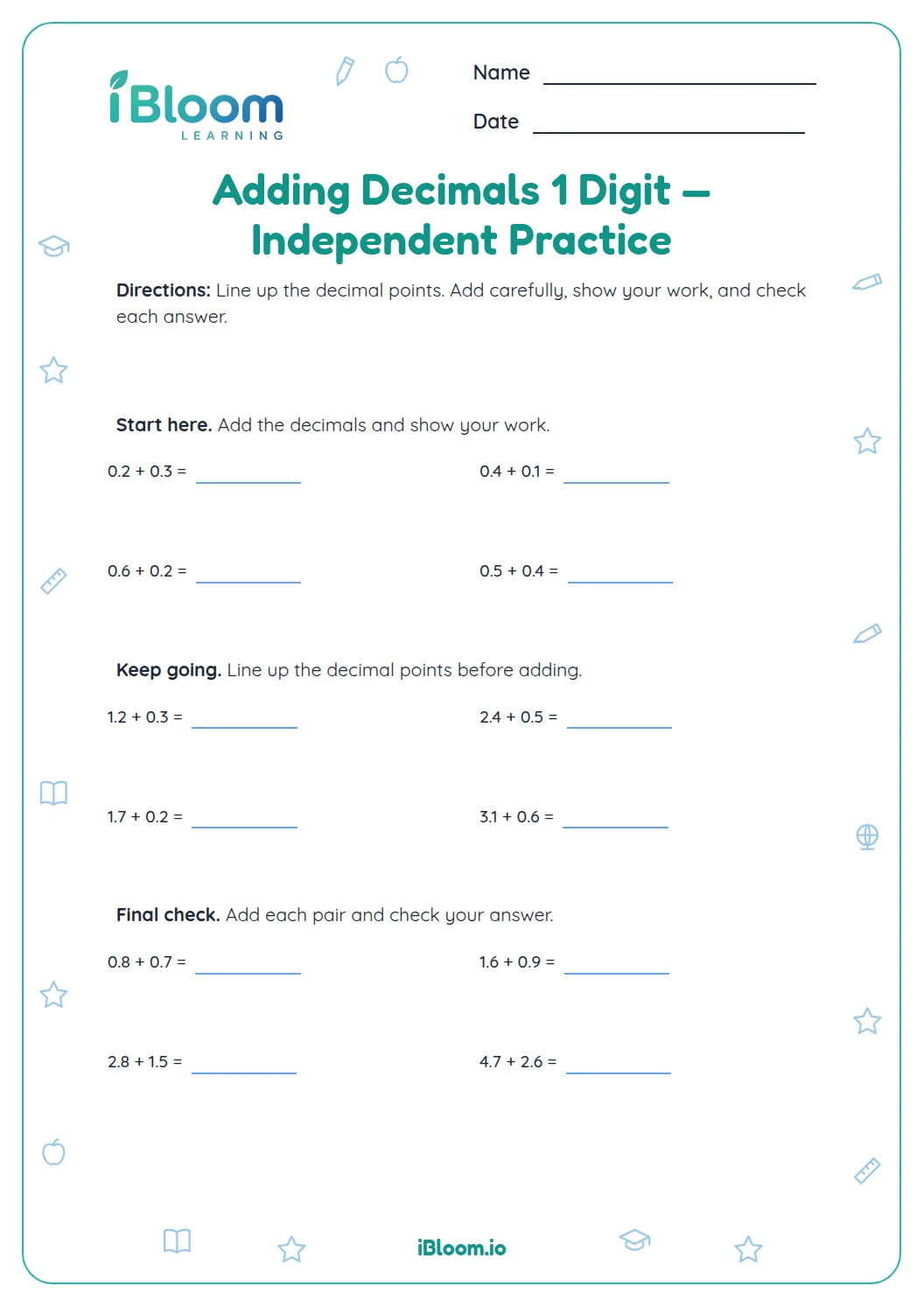
This free Grade 3 worksheet guides children through adding numbers with one decimal place. Part A guides 2.3 + 1.4: add tenths, add ones and combine. Part B provides twelve grids for stacking and solving sums. Three begin without regrouping, followed by nine that trade ten tenths for a whole. Part C asks children to explain decimal alignment and carrying. The 14 questions cover 13 distinct additions and practice the place-value method in Common Core 5.NBT.B.7. A separate answer key gives every value and a sample explanation.
Aligned to 5.NBT.B.7
How should children set out the column sums?
Write one number under the other on the work grid, with decimal points in a straight vertical line. Put the plus sign to the left of the second number and draw a line underneath. Ones belong above ones and tenths above tenths.
Part A supplies the place-value thinking for 2.3 + 1.4 before children set up their own sums. Each Part B question includes space to stack and solve the addition.
What happens when the tenths total more than nine?
Trade ten tenths for one whole. Write the remaining tenths in the tenths column and carry the new whole into the ones column. Question 5, 3.8 + 4.6, is the first column sum that needs this trade.
- 1Stack 3.8 + 4.6 with decimal points aligned.
- 28 tenths + 6 tenths = 14 tenths.
- 314 tenths = 1 whole and 4 tenths.
- 43 ones + 4 ones + 1 carried one = 8 ones.
- 5The sum is 8.4.
How does the final question check understanding?
Question 14 asks why decimal points line up and why one is carried in 3.8 + 4.6. A useful answer explains both: matching places must be added, and 14 tenths regroup as one whole and four tenths.
Accept the child’s own wording when it clearly describes both steps. If one is missing, point back to the written columns and ask what each digit represents.
Guide the first sum, then release the work
- 1Read 2.3 as 2 ones and 3 tenths, and 1.4 as 1 one and 4 tenths.
- 2Use the Part A hint to add tenths and ones separately, then write the sum.
- 3Help the child stack question 2 on its grid with the decimal points aligned.
- 4For question 5, trade 14 tenths for 1 whole and 4 tenths before adding the ones.
- 5Let the child finish the remaining sums and write the final explanation.
- 6Check values with the key and use the final explanation to revisit alignment or carrying errors.
Column-addition slips
The mistake
Writing 23 + 14 = 37 and copying 37 as the answer to 2.3 + 1.4.
The fix
Keep track of the units: the answer is 37 tenths, or 3.7. Place the decimal point under the addends’ points.
The mistake
Writing 3.8 + 4.6 as 7.14.
The fix
Fourteen tenths must be regrouped as one whole and four tenths. Add that whole to 7 to get 8.4.
The mistake
Writing 8.4 + 2.9 as 10.3 and forgetting the carried whole.
The fix
Four tenths plus nine tenths make one whole and three tenths. Add 8 + 2 + 1 to get 11 ones, giving 11.3.
Common Core alignment
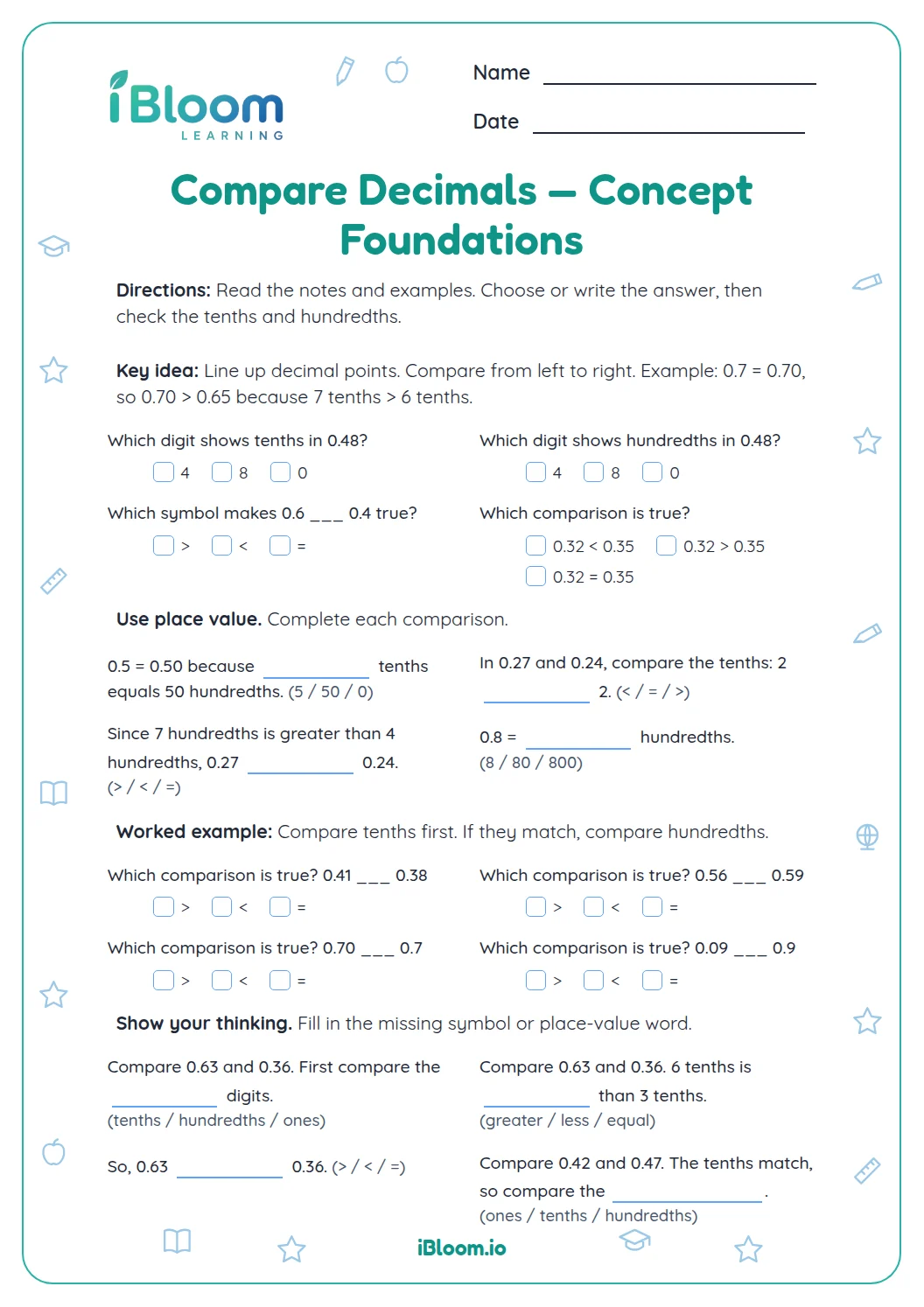
Add decimal tenths using place value and explain alignment and regrouping.
On this sheet: The guided sum and column work connect tenths and ones to written addition; Part C asks for reasoning.
Show the official wordingHide the official wording
Add, subtract, multiply, and divide decimals to hundredths, using concrete models or drawings and strategies based on place value, properties of operations, and/or the relationship between addition and subtraction; relate the strategy to a written method and explain the reasoning used.
What to practice next
Make more practice
Further reading
Questions parents and teachers ask
What does one digit mean in this worksheet title?
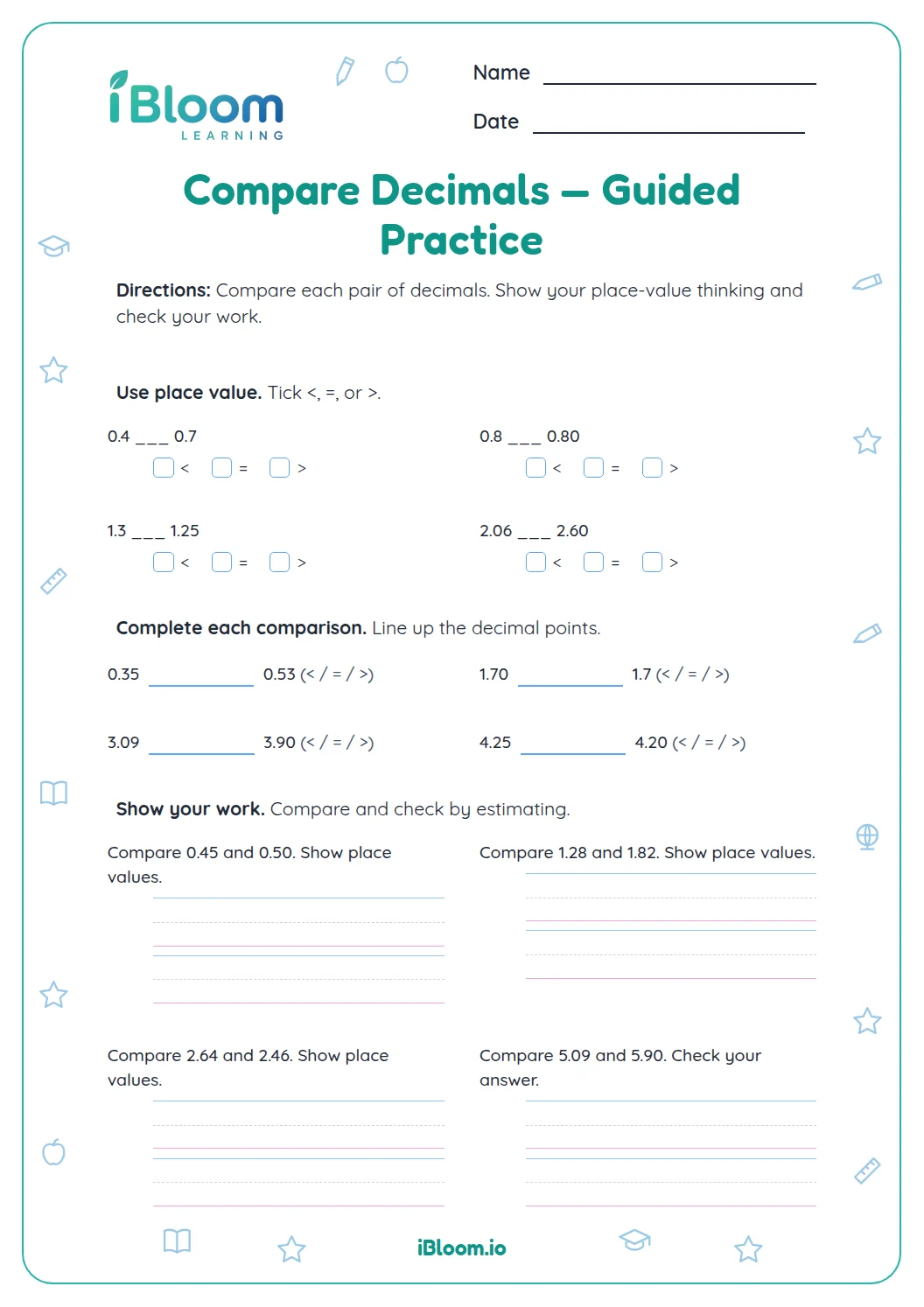
It means one digit after the decimal point: the addends are written in tenths, such as 3.8 and 4.6. Part A guides one addition with a place-value hint. Twelve column sums follow, including additions without regrouping and additions that trade ten tenths for a whole.
Are the column sums already stacked?
Children stack the twelve sums themselves on the printed work grids. This makes aligning decimal points part of the practice. An adult can demonstrate the first setup by writing one addend under the other, keeping ones and tenths in matching columns, then drawing an addition line.
Which questions require regrouping?
Questions 5 through 13 require regrouping. Their tenths totals reach or exceed ten, so children carry one whole into the ones column. Questions 2 through 4 practice alignment without regrouping. For 6.8 + 0.2, the key uses 7.0 to show the tenths place; 7 is equally correct.
How can my child check 8.4 + 2.9?
Subtract either addend from the sum to check it: 11.3 − 2.9 = 8.4. A quick estimate also helps: 8.4 is near 8 and 2.9 is near 3, so the sum should be near 11. Then inspect the columns for the carried whole.
How should I check the final explanation?
Look for both place-value ideas in question 14. The child should explain that aligning decimal points keeps ones with ones and tenths with tenths. Then they should explain that 14 tenths make one whole to carry and four tenths to keep. Accept equivalent wording.