

About this worksheet
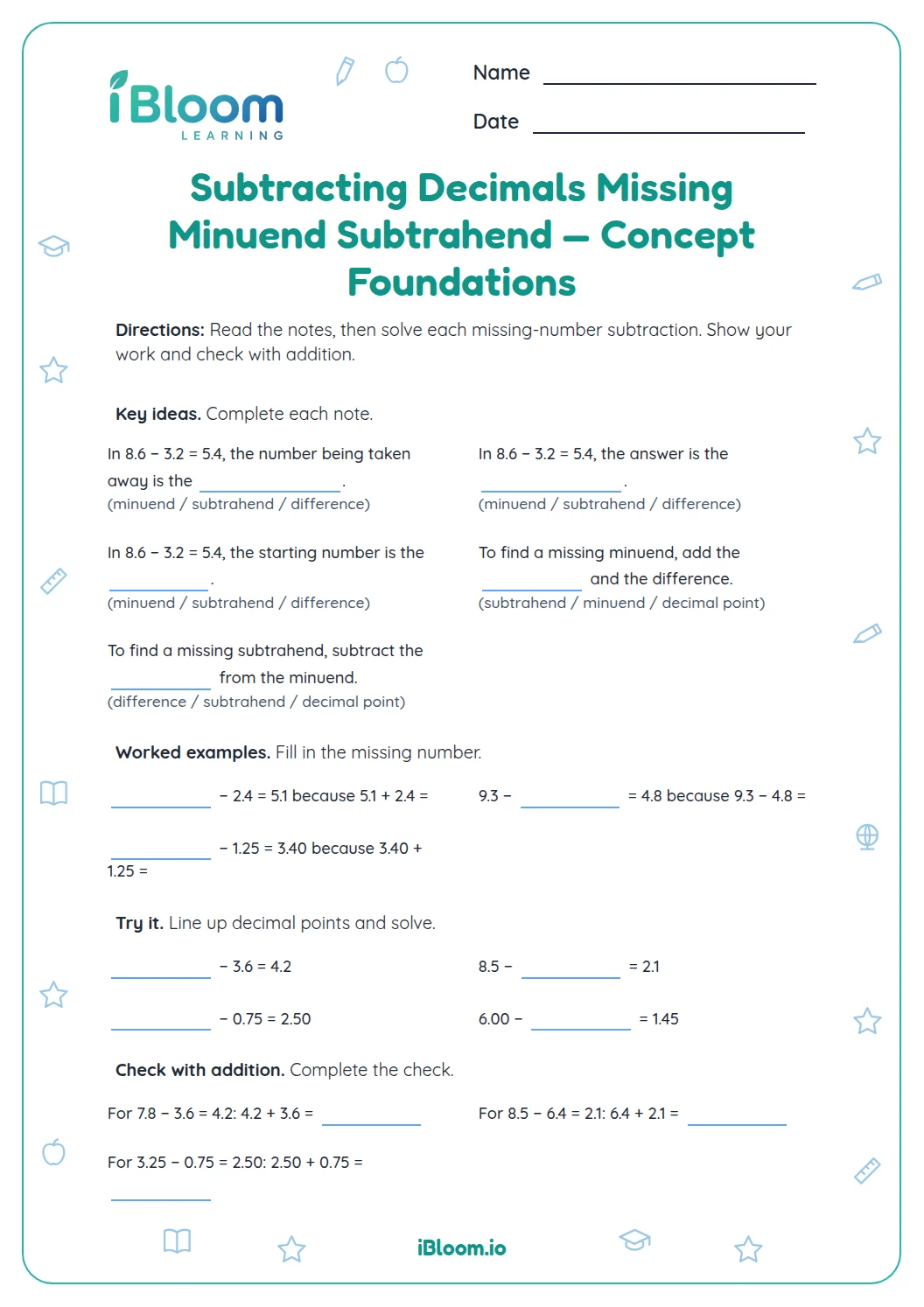
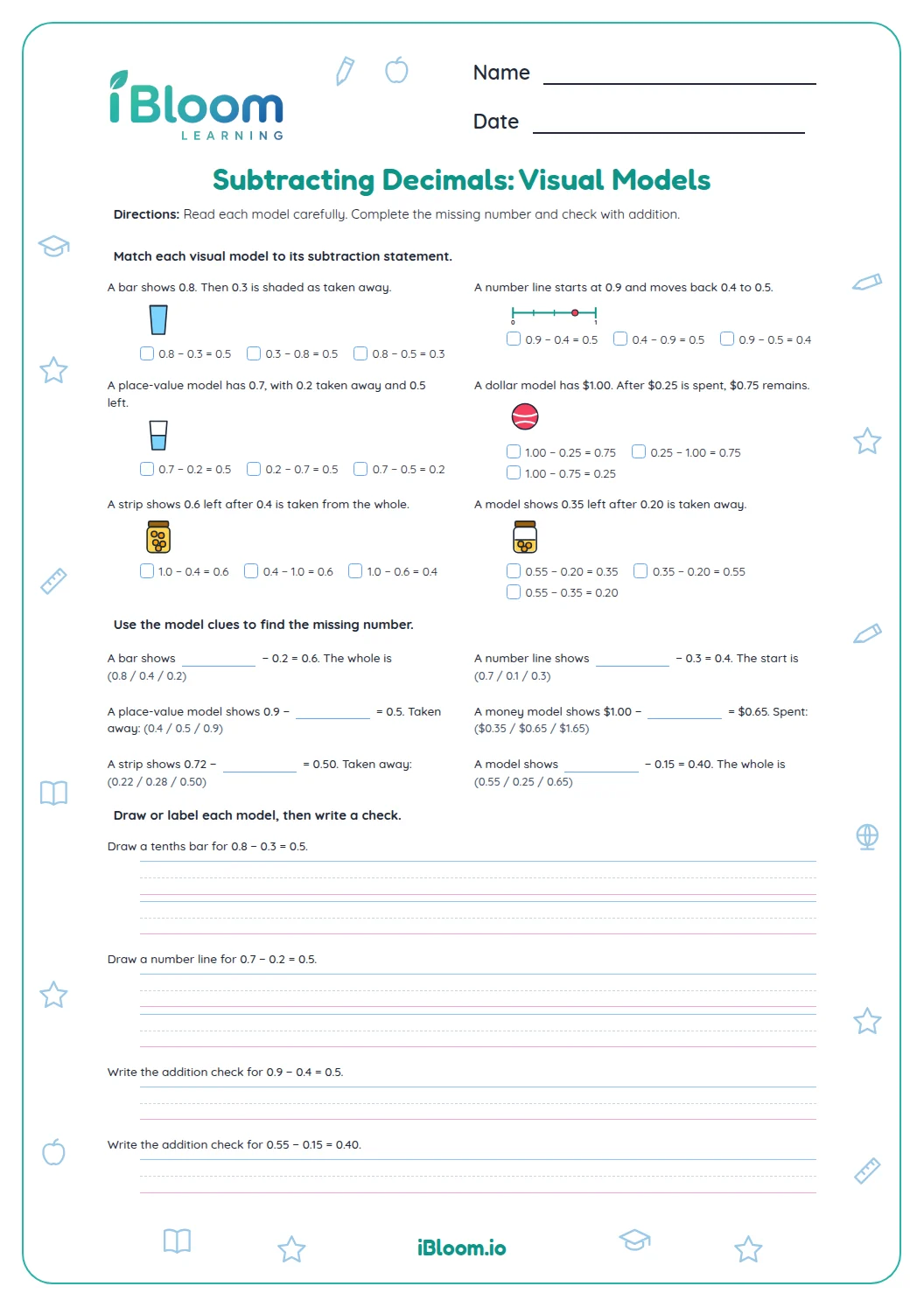
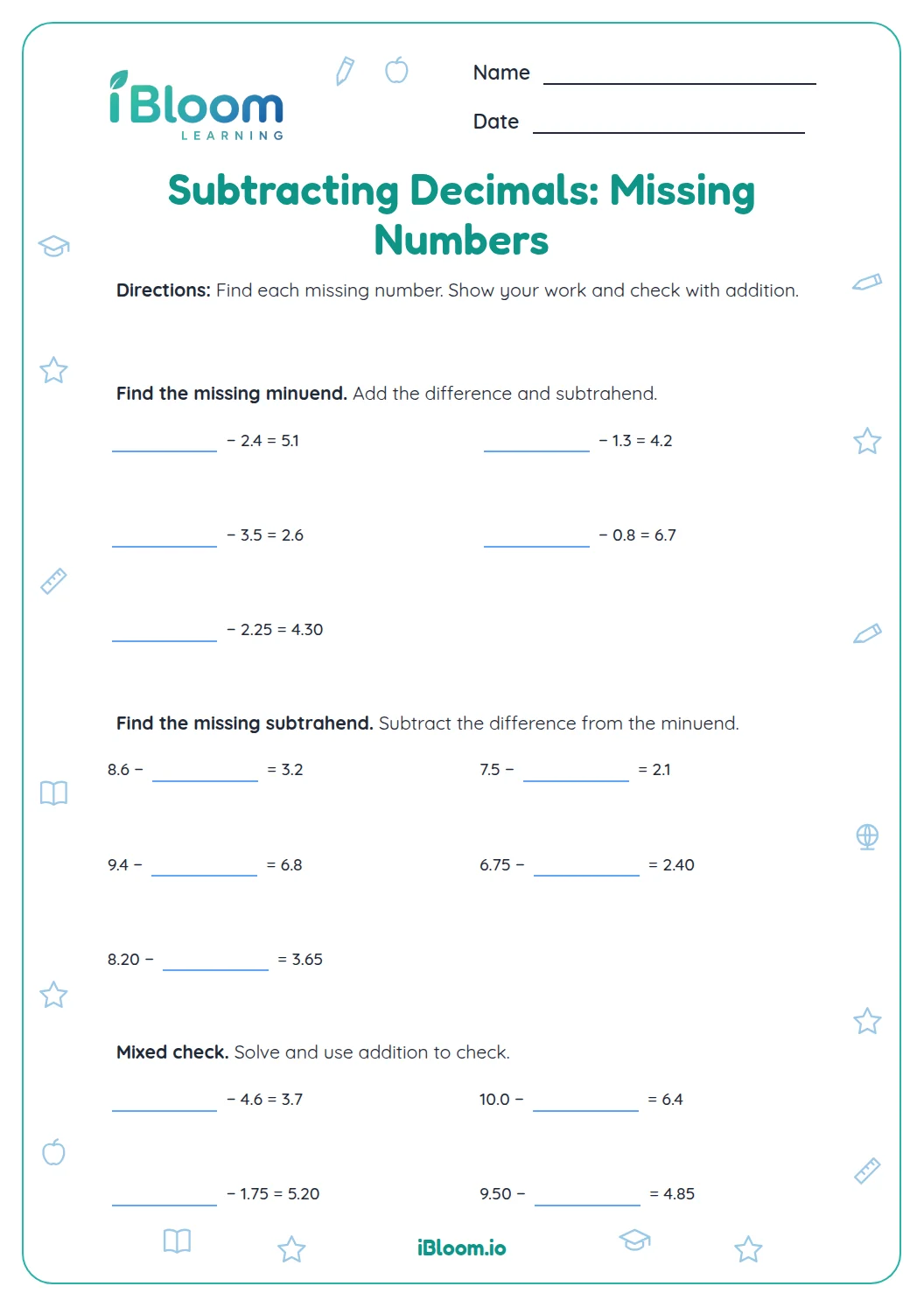
This guided worksheet practices missing minuends and subtrahends in decimal subtraction using tenths. Children solve equations such as ___ − 0.3 = 0.4, then check by adding the missing part back. Three short measurement stories use meters and liters. The sheet’s operation is named in the title and connects to adding and subtracting decimals (CCSS 5.NBT.B.7); the answer key shows each missing value.
Aligned to 5.NBT.B.7
How do you find a missing starting number?
A minuend is the starting number in a subtraction equation. If the start is missing, add the amount taken away to the amount left.
- 1___ − 0.3 = 0.4
- 20.4 + 0.3 = 0.7
- 3The missing start is 0.7.
How do you find the amount taken away?
Subtract the amount left from the starting amount. In 0.9 − ___ = 0.5, calculate 0.9 − 0.5 = 0.4. Check: 0.9 − 0.4 = 0.5.
What is on this worksheet?
Questions 1–5 and 10 ask for a missing starting amount. Questions 6–9 ask for a missing amount taken away or a related sum. The last five use equations and short measurement stories, with units in the answers.
How to solve and check
- 1Decide whether the start or the amount taken away is missing.
- 2For a missing start, add the amount taken away to the amount left.
- 3For a missing part, subtract the amount left from the start.
- 4Keep tenths lined up by place value.
- 5Substitute the answer and check that the subtraction is true.
Common decimal subtraction slips
The mistake
Subtracting the smaller tenths digit from the larger without considering the equation.
The fix
Use the known start and result to decide whether addition or subtraction finds the blank.
The mistake
Putting the leftover amount in a missing-start blank.
The fix
Add the amount removed to the amount left to rebuild the start.
The mistake
Leaving off the measurement unit in a story answer.
The fix
Include meters for ribbon and board lengths and liters for water.
Common Core alignment
The worksheet practices decimal subtraction and checking with addition.
Add and subtract decimals by aligning place values and checking the result.
On this sheet: Learners subtract tenths and use the relationship between addition and subtraction to find or check missing values.
Show the official wordingHide the official wording
Add, subtract, multiply, and divide decimals to hundredths, using concrete models or drawings and strategies based on place value, properties of operations, and/or the relationship between addition and subtraction; relate the strategy to a written method and explain the reasoning used.
What to practice next
Make more practice
Further reading
Questions parents and teachers ask
How do you find a missing minuend?
Add the subtrahend to the difference. For example, if ___ − 0.3 = 0.4, add 0.3 and 0.4 to get 0.7. Substituting it back confirms 0.7 − 0.3 = 0.4. The starting amount is the minuend. Then subtract again to verify the result.
How do you find a missing subtrahend?
Subtract the difference from the starting number. In 0.9 − ___ = 0.5, calculate 0.9 − 0.5 to find 0.4. Check by putting 0.4 in the blank: 0.9 − 0.4 equals 0.5. This check confirms the missing subtrahend.
What decimal place does this worksheet use?
The equations use tenths, such as 0.7 and 1.0. That keeps attention on the missing minuend or subtrahend and the relationship between subtraction and addition. Three final questions place the same reasoning in short length or capacity stories.
Are there measurement questions?
Yes. The final part includes a ribbon length, water in a jug, and a board length, plus another short water story. Each question gives the starting amount and result or amount removed, and the key includes the matching unit.
How can a child check an answer?
Replace the blank with the proposed number and recompute the subtraction. A second check uses addition: the amount taken away plus the amount left should equal the starting amount. The key lists each missing value so a child can compare the equation directly.