
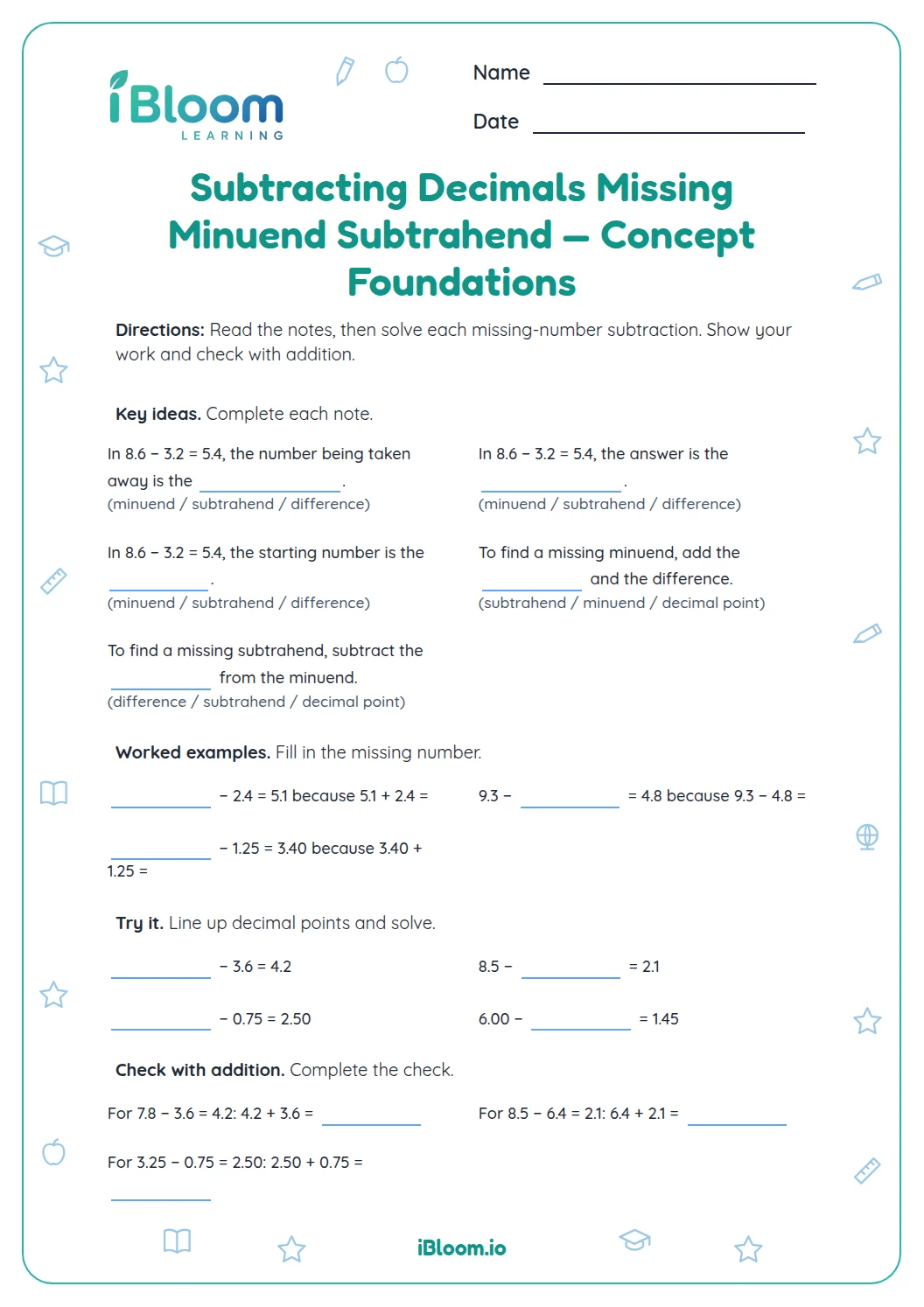
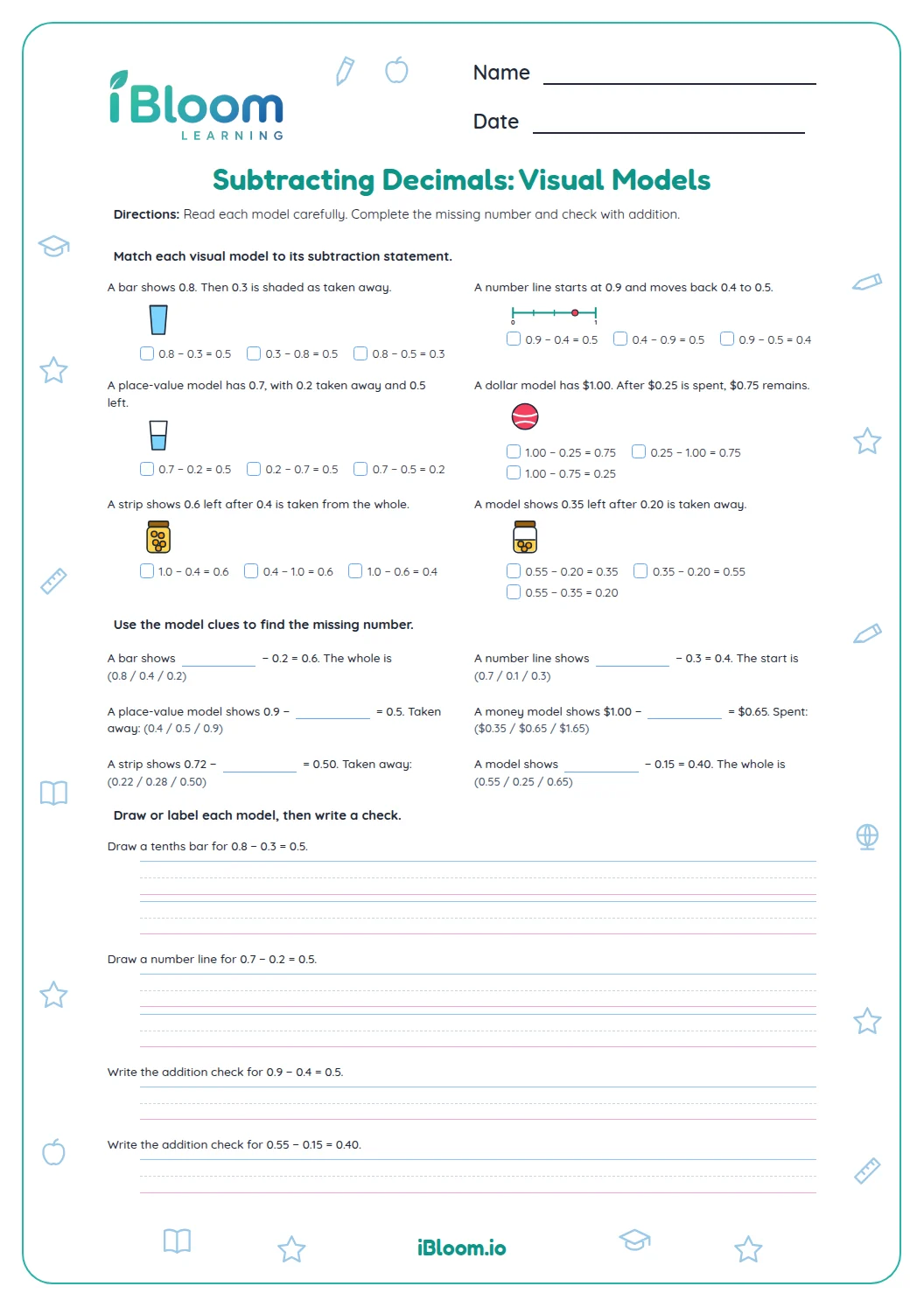
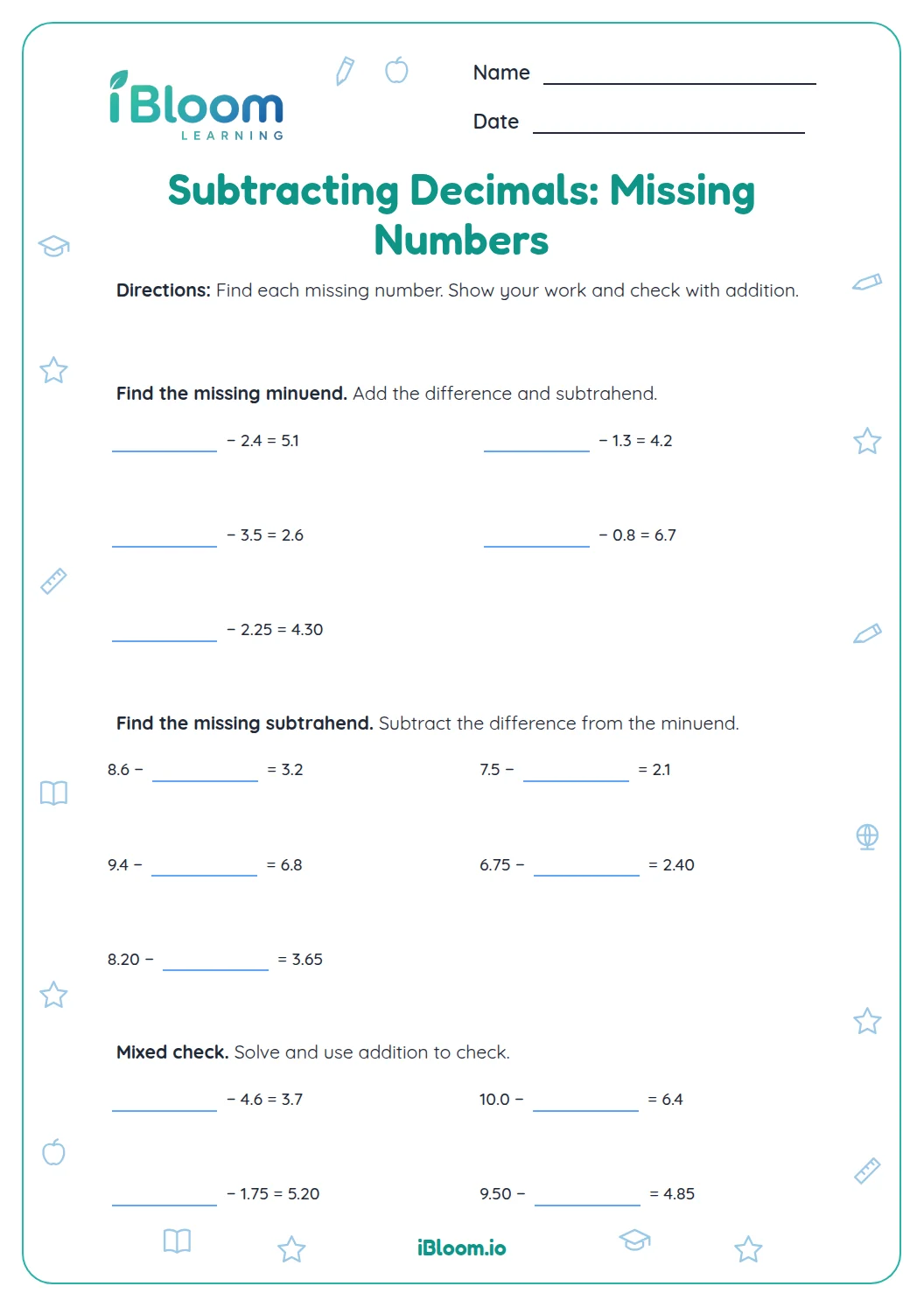


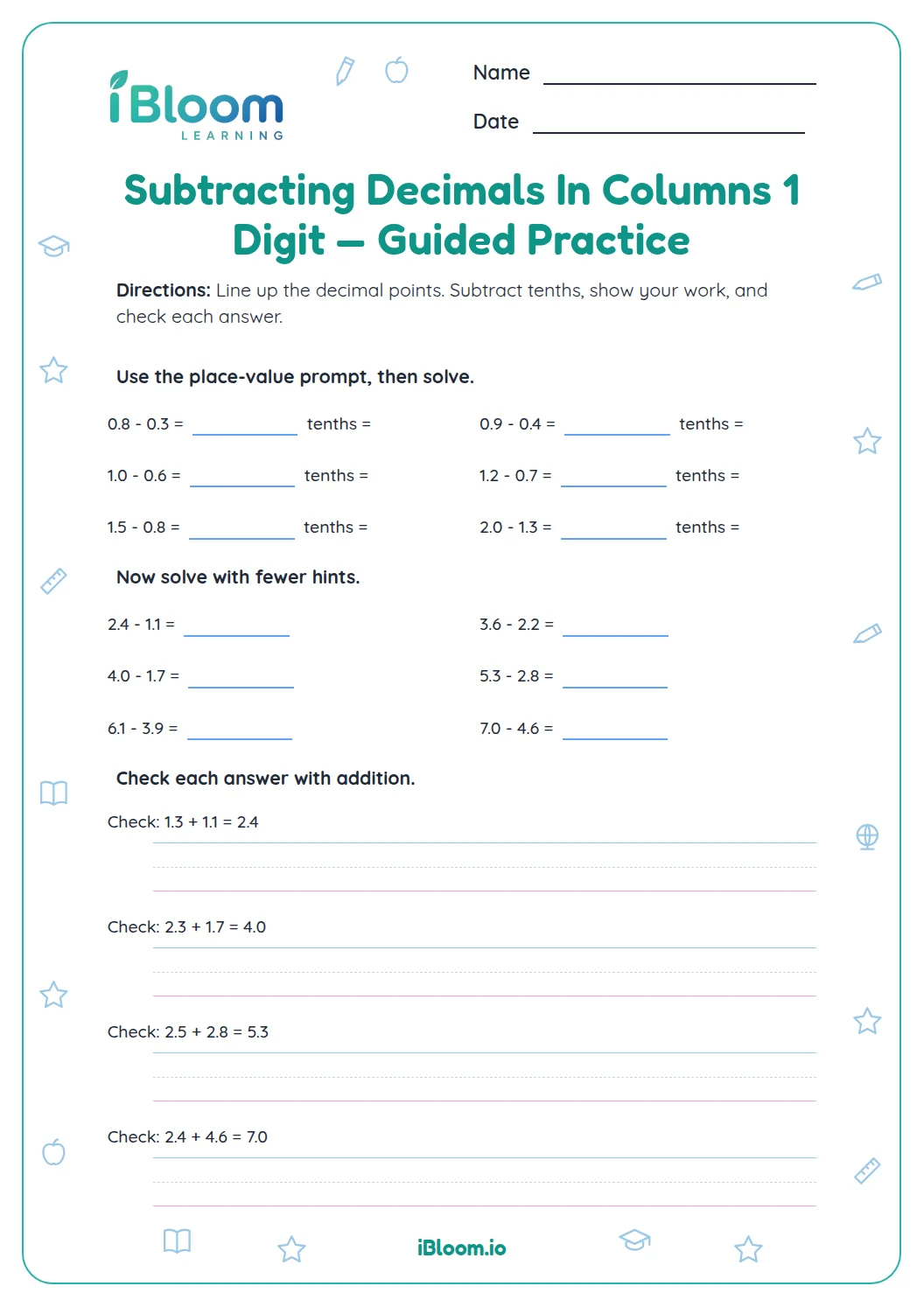
About this worksheet
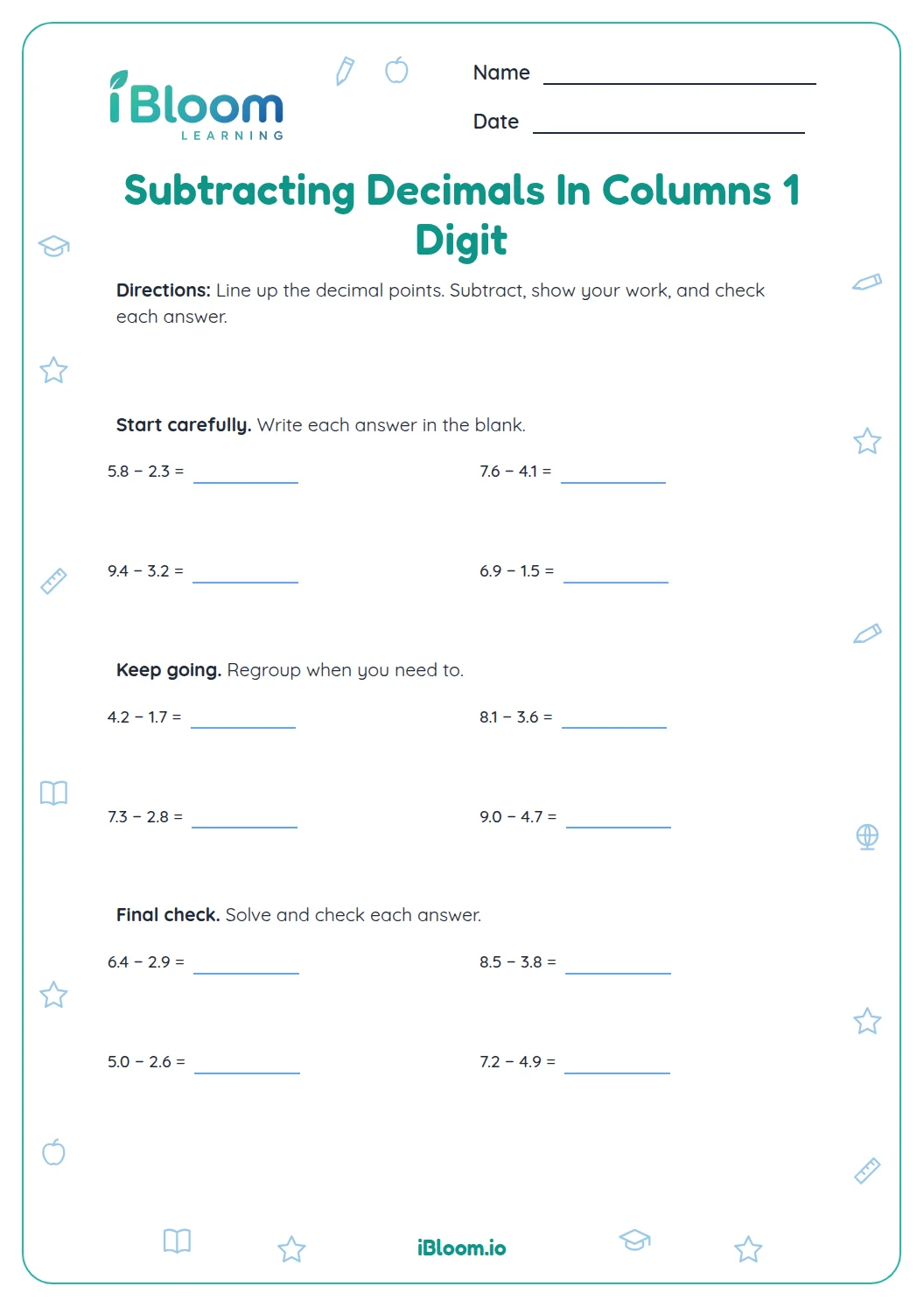
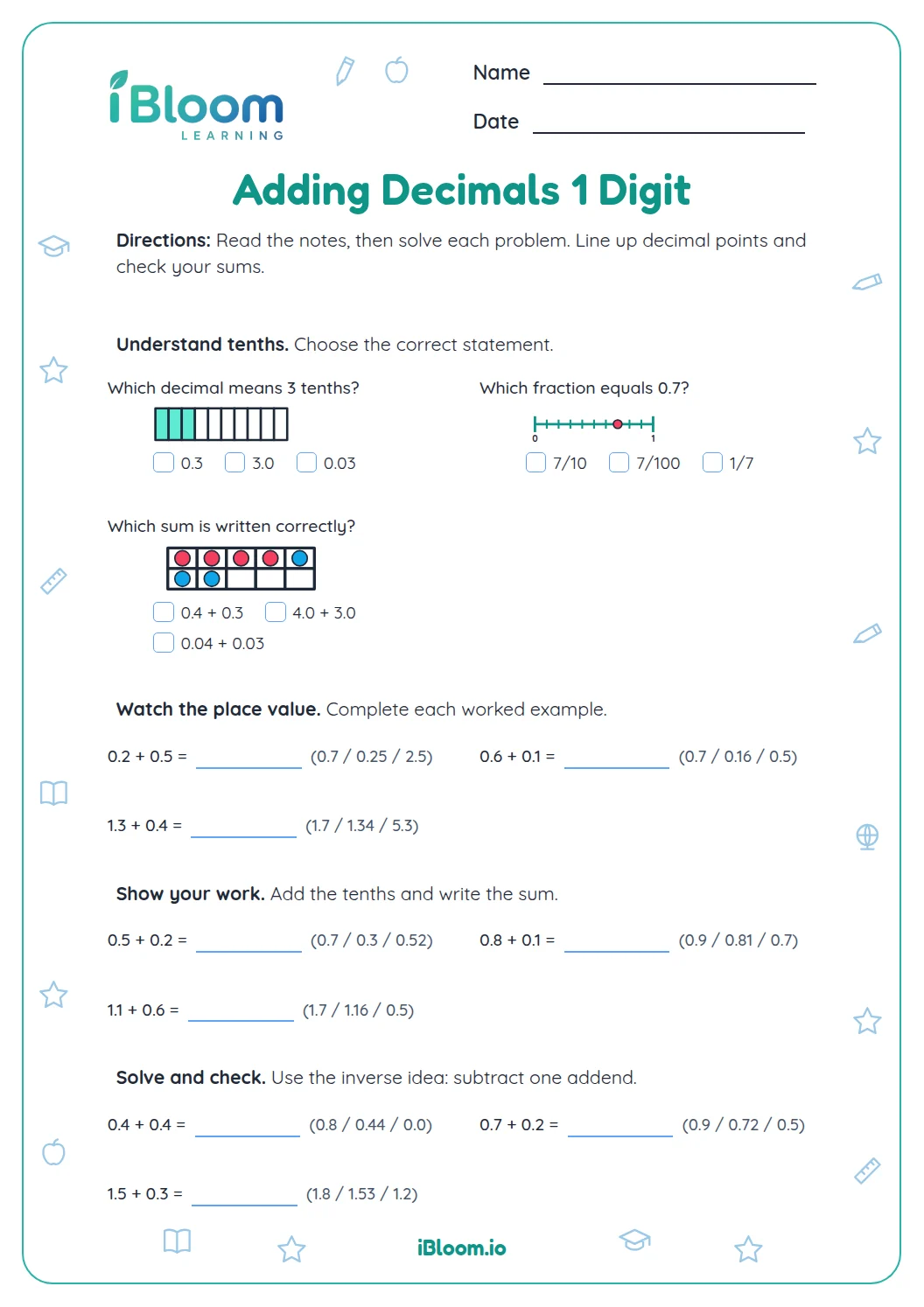
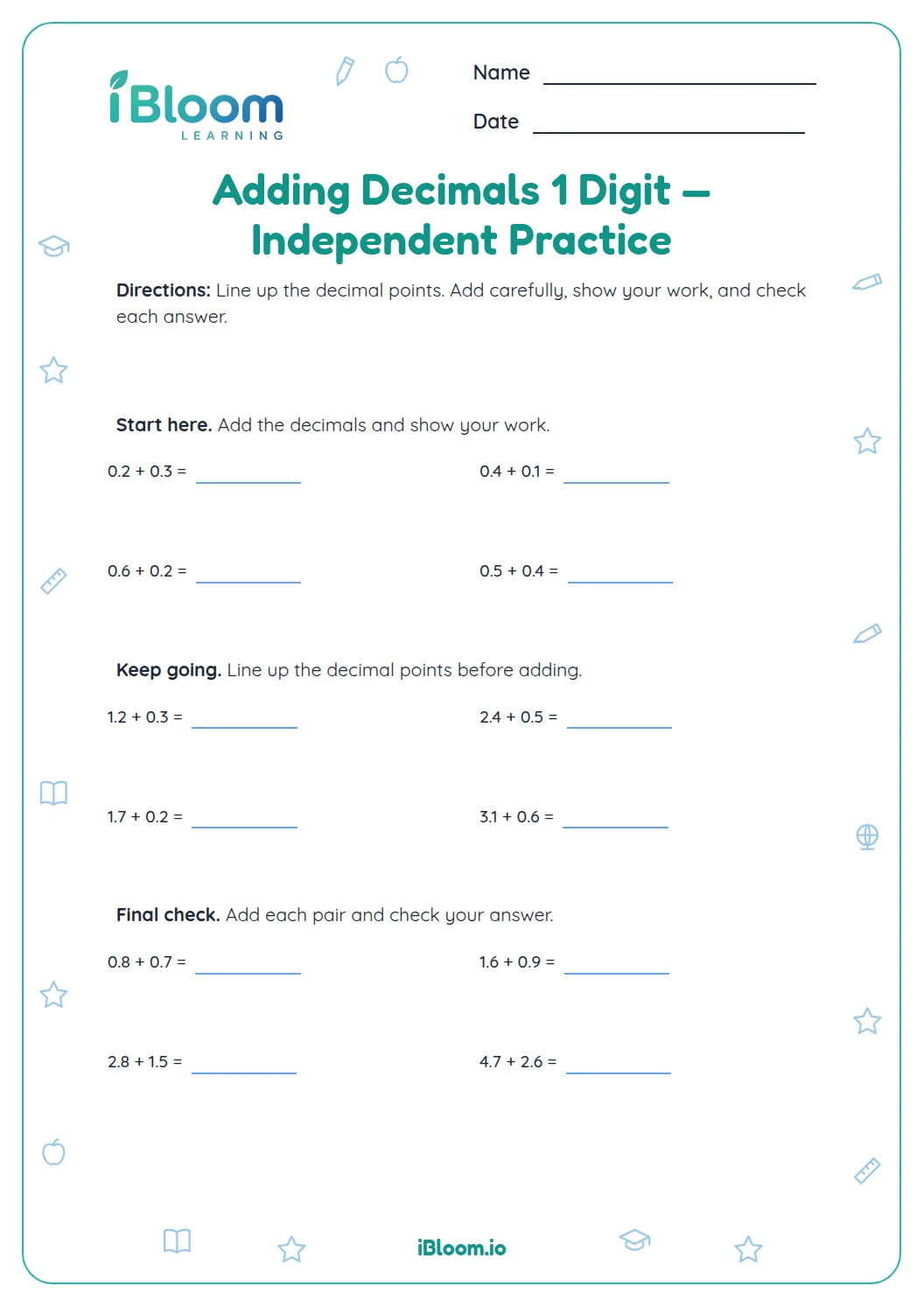
This printable turns decimal subtraction into familiar stories about ribbon, bottles, paths, thread, and other measured amounts. In Part A, children recover a missing starting amount from what was used and what remains. In Part B, they find the amount taken away. All 16 problems use decimals to hundredths and provide working space. The named decimal computation skill aligns with CCSS 5.NBT.B.7. A separate answer key includes units.
Aligned to 5.NBT.B.7
How do you find a starting amount?
When a story gives the amount removed and the amount left, add those parts to recover the starting amount. Keep decimal places lined up, including a zero when it helps.
Question 1 describes a ribbon cut by 0.35 m with 0.40 m remaining. Add 0.35 + 0.40 to find the original length, 0.75 m.
- 1Starting amount − 0.35 m = 0.40 m
- 20.35 + 0.40 = 0.75
- 3The ribbon was 0.75 m long.
How do you find the amount that was taken away?
When the starting amount and remaining amount are known, subtract the remainder from the start. The missing amount and the amount left must add back to the starting amount. For example, in question 9, 1.25 − 0.80 = 0.45 L.
What situations are on the two pages?
The first part asks for an unknown starting length, capacity, or distance. The second part asks how much was poured, used, eaten, walked, or trimmed. Each item gives working space for an equation.
- Part A: recover eight starting amounts
- Part B: find eight amounts taken away
- All results use decimal hundredths and familiar metric units
How to use this worksheet
- 1Underline the amount at the start, the change, and what remains.
- 2Decide whether the start or the amount removed is missing.
- 3Write an equation that matches the story.
- 4Line up decimal points before calculating.
- 5Attach the correct unit to the result.
- 6Check by adding the two parts back to the whole.
Common mistakes and quick fixes
The mistake
Adding when the removed amount is the unknown.
The fix
Subtract the remainder from the starting amount.
The mistake
Subtracting the known parts for a missing start.
The fix
Add the amount removed and the amount left.
The mistake
Dropping a zero or shifting a decimal place.
The fix
Line up decimal points and compare tenths with tenths, hundredths with hundredths.
Common Core alignment
The page practices decimal subtraction through place-value reasoning and the relationship between addition and subtraction.
Use place value and subtraction relationships to solve decimal stories.
On this sheet: Use place value and subtraction relationships to solve decimal stories.
Show the official wordingHide the official wording
Add, subtract, multiply, and divide decimals to hundredths, using concrete models or drawings and strategies based on place value, properties of operations, and/or the relationship between addition and subtraction; relate the strategy to a written method and explain the reasoning used.
What to practice next
Make more practice
Further reading
Questions parents and teachers ask
What does “missing minuend” mean in these stories?
The minuend is the number a subtraction starts with. When the starting amount is missing, the child can add the amount removed to the amount left. In question 1, 0.35 m + 0.40 m gives the original ribbon length, 0.75 m.
How do children find a missing amount taken away?
Subtract the amount left from the starting amount. In question 9, 1.25 L − 0.80 L = 0.45 L was poured out. A quick check is to add 0.45 L and 0.80 L and confirm the total is 1.25 L.
Why are decimals used in this Grade 3 titled page?
The source page is titled for decimal subtraction, so the new sheet keeps that named skill and uses hundredths in short real-world situations. The aligned Common Core decimal computation standard is 5.NBT.B.7; the questions keep the arithmetic accessible and focus on missing parts.
Do students need to line up decimal points?
Yes. Place the decimal points under one another before adding or subtracting. If one number has fewer decimal places, a trailing zero can make the place values easier to compare, such as writing 0.8 as 0.80. The separate answer key gives a clear way to check the result after the child has finished.
How many problems are included?
There are 16 word problems in two parts: eight ask for a starting amount and eight ask for the amount taken away. The printable and its answer key each use two pages, with working space provided for equations. The separate answer key gives a clear way to check the result after the child has finished.
Does the key include units?
Yes. The answer key includes meters, liters, kilometers, or kilograms to match each story. Keeping the unit with the number helps children report an amount that makes sense in the situation. The separate answer key gives a clear way to check the result after the child has finished.