






About this worksheet
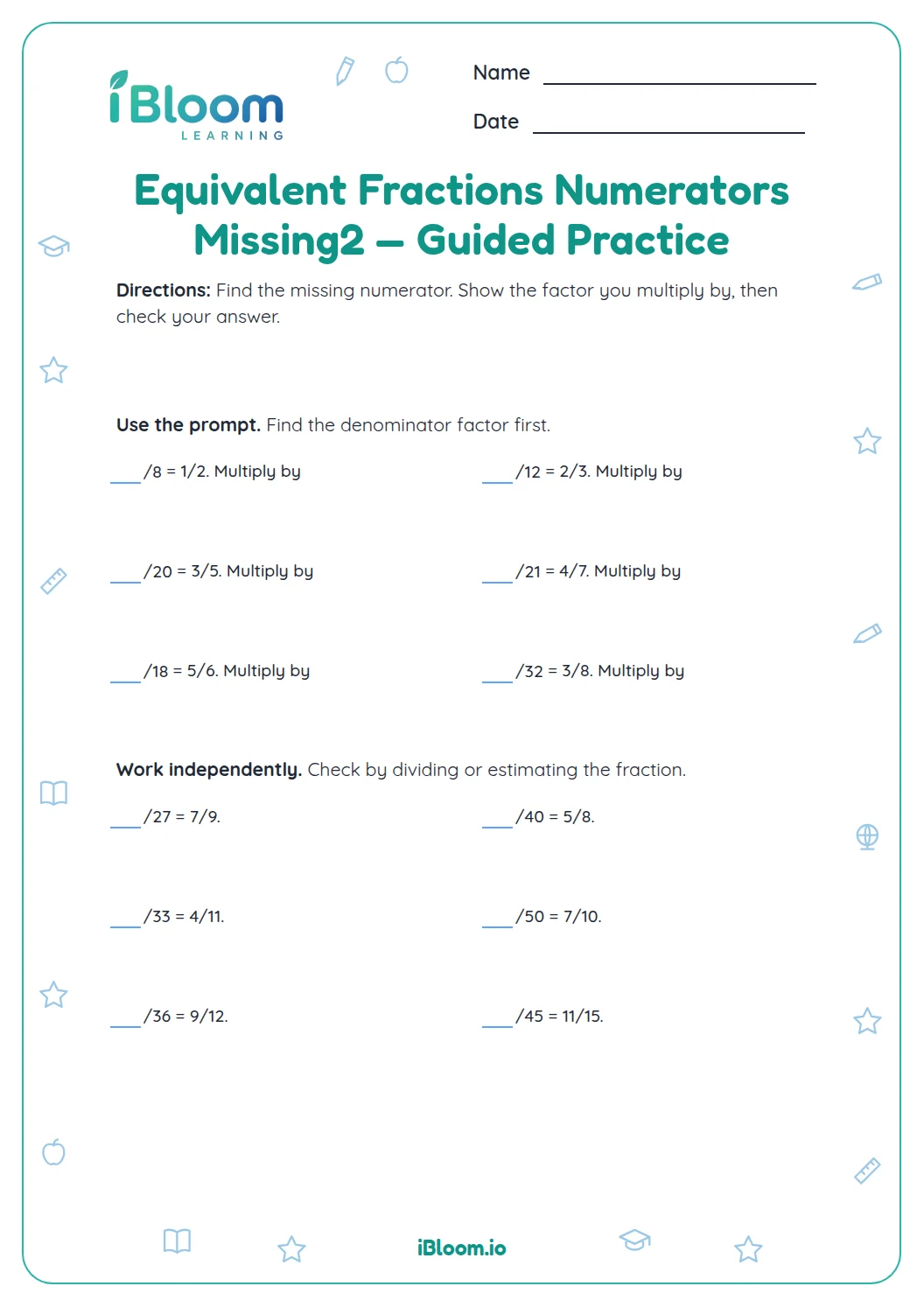
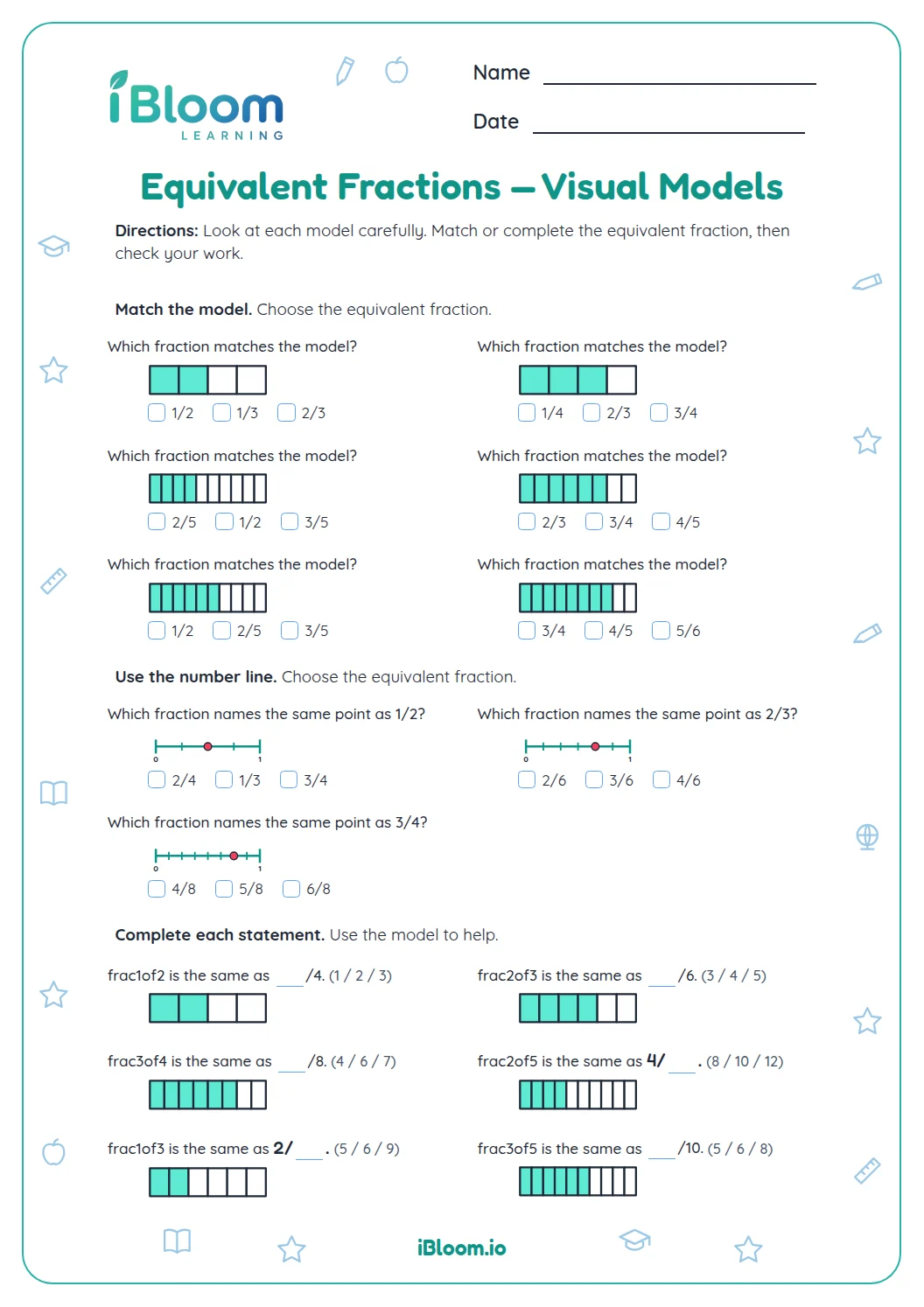
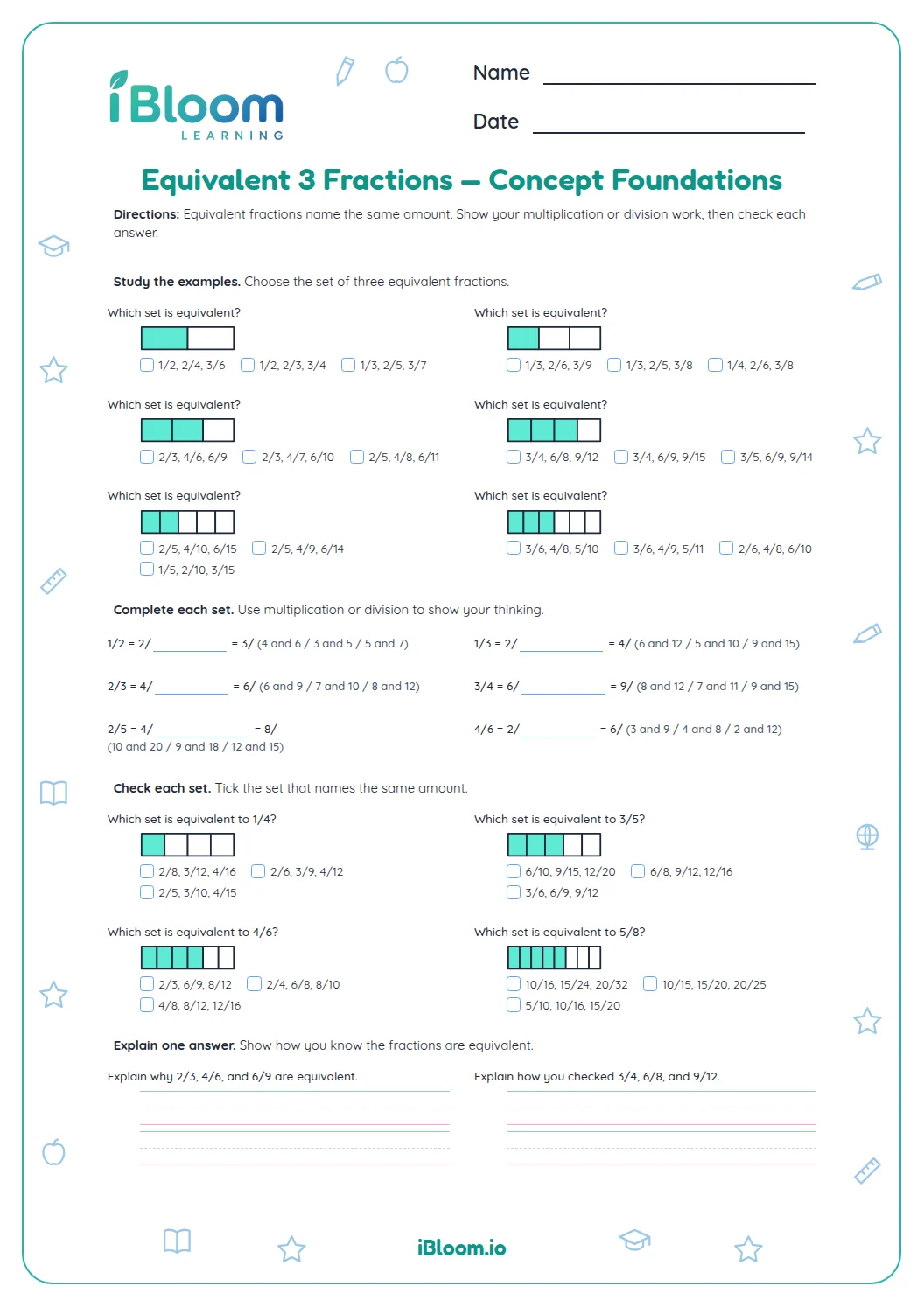
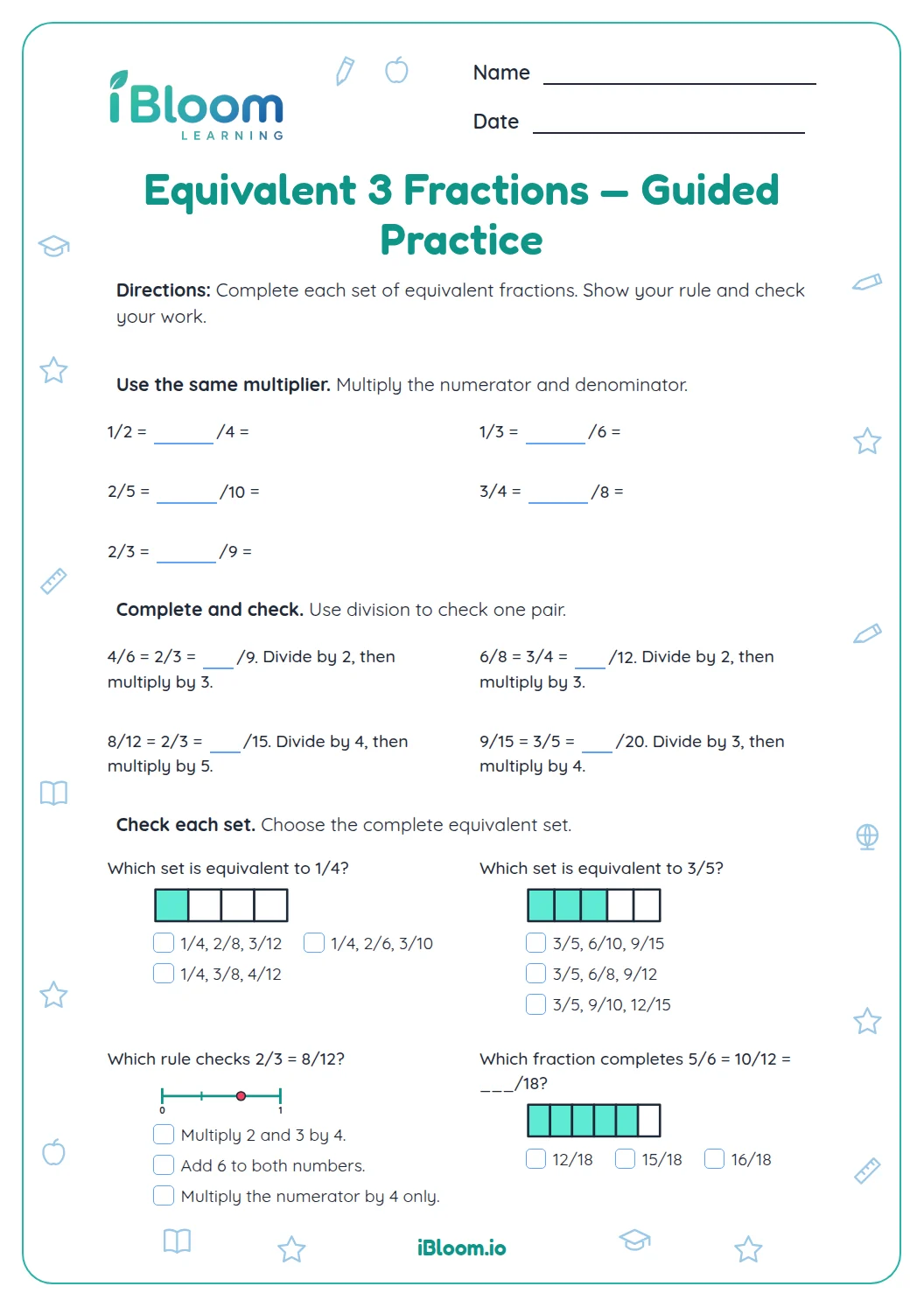
This Grade 3 worksheet helps learners generate equivalent fractions by finding missing numerators in familiar contexts such as ribbons, recipes, paths, and gardens. It progresses from finding equivalent forms to completing equations and checking real-world matches. The work aligns with Common Core 3.NF.A.3.b and includes a separate answer key.
Aligned to 3.NF.A.3.b
Why must both numbers in a fraction change together?
Equivalent fractions name the same amount only when the numerator and denominator are scaled by the same factor. Changing one alone changes the size.
- 12/4 = ___/8
- 24 is twice 2, so multiply the numerator 2 by 2: 4/8.
What will learners practice?
Sixteen questions move from generating equivalent fractions to completing numerators and checking equivalence.
How can I use the answer key?
Check each response after the learner finishes a part. For open responses, compare the answer with the model and accept other clear, correct wording.
How to use this worksheet
- 1Identify how the denominator changes from the first fraction to the second.
- 2Apply that same factor to the numerator to keep the value equal.
- 3Complete each missing numerator and check the resulting fractions.
- 4For the final questions, compare the fractions and support the yes-or-no answer.
Common mistakes and quick fixes
The mistake
How can I check 2/3 = 4/6?
The fix
Compare the scale factor: 3 becomes 6 by multiplying by 2, and 2 also becomes 4 by multiplying by 2.
The mistake
Can equivalent fractions have different numbers?
The fix
Yes. Fractions such as 1/2 and 4/8 look different but name the same amount because each whole is divided into a different number of equal parts.
The mistake
What should I do if my numerator seems too large?
The fix
Check the denominator’s scale factor first, then apply it to the numerator. Multiplying both by the same factor preserves the fraction’s value.
This worksheet practices the listed Common Core skill.
Generate equivalent fractions by finding the missing numerator in each context.
On this sheet:
Show the official wordingHide the official wording
Recognize and generate simple equivalent fractions, e.g., 1/2 = 2/4, 4/6 = 2/3. Explain why the fractions are equivalent, e.g., by using a visual fraction model.
What to practice next
Make more practice
Further reading
Questions parents and teachers ask
How do you find a missing numerator in an equivalent fraction?
Find the factor used to change the denominator, then multiply the numerator by the same factor. For example, 1/2 becomes 3/6 because both the numerator and denominator are multiplied by 3. For example, 3/4 and 6/8 are equivalent because both parts are doubled.
Why must both numbers in a fraction change together?
Equivalent fractions name the same amount only when the numerator and denominator are scaled by the same factor. Changing just one number changes how much of the whole the fraction represents. A simple fraction strip can help you see how the same amount has different names.
How can I check 2/3 = 4/6?
Check the scale factor: 3 becomes 6 by multiplying by 2, and 2 also becomes 4 by multiplying by 2. Since both parts use the same factor, the fractions are equivalent. Use multiplication to find the missing number, then check by simplifying the result.
Can equivalent fractions have different numbers?
Yes. Fractions such as 1/2 and 4/8 look different but name the same amount because the whole is divided into a different number of equal parts. The questions practice recognizing that relationship. The real-world story gives a whole, such as one yard or one cup, to compare.
What if my numerator seems too large?
Check the denominator’s scale factor first, then apply it to the numerator. If the denominator doubles, the numerator must double too. This keeps the fraction’s value unchanged. Keep the denominator and numerator in the same order when writing the completed fraction.