







About this worksheet
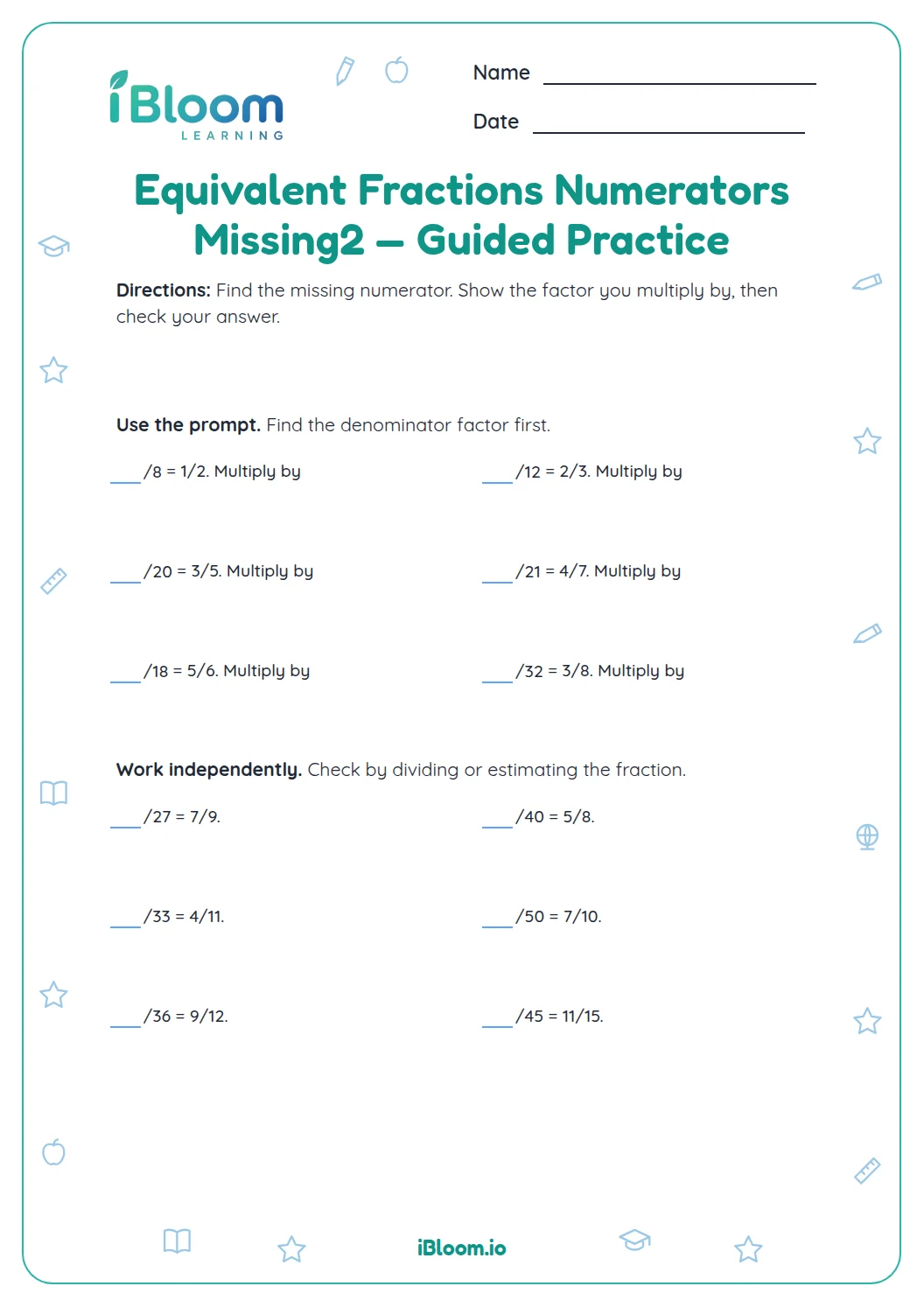
This free printable worksheet gives Grade 3 students six equivalent-fraction puzzles with the top number missing, such as 2/3 = ?/15. To solve each one, children work out how many times bigger the new denominator is, then multiply the numerator by the same number. It practices Common Core standard 3.NF.A.3.b, generating equivalent fractions, with denominators that include sevenths and ninths and go up to 32. A separate answer key shows every missing numerator.
Aligned to 3.NF.A.3.b
How do you find a missing numerator?
Look at the two denominators first. In 2/3 = ?/15, the bottom number went from 3 to 15. Ask: what do I multiply 3 by to get 15? The answer is 5.
Equivalent fractions grow the same way on top and bottom, so multiply the numerator by that same 5: 2 × 5 = 10. The missing numerator is 10, and 2/3 = 10/15.
- 12/3 = ?/15
- 23 × 5 = 15, so the factor is 5
- 32 × 5 = 10
- 42/3 = 10/15
Why does multiplying the top and bottom keep the fraction the same?
Picture a chocolate bar cut into 3 equal pieces, with 2 pieces shaded. Now cut every piece into 5 smaller slices. The bar has 15 slices, and the shaded part is 10 of them. Nothing was added or taken away: the same amount is just cut into smaller pieces.
That is why 2/3 and 10/15 are equal. Multiplying the top and bottom by 5 is the same as multiplying by 5/5, which is 1, so the size of the fraction never changes.
What is on this worksheet?
Six questions, each with the denominator already scaled up and the numerator left blank. The scale factors are 3, 4 and 5, so children use times-table facts they already know.
Two questions use sevenths and ninths, and the denominators reach 32. Those make this page a good challenge for confident Grade 3 students and a quick review for Grade 4. The trickiest is 3/8 = ?/32: children first need 32 ÷ 8 = 4, then 3 × 4.
- Question format: a/b = ?/d
- Scale factors: 3, 4 and 5
- Denominators from 3 up to 32
- Written instructions ask children to show the factor they used
How to use this worksheet at home or in class
- 1Warm up with paper: fold a strip into 3 equal parts, shade 2, then fold each part into 5. Count the shaded pieces together (10 of 15).
- 2Do question 1 out loud: “15 is 3 times 5, so the top must be 2 times 5.”
- 3Let your child finish questions 2 to 6 alone, writing the factor (for example ×5) above each fraction, as the worksheet asks.
- 4Check with the answer key. For any miss, ask one question: “How many times bigger is the bottom number?”
- 5Stretch it: ask your child to make their own equivalent fraction for 3/4 with a denominator of 24.
Common mistakes and quick fixes
The mistake
Adding instead of multiplying. For 2/3 = ?/15, a child adds 12 to both numbers and writes 14.
The fix
Ask whether 14/15 can really equal 2/3. 14/15 is almost a whole bar, while 2/3 is not. Then find the factor: 15 is 3 × 5.
The mistake
Writing the factor as the answer: writing 5 instead of 10.
The fix
Have your child circle the factor first, then write “× 5” next to the numerator before finishing the multiplication.
The mistake
Getting stuck on 32 ÷ 8 or 27 ÷ 9.
The fix
Skip-count by the old denominator (8, 16, 24, 32) and count the jumps. Four jumps means the factor is 4.
Common Core alignment
Most US states teach fractions with the Common Core standards or a close state version, so this page fits Grade 3 and Grade 4 classrooms in most of the country.
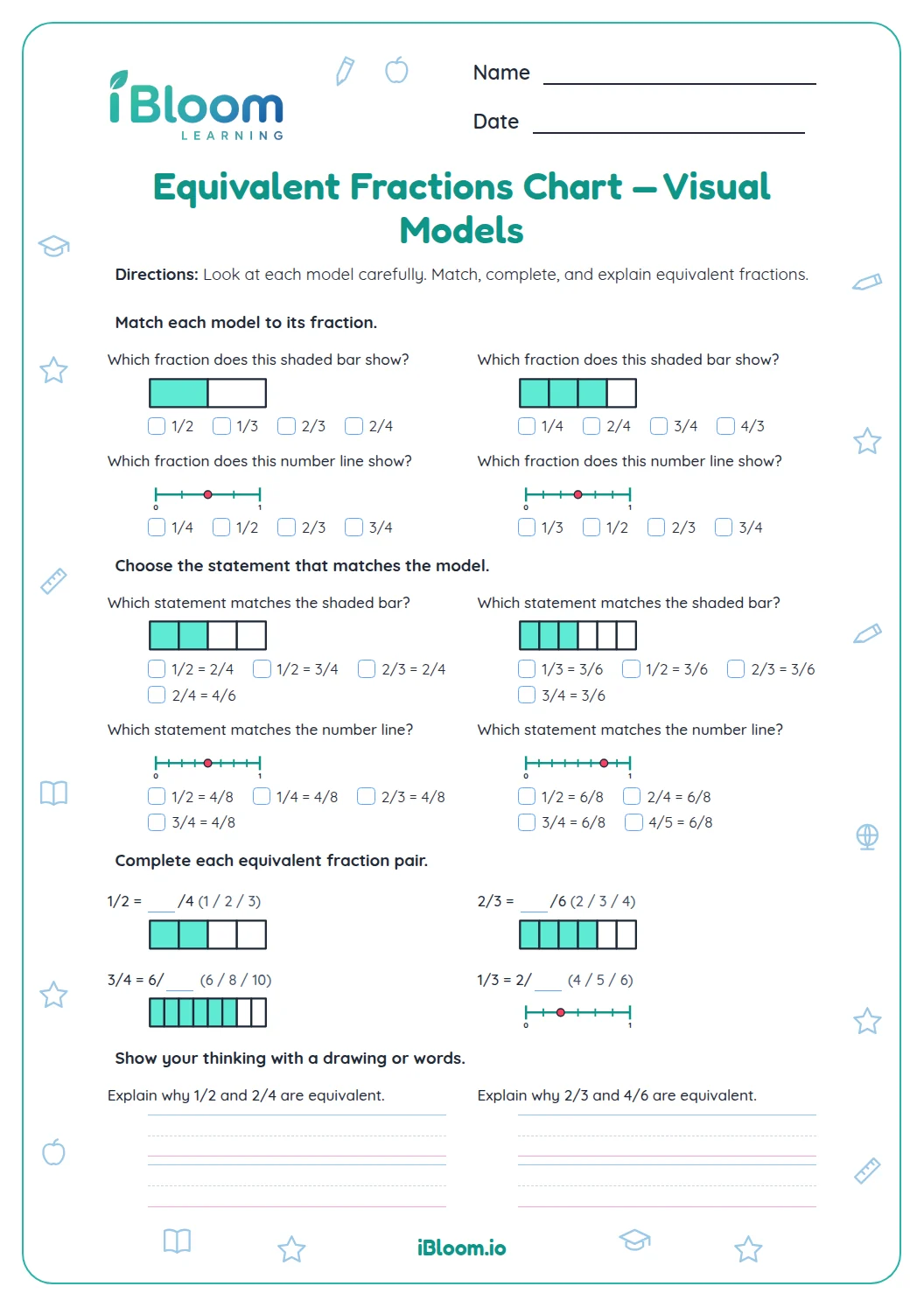
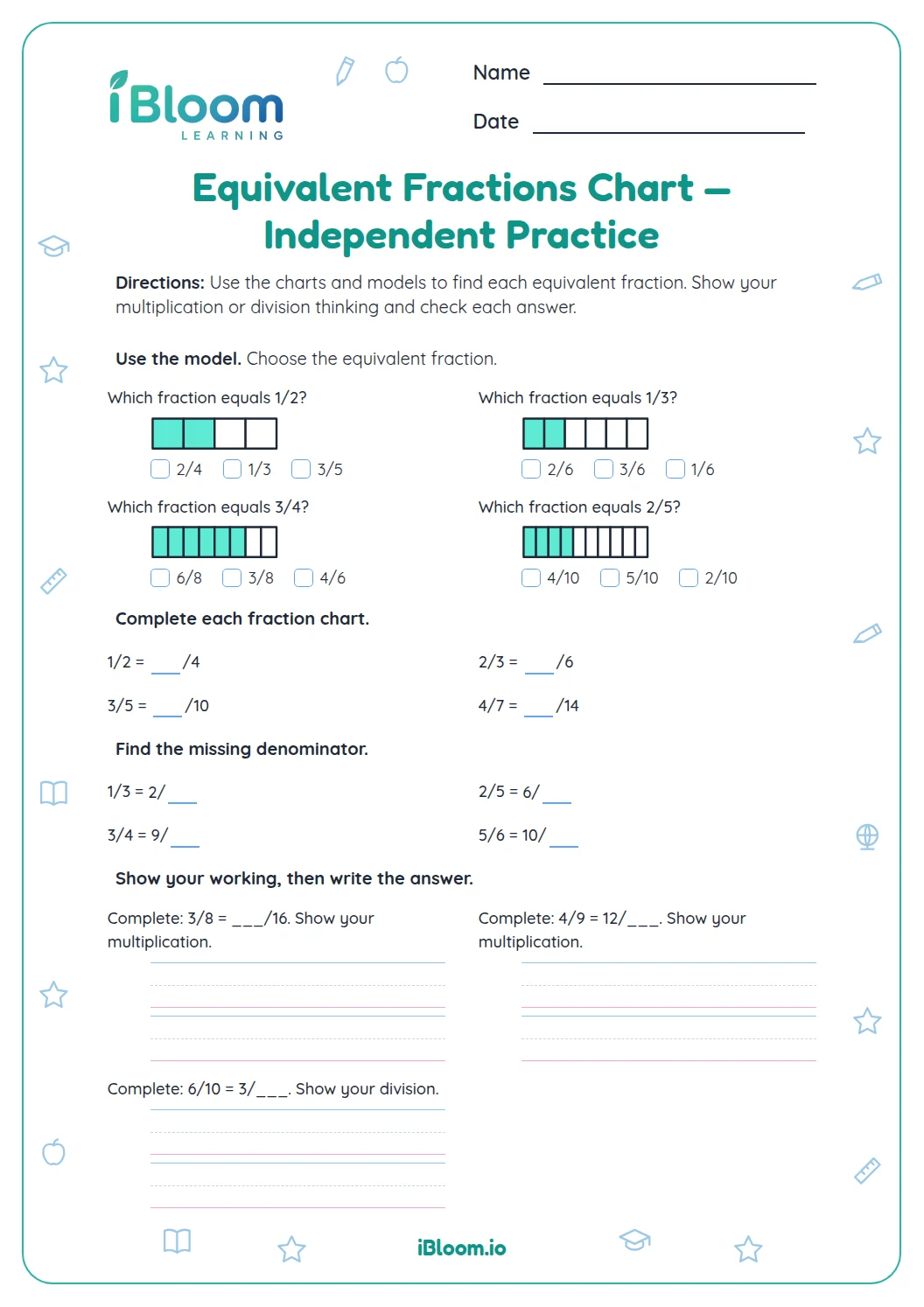
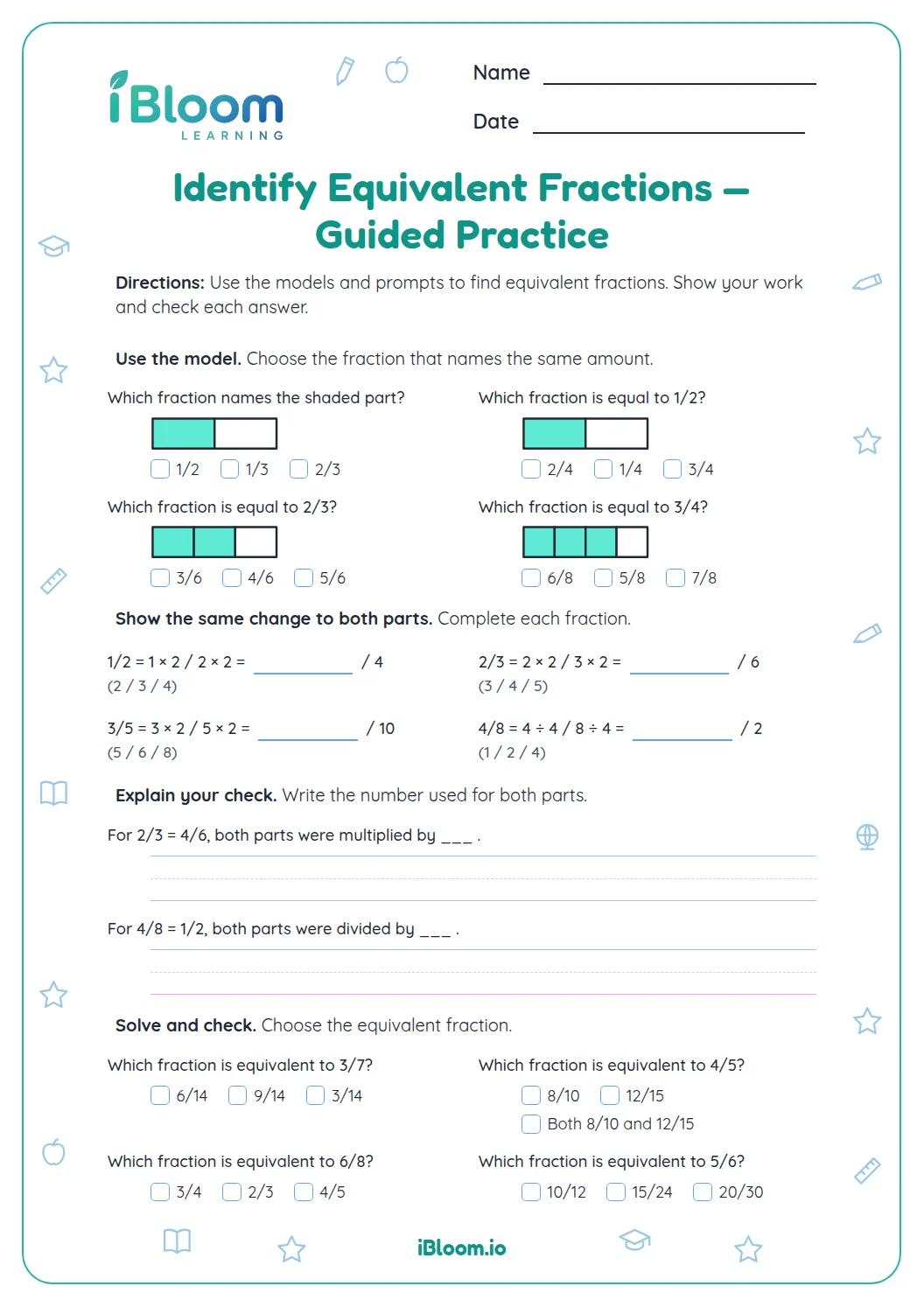
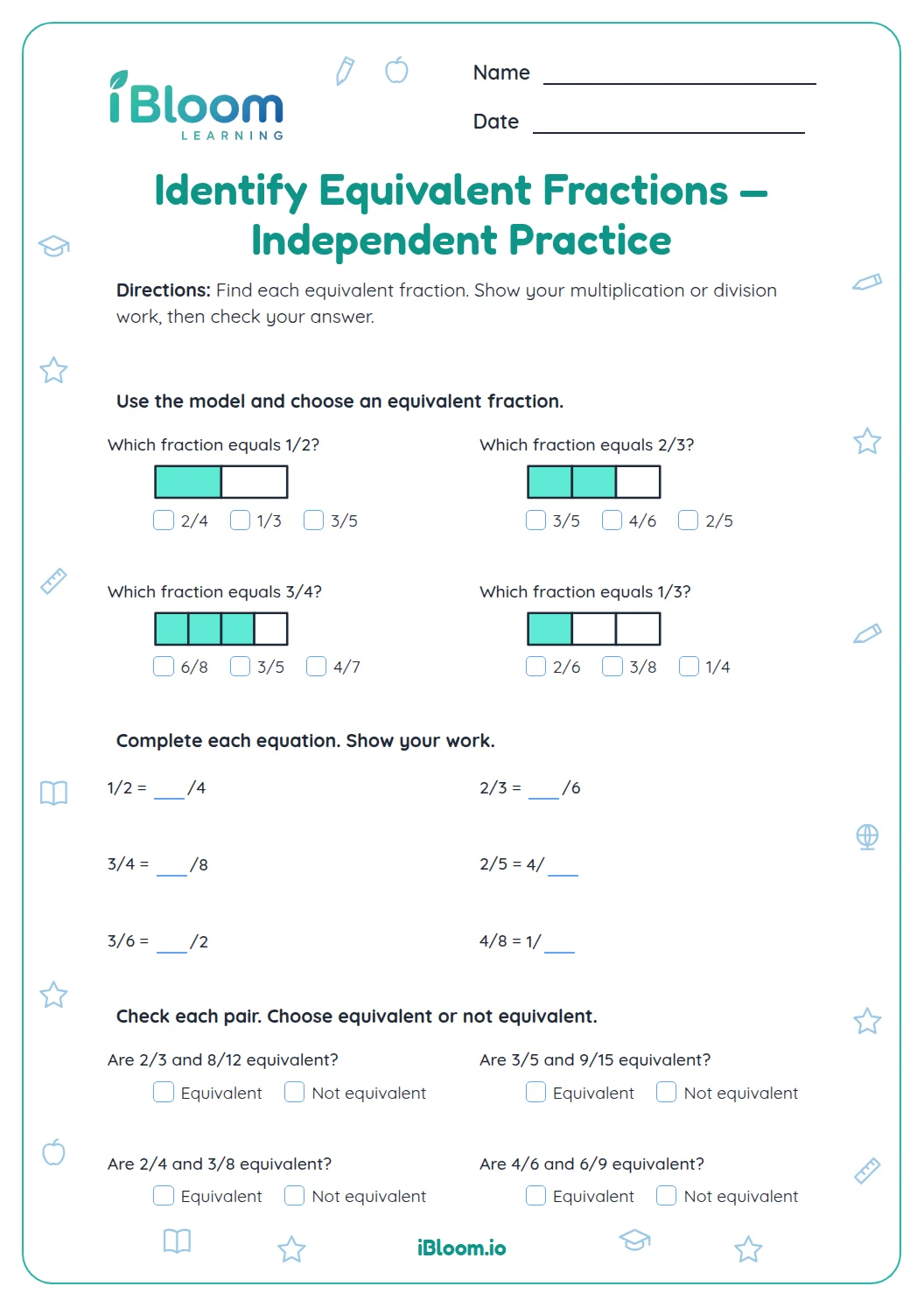
Make equivalent fractions, like 1/2 = 2/4, and explain why they are equal.
On this sheet: Every question asks children to build an equivalent fraction by finding the missing numerator.
Show the official wordingHide the official wording
Recognize and generate simple equivalent fractions, e.g., 1/2 = 2/4, 4/6 = 2/3. Explain why the fractions are equivalent, e.g., by using a visual fraction model.
What to practice next
Make more practice
Further reading
- Equivalent Fractions Worksheets for Grade 3
- Why Does My Child Think a Bigger Denominator Means a Bigger Fraction?
- Grade 4 Equivalent Fractions Models
- Grade 3 Fraction Number Line Checkpoints
- Common Core State Standards for Mathematics (official site)The full standards from the organizations that wrote them.
Questions parents and teachers ask
What is a missing numerator in equivalent fractions?
A missing numerator is the blank top number in a fraction that must equal another fraction, as in 2/3 = ?/15. To find it, work out what the first denominator was multiplied by, then multiply the first numerator by the same number. Here 3 × 5 = 15, so 2 × 5 = 10.
What grade is this worksheet for?
This worksheet is written for Grade 3, where children first generate equivalent fractions under Common Core 3.NF.A.3.b. Because it uses sevenths, ninths and denominators up to 32, it also works well as quick review in Grade 4, where 4.NF.A.1 explains the multiply-top-and-bottom rule.
How do I help my child if they get stuck?
Ask one question: how many times bigger is the bottom number? Once your child finds that factor, they multiply the top by it. If the division is hard, skip-count by the old denominator to reach the new one, and count the jumps. A folded paper strip makes the idea visible.
Why does my child add instead of multiply?
Adding the same number to the top and bottom feels natural, but it changes the fraction's size. Show that 14/15, the result of adding 12, is almost a whole, while 2/3 is clearly less. Then show that cutting each third into 5 pieces gives 10/15, the same amount.
How long does this worksheet take?
Most Grade 3 children finish the six questions in about 10 to 15 minutes. Allow a few extra minutes for writing the factor above each fraction, which the instructions ask for, and for checking answers together with the answer key afterward.
Is there an answer key?
Yes. The answer key is a separate page that shows every missing numerator, so you can print the worksheet on its own and keep the answers for checking. You can download both as free PDFs or print them from this page.