







About this worksheet
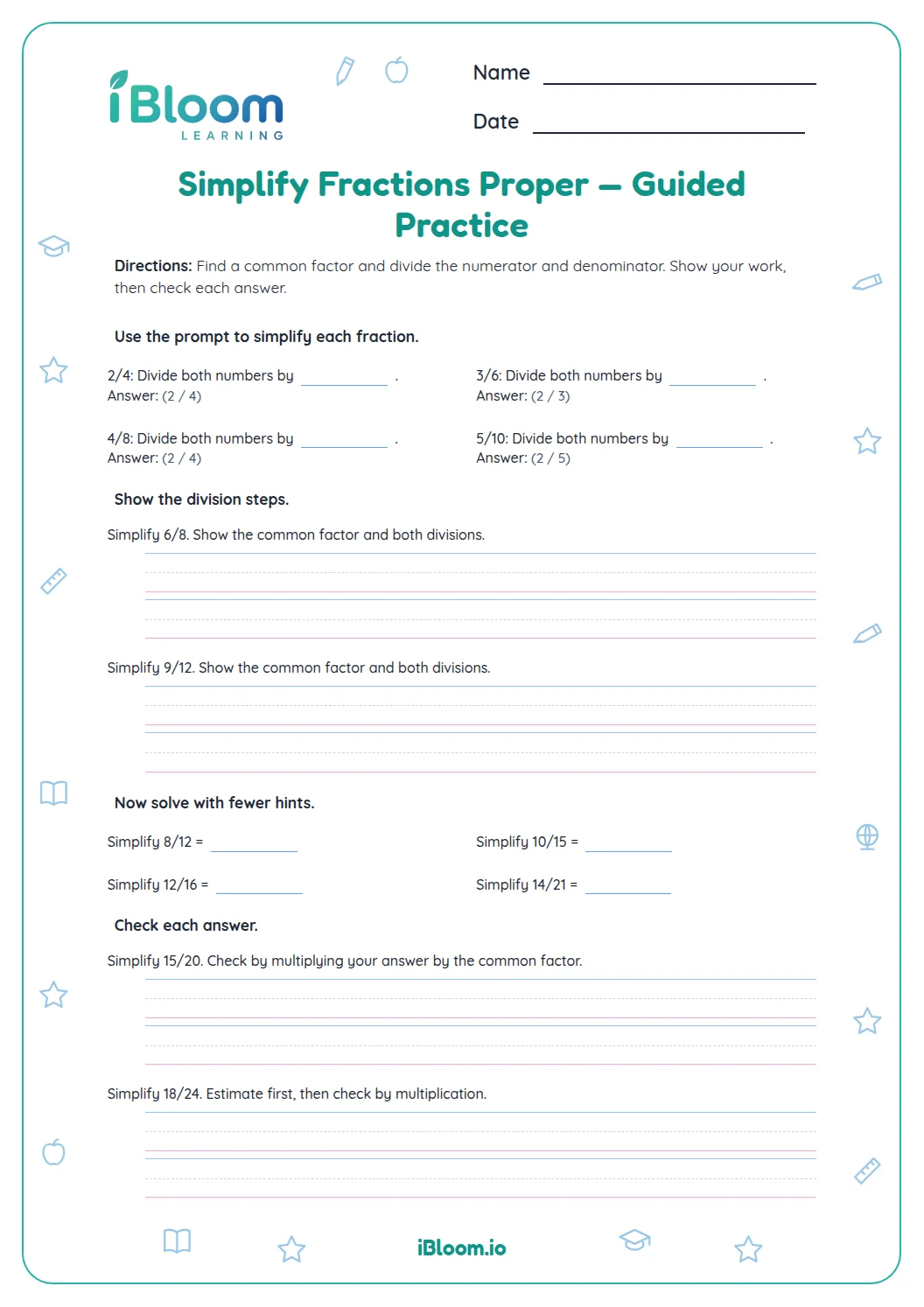
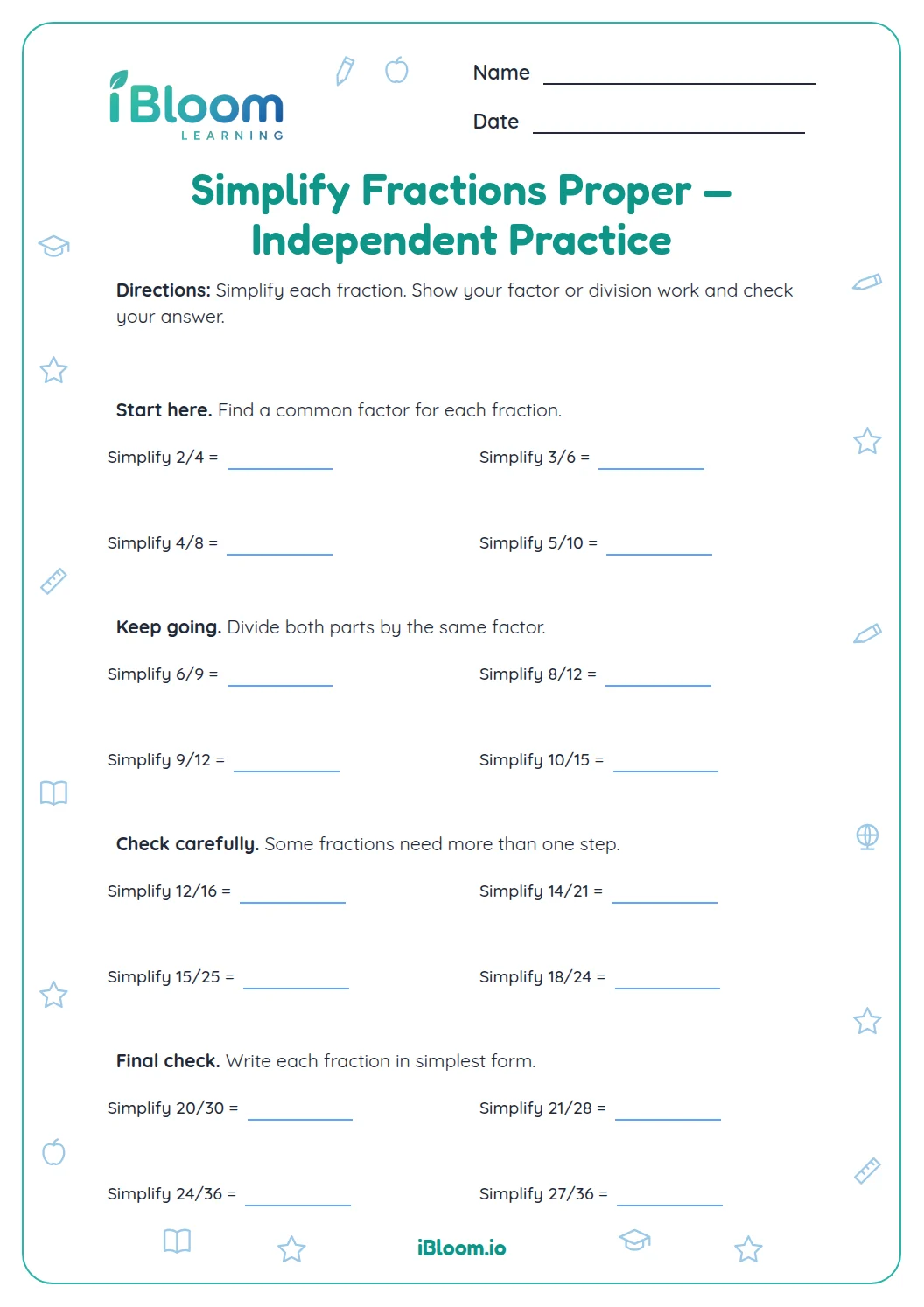
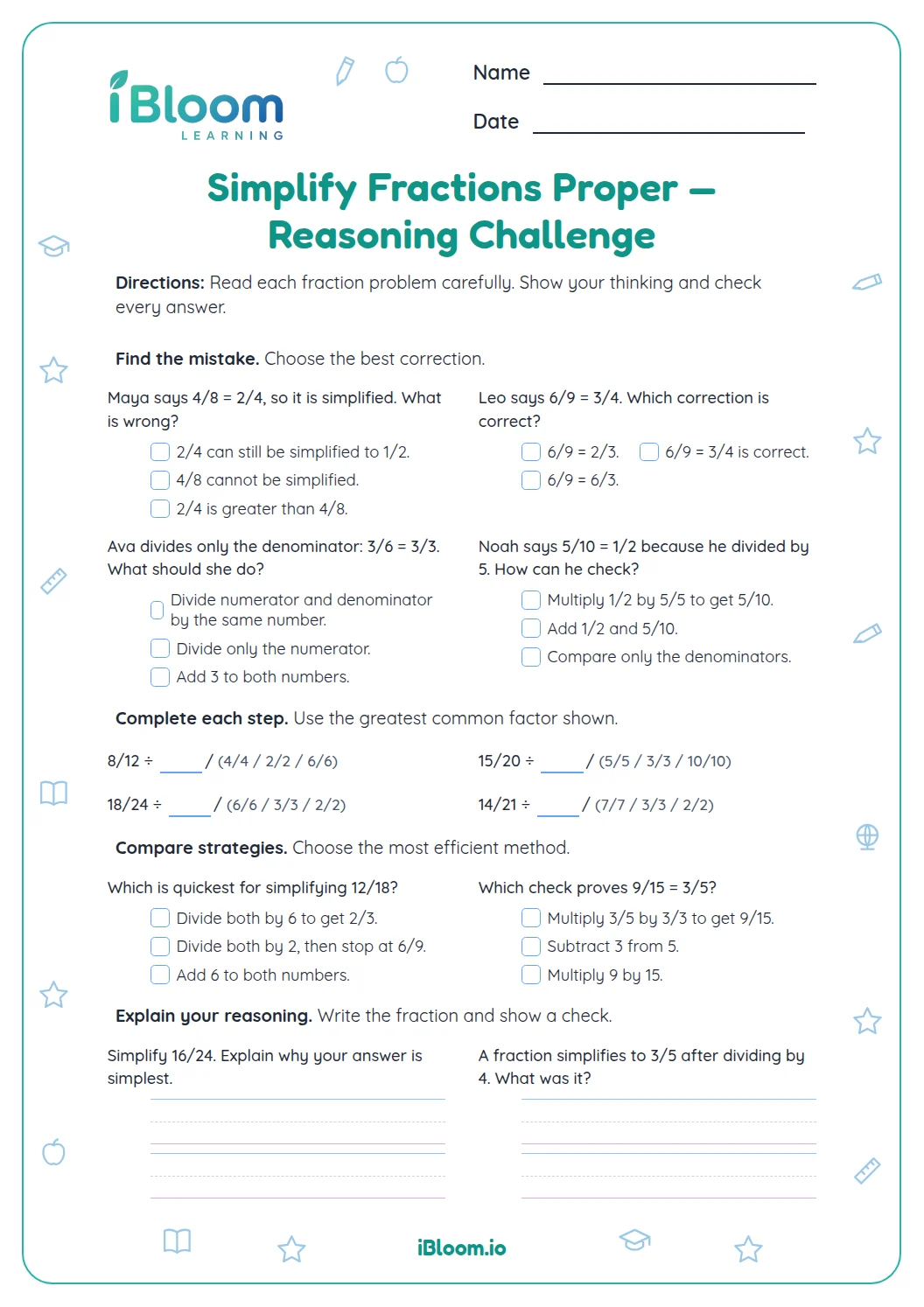
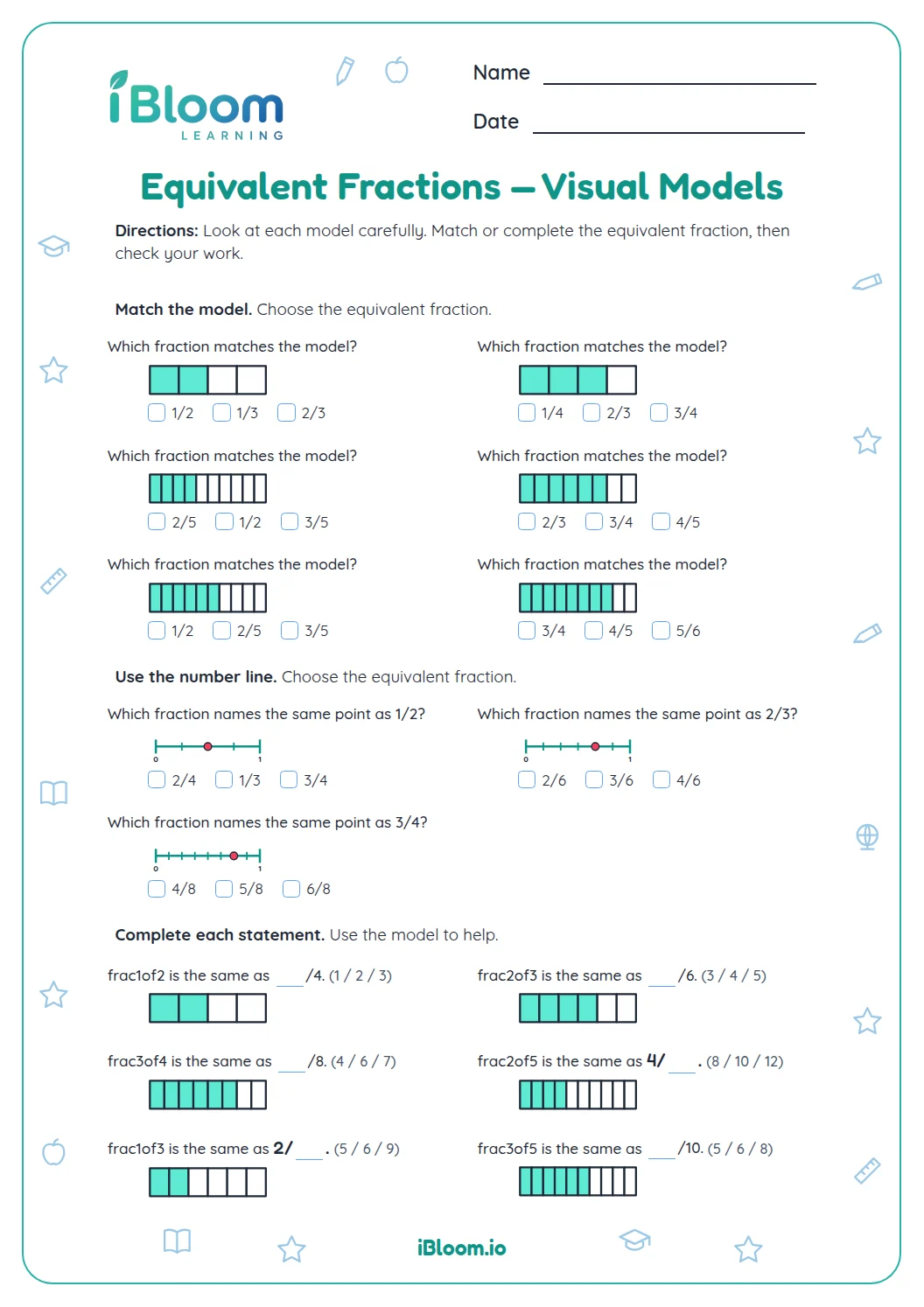
This Grade 3 worksheet has 14 questions on simplifying proper fractions. Children read shaded bars and circles, name equivalent fractions, compare values, and apply the idea in short situations. A separate answer key shows the correct choices. The models help children see that simplifying keeps the shaded amount the same. It practices CCSS 3.NF.A.3.b.
Aligned to 3.NF.A.3.b
How can you simplify a fraction?
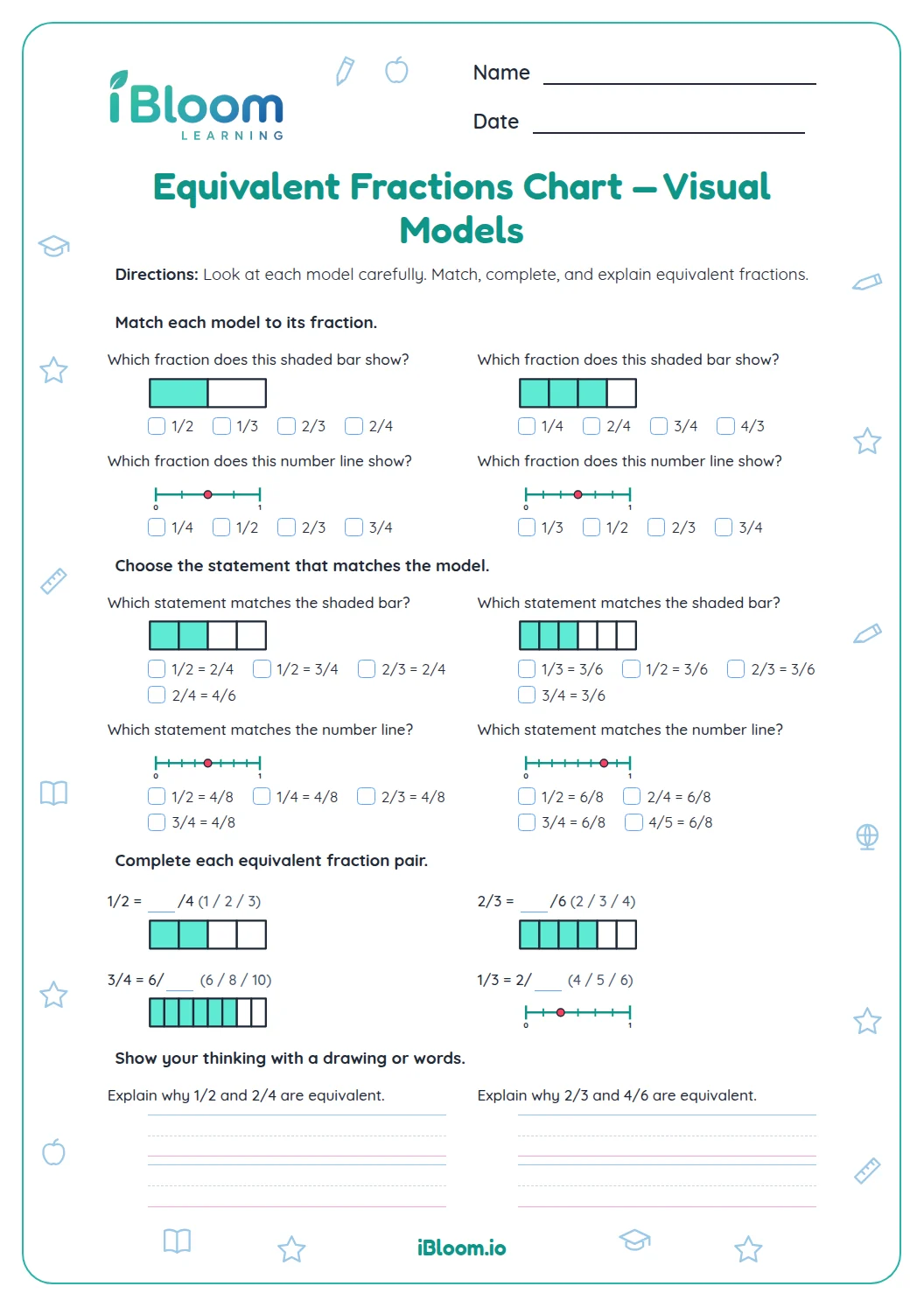
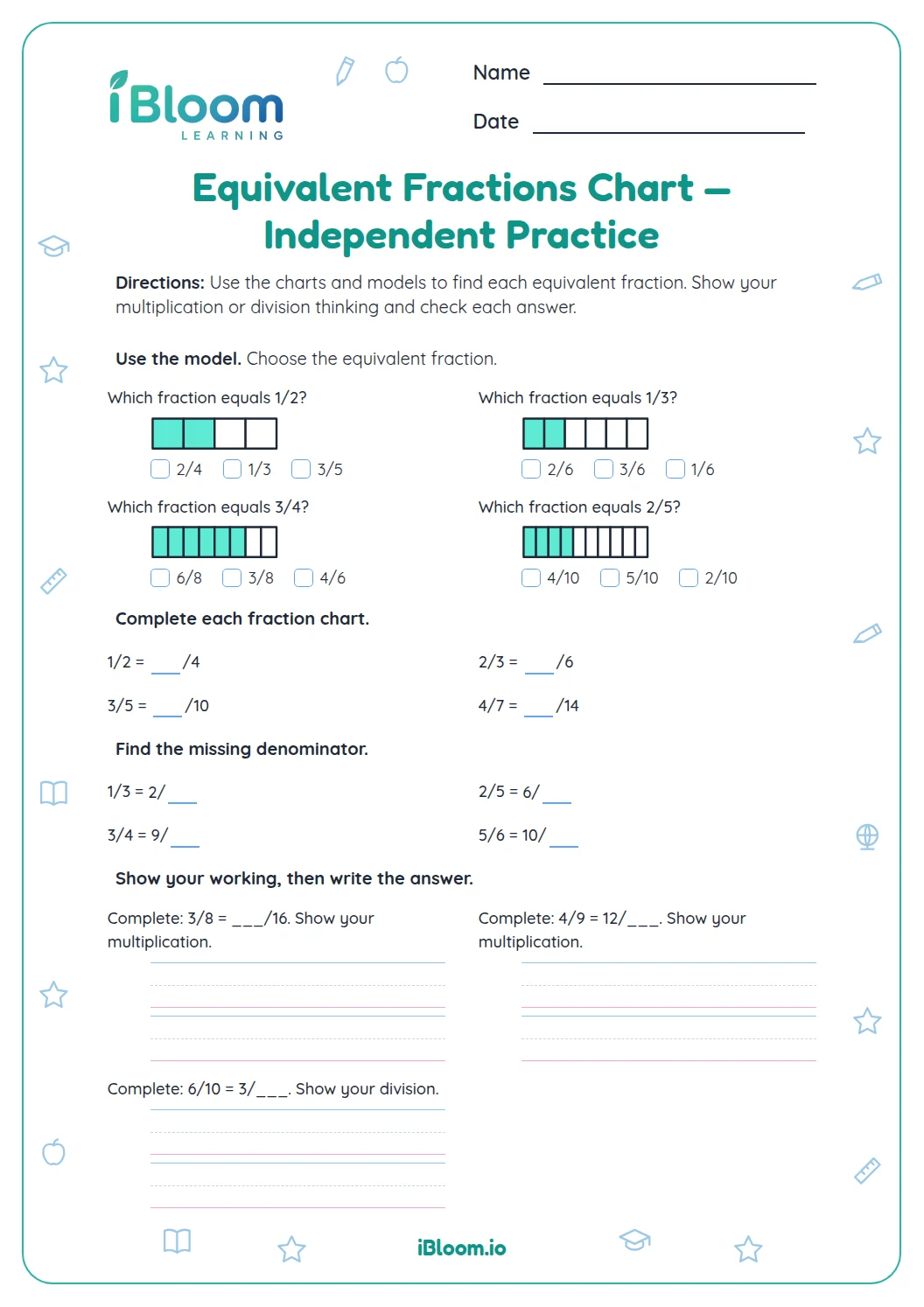
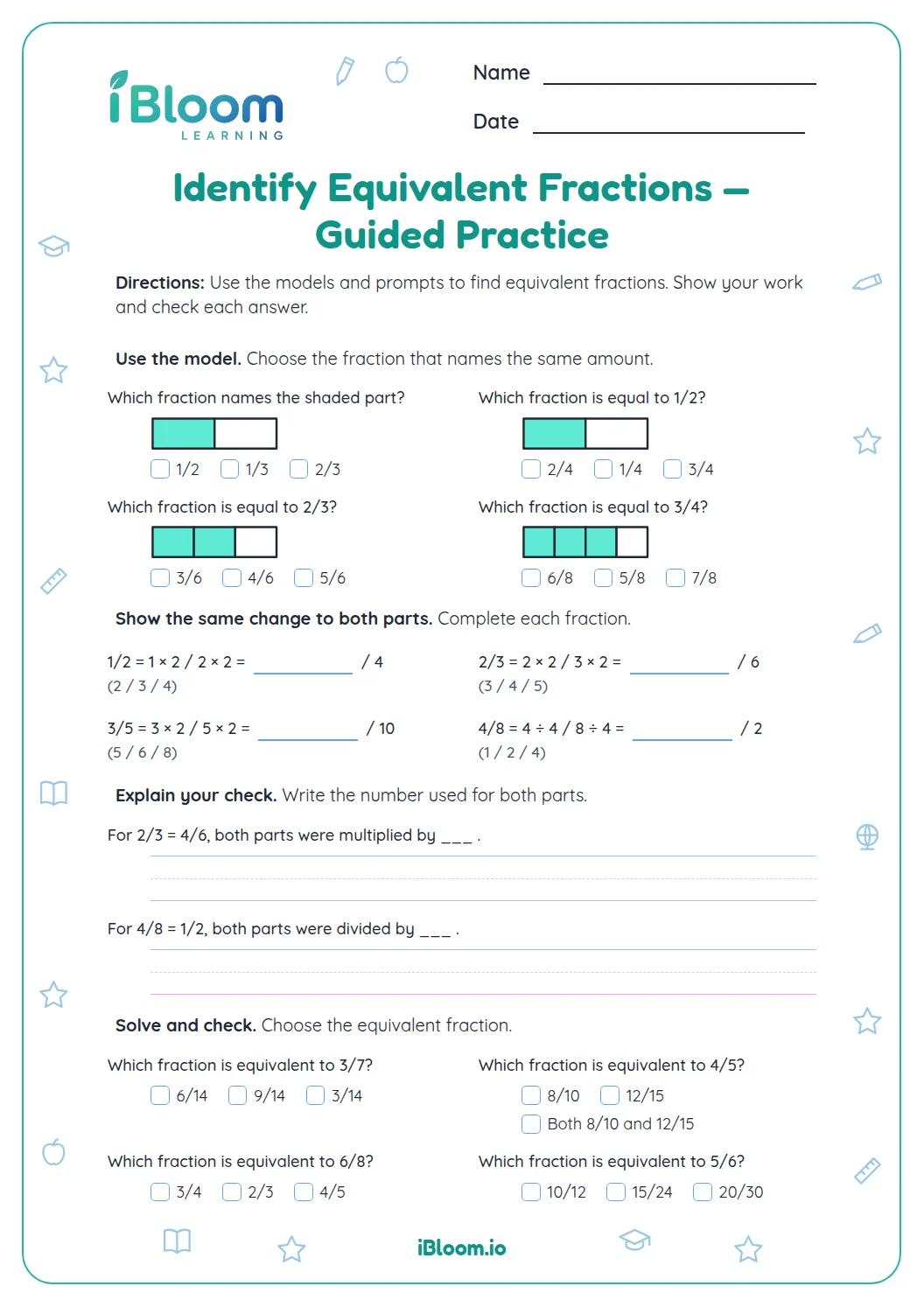
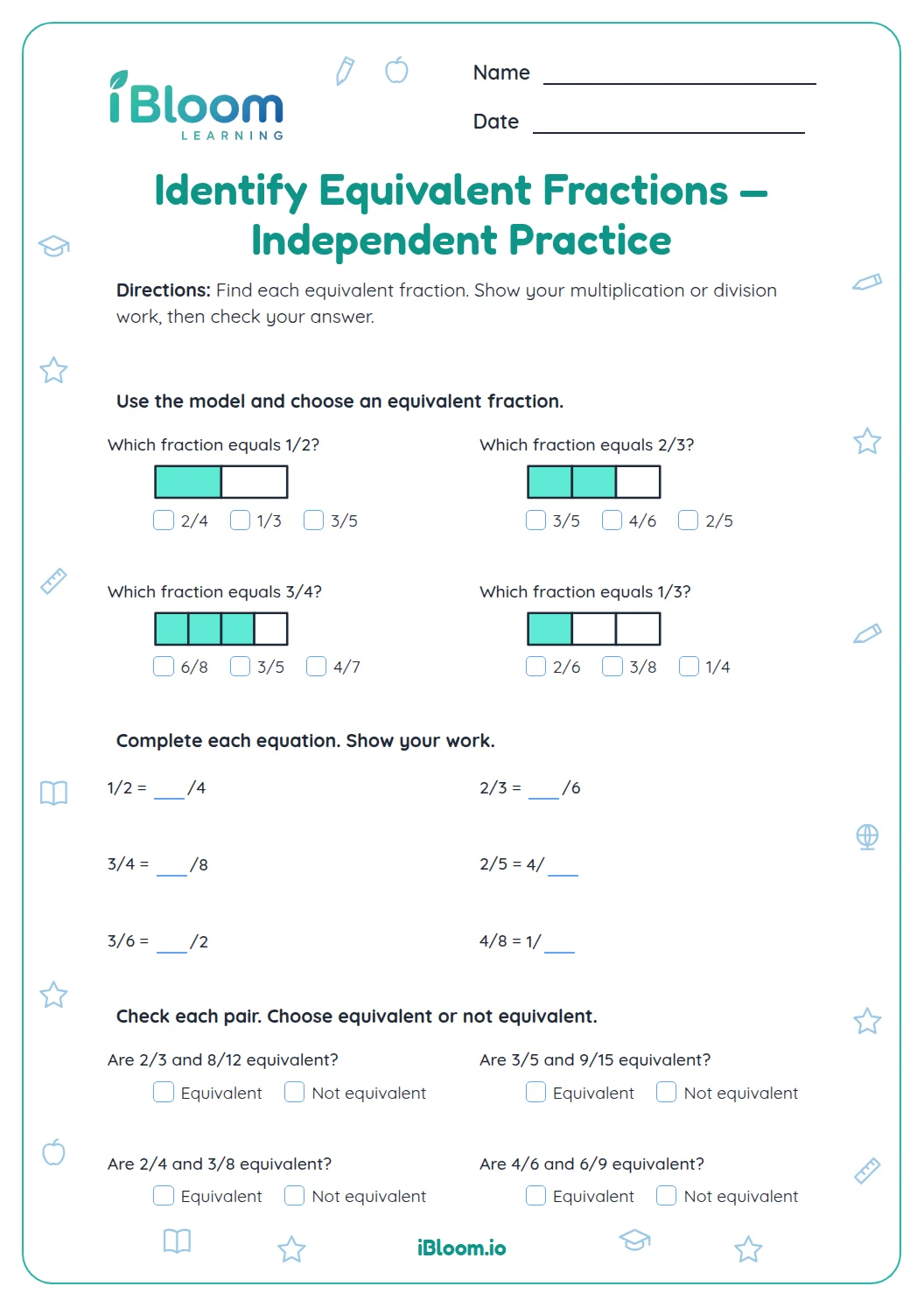
A shaded fraction names part of one whole. To simplify it, group equal pieces into larger equal parts; the amount shaded stays the same. For example, two shaded fourths cover one half, so 2/4 = 1/2.
The first model asks children to identify a shaded fraction, then the choices practice equivalence, simplest form, comparison, and short applications. The final circle model has 2 of 6 equal parts shaded, or 1/3.
- 1The 2 shaded parts out of 4 make 2/4. Pair the four parts into two equal groups: one of the two groups is shaded, so 2/4 = 1/2.
What will children practice?
The first model asks children to identify a shaded fraction, then the choices practice equivalence, simplest form, comparison, and short applications. The final circle model has 2 of 6 equal parts shaded, or 1/3.
How can children check their answers?
Read each numerator and denominator as counts of the same whole. A simpler fraction must name the same amount, with no common factor left to divide out.
How to use this worksheet
- 1Count the equal parts in the whole.
- 2Count how many parts are shaded.
- 3Find a simpler fraction that names the same shaded amount.
- 4Check that the two fractions represent the same size.
Common mistakes and quick fixes
The mistake
Changing the amount while simplifying.
The fix
Divide the numerator and denominator by the same number so the value stays equal.
The mistake
Simplifying only the denominator.
The fix
Whatever factor reduces the denominator must also reduce the numerator.
The mistake
Confusing the number of shaded pieces with the total pieces.
The fix
Write shaded parts over all equal parts before simplifying.
Common Core alignment
This worksheet practices simplifying proper fractions through the skills named below.
Use visual models to show and explain equivalent fractions.
On this sheet: Use visual models to show and explain equivalent fractions.
Show the official wordingHide the official wording
Recognize and generate simple equivalent fractions, e.g., 1/2 = 2/4, 4/6 = 2/3. Explain why the fractions are equivalent, e.g., by using a visual fraction model.
What to practice next
Make more practice
Further reading
Questions parents and teachers ask
What does it mean to simplify a fraction?
Simplifying means writing an equivalent fraction with smaller numbers. The shaded amount stays the same. For example, 2/4 simplifies to 1/2 because two shaded fourths cover exactly half of the model. Point to the equal parts as you explain why the amount stays unchanged.
How does a model show equivalent fractions?
A model divides the same whole into equal parts. If two of four parts are shaded, the same region is one of two equal halves. Comparing the shaded area makes the equivalence visible before children use the numbers.
What is the simplest form of 8/12?
The simplest form is 2/3. Divide both 8 and 12 by 4: 8 ÷ 4 = 2 and 12 ÷ 4 = 3. The worksheet also asks children to recognize equivalent fractions such as 4/6 and 2/3, which name the same amount.
Why must both numbers change by the same factor?
The numerator counts selected parts and the denominator counts all equal parts in the whole. Dividing both by the same factor groups the selected and total parts equally, preserving the value. Changing only one number changes the amount represented.
What does the answer key include?
The separate answer key gives the correct choice or fraction for all 14 questions. Most items use a selected answer, so children can compare their response directly and revisit the model when they need to check why two fractions are equivalent.
How many practice questions are included?
There are 14 questions in two parts: six shaded fraction models, followed by eight questions on equivalence, simplest form, comparison, and applications. The separate answer key follows the same order and gives a correct response for every model and choice.