







About this worksheet
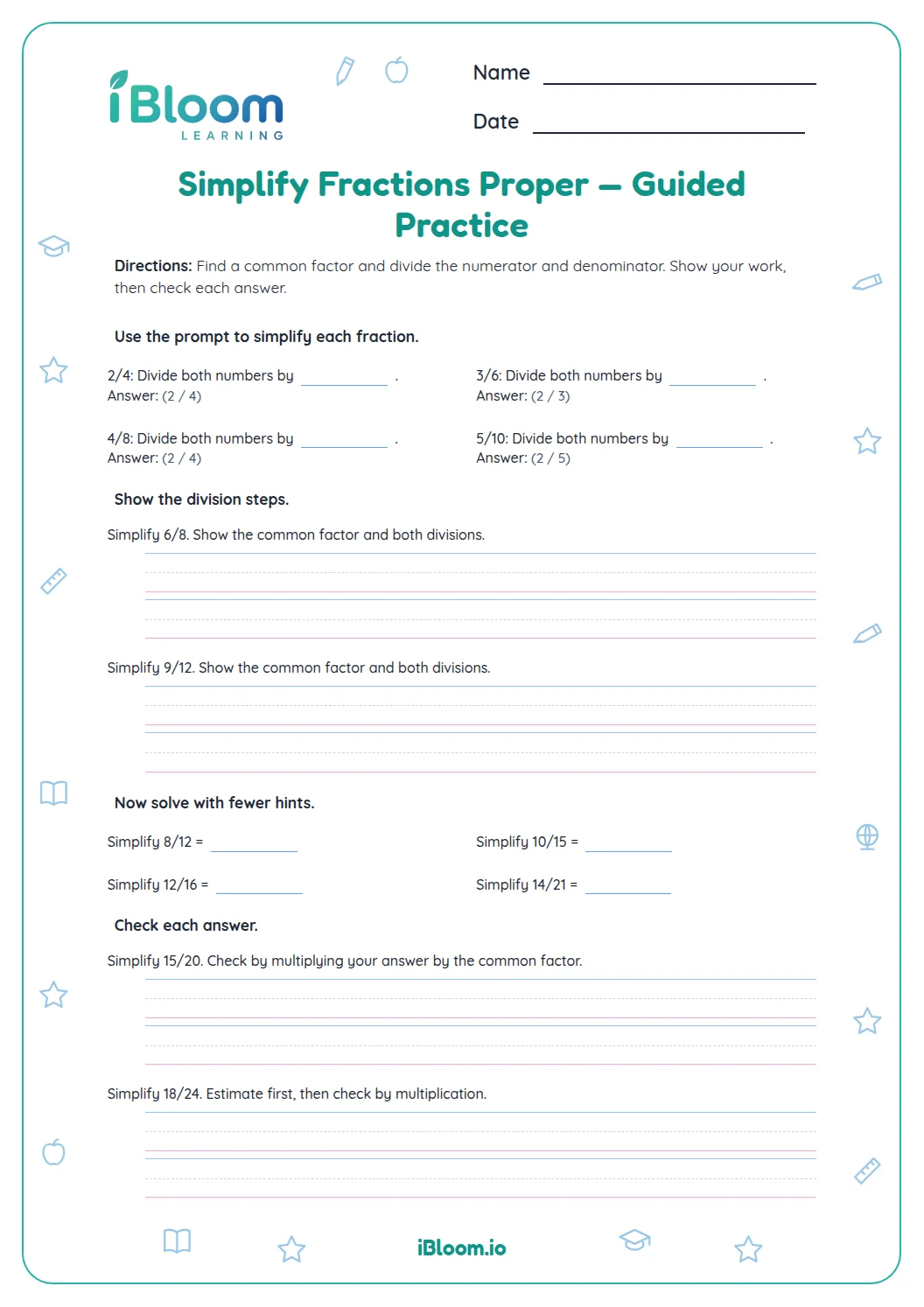
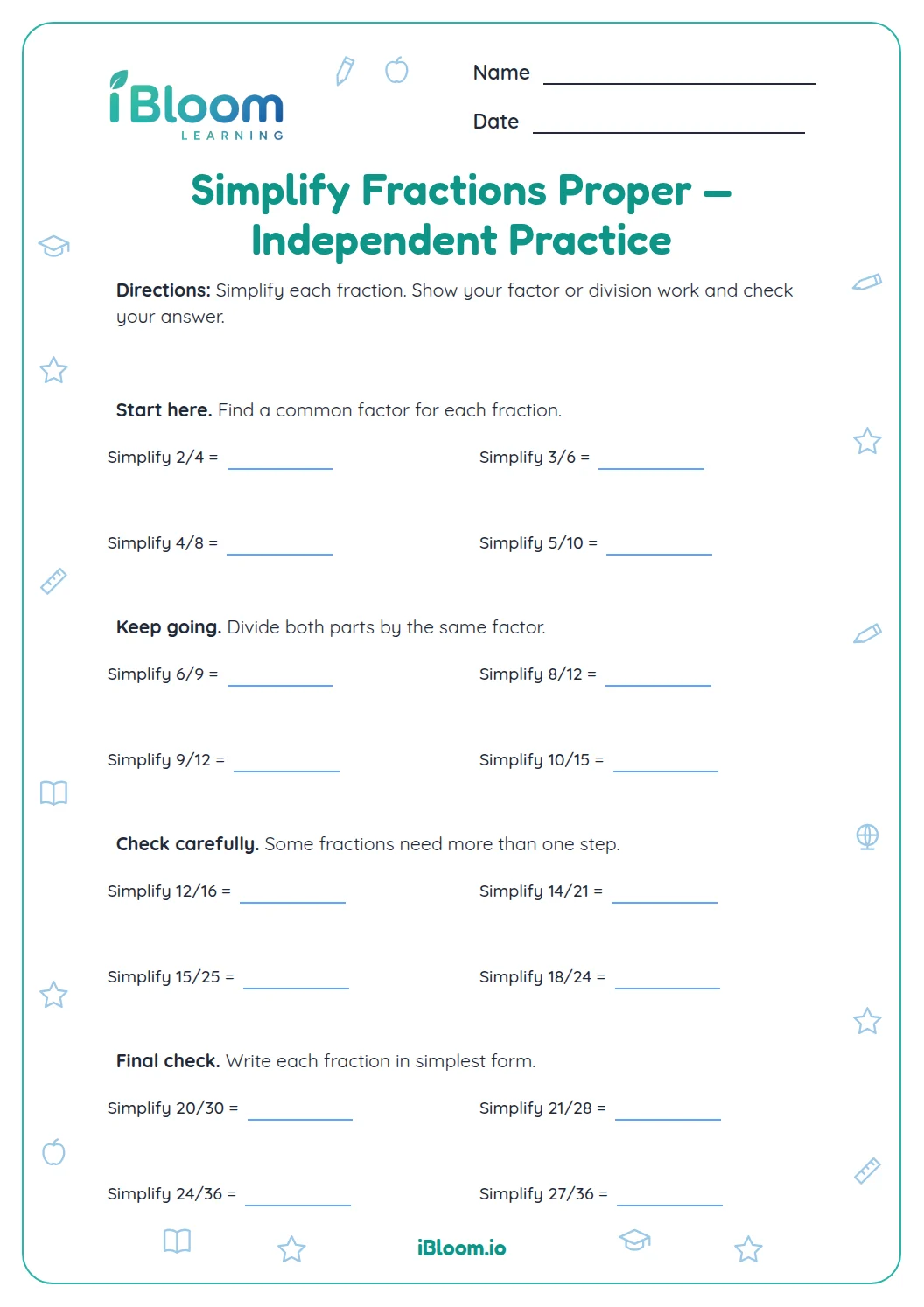
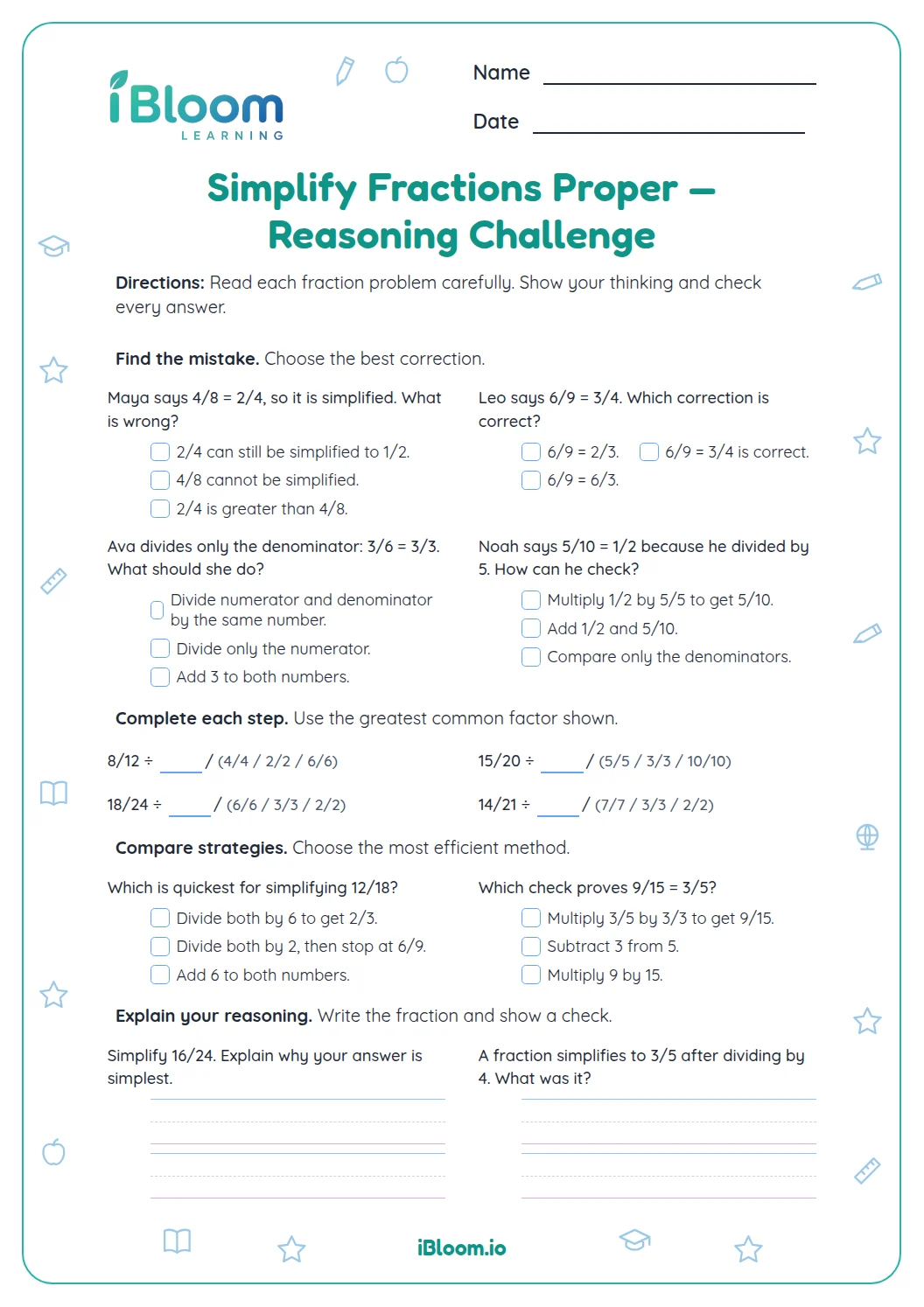
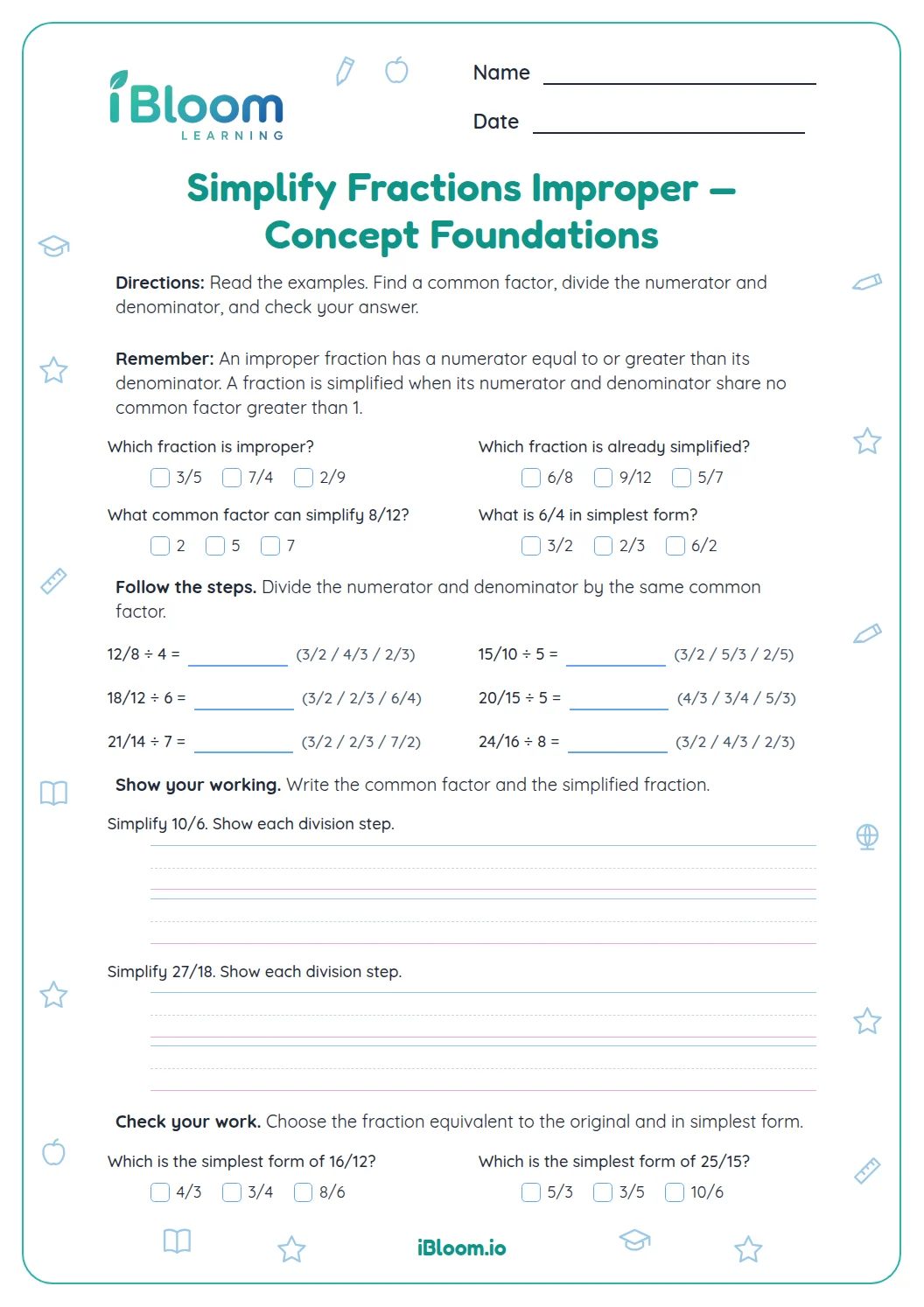
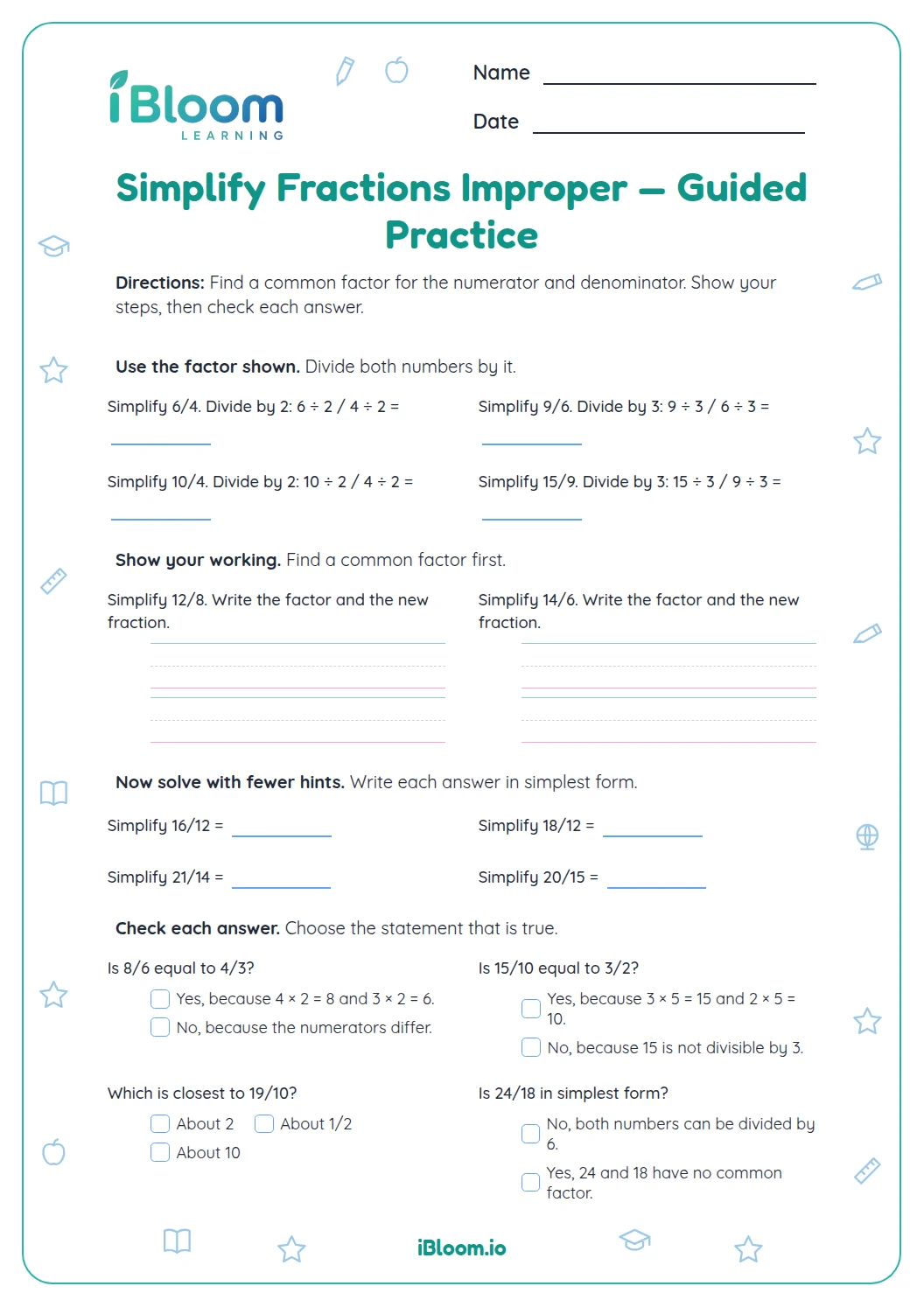
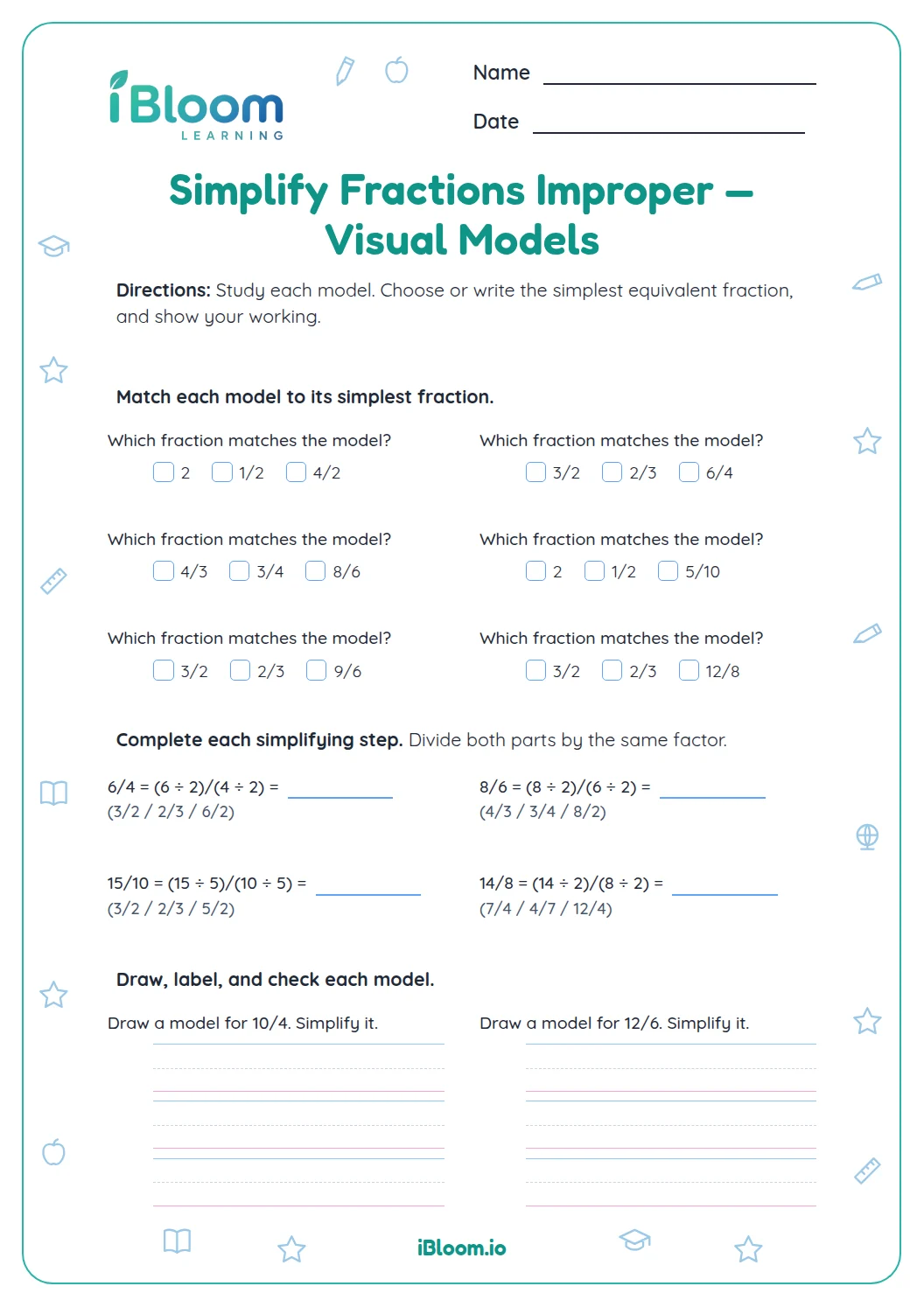
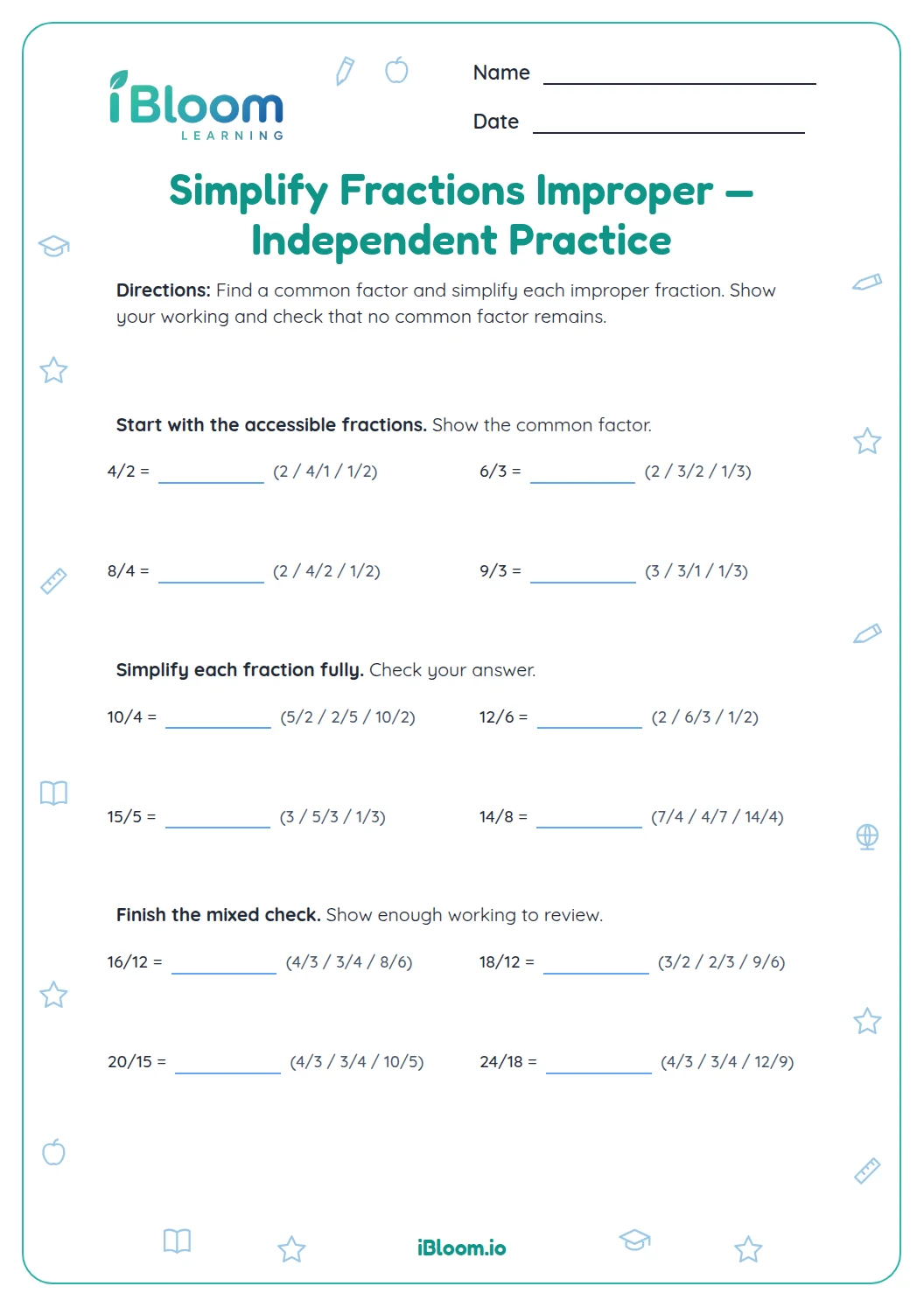
This printable Grade 3 worksheet gives learners 18 questions on simplifying proper fractions to equivalent fractions in lowest terms. The three parts move from a supported first step to independent practice, and a separate answer key makes it easy to check the work. Use the worked example to model the strategy before the learner begins. The practice supports Common Core 3.NF.A.3.b.
Aligned to 3.NF.A.3.b
What makes two fractions equivalent?
Equivalent fractions name the same amount. To simplify, divide the numerator and denominator by the same factor; dividing only one changes the value. Continue until no common factor greater than 1 remains.
- 14/8: divide the top and bottom by 4.
- 24 ÷ 4 = 1 and 8 ÷ 4 = 2, so 4/8 = 1/2.
How does the practice move toward independent work?
Part A uses familiar fractions and prompts learners to divide both terms by a shared factor. Part B asks them to find a common factor. Part C gives proper fractions to simplify to lowest terms.
How can learners tell when a fraction is simplest?
Check that the numerator and denominator were divided by the same number. Then see whether any whole number greater than 1 divides both remaining terms. Use the answer key to confirm each result.
How to use this worksheet
- 1Read the directions and name the skill being practiced.
- 2Work through the first part together, explaining the clue or step.
- 3Complete each question and keep the answers in order.
- 4Pause between parts to check the work with the key.
- 5For a missed item, redo the step and explain why the corrected answer fits.
Fraction simplification mistakes
The mistake
Dividing only the numerator or only the denominator.
The fix
Divide both terms by the same factor to keep an equivalent fraction.
The mistake
Stopping at an equivalent fraction that can still be reduced.
The fix
Check whether the new numerator and denominator share another factor.
The mistake
Subtracting the same number from both terms.
The fix
Use division by a shared factor, not subtraction.
Common Core alignment
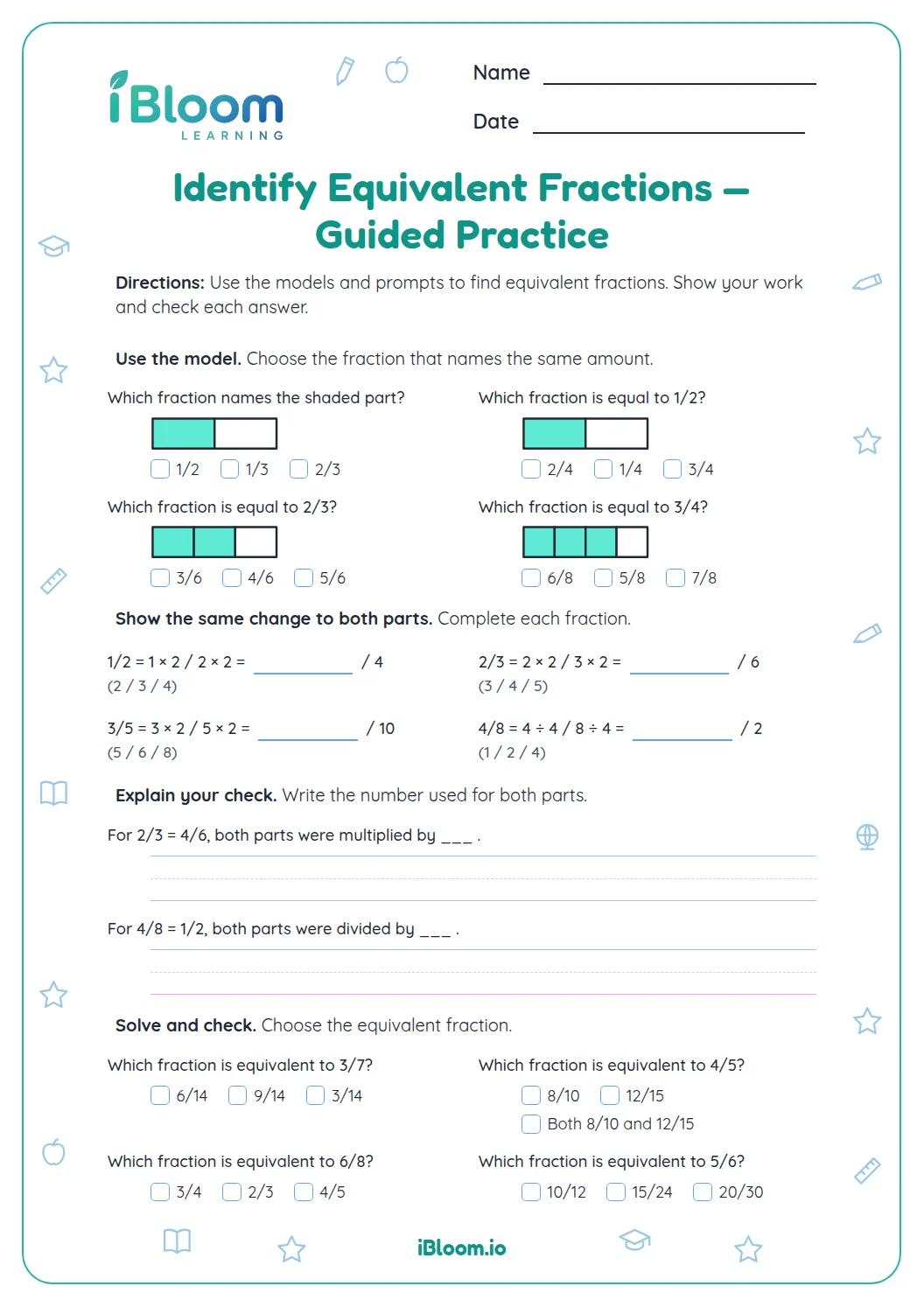
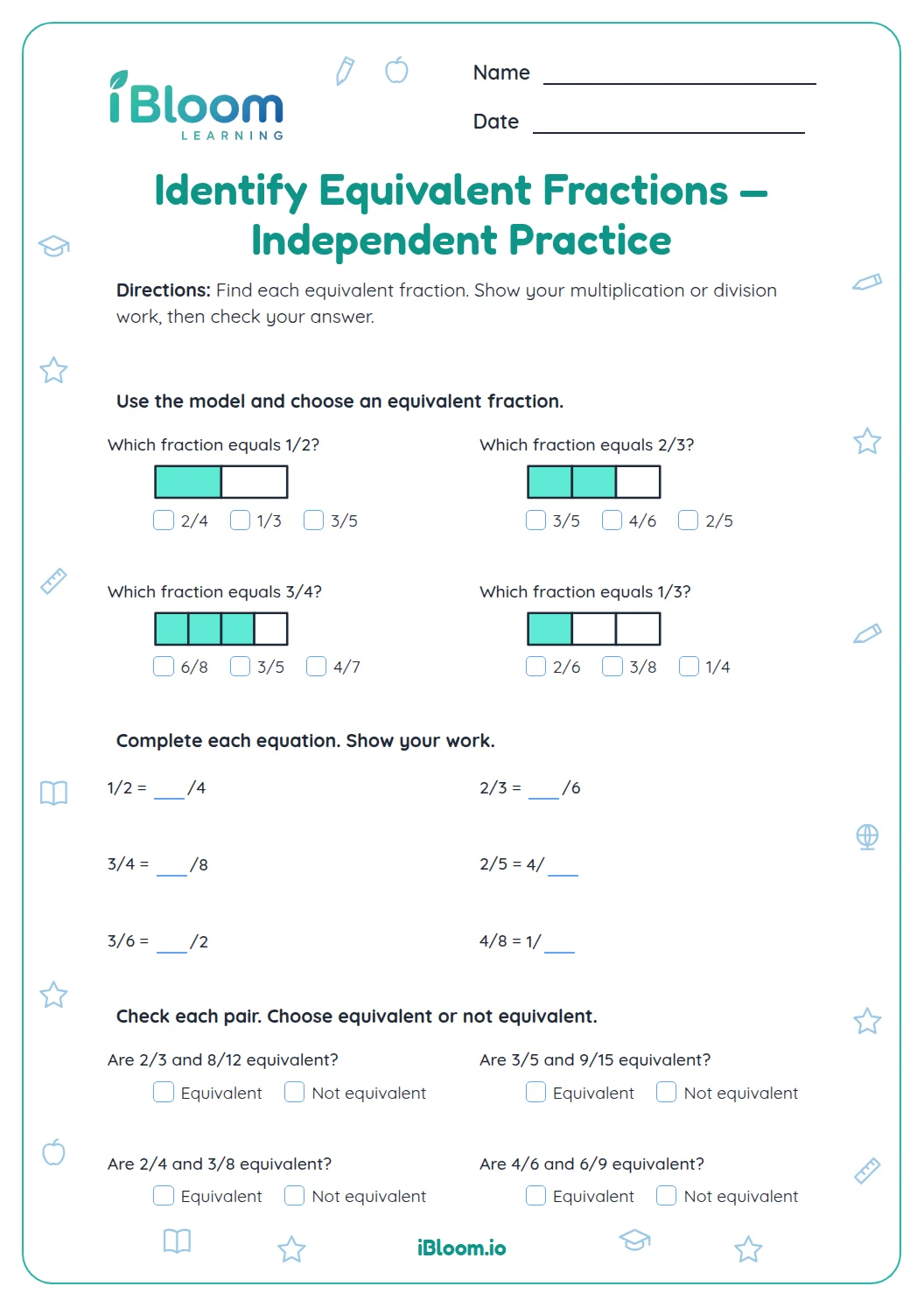
Generate equivalent fractions by dividing the numerator and denominator by the same factor.
On this sheet: Learners simplify proper fractions by dividing both terms by a common factor.
Show the official wordingHide the official wording
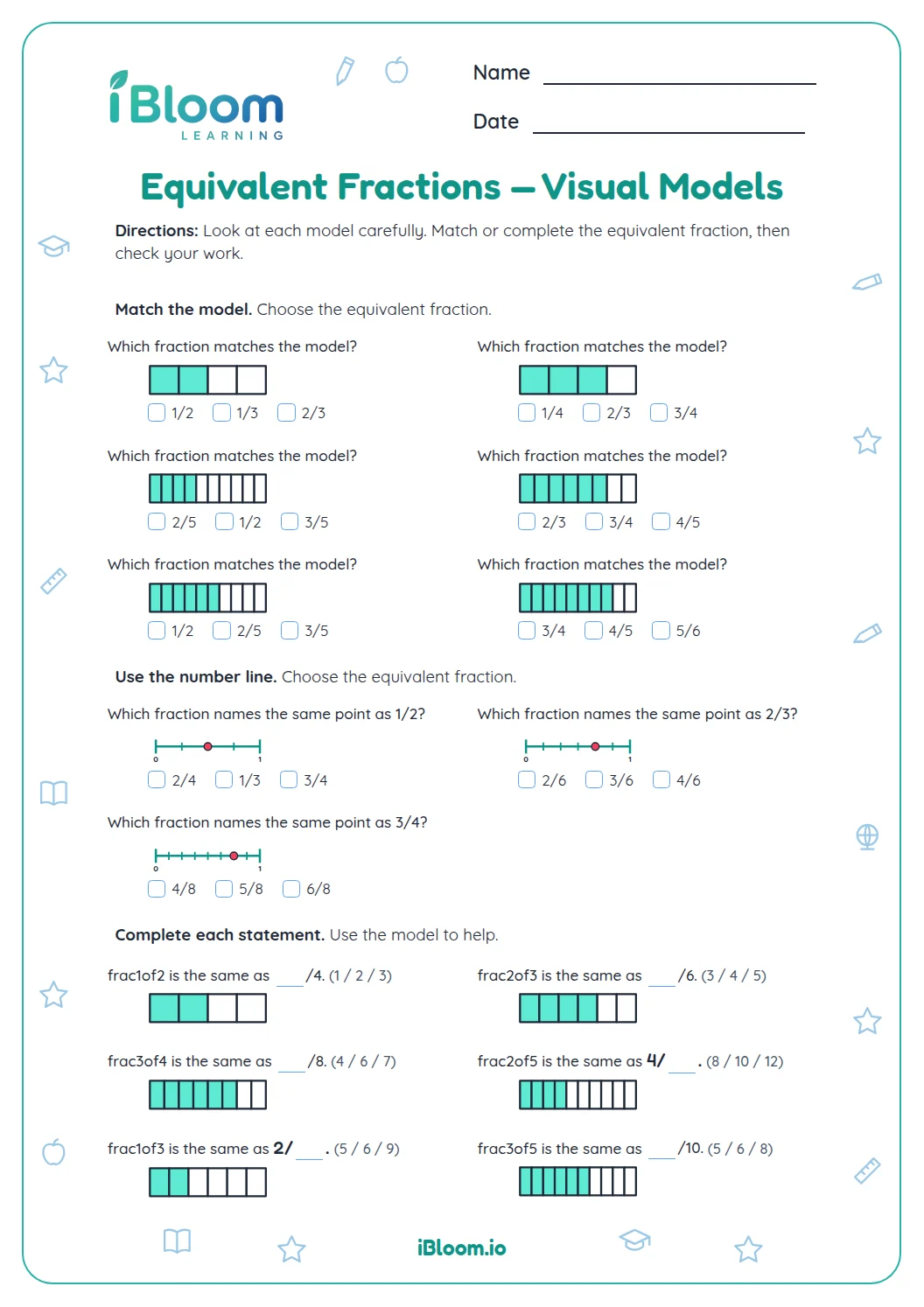
Recognize and generate simple equivalent fractions, e.g., 1/2 = 2/4, 4/6 = 2/3. Explain why the fractions are equivalent, e.g., by using a visual fraction model.
What to practice next
Make more practice
Further reading
Questions parents and teachers ask
What does it mean to simplify a proper fraction?
Simplifying means writing an equivalent fraction with smaller terms until no common factor remains. For example, dividing both 4 and 8 by 4 gives 1/2. The worksheet moves from supported common-factor steps to independent practice. Ask the learner to explain one answer aloud, then use the printed key to check the result and the clue that supports it.
What is a proper fraction?
A proper fraction has a numerator smaller than its denominator, so its value is less than one whole. Each practice question uses a proper fraction and asks the learner to write its simplest equivalent form. Ask the learner to explain one answer aloud, then use the printed key to check the result and the clue that supports it.
Why must both parts of a fraction be divided by the same number?
The numerator and denominator describe one fraction together. Dividing both by the same factor keeps the value equivalent; changing only one term changes the amount. The worked example models this with 4/8 and 1/2. Ask the learner to explain one answer aloud, then use the printed key to check the result and the clue that supports it.
How can learners check that a fraction is in lowest terms?
Look for a whole number greater than 1 that divides both terms. If one does, divide both terms by it again. If none does, the fraction is in lowest terms. The answer key lists simplified forms. Learners can check for a common factor before writing the final answer.
What does this worksheet include?
This two-page Grade 3 worksheet contains 18 questions in three parts. It begins with common-factor prompts and continues to independent simplification of proper fractions. A separate answer key supports checking and review after each part. Ask the learner to explain one answer aloud, then use the printed key to check the result and the clue that supports it.