


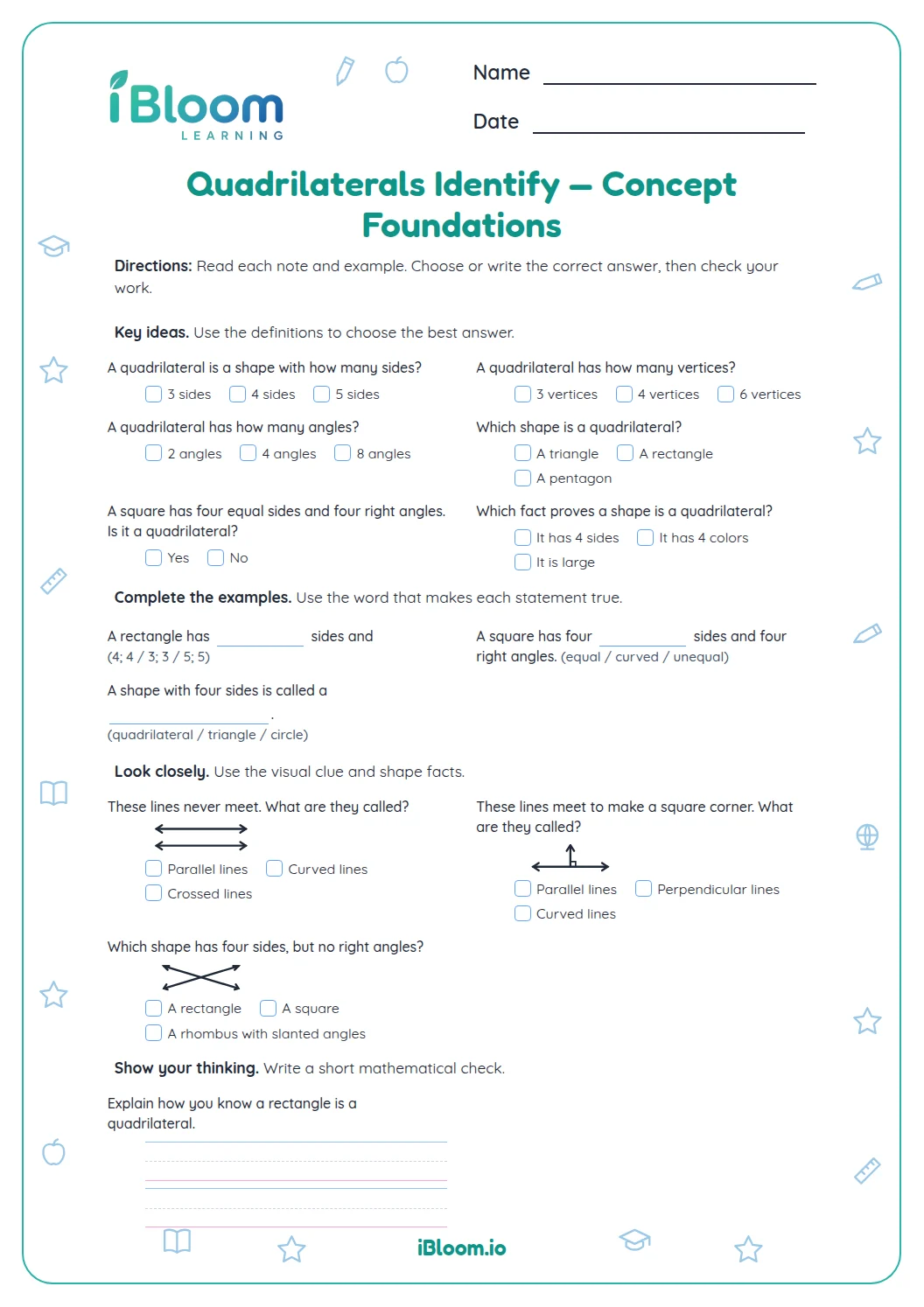
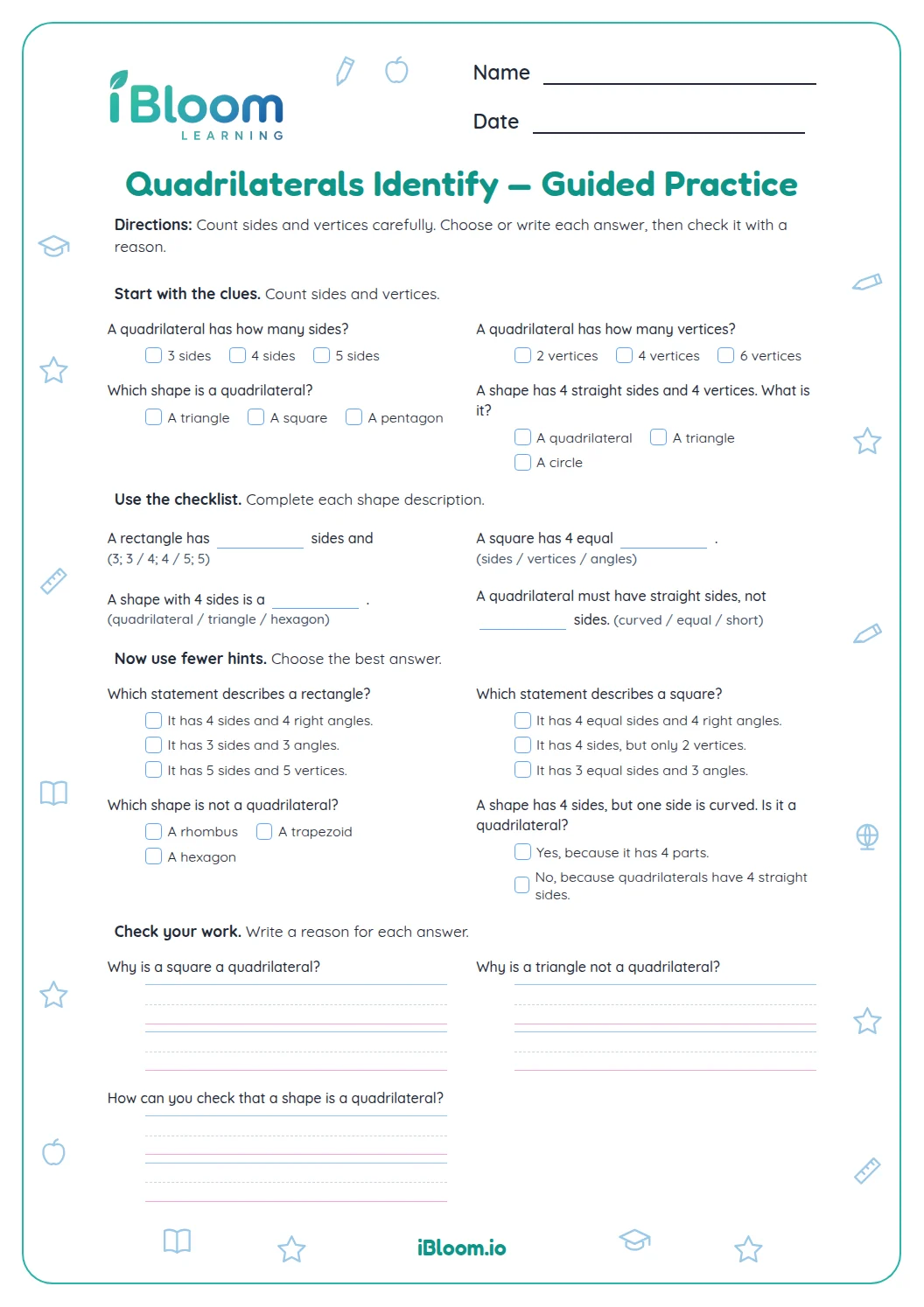
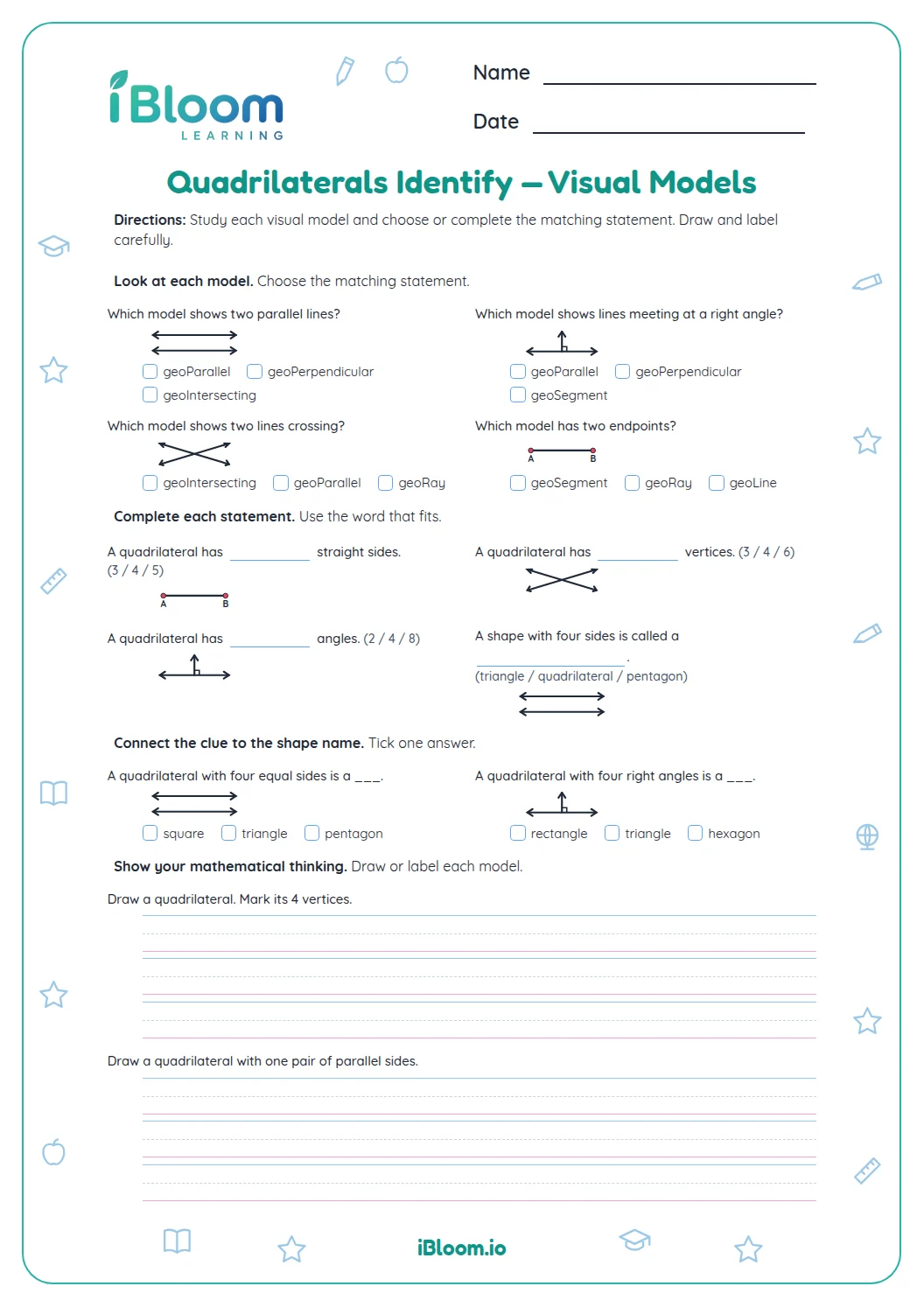
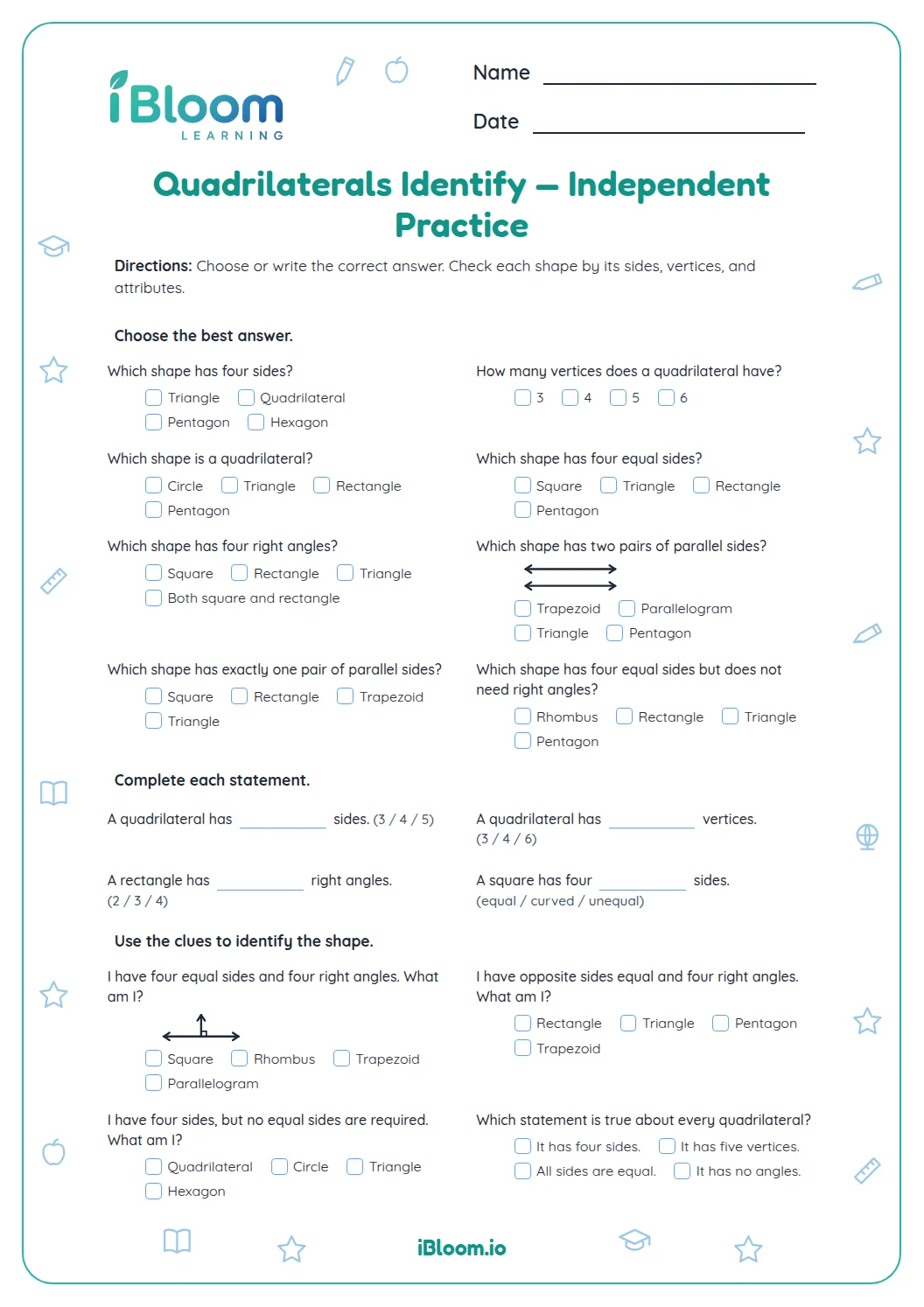

About this worksheet
This free Grade 3 geometry worksheet has fourteen questions about matching size and shape. Part A shows four labeled pairs for a yes-or-no decision with a reason. Part B has four choices about quadrilaterals, equal sides, turns, and size. Part C practices matching measurements with rectangles, squares, triangles, and circles; Part D asks for two explanations. Children distinguish a shared property from congruence and use matching measurements to justify a match. The quadrilateral comparisons practice Common Core 3.G.A.1. A separate answer key gives decisions, missing lengths, and sample reasons.
Aligned to 3.G.A.1
What should children check in each pair?
Each pair in Part A labels its shapes A and B. Children decide whether the outlines match exactly in size and shape, then give a brief reason. The pairs include squares, a rectangle, right triangles, a hexagon, and a pentagon.
Have children compare the whole outline. The two right triangles match, while the rectangle and square have different shapes. For the final pair, the different side counts give a quick reason why the shapes cannot be congruent.
Why are shared properties not enough?
A square and a rectangle are both quadrilaterals because each has four straight sides. That shared property tells us their larger category. It does not tell us that one outline would fit exactly over the other.
Question 6 adds a more demanding comparison: squares and rhombuses both have four equal sides, yet their angles can differ. Children need to consider more than one property before deciding that two shapes match.
Does turning a shape change congruence?
Turning a paper shape changes which way it faces. It keeps its lengths and angles, so the turned shape remains congruent to its original shape. Children can demonstrate this with a rectangular index card.
Part C checks matching lengths before the final explanations. For question 9, turning a 2 cm by 8 cm rectangle gives an 8 cm by 2 cm rectangle. Both dimensions must match.
- 1Rectangle 1 measures 3 cm by 5 cm.
- 2Rectangle 2 measures 3 cm by 5 cm and is turned sideways.
- 3Turn one rectangle to align the 3 cm and 5 cm sides.
- 4Answer: Yes, they have the same size and shape.
How to use this worksheet
- 1Review congruent as “same size and same shape.”
- 2Compare each Part A pair and give a brief reason.
- 3Check the four Part B claims using size, sides, and angles.
- 4Complete Part C by matching corresponding measurements.
- 5Turn an index card to help explain question 14, then check both Part D responses.
Mistakes to check together
The mistake
Matching every pair with the same number of sides.
The fix
Compare lengths and angles as well as the side count.
The mistake
Rejecting a match because one rectangle is turned.
The fix
Turn a paper rectangle and notice that its dimensions stay the same.
The mistake
Calling squares of different sizes congruent.
The fix
Check the side lengths: 2 cm and 5 cm cannot match exactly.
Common Core alignment
Compare shared attributes of quadrilaterals, squares, rectangles, and rhombuses.
On this sheet: Questions 5, 6, and 13 distinguish shared quadrilateral attributes from exact matches.
Show the official wordingHide the official wording
Understand that shapes in different categories (e.g., rhombuses, rectangles, and others) may share attributes (e.g., having four sides), and that the shared attributes can define a larger category (e.g., quadrilaterals). Recognize rhombuses, rectangles, and squares as examples of quadrilaterals, and draw examples of quadrilaterals that do not belong to any of these subcategories.
What to practice next
Make more practice
Further reading
Questions parents and teachers ask
What does congruent mean on this sheet?
Congruent means having the same size and the same shape. Part A compares four labeled pairs; Part B checks four claims. Part C asks for matching measurements in four shapes, and Part D asks children to explain a shared-category mistake and a turned rectangle.
Are all squares congruent?
No, squares can have different side lengths. Question 8 compares a square with 2 cm sides and one with 5 cm sides. They share the same shape and both belong to the square category, but their sizes differ, so their outlines cannot fit exactly over one another.
Can a turned rectangle still be congruent?
Yes, turning a rectangle keeps its side lengths and angles unchanged. Question 14 describes two rectangles measuring 3 cm by 5 cm, with one turned sideways. Children should explain that the measurements still match. Rotating an index card on the table makes this idea easy to check.
Why does the sheet include quadrilateral questions?
Those questions help children separate a shared category from an exact match. Squares, rectangles, and rhombuses all have four sides, so they are quadrilaterals. The worksheet asks children to notice that this shared attribute alone does not establish equal size and shape, supporting Common Core 3.G.A.1.
How should I score the two explanations?
Accept a brief explanation that addresses the mathematical reason in the question. For question 13, children should say that four-sided shapes can differ in shape or size. For question 14, they should connect the matching measurements to congruence. The key gives samples, so identical wording is unnecessary.