
About this worksheet
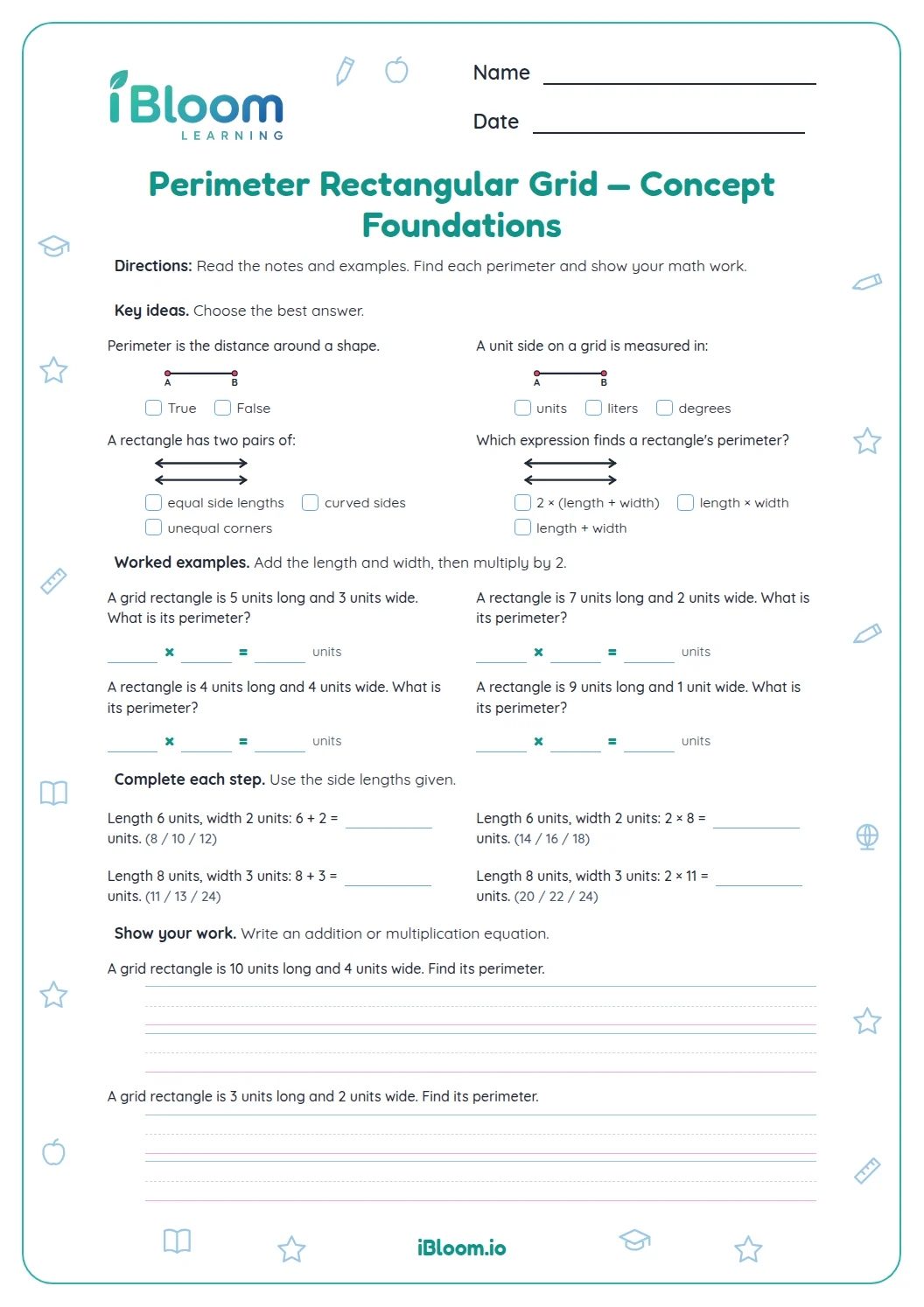
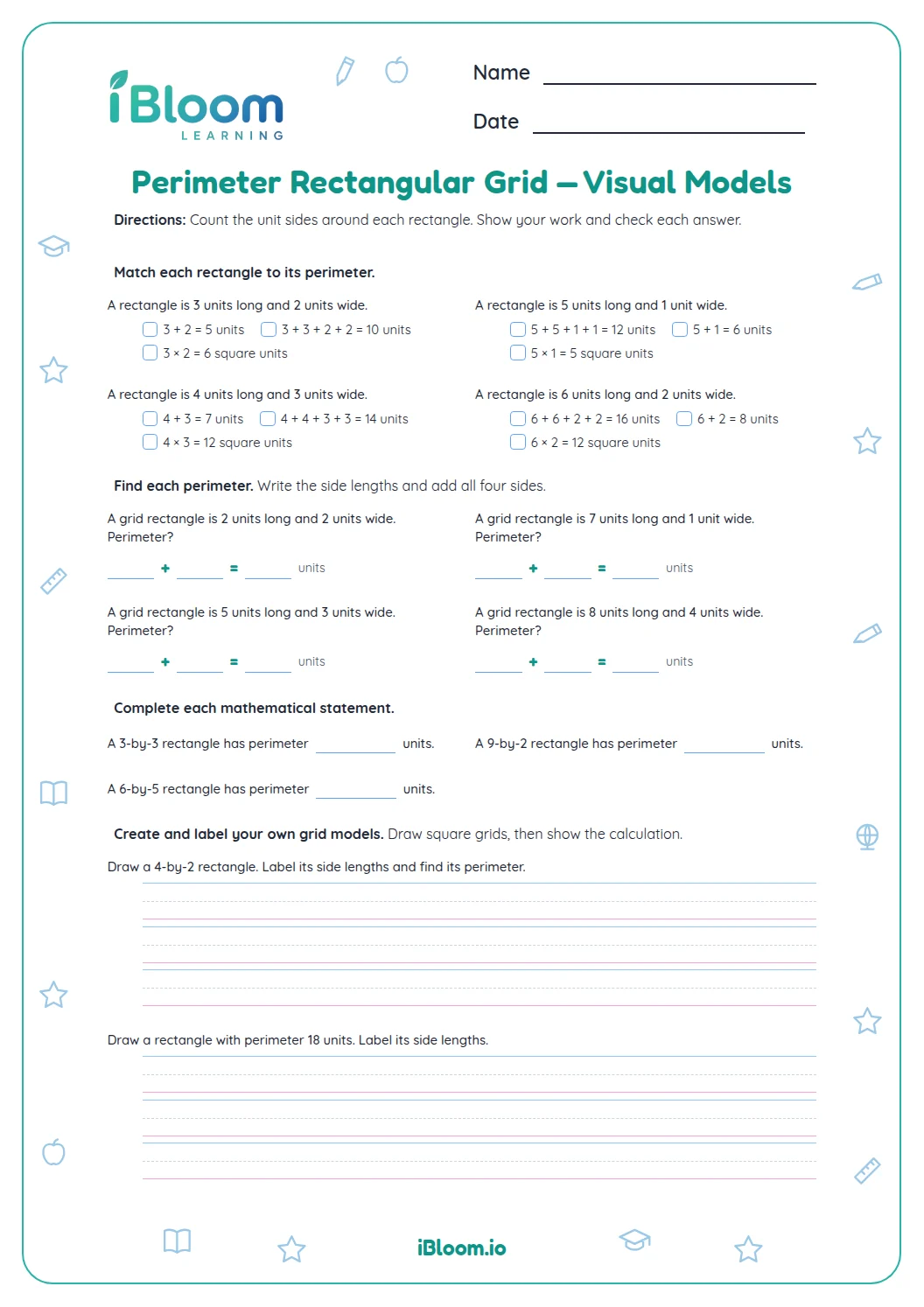
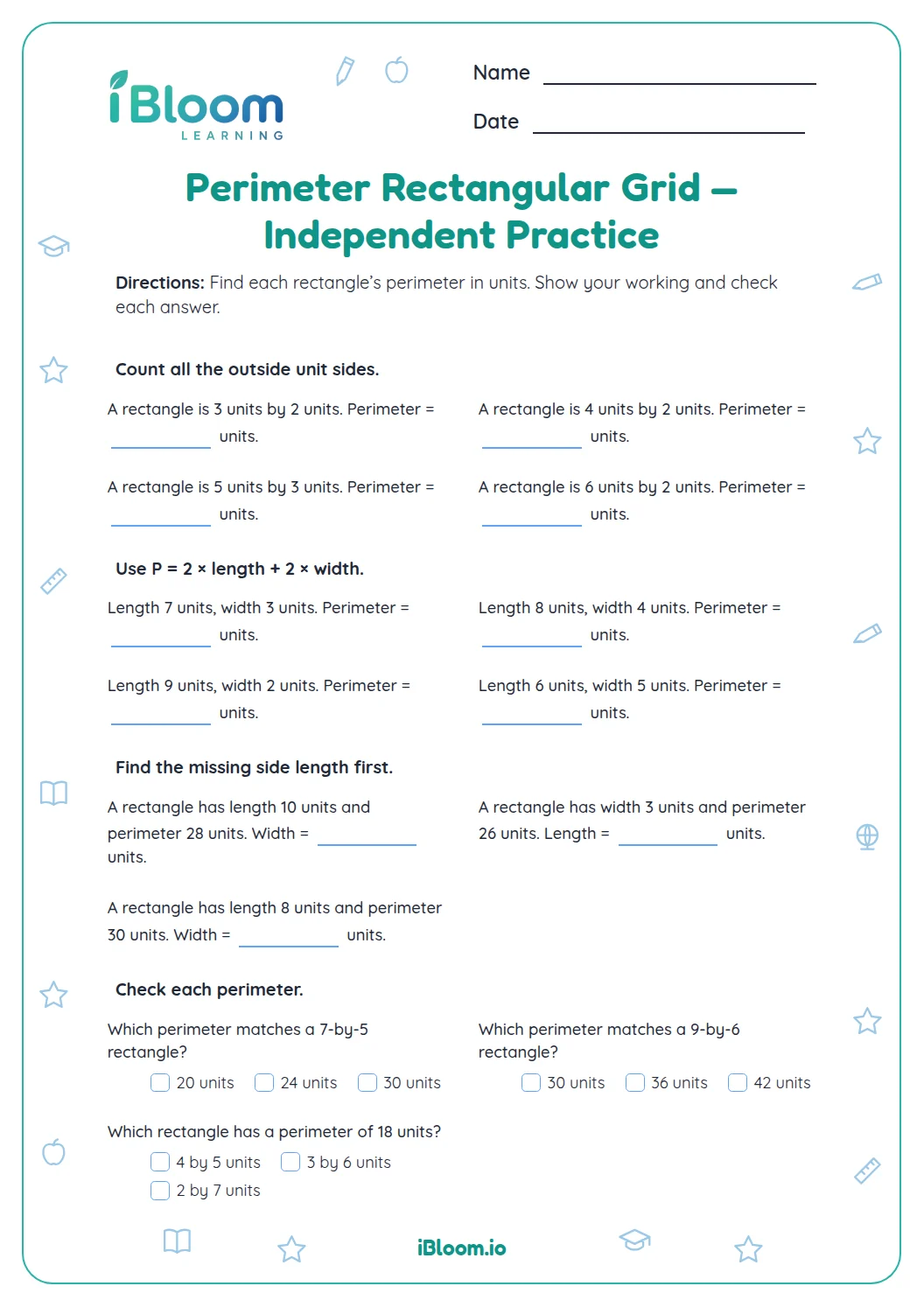
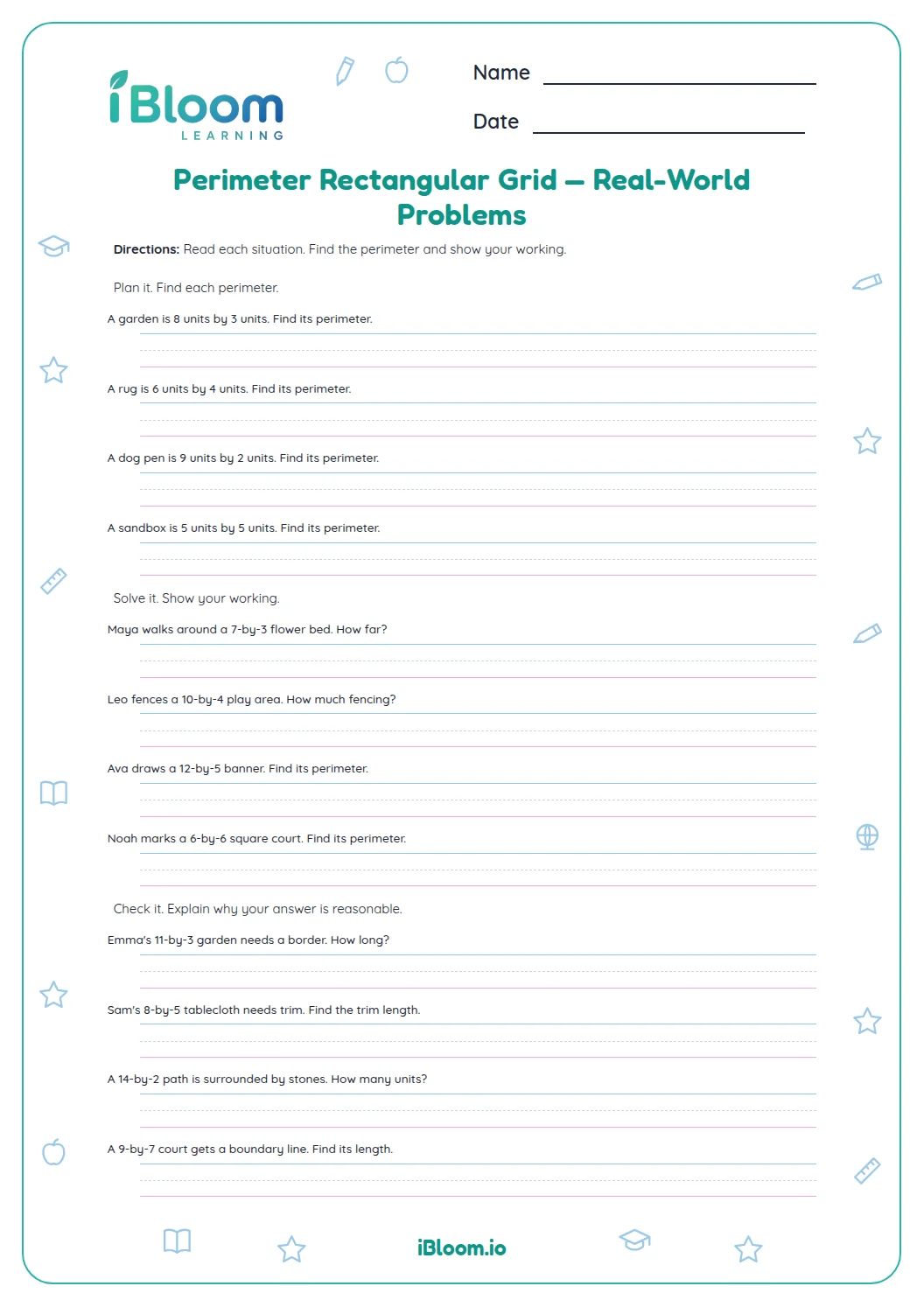
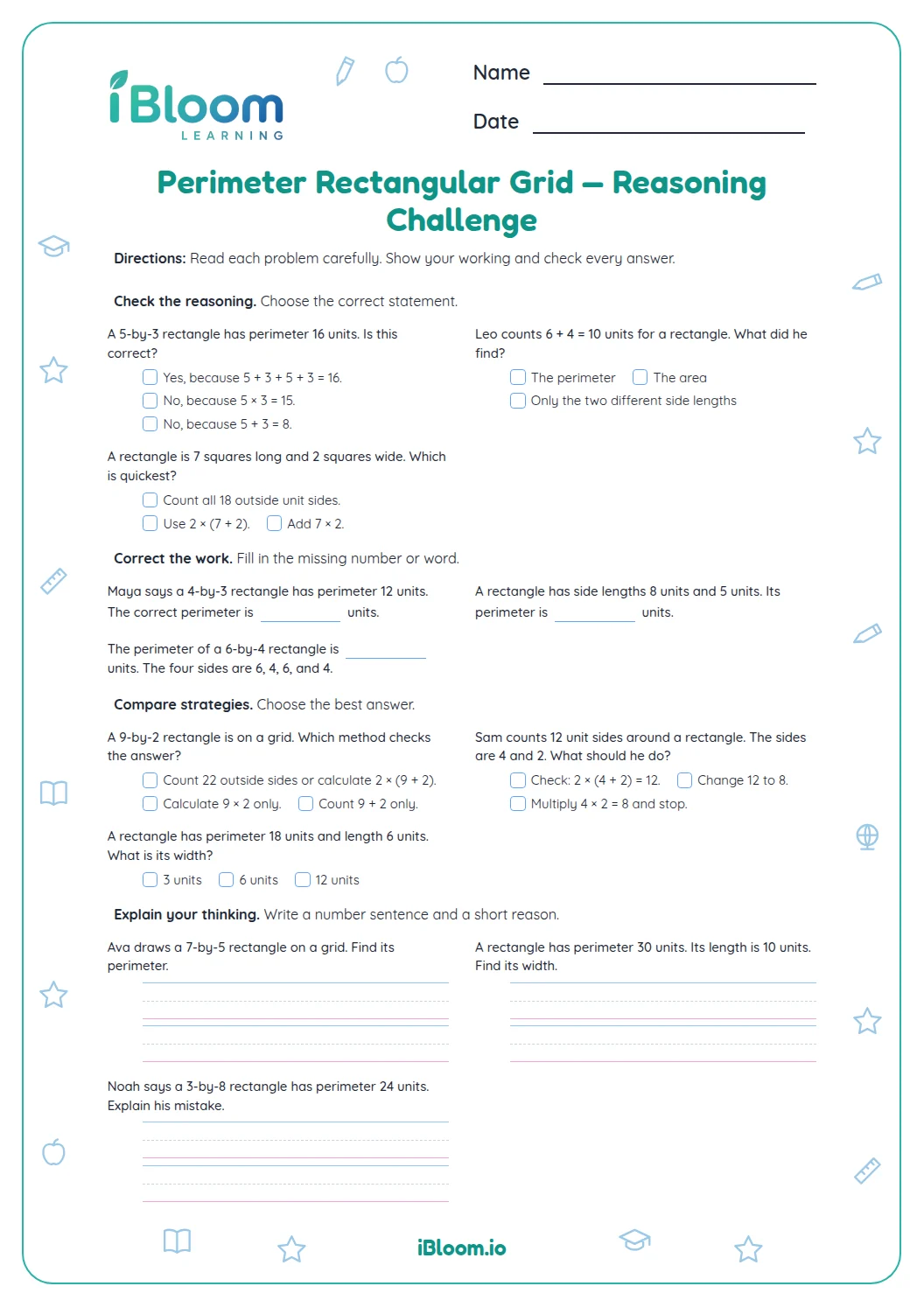
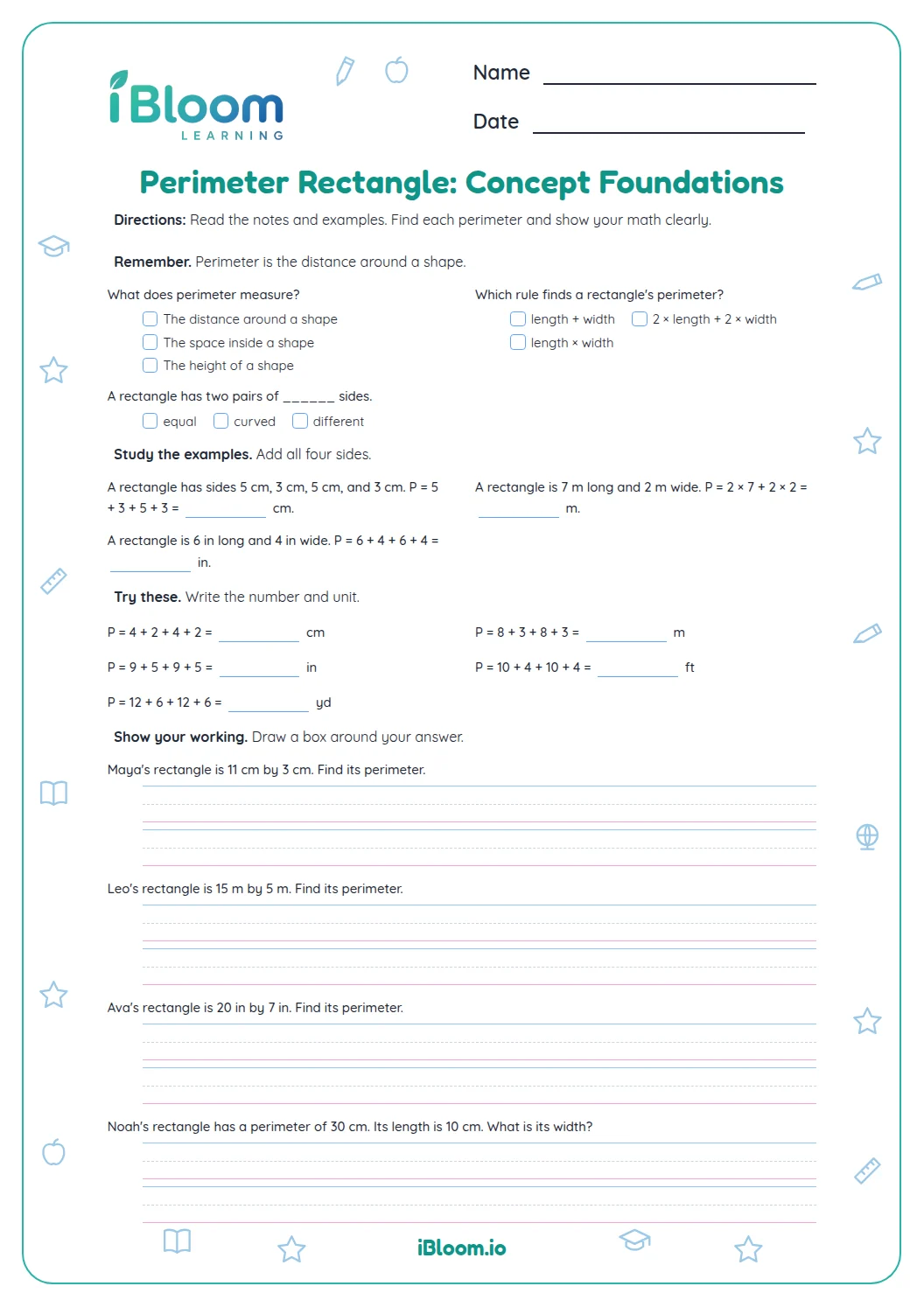
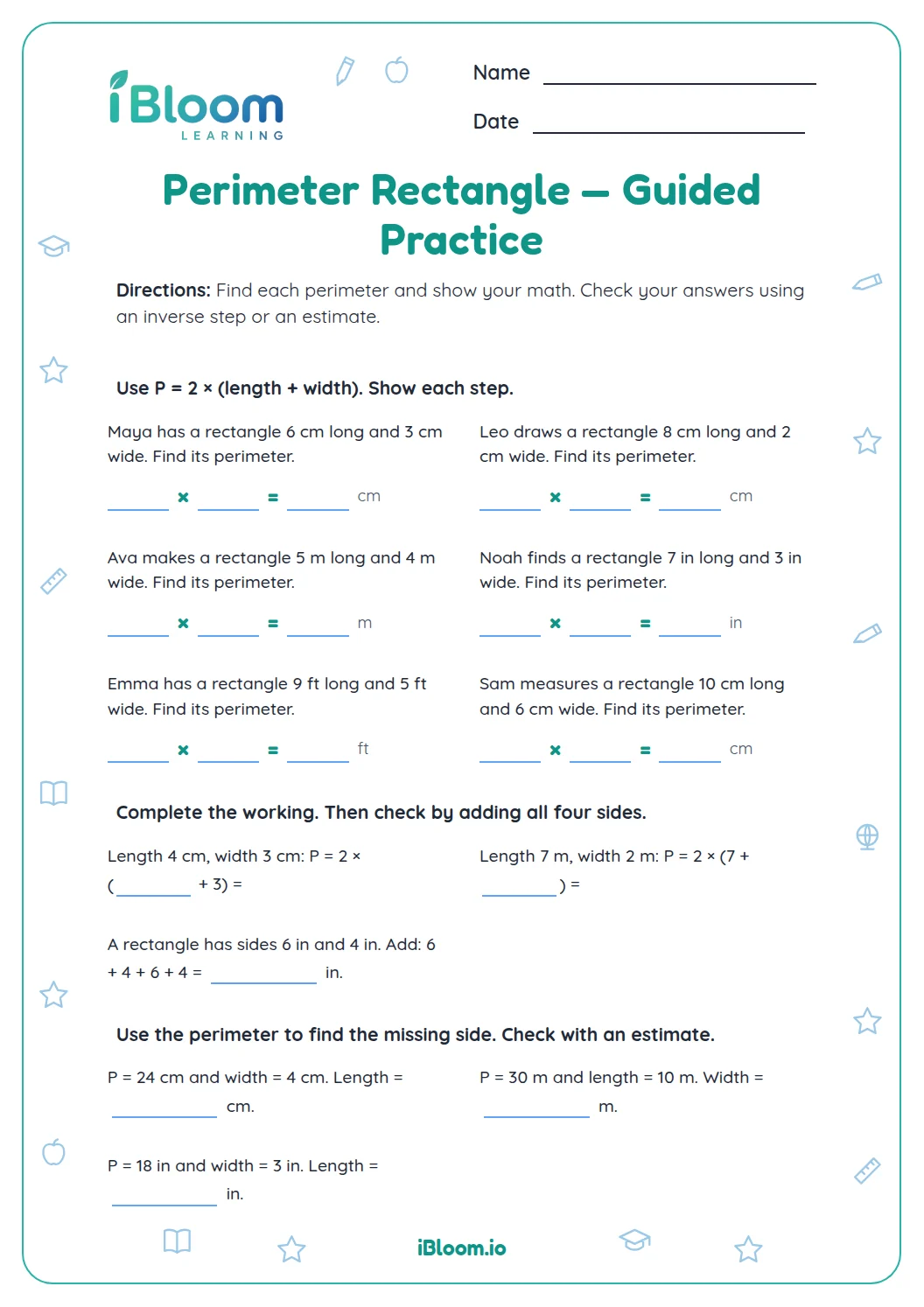
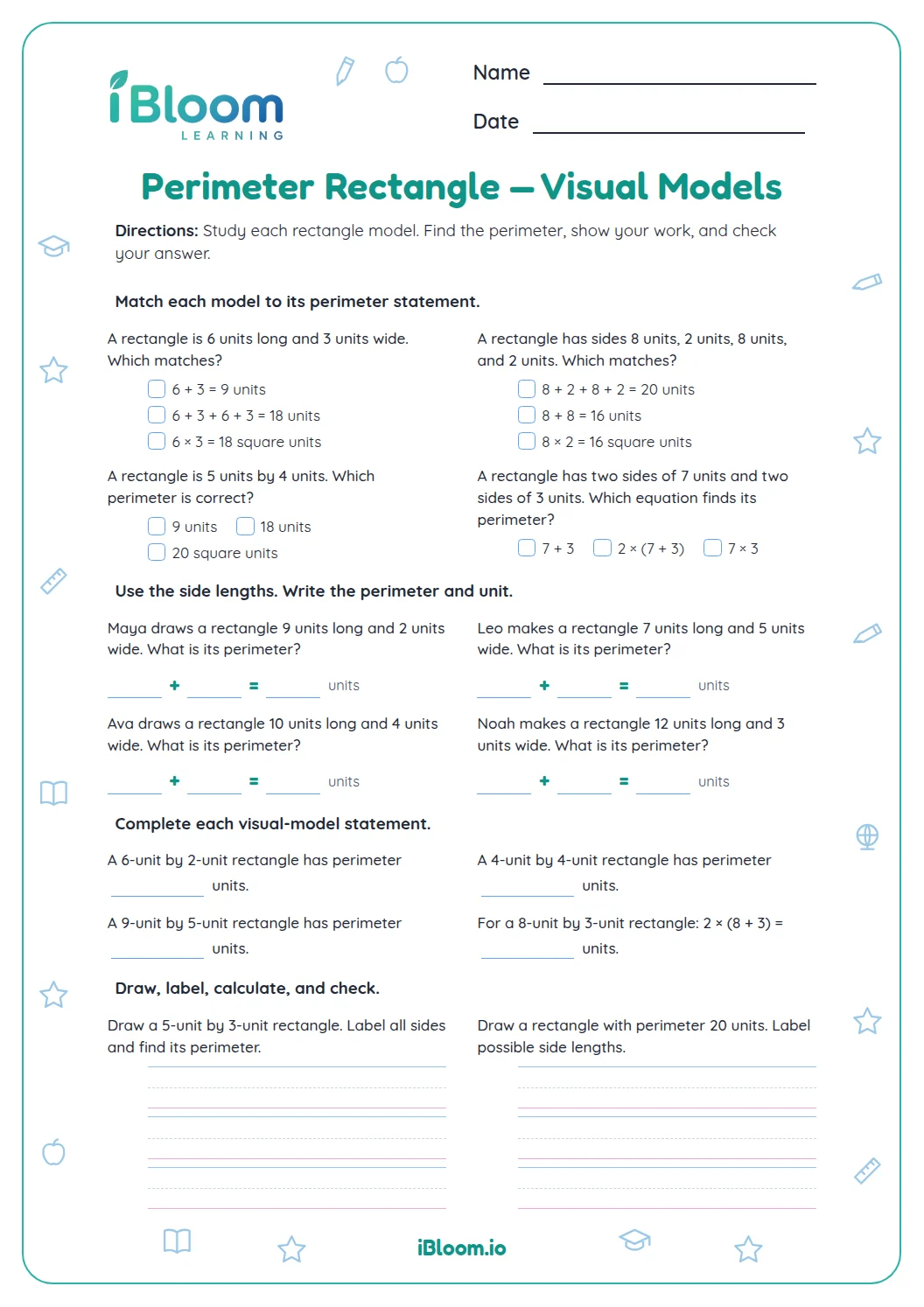
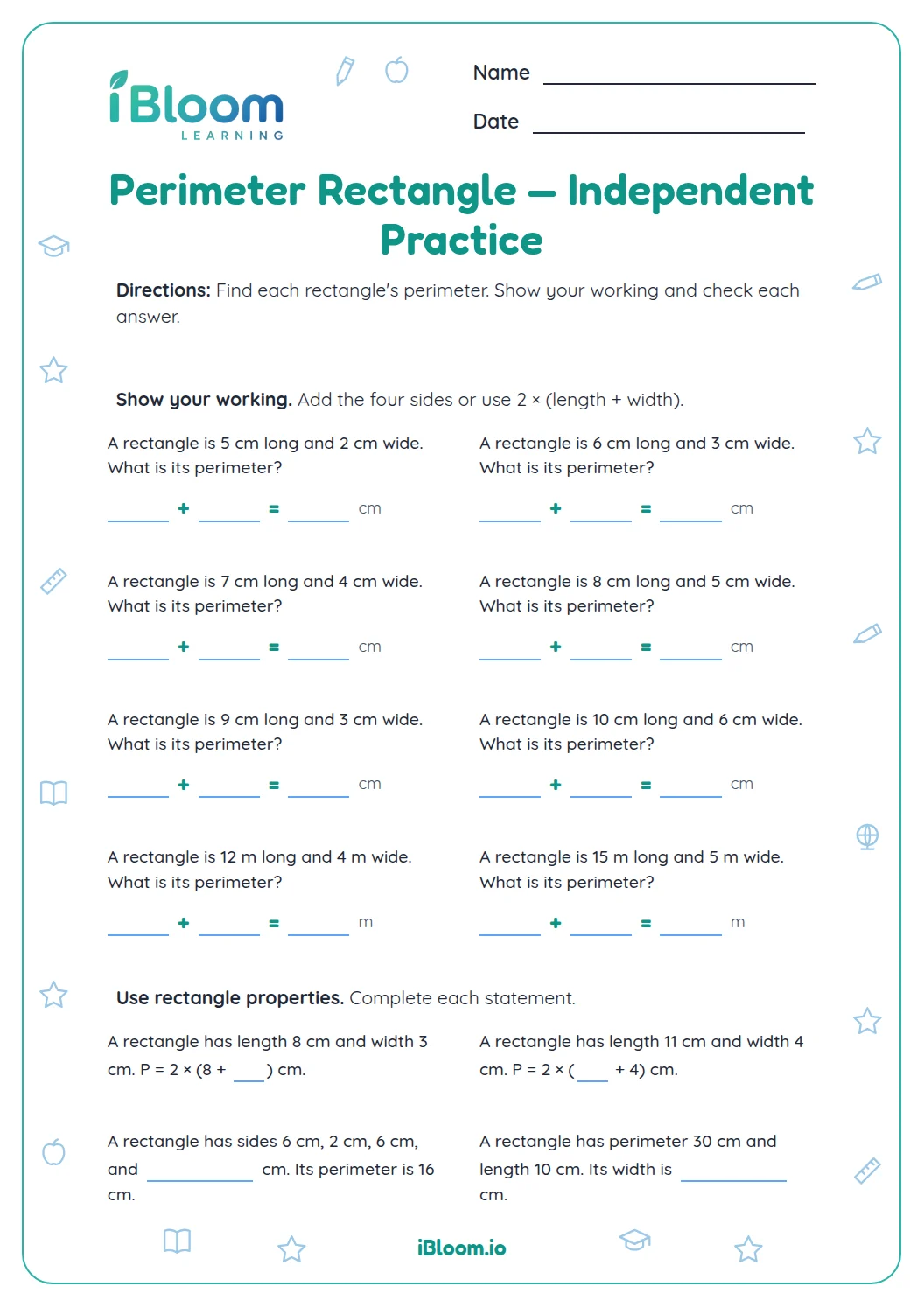
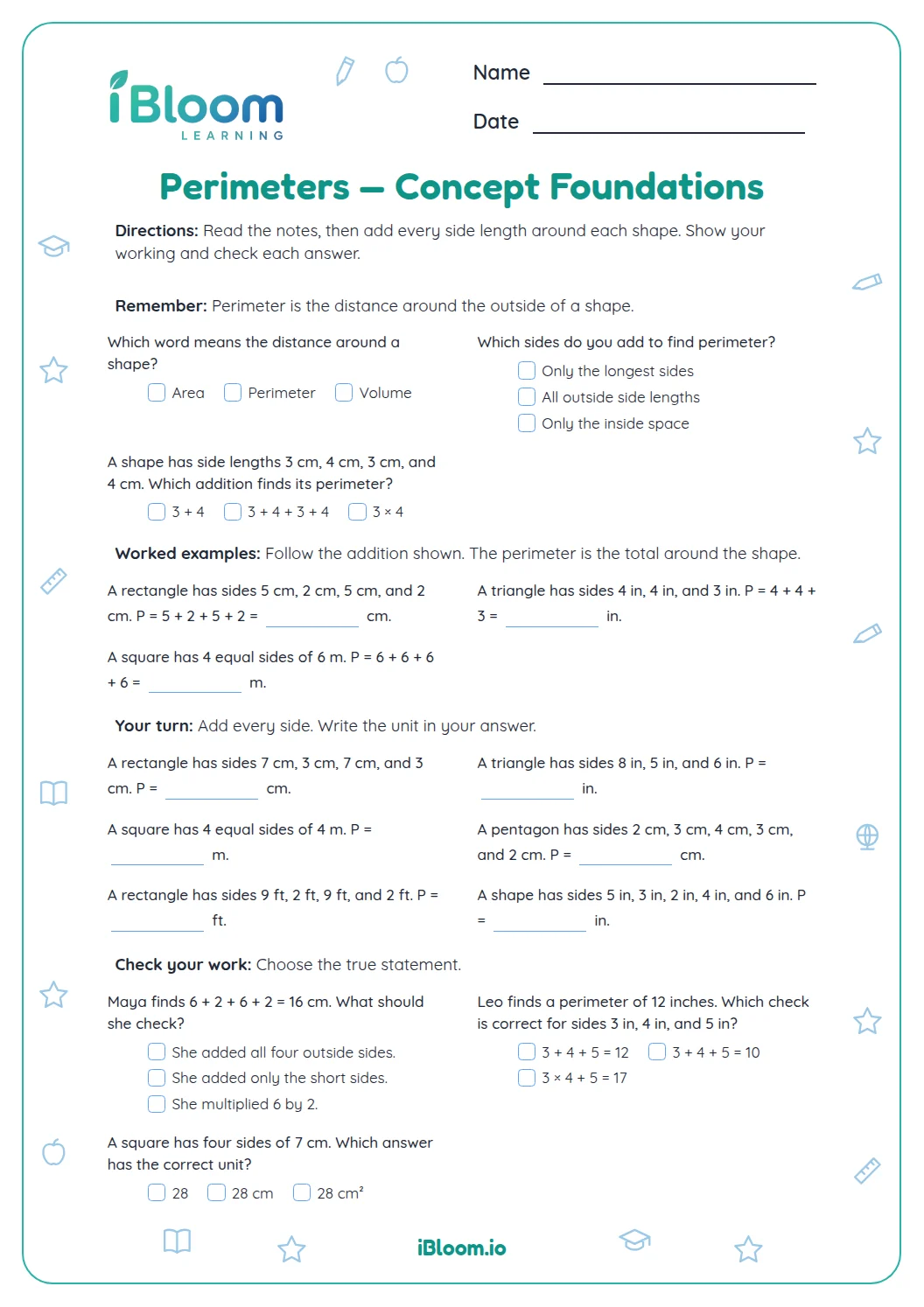
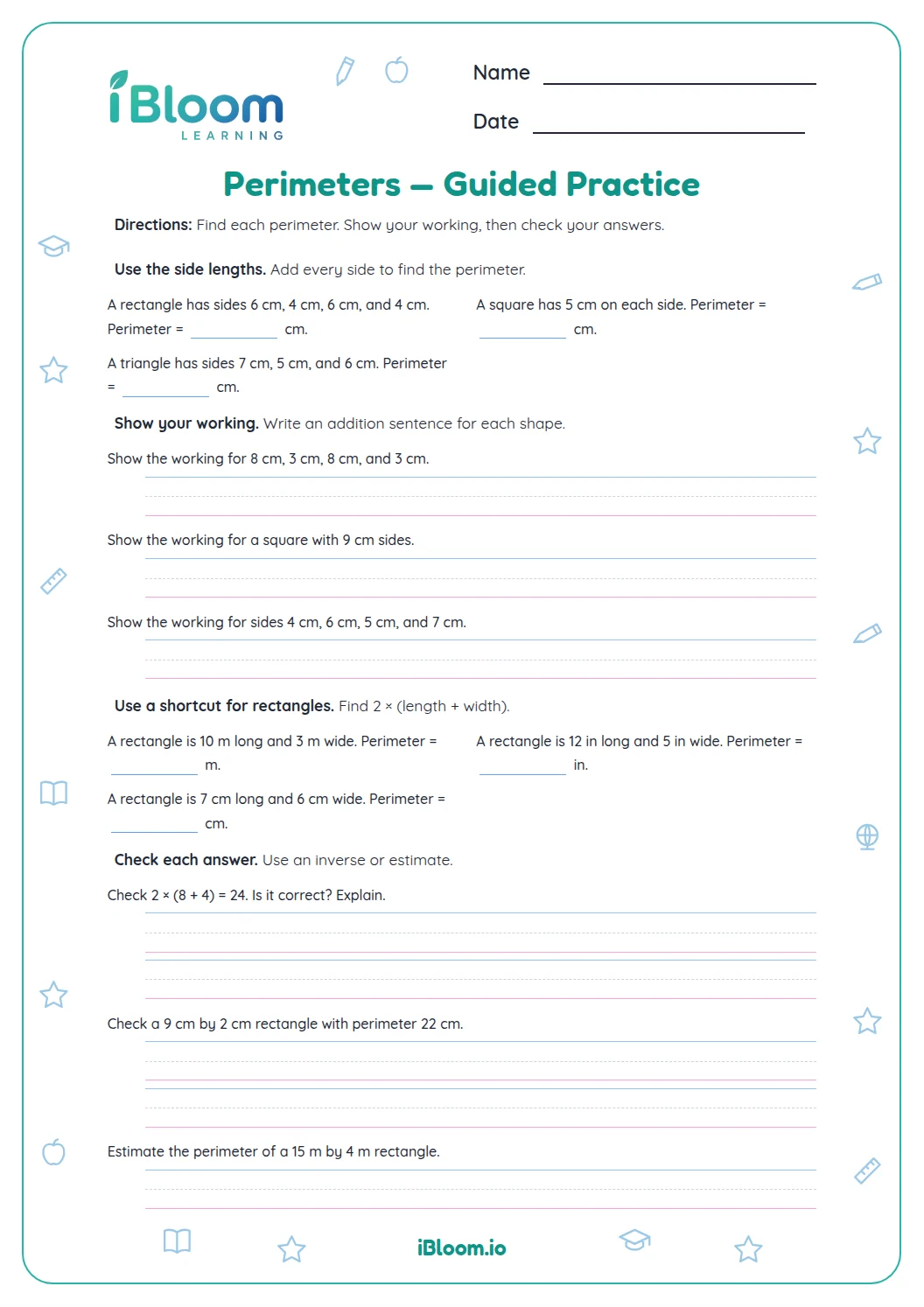
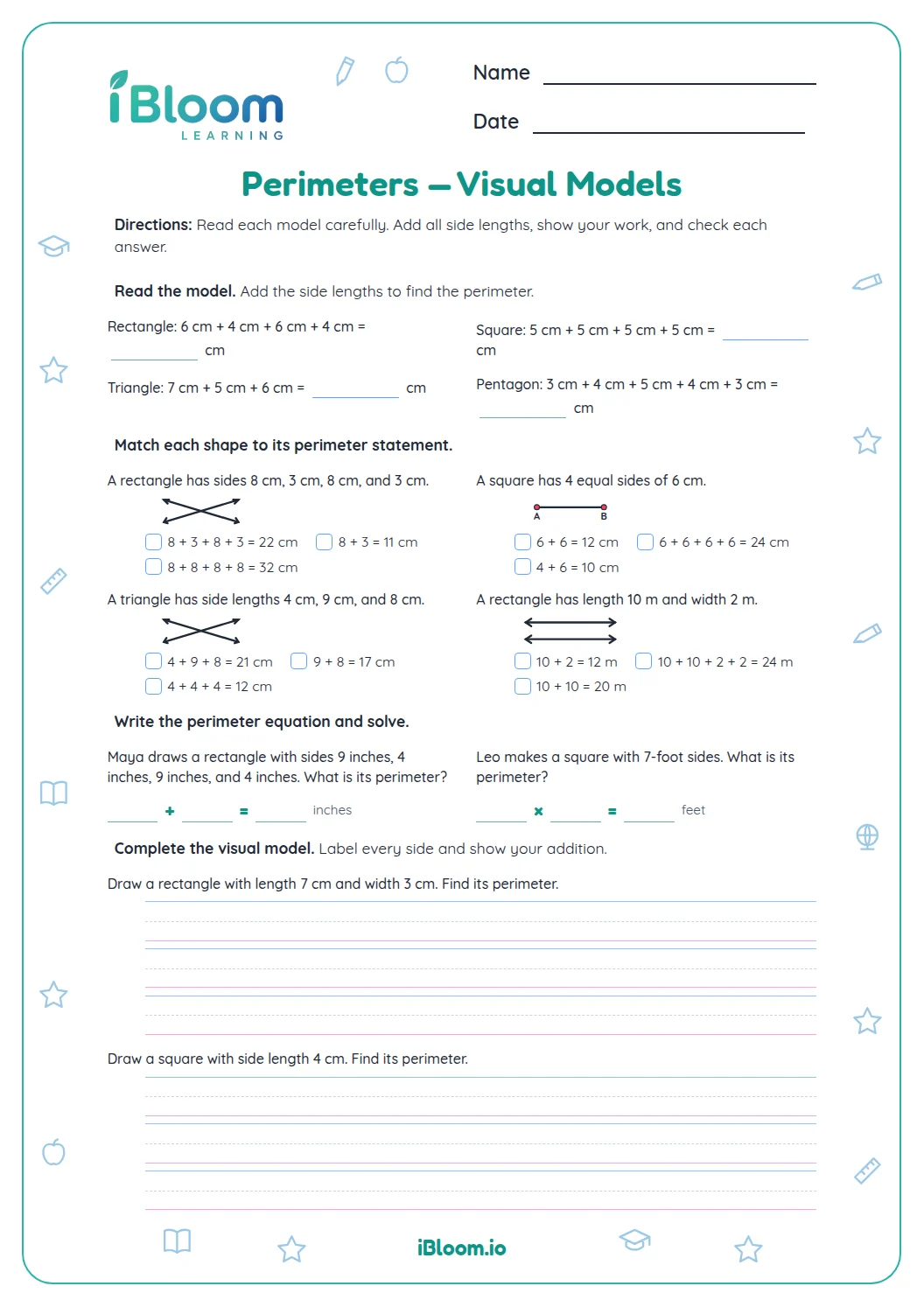
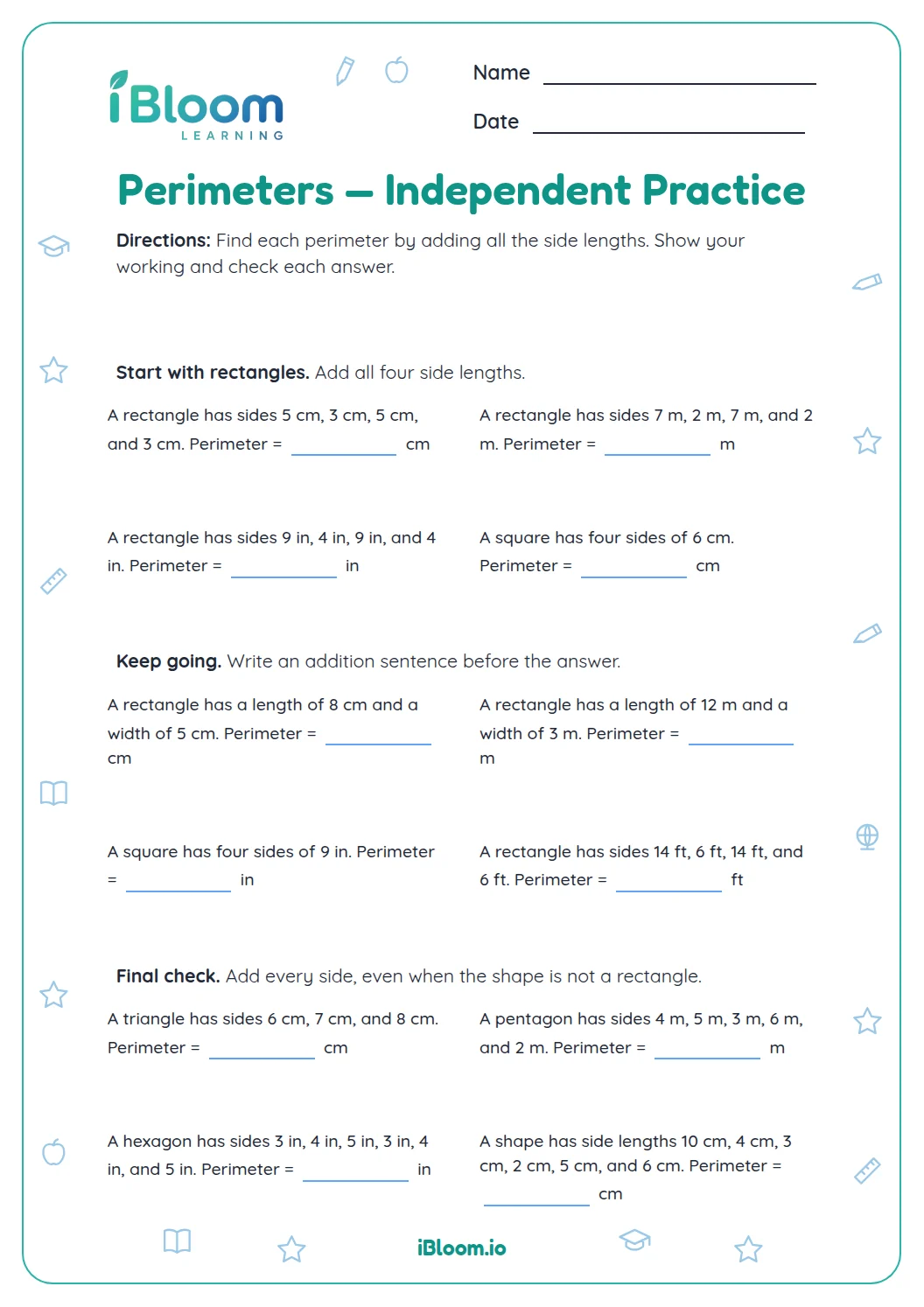
This Grade 3 worksheet gives 16 rectangle perimeter problems. The first six problems use rectangular grids so students can count the unit edges around each shape; The remaining ten name side lengths and asks students to show an equation. The answer key includes each perimeter in units. Students should count the outside boundary, not the interior grid lines.
Aligned to 3.MD.D.8
What does perimeter measure on a grid?
Perimeter is the distance around the outside of a shape. On a square grid, count the unit edges along every outer side. Do not count the inside grid lines. A rectangle has two equal long sides and two equal short sides.
- 1Length = 4 units
- 2Width = 2 units
- 34 + 2 + 4 + 2 = 12
- 4Perimeter = 12 units
How can you find a rectangle’s perimeter efficiently?
Add the length and width, then double that total because each appears twice: P = 2 × length + 2 × width. For a 5-by-3 rectangle, 5 + 3 + 5 + 3 = 16 units.
- 1Length = 7 units; width = 2 units
- 27 + 2 + 7 + 2 = 18
- 3Or 2 × 7 + 2 × 2 = 18
- 4Perimeter = 18 units
Which edges belong in the perimeter?
Only the outside boundary counts. A quick check is to trace your finger around the rectangle once, starting and ending at the same corner. The total should include four sides and use units, not square units.
How can an adult support this practice?
- 1Point to the rectangle’s outside boundary.
- 2Count the unit edges along one side and its opposite side.
- 3Count the remaining two sides.
- 4Add all four side lengths, including units.
- 5Check by doubling the length plus the width.
Common mistakes and quick fixes
The mistake
Counting interior grid lines.
The fix
Trace only the shape’s outside boundary.
The mistake
Adding only the length and width once.
The fix
Remember that each side length occurs on two opposite sides.
The mistake
Writing square units for perimeter.
The fix
Use units because perimeter measures distance around a shape.
This page gives students focused practice with the skills named below.
Students find rectangle perimeters from grid edges and given side lengths.
On this sheet:
Show the official wordingHide the official wording
Solve real world and mathematical problems involving perimeters of polygons, including finding the perimeter given the side lengths, finding an unknown side length, and exhibiting rectangles with the same perimeter and different areas or with the same area and different perimeters.
What to practice next
Make more practice
Further reading
Questions parents and teachers ask
What is the perimeter of a rectangle?
Perimeter is the distance around a rectangle. Add all four side lengths. For a rectangle 4 units long and 2 units wide, add 4 + 2 + 4 + 2. The perimeter is 12 units, with each side counted once.
Do the inside grid lines count?
No. Interior grid lines do not form part of the outside boundary. Trace only the rectangle’s outer edge, counting every unit segment once, to find its perimeter. The shaded interior may help show the rectangle’s size, but the perimeter follows only the outer edge. Leave every line inside the rectangle out of the total.
Why does a rectangle have two pairs of equal sides?
A rectangle’s opposite sides have the same length. It has two sides equal to its length and two sides equal to its width. That is why the perimeter can be written as length + width + length + width.
Should perimeter be written in square units?
No. Perimeter measures a length around the shape, so use linear units such as units. Square units describe area, which measures the space inside a shape. Perimeter is a distance around a shape, so the answer uses units. Area counts square units inside the shape; it is a different measurement.
How can a student check a perimeter answer?
Add length + width + length + width, then check with 2 × length + 2 × width. A matching total confirms that all four outside sides were included. Retrace the boundary if the methods disagree, and use linear units.