
About this worksheet
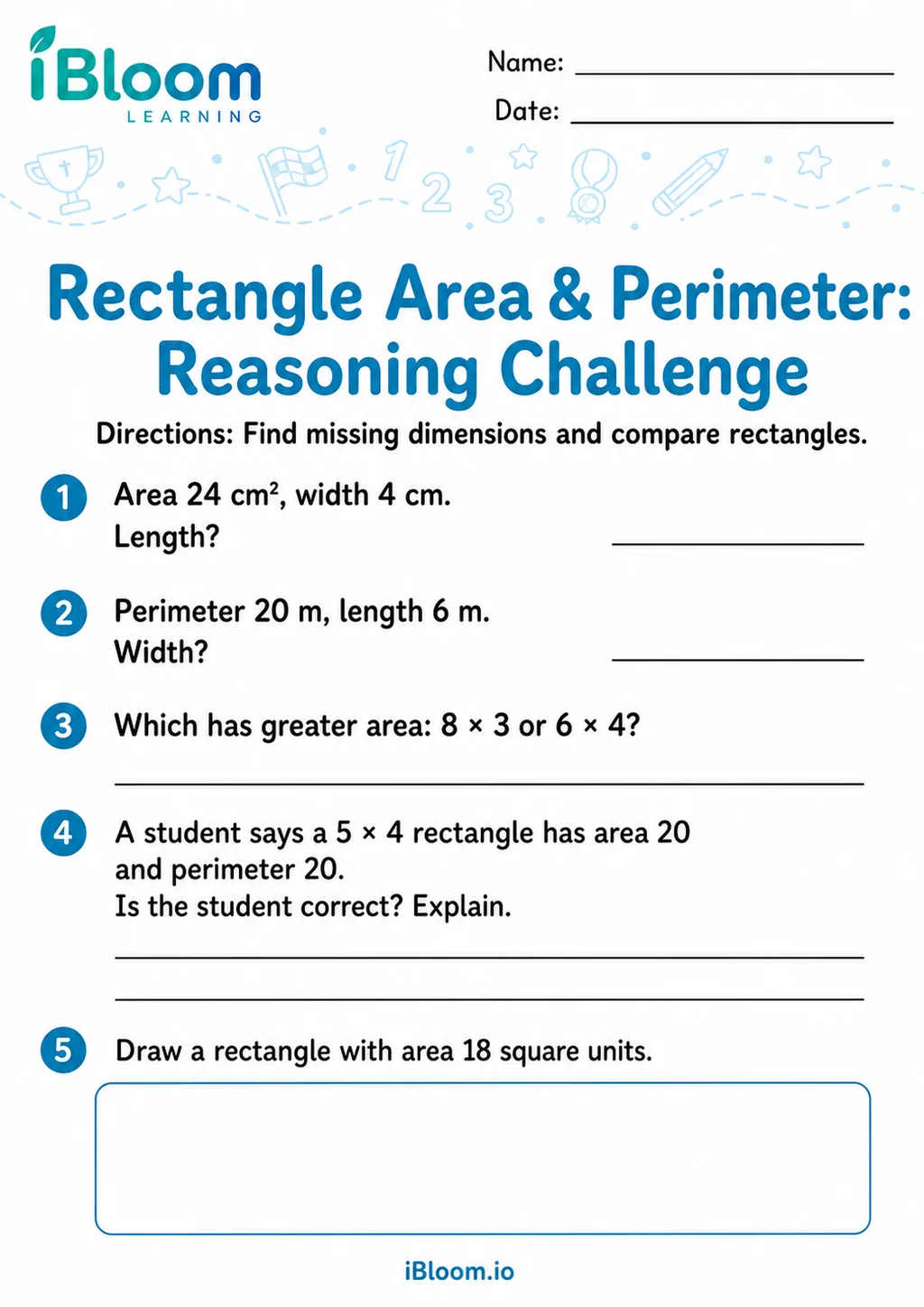
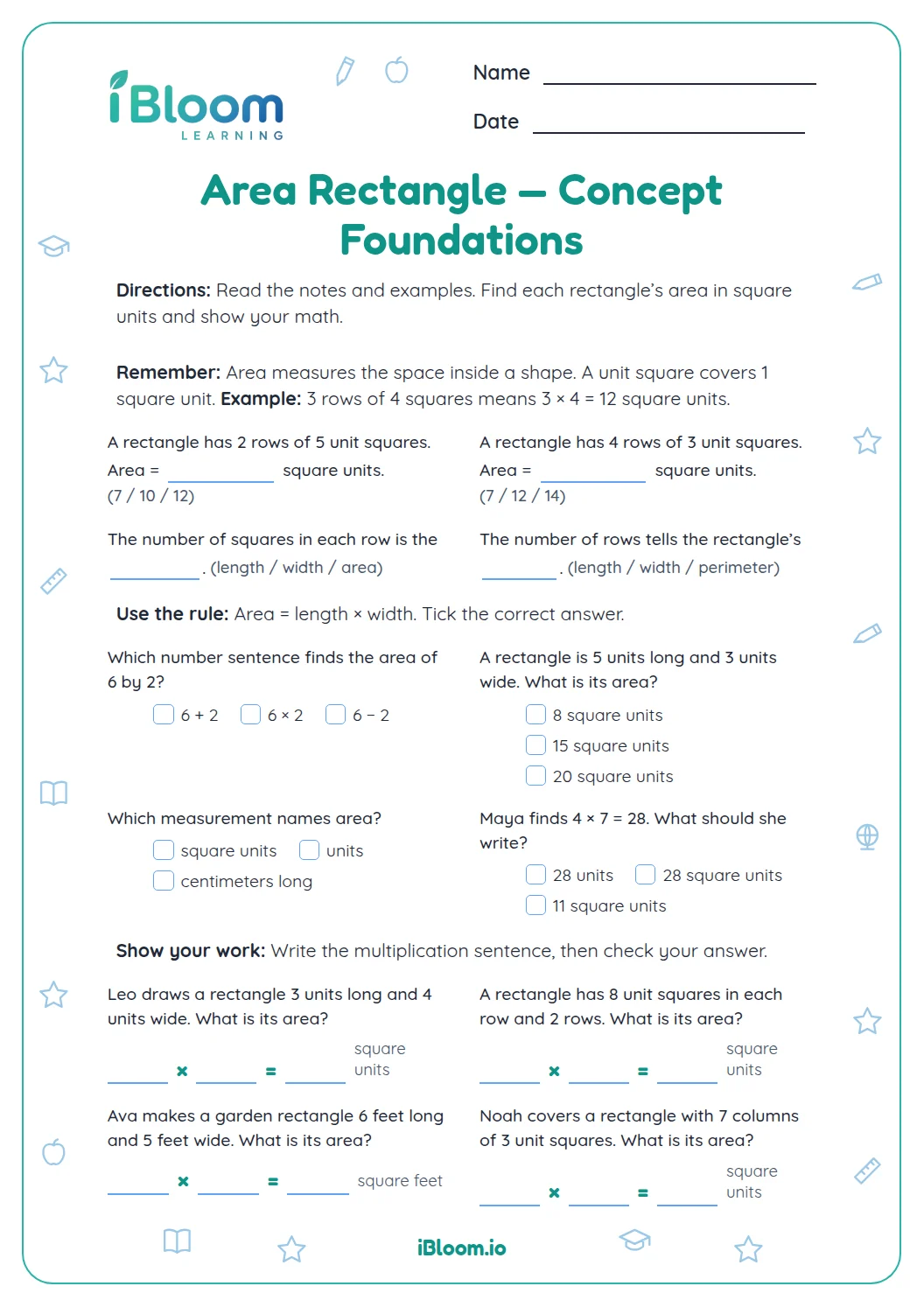
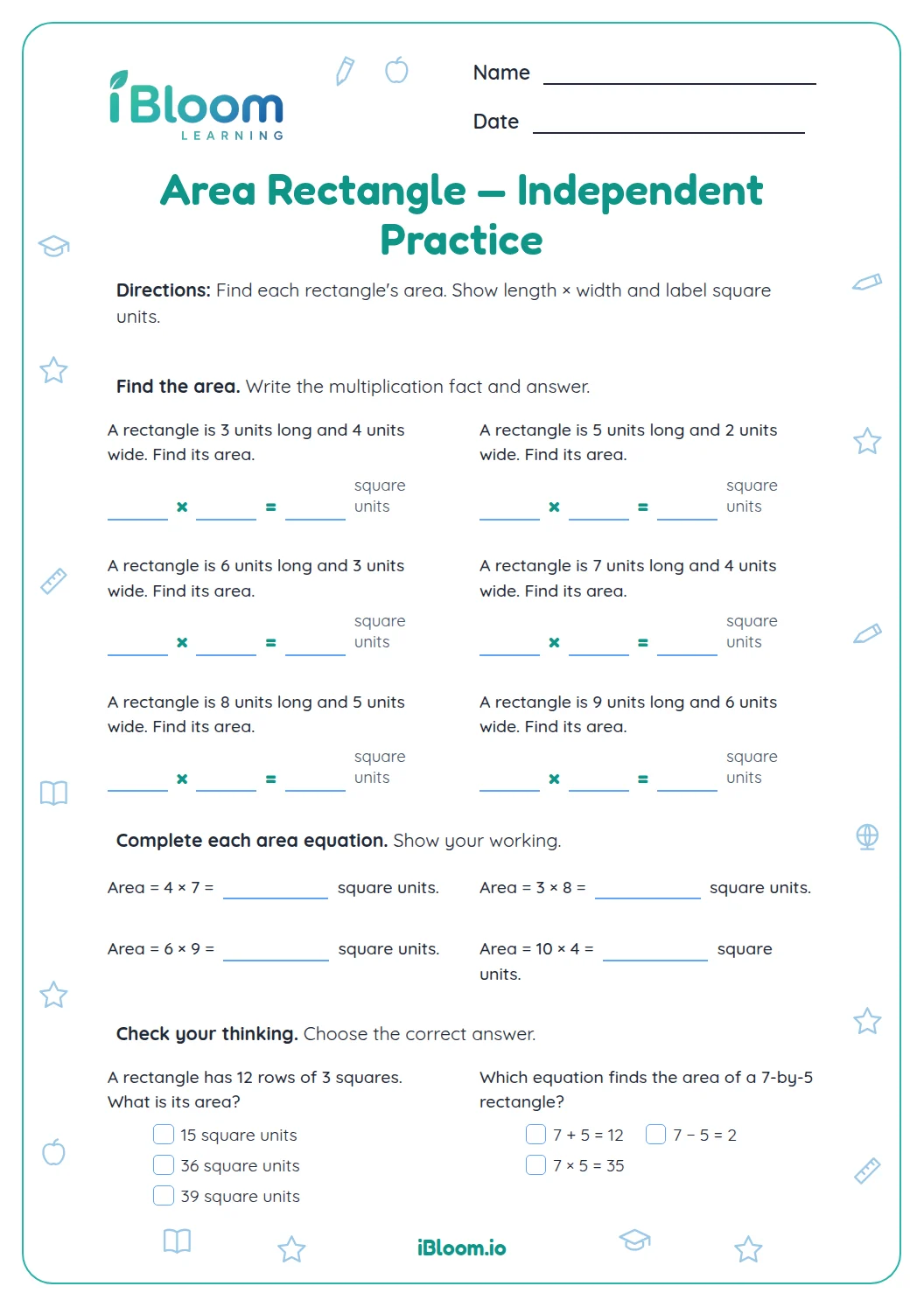
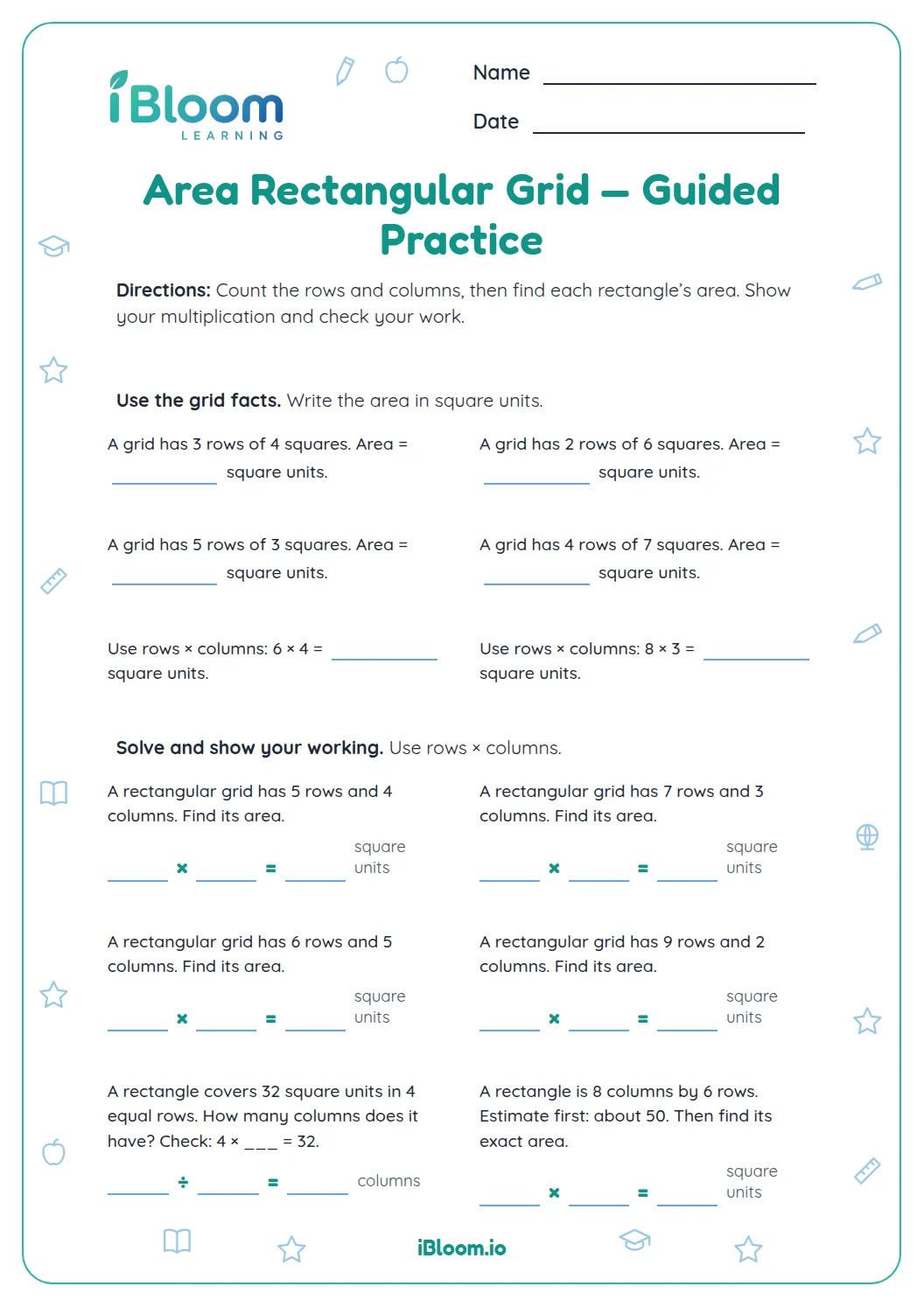
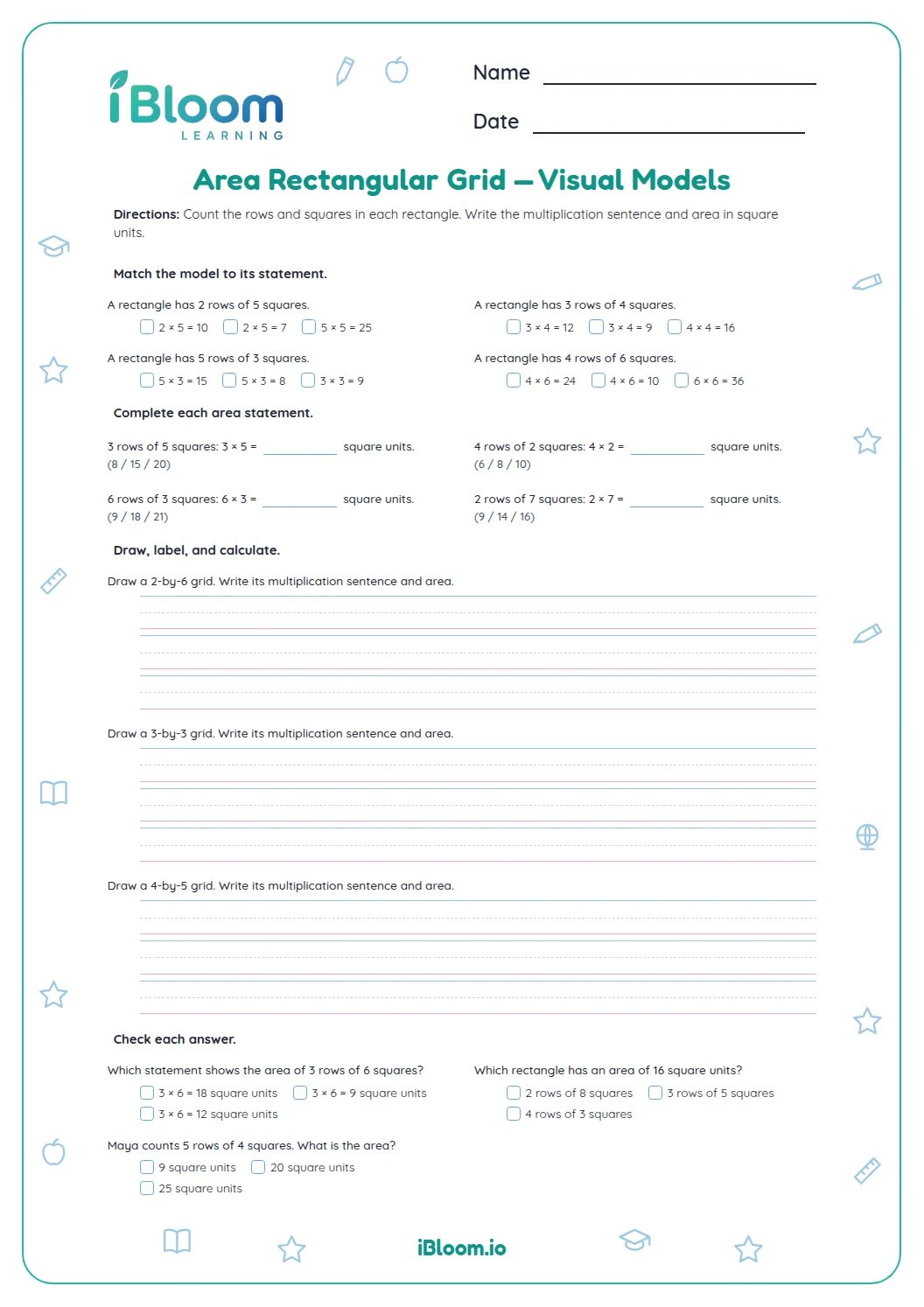
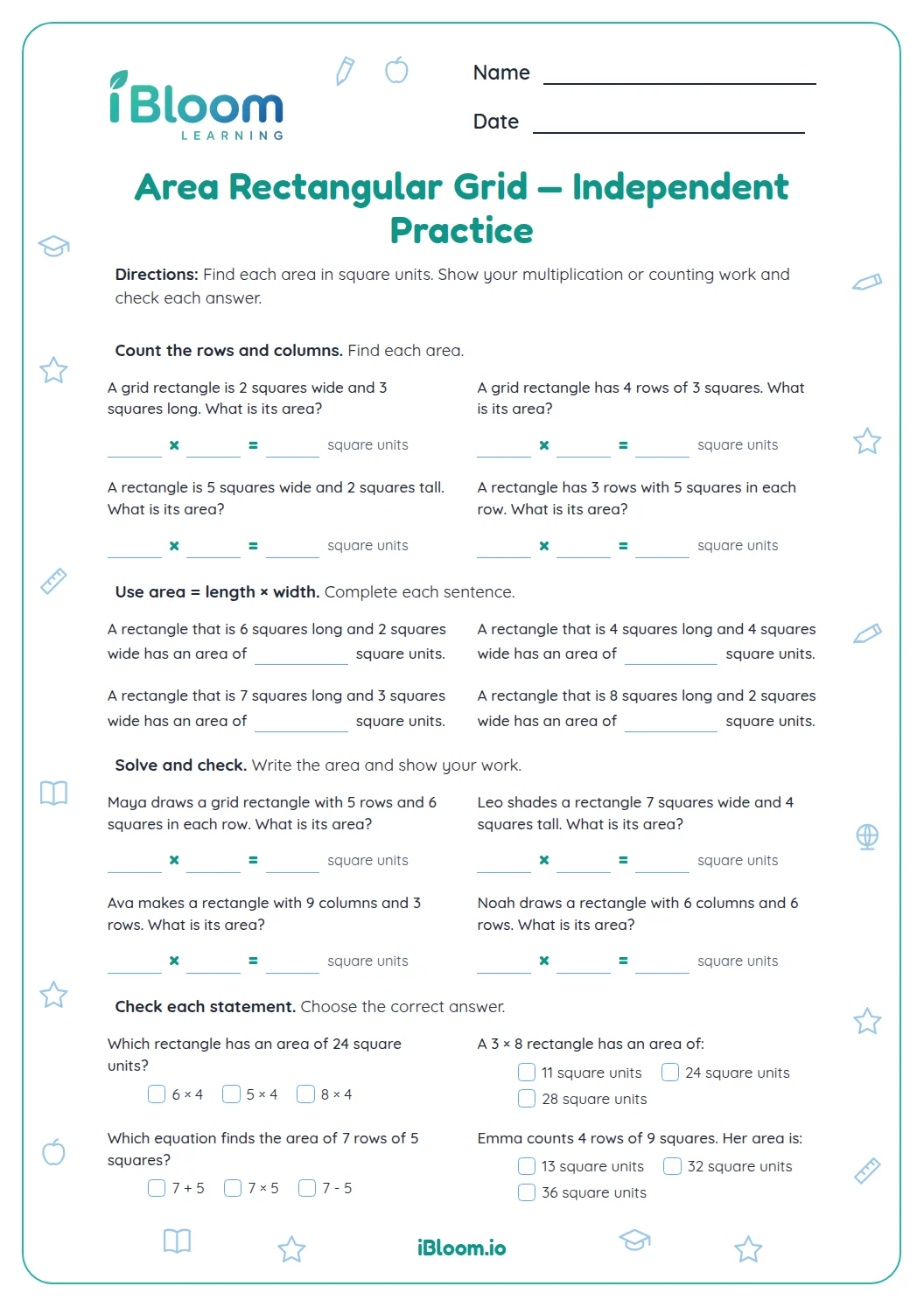
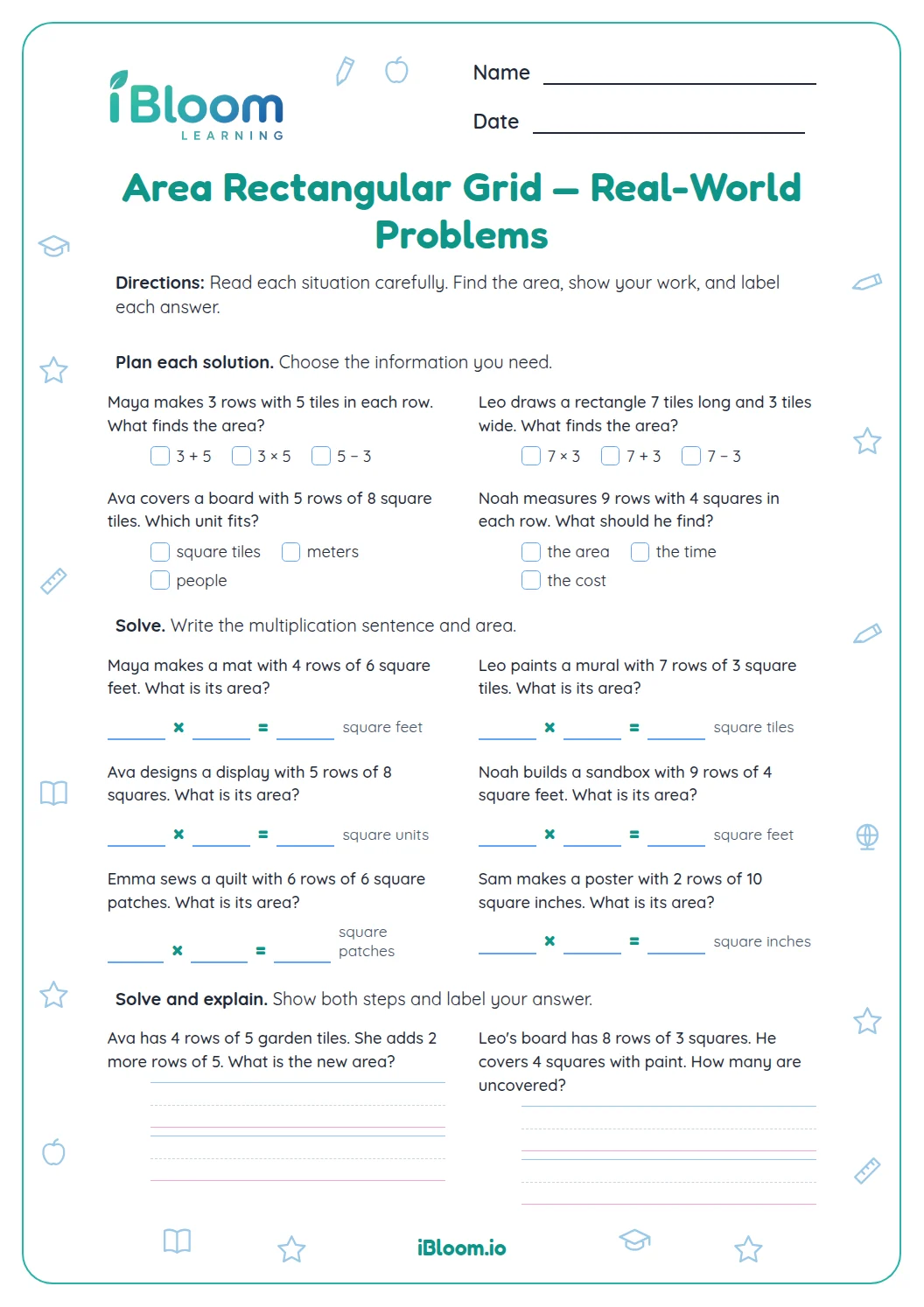
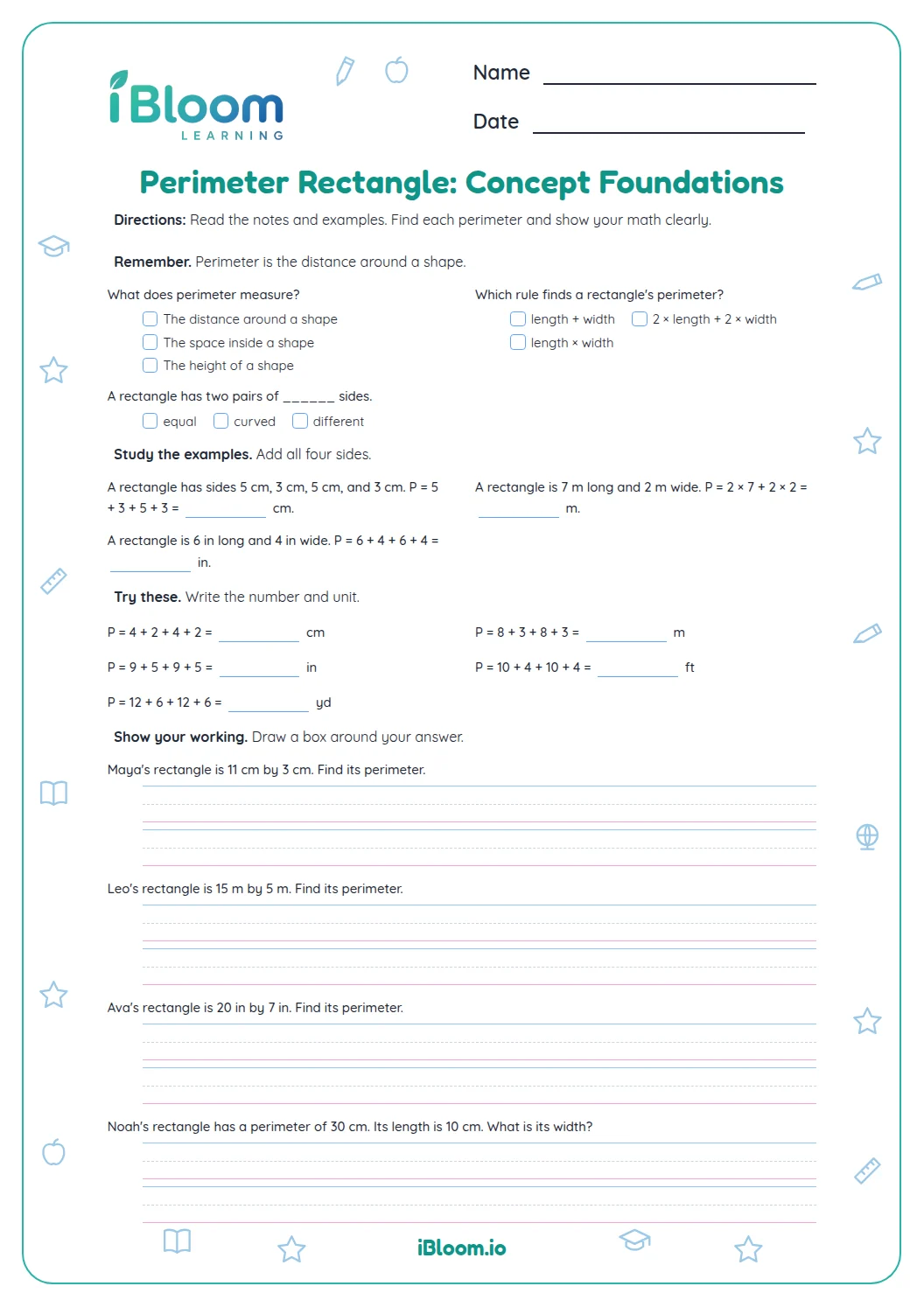
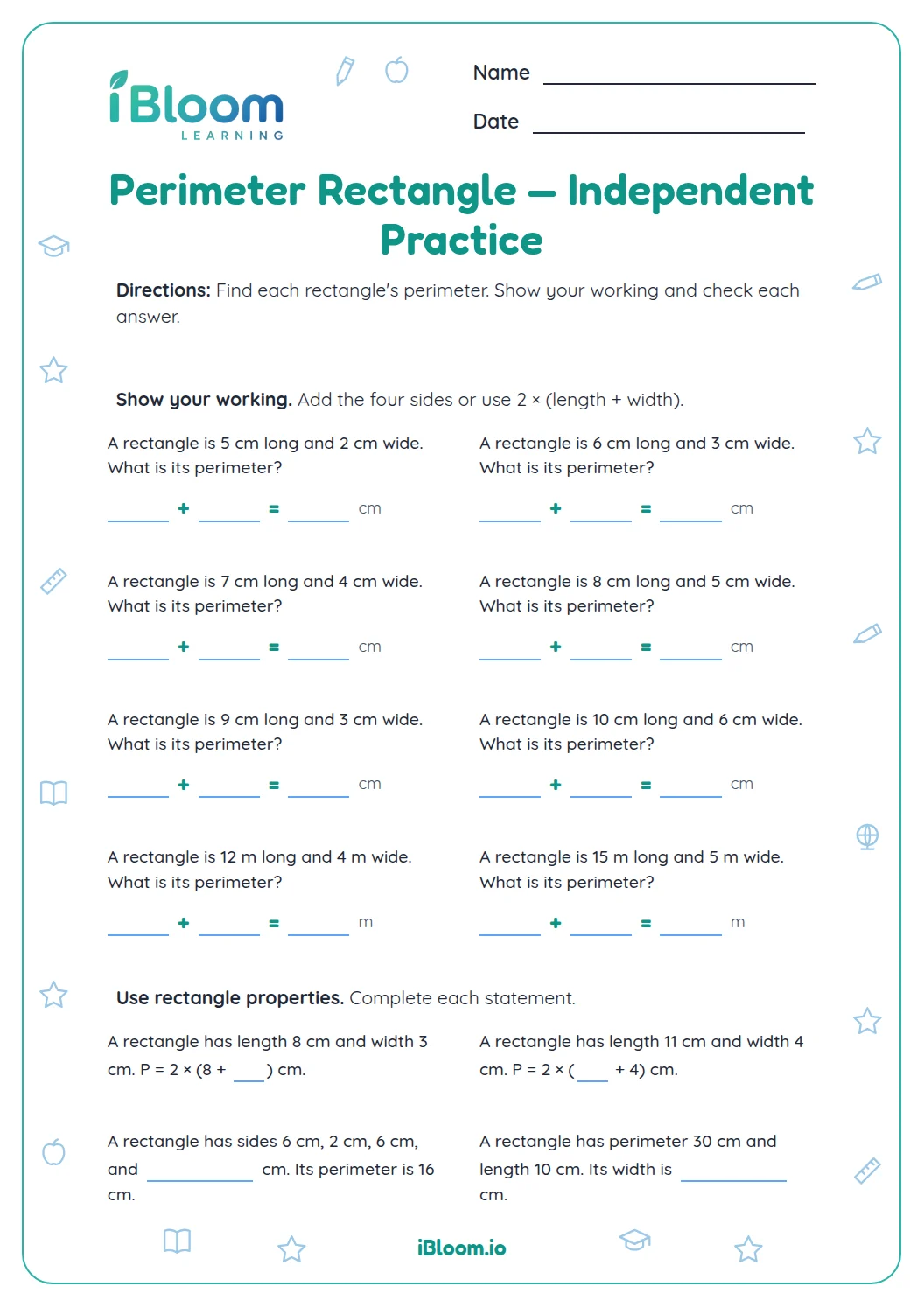
This Grade 3 worksheet gives 14 independent problems about rectangle area and perimeter. One problem uses a grid model; the others give side lengths for practice build fluency with side lengths alone. Children connect rows and columns to multiplication and count all four sides for perimeter. It aligns with CCSS 3.MD.C.7 and comes with a separate answer key.
Aligned to 3.MD.C.7
How can a grid show rectangle area?
Multiply the side lengths or count the unit squares inside the grid to find area. For question 1, 4 by 3 units gives 12 square units.
How can children find the perimeter?
Add the four side lengths. In question 1, the sides are 4, 3, 4, and 3 units, so the perimeter is 14 units.
Why do the answers use different units?
Area is measured in square units because it covers a surface. Perimeter is measured in units because it is a length around the boundary.
What should children write for each model?
Each question gives named side lengths. Children use multiplication to find area and addition to find the distance around the rectangle.
How to use this worksheet
- 1Look at the side lengths named in each question.
- 2Use rows times columns to find the number of square units.
- 3Add both pairs of equal sides to find perimeter.
- 4Write area and perimeter as two labeled answers.
- 5Check that area uses square units and perimeter uses units.
Common mistakes and quick fixes
The mistake
Using the area as the perimeter.
The fix
Add the four side lengths separately from counting the squares.
The mistake
Writing perimeter in square units.
The fix
Use units for a boundary length and square units for area.
The mistake
Counting only the shaded squares in one row.
The fix
Multiply the number of rows by the squares in each row.
Common Core alignment
This worksheet gives focused practice with the reading and math skills described below.
Relate rectangle area to multiplication and addition.
On this sheet: Relate rectangle area to multiplication and addition.
Show the official wordingHide the official wording
Relate area to the operations of multiplication and addition.
What to practice next
Make more practice
Further reading
Questions parents and teachers ask
What is the difference between area and perimeter?
Area measures the square units covering the inside of a rectangle. Perimeter measures the distance around its outside edge. For a rectangle that is 4 by 3 units, the area is 12 square units and the perimeter is 14 units.
How can students find rectangle area?
Multiply the side lengths or count the unit squares in the grid model. For example, 4 rows of 3 squares make 12 square units. The worksheet repeats this relationship with different side lengths so children can connect multiplication with the covered space.
How can students find rectangle perimeter?
Add all four sides, or double the length and double the width, then add those two amounts. A 4-by-3 rectangle has sides 4, 3, 4, and 3, so its perimeter is 14 units. Perimeter uses linear units, not square units.
Why do area and perimeter use different units?
Area counts square units because it describes how much surface is inside the rectangle. Perimeter is a length, so it uses regular units. Labeling both answers helps children keep the two measurements separate even when they come from the same pair of side lengths.
What is included in the answer key?
The key gives both measurements for all 14 rectangles. It lists area first in square units and perimeter second in units. Children can compare each result with the side lengths, then check that their multiplication and addition describe the same rectangle.