
About this worksheet
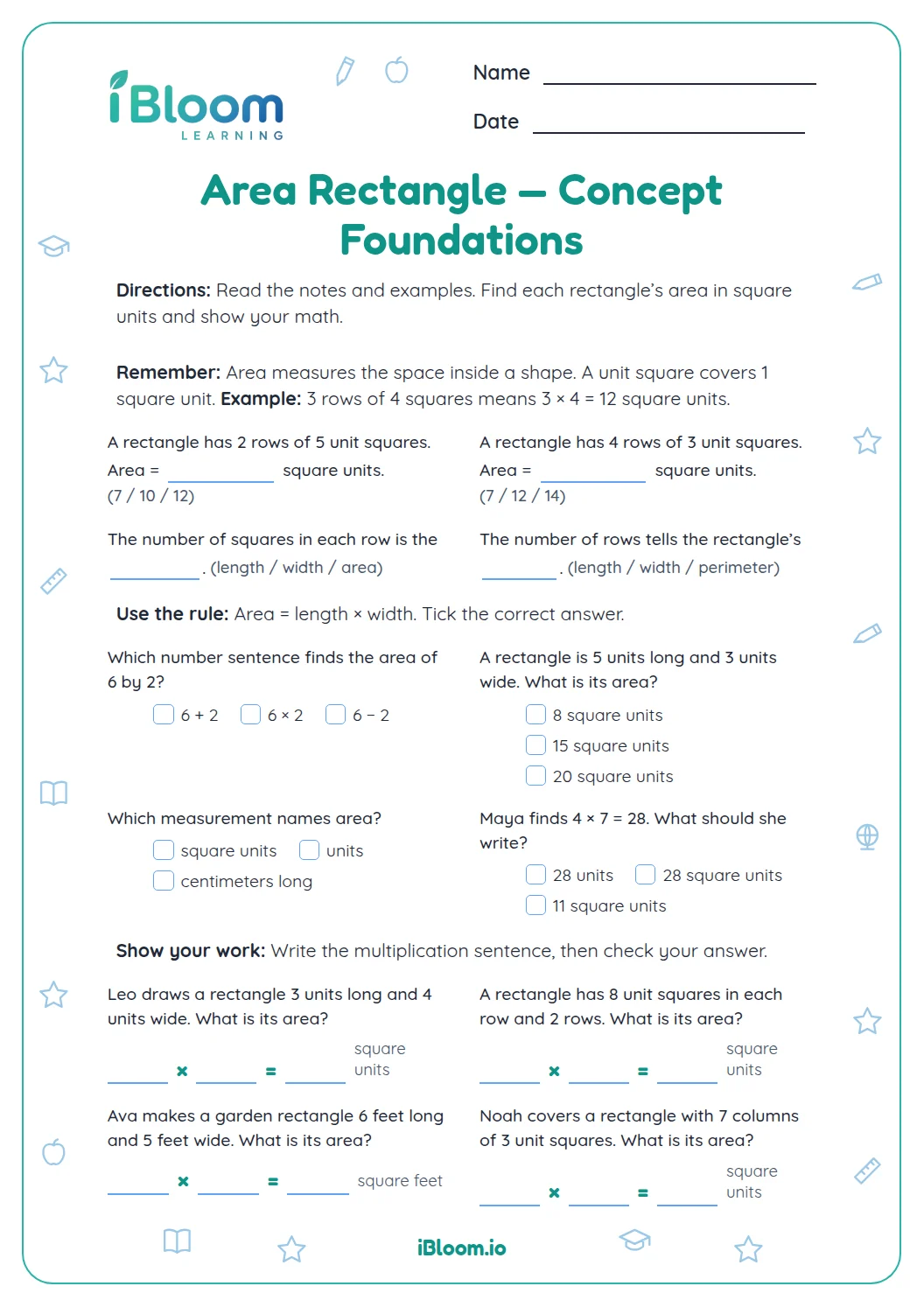
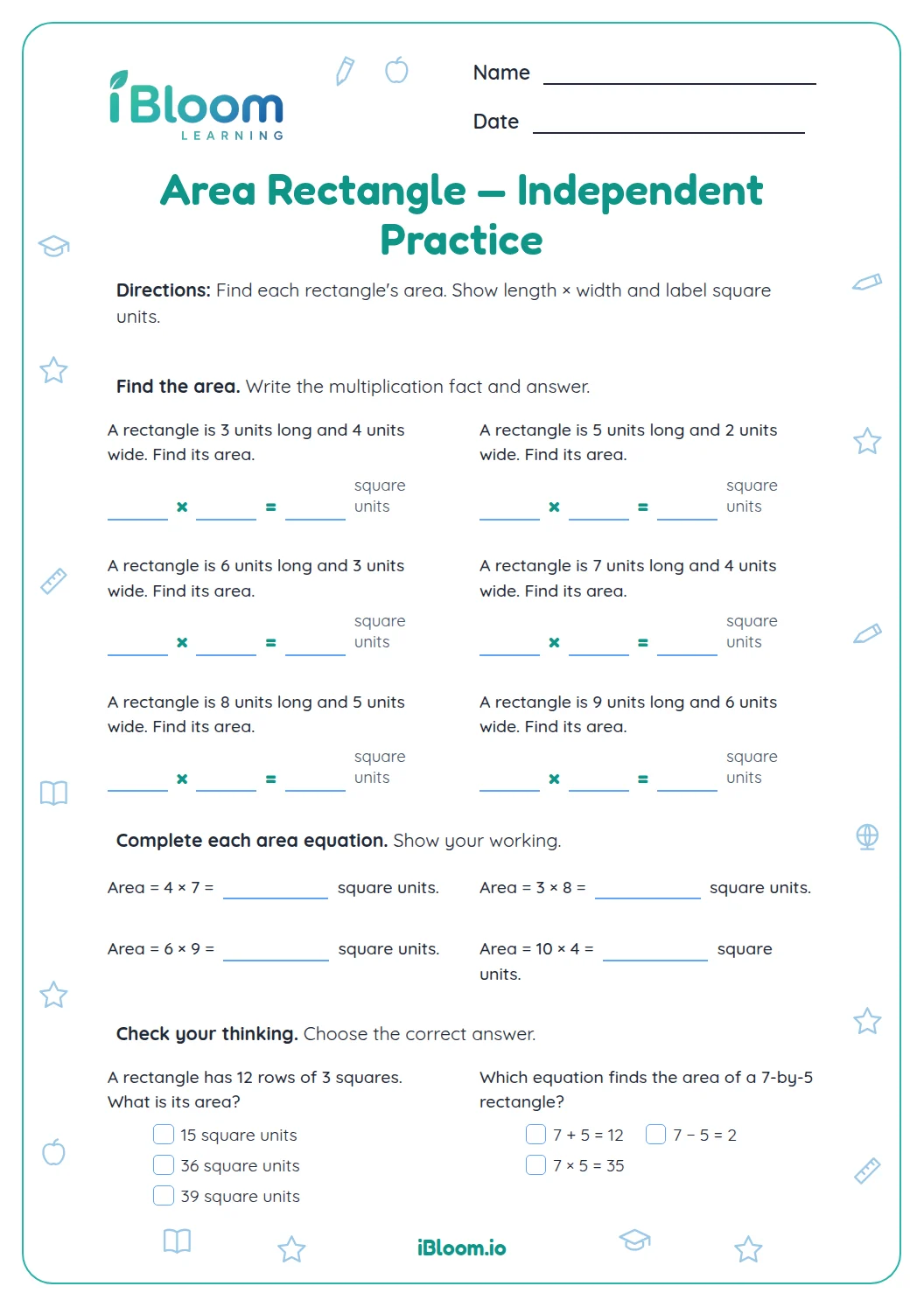
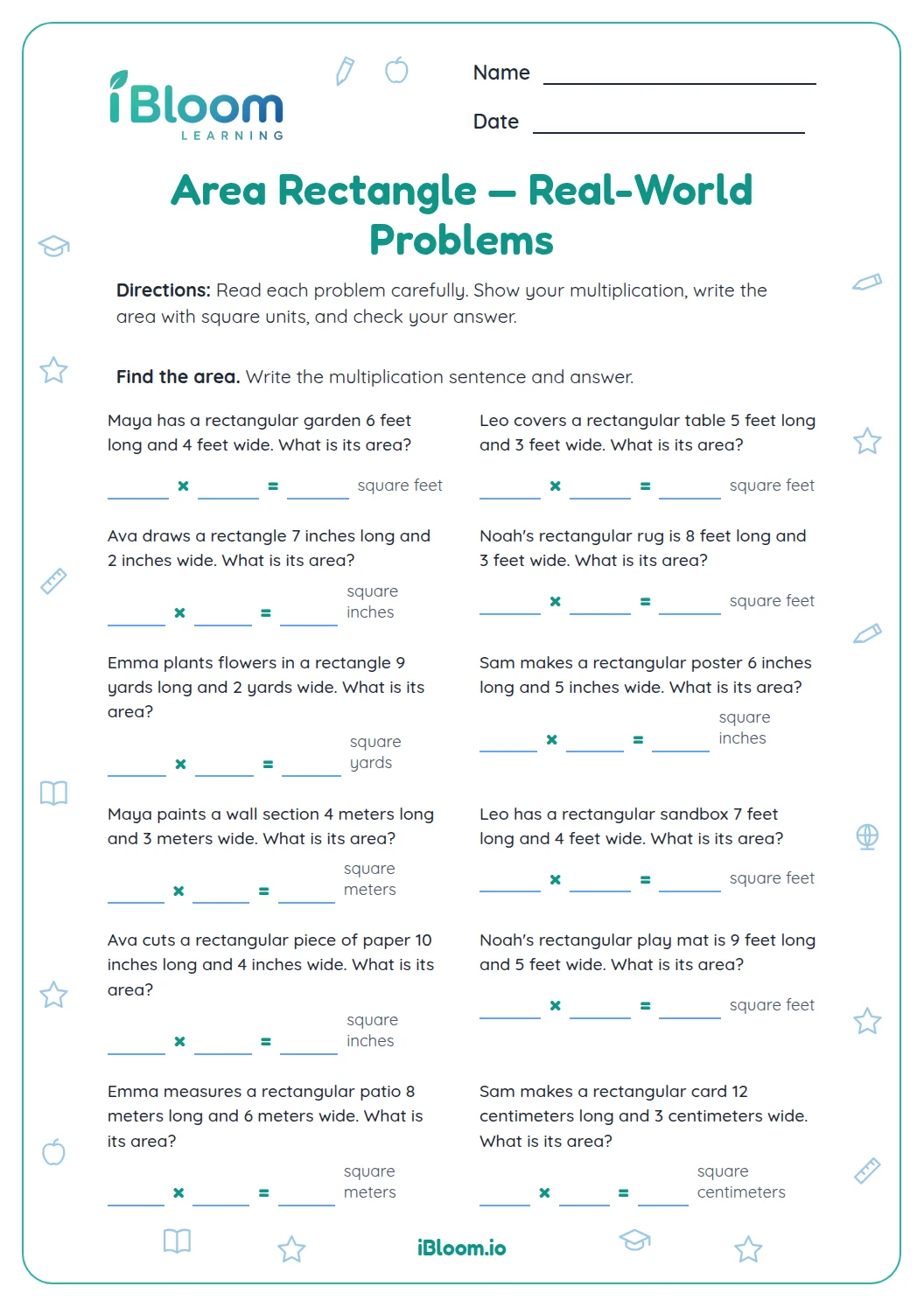
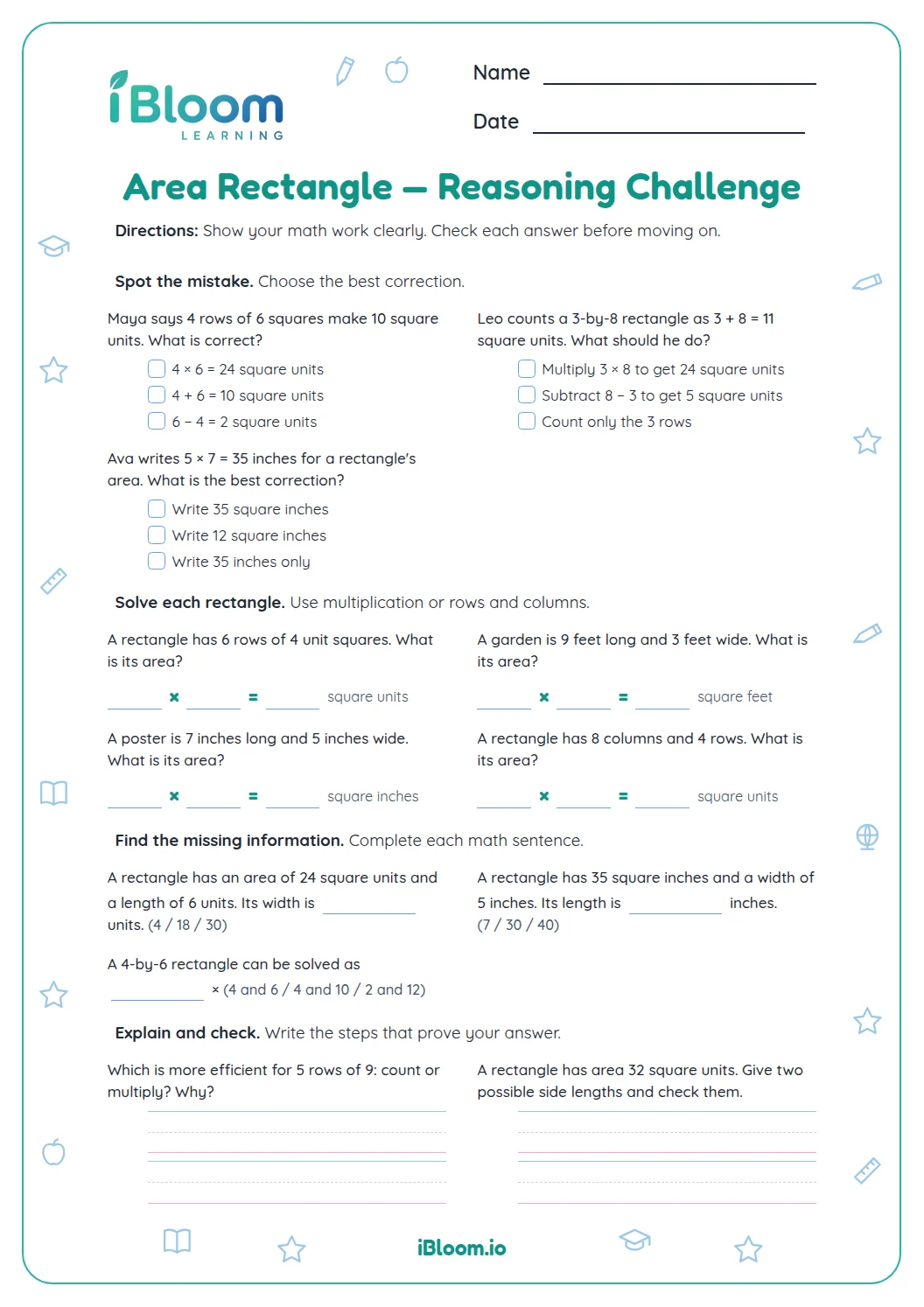
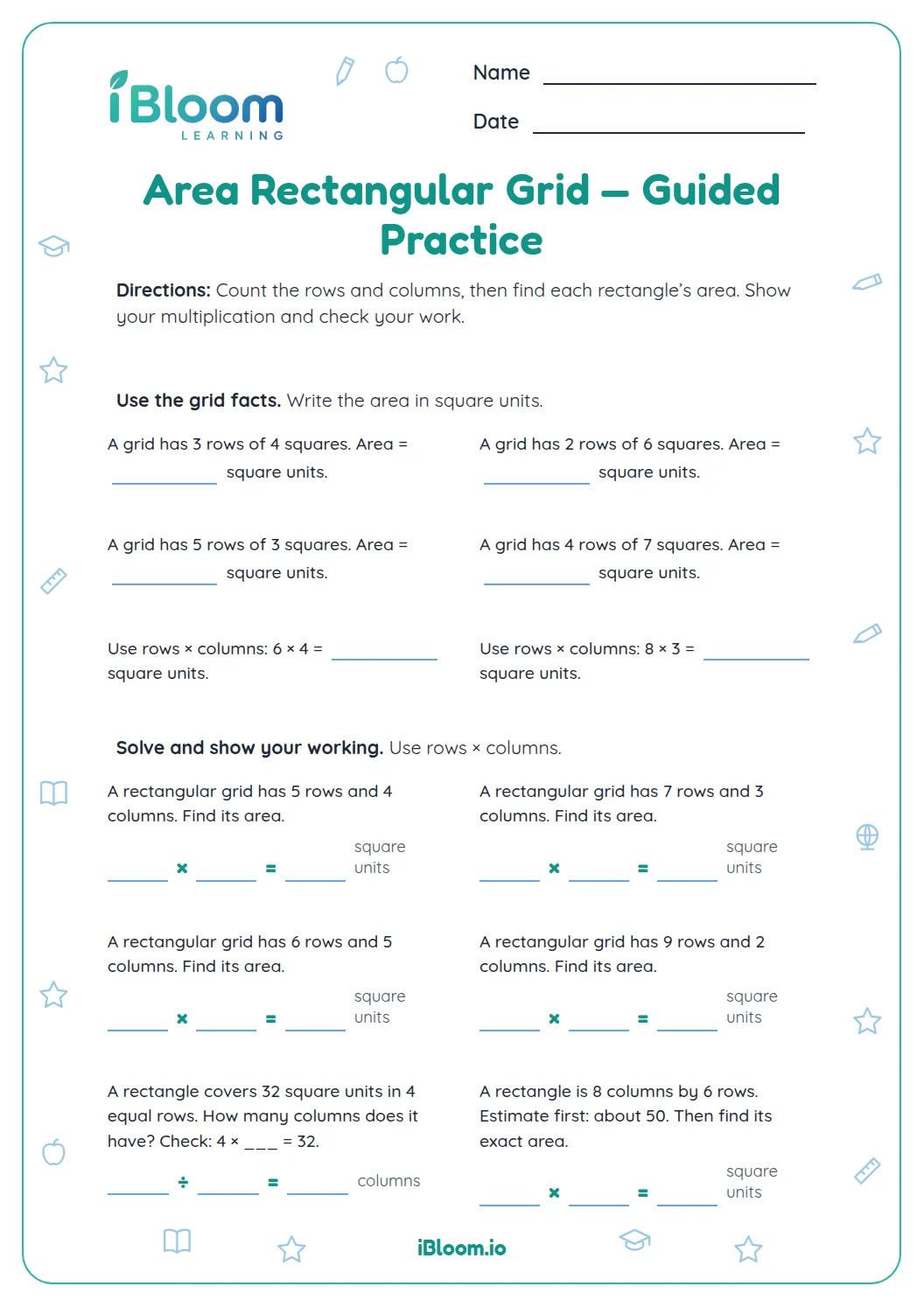
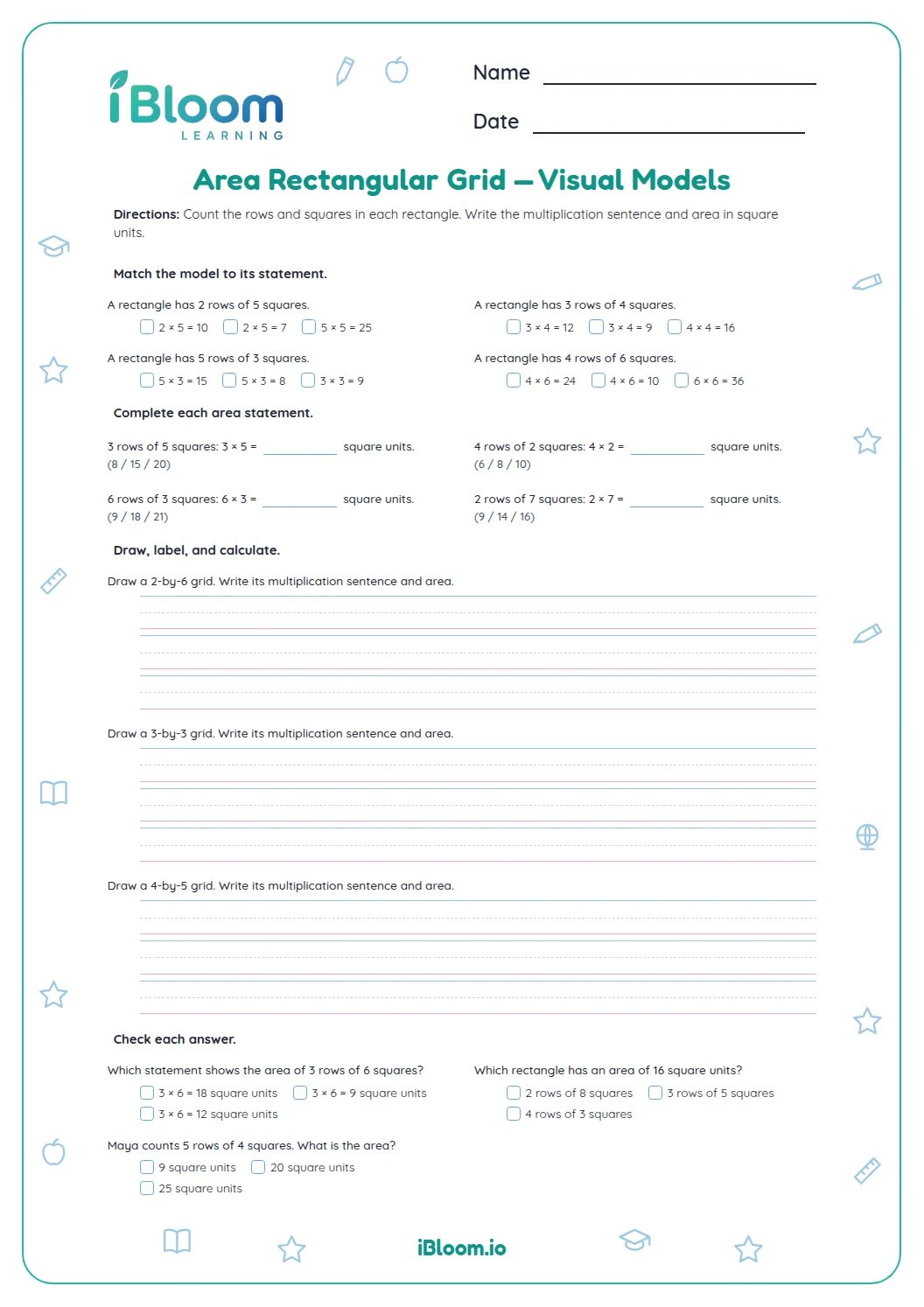
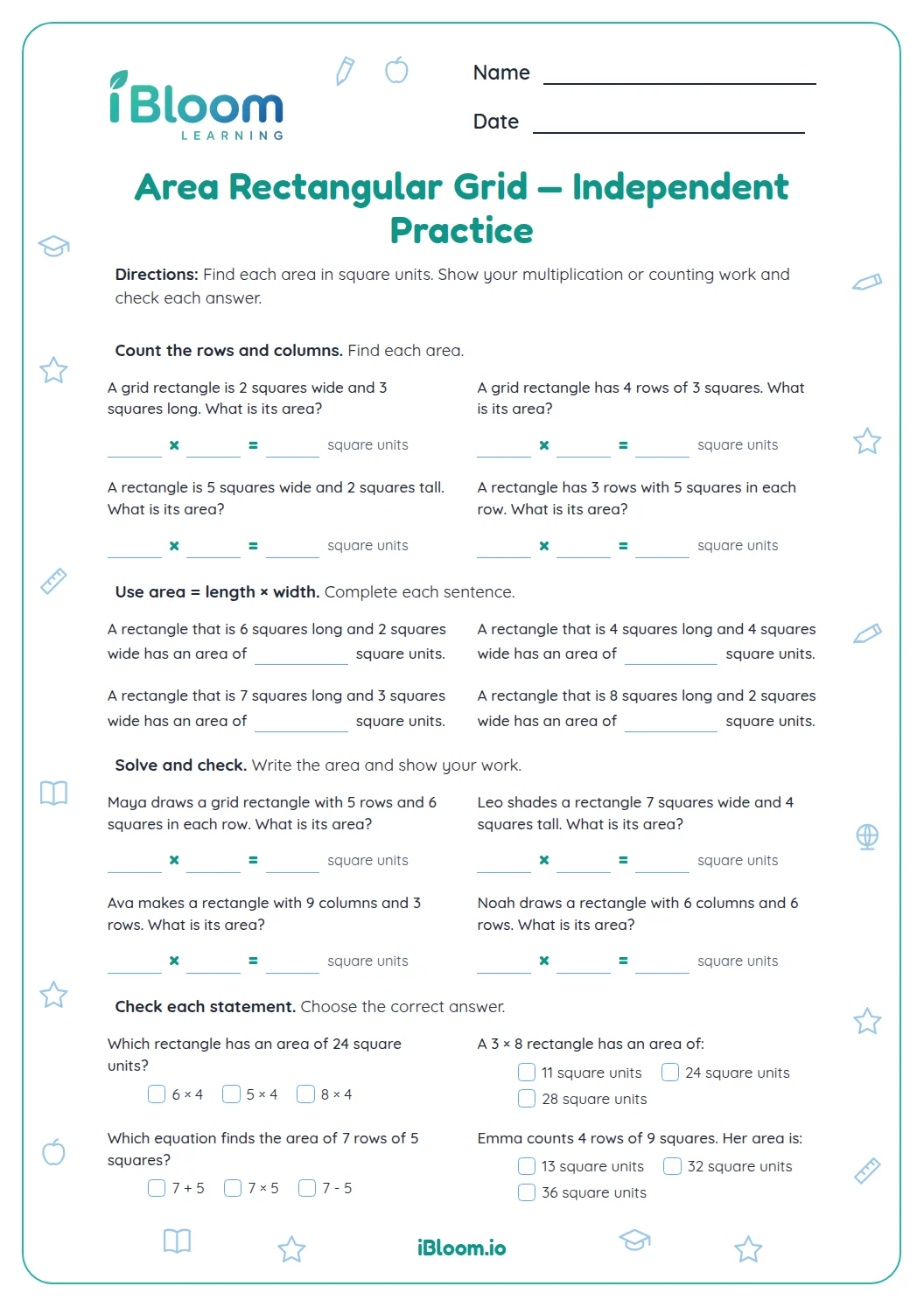
This free Grade 3 worksheet gives children 14 guided questions about rectangle area. It starts with shaded unit-square grids, then moves to multiplying whole-number side lengths in practical settings such as a garden bed, poster, tabletop, and banner. The work practices CCSS 3.MD.C.7 by linking rows and columns with multiplication and labeling area in square units. A separate answer key is included.
Aligned to 3.MD.C.7
How do rows of squares show area?
A rectangle filled with unit squares has rows and columns. Multiplying the number of rows by the number of columns gives the same total as counting every square.
Question 1 shows 2 rows with 3 squares in each row: 2 × 3 = 6 square units.
- 12 rows × 3 squares in each row
- 22 × 3 = 6
- 3Area = 6 square units
How do side lengths help find area?
For a rectangle, multiply its length by its width. Keep square units in the answer because area measures how many unit squares cover the surface.
For question 6, 8 feet × 3 feet = 24 square feet. The units describe the covered surface.
How can you check an area answer?
Check that you multiplied the two side lengths and that the product is reasonable. A rectangle that is 9 by 7 has more than 9 square units and fewer than 70.
How to use this worksheet
- 1Read the two side lengths or count the rows and columns in the model.
- 2Write a multiplication sentence with one side length in each factor.
- 3Multiply to find the number of unit squares.
- 4Label the answer in square units when the story gives a unit.
- 5Estimate or use a grid to check that the product makes sense.
Common mistakes and quick fixes
The mistake
Adding the side lengths, such as 6 + 4, instead of finding how many squares cover the rectangle.
The fix
Use a grid: 6 rows of 4 squares means 6 groups of 4, or 24.
The mistake
Writing “24 feet” for a floor area.
The fix
Area uses square units, so write “24 square feet.”
The mistake
Counting only one row of a tiled rectangle.
The fix
Count equal rows, then multiply rows by squares in each row.
Common Core alignment
This worksheet practices the following skills.
Relate rectangle area to multiplication using models and real-world side lengths.
On this sheet: Shaded grids let children compare counting unit squares with multiplying rows by columns.
Show the official wordingHide the official wording
Relate area to the operations of multiplication and addition.
What to practice next
Make more practice
Further reading
Questions parents and teachers ask
What does area measure?
Area tells how many unit squares cover the inside of a flat shape. On this sheet, children find rectangle area by counting equal squares or multiplying the number of rows by the number in each row. Answers in stories use square units, such as square feet or square inches.
How do you find the area of a rectangle?
Multiply its length by its width. For example, question 6 has a garden bed that is 8 feet long and 3 feet wide, so 8 × 3 = 24 square feet. A grid can help a child see why the multiplication counts all the unit squares.
Why does area use square units?
A unit square is a small square used to cover a surface without gaps or overlaps. Counting those squares measures the surface. That is why question 10’s tabletop area is given in square feet, not simply feet, which would describe a length.
How is a grid model useful?
A grid makes each unit square visible. Children can count the squares in one row, then see that the same row repeats. Question 1 shows 2 rows of 3 squares, so 2 × 3 = 6. The later problems connect this model to side lengths and practical area questions.
What should a child do if the side lengths are reversed?
The order of the factors can switch without changing the product: 6 × 4 and 4 × 6 both equal 24. Match each dimension to one factor, multiply, and include the appropriate square unit in a word problem.
Does the worksheet include an answer key?
Yes. The separate key gives the area for each of the 14 questions, including square-unit labels for the story problems. Children can work through the models first, then use the key to check calculations and labels. It also shows the final unit label for each story so the child can review both the product and what it measures.