
About this worksheet
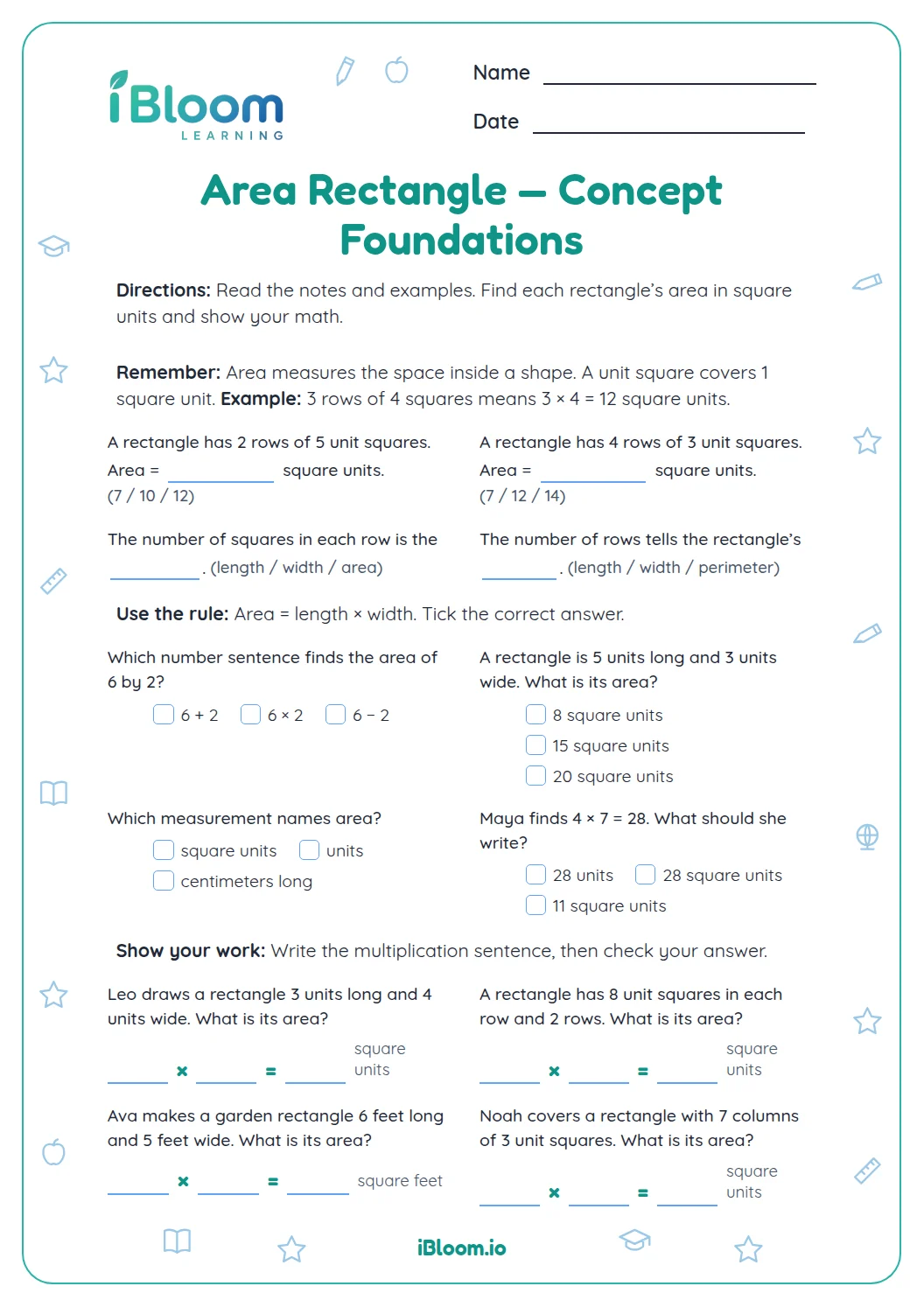
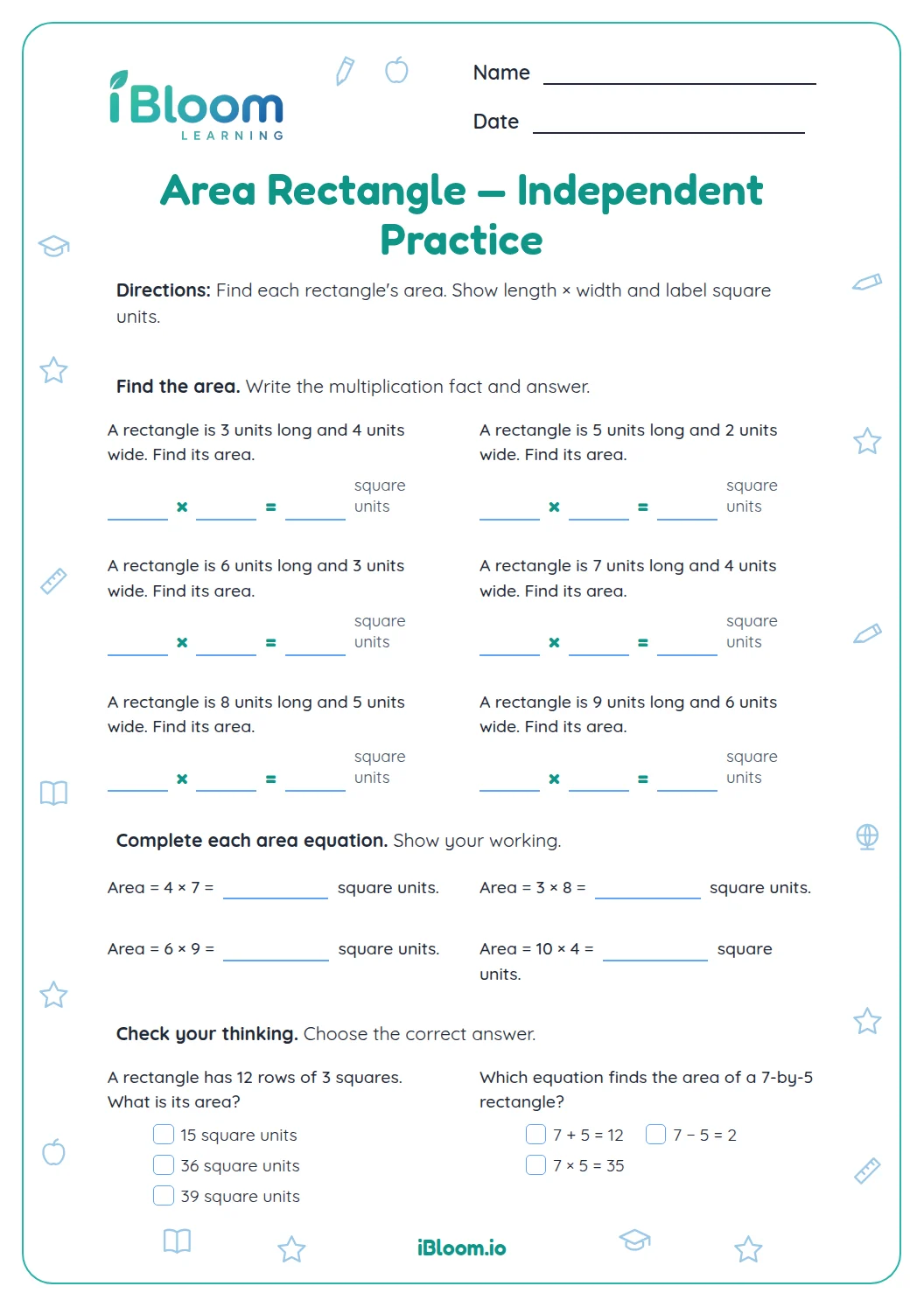
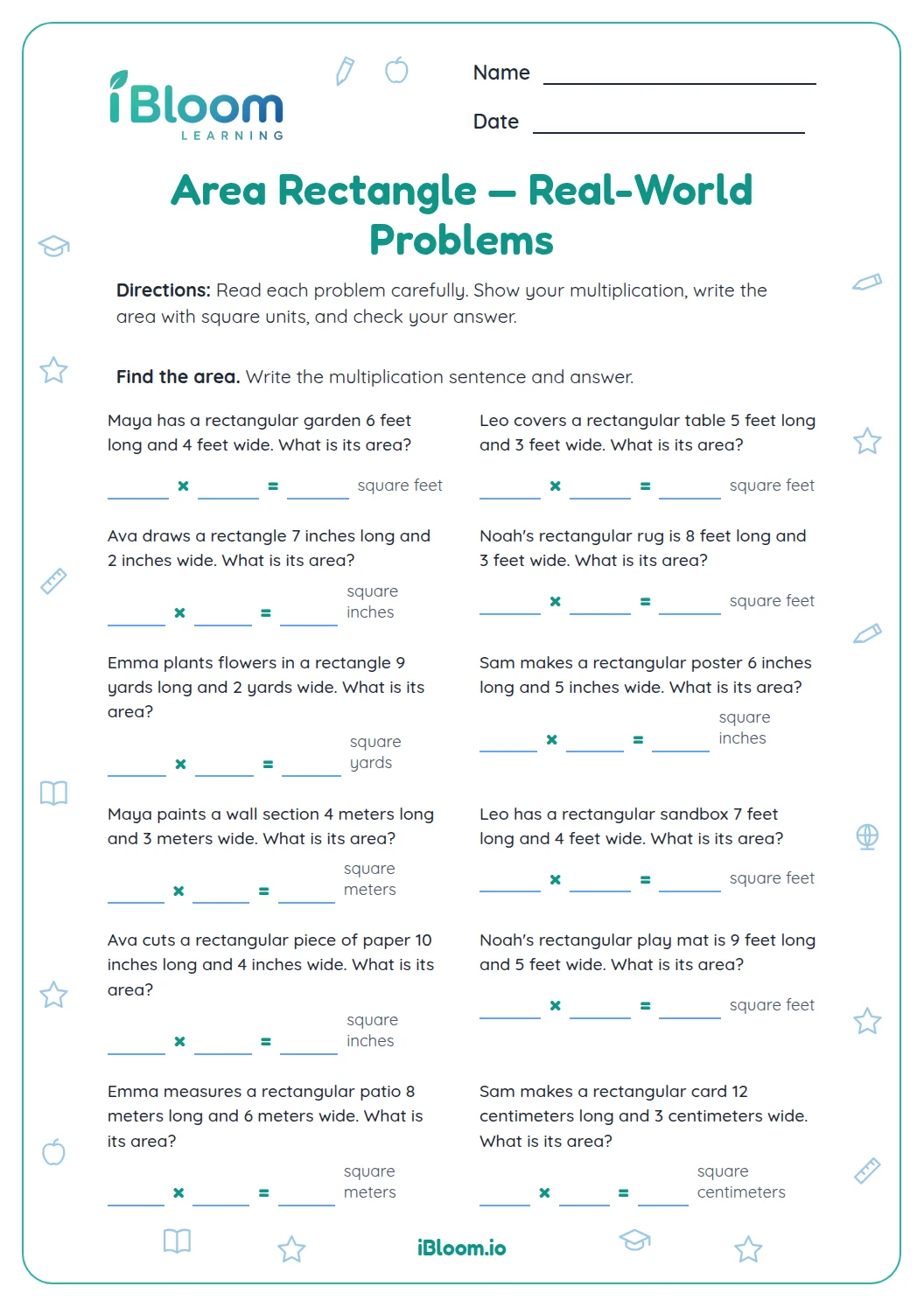
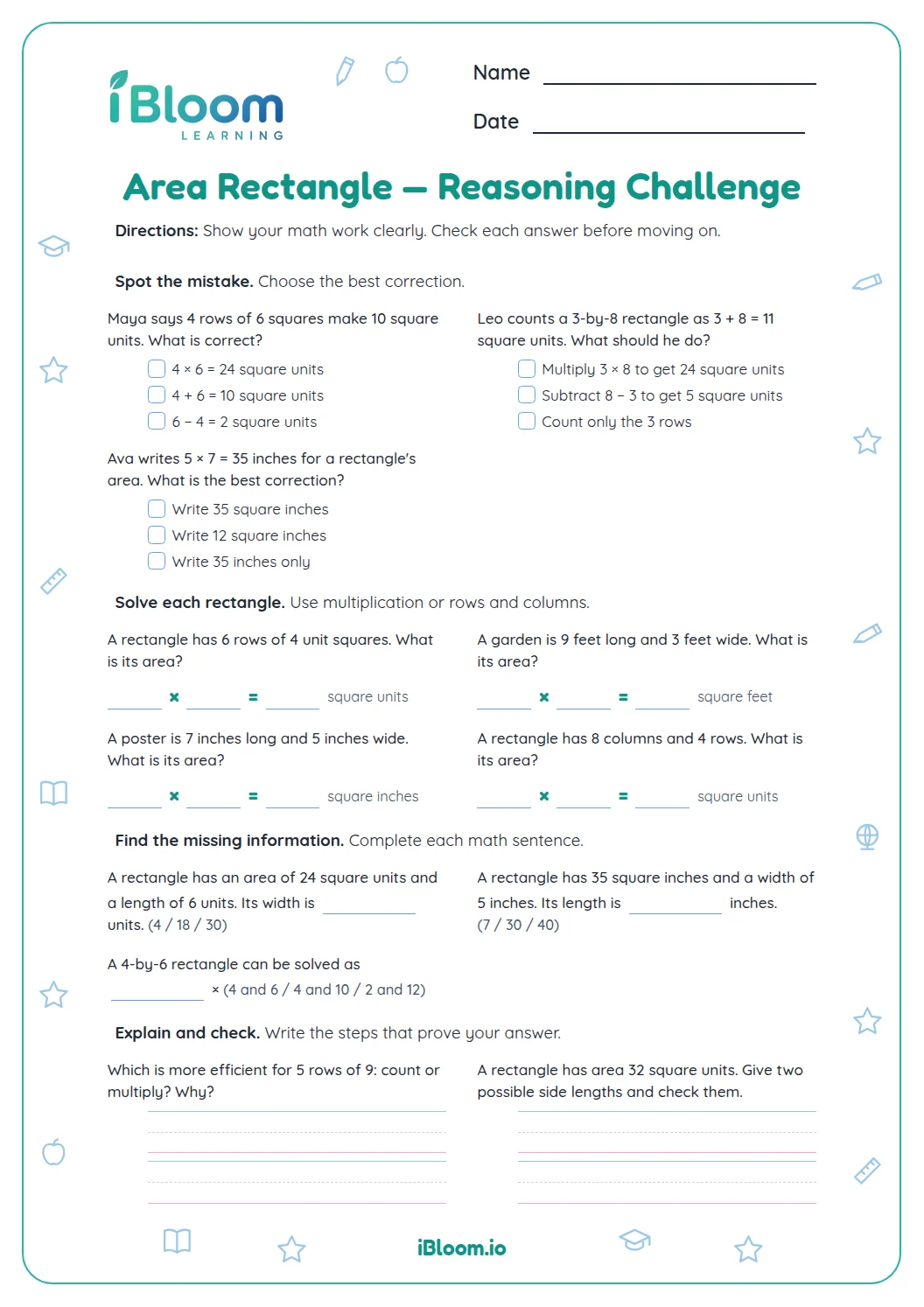
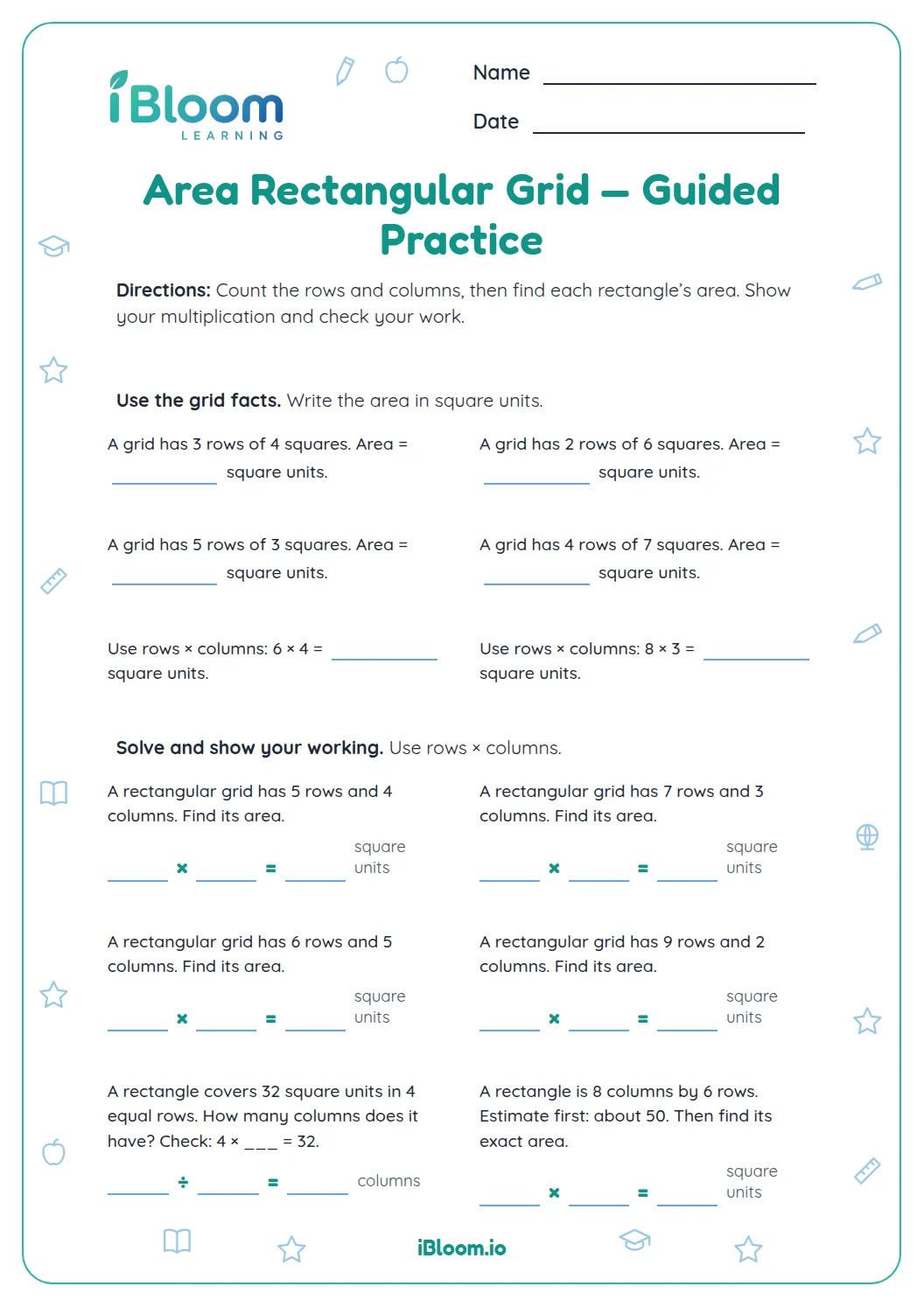
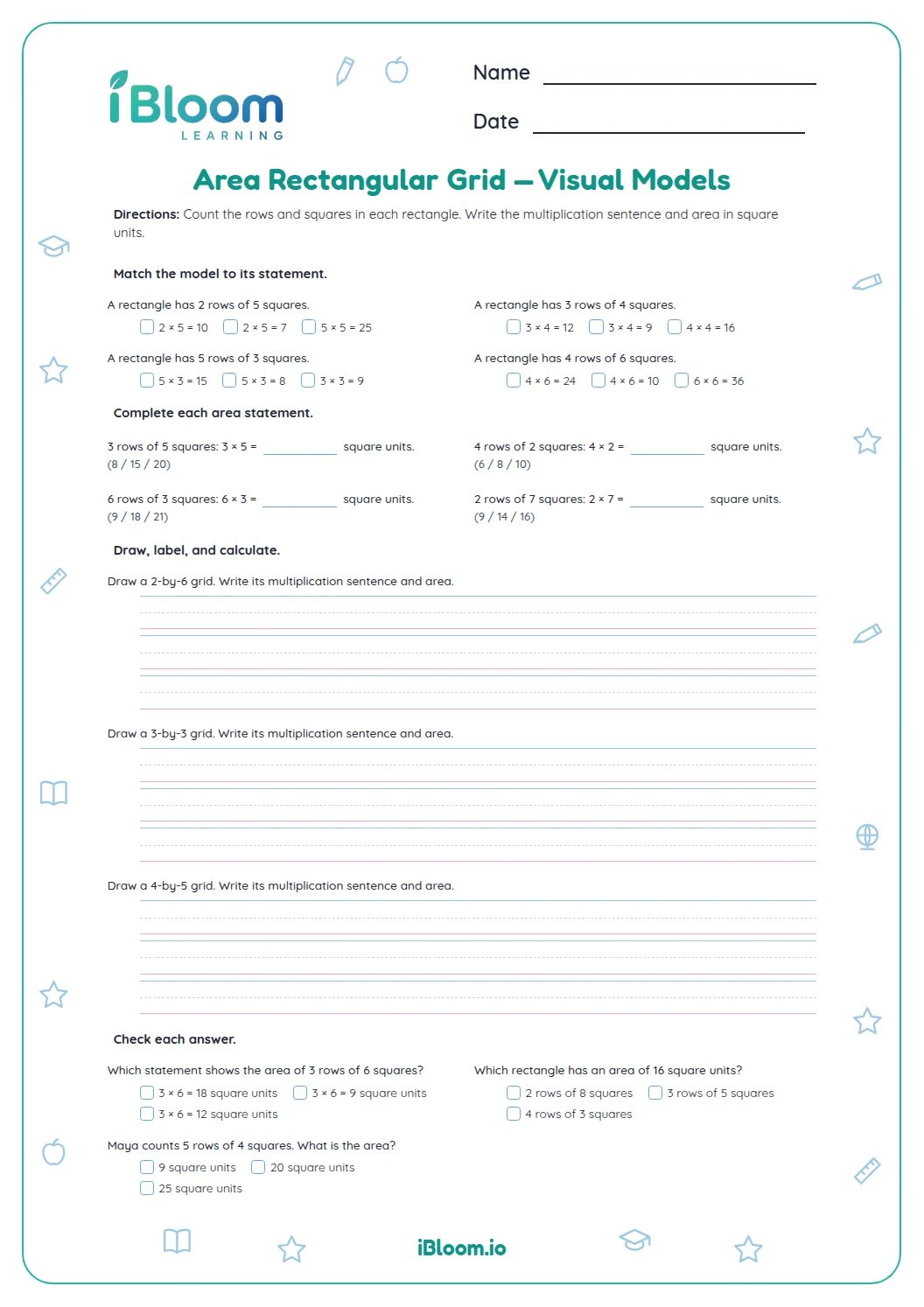
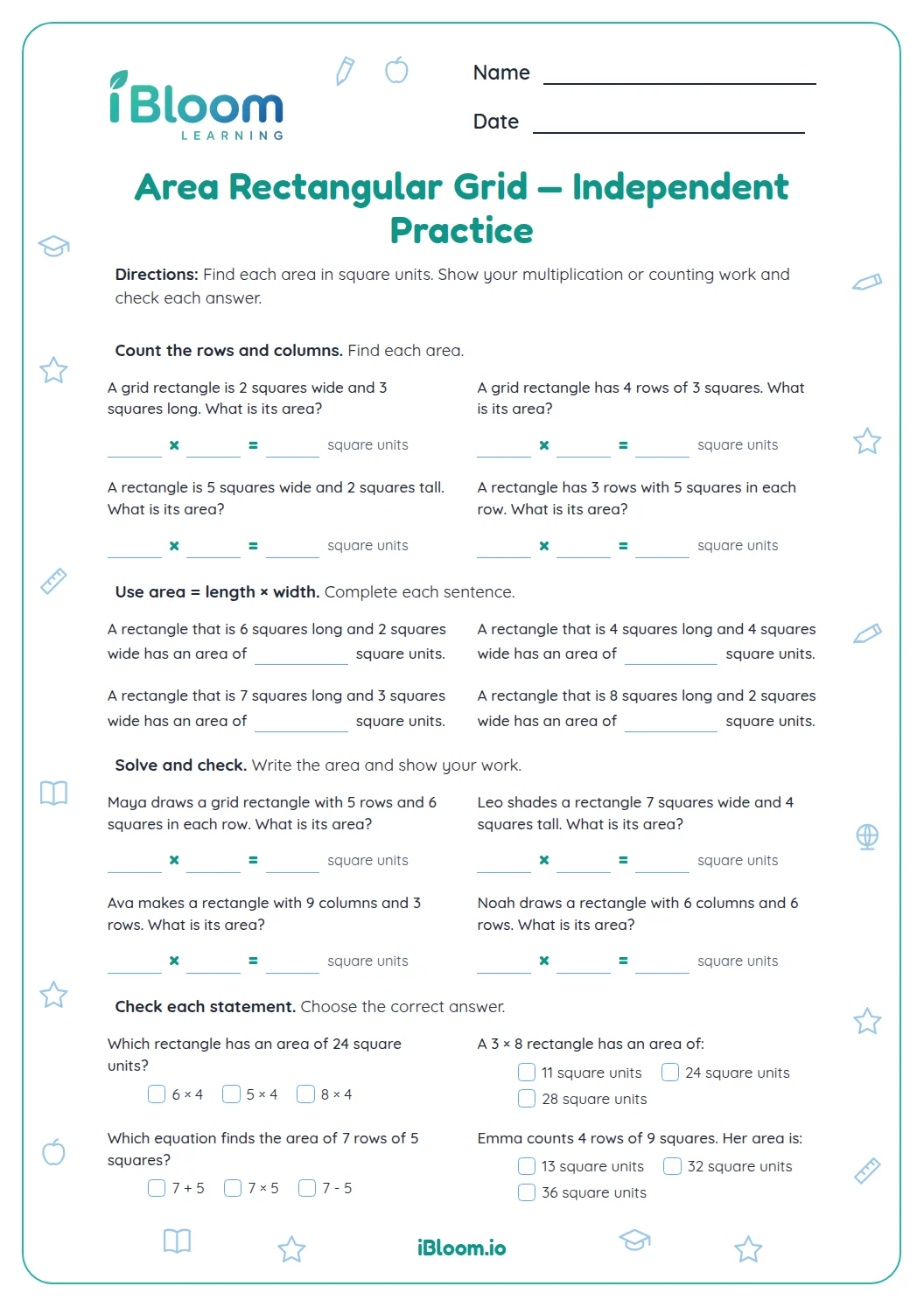
This free Grade 3 printable teaches rectangle area through the unit-square model and multiplication. Students count a shaded 4-by-3 rectangle, multiply row and side lengths, and solve area situations with square units. Fourteen questions fill two worksheet pages; the answer key is two pages. The practice aligns with Common Core 3.MD.C.7, relating area to multiplication and addition.
Aligned to 3.MD.C.7
What is on the area worksheet?
The 14 questions move through two parts. Part A begins by counting unit squares and then connects rows, columns, and side lengths to multiplication. Part B uses those products in rectangle contexts and a split-area expression.
How does the grid show area?
Question 1 shades a rectangle with 4 rows and 3 columns of unit squares. Counting 4 groups of 3 gives 12 square units. This is the same total as 4 × 3.
- 14 rows × 3 columns
- 24 × 3 = 12
- 3The shaded rectangle covers 12 square units.
When can side lengths replace counting?
For a rectangle, the side lengths give the row and column counts. A 7-by-4 rectangle has 7 groups of 4 unit squares, so its area is 28 square units. Multiplication is a quicker way to count every tile.
Why do area answers use square units?
Area counts unit squares covering a surface. A patio measured in meters on each side has area in square meters; a poster measured in inches has area in square inches. When a question gives area and one side, division can find the missing side length.
How to use this worksheet
- 1Count the shaded unit squares in the first model.
- 2Notice how many rows and columns make that total.
- 3Multiply the side lengths for each rectangle.
- 4Use square units for area and linear units for a side length.
- 5Check a product by splitting it into easier groups when helpful.
Common mistakes and quick fixes
The mistake
Adding side lengths to find area.
The fix
Count the unit squares or multiply rows by columns.
The mistake
Counting grid lines instead of square units.
The fix
Count each tile inside the rectangle.
The mistake
Writing a perimeter unit for area.
The fix
Use square units such as square centimeters.
Common Core alignment
These Common Core standards describe the central skills practiced on this page.
Relate the area model to multiplication and addition.
On this sheet: The grids show unit-square tiling and its matching multiplication equation.
Show the official wordingHide the official wording
Relate area to the operations of multiplication and addition.
What to practice next
Make more practice
Further reading
Questions parents and teachers ask
What does the shaded grid in question 1 show?
It shows a rectangle that is 4 unit squares tall and 3 unit squares wide. There are 4 groups of 3 squares, so the area is 12 square units. The grid makes the multiplication equation visible. A quick sketch of rows and columns can confirm the multiplication and units.
How many questions are on the printable?
There are 14 questions in two parts, printed over two worksheet pages. The first questions use the unit-square model and multiplication; later problems apply area to rectangles with side lengths and context. A quick sketch of rows and columns can confirm the multiplication and units.
Is area the same as perimeter?
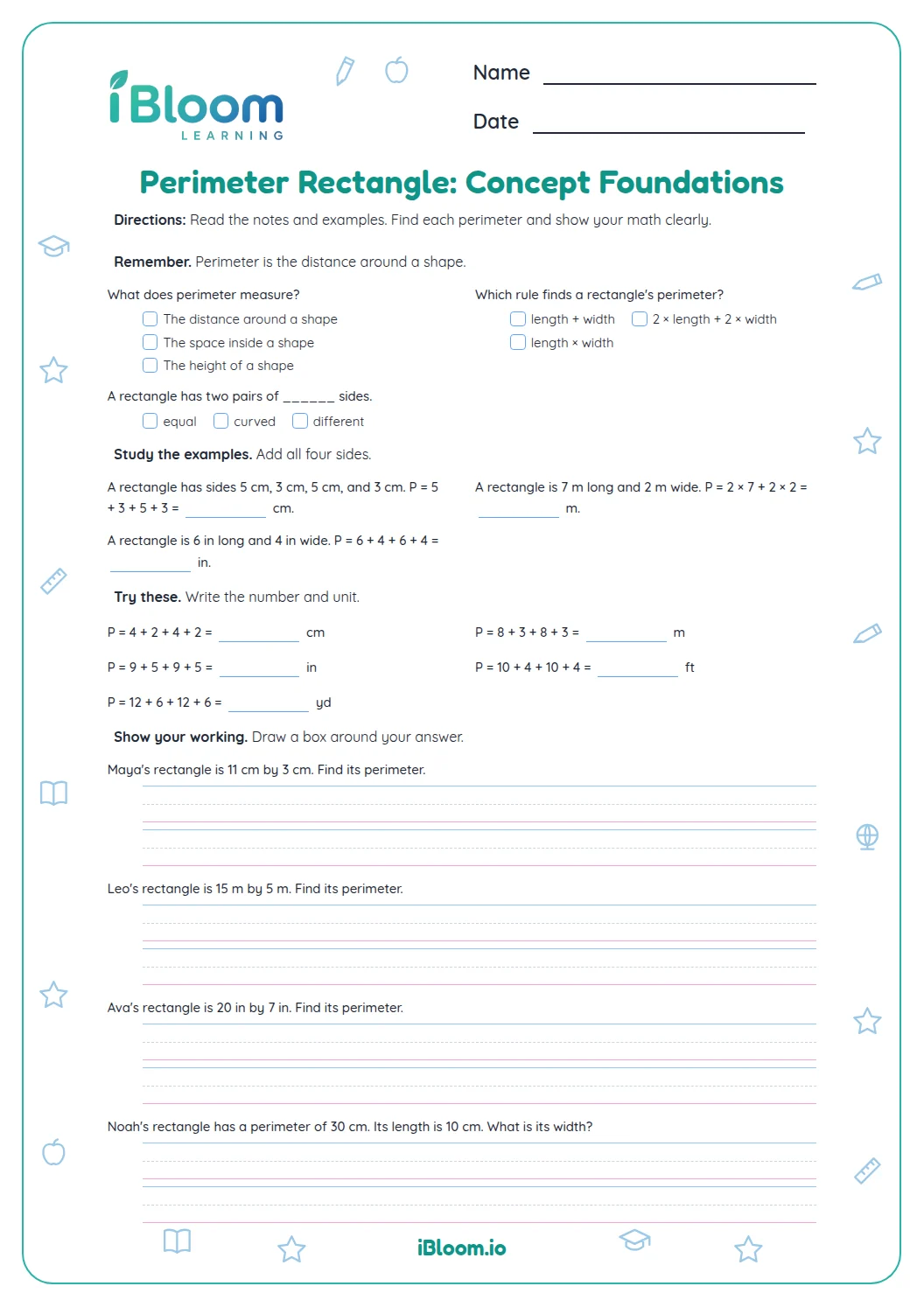
No. Area counts the square units covering the inside of a shape. Perimeter measures the distance around its outside. This worksheet focuses on area, so a 4-by-3 rectangle has 12 square units of area. A quick sketch of rows and columns can confirm the multiplication and units.
Why does question 10 ask for feet long?
That problem gives a garden area of 36 square feet and one side of 4 feet. Dividing 36 square feet by 4 feet gives a missing side of 9 feet. The square feet and feet units reduce to feet. A quick sketch of rows and columns can confirm the multiplication and units.
How should a student solve the split-area expression?
Question 13 adds the areas of two rectangles: 3 × 5 and 3 × 3. Calculate each product, then add 15 and 9 to get 24 square units. This represents combining two non-overlapping rectangular sections. A quick sketch of rows and columns can confirm the multiplication and units.
What is a useful next area activity?
The linked rectangular-grid page offers more practice counting unit squares. A perimeter worksheet is a useful companion when students are ready to compare area inside a rectangle with the distance around its edges. A quick sketch of rows and columns can confirm the multiplication and units.