





About this worksheet
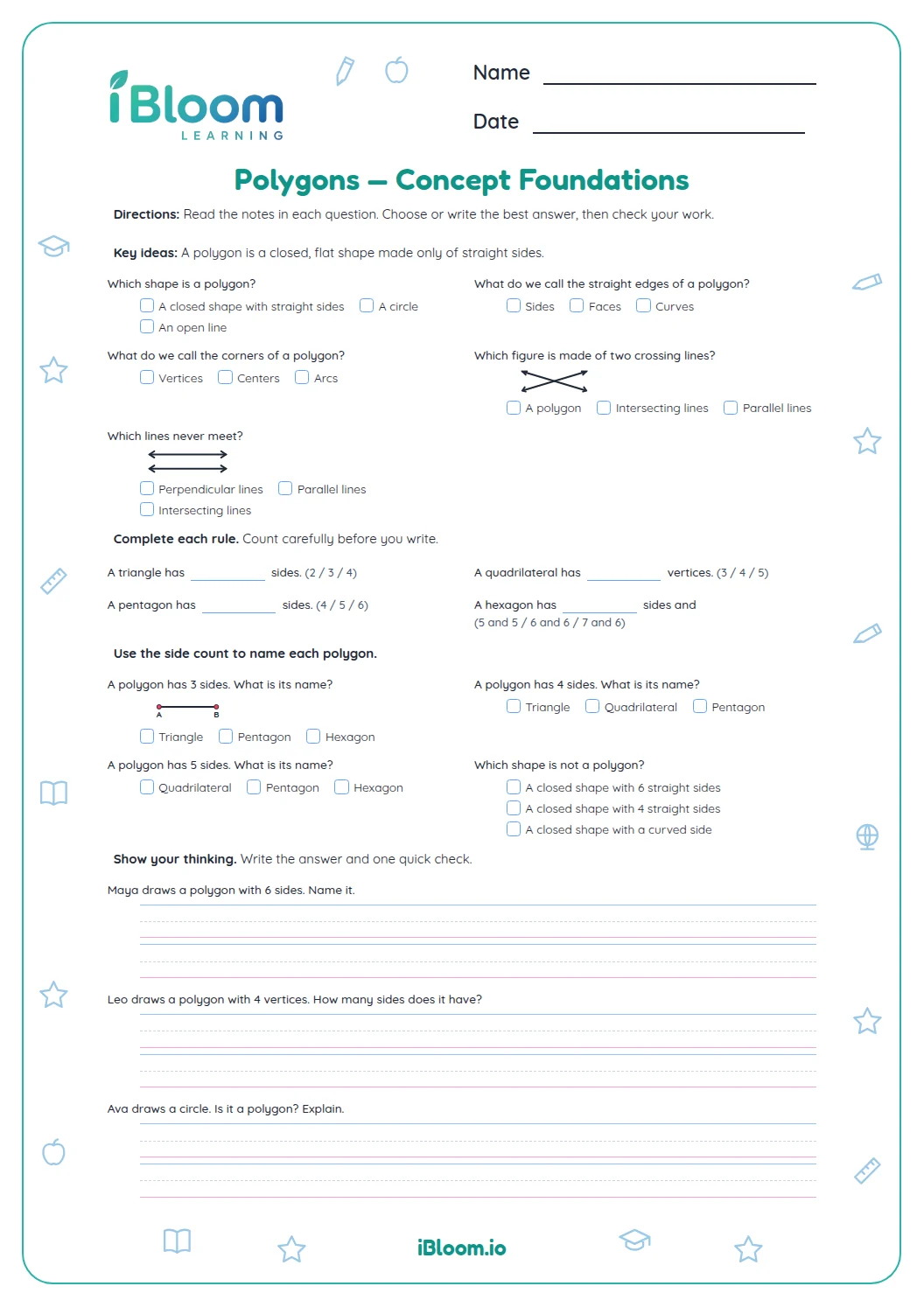
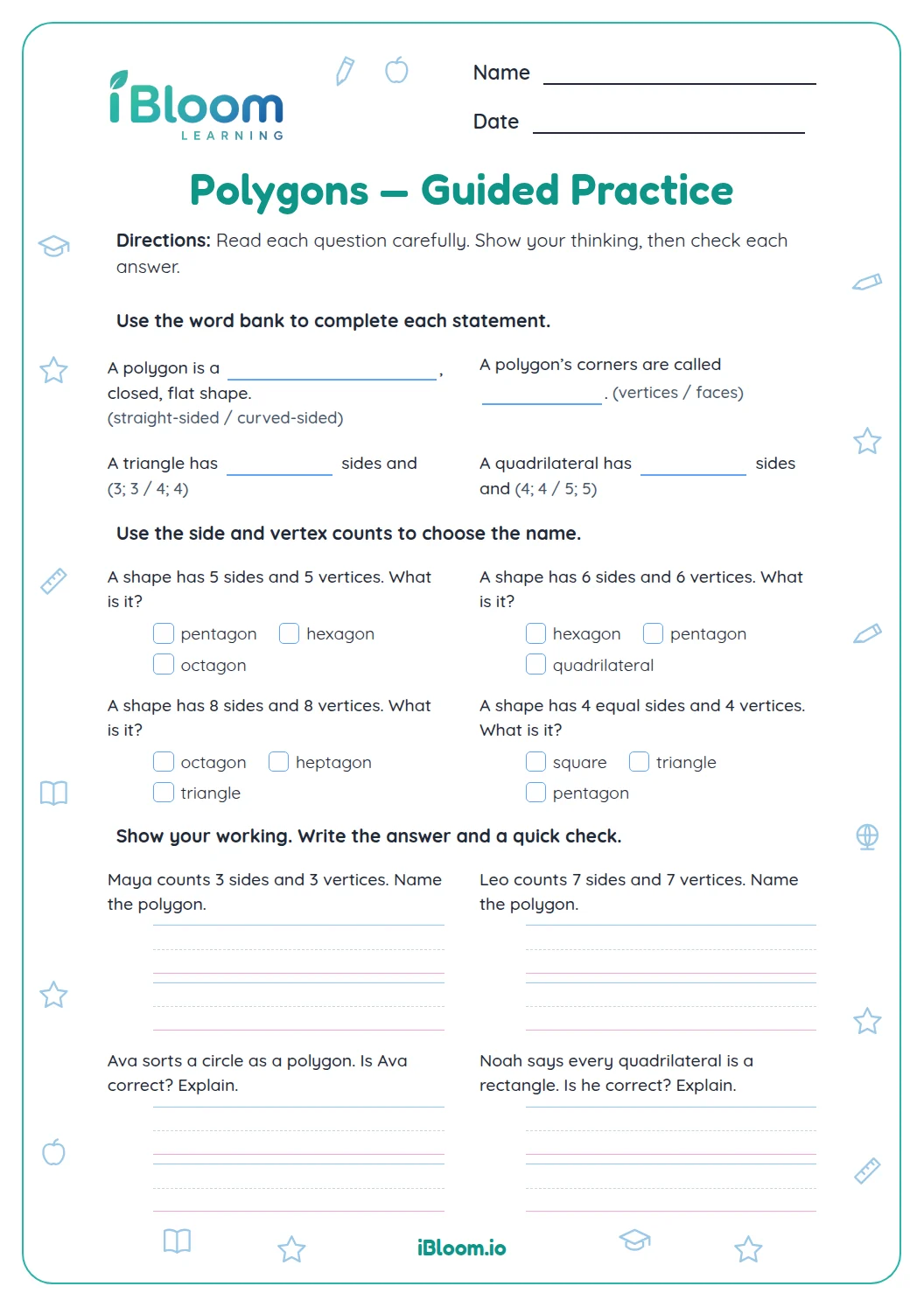
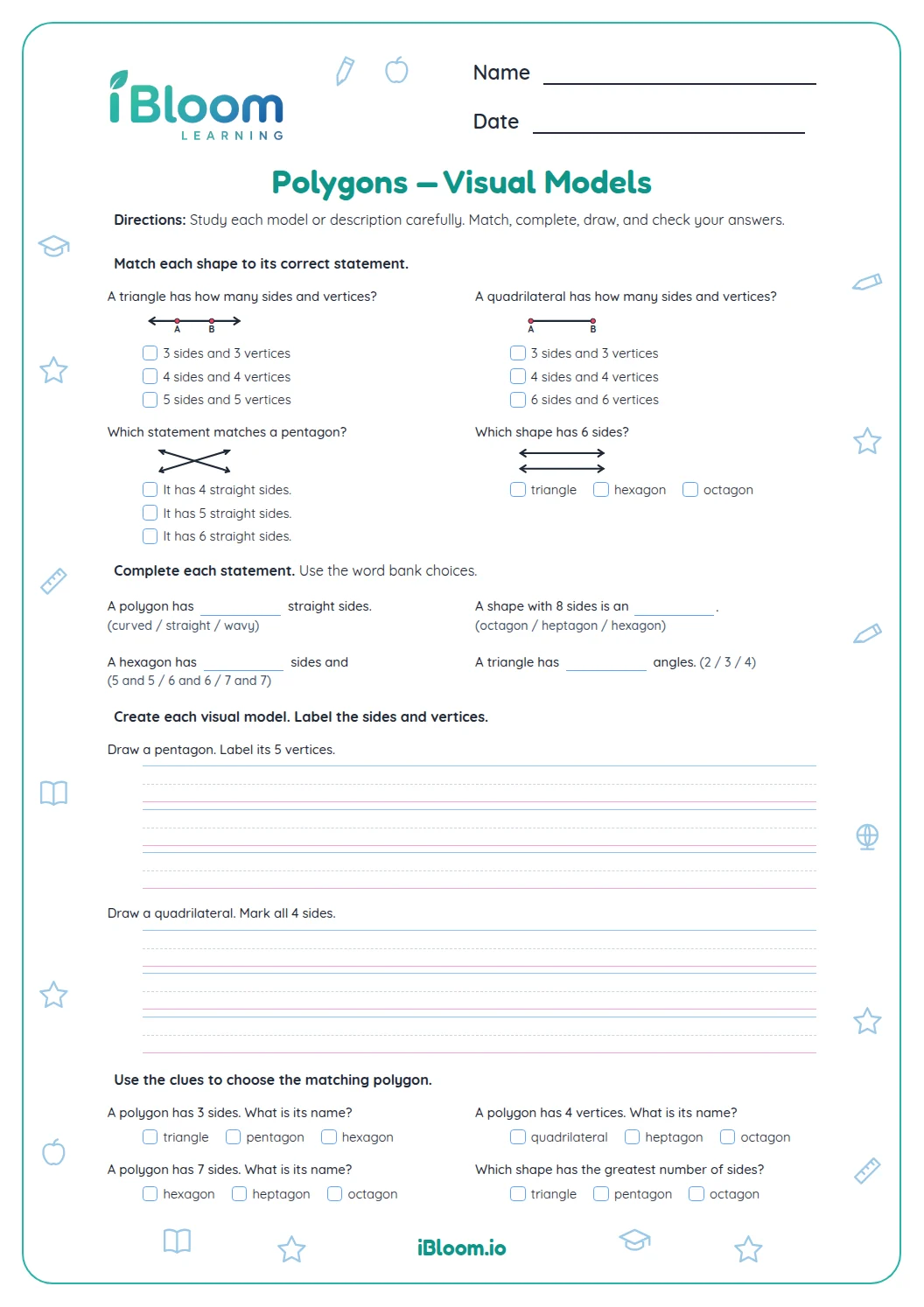
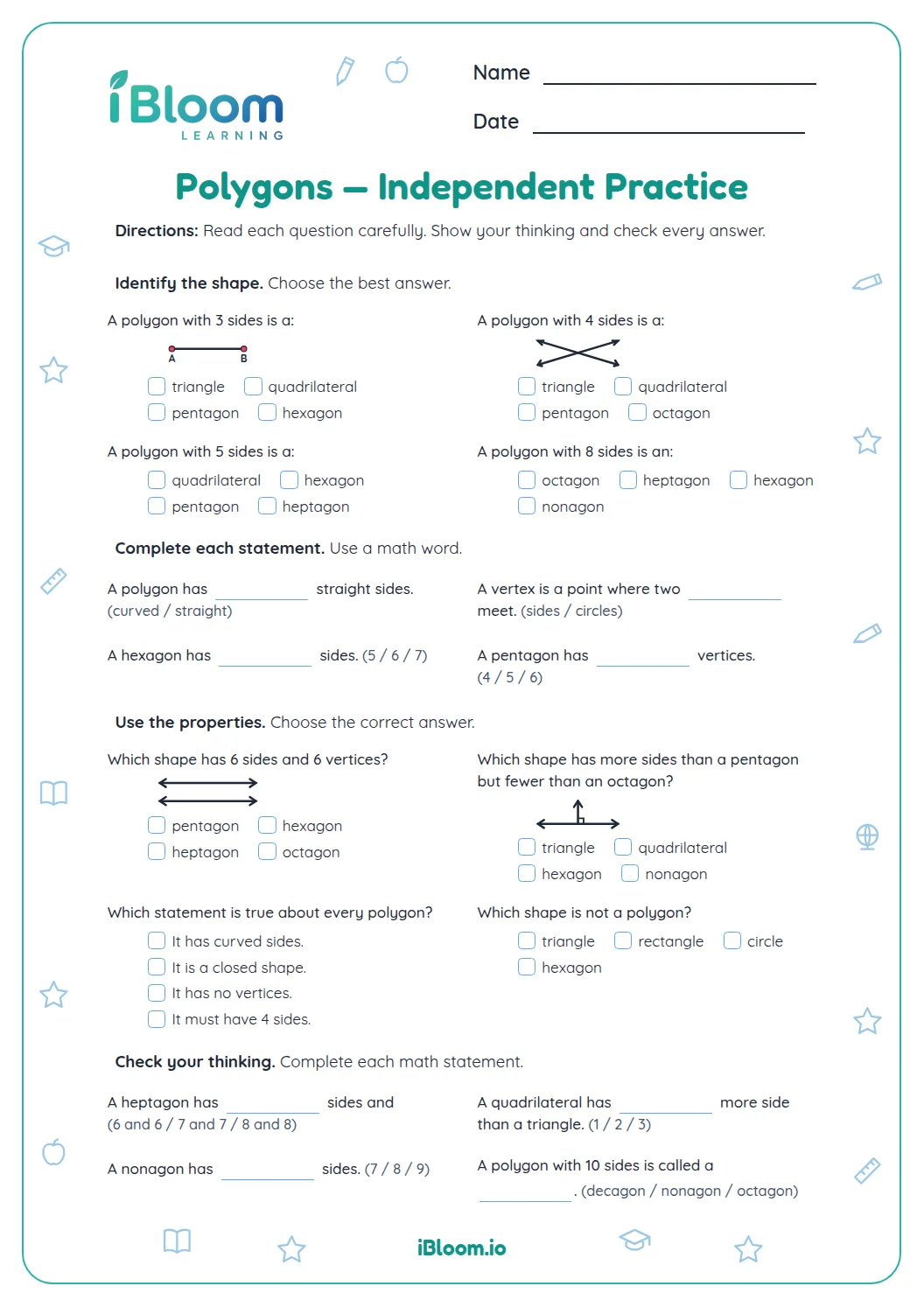
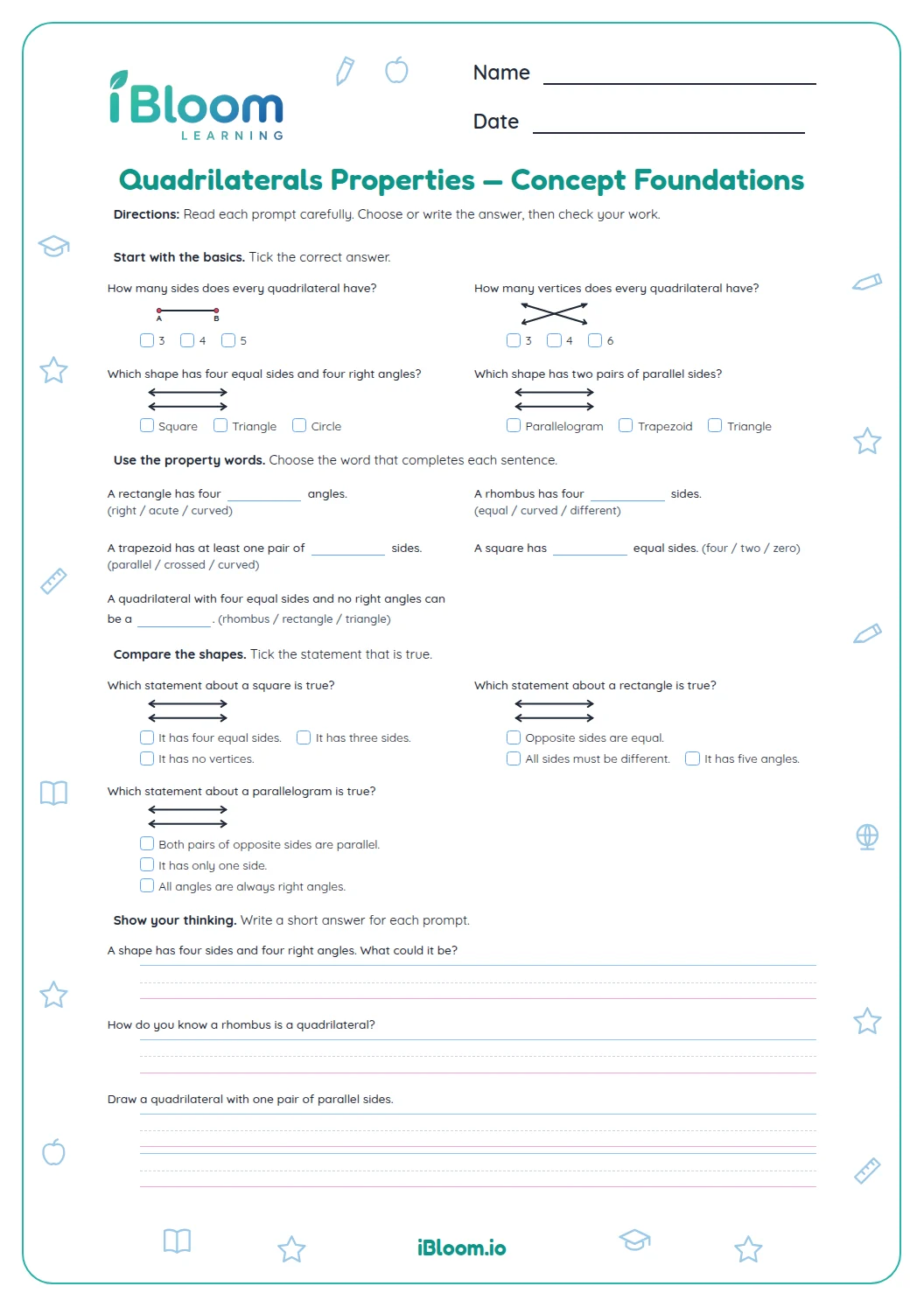
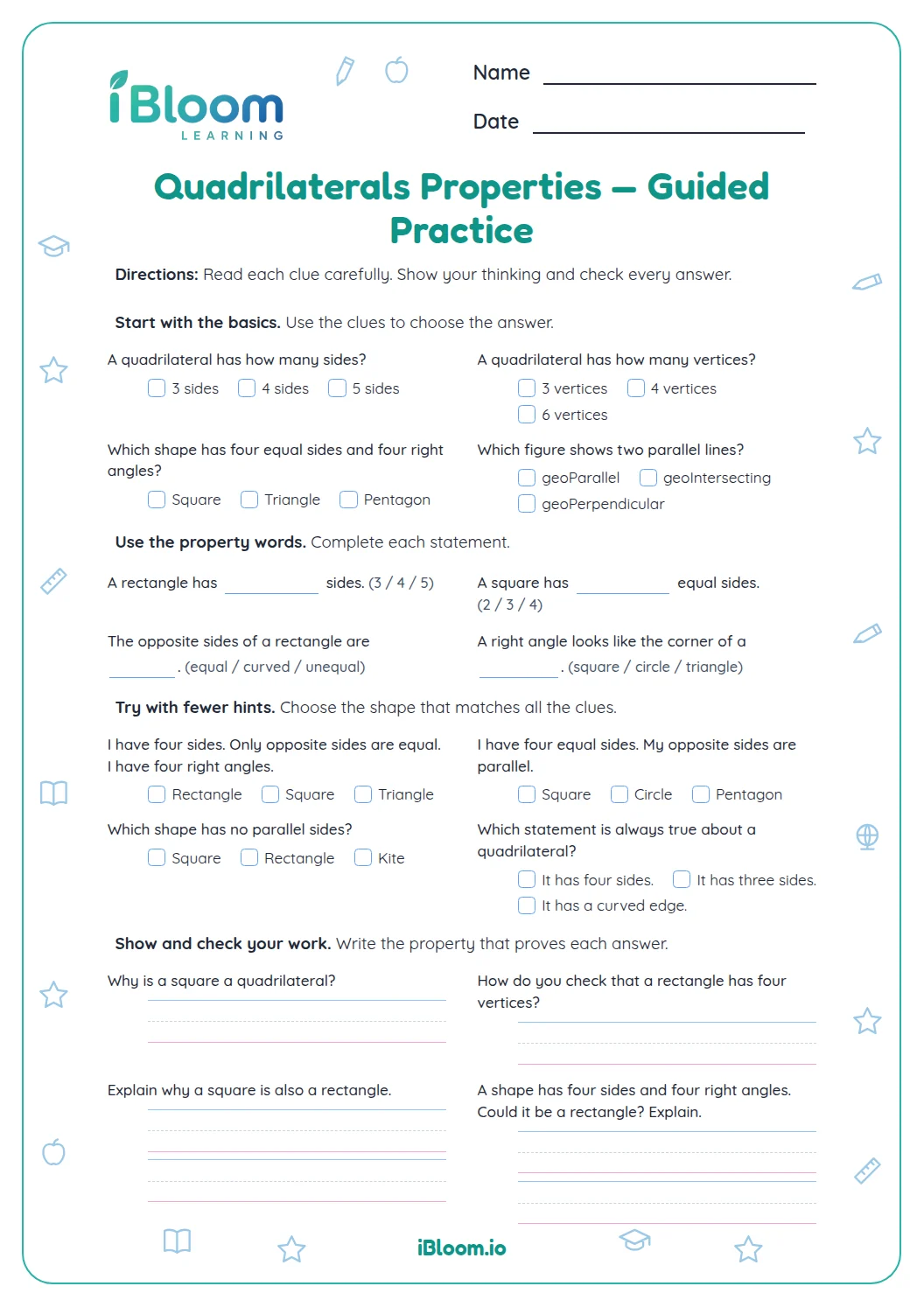
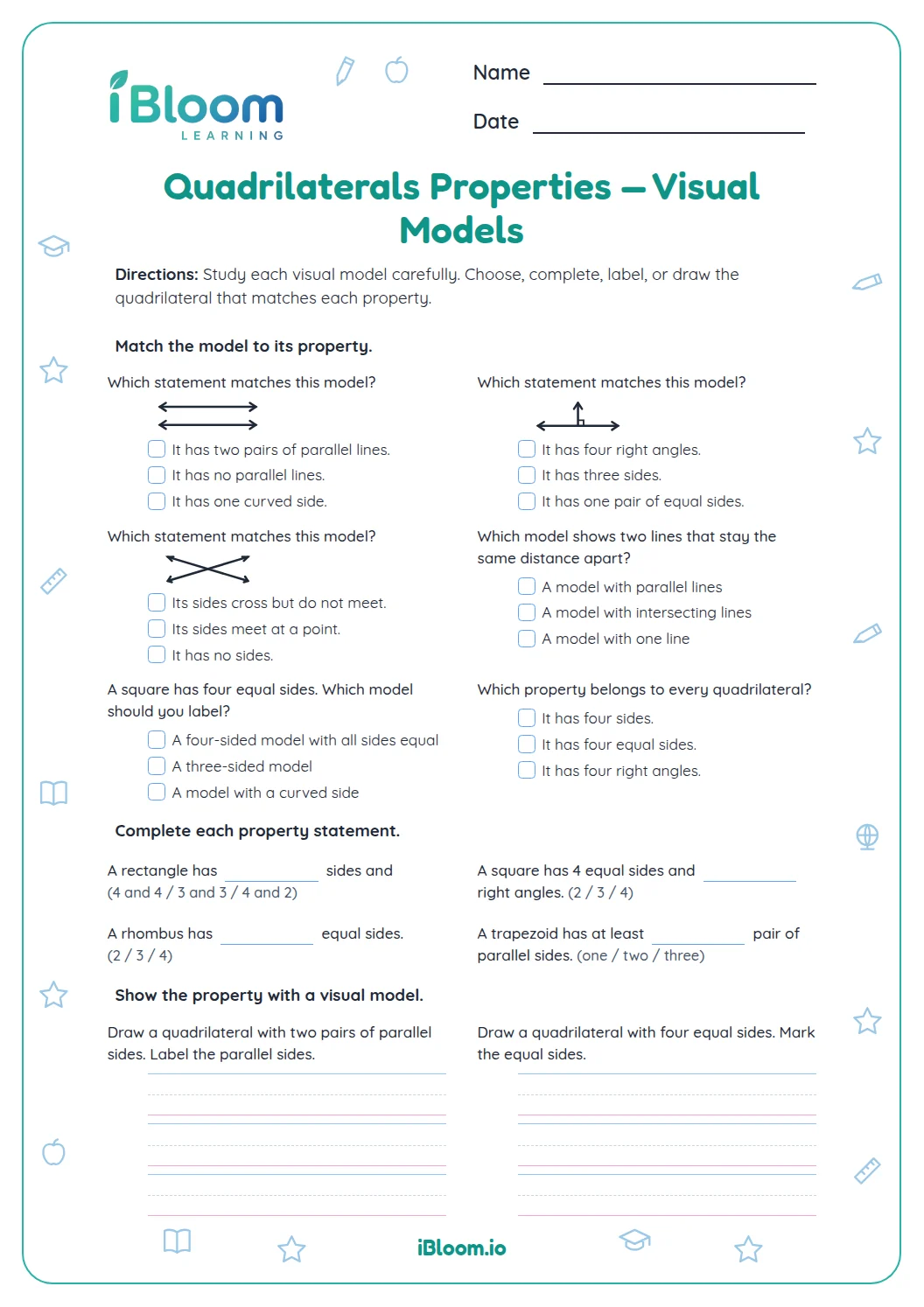
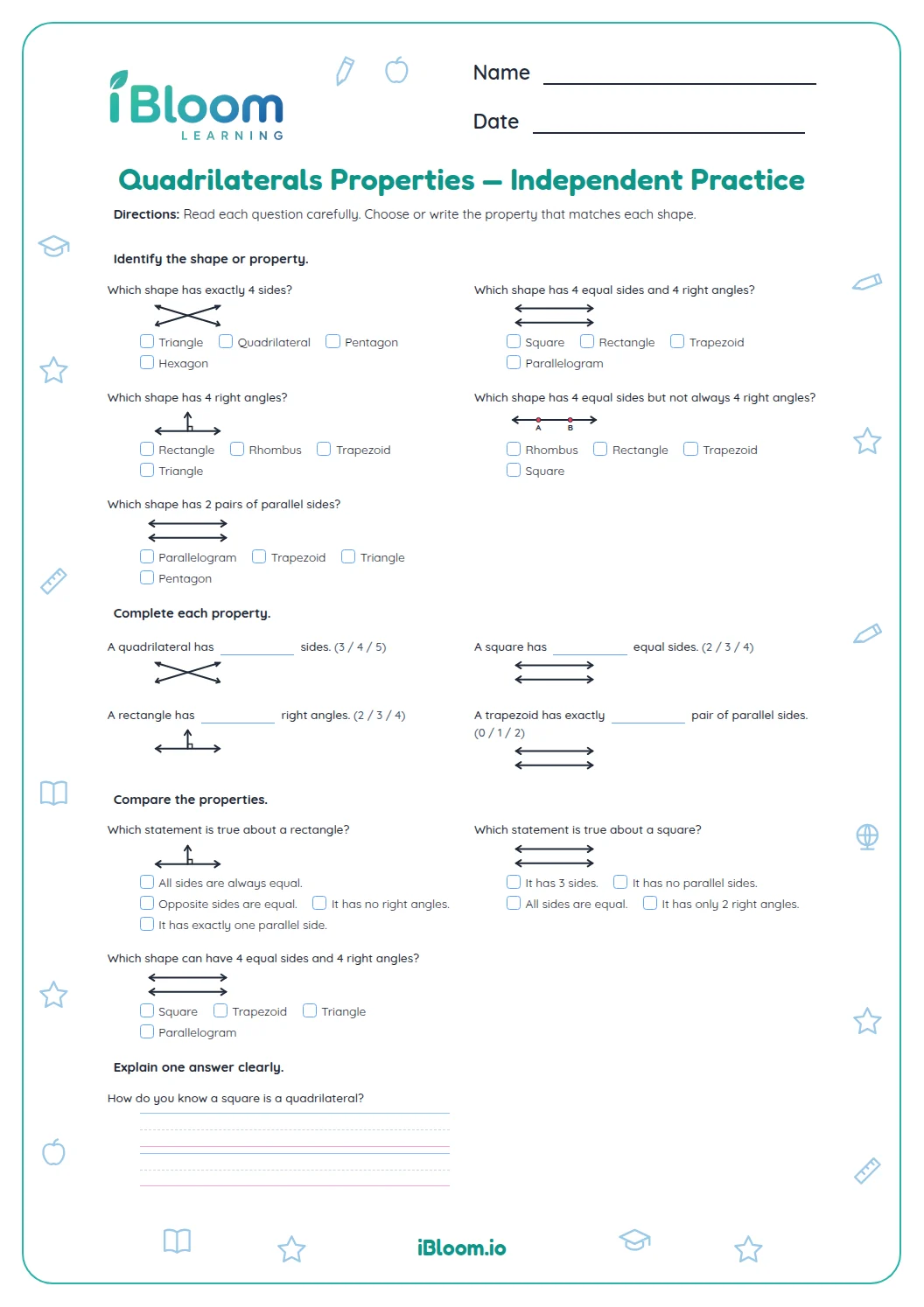
This Grade 3 geometry worksheet asks students to identify polygons, compare side counts, and test claims about quadrilaterals. Several questions include lettered shape drawings so children can reason from the figures. It has 14 questions across two parts, plus a complete key, and practices Common Core 3.G.A.1.
Aligned to 3.G.A.1
How can I tell whether a shape is a polygon?
A polygon is a closed shape made only of straight sides. A circle has a curved edge, so it is not a polygon. Compare the boundaries of the lettered shapes in Part A.
- 1Pentagon: 5 straight sides
- 2Circle: curved edge
- 3The pentagon is a polygon.
How do polygons fit into larger groups?
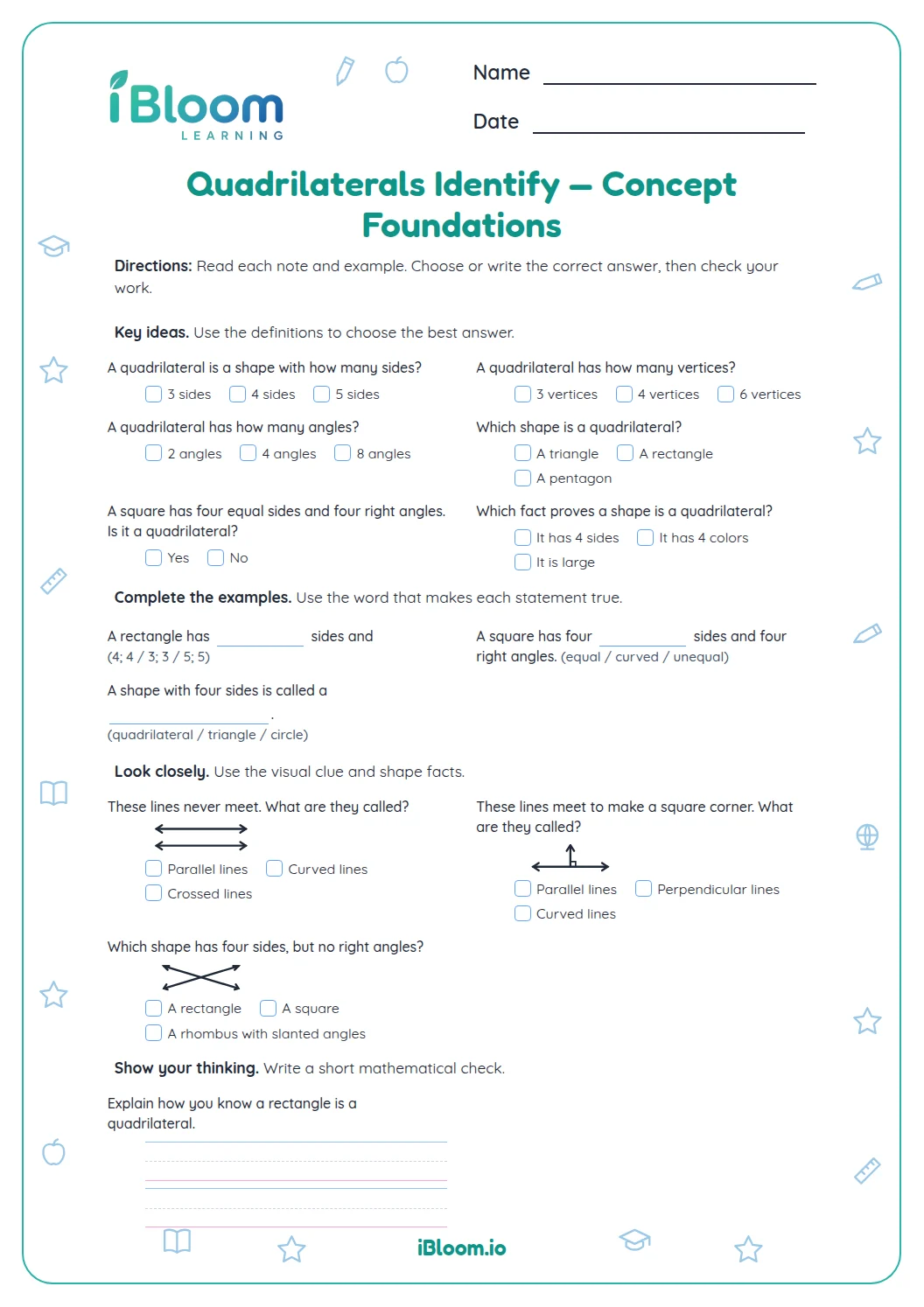
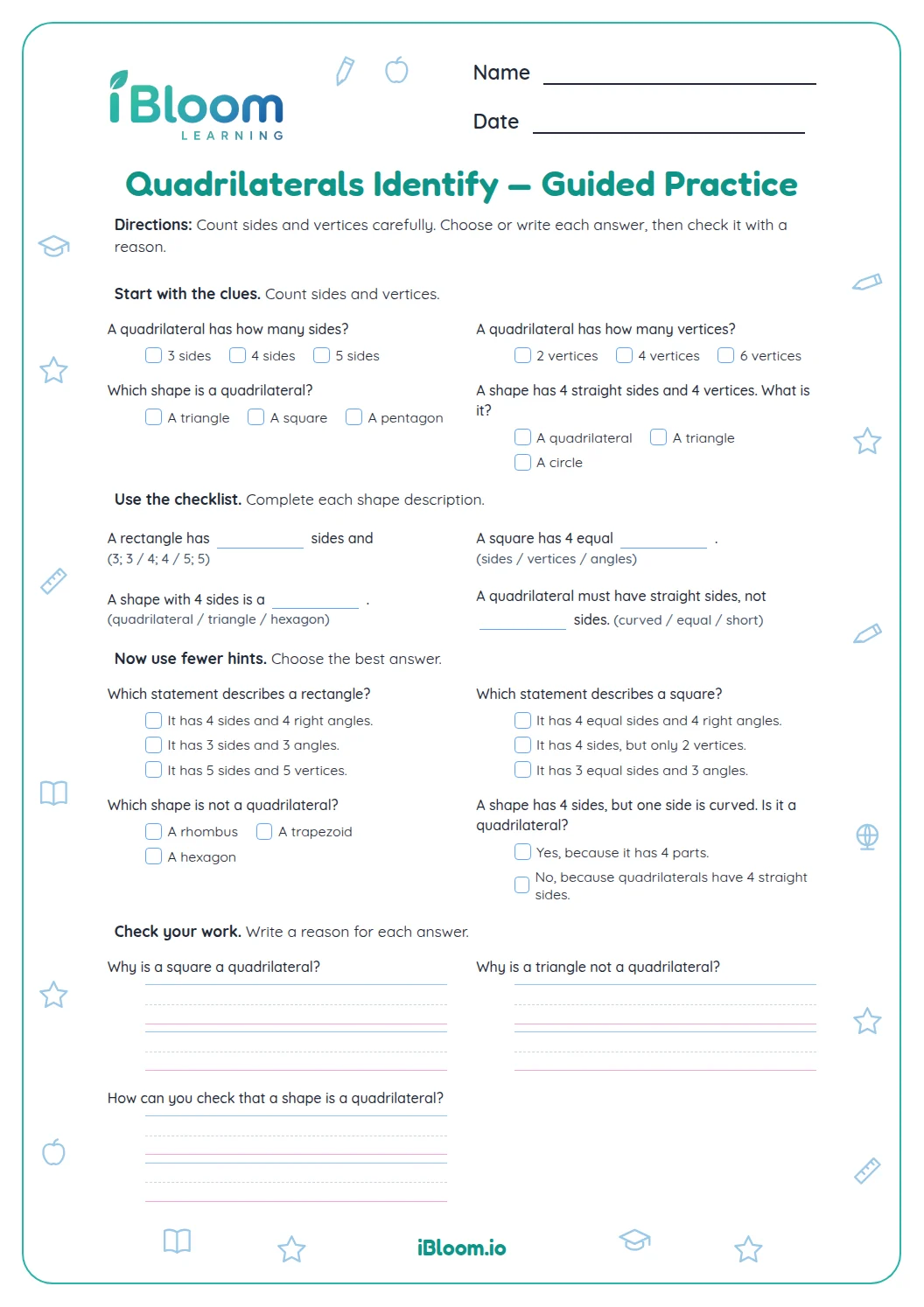
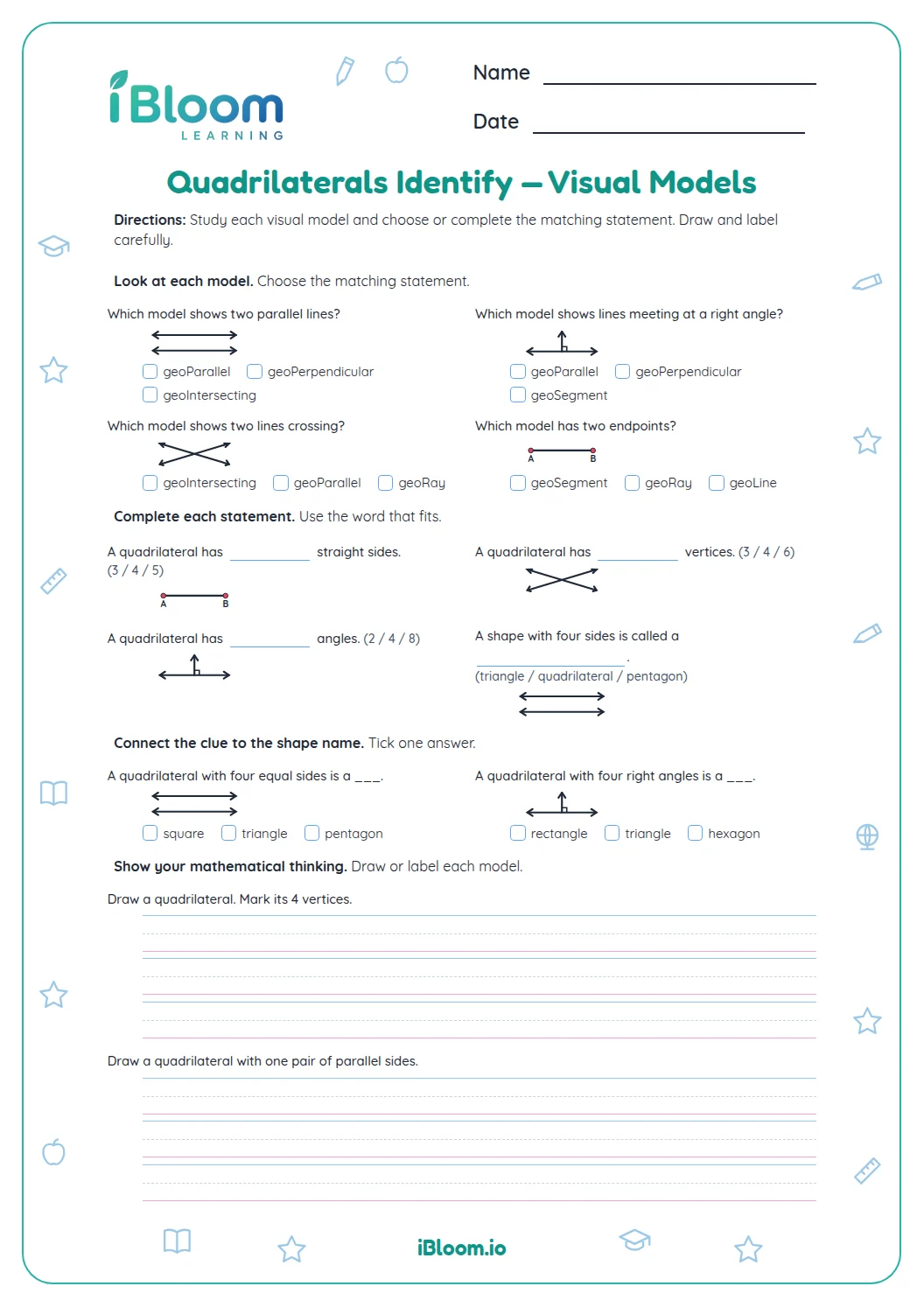
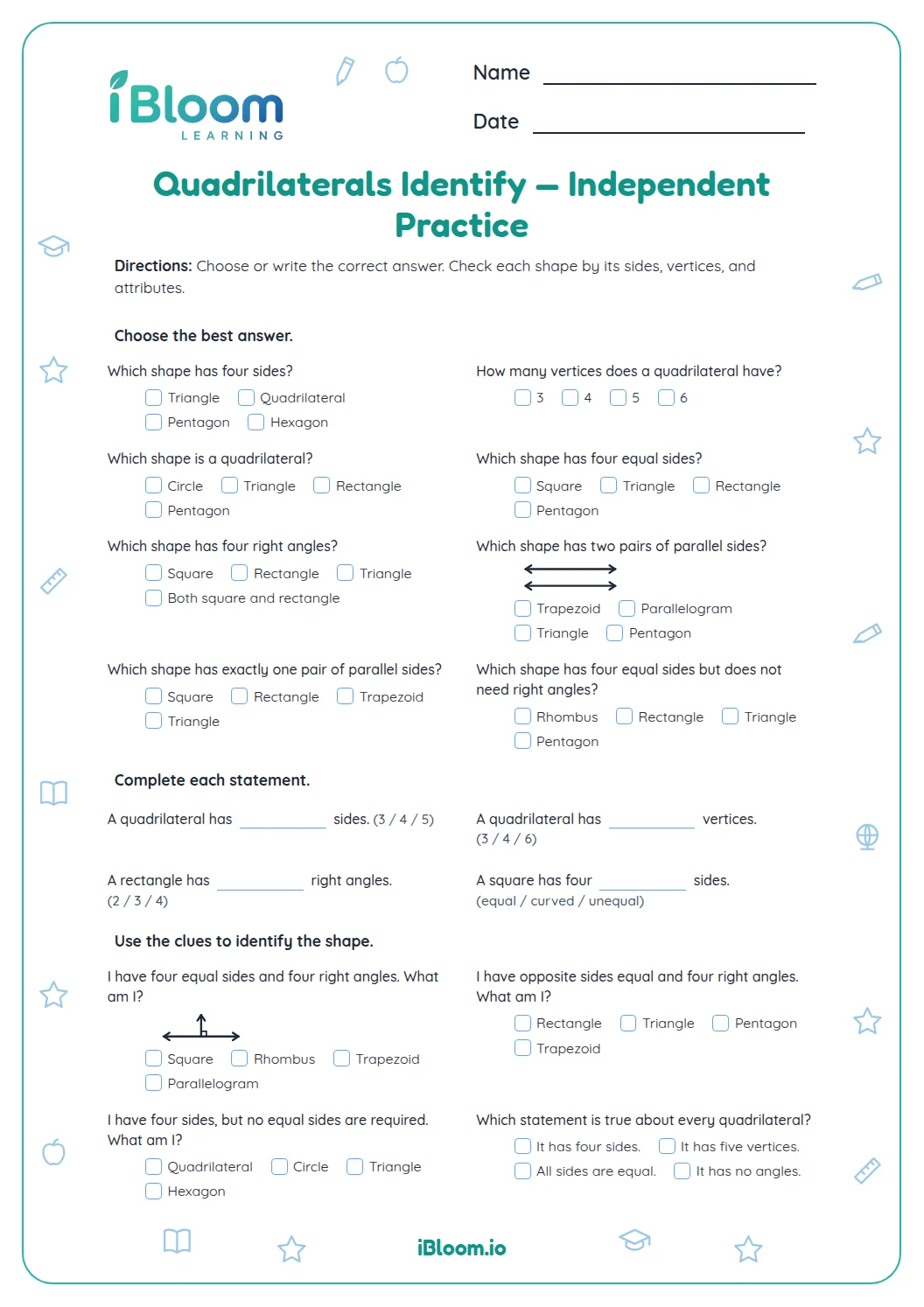
A square, rectangle, and rhombus each have four sides, so each is a quadrilateral. A quadrilateral does not have to be a square; a rectangle is one counterexample.
How can a side count test a claim?
Count each straight side once. A pentagon has five sides, a hexagon has six, and an octagon has eight. A square belongs to the larger group of quadrilaterals because it has four sides.
How to use this worksheet
- 1Check that the outline is closed.
- 2Look for straight sides rather than curves.
- 3Count sides once around the boundary.
- 4Use the side count to name the polygon.
- 5For a category question, identify the shared attribute.
Common mistakes and quick fixes
The mistake
Calling a circle a polygon
The fix
Check whether its boundary is made of straight sides.
The mistake
Thinking every quadrilateral is a square
The fix
A rectangle or rhombus also has four sides.
The mistake
Skipping a side when counting
The fix
Start at one corner and count each segment once around.
Common Core alignment
This worksheet practices a named Common Core math skill through its problems and worked example.
Group polygons by shared attributes such as side count and quadrilateral membership.
On this sheet: Group polygons by shared attributes such as side count and quadrilateral membership.
Show the official wordingHide the official wording
Understand that shapes in different categories (e.g., rhombuses, rectangles, and others) may share attributes (e.g., having four sides), and that the shared attributes can define a larger category (e.g., quadrilaterals). Recognize rhombuses, rectangles, and squares as examples of quadrilaterals, and draw examples of quadrilaterals that do not belong to any of these subcategories.
What to practice next
Make more practice
Further reading
Questions parents and teachers ask
What is a polygon?
A polygon is a closed two-dimensional shape made from straight line segments. Its sides meet at corners and form a closed boundary. A circle or oval has a curved boundary, so neither one is a polygon. The separate answer key gives each result so students can check their own work.
How many sides does a hexagon have?
A hexagon has six straight sides. A pentagon has five sides, and an octagon has eight. Counting carefully around the boundary is a reliable way to identify each polygon by its name. The separate answer key gives each result so students can check their own work.
Is every quadrilateral a square?
No. A quadrilateral is any polygon with four sides. A rectangle or rhombus is also a quadrilateral, so either shape is a counterexample to the claim that every quadrilateral is a square. The separate answer key gives each result so students can check their own work.
Can a square be called a quadrilateral?
Yes. A square has four straight sides, so it belongs to the larger quadrilateral category. It also has the more specific attributes that make it a square. A shape can fit both a narrow and a broad category. The separate answer key gives each result so students can check their own work.
Why is a circle not a polygon?
A circle has a curved edge rather than straight line segments. Since a polygon is made from straight sides, a circle does not fit the definition. Check the boundary, not just whether the shape is closed. The separate answer key gives each result so students can check their own work.