Free printable practice
Symmetrical Shapes Practice Activities
Grade 3 printable geometry worksheets for identifying, drawing, and checking symmetrical shapes and lines of symmetry.
Free printable worksheet PDFs
Preview every available page, then download the free worksheet PDF for home, homeschool, tutoring, or classroom practice.
Preview the exact activity before downloading it.
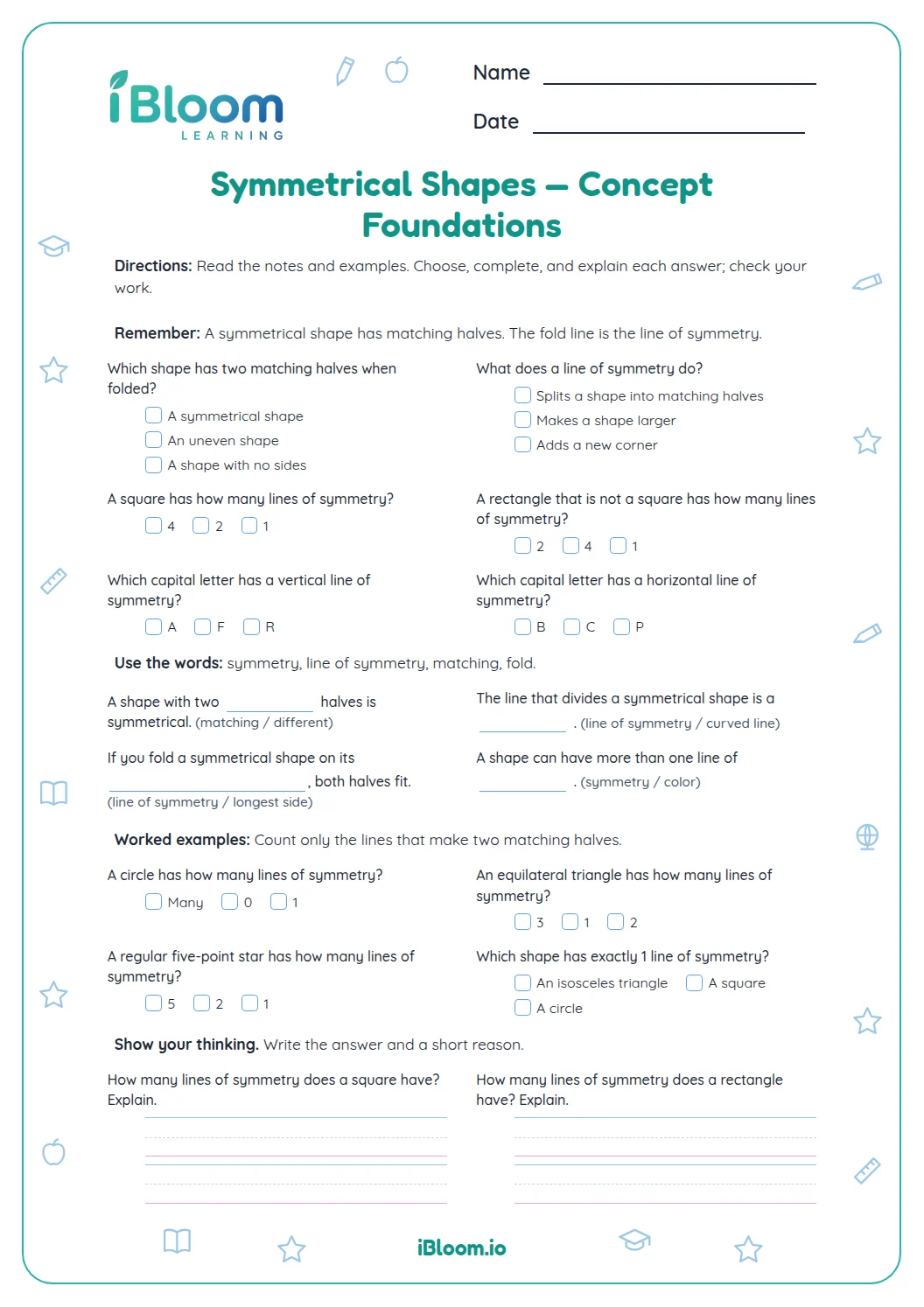 Symmetrical Shapes — Concept FoundationsGrade 3 printable geometry worksheets for identifying, drawing, and checking symmetrical shapes and lines of symmetry. This Grade 3 foundations worksheet adds concise teaching notes, worked examples, and supported first attempts.Grade 3Free PDF preview
 Symmetrical Shapes — Guided PracticeGrade 3 printable geometry worksheets for identifying, drawing, and checking symmetrical shapes and lines of symmetry. This Grade 3 guided-practice worksheet progresses from prompts and checkpoints to independent questions.Grade 3Free PDF preview
 Symmetrical Shapes — Visual ModelsGrade 3 printable geometry worksheets for identifying, drawing, and checking symmetrical shapes and lines of symmetry. This Grade 3 visual-model worksheet connects suitable diagrams, tables, number lines, or place-value models to mathematical notation.Grade 3Free PDF preview
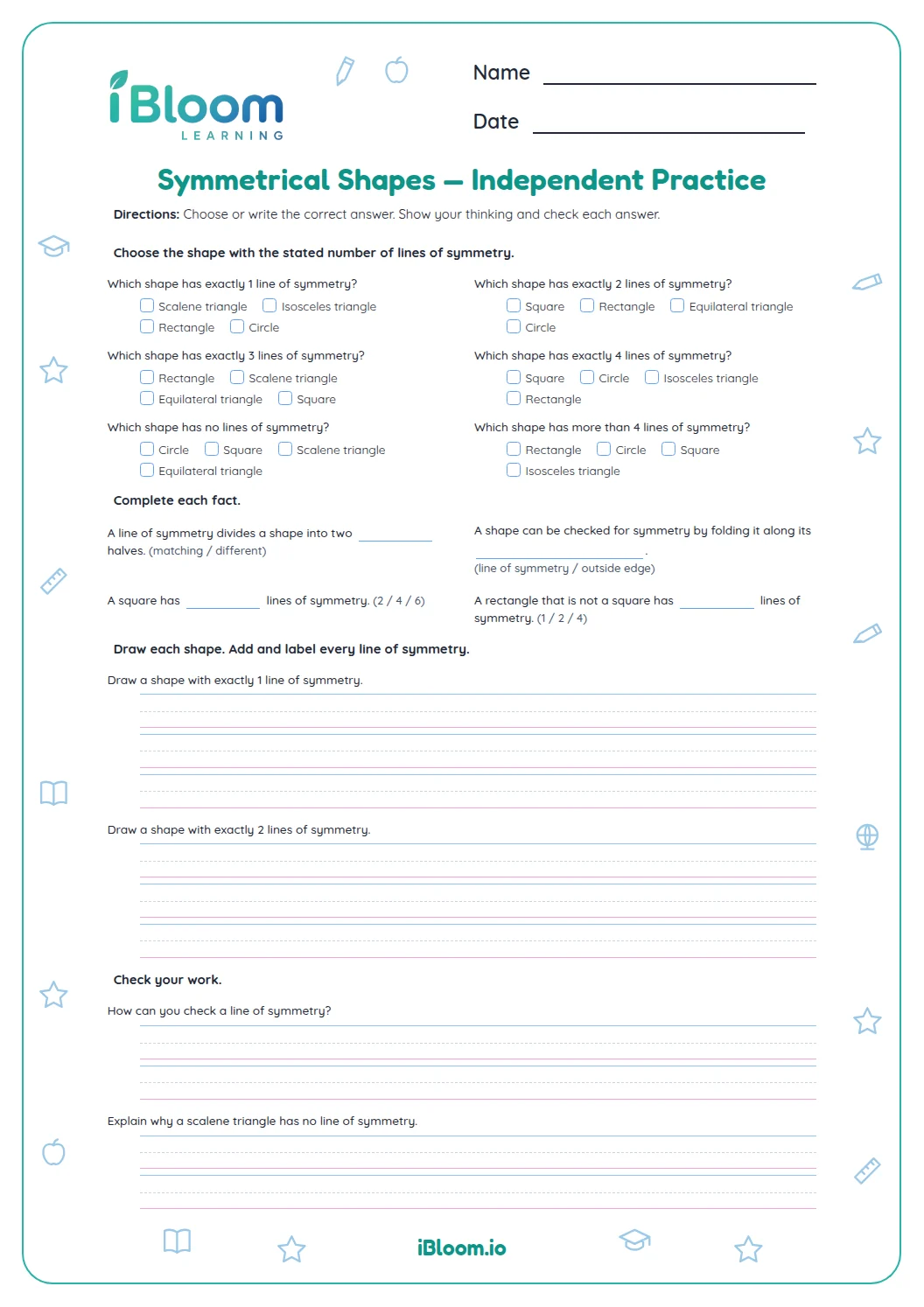 Symmetrical Shapes — Independent PracticeGrade 3 printable geometry worksheets for identifying, drawing, and checking symmetrical shapes and lines of symmetry. This Grade 3 independent-practice worksheet provides a balanced sequence of accurate, grade-level exercises.Grade 3Free PDF preview4 pages
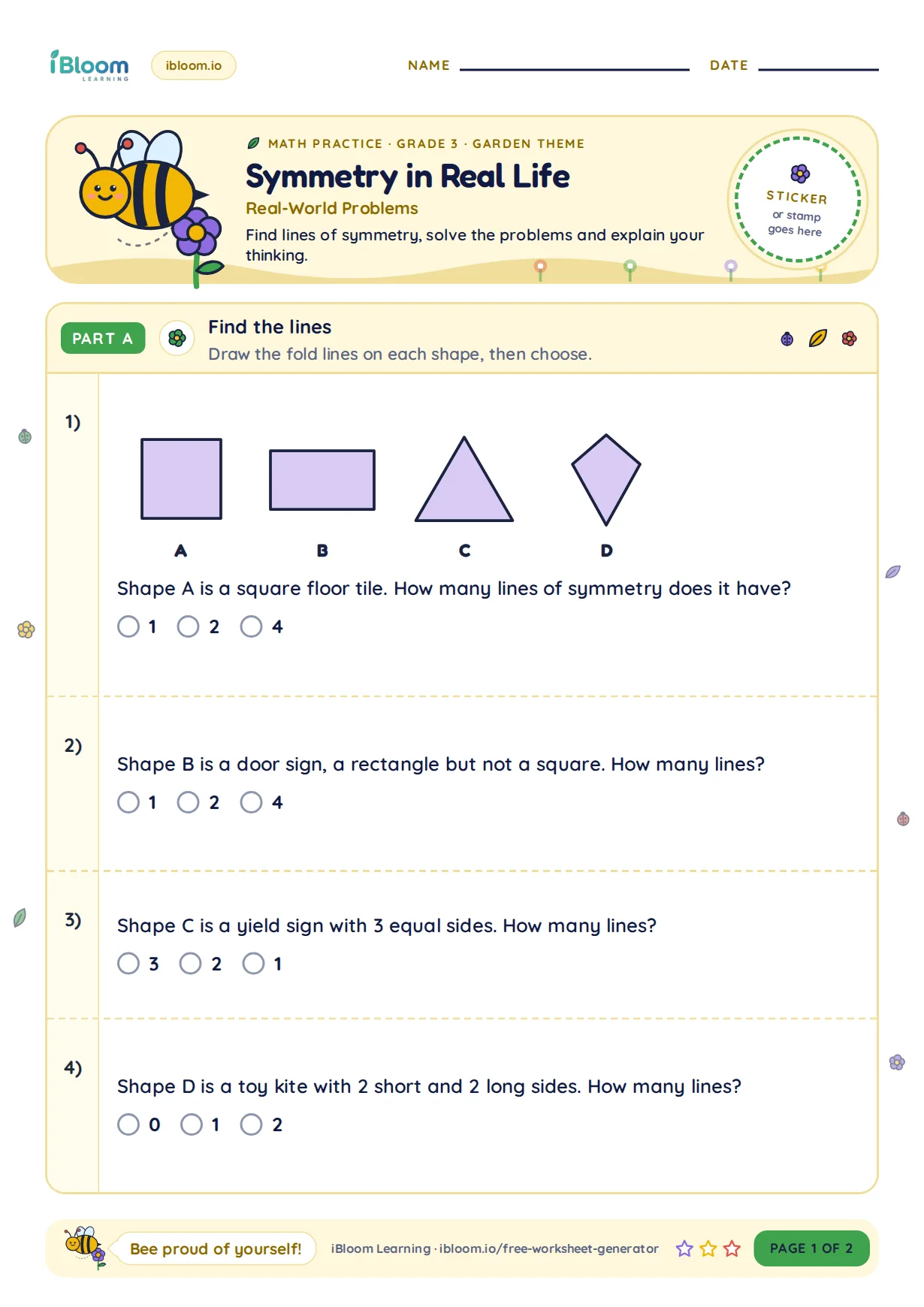 Symmetrical Shapes — Real-World ProblemsGrade 3 printable geometry worksheets for identifying, drawing, and checking symmetrical shapes and lines of symmetry. This Grade 3 application worksheet uses realistic one-step and multi-step situations with room to model and solve.Grade 3Free PDF preview
 Symmetrical Shapes — Reasoning ChallengeGrade 3 printable geometry worksheets for identifying, drawing, and checking symmetrical shapes and lines of symmetry. This Grade 3 reasoning worksheet combines error analysis, strategy comparison, missing information, and a gentle extension.Grade 3Free PDF preview
Practice that builds confidence
What children learn
These Grade 3 geometry worksheets help children understand symmetrical shapes by looking for matching halves, mirror images, and lines of symmetry. Students practise deciding whether a shape is symmetrical, locating the line that divides it evenly, and completing simple balanced figures.
The printable activities include shape sorting, drawing missing halves, tracing possible symmetry lines, and checking designs for equal parts. They are useful for building visual reasoning before children move on to more complex geometry work.
Symmetry work in Grade 3 helps students see that a shape is not symmetrical just because it looks neat or balanced. A line of symmetry must split the shape into two parts that match exactly when folded. These worksheets use familiar geometric figures and simple designs so children can compare left and right, top and bottom, and diagonal halves with care.
Skill progression on the page
Children begin by identifying whether a whole shape has symmetry. They then mark a possible line of symmetry and decide if the two sides are mirror images. Later tasks ask them to complete the missing half of a figure, which requires closer attention to distance, direction, corners, and curves. This progression moves students from recognizing symmetry to creating it.
Parent practice routine
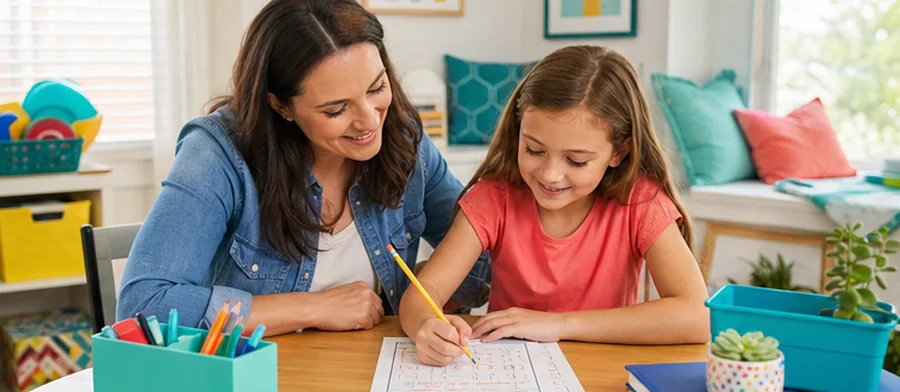
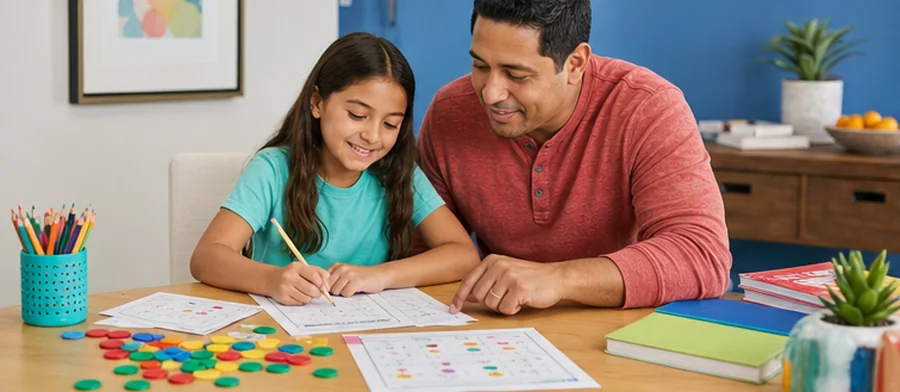
At home, start with a quick fold-and-check routine. Give your child a paper shape, ask where it might fold into matching halves, and let them test the idea. Then use one worksheet section at a time: first circle symmetrical shapes, then draw lines of symmetry, and finally complete a half-drawn picture. Ask, “Would both sides cover each other exactly?” to encourage mathematical thinking instead of guessing.
Classroom uses for teachers
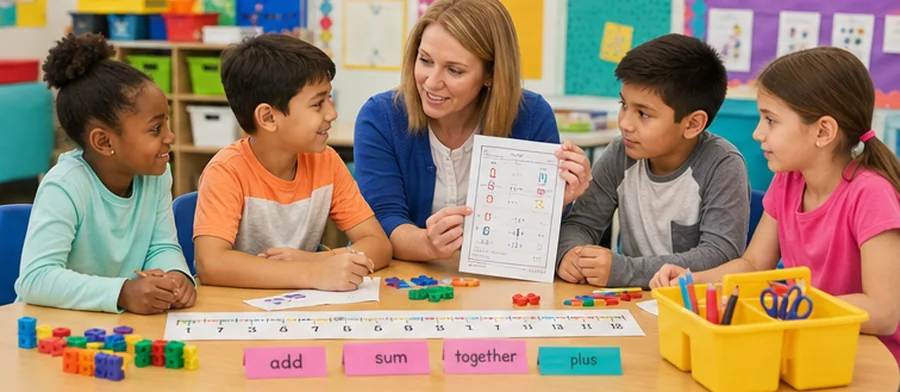
Teachers can use these printables in geometry lessons, morning review, small-group centers, or as a follow-up after hands-on folding activities. They also work well for partner checks: one student draws a symmetry line and the other explains why it works or does not work. Completed pages can support quick formative assessment of vocabulary such as symmetrical, line of symmetry, mirror image, equal halves, vertical, horizontal, and diagonal.
Common errors to watch for
Some students draw a line through the middle of a shape without checking whether the two sides match. Others confuse equal area with symmetry; two parts may look similar in size but still not be mirror images. When completing a shape, children may copy the same direction instead of reflecting it, causing corners or curves to face the wrong way.
Free printable PDF download
Use this symmetrical shapes worksheets grade 3 page to preview the activity, print it, or download it as a PDF for quick practice. It works well for homework, homeschool lessons, tutoring, morning work, revision, and classroom centers.
Answers and answer key support
After the child completes the worksheet independently, parents and teachers can use the answer support or answer key information to check the work, review mistakes, and choose the next practice step.
Why iBloom worksheets help
The activities give children repeated, focused practice with clear visual examples rather than crowded pages. A child-friendly strategy is: “Fold it in your mind, then check the match.” If every point on one side has a matching point the same distance from the line on the other side, the shape is symmetrical.
Helpful answers
Frequently asked questions
What should a Grade 3 student know about symmetrical shapes?
A Grade 3 student should understand that a symmetrical shape can be divided by a line into two matching mirror-image halves. They should be able to identify symmetrical shapes, draw a correct line of symmetry, and complete simple missing halves.
How can I explain a line of symmetry to my child?
Explain it as an imaginary fold line. If the shape could be folded on that line and both sides matched exactly, the line is a line of symmetry.
Do these worksheets include both vertical and horizontal symmetry?
Yes. The practice can include different directions for symmetry lines, such as vertical, horizontal, and simple diagonal lines, depending on the shape or design shown.
Why does my child draw a line through the center but still get the answer wrong?
A center line is not always a line of symmetry. The two sides must match exactly in shape, size, and position. Encourage your child to compare corners, edges, and distances from the line.
Are completing-the-shape activities important for learning symmetry?
Yes. Completing the missing half helps children move beyond recognizing symmetry. They must reflect each part across the line, which strengthens spatial reasoning and geometry vocabulary.
Is this symmetrical shapes worksheets grade 3 free?
Yes. You can preview it for free and use the printable worksheet for home or classroom practice.
Can I download this symmetrical shapes worksheets grade 3 as a PDF?
Yes. Use the worksheet download option to save a printable PDF, or print the worksheet directly from the page.
Does this symmetrical shapes worksheets grade 3 include answers or an answer key?
When the activity has fixed answers, iBloom includes answer support so parents and teachers can check the completed worksheet.