






About this worksheet
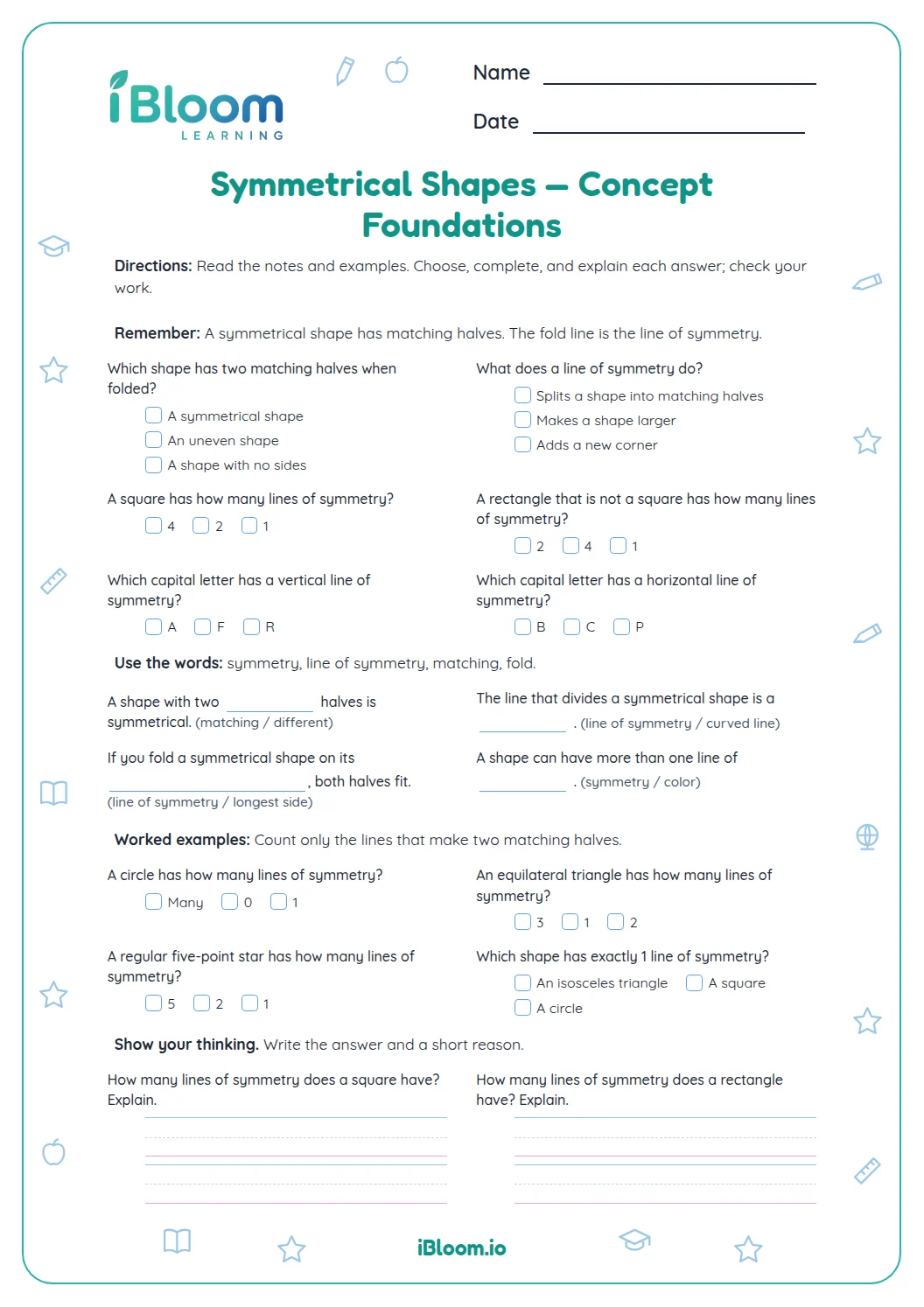
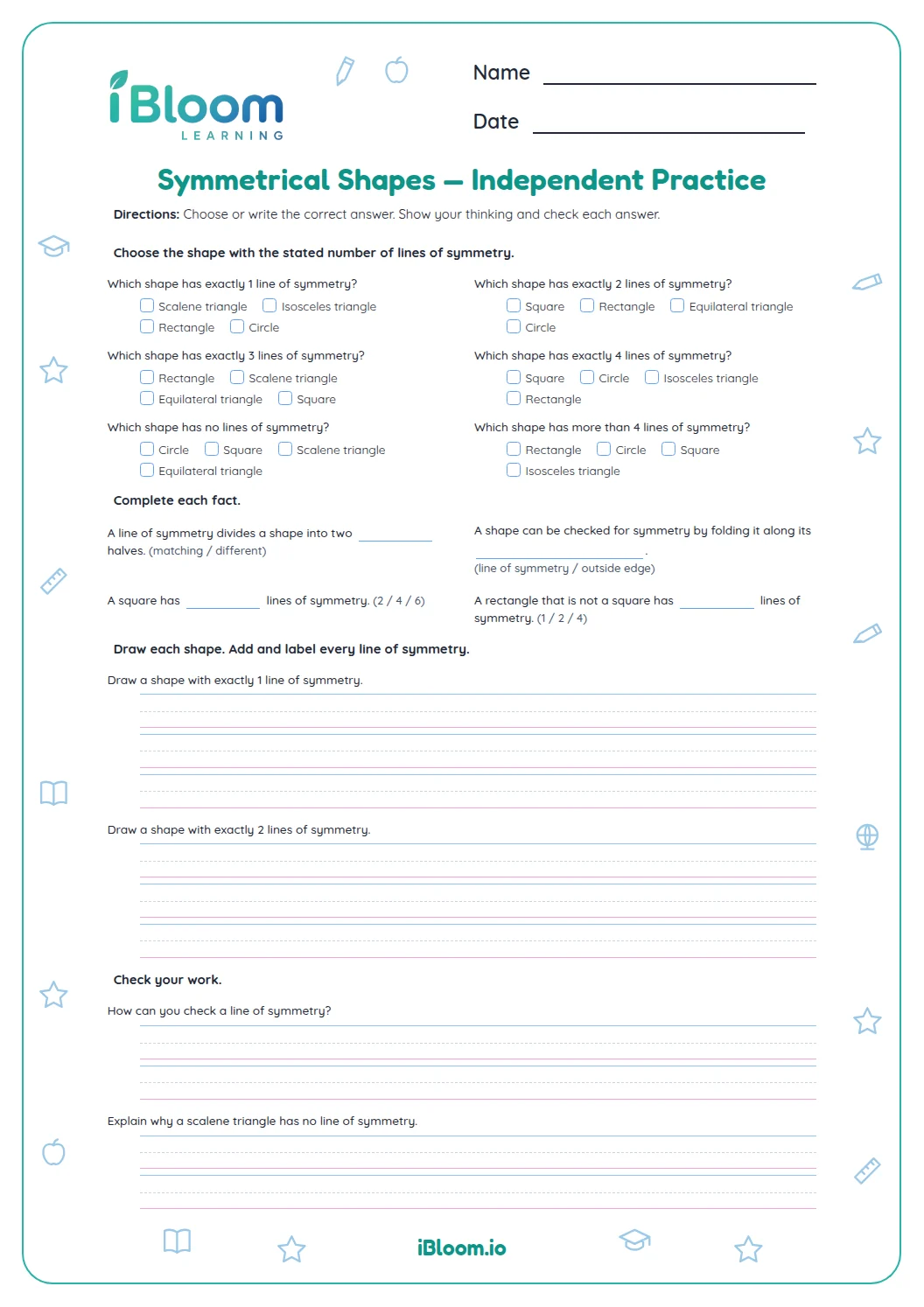
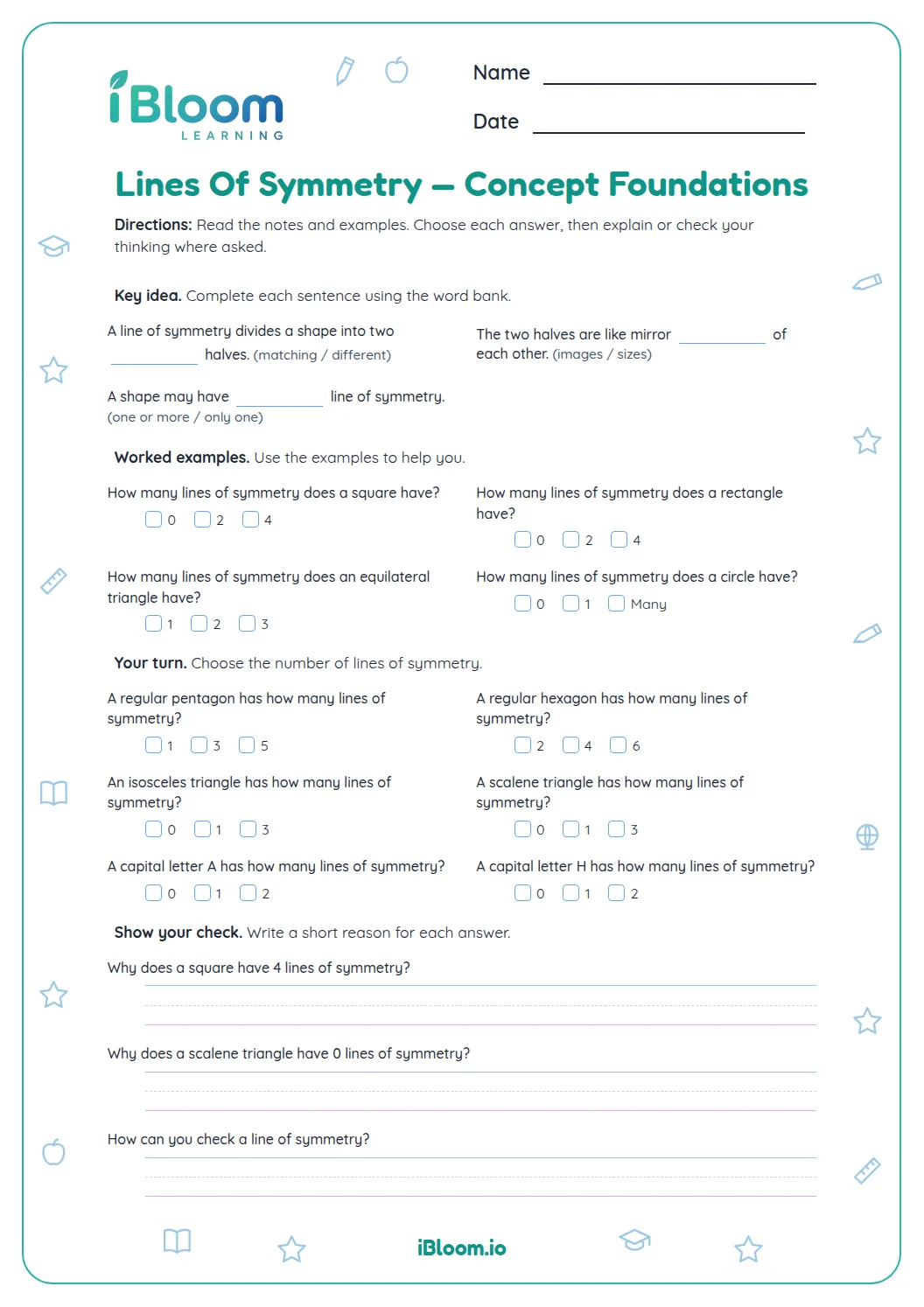
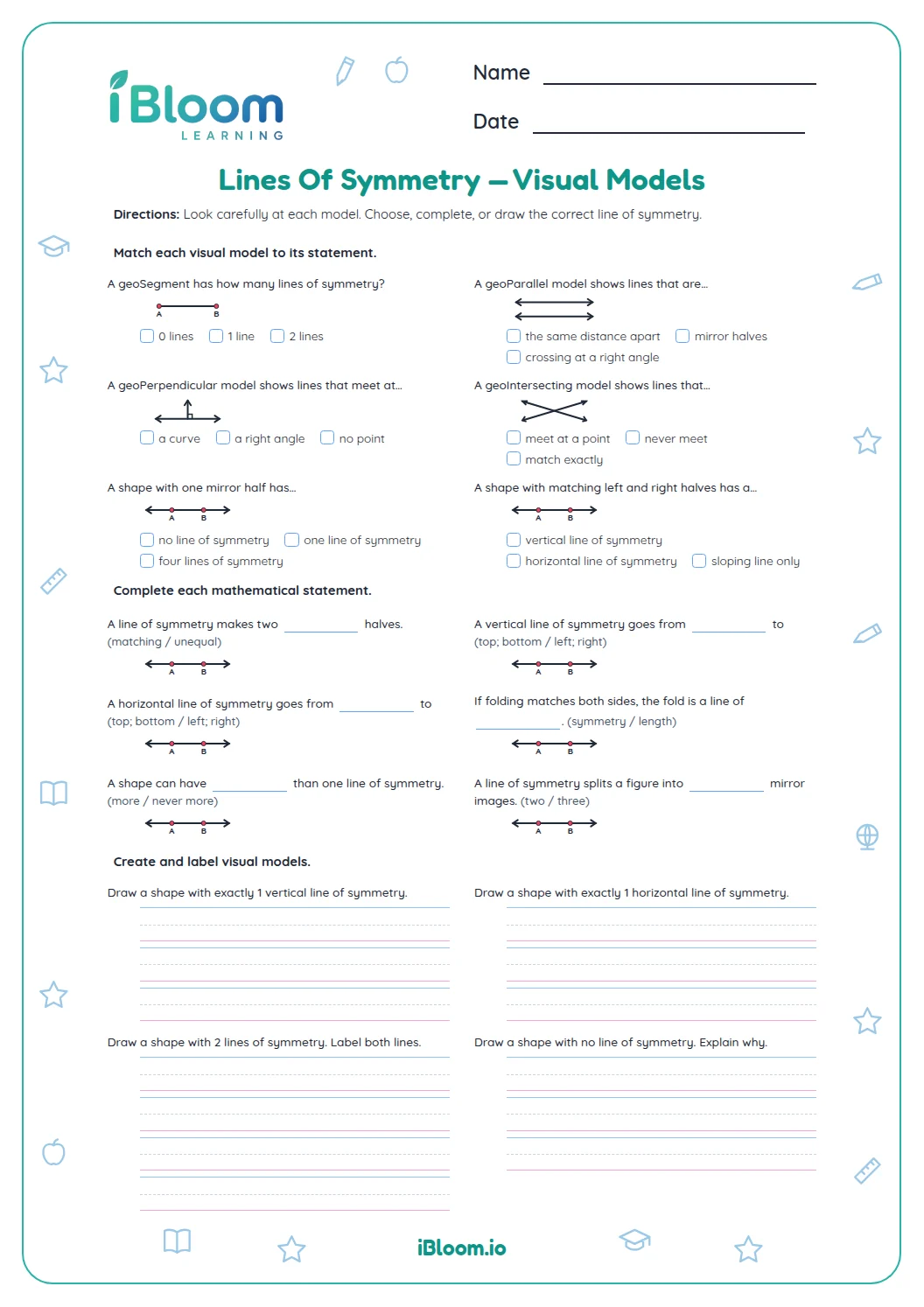
This free printable Grade 3 worksheet puts lines of symmetry to work on everyday objects. Children draw and count the lines of symmetry on a square floor tile, a rectangular door sign, a yield sign and a toy kite, then solve three word problems where symmetry makes equal groups, such as 6 heart cards cut into 12 matching halves. They finish by explaining why a rectangle does not have 4 lines and drawing a shape with exactly one. It practices Common Core 4.G.A.3 and 3.OA.A.3, with 9 questions on two pages and an answer key.
Aligned to 4.G.A.3 and 3.OA.A.3
How do you count the lines of symmetry in a shape?
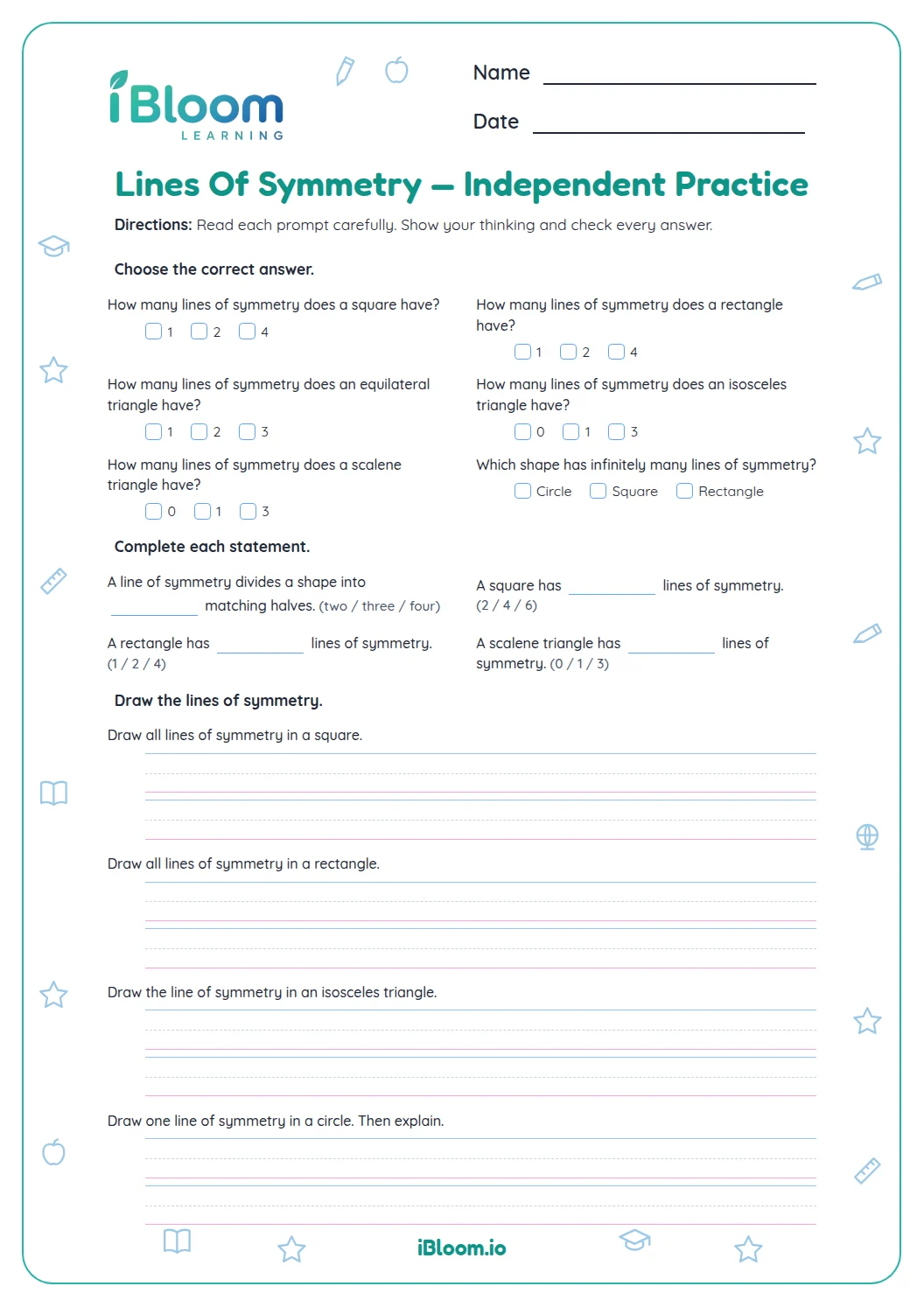
Imagine folding the shape so the edges land exactly on top of each other. Every fold that works is a line of symmetry. A square folds four ways: down the middle both ways and along each diagonal. A rectangle that is not a square folds only down the middle both ways, so it has 2. A triangle with 3 equal sides folds from each corner to the middle of the opposite side, so it has 3.
In Part A all four shapes are drawn side by side, and children draw the fold lines on each one before choosing a number, so the answer comes from the drawing rather than a guess. The kite folds only one way, from its top point to its bottom point. Children who want to check can cut the shapes from paper and fold them.
- 1A square floor tile
- 2Fold top to bottom: 1 line
- 3Fold left to right: 2 lines
- 4Fold along each diagonal: 3 and 4 lines
- 5A square has 4 lines of symmetry.
How does symmetry help with word problems?
Symmetry means the two sides match, so whatever is on one side is also on the other. That turns symmetry stories into multiplication and division. When Maya cuts 6 heart cards along their line of symmetry, each card makes 2 matching halves, so 6 × 2 = 12 halves. A banner with 18 stars and two matching halves has 18 ÷ 2 = 9 stars on each half.
The third problem multiplies lines of symmetry: Ava's 4 square flags each have 4 lines, so together they have 4 × 4 = 16. Each problem is a fill-in sentence, and children can write the number sentence beside it.
What is on this worksheet?
Nine questions in four parts, from finding the lines on a shape to explaining and drawing.
- Part A, Find the lines: draw and count the lines on a square tile, a door sign, a yield sign and a kite
- Part B, Solve: three word problems about heart cards, a banner and square flags
- Part C, Explain: is a rectangle with 4 sides sure to have 4 lines of symmetry?
- Part D, Draw: a shape with exactly 1 line of symmetry, and its line
- Answer key on two separate pages
How to use this worksheet at home or in class
- 1Fold a square of paper edge to edge, then corner to corner, and open it. Count the creases: they are the lines of symmetry.
- 2Repeat with a paper rectangle. Fold it corner to corner and notice that the halves do not match.
- 3In Part A, ask your child to draw every line on the shape with a ruler before choosing the number.
- 4For Part B, ask for the number sentence before filling in the blank, such as 6 × 2 = 12, and say what the 12 counts.
- 5Read Mia's claim in Part C aloud. A good answer says how many lines a rectangle has and why the diagonal fold fails.
- 6Check with the answer key. For the drawing, any shape that folds into matching halves in one way only is correct.
Common mistakes and quick fixes
The mistake
Drawing the diagonals on the rectangular door sign and answering 4.
The fix
Fold a paper rectangle corner to corner. The corners do not meet, so the halves do not match. Only the two folds through the middles of the sides work.
The mistake
Adding a line across the kite from side to side, so shape D gets 2 lines.
The fix
Fold a paper kite across the middle. The short sides land on the long sides, so the halves do not match. Only the fold from the top point to the bottom point works.
The mistake
Answering 6 in Maya's problem by counting cards instead of halves.
The fix
Read what is being counted. The question asks for halves, and every card makes 2, so 6 × 2 = 12.
Common Core alignment
Most US states use the Common Core math standards or a close state version. This sheet practices the two standards below.
Find and draw the lines that fold a shape into two matching parts.
On this sheet: Children draw and count lines of symmetry on four shapes and draw a shape with exactly one line.
Show the official wordingHide the official wording
Recognize a line of symmetry for a two-dimensional figure as a line across the figure such that the figure can be folded along the line into matching parts. Identify line-symmetric figures and draw lines of symmetry.
Solve equal-group problems with multiplication and division.
On this sheet: The heart cards, banner and flags are equal-group problems solved with × and ÷.
Show the official wordingHide the official wording
Use multiplication and division within 100 to solve word problems in situations involving equal groups, arrays, and measurement quantities, e.g., by using drawings and equations with a symbol for the unknown number to represent the problem.
What to practice next
Make more practice
Further reading
Questions parents and teachers ask
How many lines of symmetry does a square have?
A square has 4 lines of symmetry: one down the middle each way and one along each diagonal. Folding along any of them puts the edges exactly on top of each other. Question 1 shows a square floor tile, and children can fold a paper square to find all four creases.
Why does a rectangle have only 2 lines of symmetry?
A rectangle that is not a square folds into matching halves only through the middles of its sides, once each way. Its diagonals do not work, because folding corner to corner leaves the corners sticking out. Question 2 asks about a door sign shaped like this, and Mia's claim in question 8 tests it again.
How many lines of symmetry does a kite have?
A kite with two short sides and two long sides has exactly 1 line of symmetry, running from the top point to the bottom point between the matching sides. A fold across the middle does not work, because the short sides would land on the long ones. Question 4 uses a toy kite for this.
Why do the word problems use multiplication and division?
Symmetry makes equal groups: every card cut along its line makes two matching halves, and both halves of a symmetrical banner hold the same number of stars. So Maya's 6 cards make 6 × 2 halves, and 18 stars split as 18 ÷ 2 on each half. Part B has three problems of this kind.
What counts as a good drawing for the last question?
Any shape that folds into matching halves in exactly one way, such as a heart, a kite or a triangle with two equal sides, with its line drawn through the middle. A square or a rectangle will not work, because each folds more than one way. The key lists a few examples to check against.
Is there an answer key for this worksheet?
Yes. The two answer key pages give the number of lines for each shape in Part A, the three Part B answers (12, 9 and 16), a model answer for Mia's claim and example shapes for the drawing in Part D. Print the worksheet by itself, keep the key for checking, or download both as a free PDF.