


About this worksheet
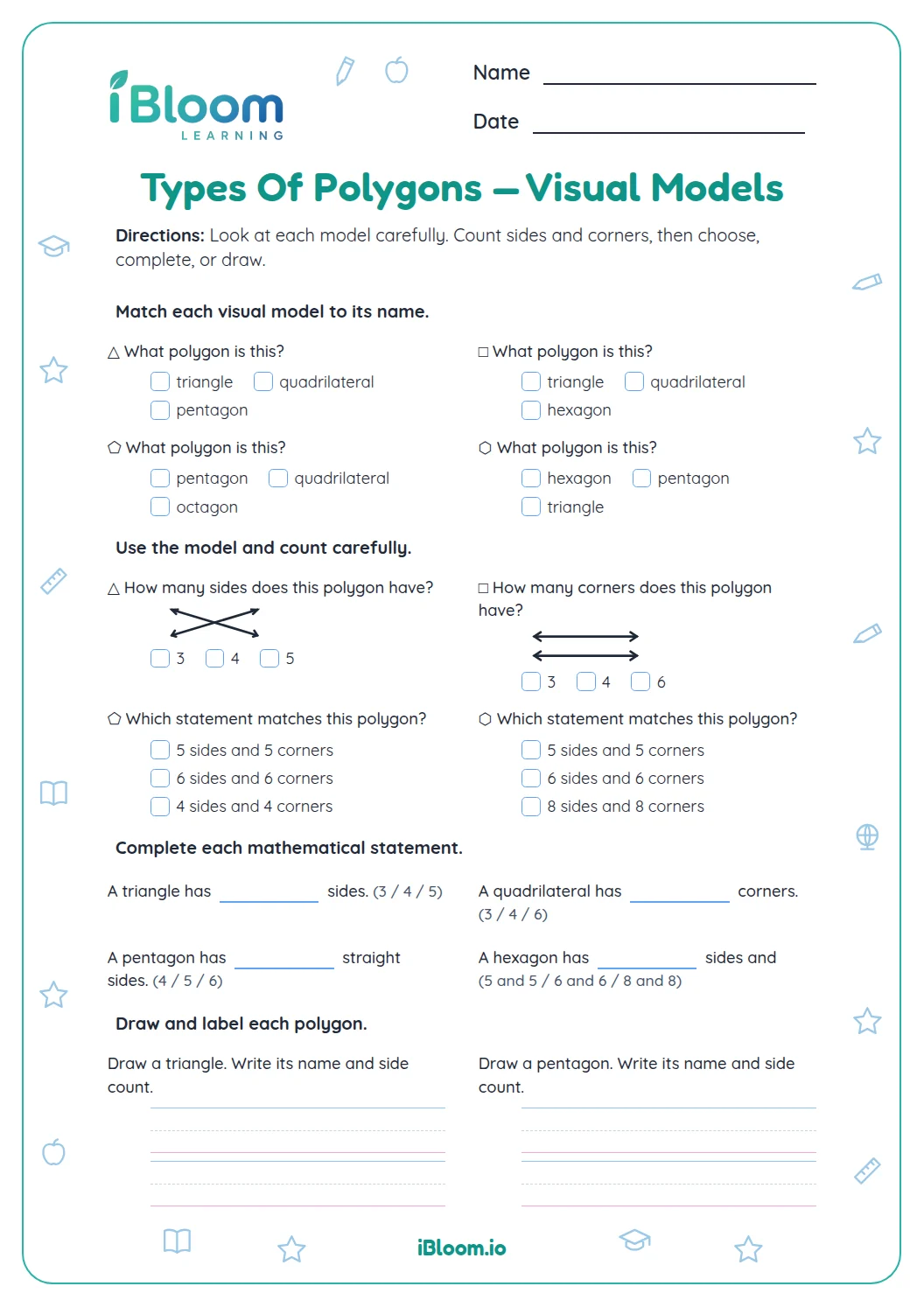
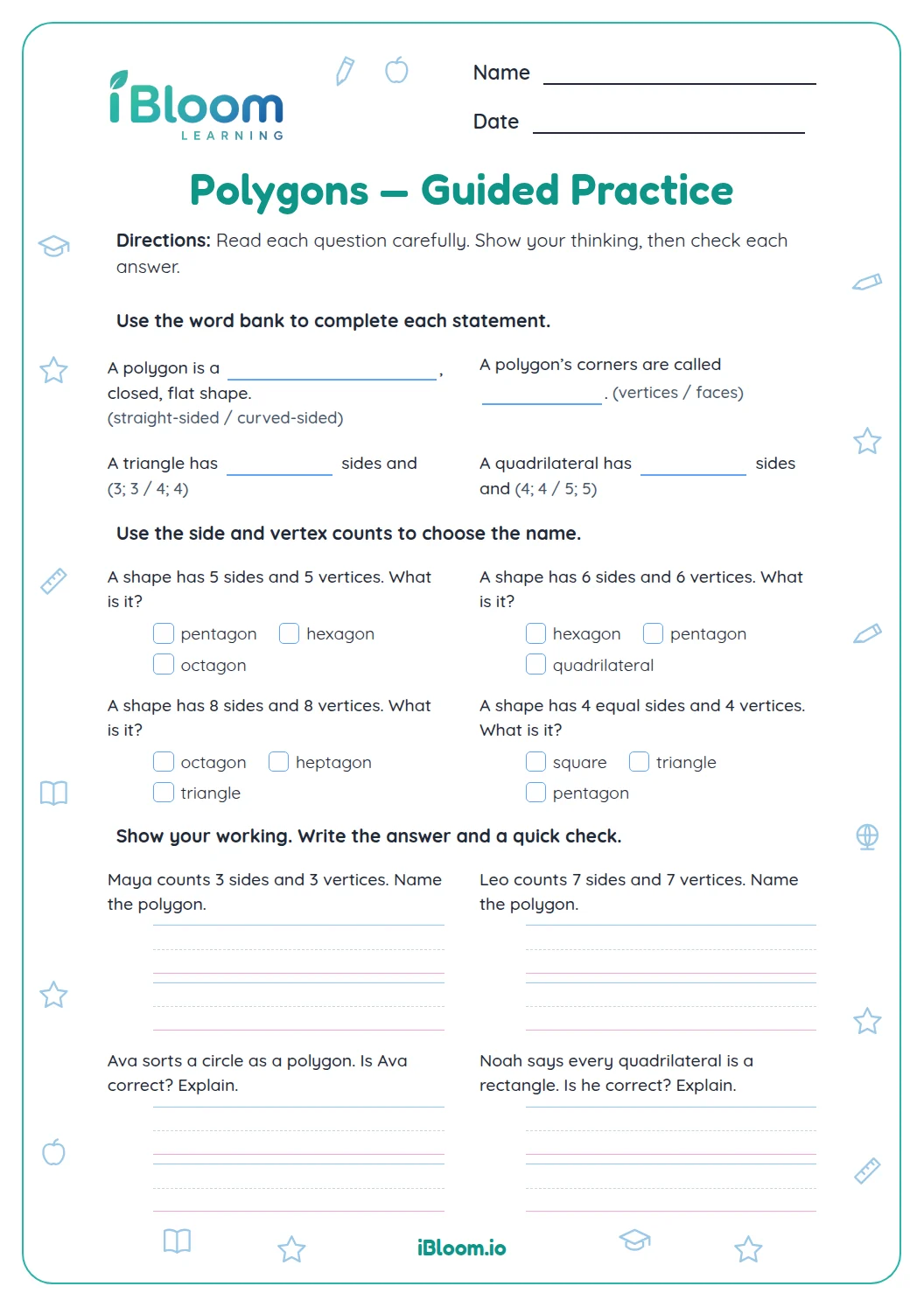
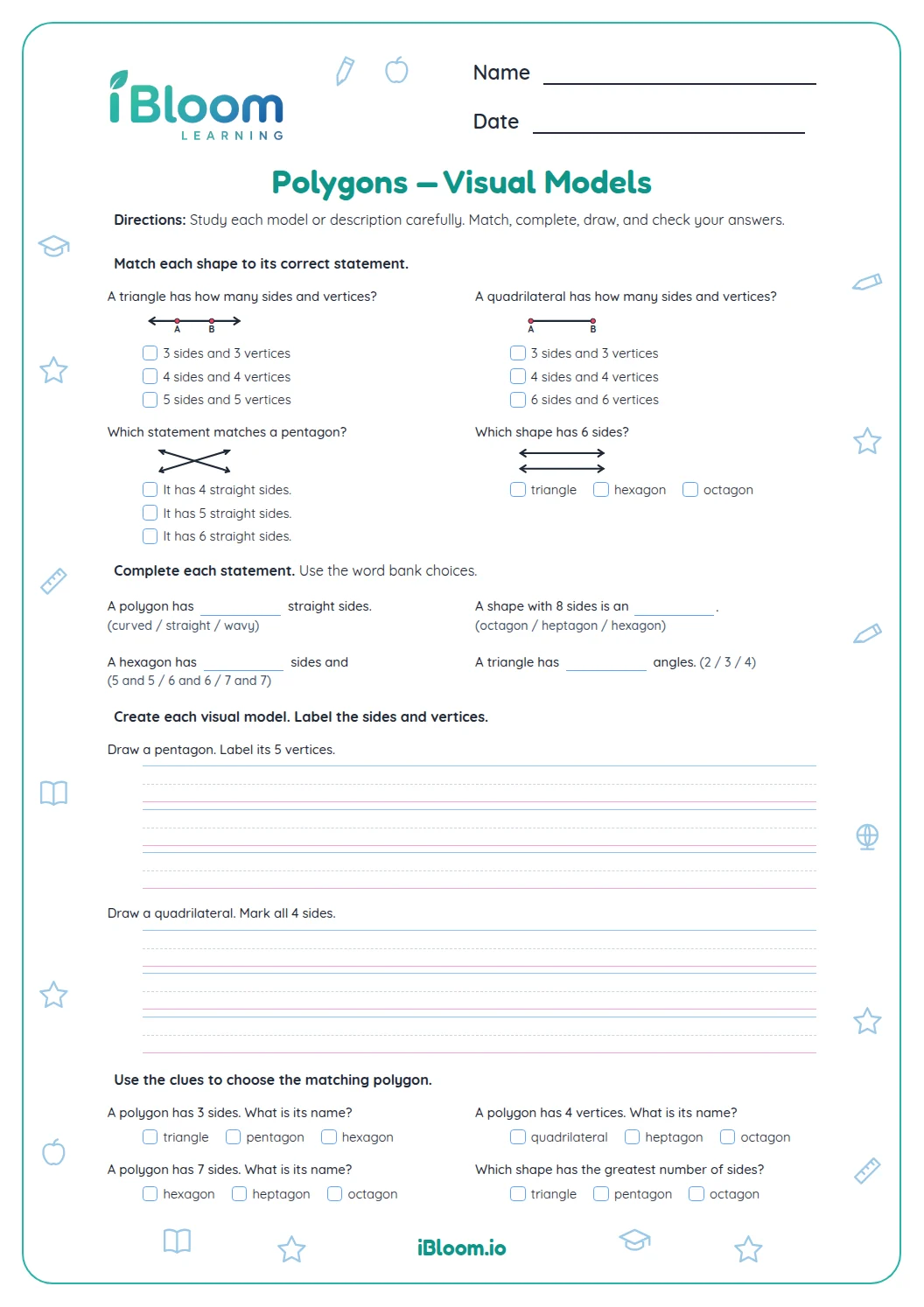
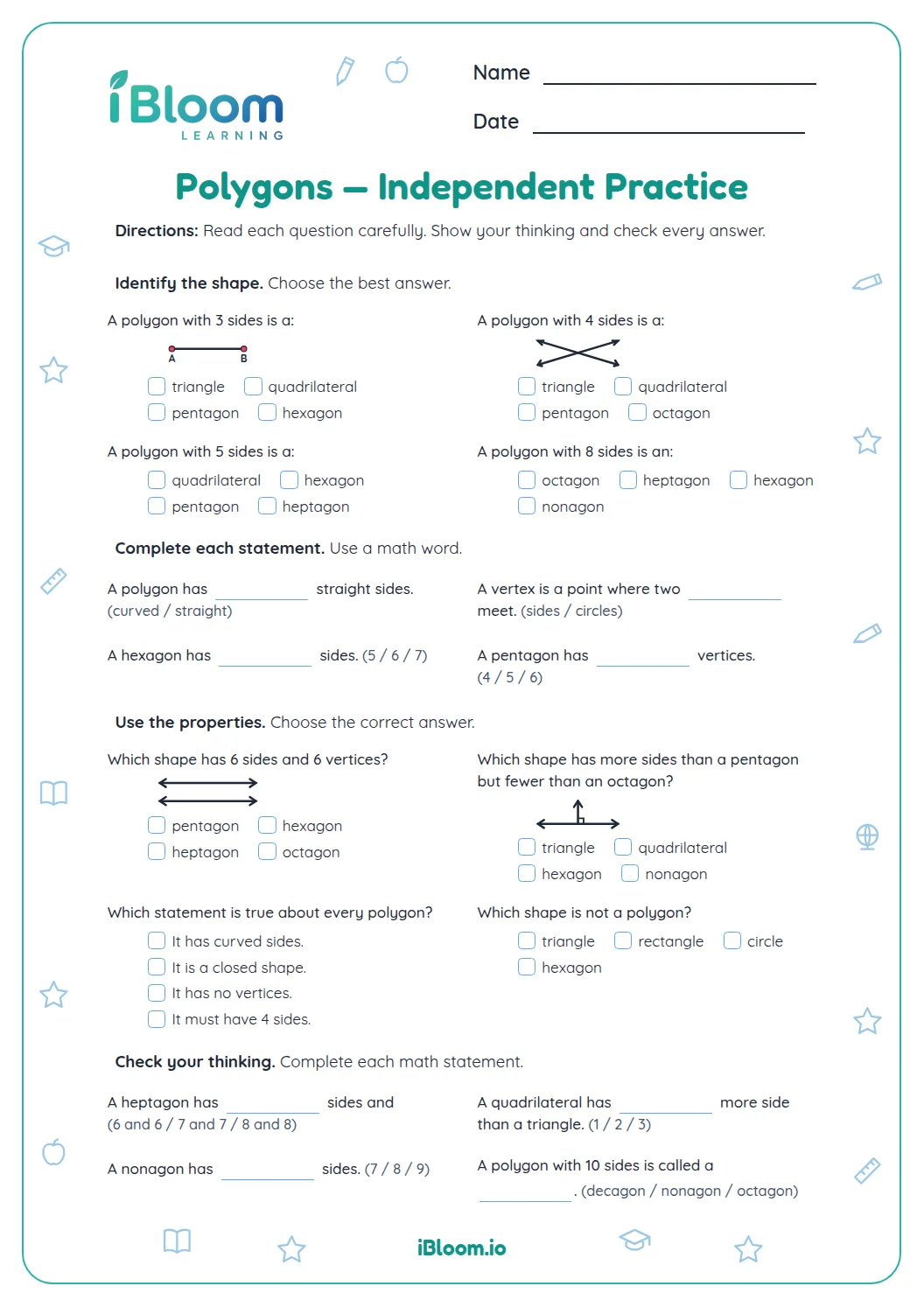
A polygon is a closed, flat shape made only of straight sides. A triangle has three sides, a quadrilateral has four, and an octagon has eight. Students use these clues to name shapes, count vertices, sort a circle from polygons, and draw one polygon of their own.
Aligned to 3.G.A.1
What makes a shape a polygon?
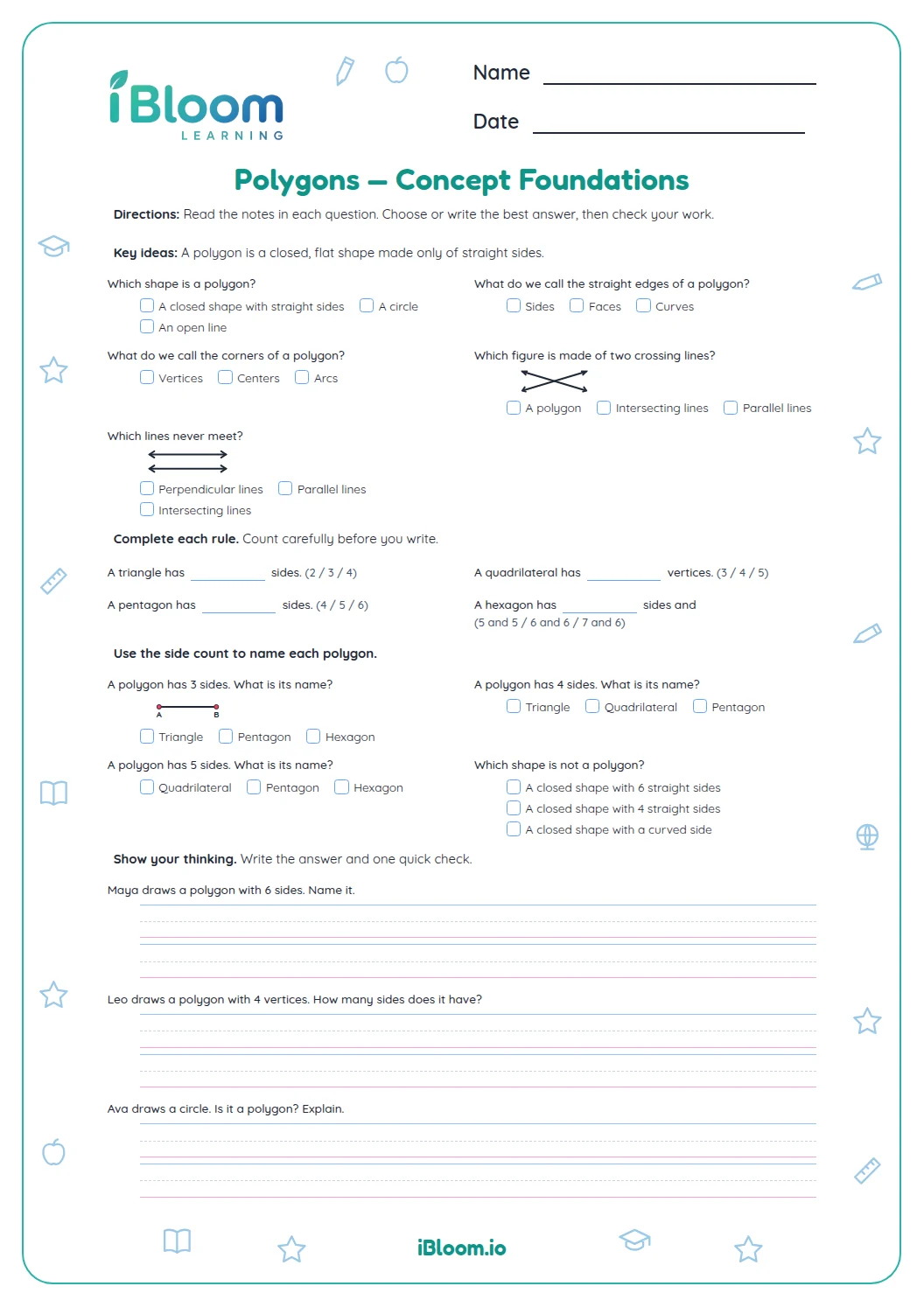
A polygon is a closed, flat shape made only of straight sides. A circle is closed but has a curved edge, so it is not a polygon. The side count equals the vertex count.
- 1Shape A is a circle.
- 2Its boundary is curved, so it is not a polygon.
How do side counts name polygons?
A triangle has 3 sides, a quadrilateral 4, a pentagon 5, a hexagon 6, and an octagon 8. The labeled examples in Part B let students name shapes by their side counts.
How can students check a polygon?
Check that the outline is closed, count its straight sides, and confirm that the vertices match that count. Questions in Part C ask students to apply these defining features.
How to use this worksheet
- 1Check that the outline is closed.
- 2Look for straight sides only; a curved edge means it is not a polygon.
- 3Count each side once.
- 4Count the vertices and compare that total with the side count.
- 5Use the side count to name the polygon.
Common mistakes and quick fixes
The mistake
Calling a circle a polygon because its outline is closed.
The fix
A polygon must have straight sides; a circle has a curved edge.
The mistake
Counting a corner as an extra side.
The fix
Count each edge between two neighboring corners as one side.
The mistake
Calling a 7-sided polygon an octagon.
The fix
A heptagon has 7 sides; an octagon has 8.
Common Core alignment
The worksheet names polygons by side count and connects shared attributes such as four sides.
Use shared shape attributes, such as side count, to group and describe shapes.
On this sheet: Learners connect polygon names and side counts, including the quadrilateral category.
Show the official wordingHide the official wording
Understand that shapes in different categories (e.g., rhombuses, rectangles, and others) may share attributes (e.g., having four sides), and that the shared attributes can define a larger category (e.g., quadrilaterals).
What to practice next
Make more practice
Further reading
Questions parents and teachers ask
What makes a shape a polygon?
A polygon is a closed, flat shape made only of straight sides. The sides meet at vertices. If an outline has an open gap or a curved edge, it does not meet the definition used on this worksheet. The side count gives a reliable way to distinguish the names.
How many sides does a pentagon have?
A pentagon has five sides and five vertices. This sheet asks learners to name polygons from side counts and identify each shape in a five-shape model. Count each straight edge once, then match the count to the polygon name.
Is a circle a polygon?
No. A circle has a curved edge rather than straight sides. The shape question uses a circle beside polygons so students can apply the defining rule. The side count gives a reliable way to distinguish the names. Students can apply the same definition to each shape on the page.
How do students name a polygon?
For the shapes practiced here, count the sides: 3 is a triangle, 4 is a quadrilateral, 5 is a pentagon, 6 is a hexagon, and 8 is an octagon. A seven-sided polygon is a heptagon. The side count gives a reliable way to distinguish the names.
Do polygons have the same number of sides and vertices?
Yes. Every side meets another side at a vertex, so a polygon has the same count of sides and vertices. A hexagon, for example, has six of each. The side count gives a reliable way to distinguish the names. Students can apply the same definition to each shape on the page.
Does this worksheet include an answer key?
Yes. The separate answer key identifies the pictured shapes and gives the side counts and polygon names for the rule questions. Students can use it to check both what they saw and what they reasoned from the definition. The side count gives a reliable way to distinguish the names.