


About this worksheet
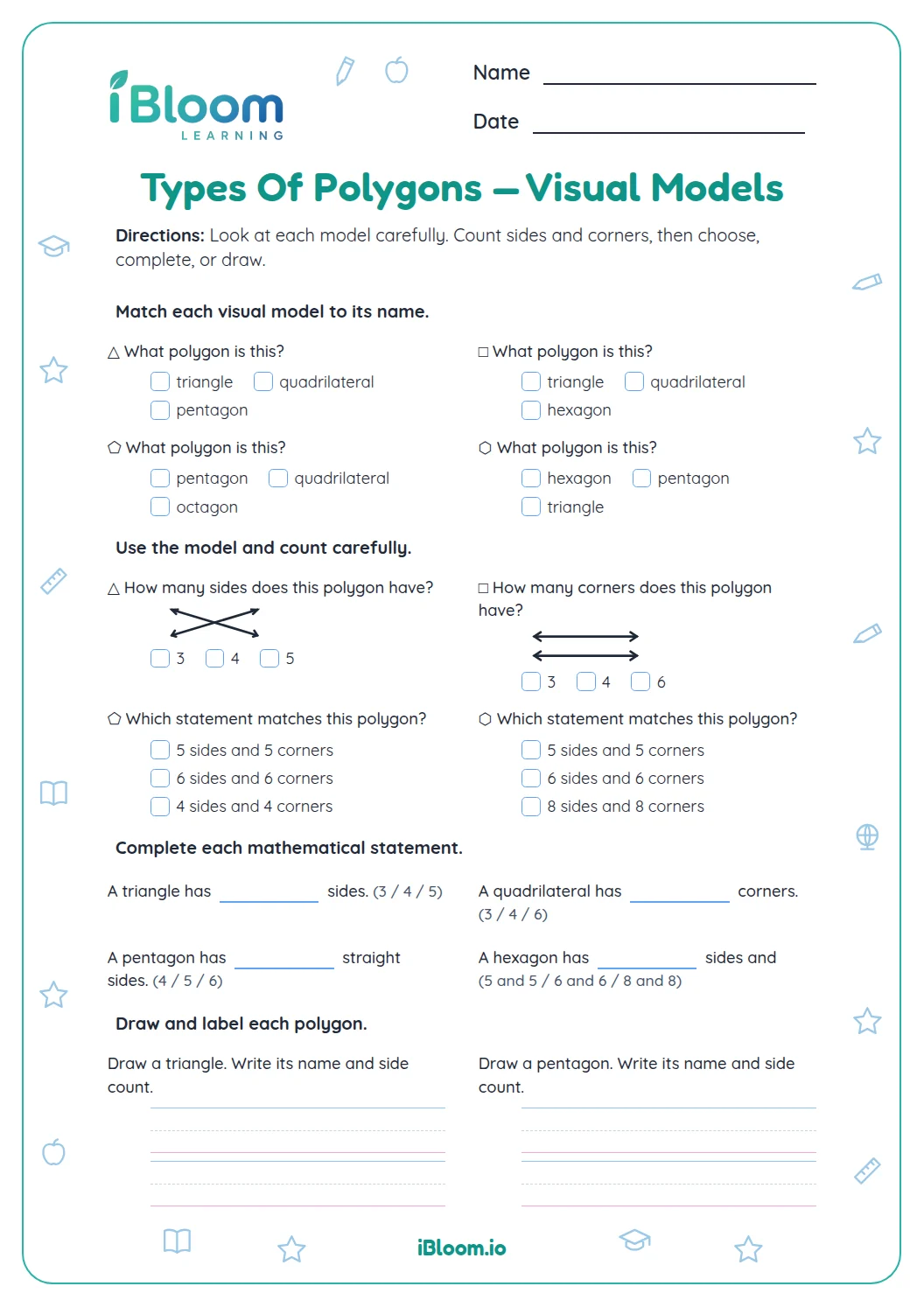
This Grade 3 printable focuses on recognizing polygons by their defining features: a closed boundary made from straight sides. Across 15 questions, learners identify shapes, count sides, connect side counts to polygon names, and check classmates’ claims. The separate key gives concise responses for self-checking or adult review. The work supports CCSS 3.G.A.1 by comparing shapes through shared attributes and recognizing quadrilaterals.
Aligned to 3.G.A.1
What makes a shape a polygon?
A polygon is a closed, flat shape made only of straight line segments. A circle is closed but has a curved boundary; an open figure does not close. Check both parts of the definition before naming a shape.
- 1Which description fits every polygon?
- 2A polygon must be closed and have only straight sides.
How do side counts help name polygons?
A polygon name is linked to its side count: a triangle has 3, a quadrilateral 4, a pentagon 5, a hexagon 6, a heptagon 7, and an octagon 8. The items mix names, counts, and vertices so learners use the relationship in more than one way.
How can learners check a shape claim?
Check whether the boundary closes and whether every side is straight. Then count the sides and vertices; the counts match. For example, a hexagon has six sides and six vertices.
How to use this worksheet
- 1Read the definition in the directions and point out “closed” and “straight sides.”
- 2Complete the shape-identification items, checking both features.
- 3Count sides by tracing around each shape once.
- 4Use the side count to select or write the polygon name.
- 5For explanation items, state the count or feature that supports the answer.
- 6Check the separate key after completing the page.
Common mistakes and quick fixes
The mistake
Calling any closed shape a polygon.
The fix
Check that every boundary segment is straight; a circle has a curved boundary.
The mistake
Skipping a side when counting.
The fix
Start at one corner and move around the whole boundary, counting each side once.
The mistake
Mixing up a polygon name and its side count.
The fix
Match the count to the name: five is pentagon, six is hexagon, seven is heptagon, eight is octagon.
Curriculum alignment
This worksheet gives practice with the Common Core skill below.
Classify shapes by shared attributes and recognize examples of quadrilaterals.
On this sheet: Learners classify polygons and connect side counts with larger shape categories.
Show the official wordingHide the official wording
Understand that shapes in different categories (e.g., rhombuses, rectangles, and others) may share attributes (e.g., having four sides), and that the shared attributes can define a larger category (e.g., quadrilaterals).
What to practice next
Make more practice
Further reading
Questions parents and teachers ask
What makes a shape a polygon?
A polygon is a closed shape with straight sides. The first questions ask learners to apply both parts of that definition to pictured shapes. A closed circle does not qualify because its edge curves; an open figure does not qualify because its boundary does not close.
How many questions are included?
The printable has 15 questions in four parts: identifying polygons, counting sides, using the definition, and checking shape claims. The first items use choices; later items ask learners to fill in counts or explain a classification. A separate answer key is included.
Which polygon names does the sheet use?
The sheet names triangles, quadrilaterals, pentagons, hexagons, heptagons, and octagons. Each name matches a side count. Learners also count vertices and apply the rule that a polygon is closed with straight sides. These checks help connect vocabulary to the shapes.
What is the main idea in the worked example?
Question 1 asks for the description that fits every polygon: it must be closed and have straight sides. The later questions apply that rule to individual figures and statements. Review the reason for an answer, not only the polygon name.
Does this worksheet include an answer key?
Yes. The key lists the correct choice or missing count for each question and gives short model explanations for the reasoning prompts. Have the learner finish first, then compare each response with the key and revisit the definition when a classification is missed.