
About this worksheet
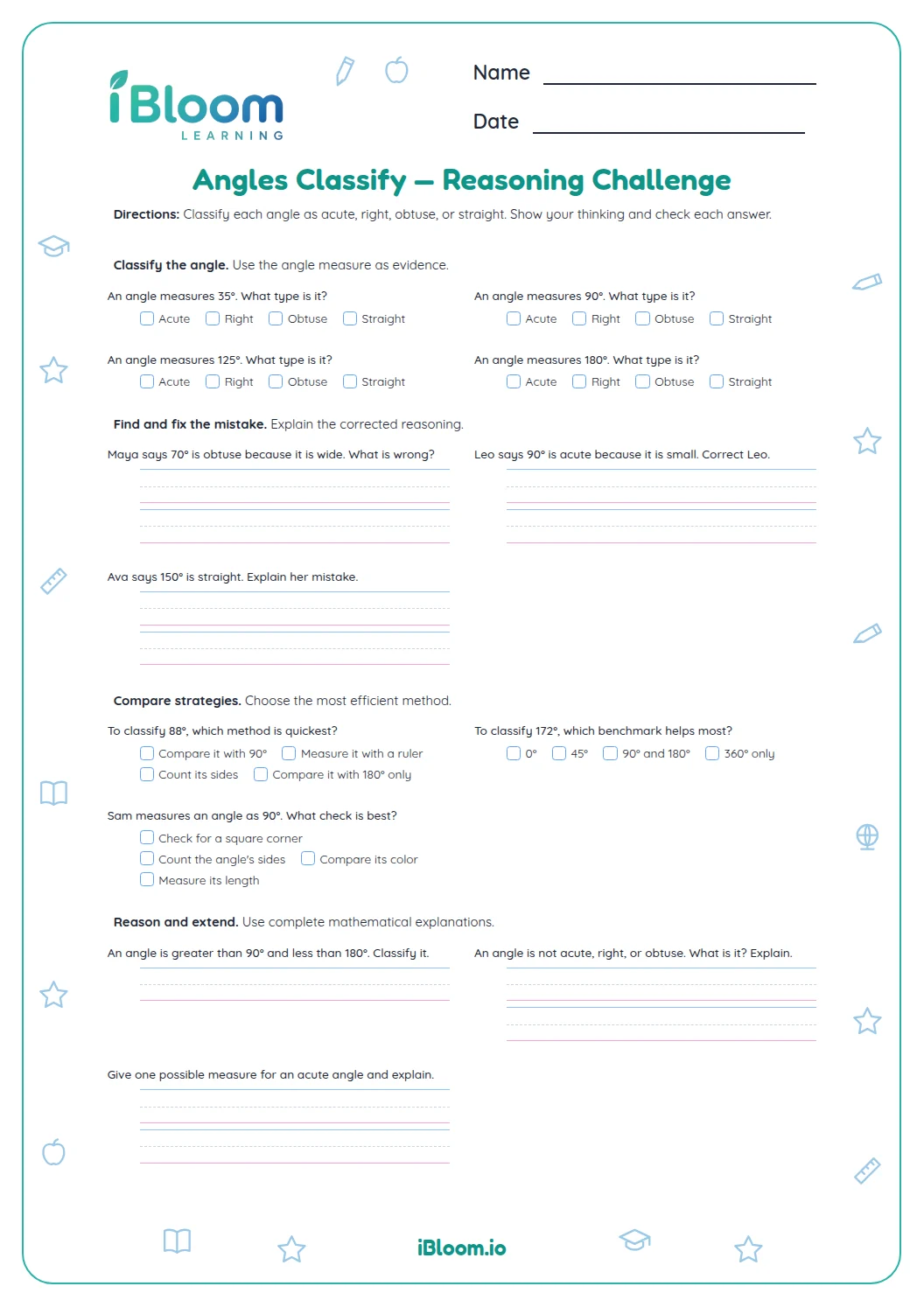
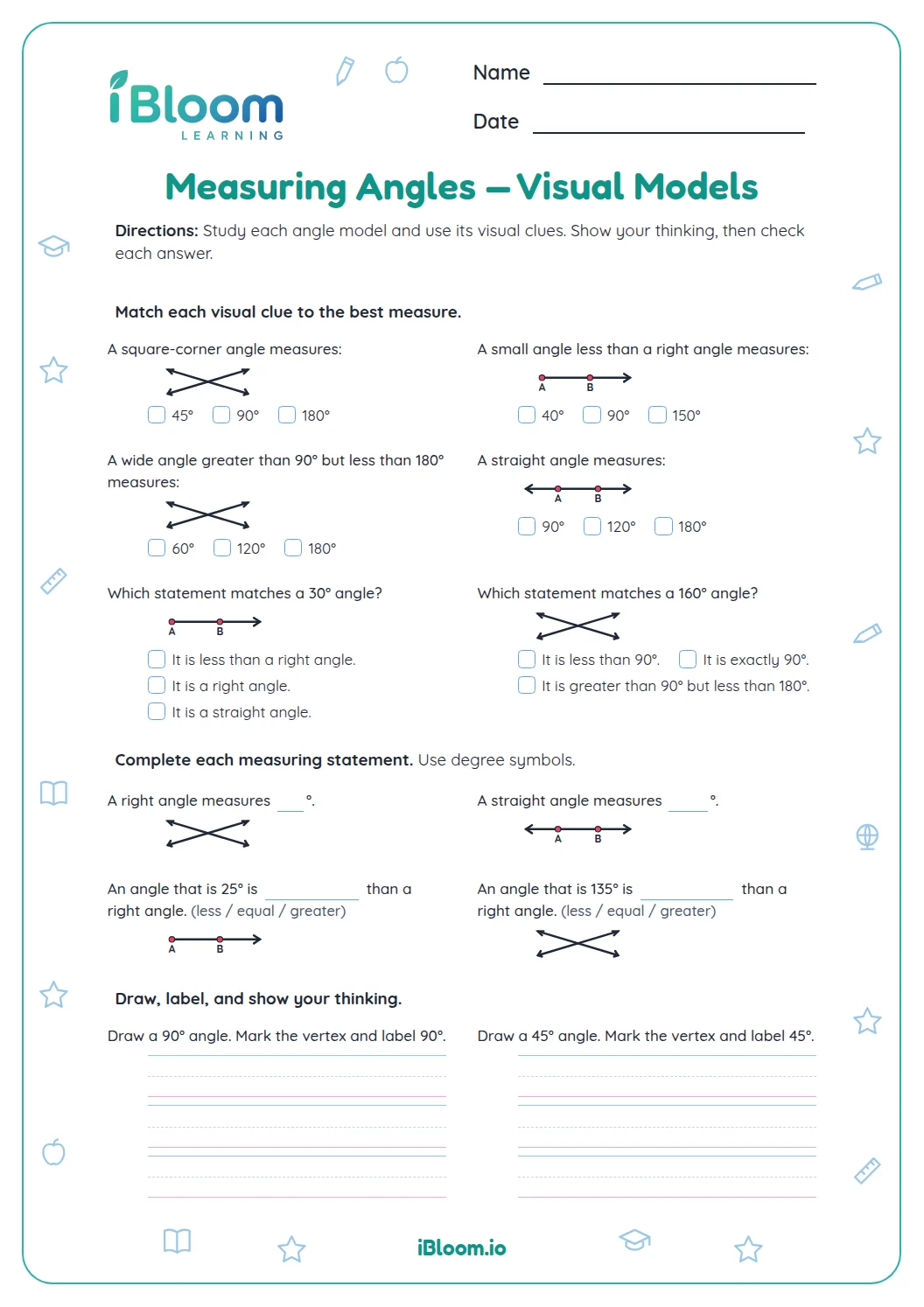
This Grade 3 printable gives students 14 chances to classify angle openings as acute, right, or obtuse. Each prompt describes an opening in relation to a familiar square corner, so students use the same comparison throughout. The separate answer key gives a classification for every item.
Aligned to 4.G.A.1
How can you classify an angle by its opening?
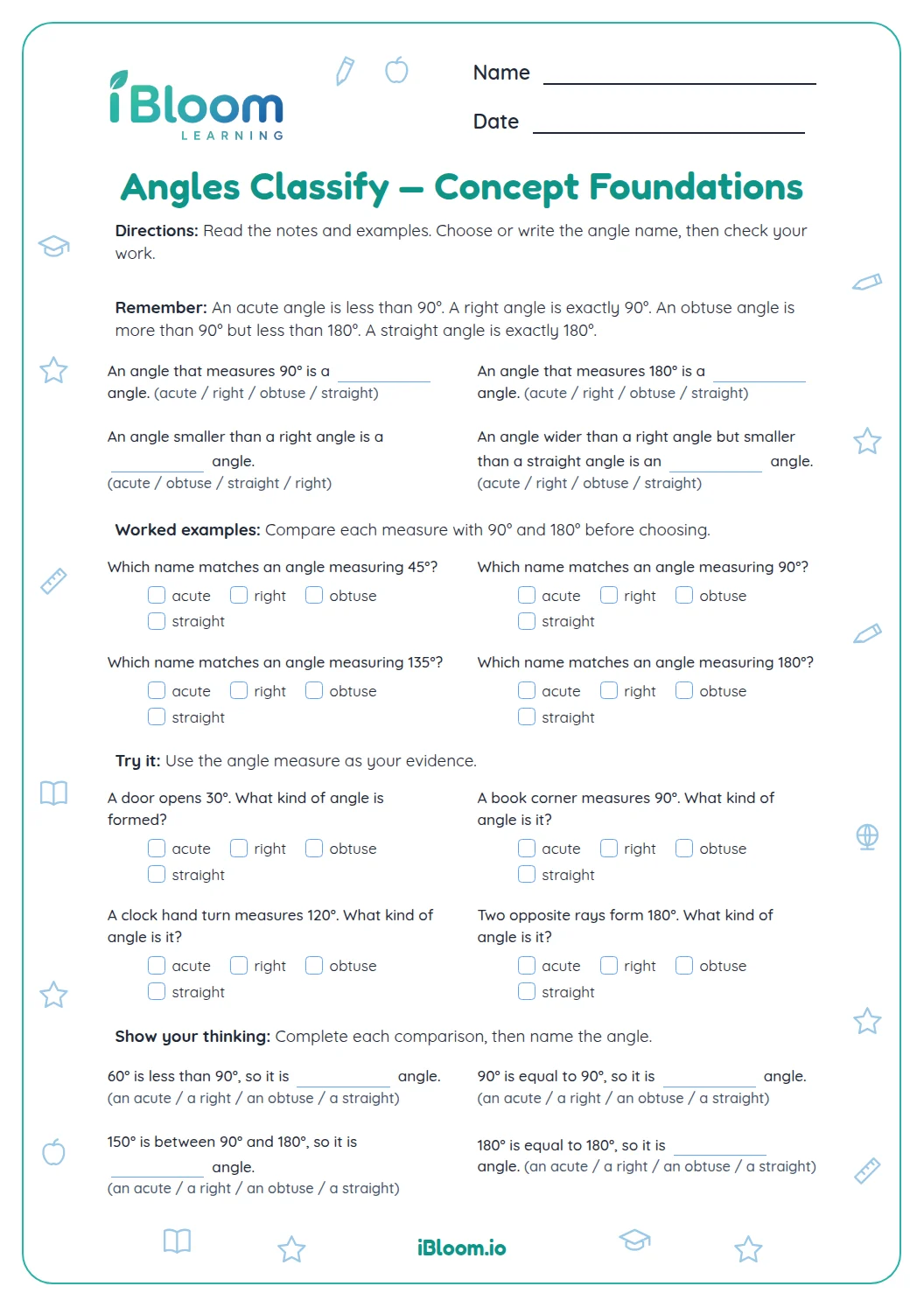
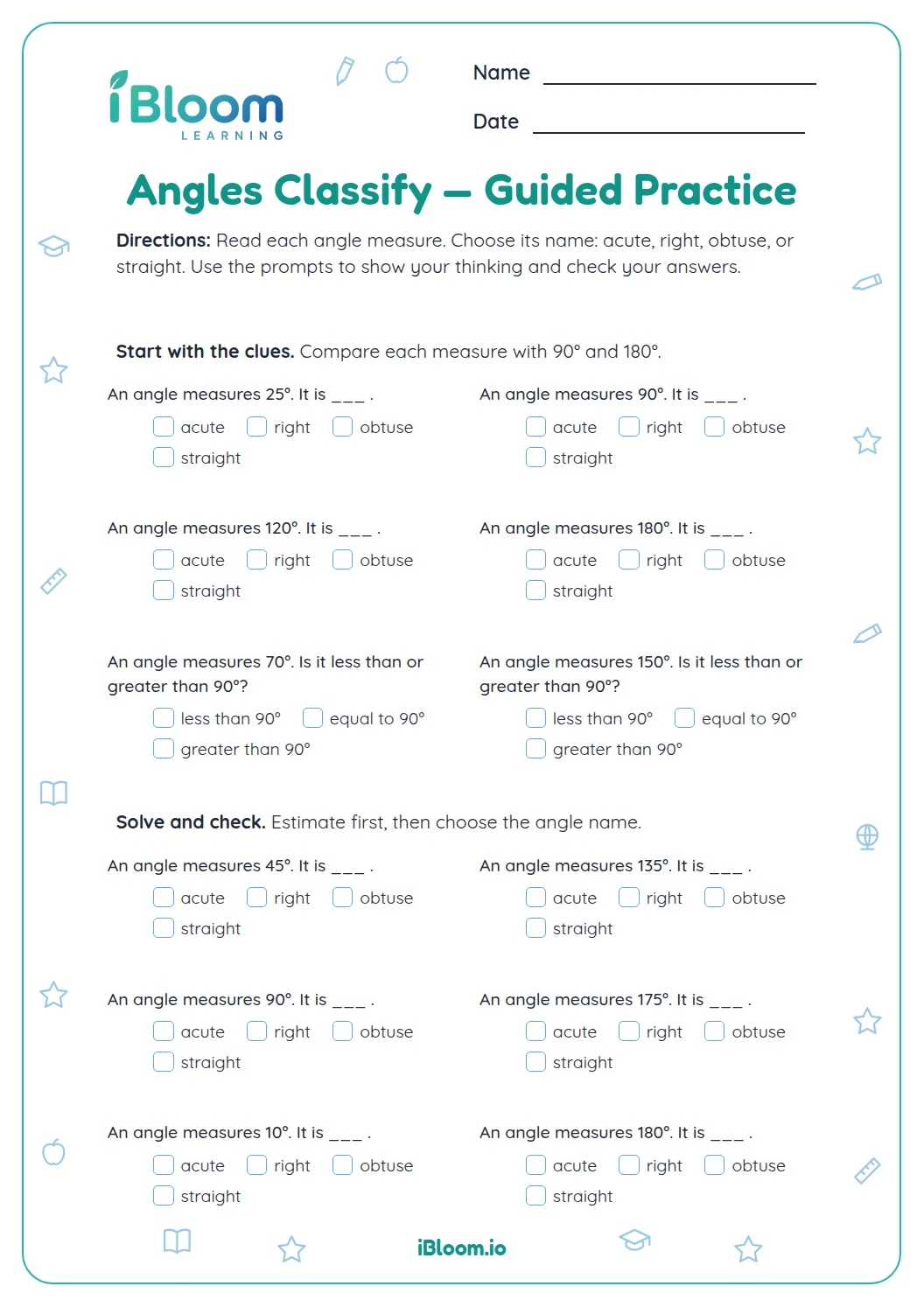
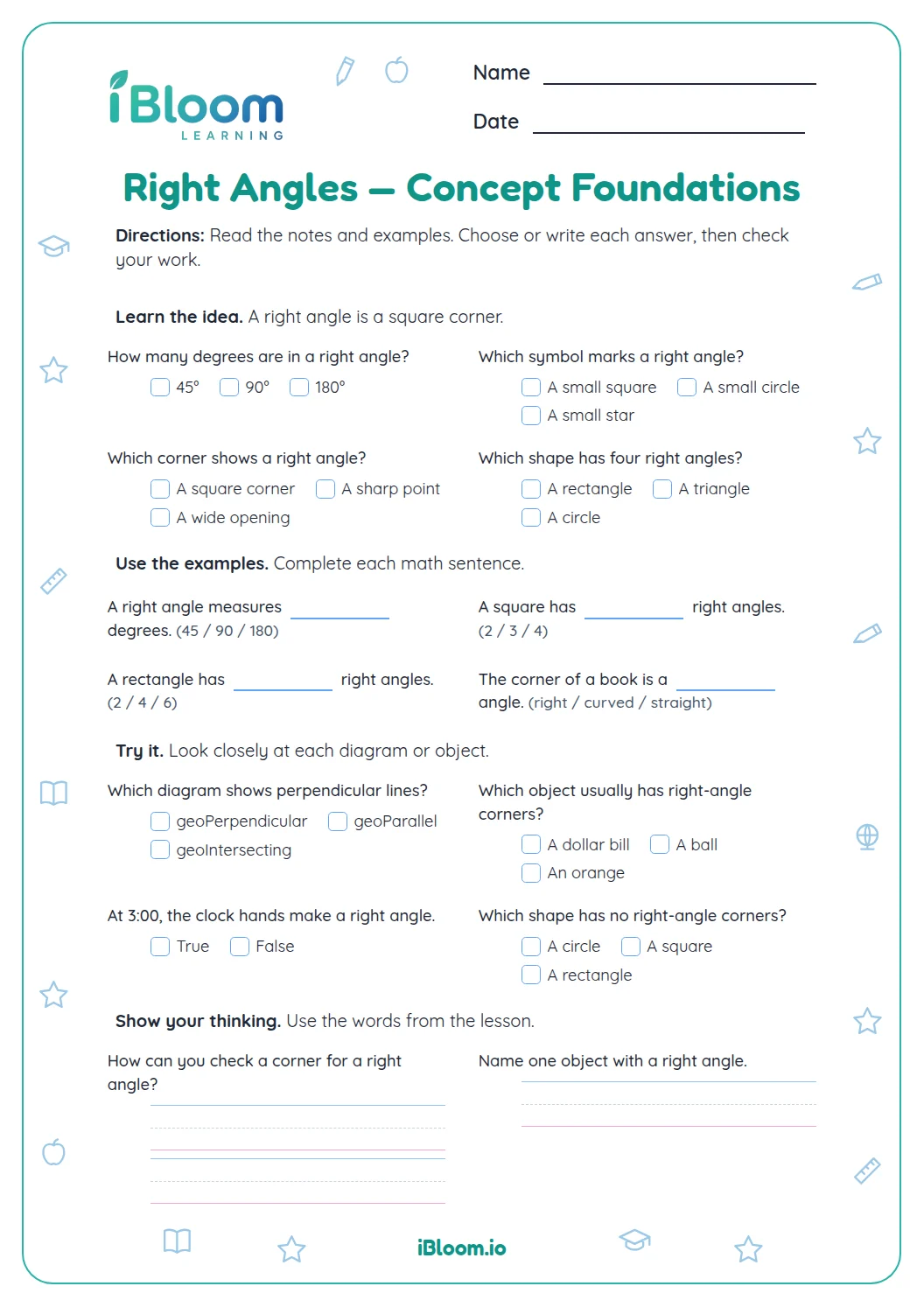
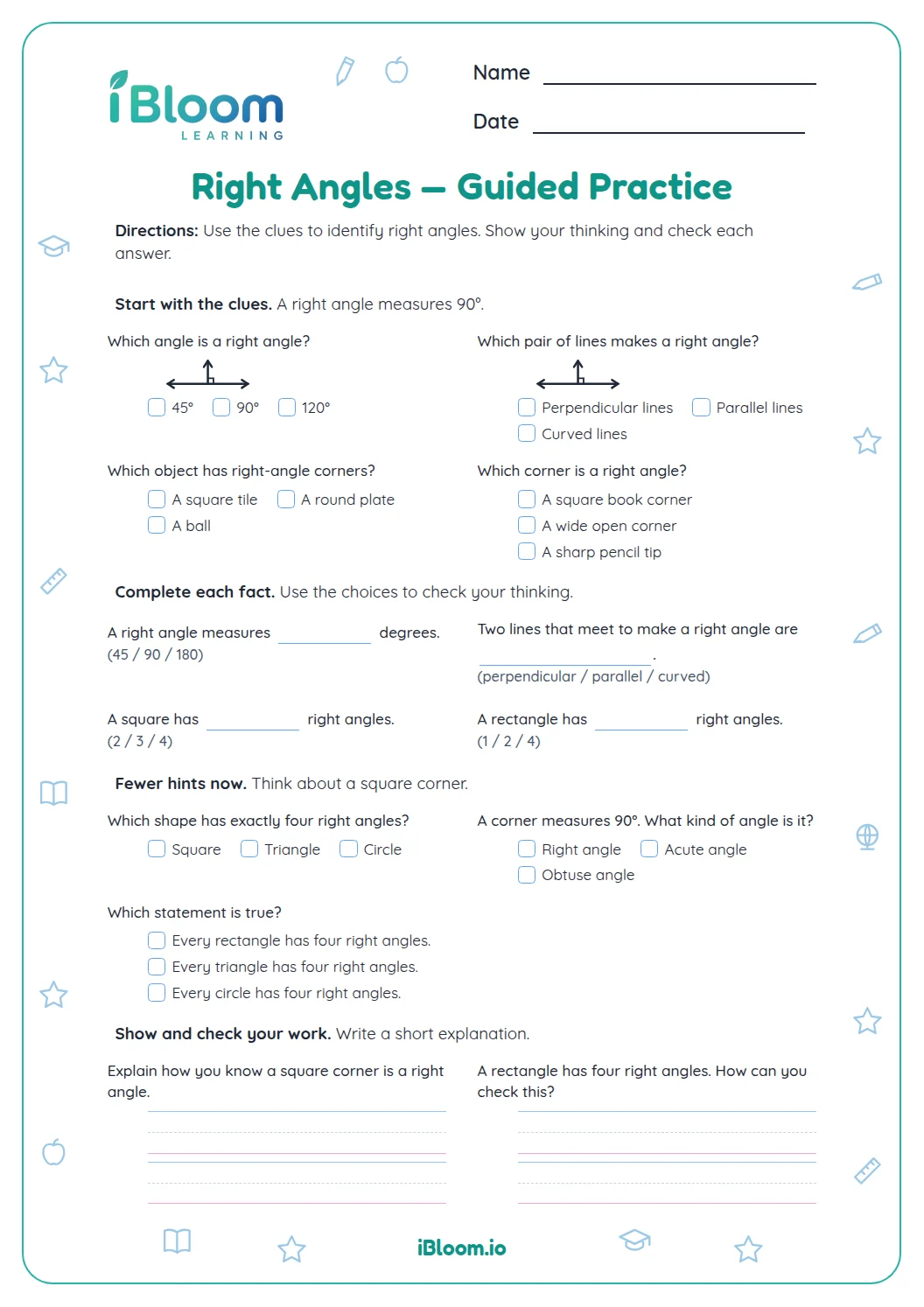
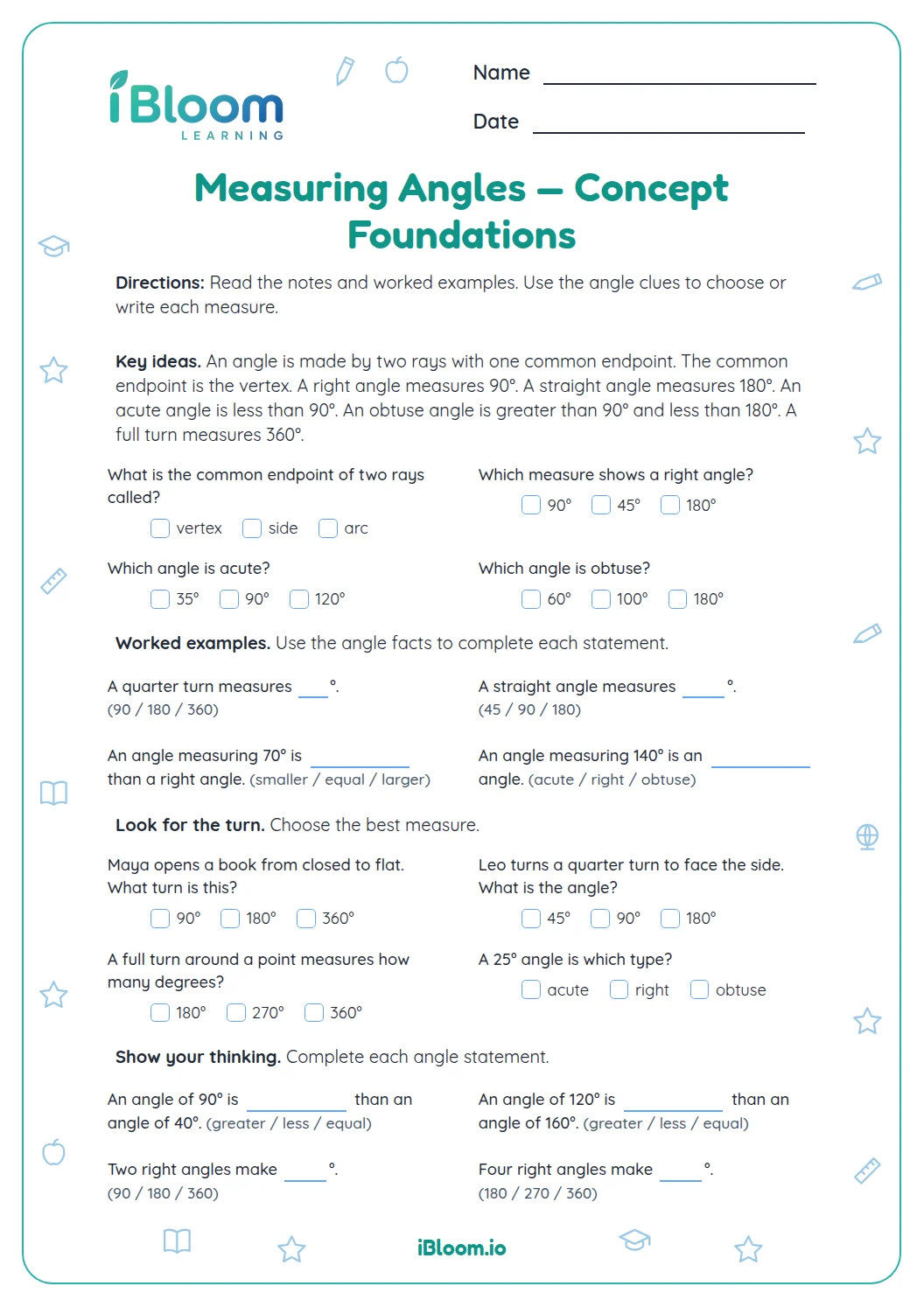
An angle is made by two rays that meet at one endpoint. Compare its opening with a square corner: a smaller opening is acute, a square corner is right, and a wider opening is obtuse.
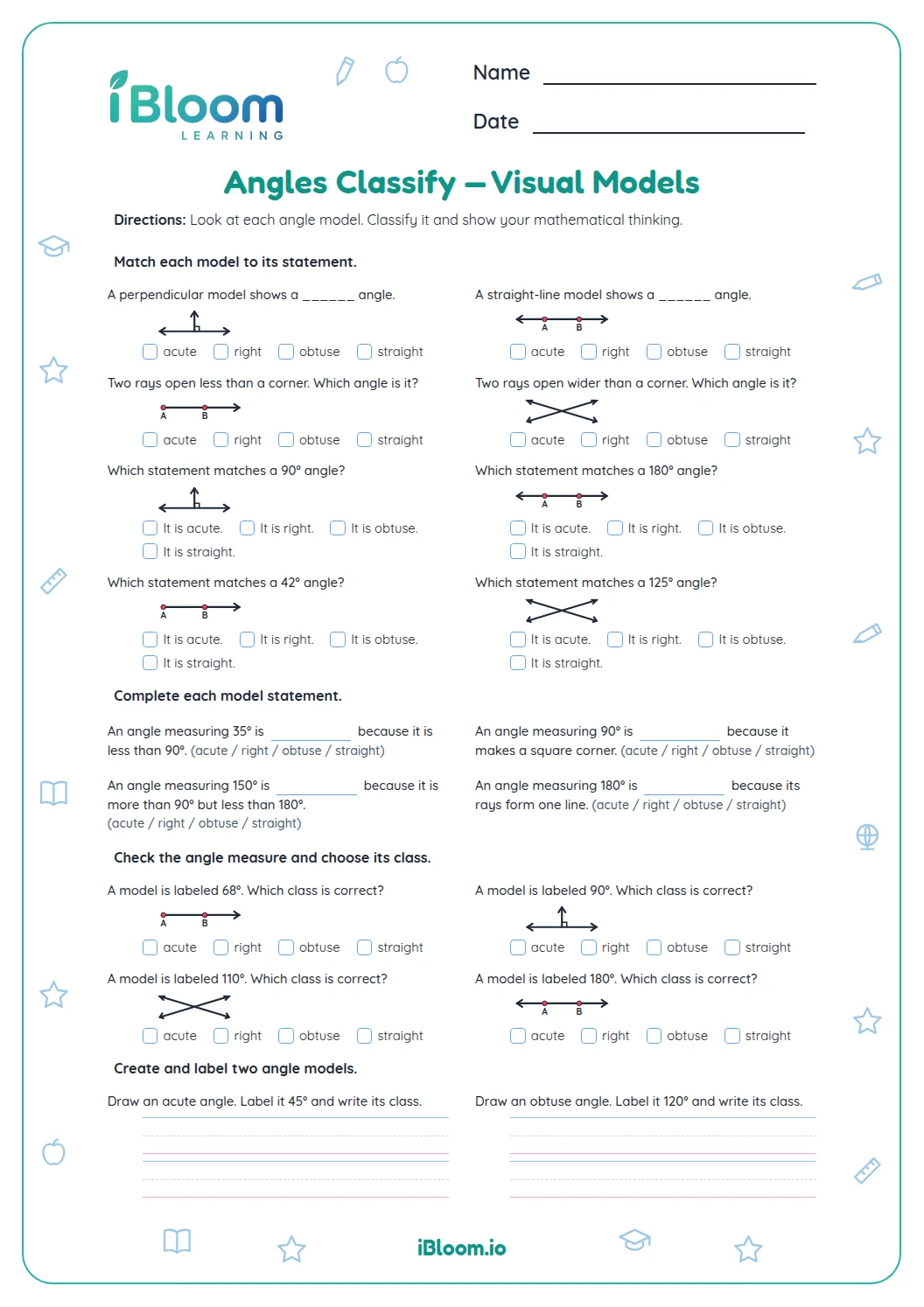
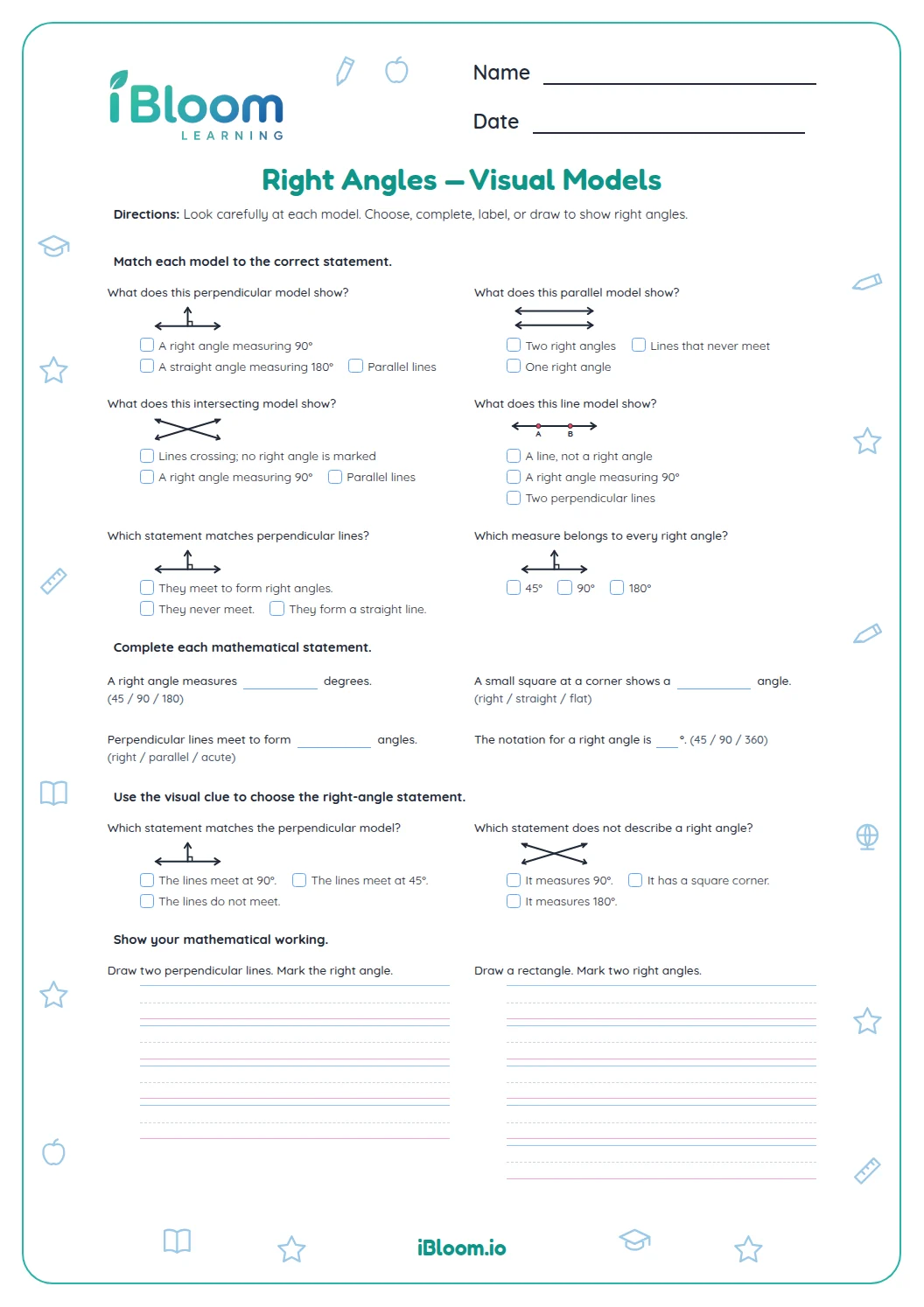
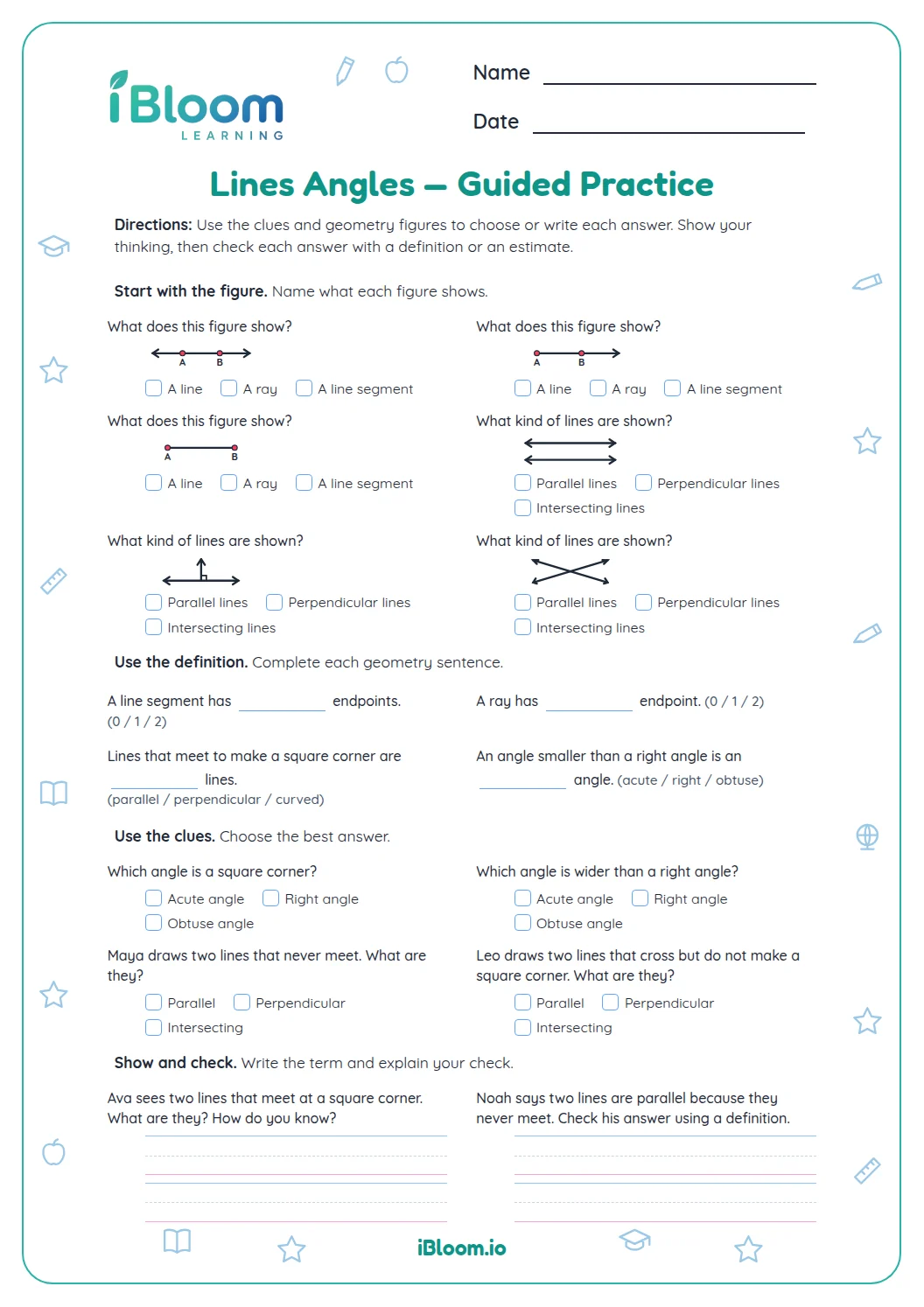
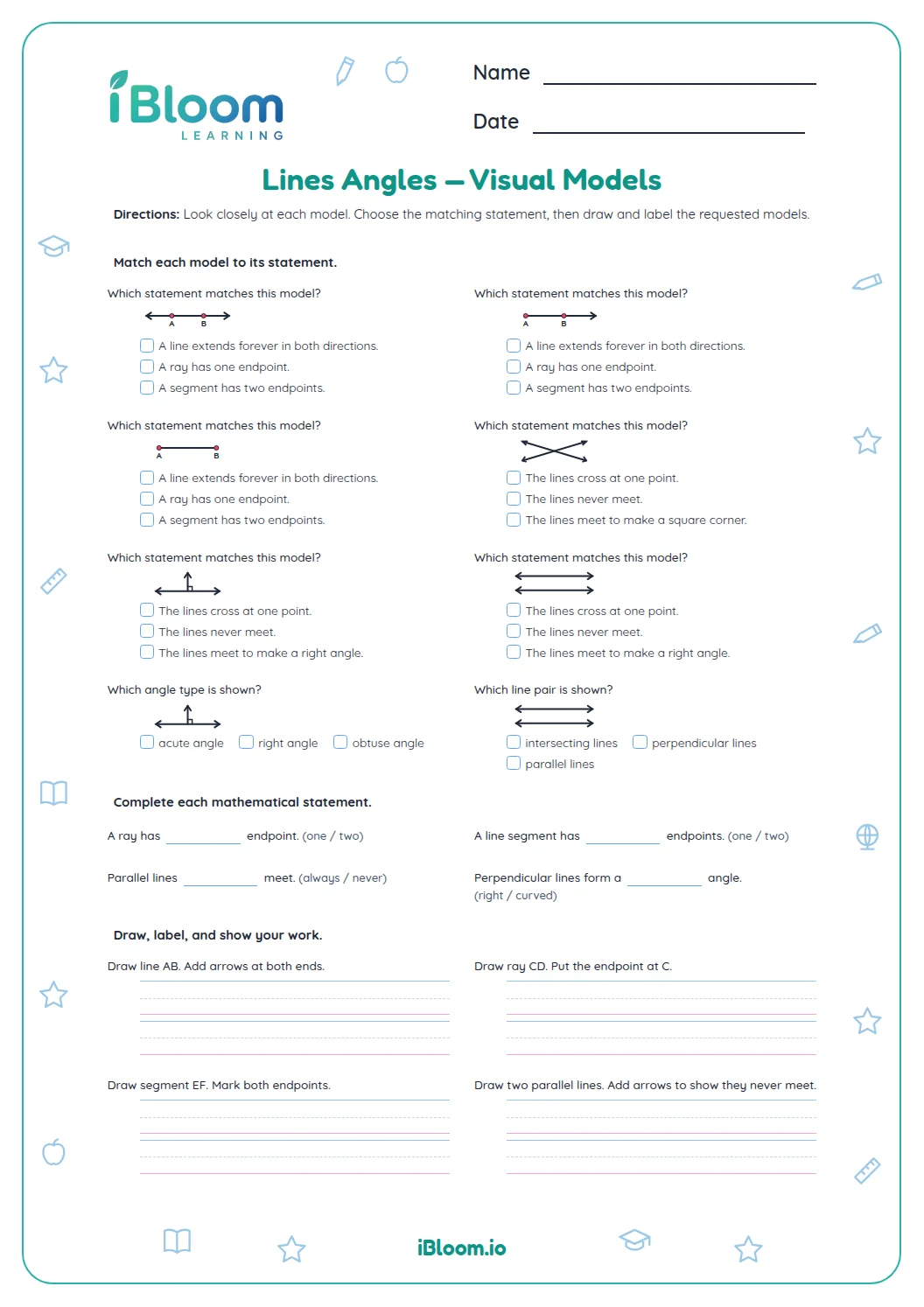
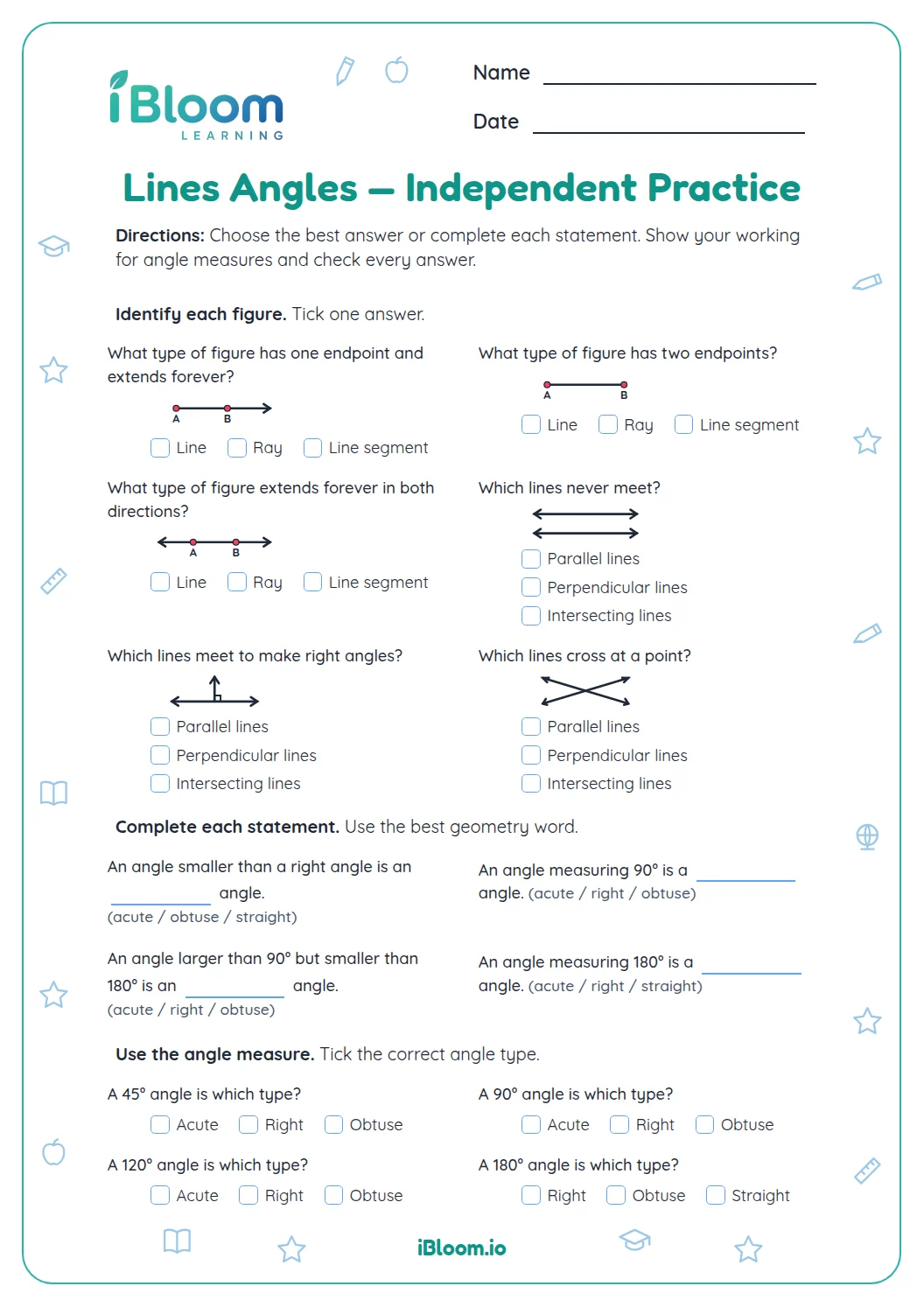
The drawings show each angle without a degree label. Look at the opening, then choose the name that fits.
- 1A square corner is a right angle.
- 2An opening smaller than that corner is acute.
- 3Check the drawn rays, then name the angle type.
Why use a right angle as a benchmark?
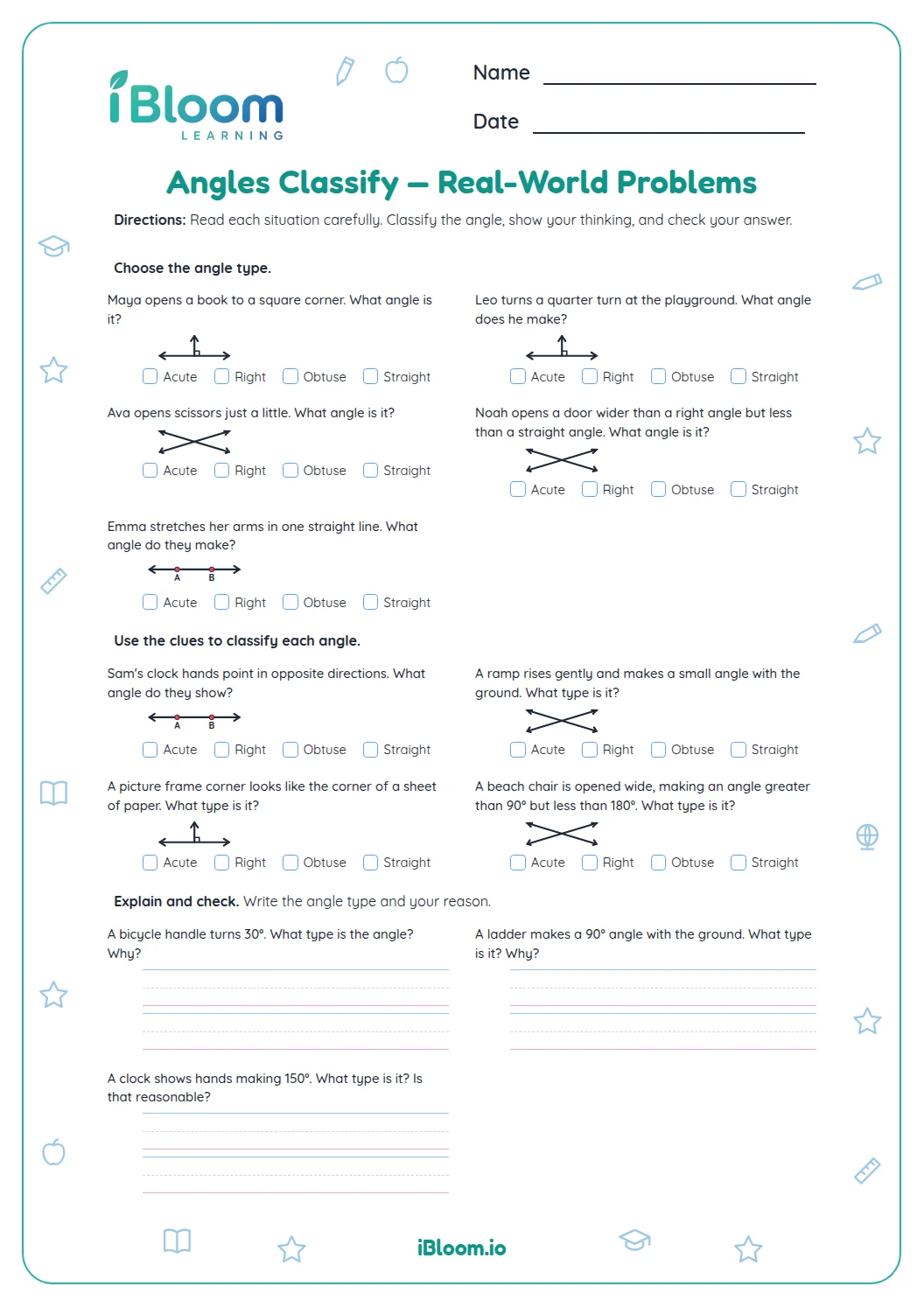
Part A classifies ten drawn angles. Part B uses four everyday clues to apply the same comparison. A clue such as “wider than a square corner but not flat” describes an obtuse angle.
What will students see in the practice?
Check each answer by comparing the opening with a square corner. The key names the angle type for every drawing and clue.
How can you use this worksheet?
- 1Look at the two rays and their shared endpoint.
- 2Imagine a square corner as a right-angle benchmark.
- 3Decide whether the opening is smaller, equal, or wider.
- 4Choose acute, right, or obtuse.
- 5Use the key to review any angle you misclassified.
Common mistakes and quick fixes
The mistake
Calling every narrow-looking angle right.
The fix
Compare its opening with a square corner before choosing.
The mistake
Thinking a tilted angle changes its type.
The fix
Turn the page mentally; angle type depends on opening, not direction.
The mistake
Calling a straight line obtuse.
The fix
Check that the rays do not form one straight line; these items use acute, right, or obtuse.
Common Core alignment
This practice connects the worksheet tasks to the stated Common Core skill.
Identify and name acute, right, and obtuse angles in figures.
On this sheet: Students classify drawn angles by comparing their openings with a right angle.
Show the official wordingHide the official wording
Draw points, lines, line segments, rays, angles (right, acute, obtuse), and perpendicular and parallel lines. Identify these in two-dimensional figures.
What to practice next
Make more practice
Further reading
Questions parents and teachers ask
What angle types does the worksheet ask students to name?
The sheet asks students to name an angle acute, right, or obtuse. They classify 14 short descriptions, using a square corner as the comparison for each opening. The answer key lists the name that fits every item and makes checking straightforward.
How can a student tell acute from obtuse?
This printable is labeled for Grade 3 and uses visual comparisons rather than degree measurements. Students decide whether an angle is narrower than, equal to, or wider than a square corner, using drawings and familiar objects such as a page or open book.
Why do some questions show angles and others give clues?
An acute angle opens less than a square corner, a right angle makes a square corner, and an obtuse angle opens wider than a square corner but is not flat. Students use those comparisons to classify the drawings and descriptions on this sheet.
Does this worksheet ask for exact angle measures?
No. The questions describe each angle opening in relation to a square corner, without using a degree measure. Students apply the same comparison across all 14 prompts and use the key to check each classification afterward. This keeps attention on angle size.
How many questions and pages are included?
There are 14 questions with short descriptions of angle openings. The worksheet and its separate answer key each have two pages. Students can use the key to check each classification after finishing and discuss any missed comparison together.