
About this worksheet
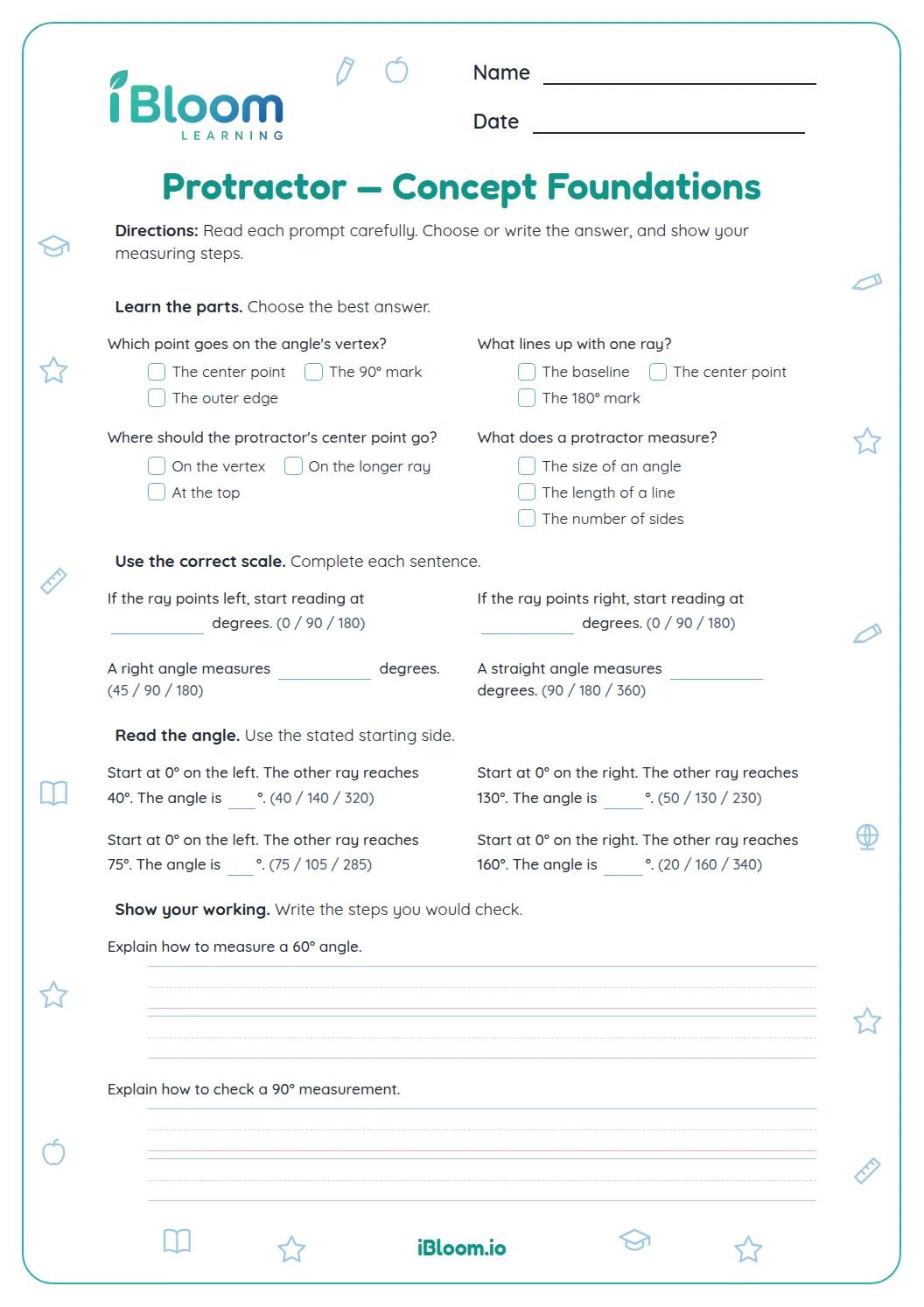
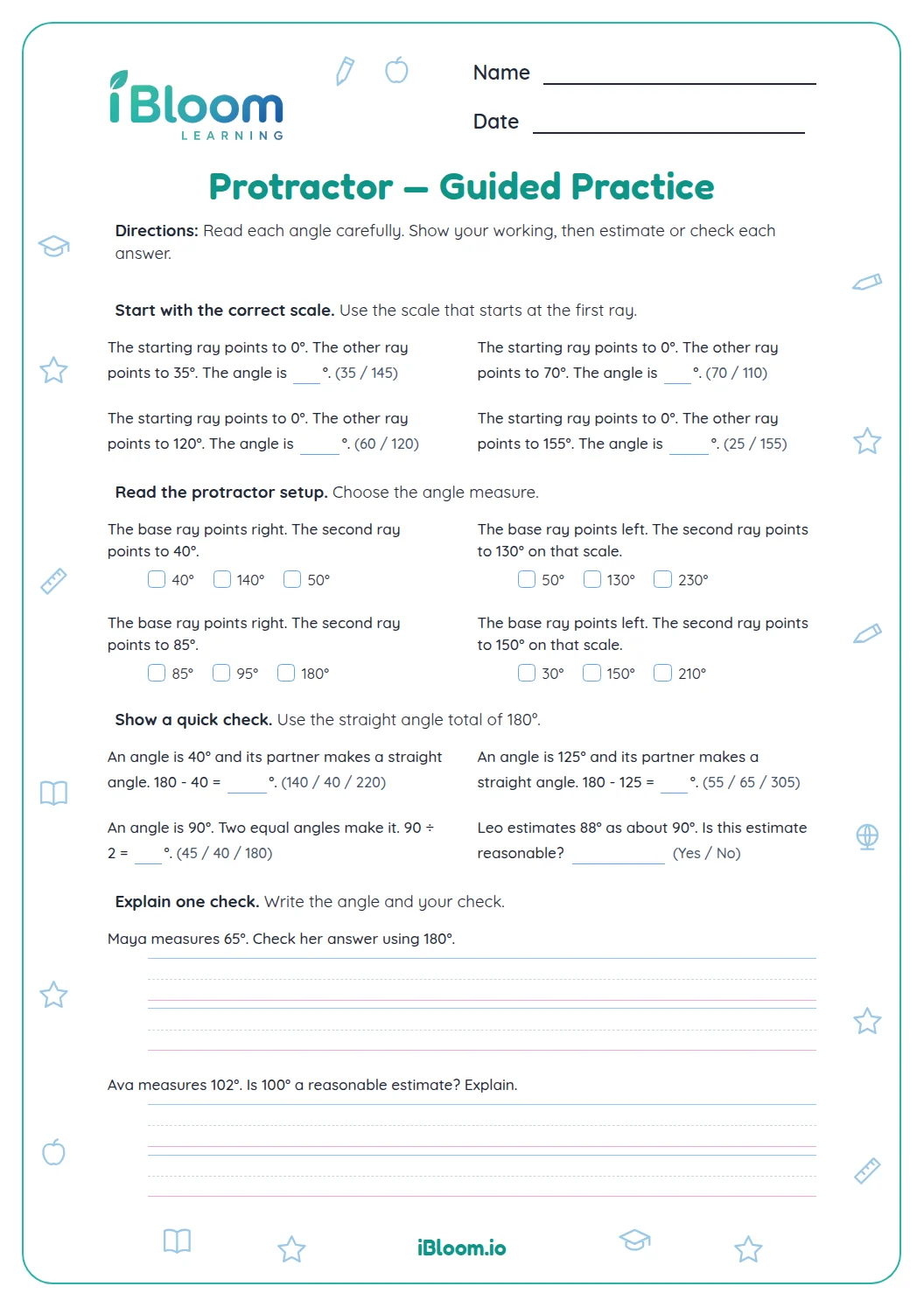
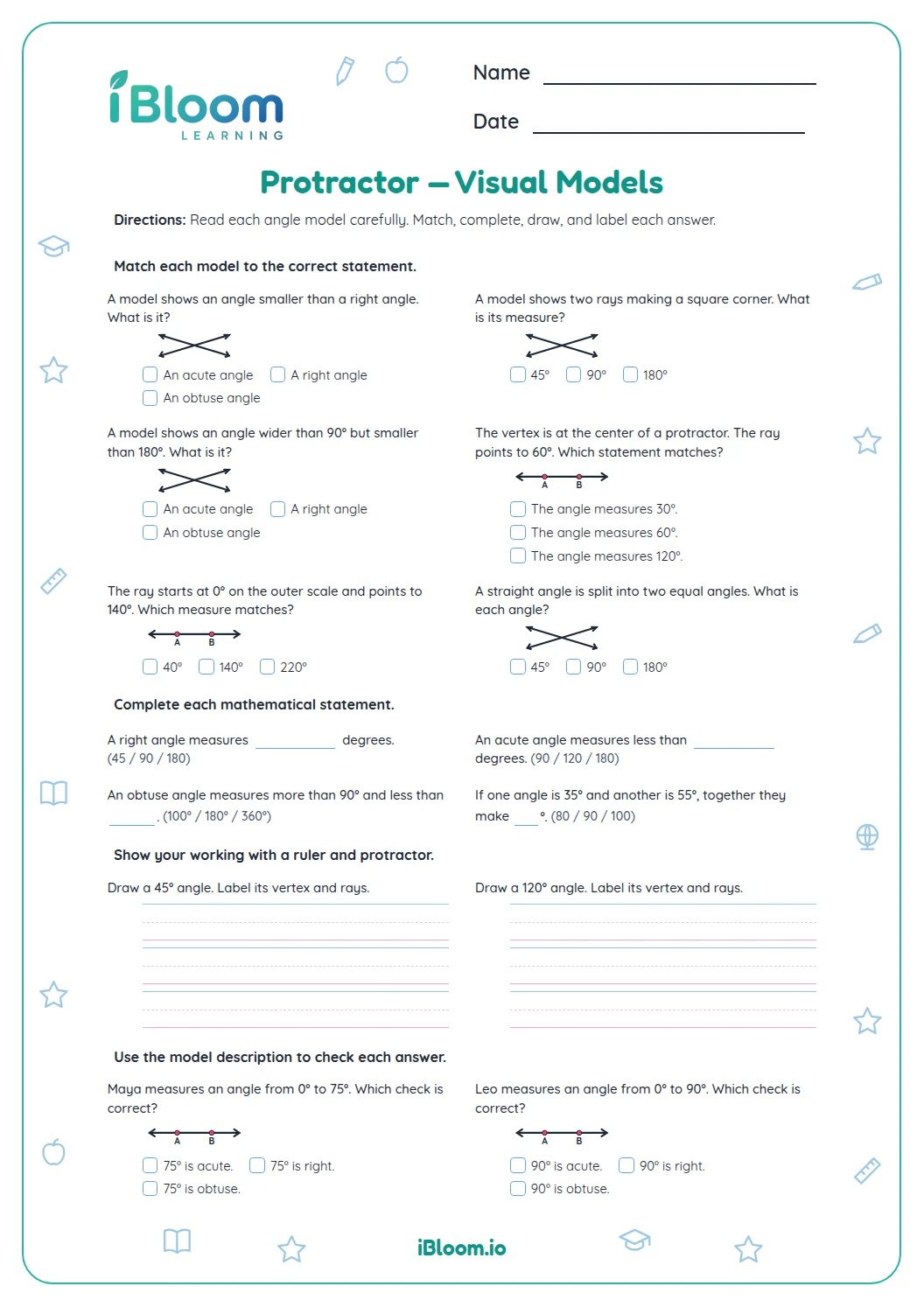
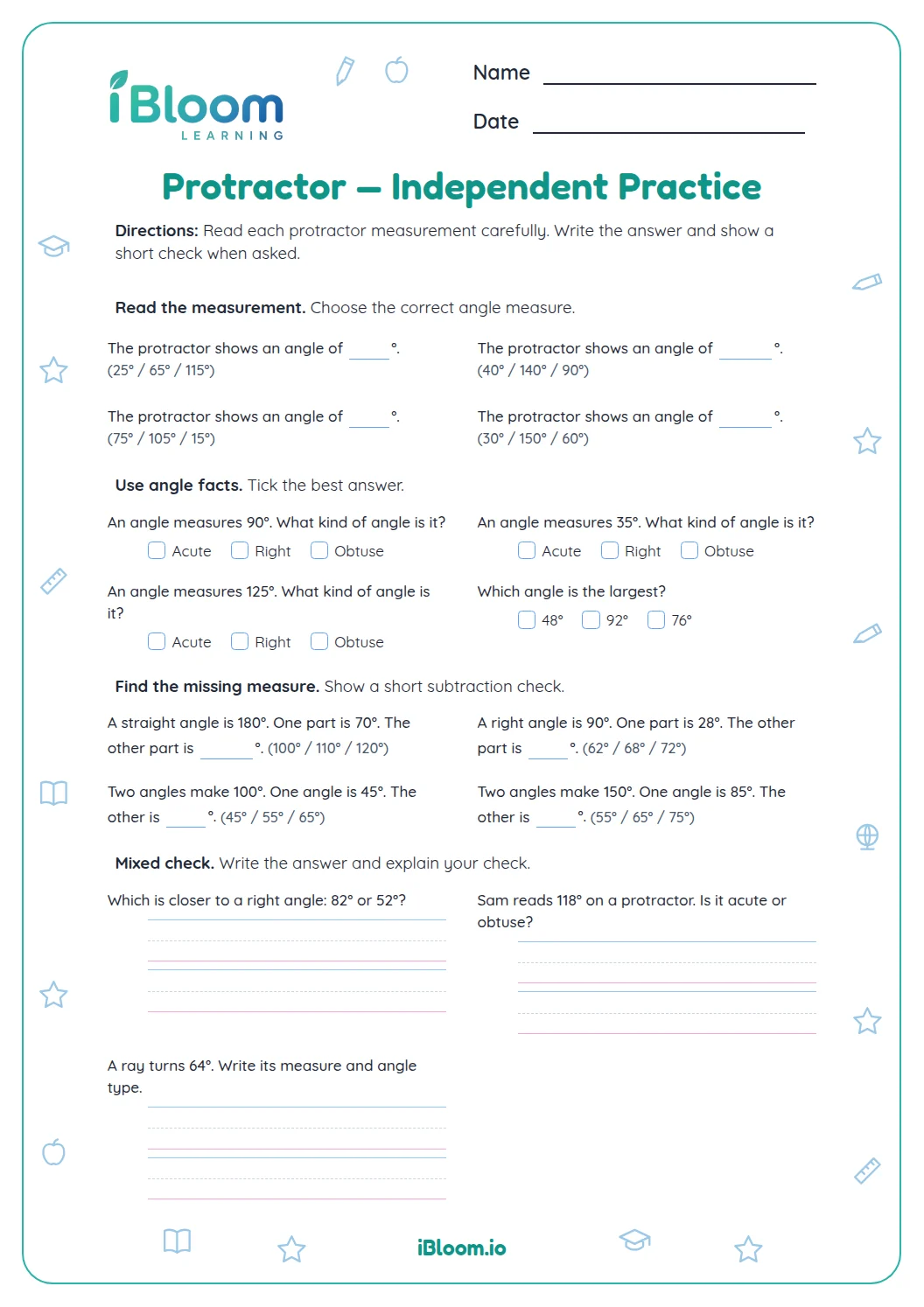
This Grade 3 guided practice focuses on measuring angles and reasoning with degree measures. The 16 questions begin with four drawn angles to measure, then compare angles with a right angle and solve missing-measure equations. A separate answer key gives the measures and results for checking.
Aligned to 4.MD.C.6
What makes an angle larger?
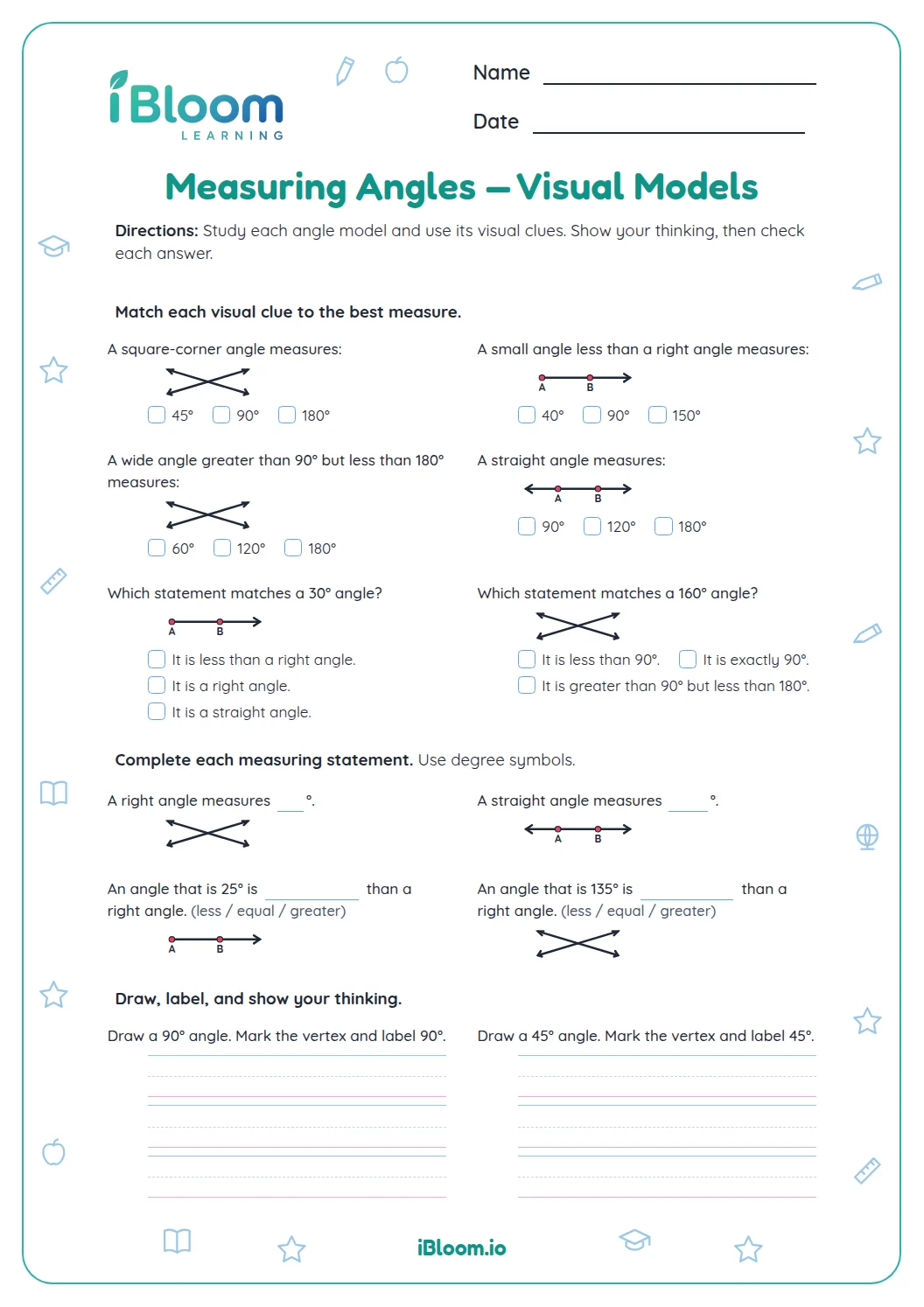
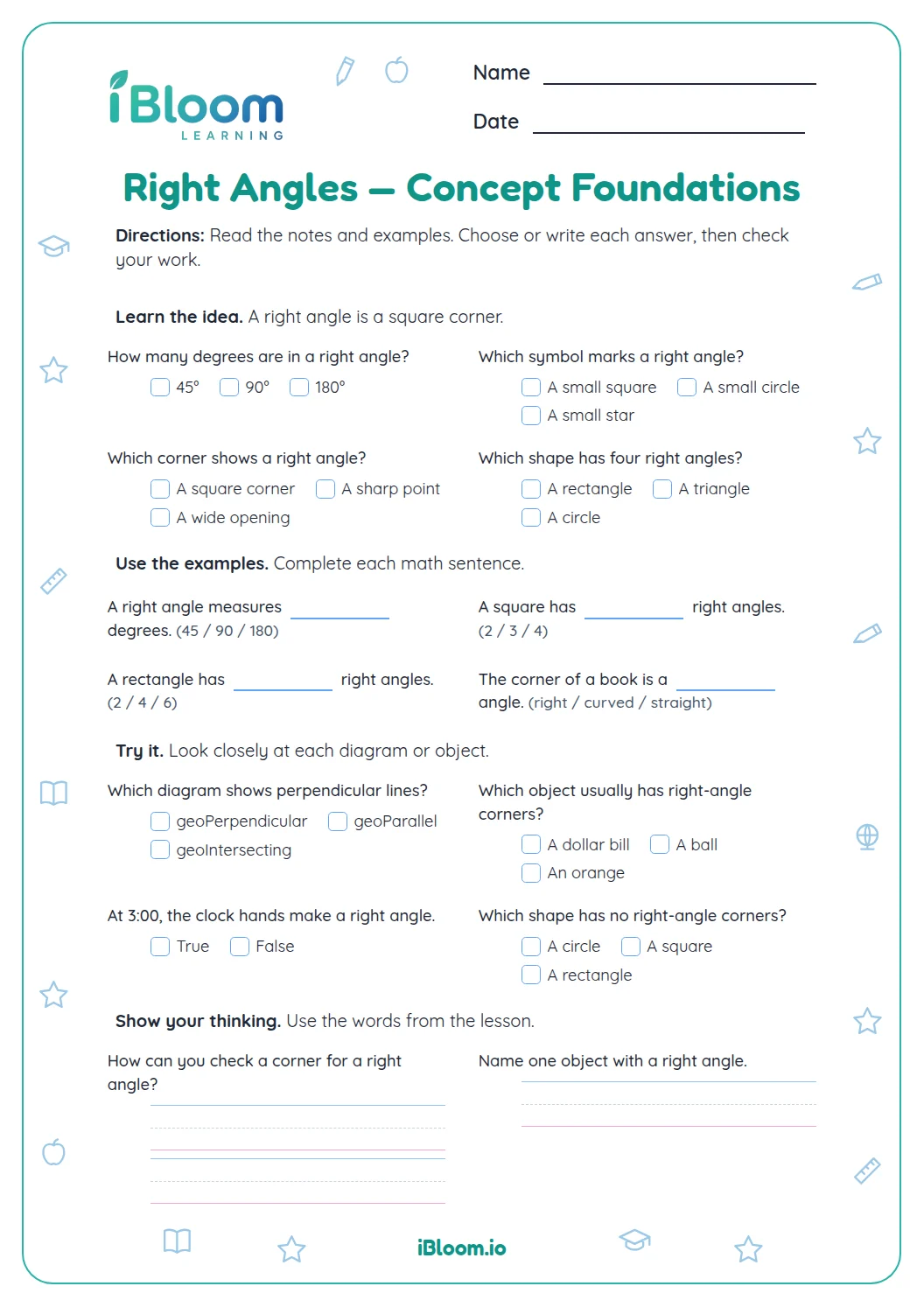
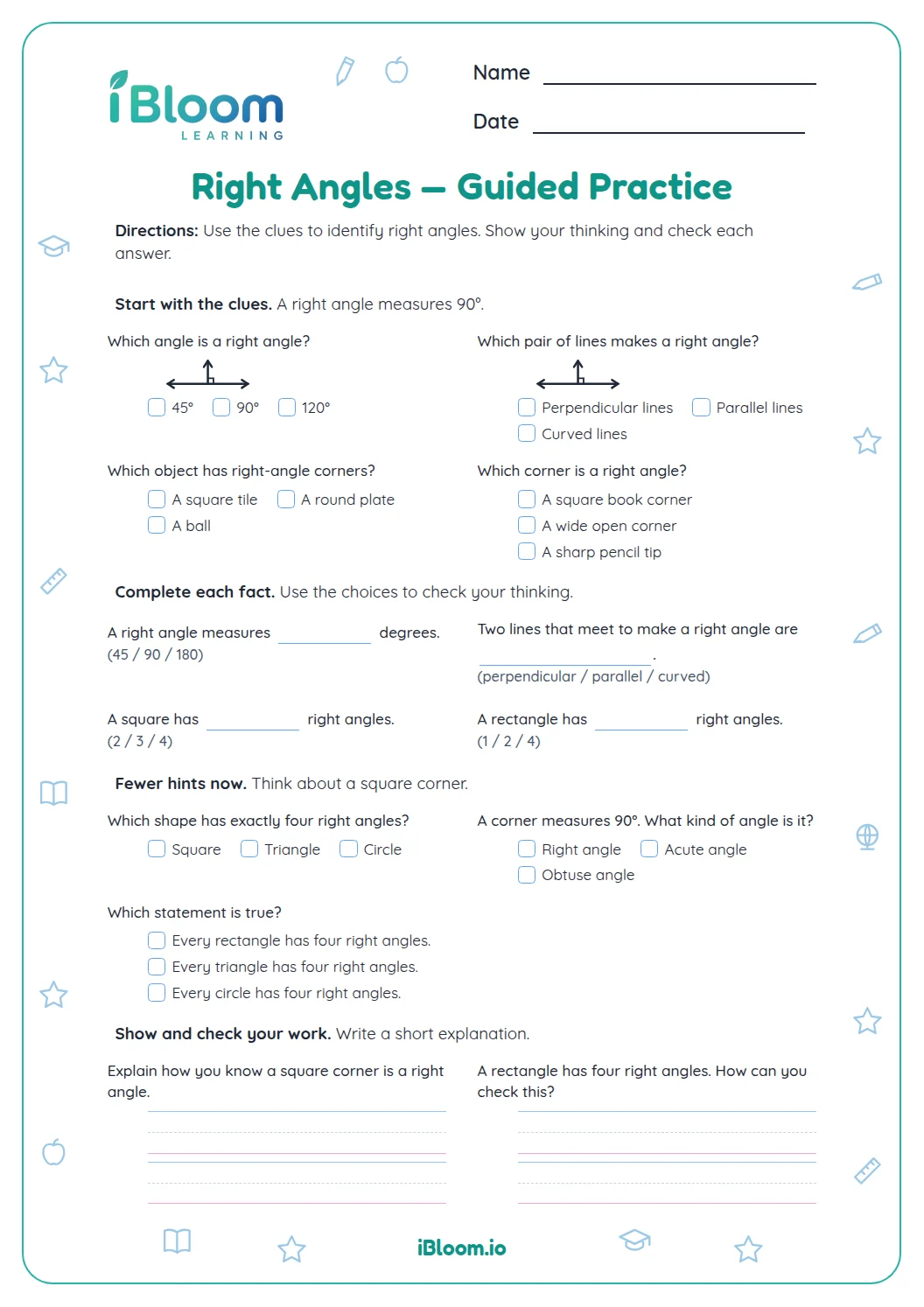
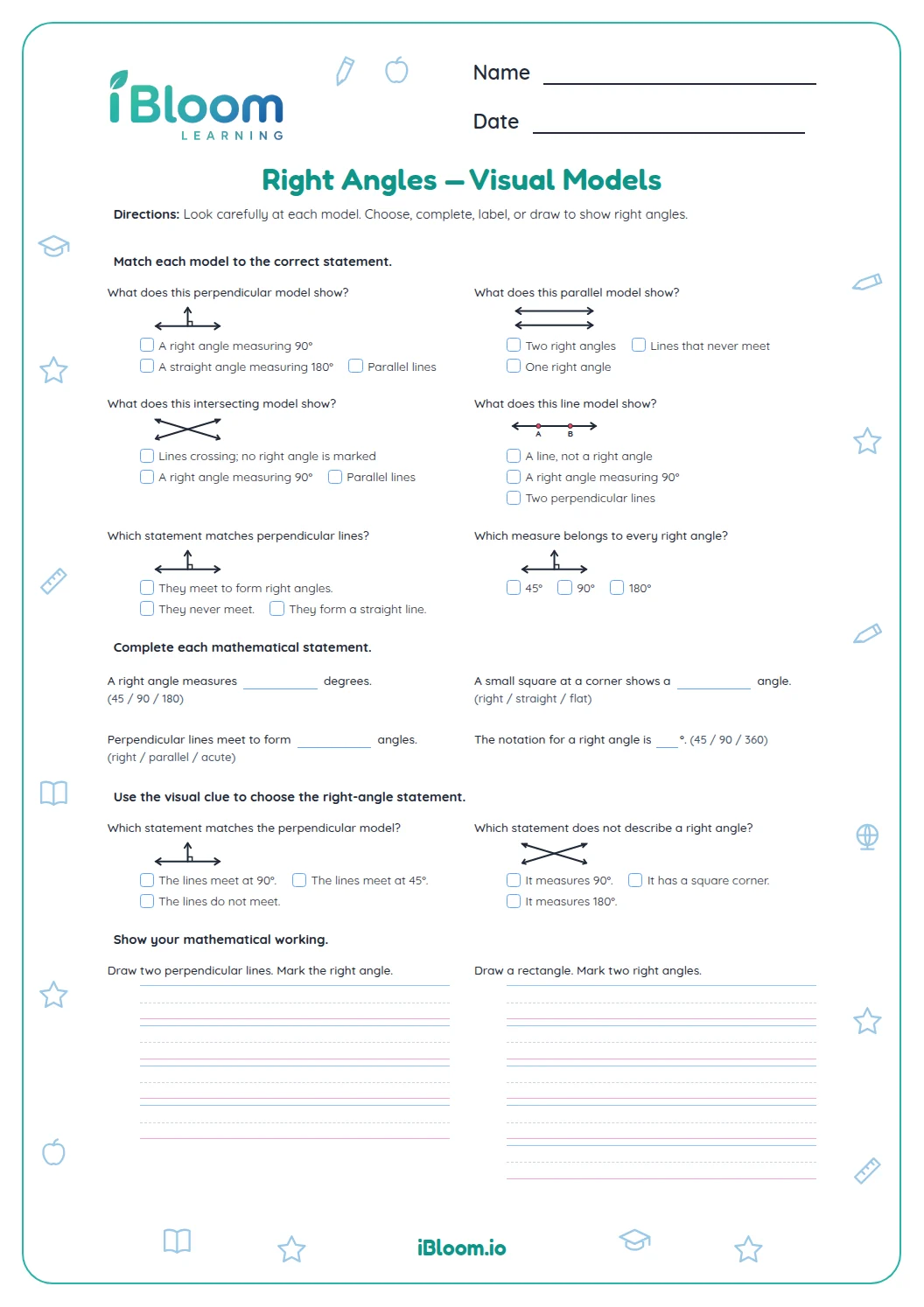
An angle measures the turn between two rays that share an endpoint. The rays can be short or long; the size comes from how wide the opening is. A right angle measures 90 degrees.
- 1Angle A is drawn at 30°.
- 2Line up the protractor center with the vertex.
- 3Read the scale where the ray crosses: 30°.
How can you classify an angle?
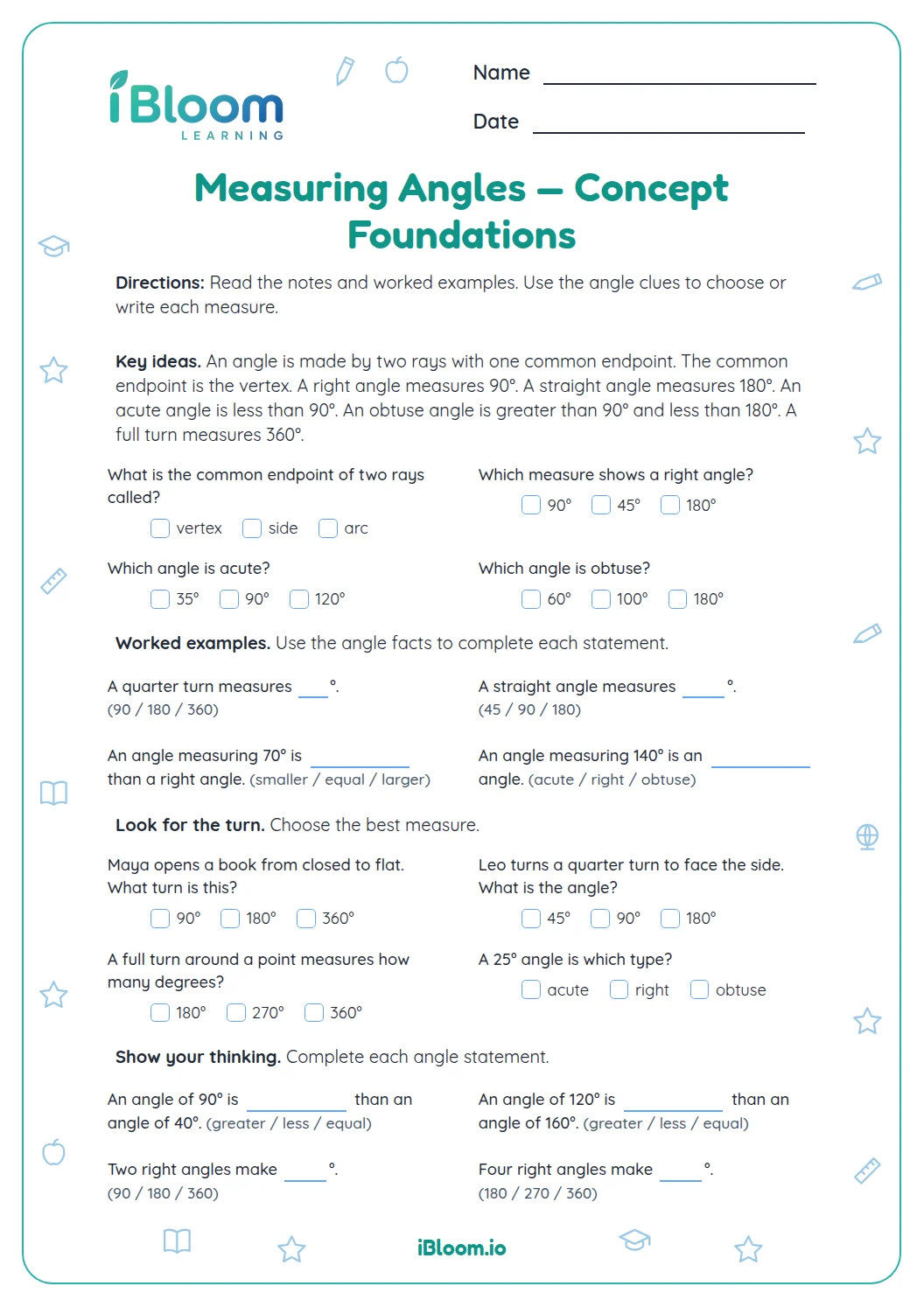
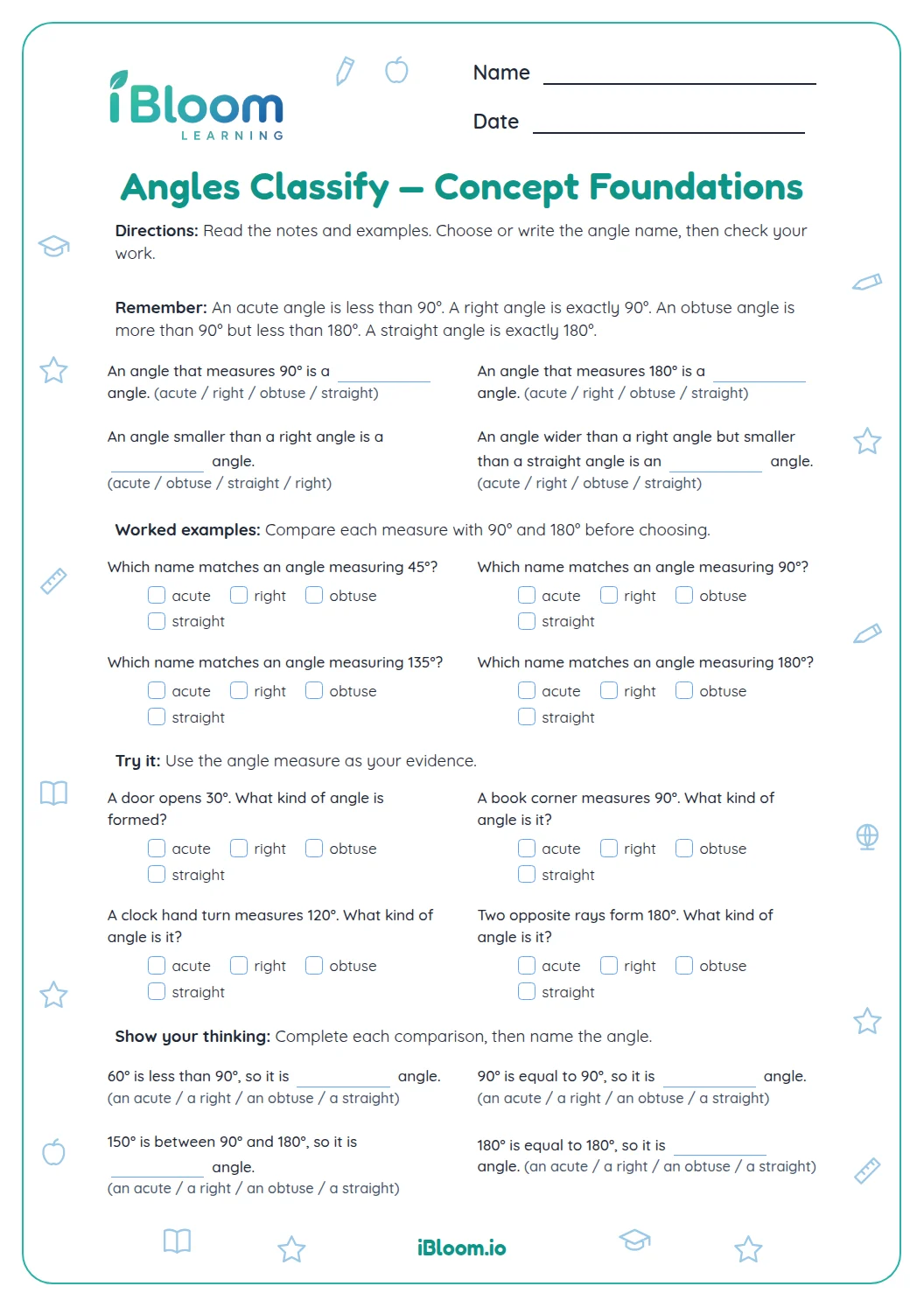
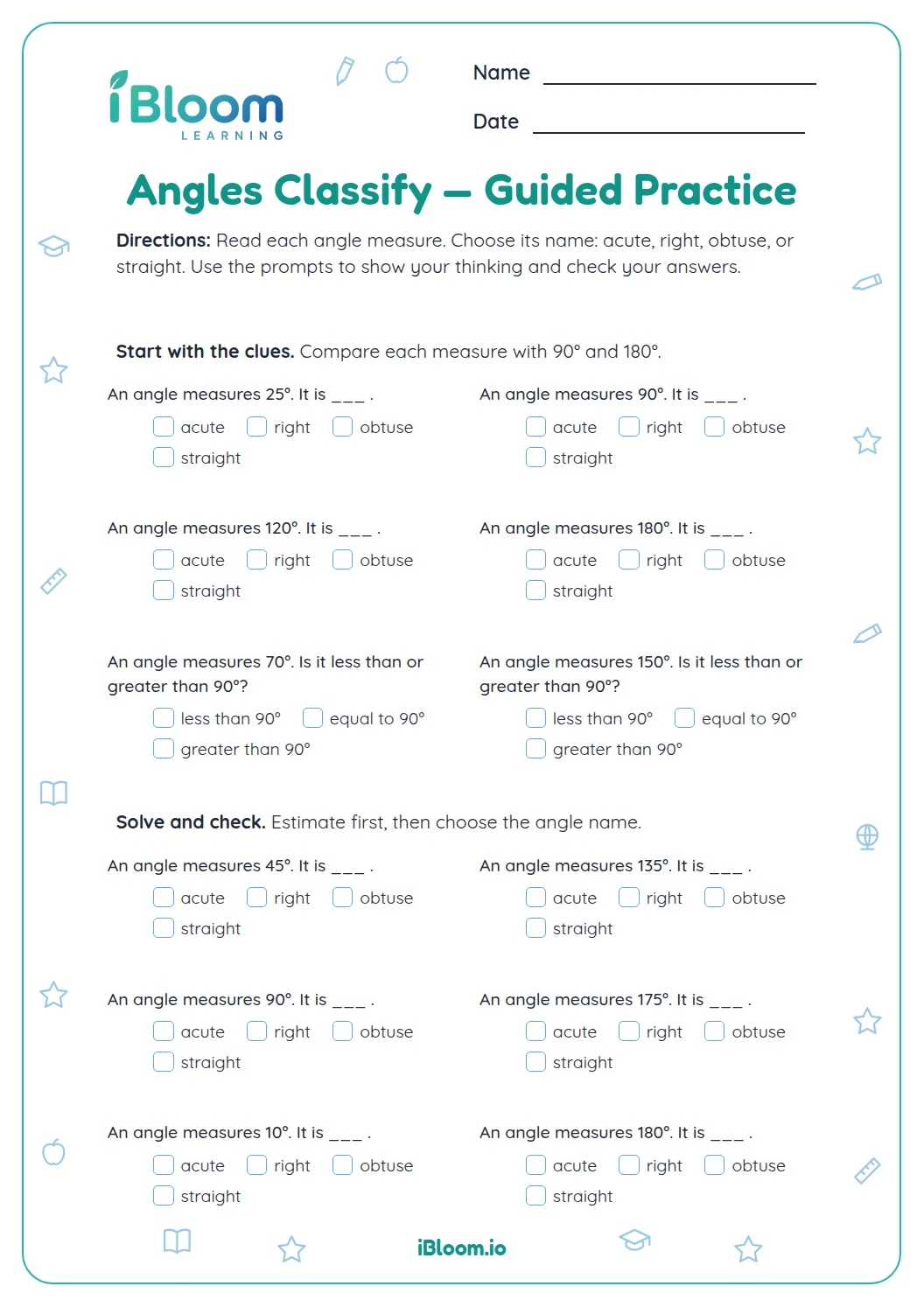
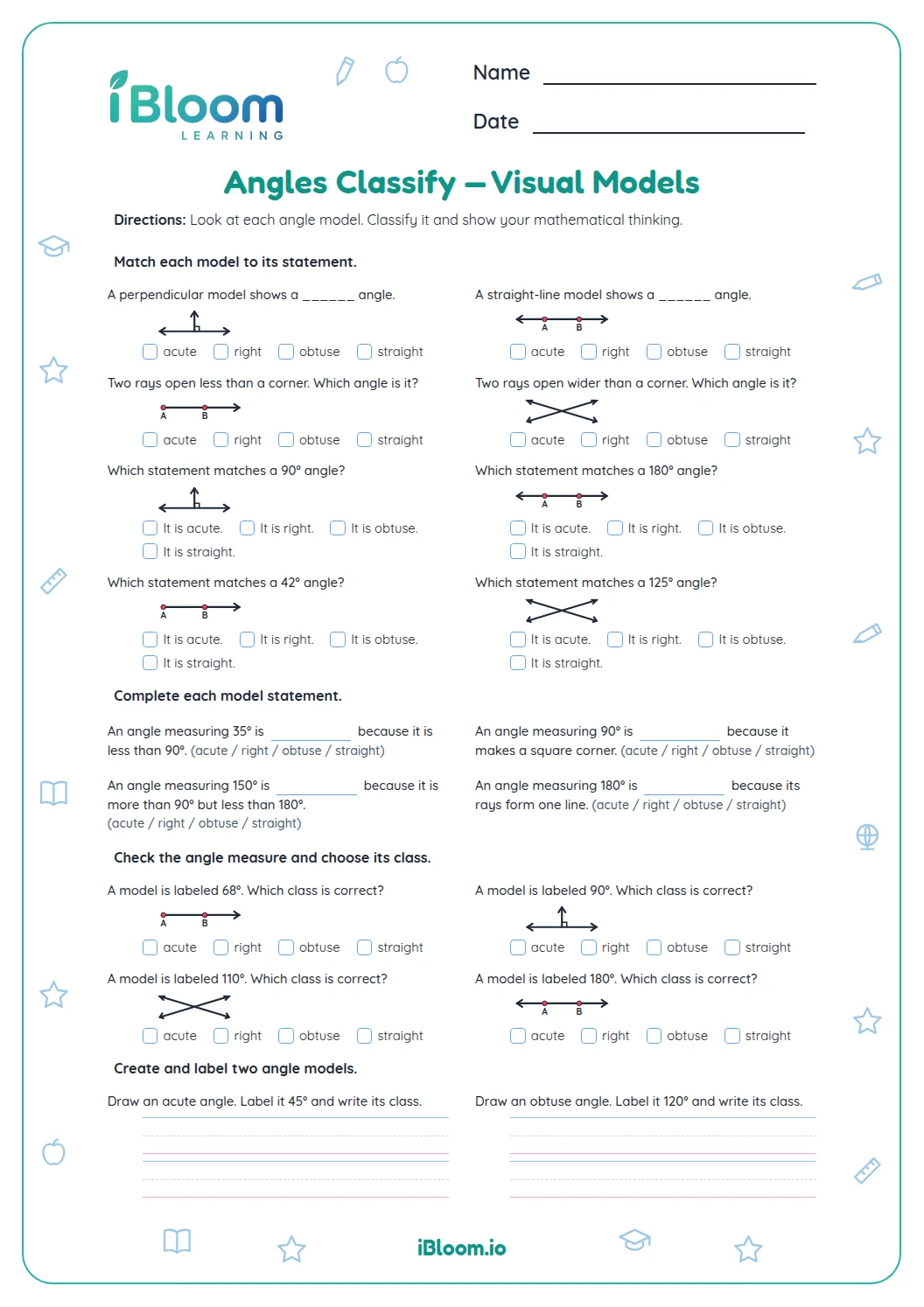
Compare a measure with 90 degrees. An acute angle is less than 90°, a right angle equals 90°, and an obtuse angle is greater than 90° and less than 180°.
How do you read a degree measure?
Part C uses addition and subtraction to find unknown measures. If two parts make 90°, subtract the known part from 90°. For a total angle, add the measures of its parts.
How to use this worksheet
- 1Find the two rays and their shared endpoint.
- 2Compare the opening with a square corner measuring 90°.
- 3Name acute, right, or obtuse when asked.
- 4For a measurement question, read the angle label and include the degree sign.
- 5Check whether your comparison is below, equal to, or above 90°.
Common mistakes and quick fixes
The mistake
Judging by ray length.
The fix
Focus on the opening between the rays, not how far the rays extend.
The mistake
Calling every wide-looking angle obtuse without checking.
The fix
Use 90° as the reference: equal is right, smaller is acute, larger is obtuse.
The mistake
Leaving off degrees in a measurement.
The fix
Write the number followed by the degree symbol, such as 45°.
Common Core alignment
The guided work connects a measured angle with its degree value and uses angle relationships to find unknown measures.
Measure angles in whole-number degrees with a protractor and relate them to angle measures.
On this sheet: Question 1 asks learners to measure a drawn angle with a protractor; the remaining items use whole-number angle measures.
Show the official wordingHide the official wording
Measure angles in whole-number degrees using a protractor. Sketch angles of specified measure.
What to practice next
Make more practice
Further reading
Questions parents and teachers ask
What is an acute angle?
An acute angle is smaller than a right angle, which measures 90 degrees. This worksheet asks learners to measure drawn angles and compare stated measures with 90°. The answer key includes the measurements and classifications so a child can check the comparison.
Do longer rays make a bigger angle?
No. Angle size depends on the opening between the rays, not their drawn length. For the first four questions, place a protractor at the vertex and read where a ray crosses the scale. The measure records the size of the opening.
What is the measure of a right angle?
A right angle measures 90 degrees. It is the reference for deciding whether another angle is acute or obtuse. Compare each measure with 90 before naming its type; question 2 gives 90° as a check of the right-angle benchmark.
Why do some questions ask for missing degrees?
The missing-measure questions connect angle measures with addition and subtraction. Subtract a known part from a total, or add parts when the total is unknown. For example, 35° + ___° = 90° has a missing measure of 55°.
Does the worksheet ask learners to use a protractor?
Yes. Questions 1–4 show drawn angles and ask learners to measure them with a protractor. Later questions use comparisons and equations to reason about angle measures. The drawings and calculations give practice reading degrees and using them in related problems.
How long does the worksheet take?
About fifteen minutes is a useful estimate for measuring, comparing, and solving 16 angle questions. Learners who explain how they read the protractor or show the subtraction in an equation may need more time. The key supports checking each result.