
About this worksheet
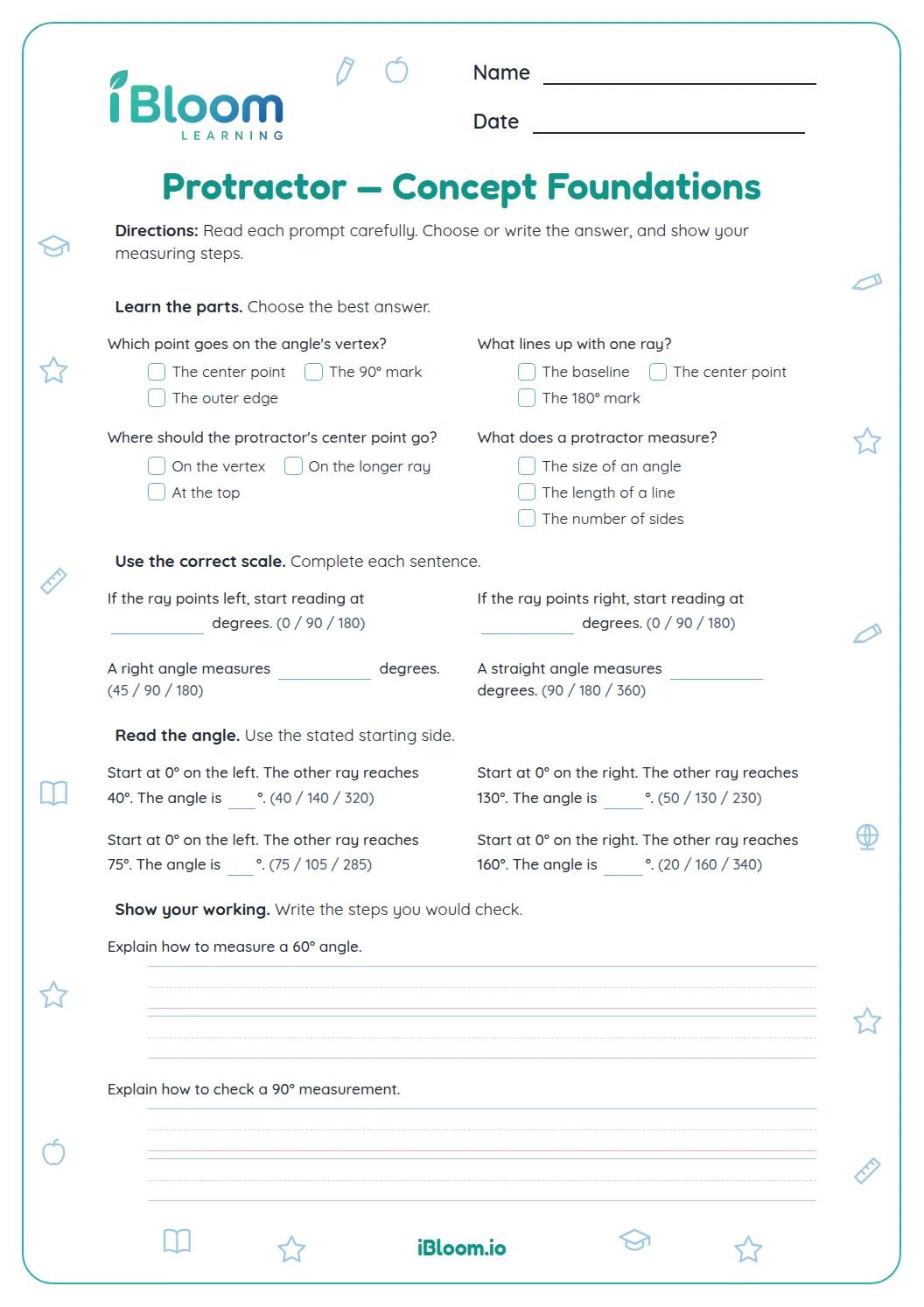
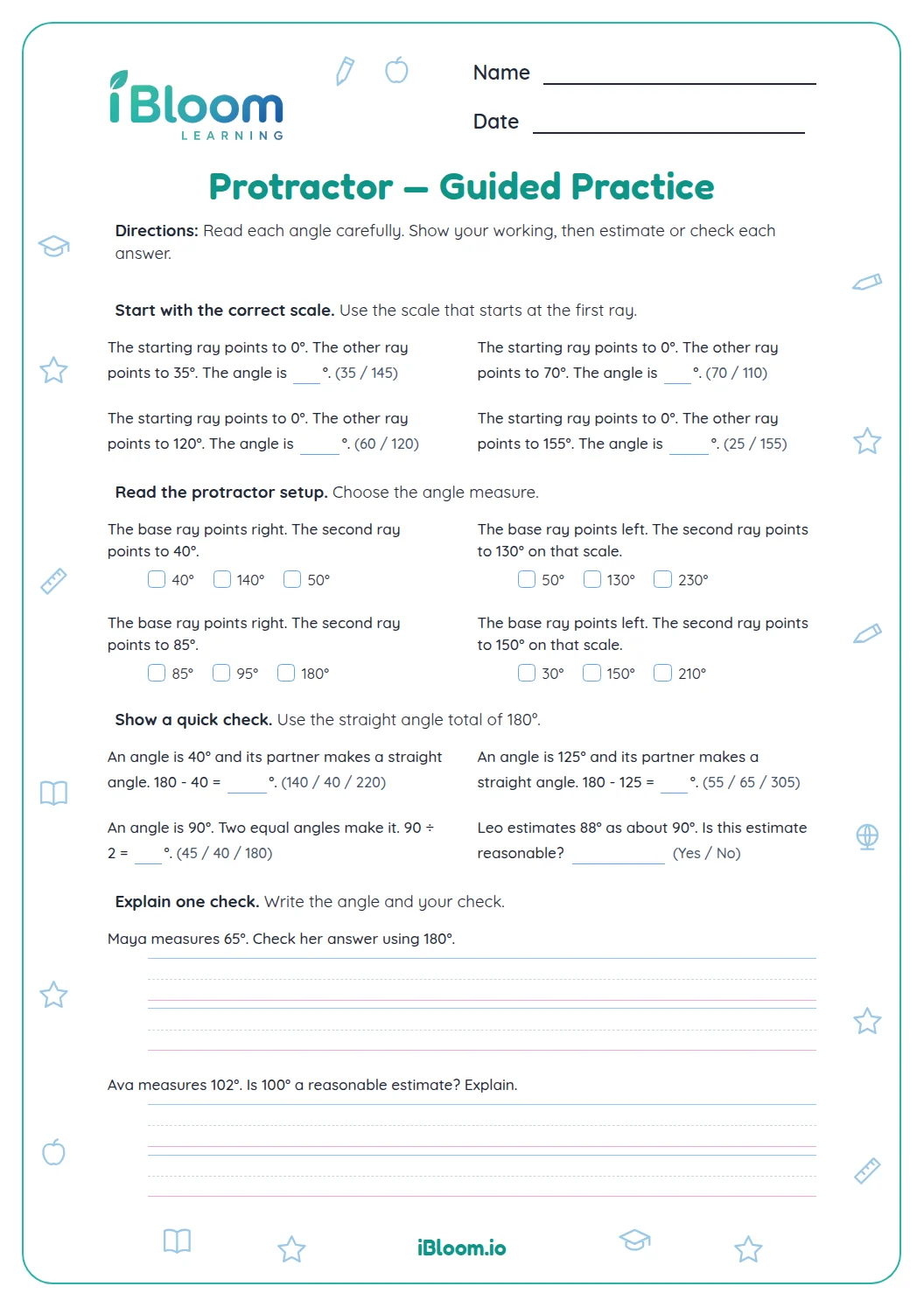
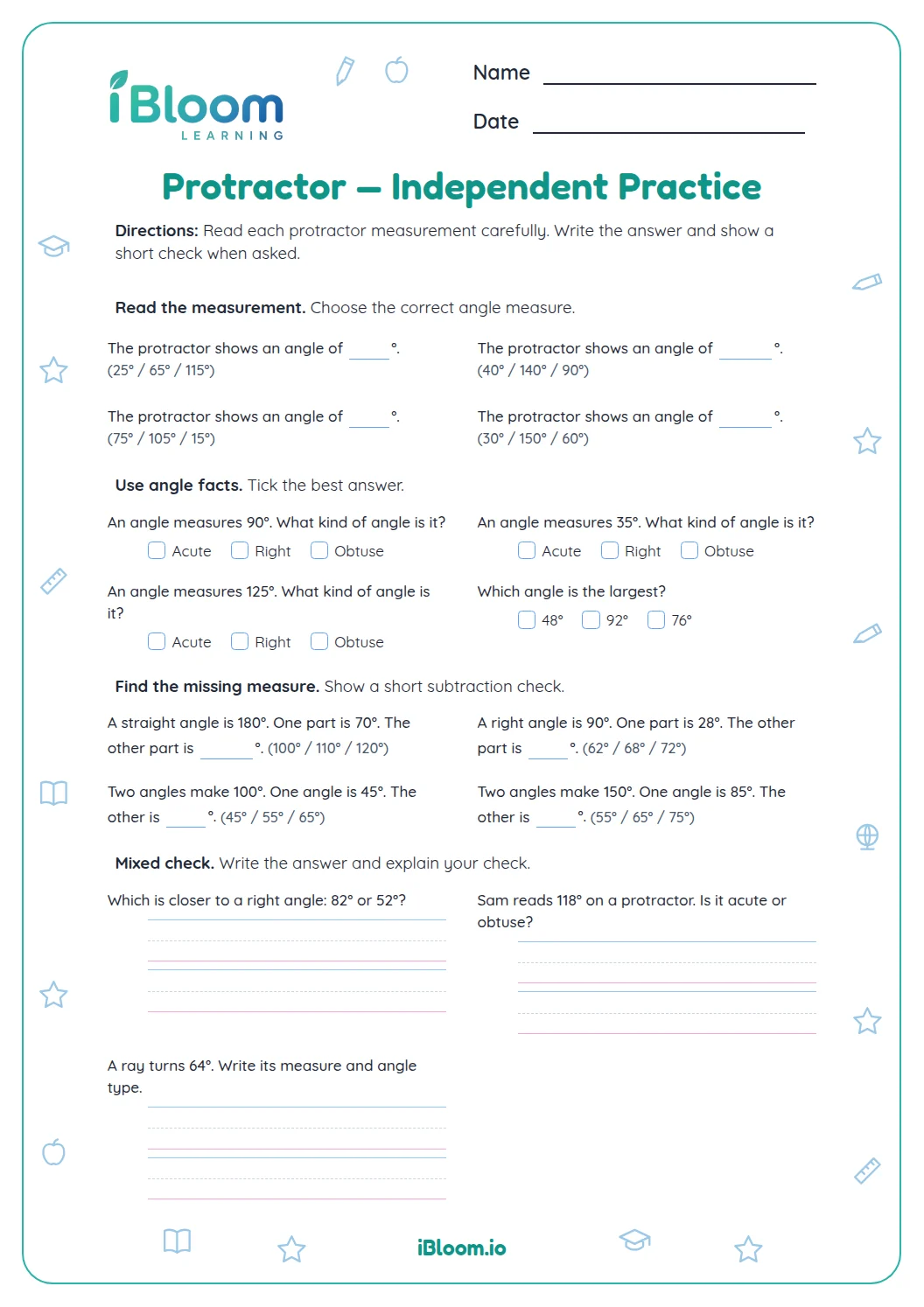
This Grade 3 printable builds angle reasoning through quarter- and half-turn benchmarks, labeled angle models, and everyday situations. Learners find missing measures, add successive turns, and compare an angle with a right angle. Fourteen questions move from familiar benchmarks to calculations and a short explanation; a separate answer key supports checking.
How do turn benchmarks help with angles?
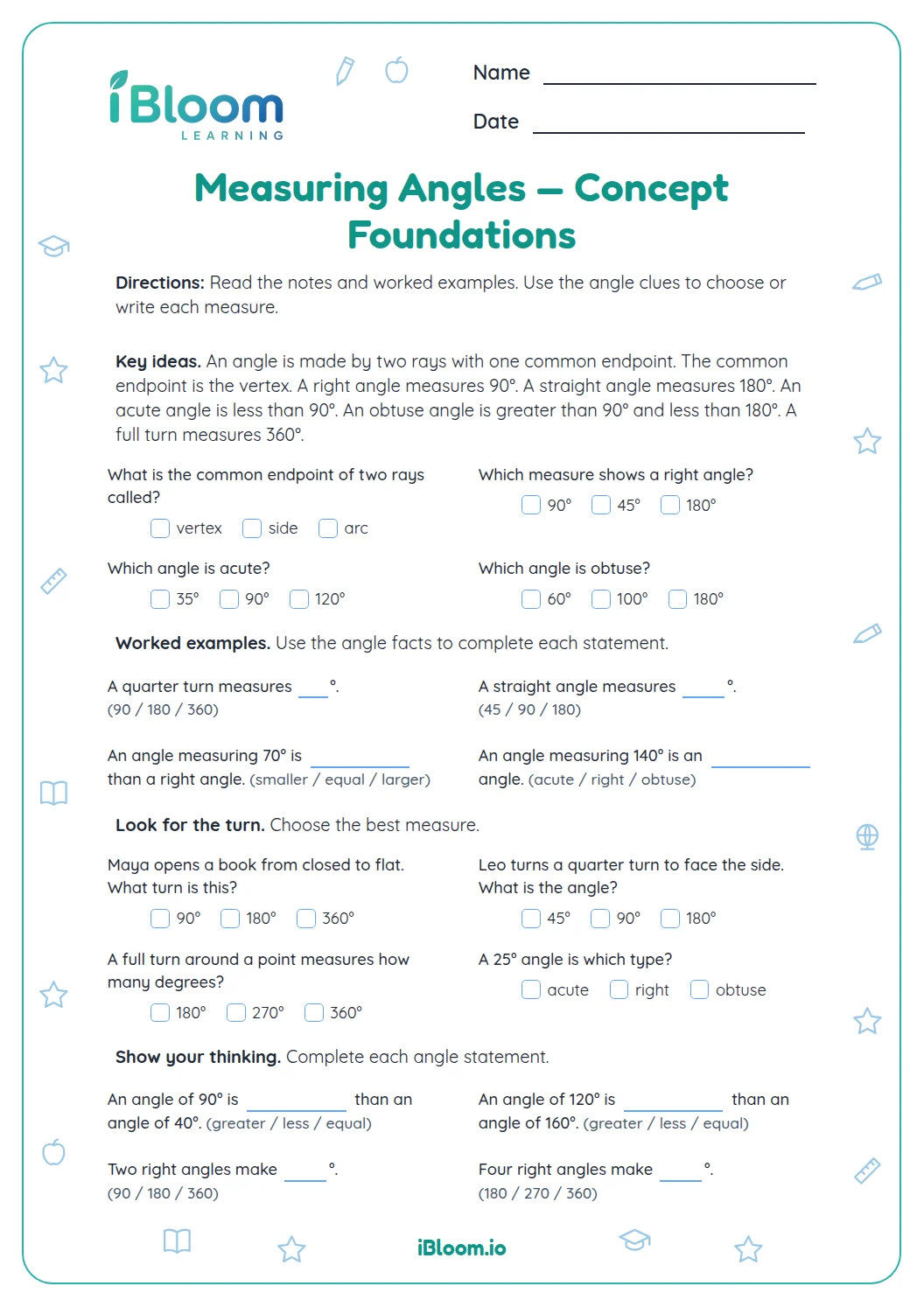
A quarter turn is 90°, and a half turn is 180°. These benchmarks make it easier to judge whether an angle is smaller or larger than a right angle.
Question 8 asks how many degrees 35° is below a right angle. Subtract 35° from 90° to get 55°.
- 1Right angle: 90°
- 2Known turn: 35°
- 390° − 35° = 55°
What can an angle model tell you?
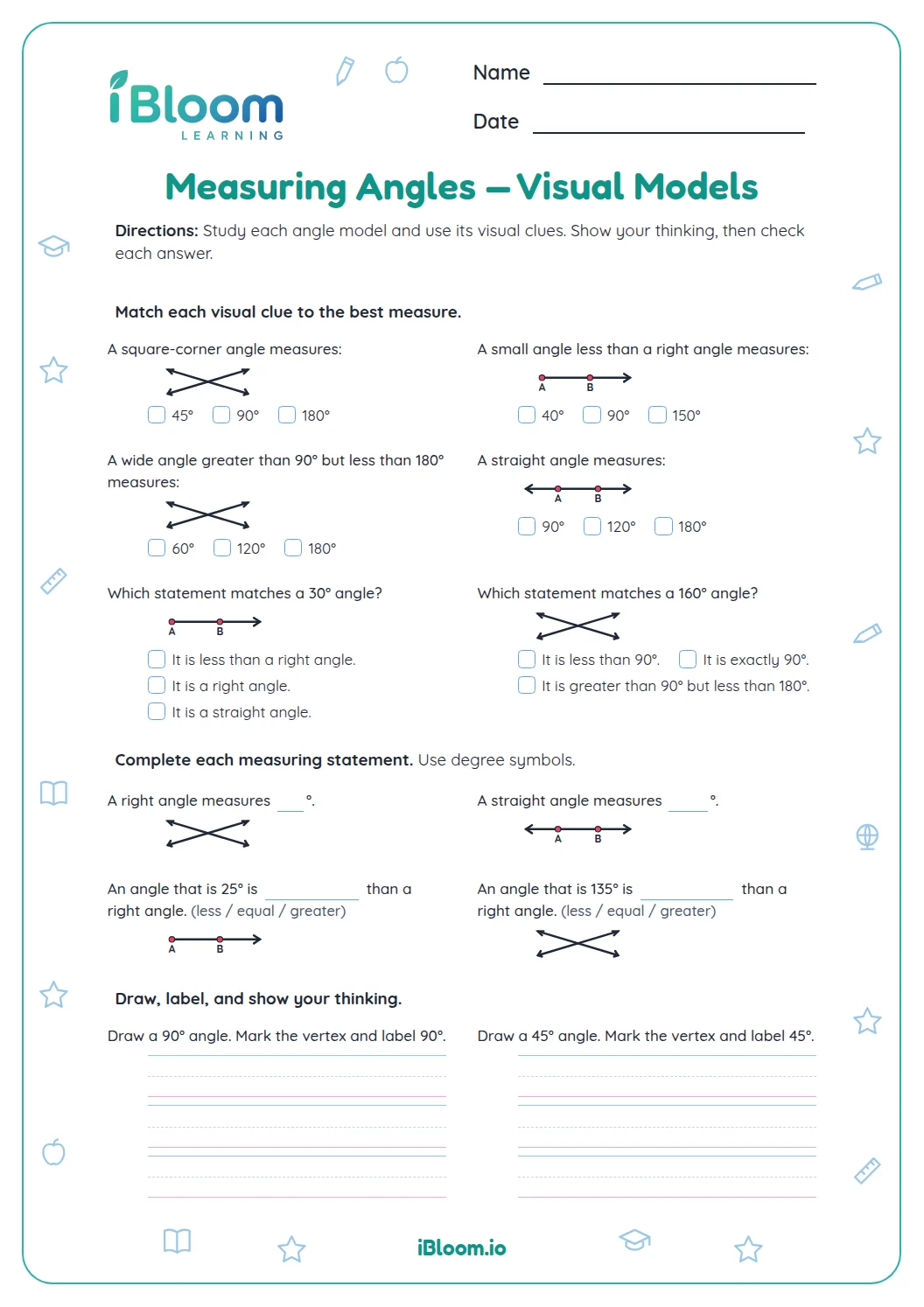
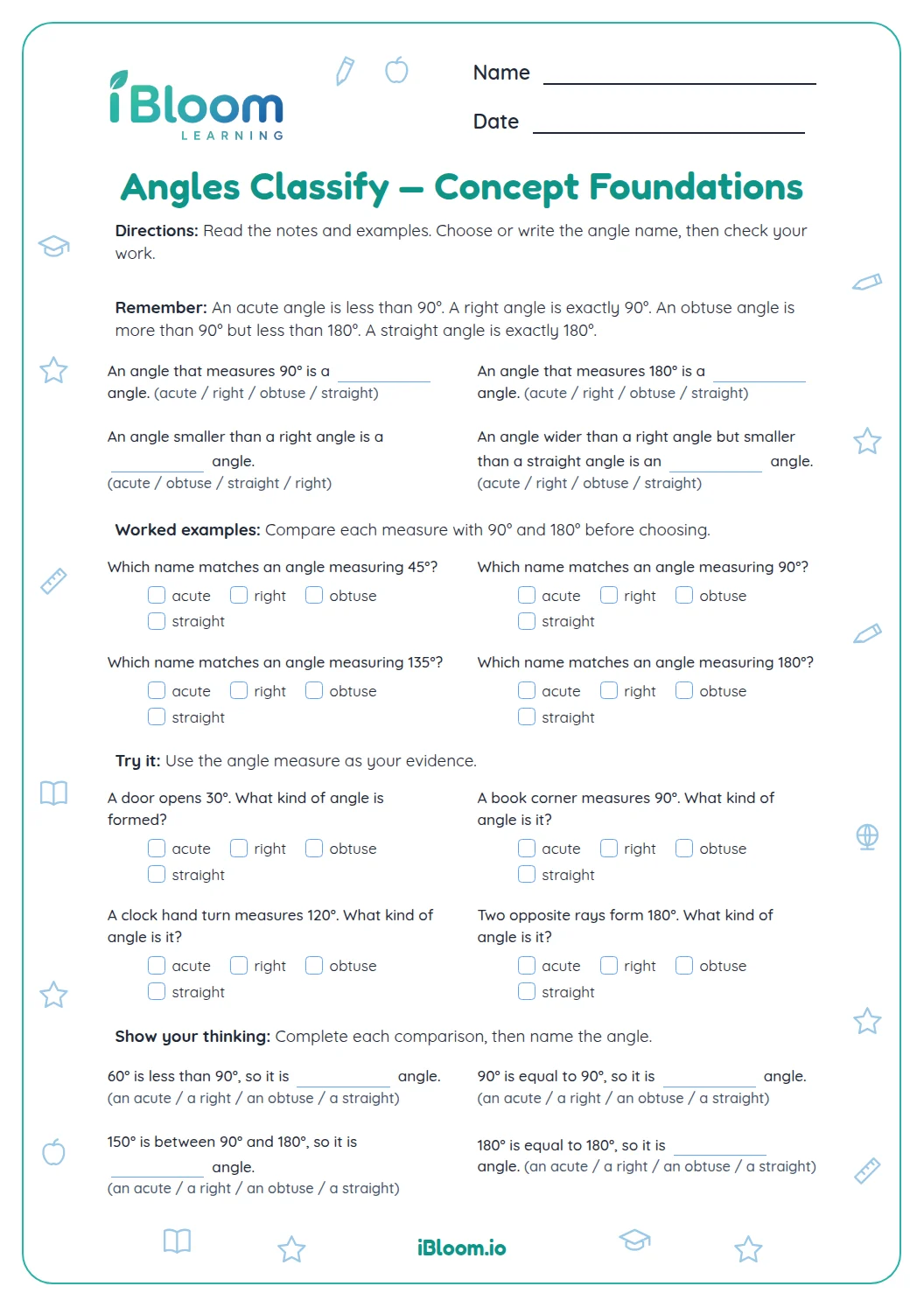
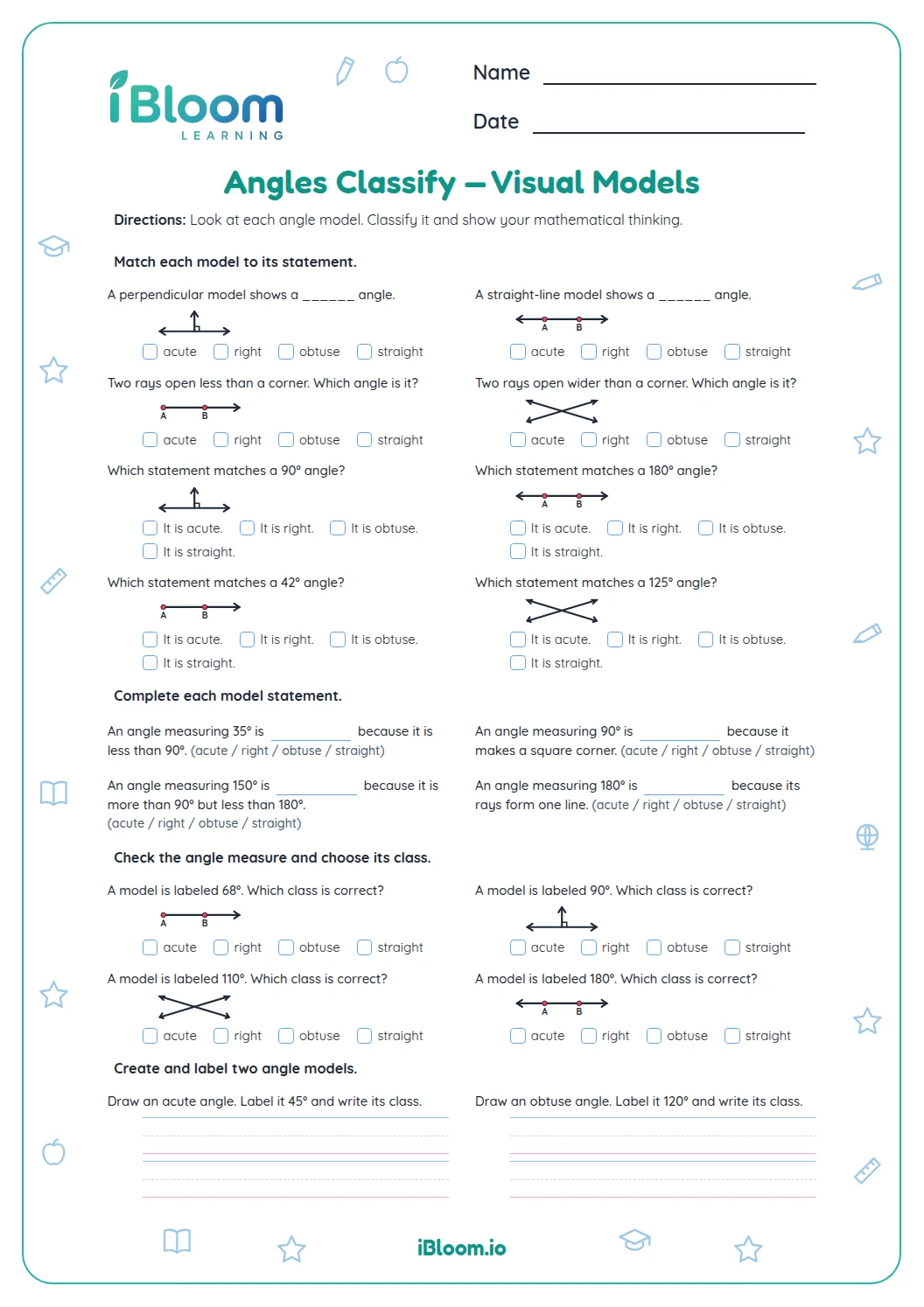
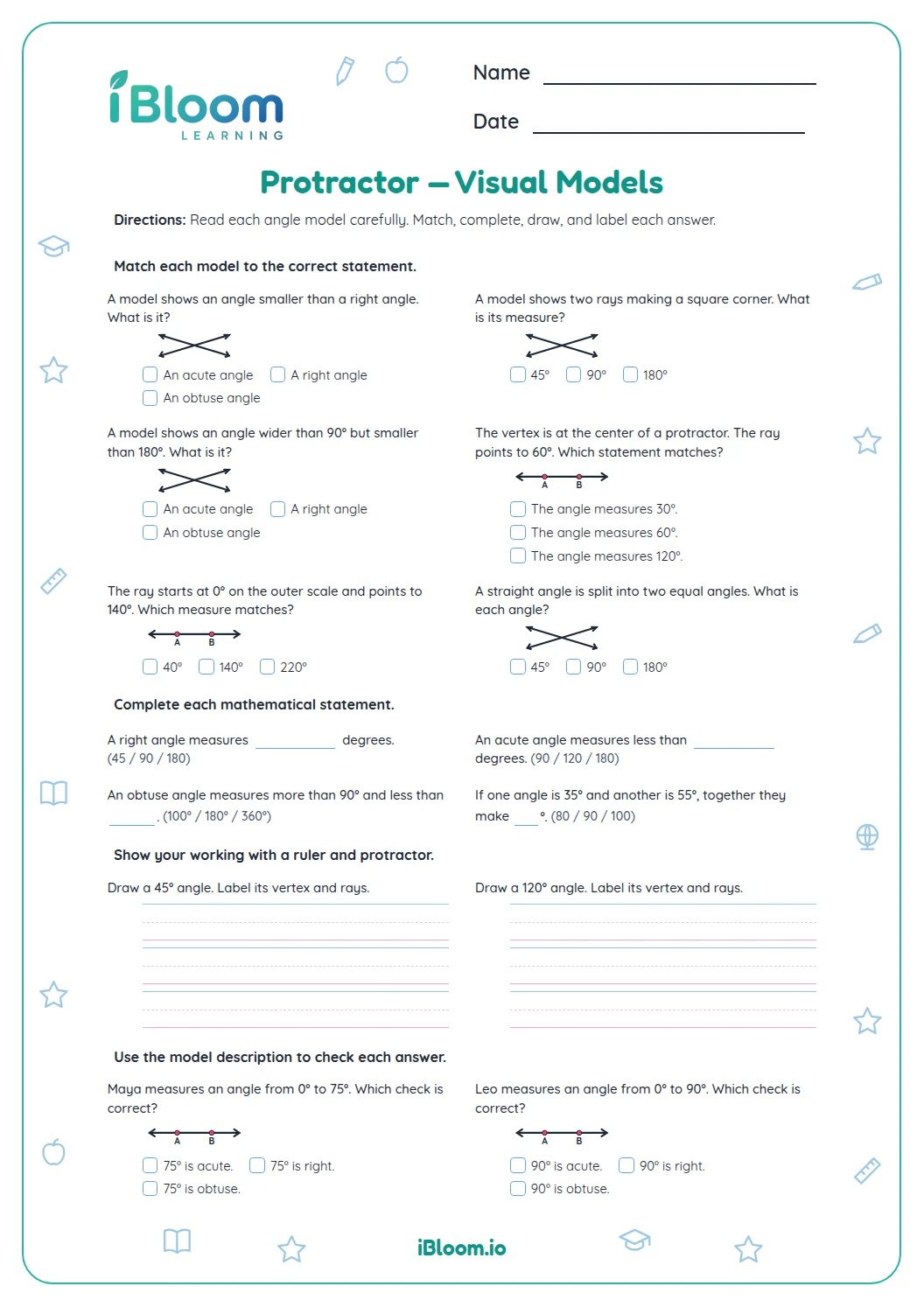
The labeled drawings show the opening between two rays. Learners compare each opening with a right angle: an angle under 90° is acute, 90° is right, and an angle greater than 90° but less than 180° is obtuse.
How do the turn stories use addition and subtraction?
Add when a turn continues or two measures make a total. Subtract when a story gives a target and asks how many degrees remain or how far a measure is from a benchmark. Question 10 subtracts 150° from a 180° half turn, leaving 30°.
How to solve the angle questions
- 1Recall that a quarter turn is 90° and a half turn is 180°.
- 2Read the degree measure on each labeled model.
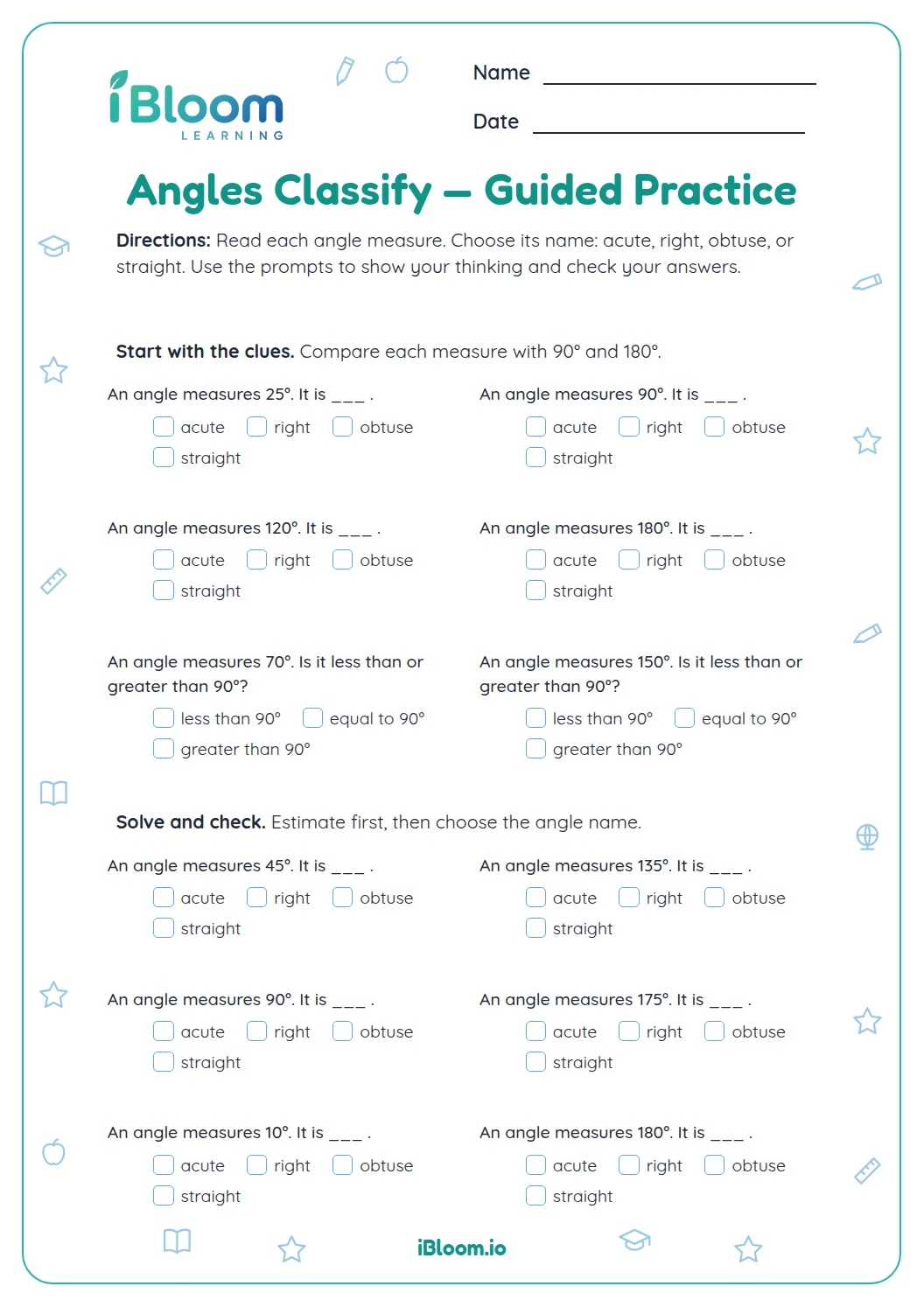
- 3Compare the measure with 90° to classify an angle.
- 4Add when turns continue or combine.
- 5Subtract when the question asks what remains or how far apart measures are.
Common angle mistakes and fixes
The mistake
Treating a quarter turn as 180°.
The fix
A quarter turn is one of four equal parts of a full turn: 90°.
The mistake
Calling every angle below 180° obtuse.
The fix
Compare with 90°: smaller is acute, equal is right, and larger is obtuse.
The mistake
Adding when a story asks how many degrees remain.
The fix
Find the target total, then subtract the amount already turned.
What to practice next
Make more practice
Further reading
Questions parents and teachers ask
How many degrees are in a quarter turn?
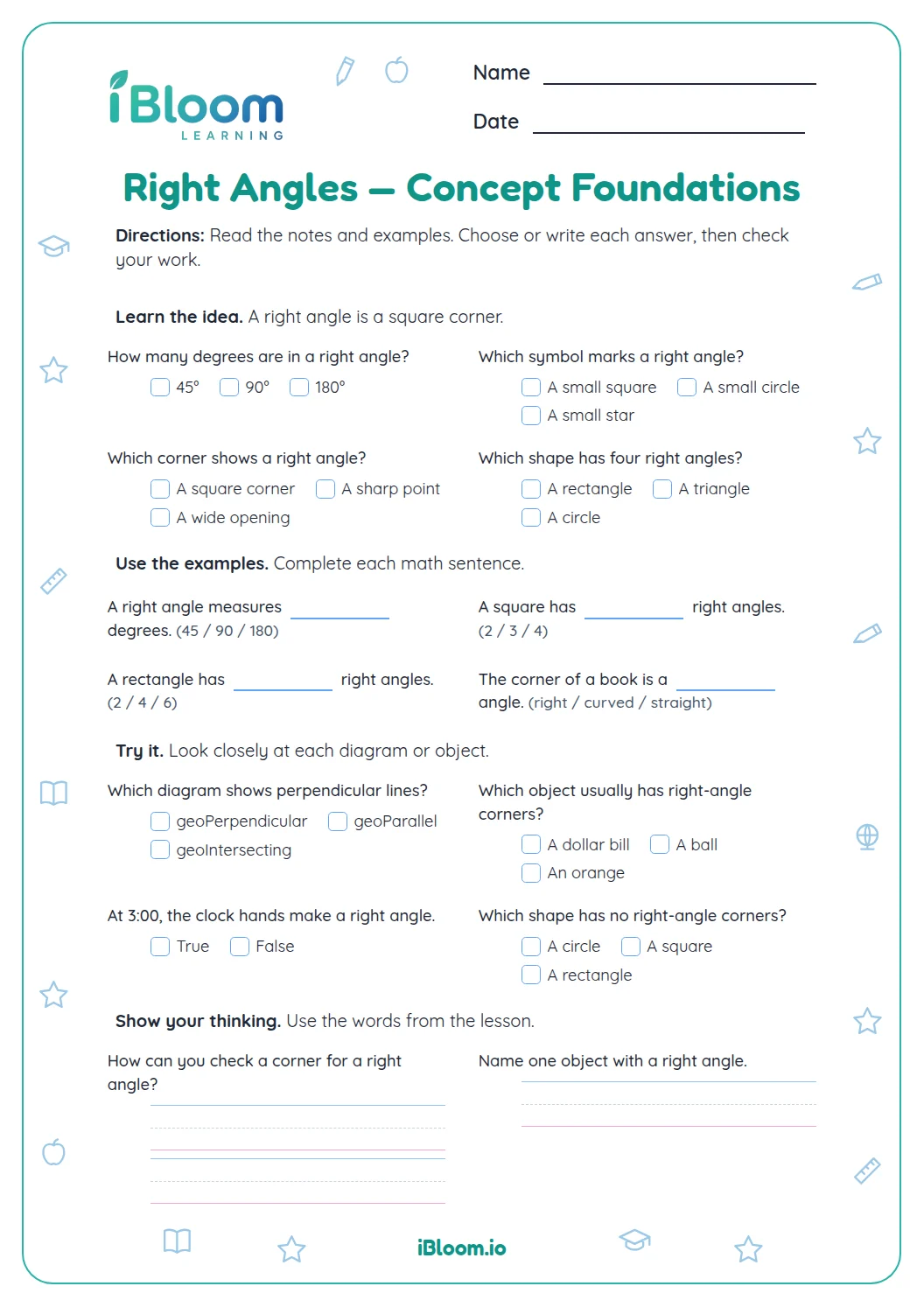
A quarter turn is 90°, one fourth of a full 360° turn. Questions 1 and 3 connect this benchmark to a direct fact and a right-angle situation. Use a paper corner or turn your hand a quarter turn to help a learner picture the amount.
How many degrees are in a half turn?
A half turn is 180°, half of a full 360° turn. Question 2 asks for this benchmark, and question 10 uses 180° as the target for a robot turn. The learner subtracts the 150° already turned to find the 30° still needed.
How does the worksheet show angle measures?
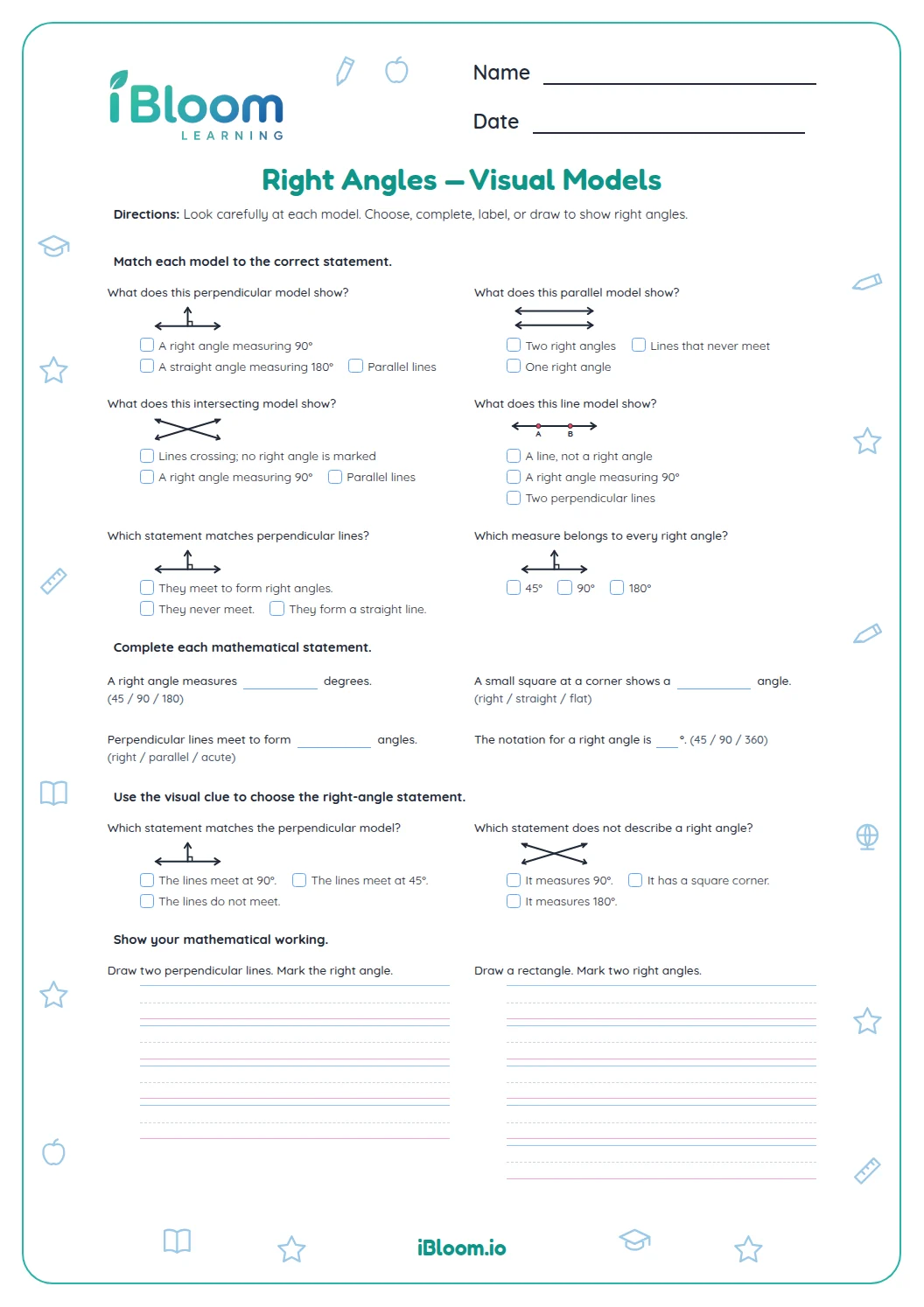
Questions 4 through 6 include labeled angle drawings. Learners use the opening between the rays to identify a quarter-turn corner or classify an angle, then relate those models to the 90° benchmark. The written prompts provide any exact degree values needed for calculations.
How do children solve a missing-angle story?
Identify the target and the amount already known. If a robot needs 180° for a half turn and has turned 150°, subtract 150° from 180°; 30° remain. Questions that ask for a combined turn use addition instead. The robot-turn example makes this subtraction visible.
Does the worksheet include an answer key?
Yes. The key gives the numerical answers for the benchmark, model, and calculation questions, plus a sample explanation for question 14. Accept equivalent wording in the explanation when it correctly compares 110° with a 90° right angle. The key separates the measures from the worksheet prompts for easy review.