
About this worksheet
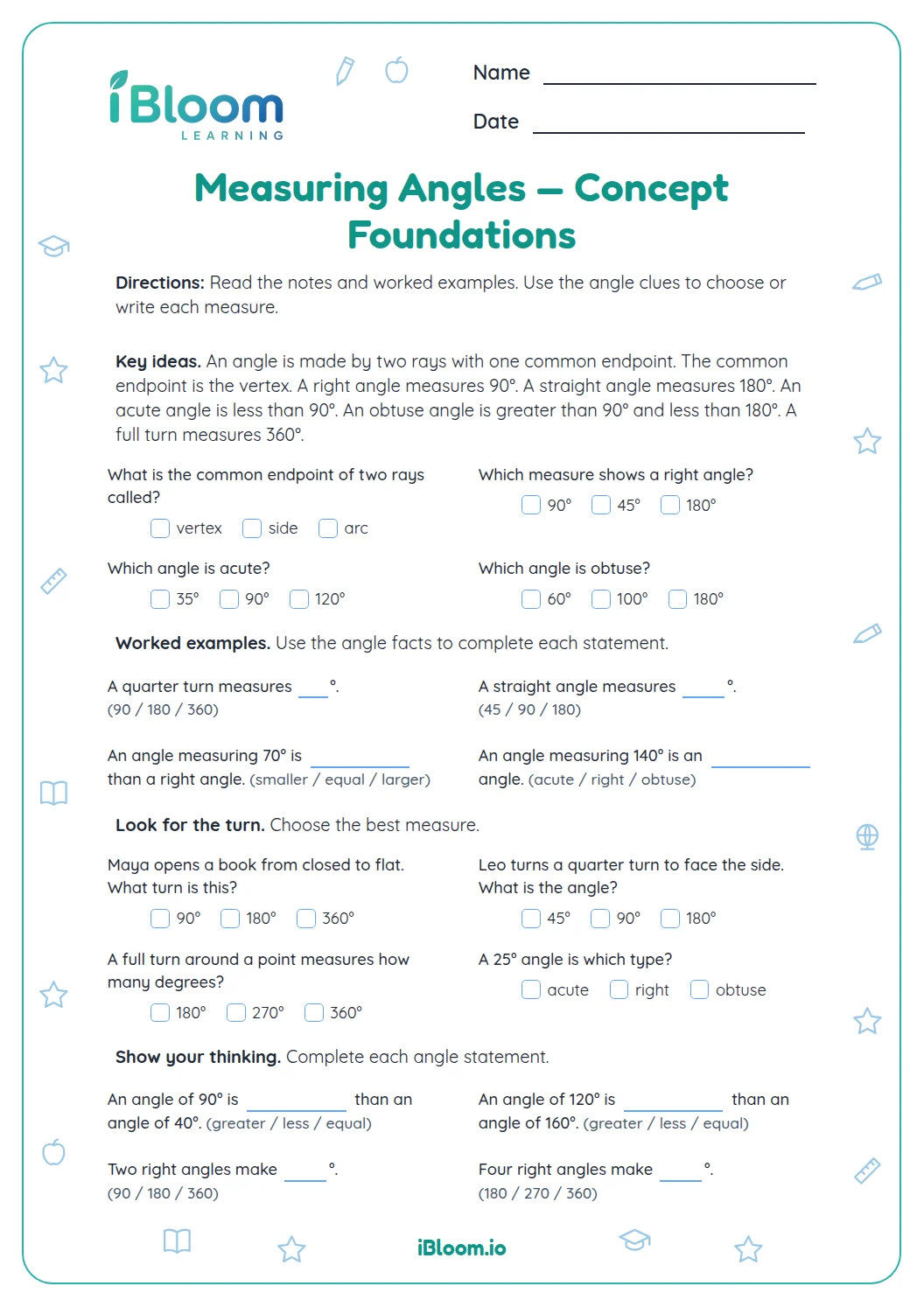
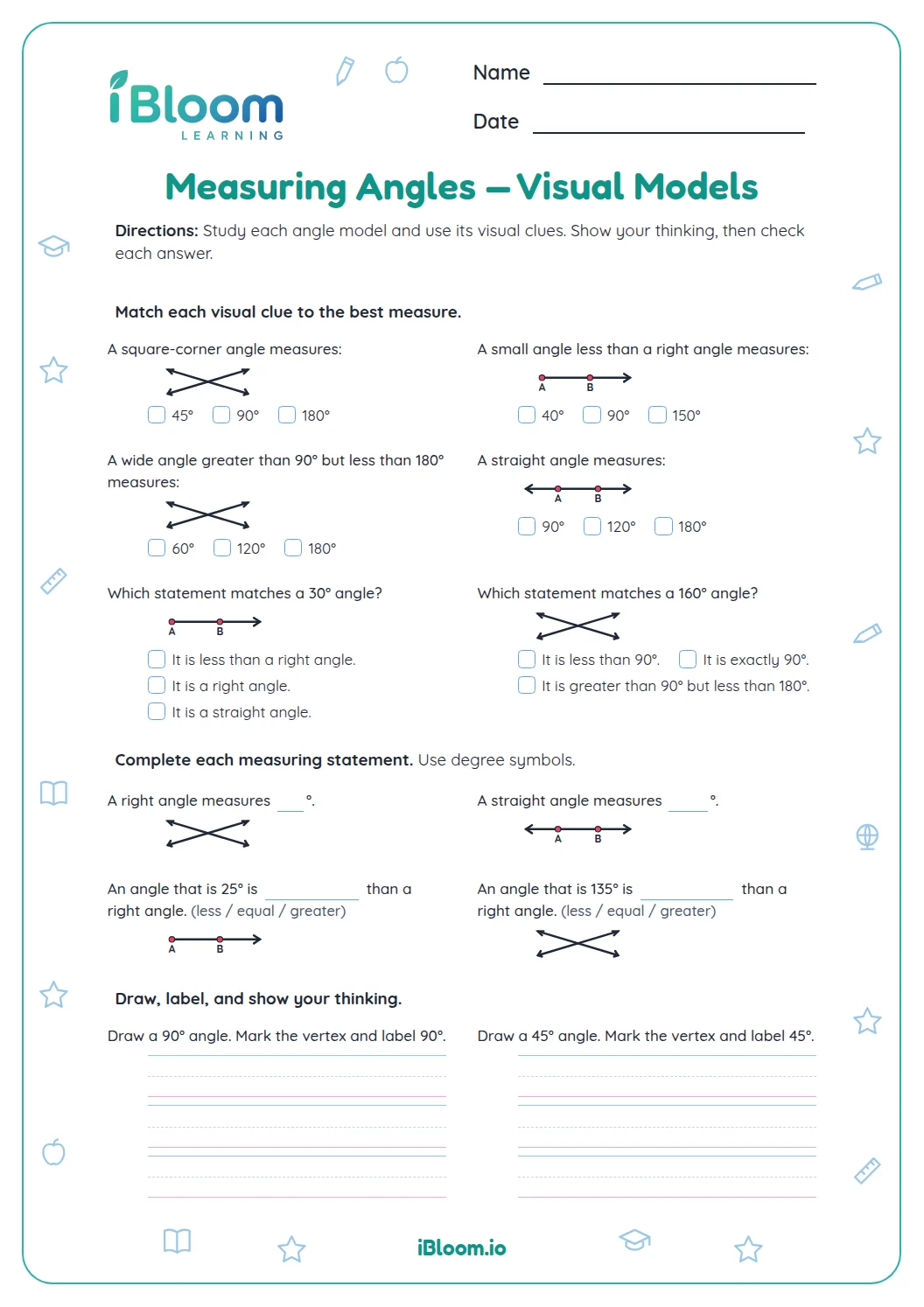
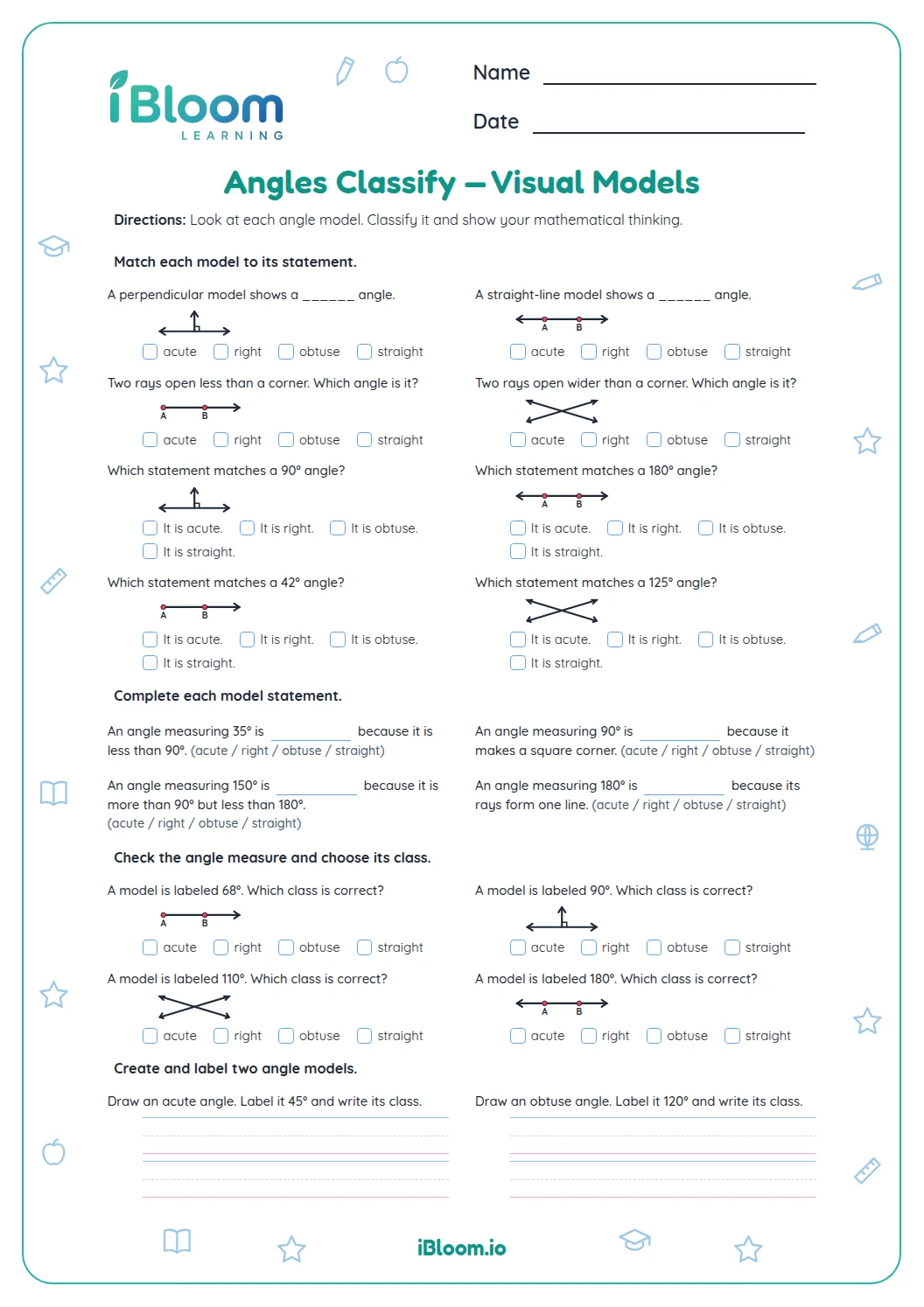
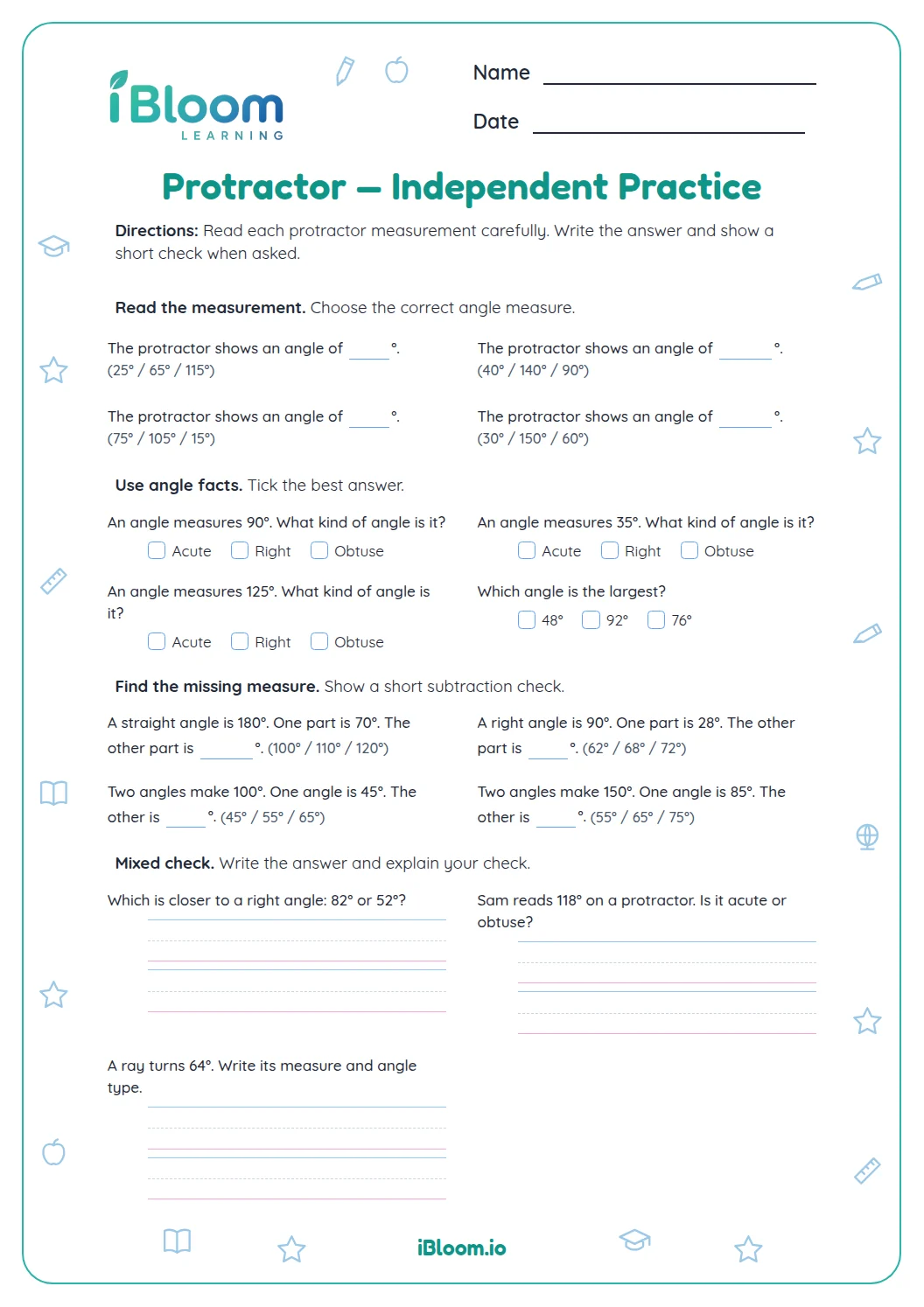
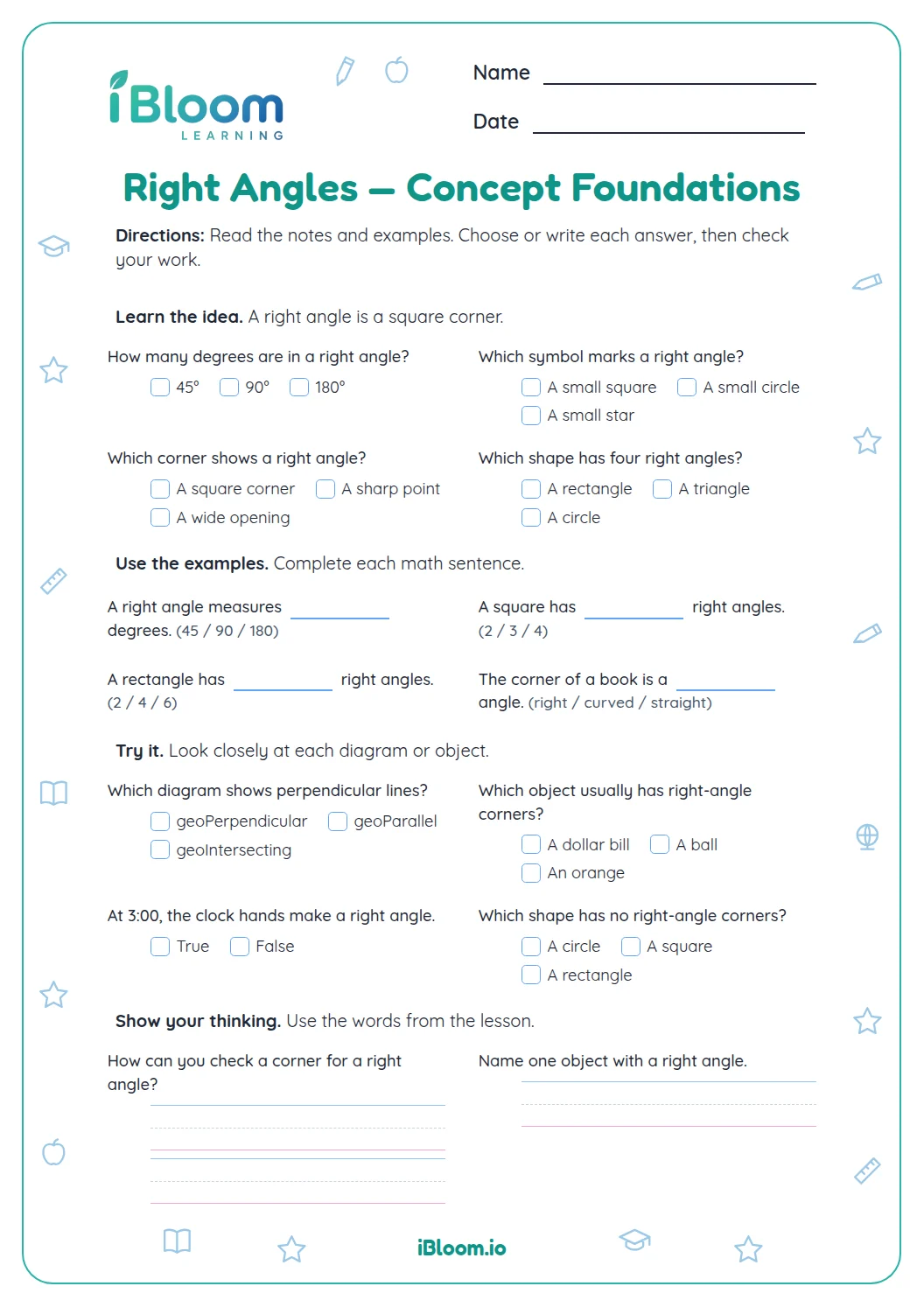
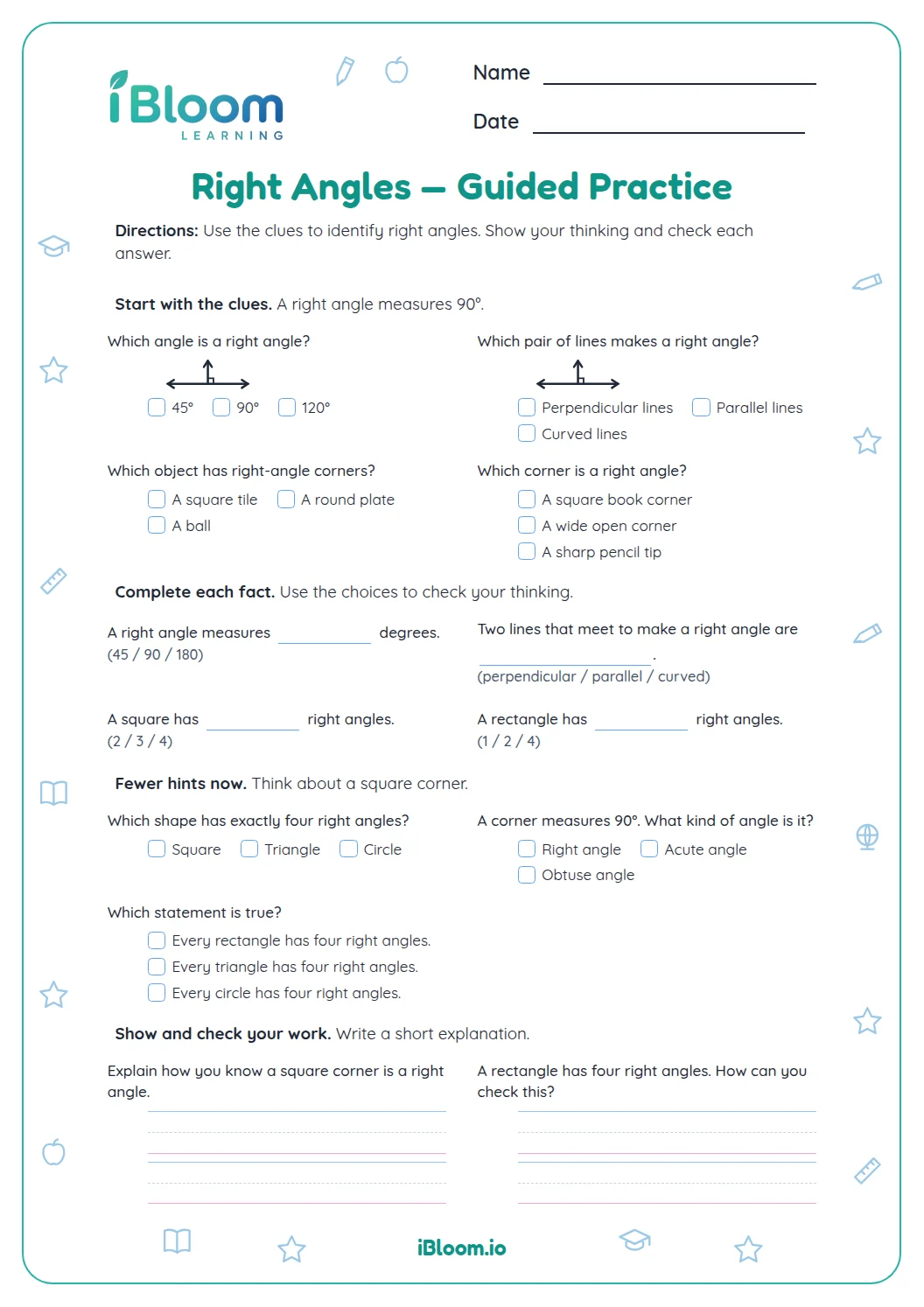
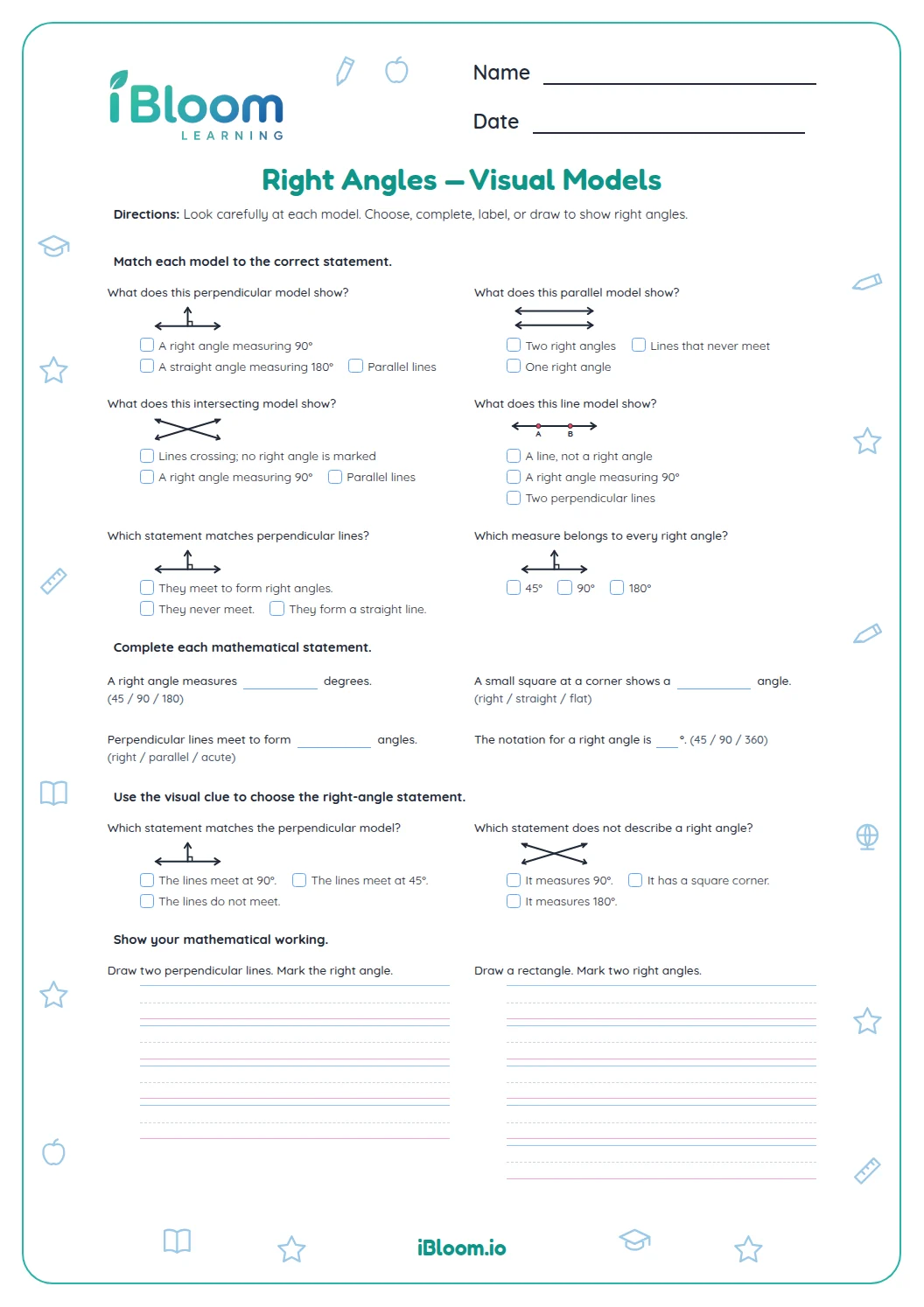
This printable Grade 3 geometry page gives 14 questions about angle size and ray readings. Learners compare acute, right, and obtuse angles, then subtract two ray readings to find the turn between them. The sheet includes one drawn angle, degree-based classification checks, ray-reading choices, and independent subtraction; a separate answer key supports review.
What does an angle measure?
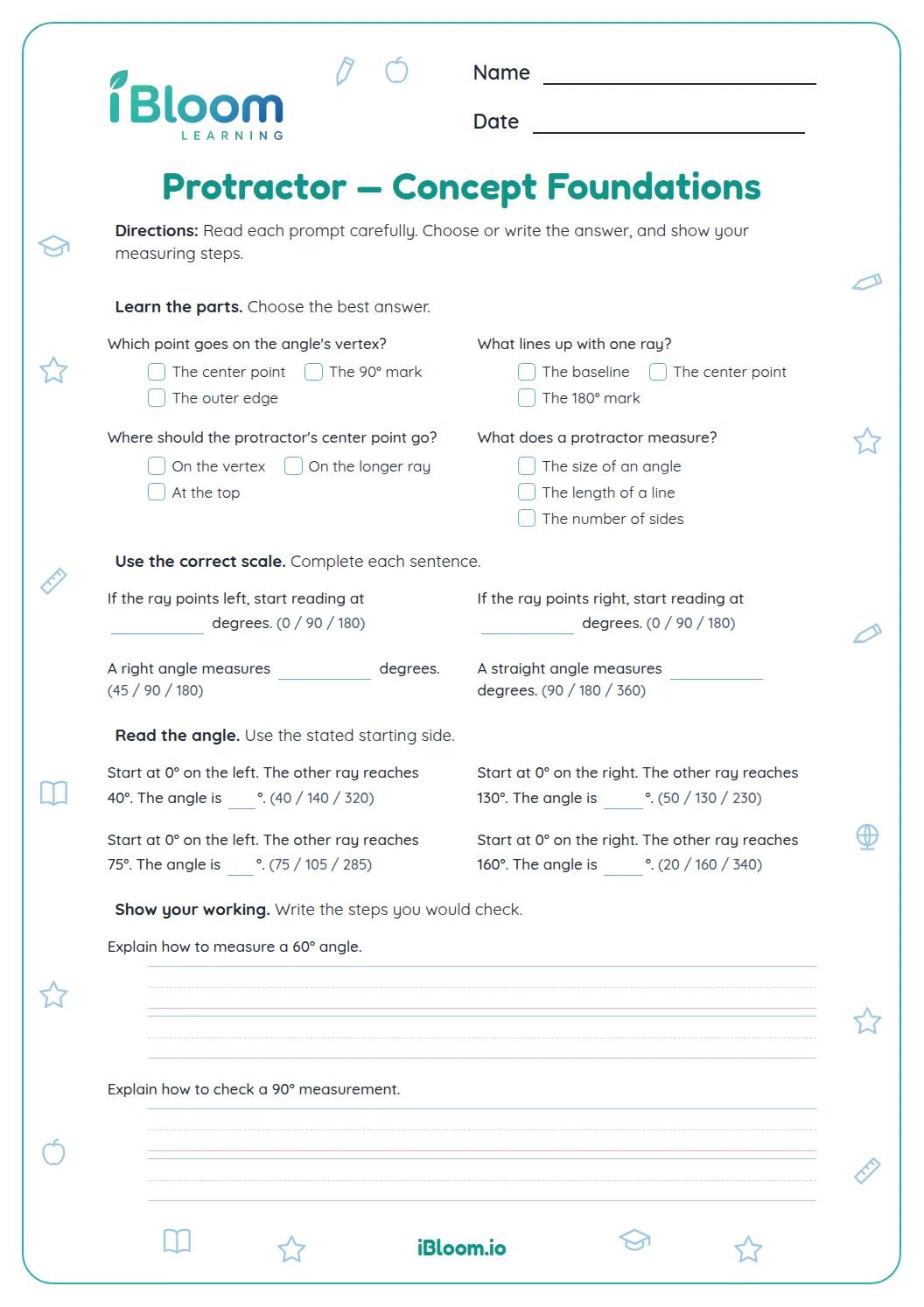
An angle measures the turn between two rays that share an endpoint. Compare the opening with a right angle of 90° to classify it, or subtract the smaller ray reading from the larger one to find the difference.
This printable Grade 3 geometry page gives 14 questions about angle size and ray readings. Learners compare acute, right, and obtuse angles, then subtract two ray readings to find the turn between them. The sheet includes one drawn angle, degree-based classification checks, ray-reading choices, and independent subtraction; a separate answer key supports review.
How can a right angle help?
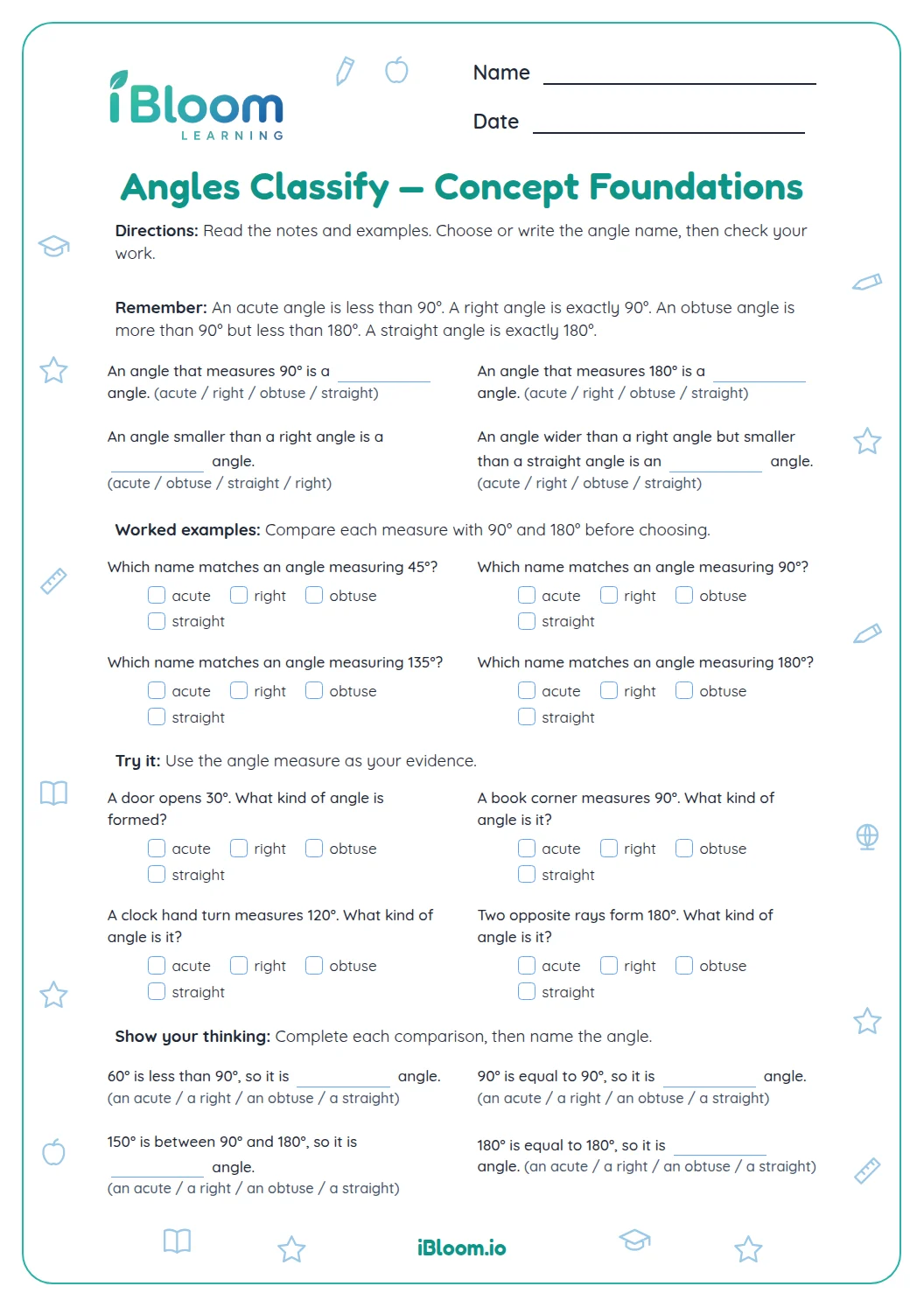
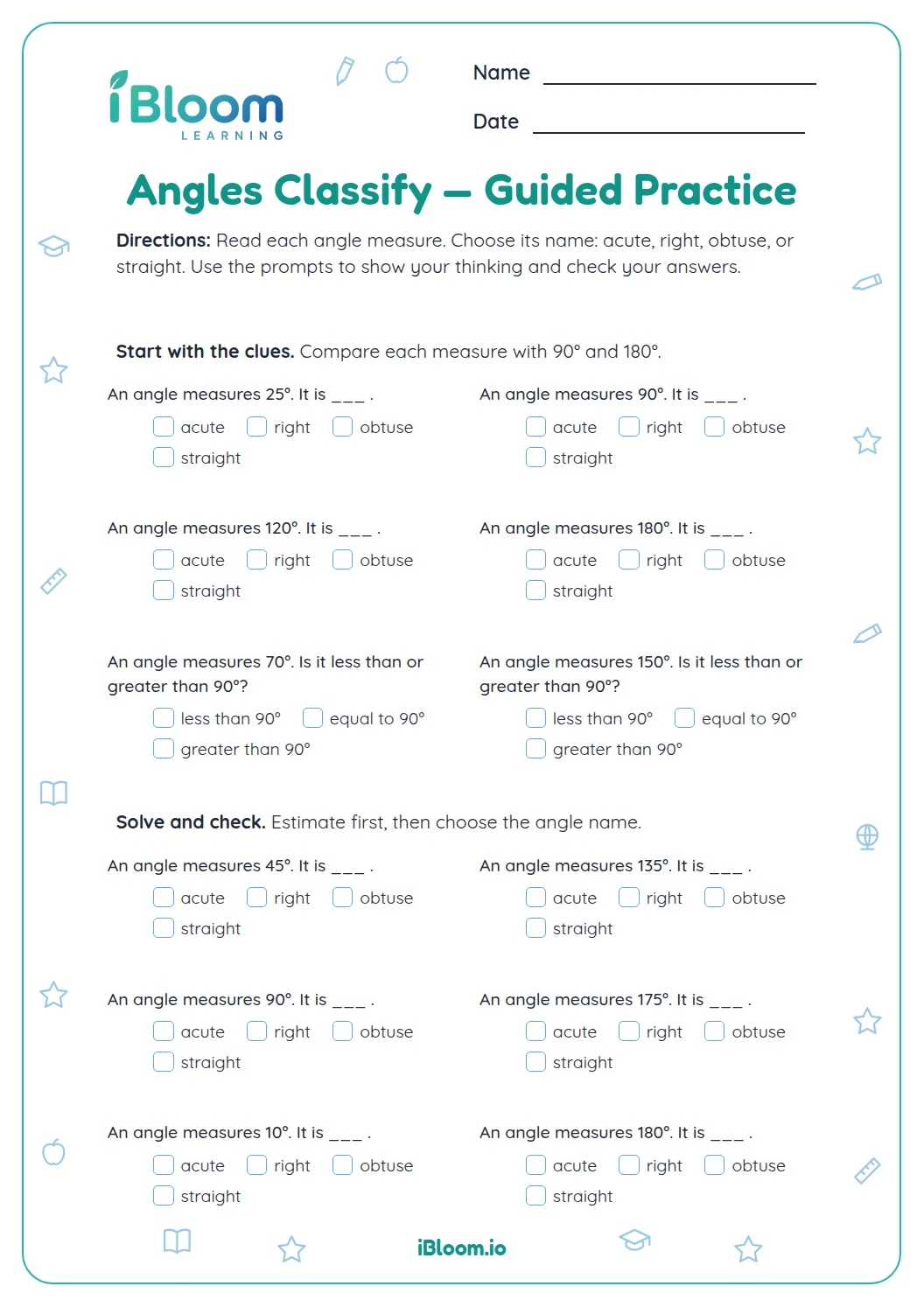
A right angle measures 90°. An acute angle opens less than a right angle; an obtuse angle opens wider. Compare the opening with a square corner before using ray readings.
What questions are on the sheet?
The worksheet contains 14 questions in 4 parts. The answer key is on a separate page.
- Name acute, right, and obtuse angles.
- Subtract ray readings to find angle measures.
- Choose measures from two ray readings.
- Complete two final angle-difference questions.
How to use this worksheet
- 1Read the one-sentence directions and complete each part in order.
- 2Pause at the end of each part to check how you reached an answer.
- 3Use the separate answer key to review answers and revisit any missed item.
- 4For open responses, compare your idea with the sample and explain your thinking.
Common slips to check
The mistake
Using one ray reading as the angle measure.
The fix
Subtract the smaller reading from the larger one to find the turn between the rays.
The mistake
Calling a 90° angle acute or obtuse.
The fix
A 90° opening is a right angle; acute is less and obtuse is greater.
The mistake
Subtracting in the order that gives a negative answer.
The fix
Start with the larger ray reading and subtract the smaller.
What to practice next
Make more practice
Further reading
Questions parents and teachers ask
What is the difference between an acute, right, and obtuse angle?
A right angle measures 90 degrees. An acute angle is smaller than 90 degrees, while an obtuse angle is larger than 90 degrees and smaller than a straight angle. Comparing each opening with a square corner helps learners classify it before checking a measurement.
How can a learner find an angle from two ray readings?
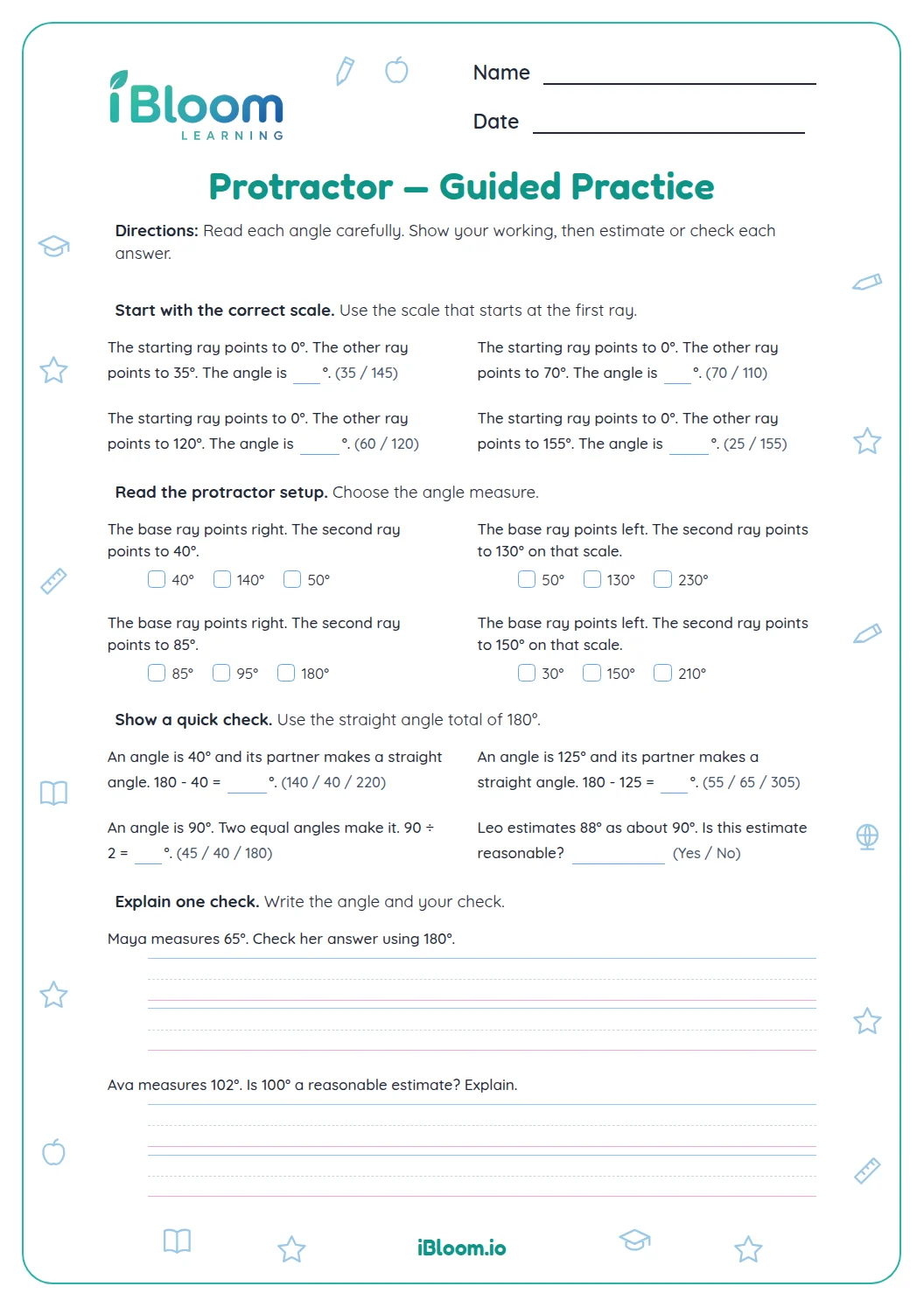
Subtract the smaller ray reading from the larger ray reading. For readings of 18 degrees and 76 degrees, calculate 76 minus 18 to get 58 degrees. The subtraction finds the turn between the two rays, rather than either ray’s position by itself.
Does this worksheet include drawings and an answer key?
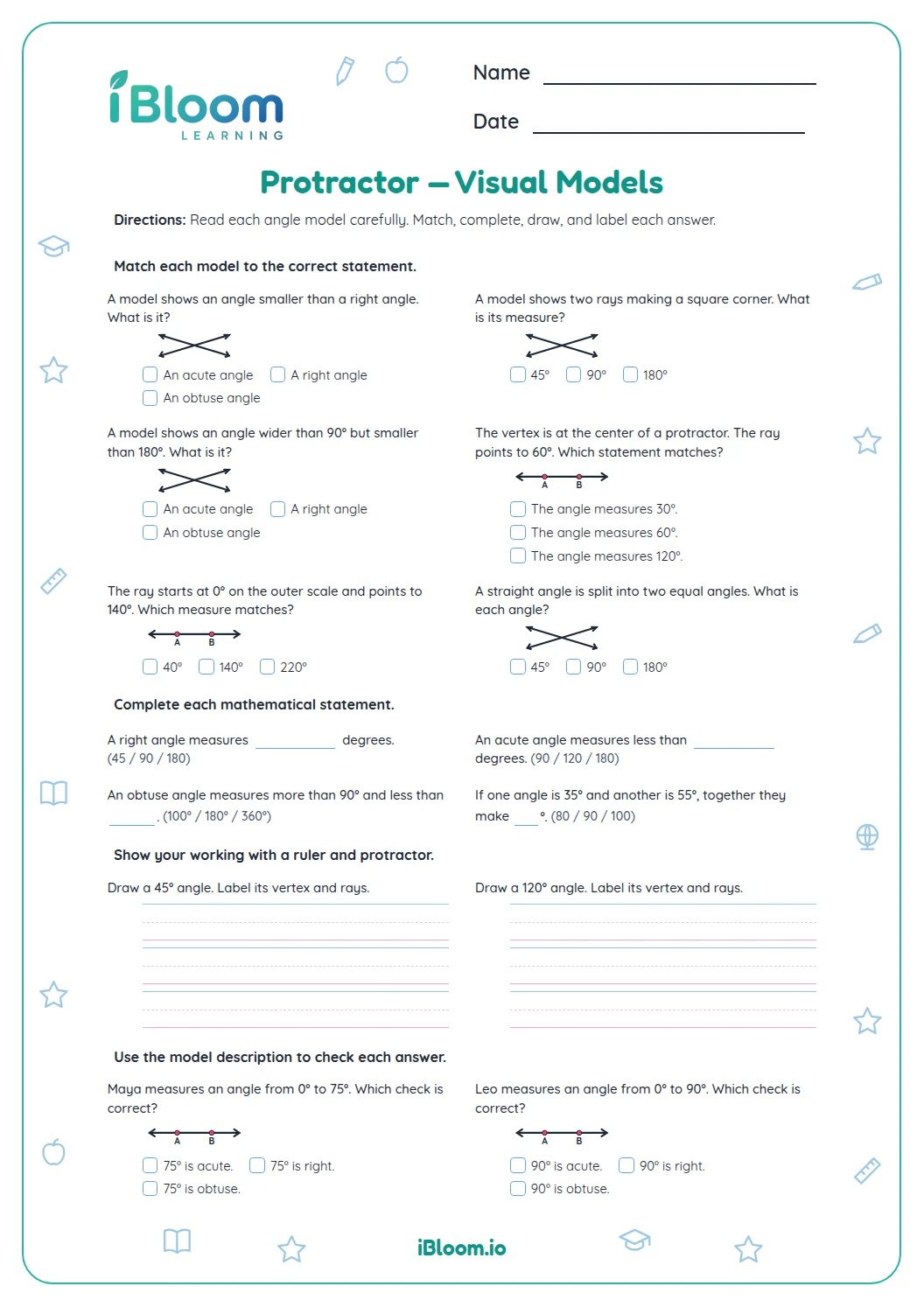
Yes. The first part includes one angle drawing and degree-based classification checks. Other items give ray readings or ask learners to choose a computed measure, and the final questions ask for a subtraction sentence. A separate answer key lists the classifications and correct degree measures.
What should a child use as a benchmark when estimating angles?
Use a right angle as a familiar benchmark. An angle that opens less than a square corner is acute; one that opens wider is obtuse. Then compare the ray readings or calculate the difference to confirm the estimate.