

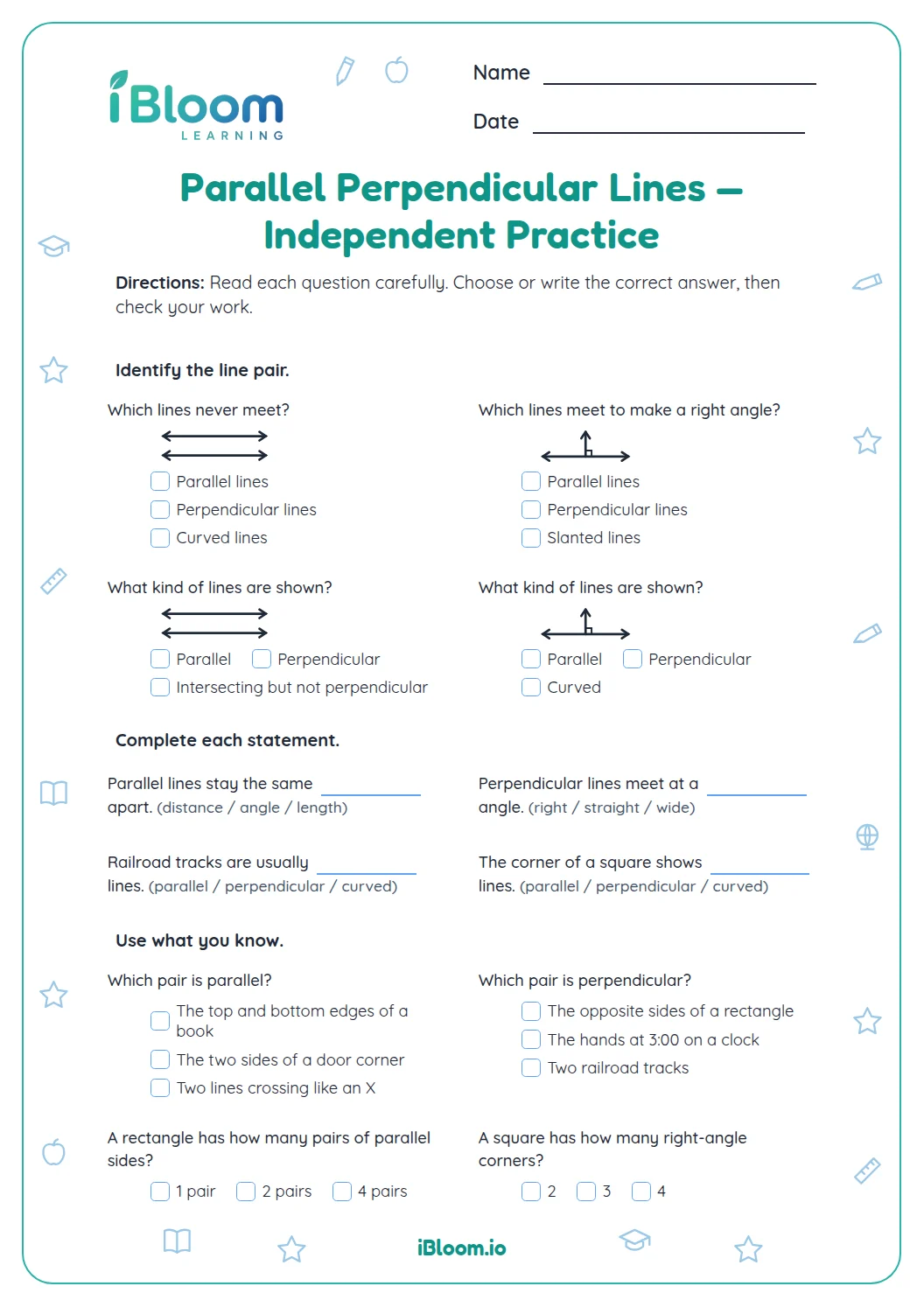
About this worksheet
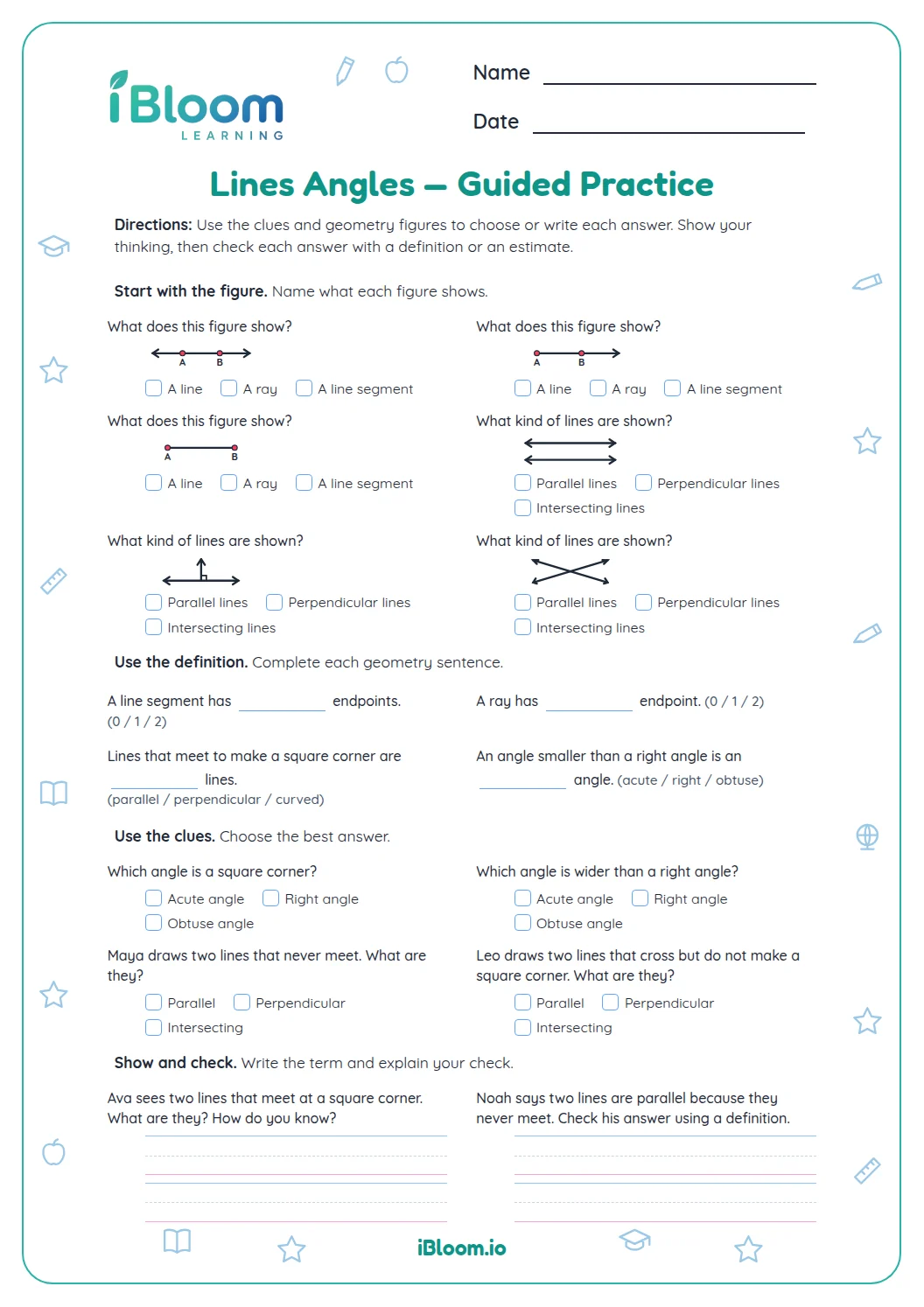
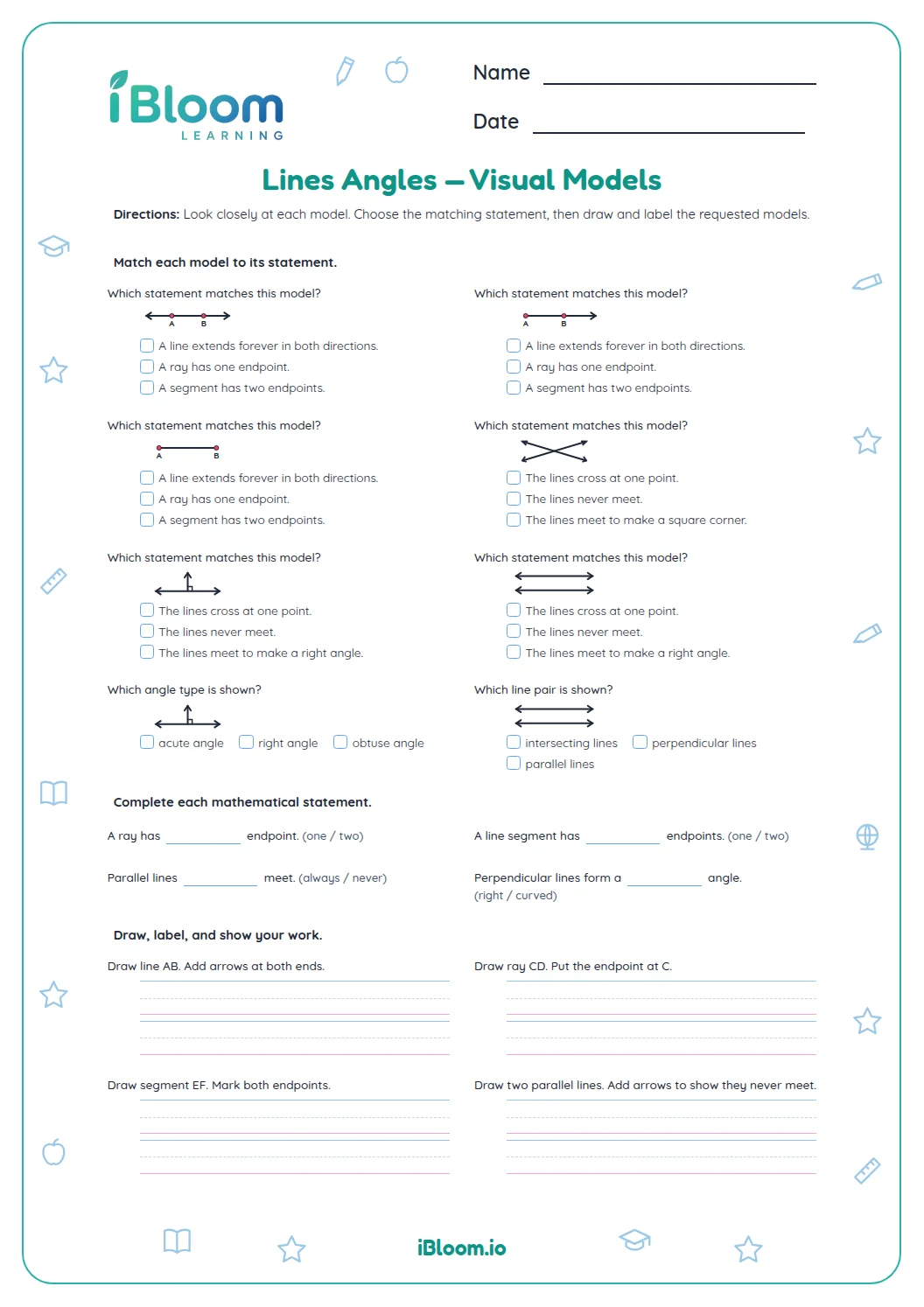
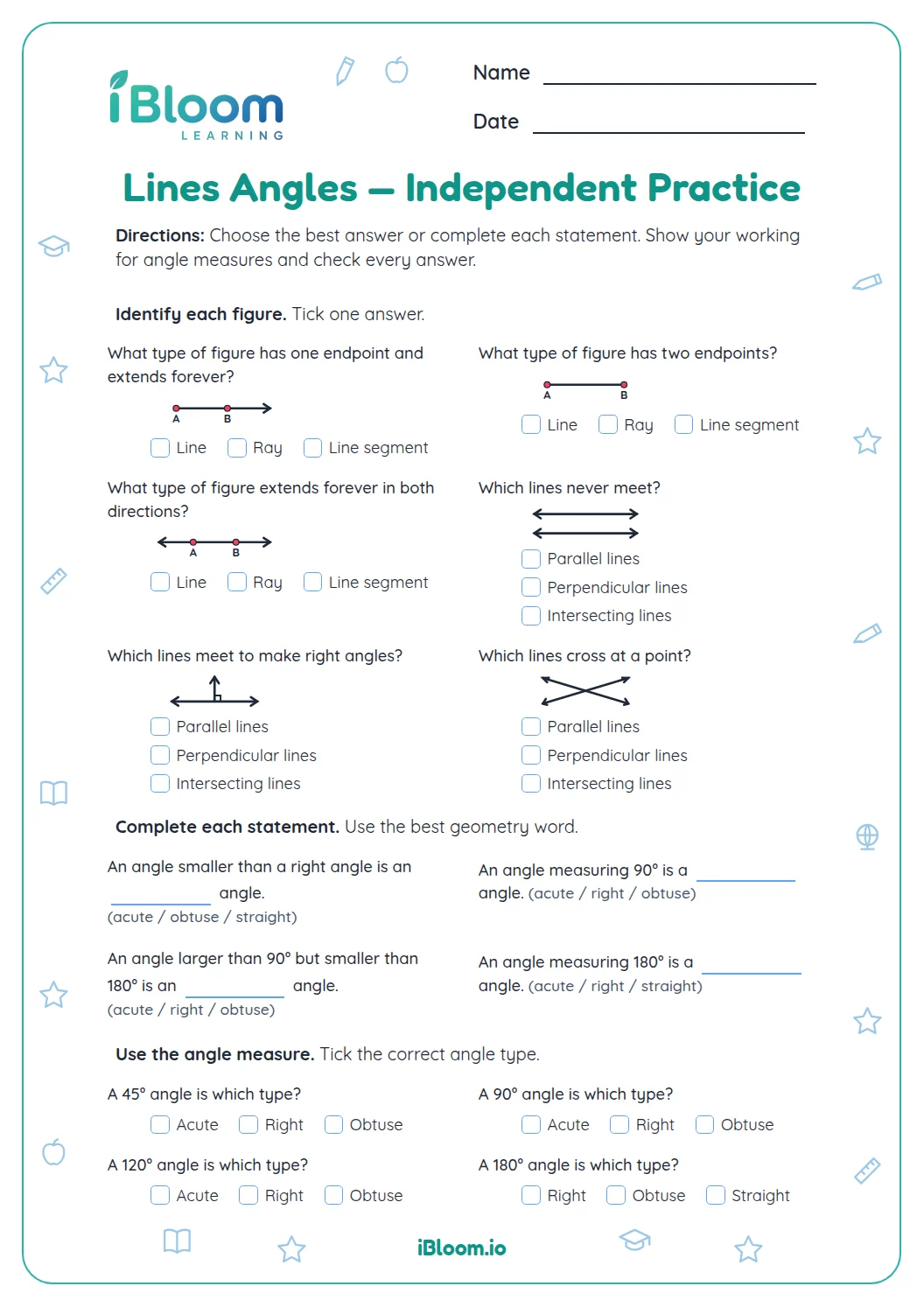
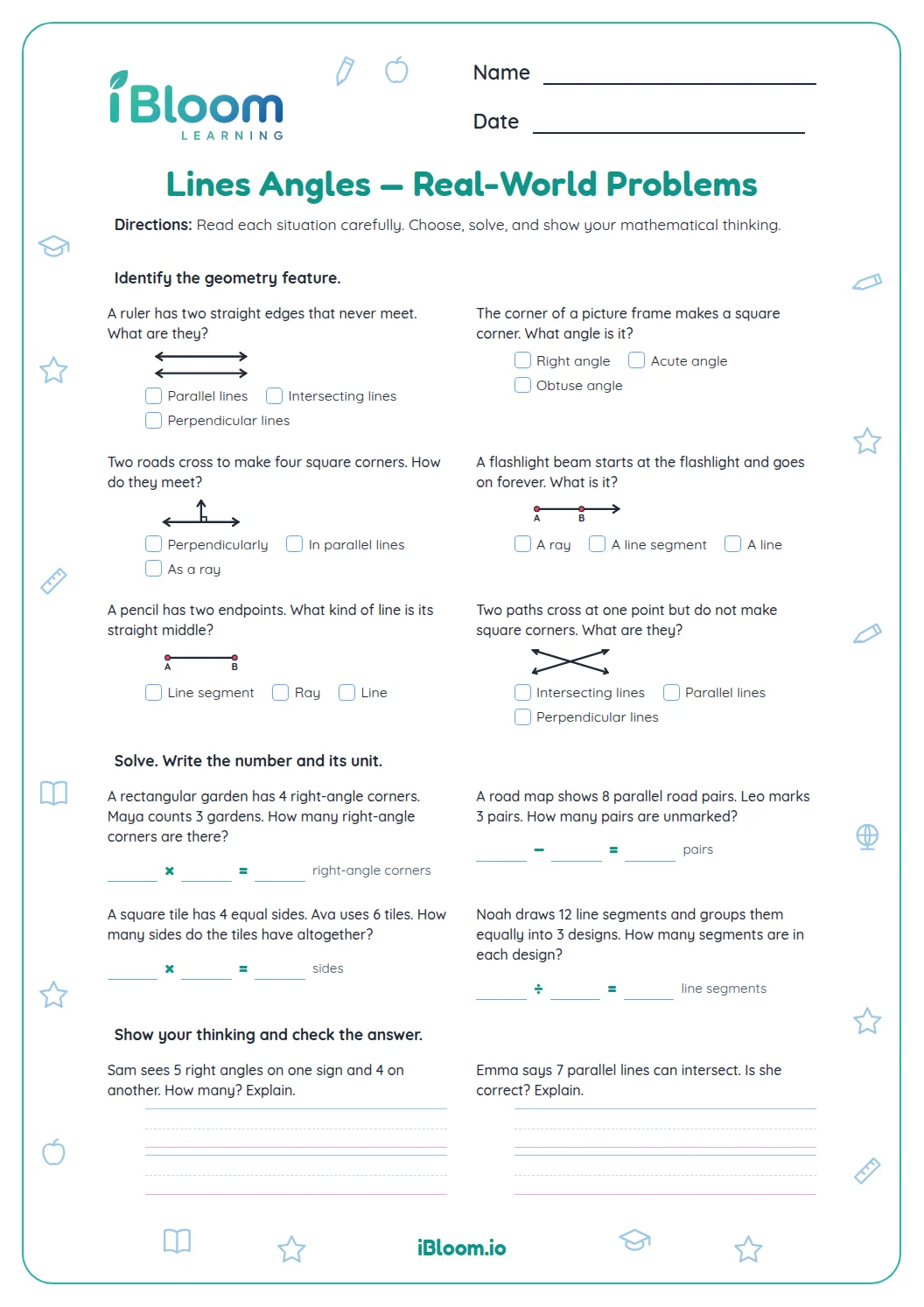
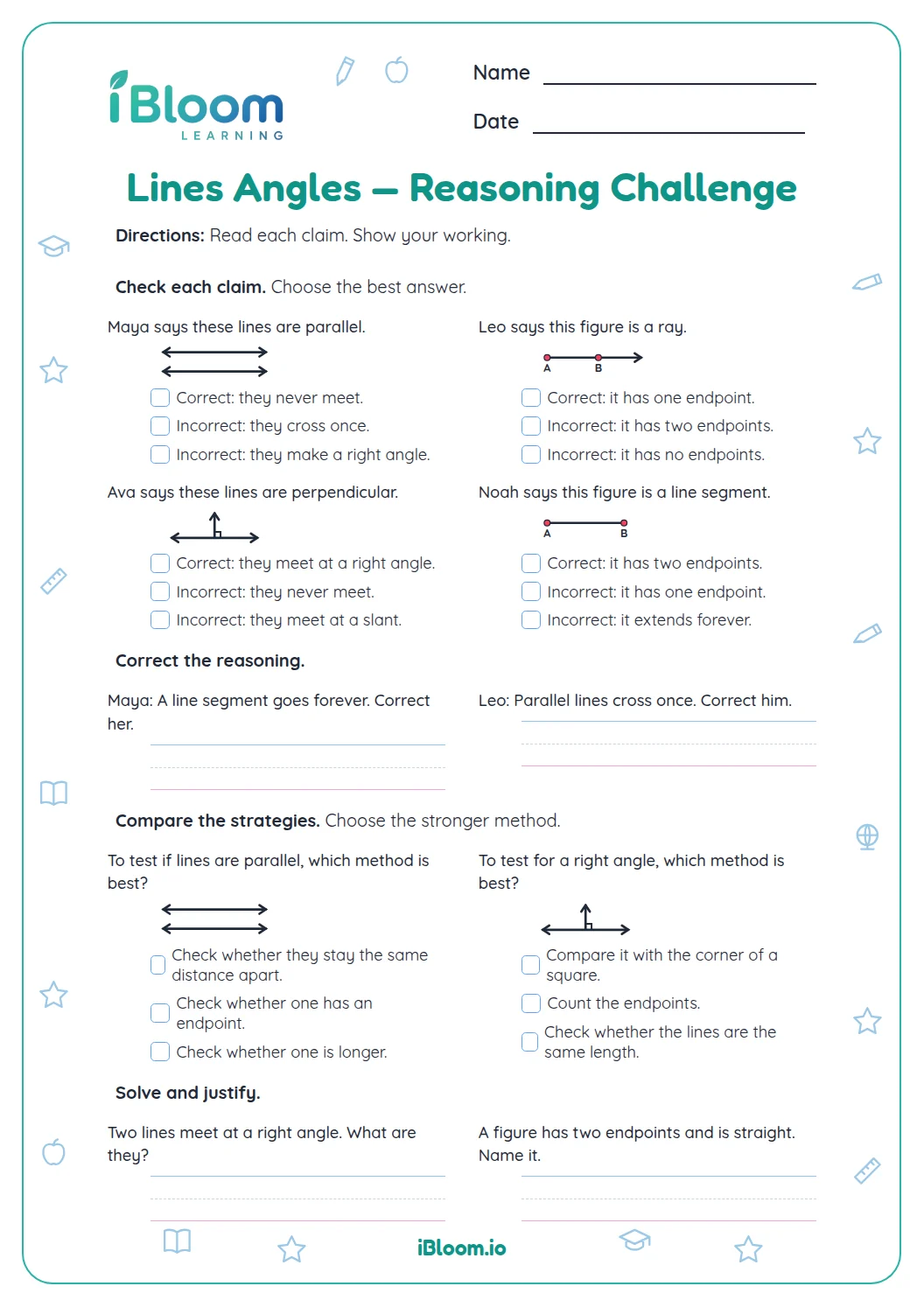
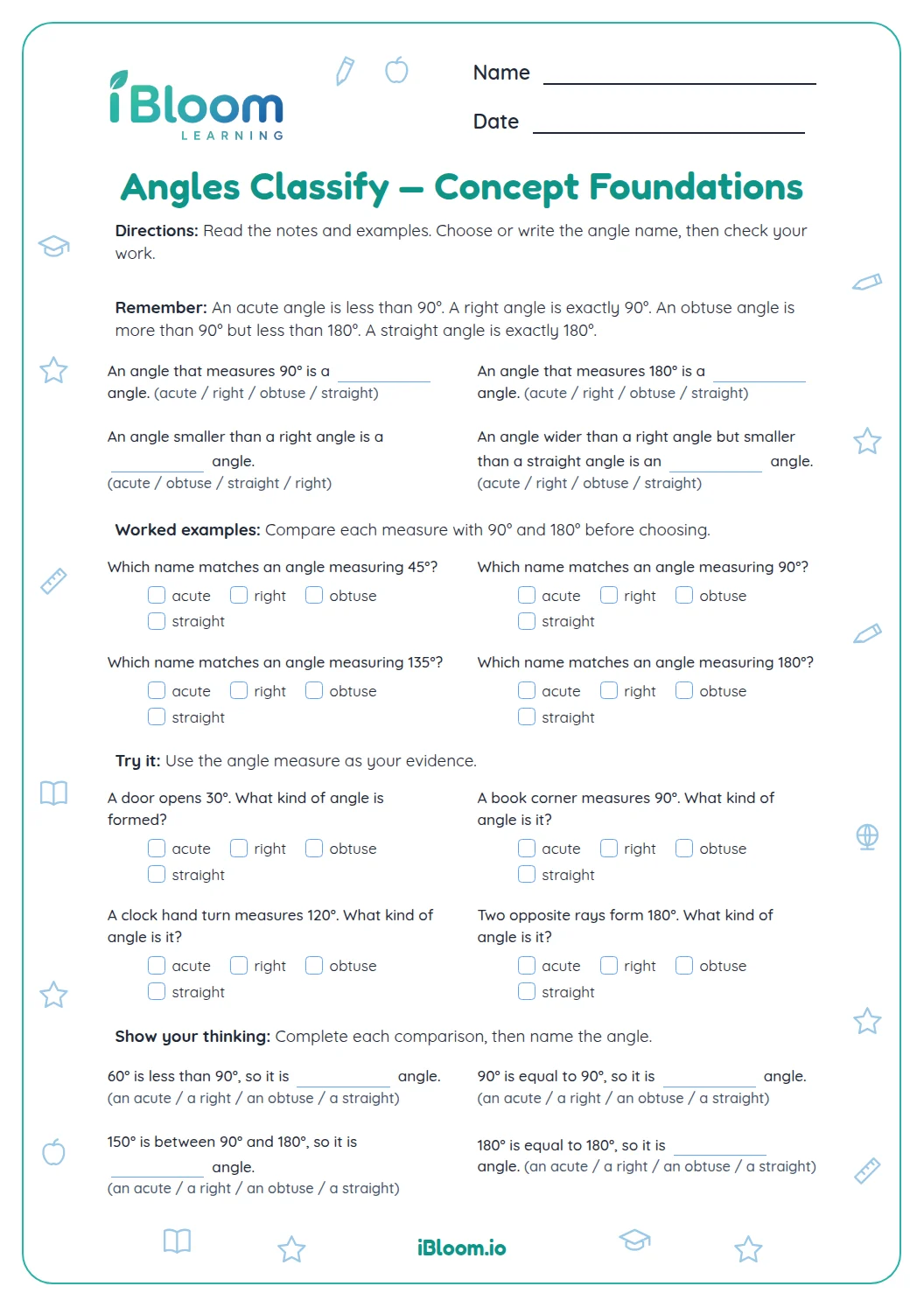
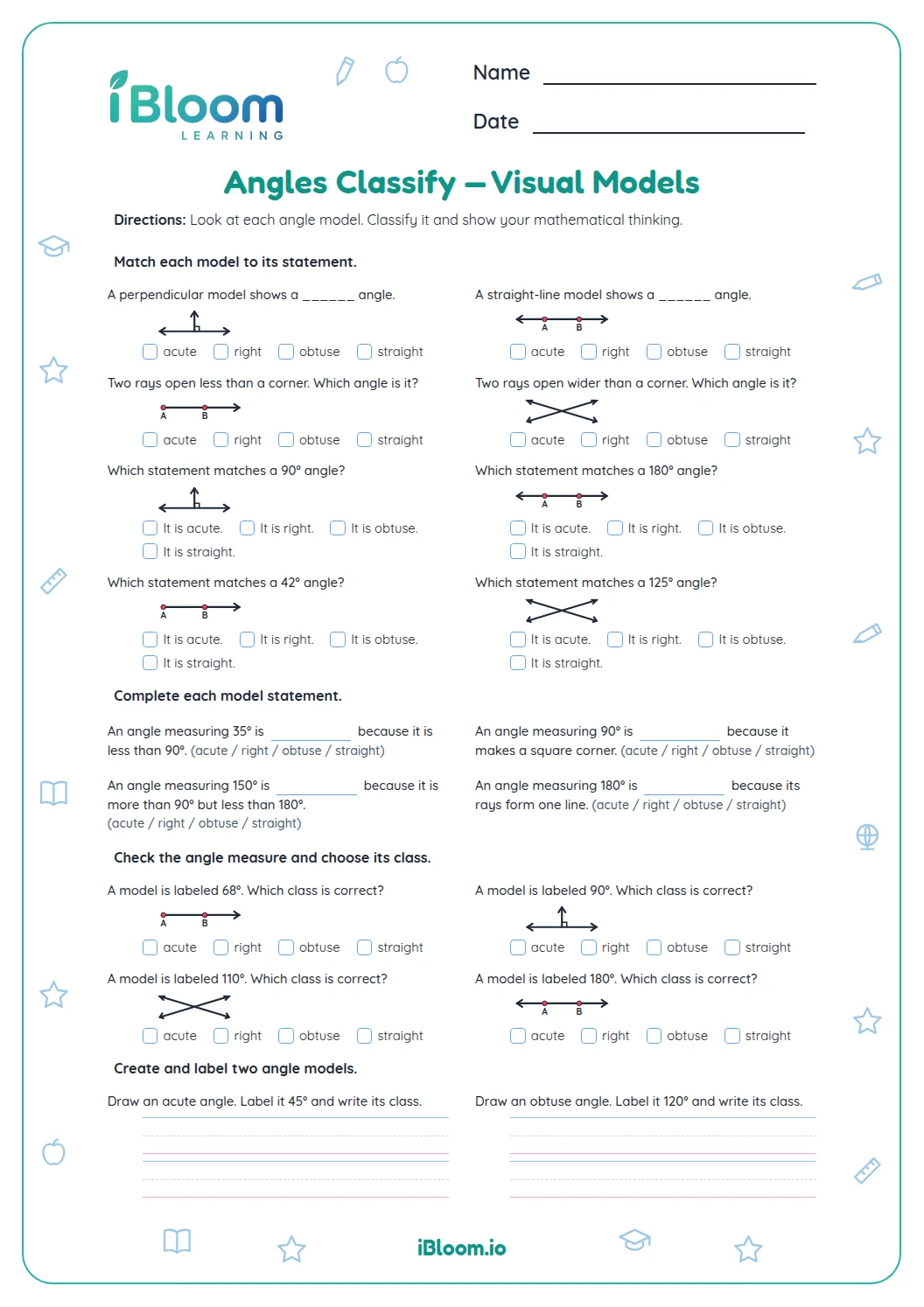
This geometry worksheet gives students 2 angle drawings to classify by comparing each opening with a square corner. Every item includes a drawn model and the separate key identifies the matching angle type.
Aligned to 4.G.A.1
How can you classify an angle?
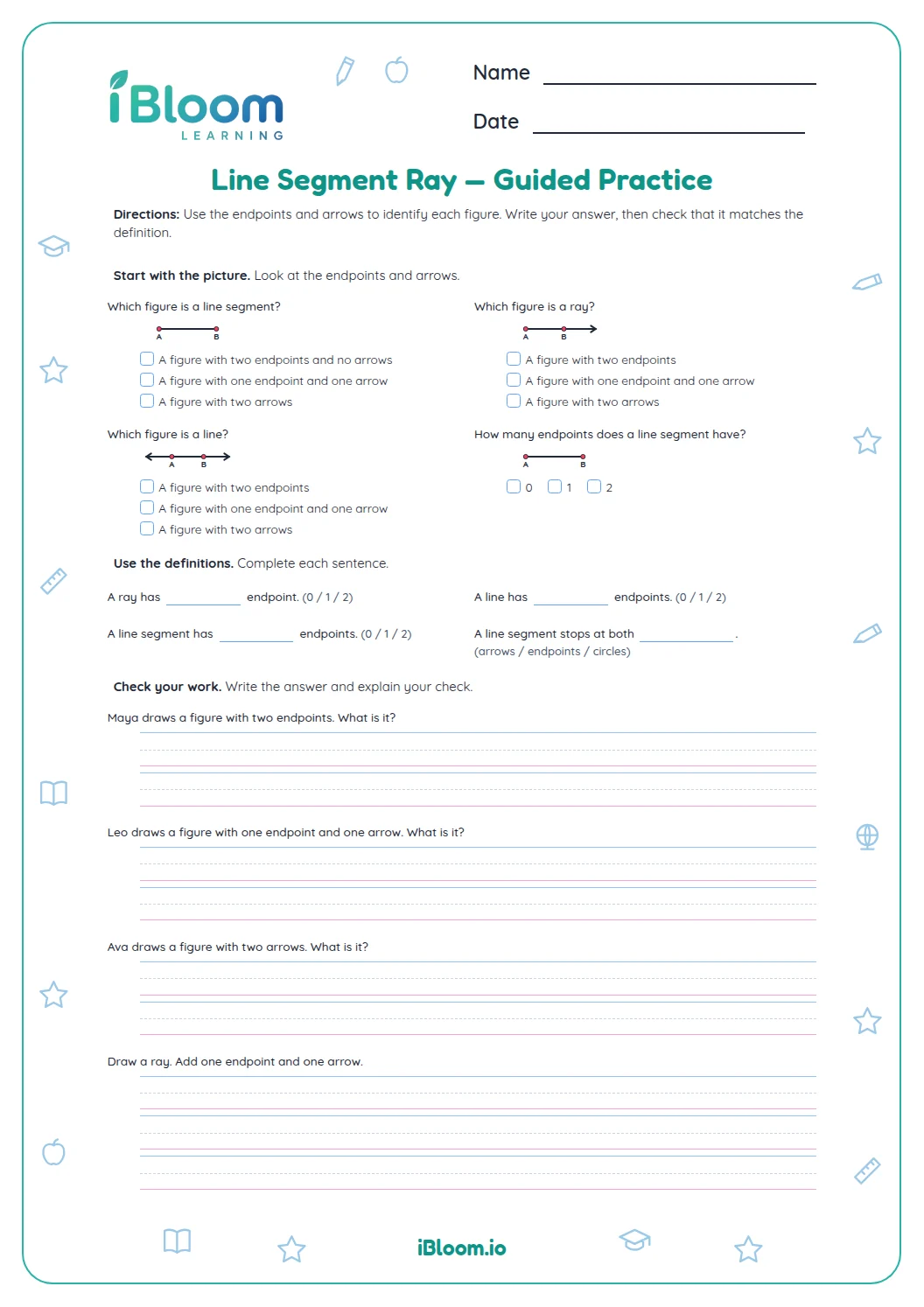
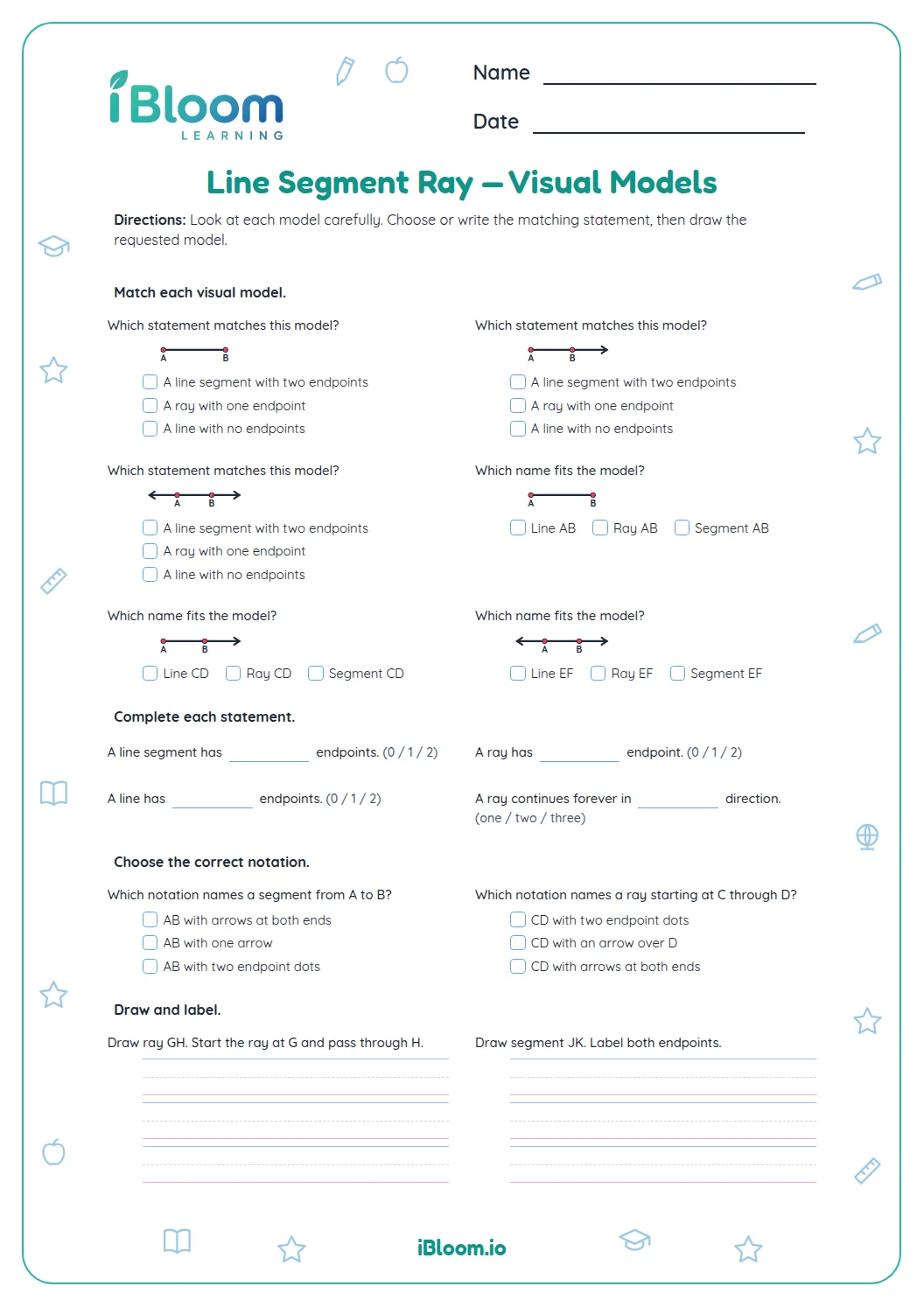
A ray starts at one endpoint and continues in one direction. A line segment has two endpoints. An angle is formed by two rays that share an endpoint. Compare angle drawings with a square corner to classify them.
- 1Two rays meet at one point.
- 2Their shared endpoint is the vertex.
What does each drawing show?
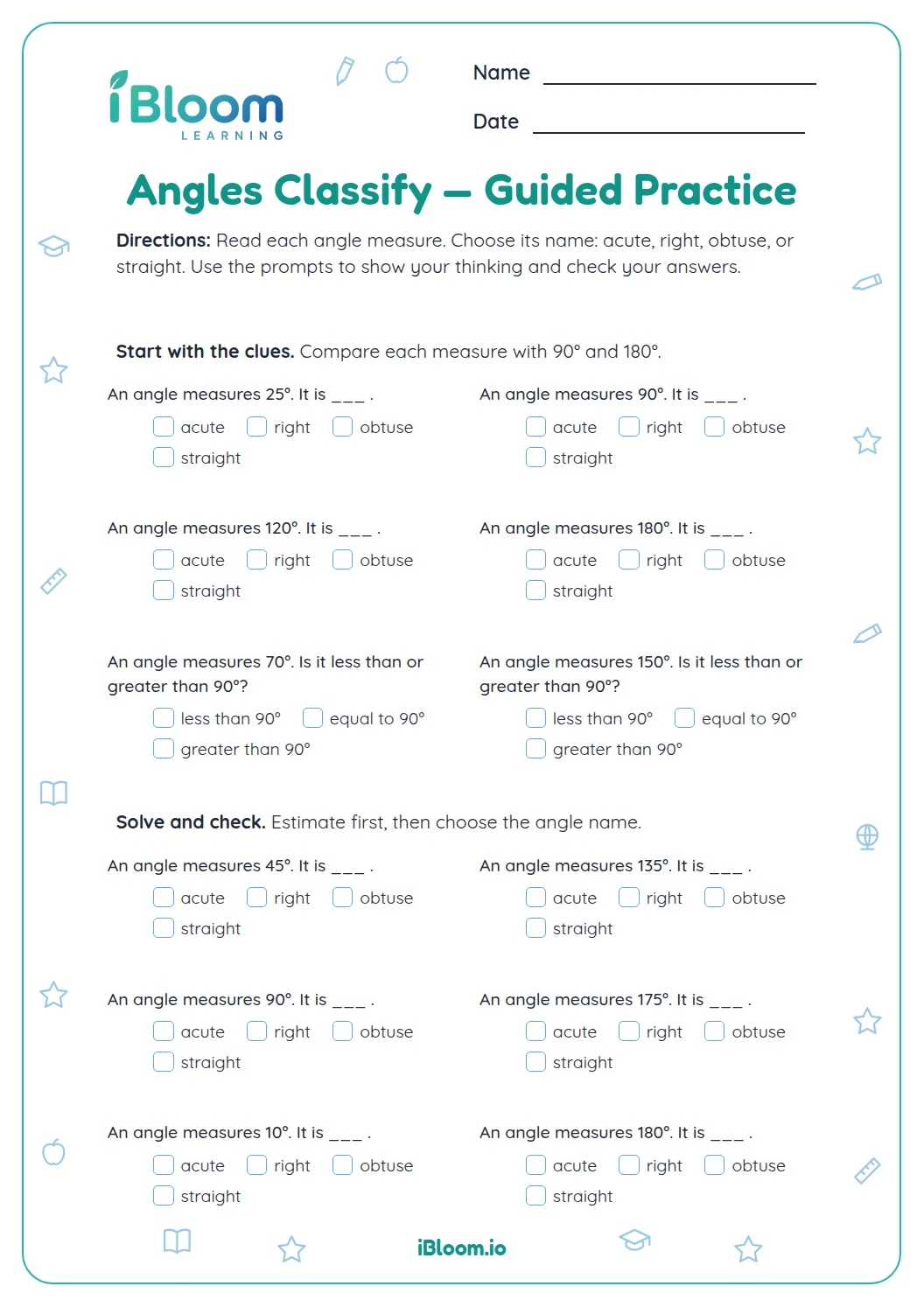
Every question includes a drawn angle. Read the opening and choose the matching name from acute, right, obtuse, and straight.
How can students check a classification?
Use the right angle as a reference. Check the answer key after classifying each drawing.
Classify each angle model
- 1Find the vertex where the two sides meet.
- 2Compare the opening with a square corner.
- 3Choose acute if it is smaller.
- 4Choose right if it matches the corner or obtuse if wider.
- 5Choose straight when the two sides form a line.
Common angle slips
The mistake
Calling every wide angle straight.
The fix
A straight angle forms one line; a wider corner is obtuse.
The mistake
Calling a square-corner angle acute.
The fix
A square corner is a right angle.
The mistake
Choosing by side length instead of opening.
The fix
Compare the space between the sides.
Common Core alignment
This page practices angle classification through drawn models.
Recognize and identify angle drawings in geometric figures.
On this sheet: Classify drawn angles as acute, right, obtuse, or straight.
Show the official wordingHide the official wording
Draw points, lines, line segments, rays, angles (right, acute, obtuse), and perpendicular and parallel lines. Identify these in two-dimensional figures.
What to practice next
Make more practice
Further reading
Questions parents and teachers ask
How can a student spot a right angle?
A right angle has the same opening as a square corner. The first four questions show drawn angle models, and the remaining items ask students to classify short angle descriptions. The answer key gives the expected name for each of the 14 questions.
What is an acute angle?
An acute angle is smaller than a right angle. Students compare an angle opening with a square corner, then select acute, right, obtuse, or straight. Four questions include drawn models, and the separate answer key lets students check every response.
What is an obtuse angle?
An obtuse angle is wider than a right angle but does not make a straight line. The sheet asks students to classify acute, right, obtuse, and straight angles. Four items show a drawn angle, and the key lists all 14 answers.
Does the sheet show angle drawings?
Yes. The first two items show drawn angle figures, which let students compare openings. The remaining questions use short angle descriptions and ask for the matching name. A separate key provides answers to all 14 classification questions and helps students review each type.
How should students use the answer key?
Compare the angle opening with a square corner before choosing an answer. Use acute for smaller, right for matching, obtuse for wider but not straight, and straight for a line. The answer key lists the expected classification for all 14 questions.