

About this worksheet
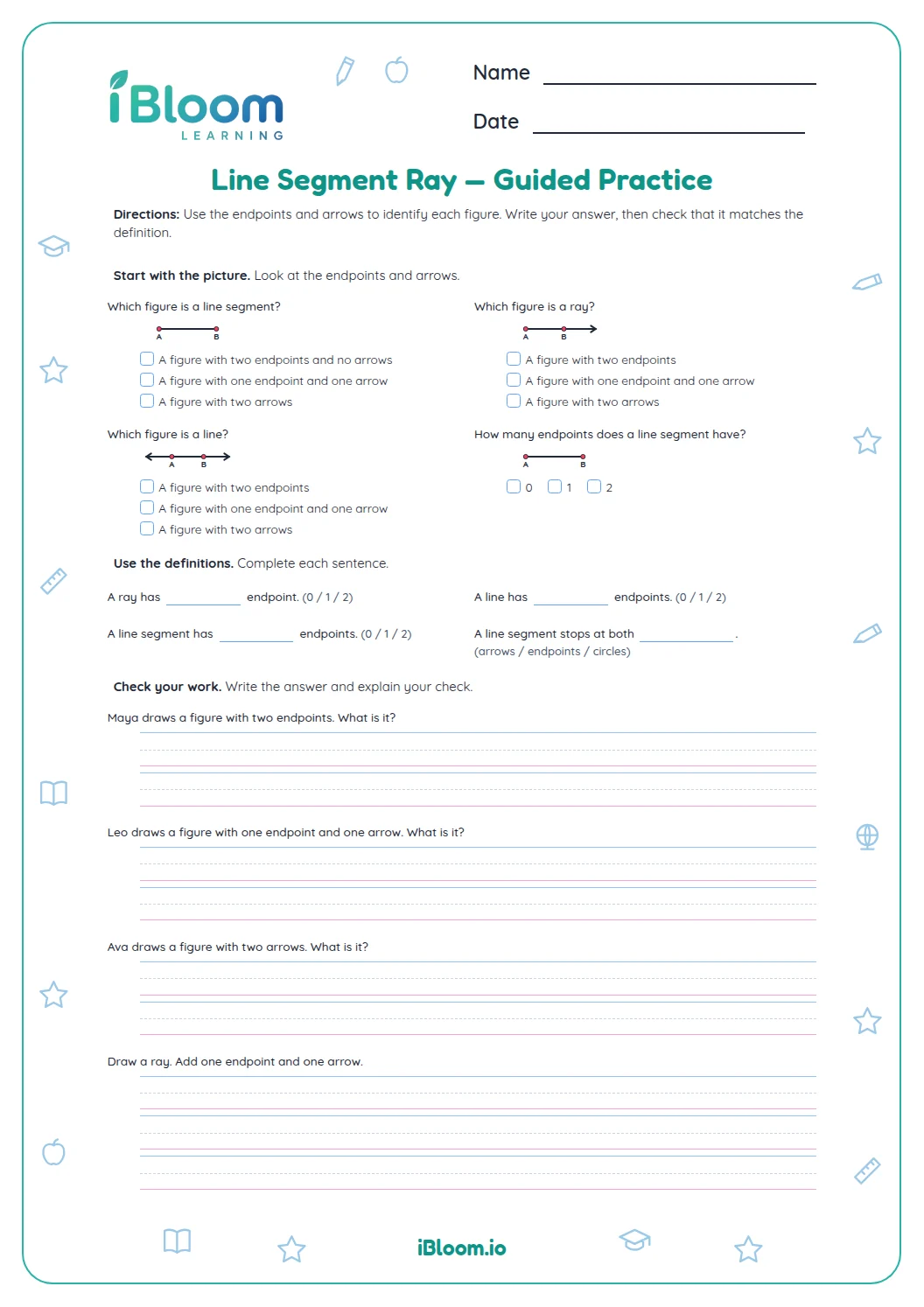
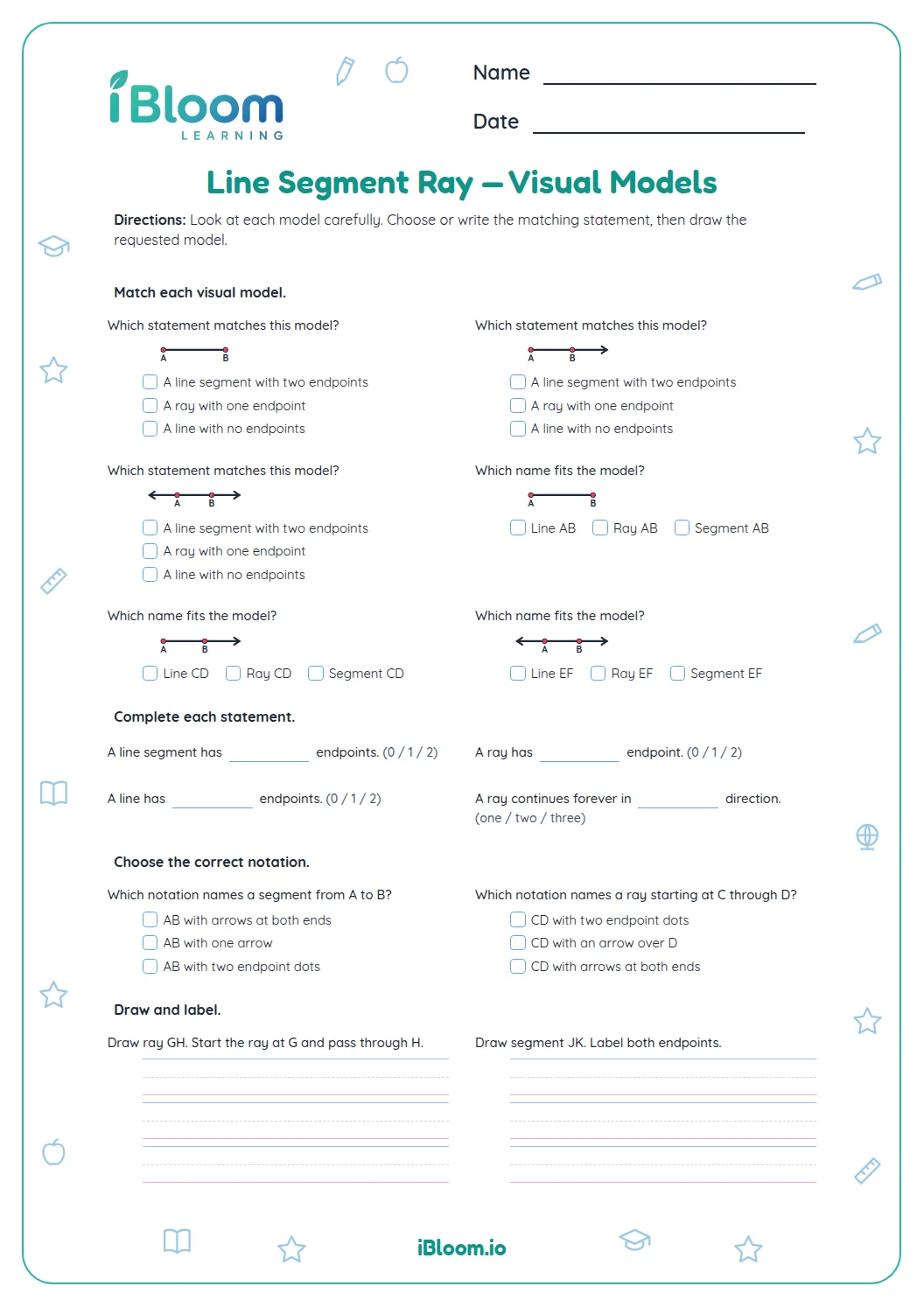
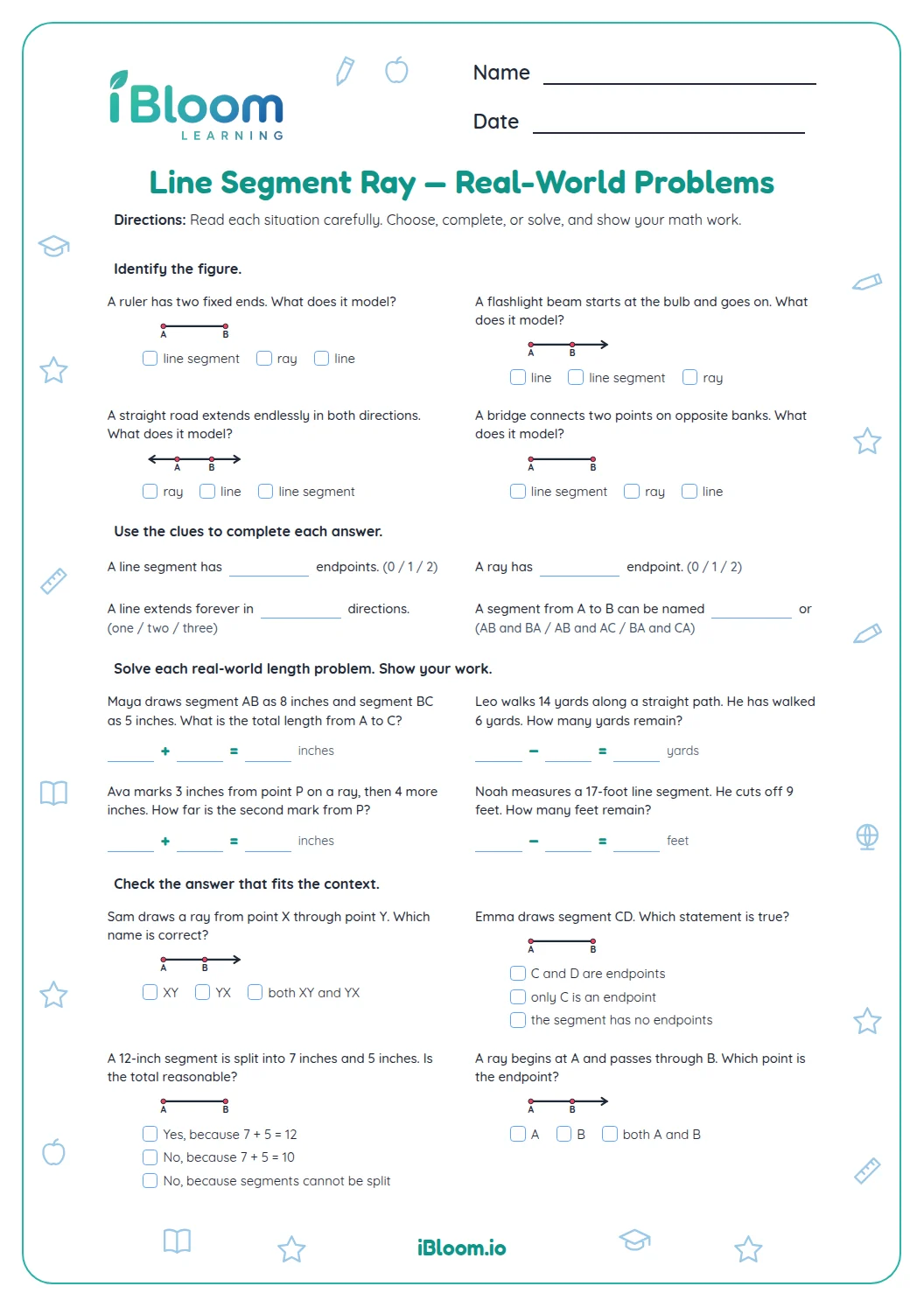
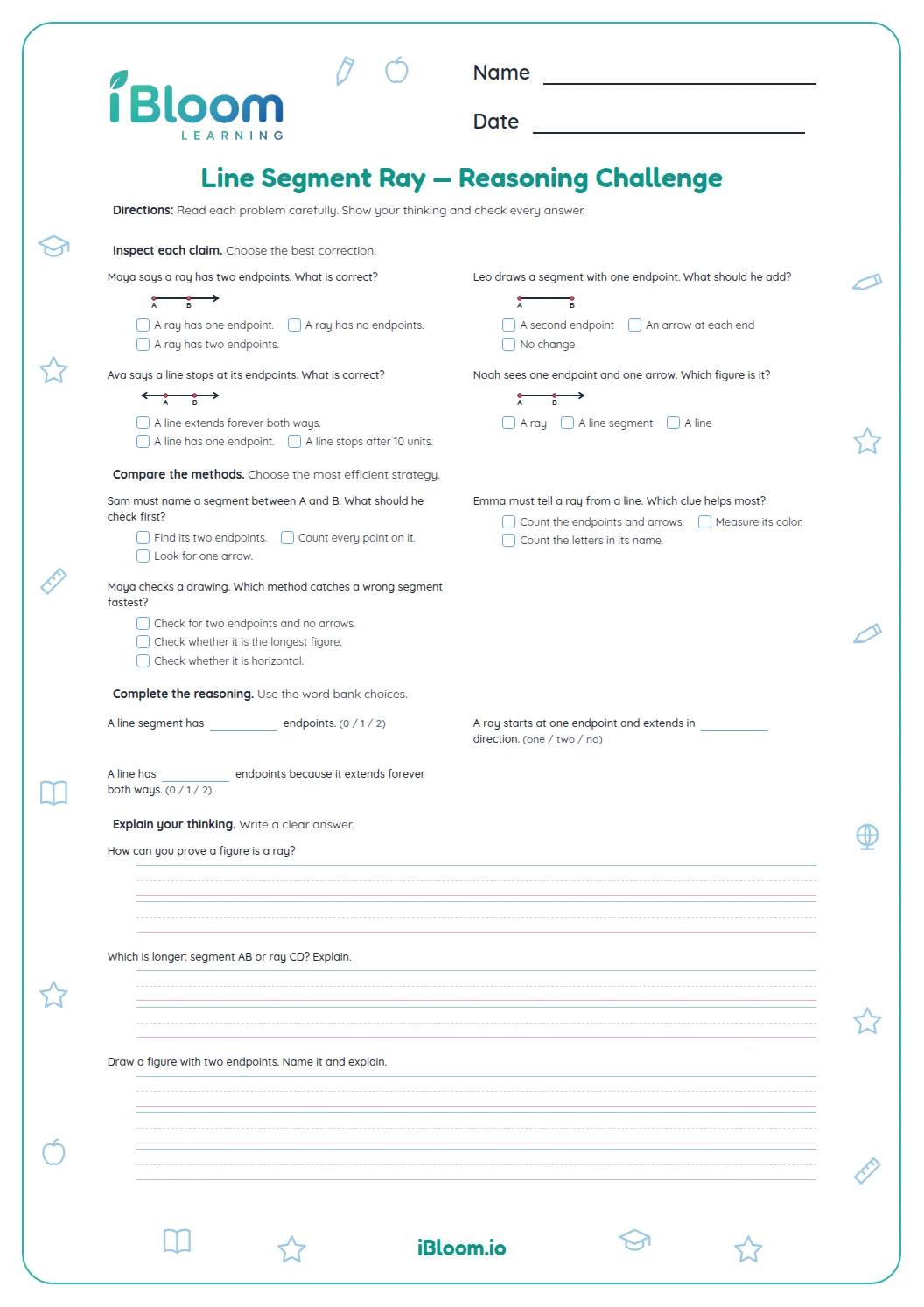
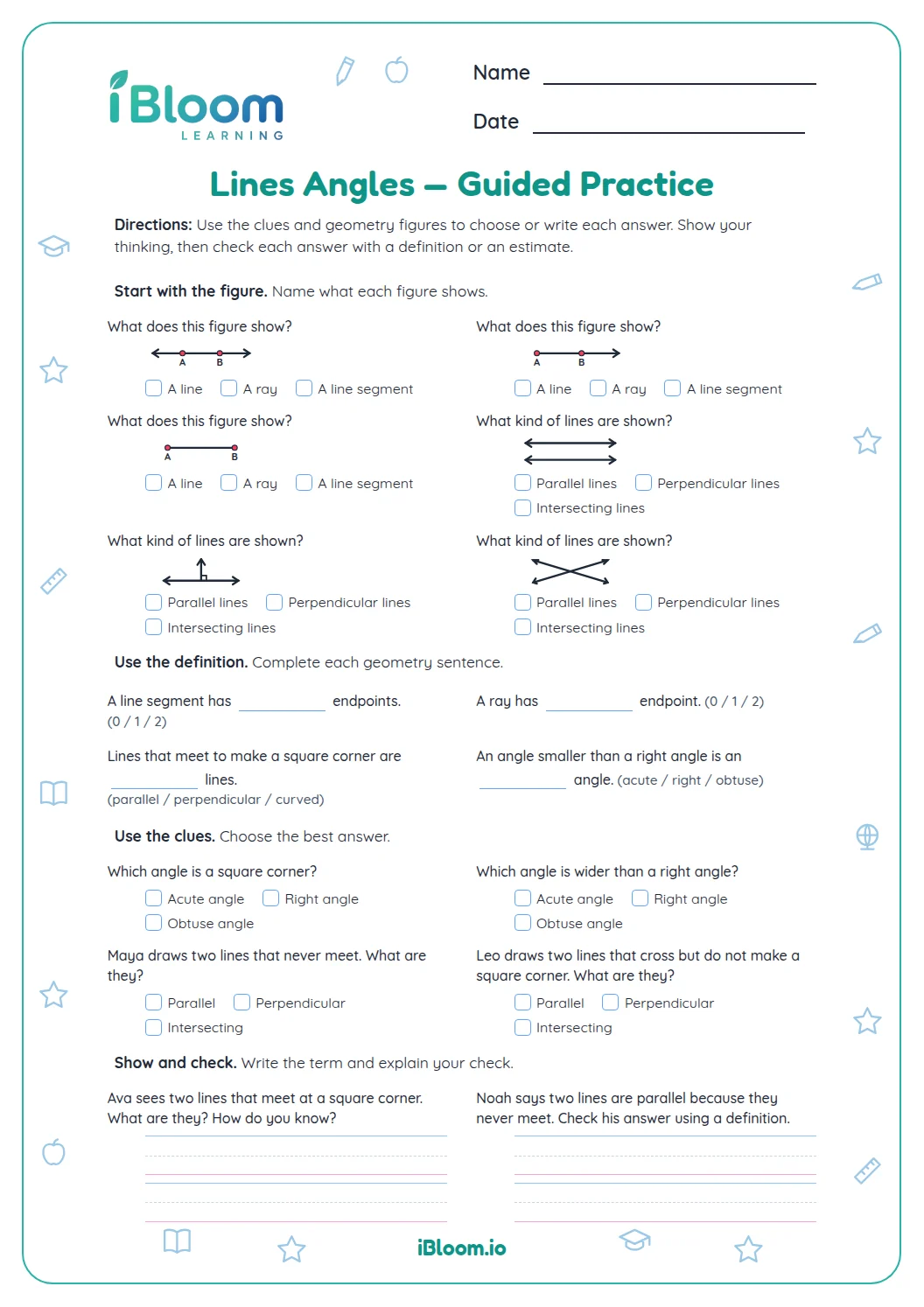
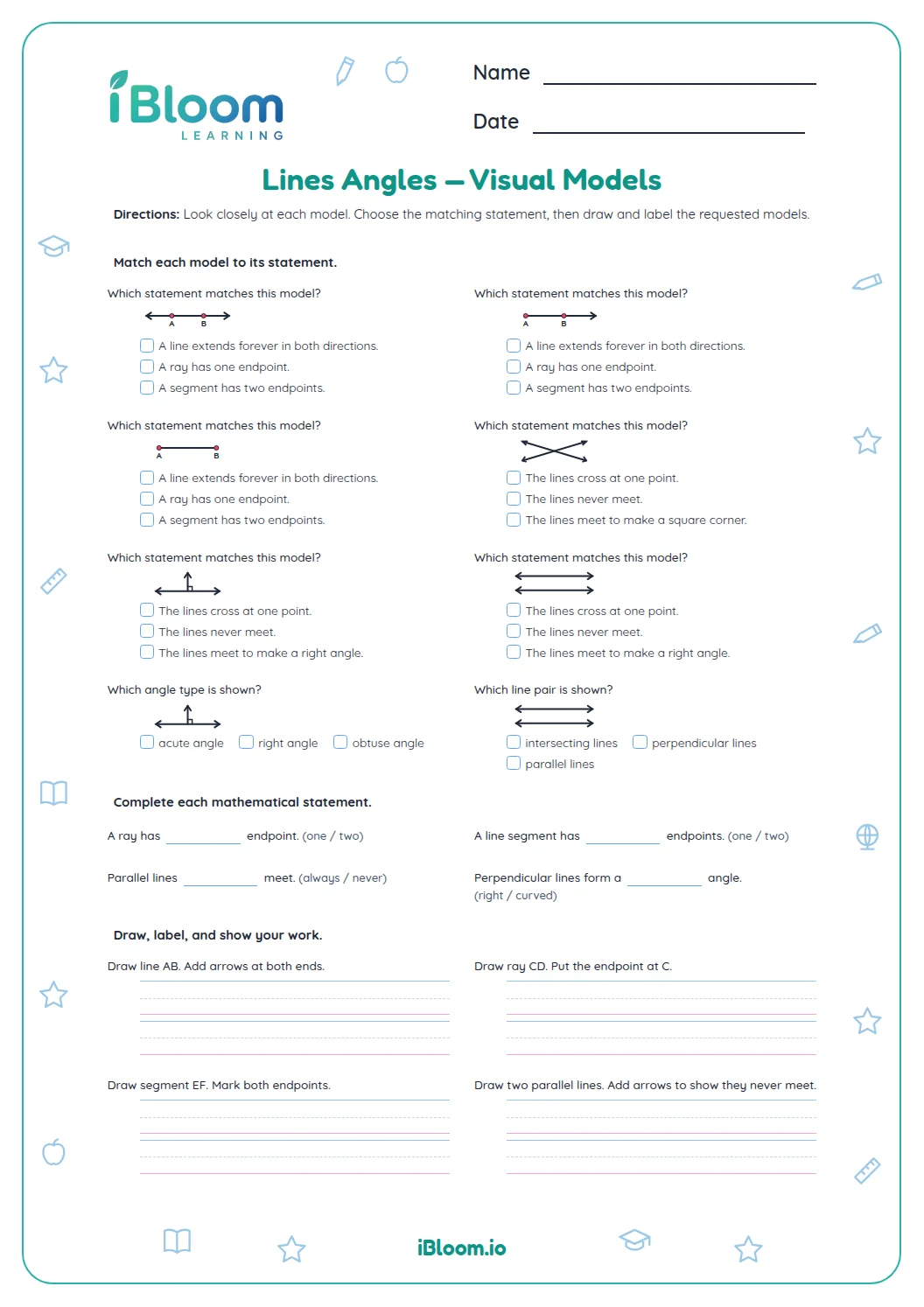
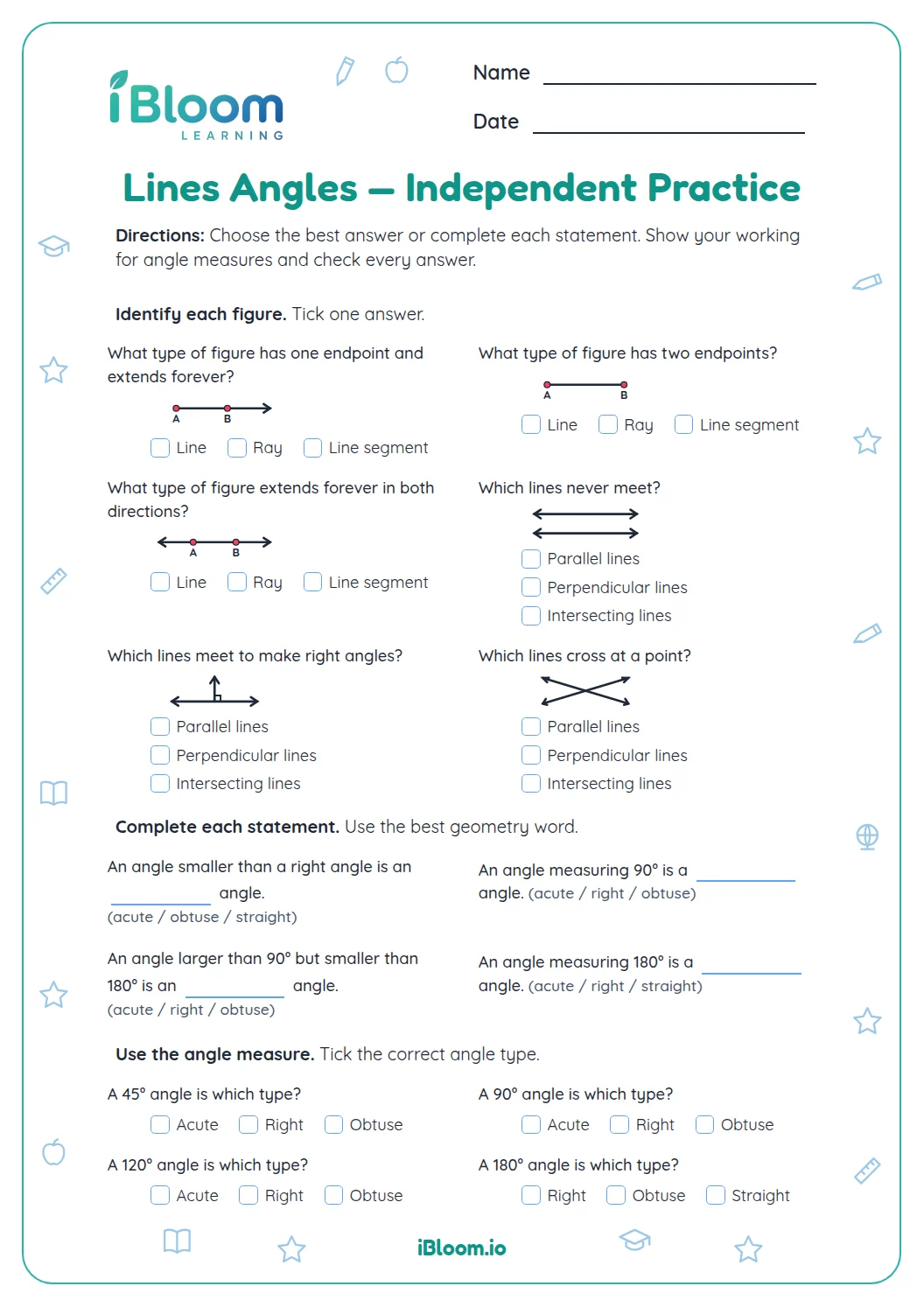
This free Grade 3 geometry printable builds the ideas behind lines, line segments and rays. Children complete statements about endpoints and direction, then apply those clues to named points and figure names. The 14 questions move from core features to using point order when naming a segment, ray or line. A separate answer key gives the expected response for each item.
Aligned to 4.G.A.1
What makes a line segment?
A line segment is part of a straight line with two endpoints. The endpoints show exactly where the segment begins and ends.
For example, if a straight path stops at A and B, it is a line segment and A and B are its endpoints. Part A reviews how many endpoints each figure has.
- 1A line segment has ___ endpoints.
- 2A segment stops at two fixed points.
- 3Answer: two
How do a ray and a line continue?
A ray has one endpoint and continues forever in one direction. When naming a ray, write its endpoint first, then another point along its path.
A line has no endpoints. It continues forever in both directions, so it has neither a beginning nor an end.
How can endpoints help identify a figure?
Part B applies the endpoint and direction clues to named points. Read which point is the endpoint, then keep the points in the order given when completing a segment, ray or line name.
How to use this worksheet at home or in class
- 1Read whether the path stops or continues.
- 2Count its endpoints: none, one or two.
- 3Check whether it continues in one direction or both.
- 4Use the same clues to complete the statements and explain your answer.
Common mistakes and quick fixes
The mistake
Calling a ray a segment because it has a starting point.
The fix
A ray has one endpoint but continues forever in one direction; a segment has two endpoints.
The mistake
Giving a line one endpoint.
The fix
A line keeps going in both directions, so it has no endpoints.
The mistake
Confusing the point a ray passes through with its endpoint.
The fix
The endpoint is where the ray starts; the ray then passes through another point.
Curriculum alignment
This page practices identifying straight figures by their endpoints and direction.
Identify lines, line segments and rays from their endpoints and direction.
On this sheet: This sheet names lines, segments and rays from descriptions of points, endpoints and direction.
Show the official wordingHide the official wording
Draw points, lines, line segments, rays, angles (right, acute, obtuse), and perpendicular and parallel lines. Identify these in two-dimensional figures.
What to practice next
Make more practice
Further reading
Questions parents and teachers ask
How is a line segment different from a line?
A line segment has two endpoints and stops there. A line continues forever in both directions and has no endpoints. Part A asks children to use those features in short statements, then Part B applies the same clues while naming figures with points.
How many endpoints does a ray have?
A ray has one endpoint, where it begins, and continues forever in one direction. For a ray that starts at P and passes through Q, P is the endpoint. Part B practices identifying the endpoint and placing it first when naming a ray.
Why does a ray continue in only one direction?
A ray continues in one direction from its endpoint and does not stop. The endpoint marks its starting point; another point lies along the ray. A line continues in both directions and has no endpoints, while a segment stops at its two endpoints.
How many questions are on this page?
There are 14 questions in two parts: six endpoint statements and eight point-naming applications. The sequence moves from identifying each figure’s defining features to applying those clues and naming it with the given points. The separate answer key lists each expected response.
What does forever mean in a geometry description?
In geometry, “continues forever” means the straight path has no stopping point in the named direction. A line continues both ways, a ray continues one way from its endpoint, and a line segment stops at each of its two endpoints.