



About this worksheet
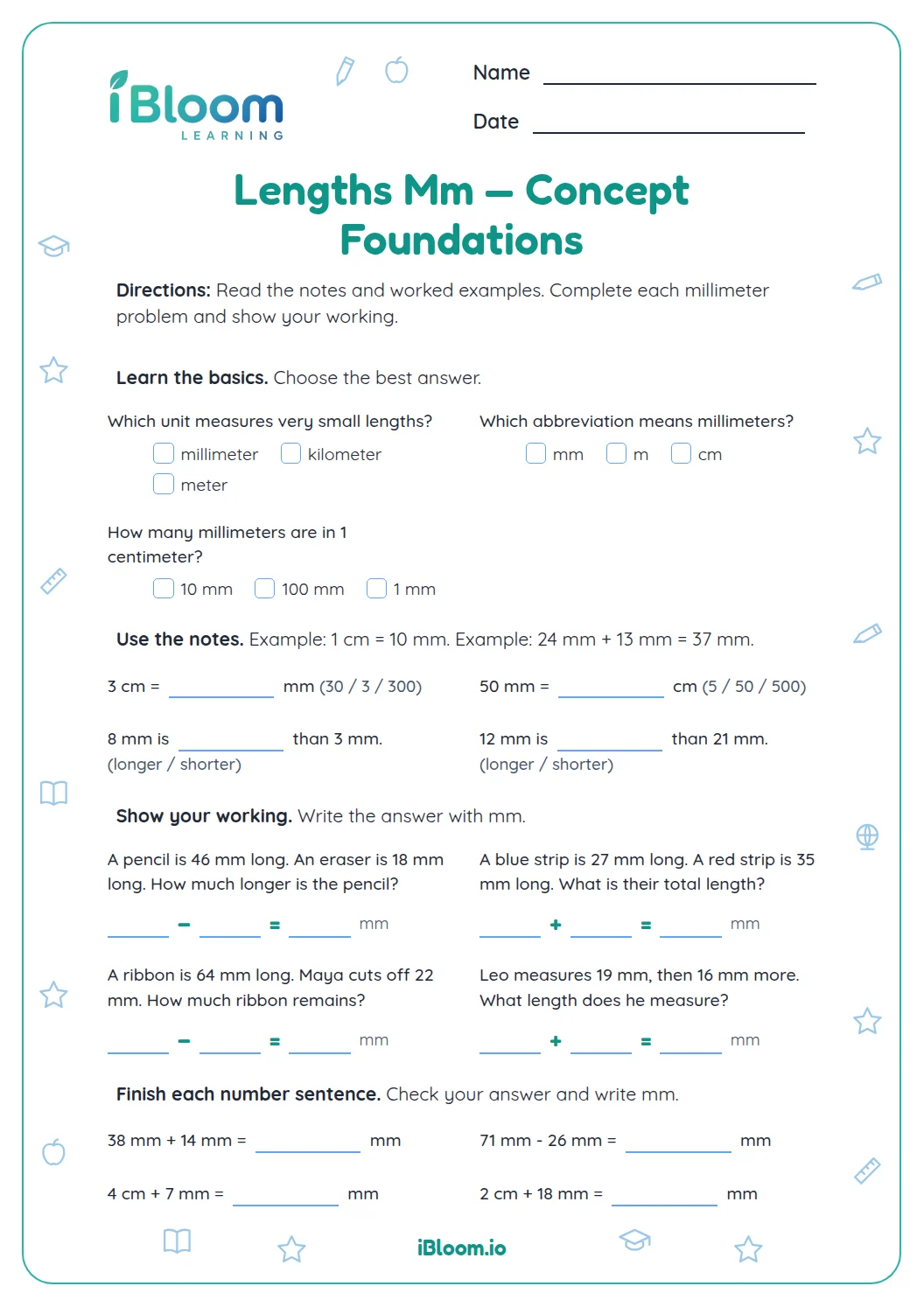
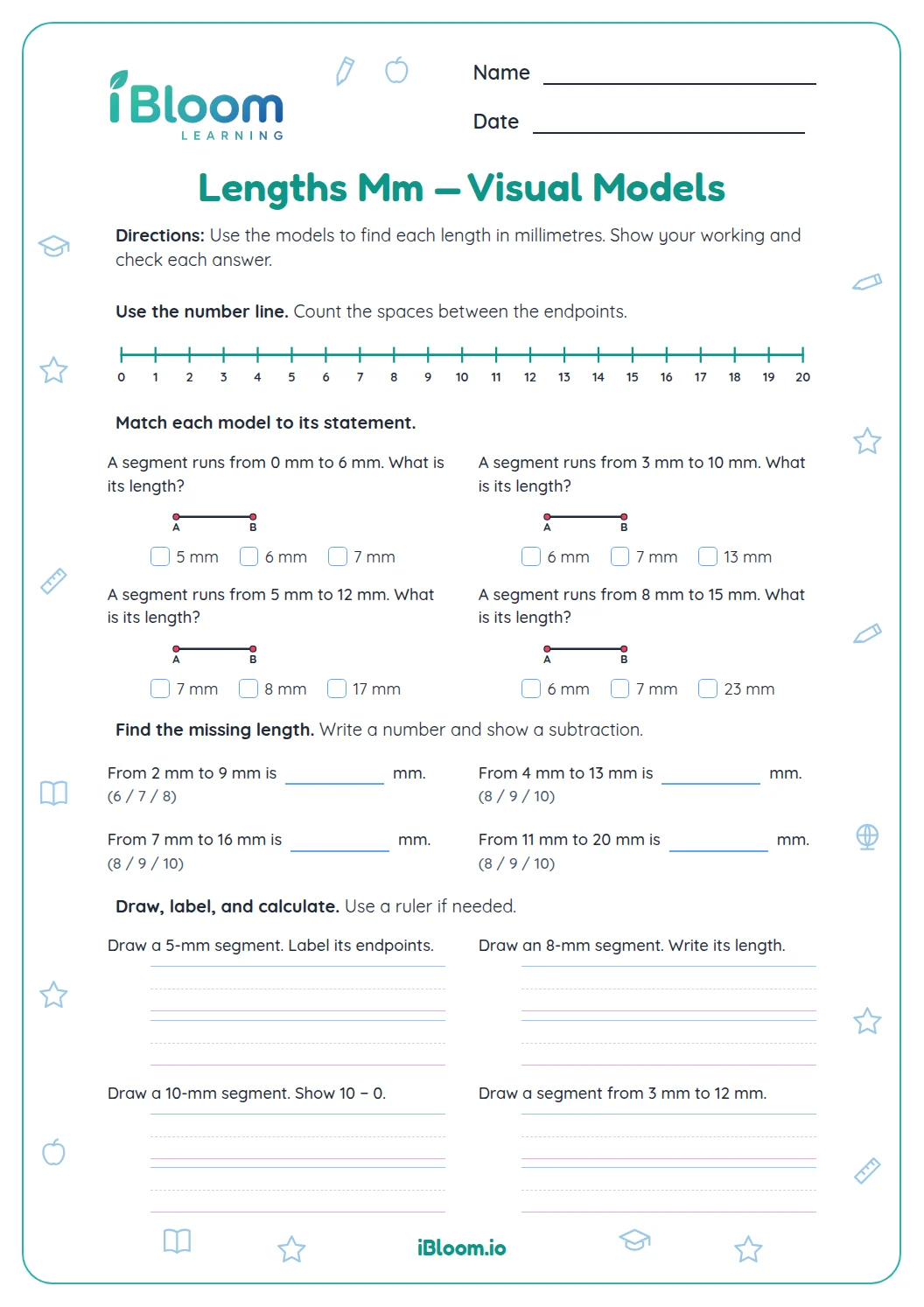
This worksheet gives Grade 3 learners 14 short stories about millimeter lengths. Students compare measures, find differences, and combine or change lengths stated in the same unit. It includes an answer key.
Aligned to 2.MD.B.5
How do you solve a millimeter story?
Read the two lengths and decide whether the story joins them, removes part, or asks for a difference. Since the quantities are already in millimeters, keep the unit unchanged.
- 1A leaf is 32 mm and a beetle is 18 mm.
- 232 − 18 = 14 mm
What kinds of length problems appear?
The 14 questions use familiar objects and plant or animal lengths. They include joining lengths, finding what remains, comparing two lengths, and finding an unknown starting length.
How can a learner check an answer?
For subtraction, add the answer to the amount removed or the shorter length. For addition, subtract one part from the total. Check that the result still has the unit millimeters.
How to use this worksheet
- 1Read what the story asks you to find.
- 2Underline the lengths and their shared unit.
- 3Choose addition or subtraction to match the story.
- 4Write the answer with millimeters.
- 5Check by reversing the operation or estimating.
Common mistakes and quick fixes
The mistake
Subtracting the smaller length from the larger when the story asks what remains.
The fix
Use the starting length minus the part removed.
The mistake
Adding when the question asks how much longer one item is.
The fix
Find the difference between the two lengths.
The mistake
Leaving off the unit.
The fix
Write mm after every final measurement.
Common Core alignment
The questions use addition and subtraction to solve length stories in the same unit.
Solve length word problems with addition and subtraction when lengths use the same unit.
On this sheet:
Show the official wordingHide the official wording
Use addition and subtraction within 100 to solve word problems involving lengths that are given in the same units, e.g., by using drawings (such as drawings of rulers) and equations with a symbol for the unknown number to represent the problem.
What to practice next
Make more practice
Further reading
Questions parents and teachers ask
What is on this millimeter worksheet?
The printable has 14 short length stories about objects, plants, and animals. Each measurement is stated in millimeters, and learners add, subtract, compare, or find an unknown length. A separate answer key follows the student pages for checking. Ask the learner to explain how the quantities in the prompt support the answer.
Do students need to change the units?
No unit changes are needed for these questions because each story gives lengths in millimeters. Learners can focus on choosing an operation that matches the situation, writing the result with millimeters, and checking whether the number makes sense. Ask the learner to explain how the quantities in the prompt support the answer.
How do you find how much longer one object is?
Subtract the shorter length from the longer length. For example, a 32 mm leaf is 14 mm longer than an 18 mm beetle because 32 − 18 = 14. The answer keeps the same unit used in the question. Ask the learner to explain how the quantities in the prompt support the answer.
How can I help a child check subtraction?
Ask the learner to add the answer to the amount taken away or to the shorter length. If that sum returns to the starting length or longer measurement, the subtraction is consistent. Then check that the answer is labeled in millimeters.
How many problems are included?
There are 14 questions, arranged in three parts that move from familiar length stories to reasoning about unknown lengths. The separate answer key lists the responses in matching question order for quick review, after the learner completes the worksheet. Ask the learner to explain how the quantities in the prompt support the answer.