



About this worksheet
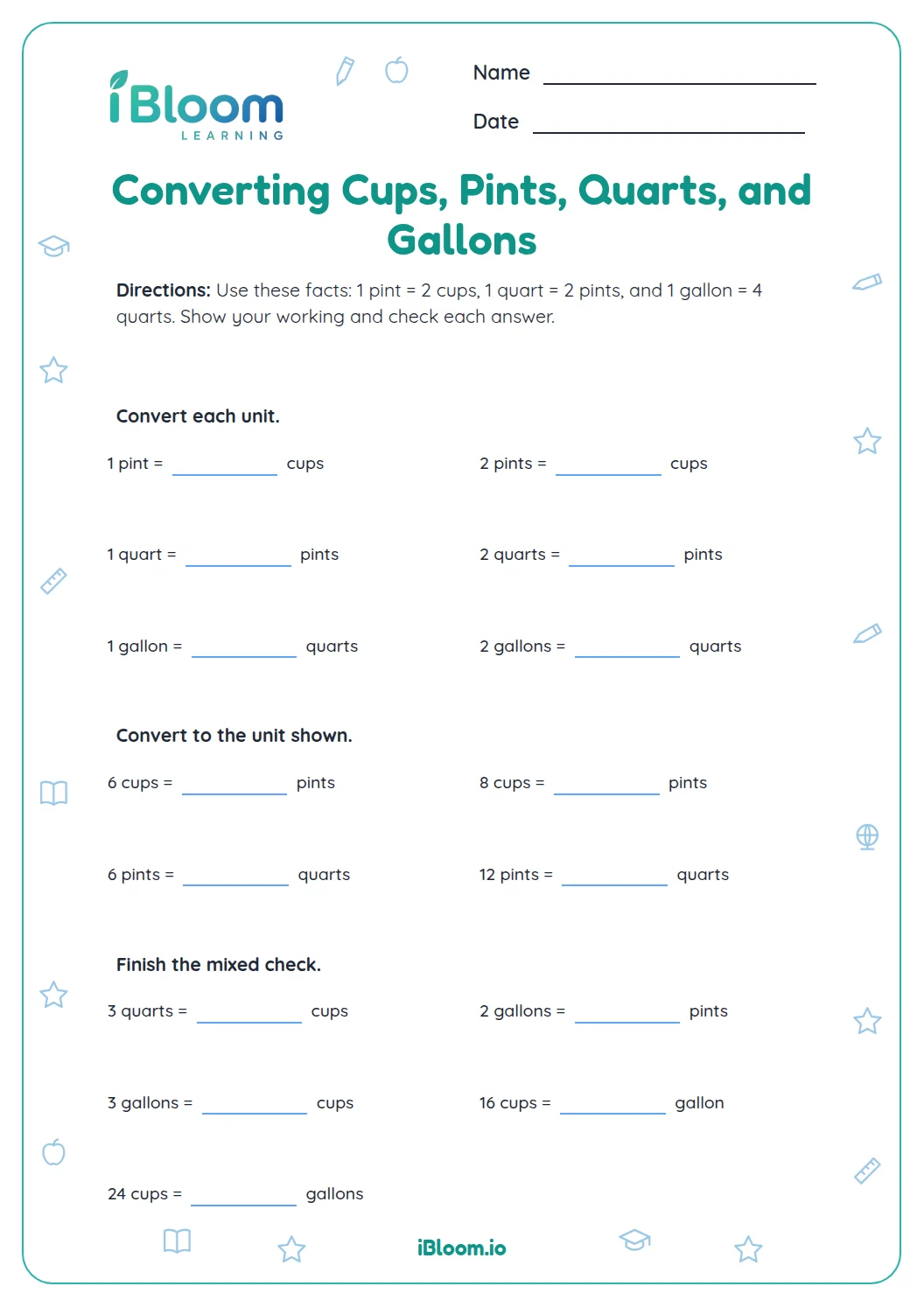
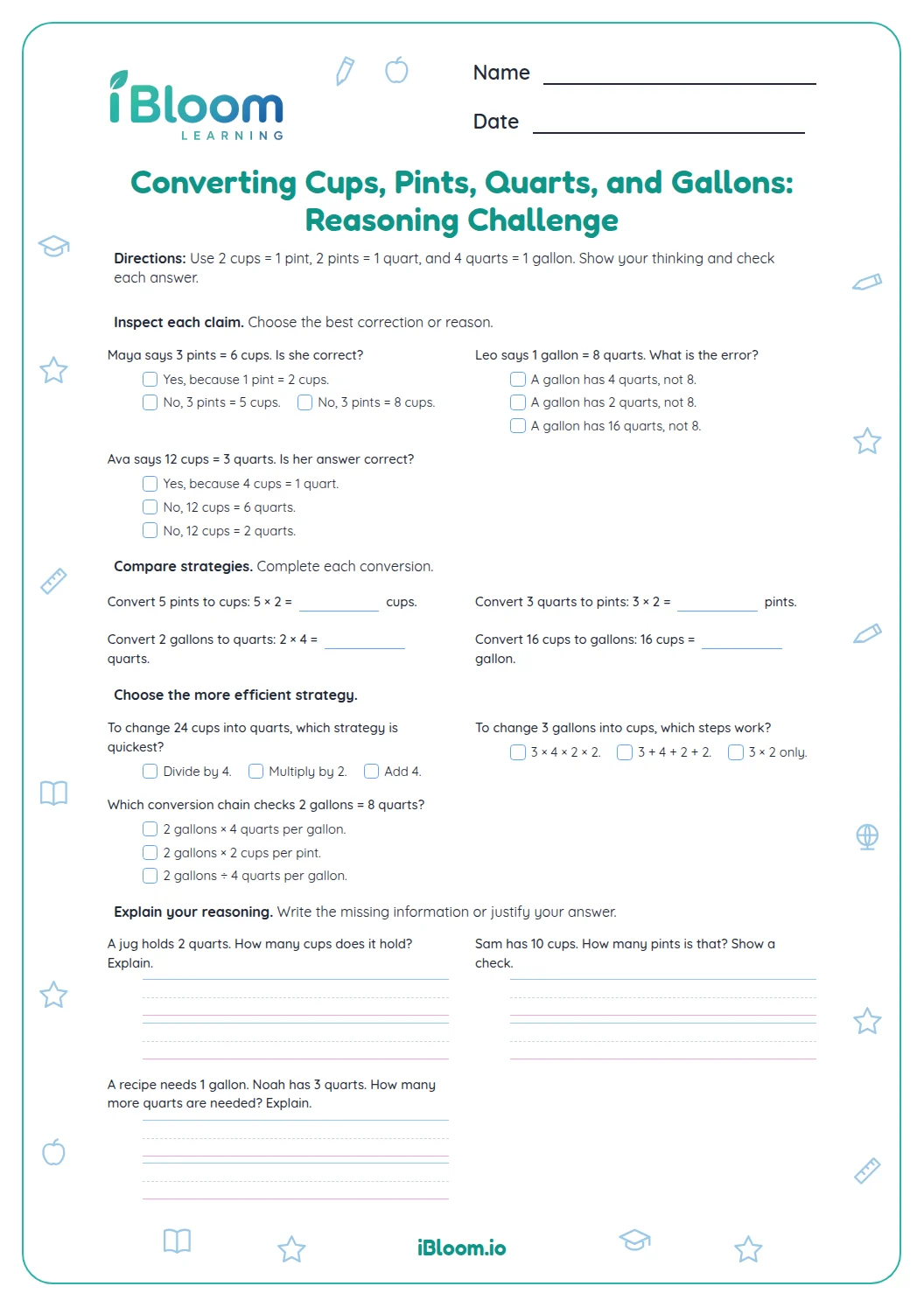
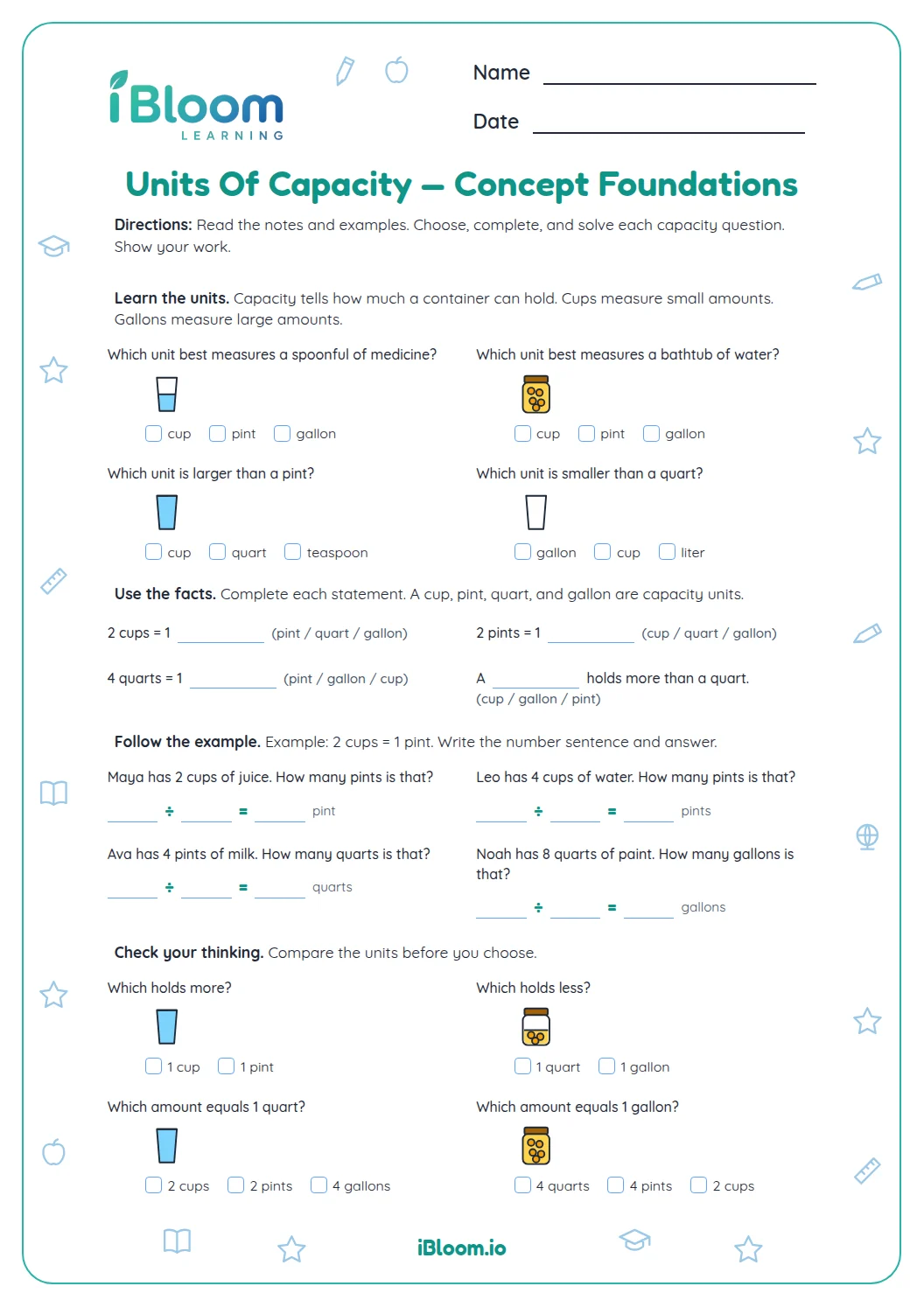
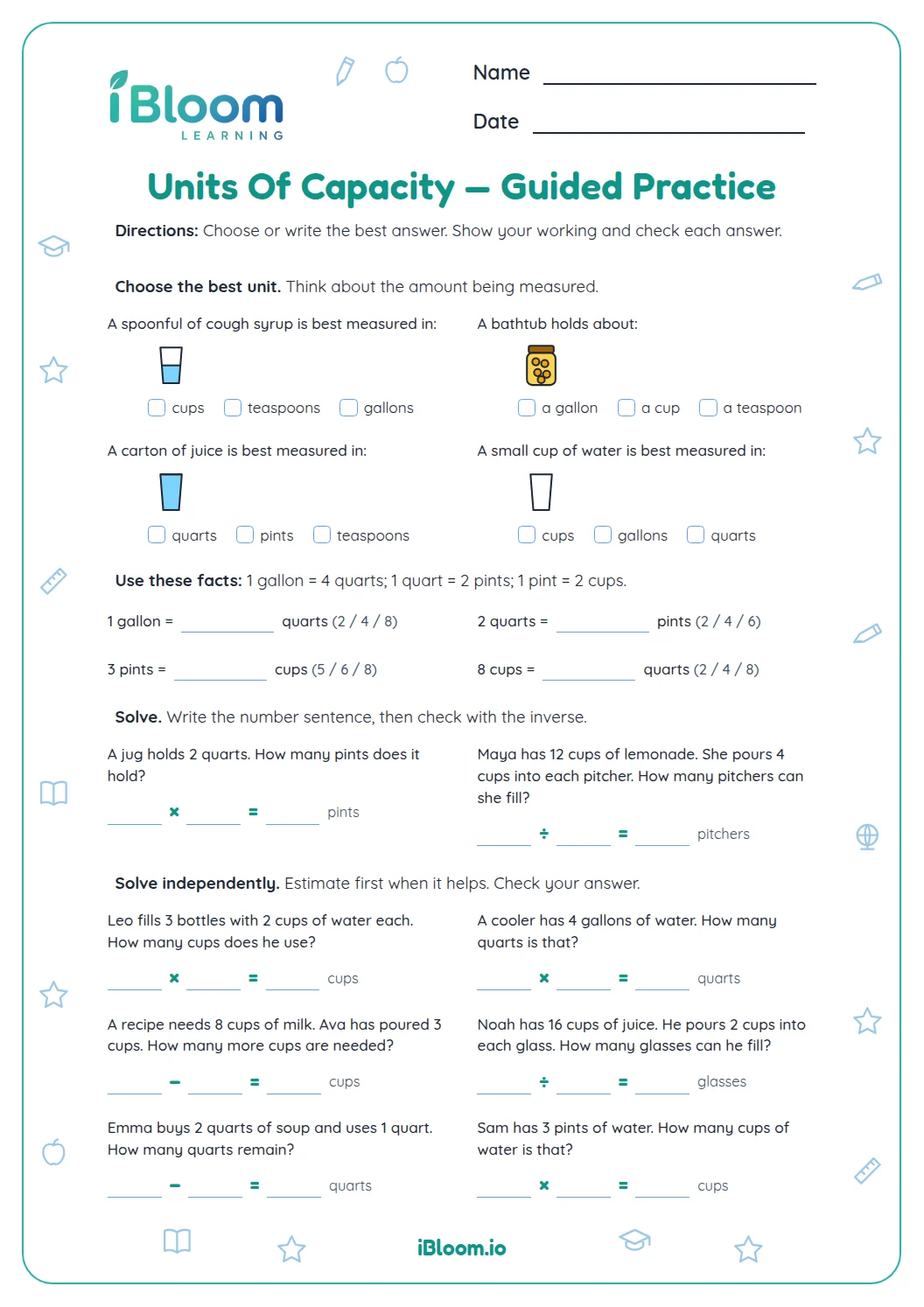
This free printable Grade 3 measurement worksheet uses equal-part bars to make US liquid capacity relationships visible. Each bar has a stated unit for the whole and a smaller unit for each part. Children read four models, complete four conversions, and solve four short word problems with room for working. The amounts stay small and use whole numbers. Common Core 4.MD.A.1 supports expressing a larger measurement unit in smaller units. A separate answer key shows all twelve results, including units for the word problems.
Aligned to 4.MD.A.1
What do the four bars represent?
Part A begins with one pint divided into two cup parts. It then shows one quart divided into four cup parts, one gallon divided into four quart parts, and one gallon divided into eight pint parts. The prompt under each bar tells the child what the whole and each part mean.
The bars are unit models: use the labels to interpret them. A bar’s printed length is not a measurement of liquid. All its parts are filled to represent the complete larger unit.
How do you use one model for a larger amount?
Count the smaller units in one whole, then multiply by the number of wholes. Part B applies this reasoning to three pints, two quarts, two gallons, and three quarts. Children can return to the Part A relationships while working.
For quarts to pints, combine the first two facts: a quart has four cups and a pint has two cups, so each quart has two pints.
- 1Question 7: 2 gallons = ___ quarts
- 2Each gallon contains 4 quarts.
- 32 × 4 = 8, so 2 gallons = 8 quarts.
How do the word problems use the same relationships?
Part C puts the conversions into four situations: a two-pint bottle, a two-quart pitcher, a gallon jug, and three one-quart cartons. Students write a calculation in the working space and put the converted amount in the answer box.
Keep the unit attached to the result. “12 cups” tells how much three quarts holds; “12” alone leaves the reader guessing which size of unit was counted.
How to use the worksheet
- 1Read the whole-unit and part-unit labels under the first bar aloud.
- 2Count the equal parts in each Part A bar and fill the four blanks.
- 3Use the models to complete Part B; derive two pints per quart from the cup relationships.
- 4Underline the requested unit in each word problem and write a calculation.
- 5Check every result with the key, then say the complete conversion aloud.
Mistakes to check together
The mistake
Writing 3 pints = 3 cups because both amounts use the number 3.
The fix
Each pint contains two cups. Count 2 + 2 + 2 to get six cups.
The mistake
Using two quarts per gallon.
The fix
Return to the gallon model with quart parts. Its four equal parts represent four quarts.
The mistake
Answering the three-quart-carton problem with 6 cups.
The fix
Six is the number of pints. Multiply three quarts by four cups per quart to get twelve cups.
Common Core alignment
Use equal-part models to express larger US capacity units in smaller units.
On this sheet: All three parts use relative unit sizes to convert liquid capacities.
Show the official wordingHide the official wording
Know relative sizes of measurement units within one system of units including km, m, cm; kg, g; lb, oz.; l, ml; hr, min, sec. Within a single system of measurement, express measurements in a larger unit in terms of a smaller unit. Record measurement equivalents in a two-column table. For example, know that 1 ft is 12 times as long as 1 in. Express the length of a 4 ft snake as 48 in. Generate a conversion table for feet and inches listing the number pairs (1, 12), (2, 24), (3, 36), …
What to practice next
Make more practice
Further reading
Questions parents and teachers ask
Which capacity facts are on the sheet?
The four models show 1 pint as 2 cups, 1 quart as 4 cups, 1 gallon as 4 quarts, and 1 gallon as 8 pints. Children also use the relationship of 2 pints per quart when completing the conversion questions. All measurements refer to US liquid capacity.
Are the bars drawn to the size of real containers?
No, the bars represent equal groups of units. The words under each drawing define the whole and its parts, such as one gallon with one quart per part. Children should count the parts using those labels; they do not need to measure the printed bar with a ruler.
How can my child solve quarts to pints?
Use the cup relationships from the first two models. One quart contains four cups, and each pint contains two cups, so four cups make two pints. For three quarts, repeat that group three times: 2 + 2 + 2 = 6 pints. The amount of liquid stays the same.
Do children need measuring cups to finish this?
No, every relationship needed can be read or worked out from the four models. Measuring cups and containers can be useful for an optional demonstration afterward. During the worksheet, have your child explain the unit labels and count equal groups before writing a multiplication fact and a final answer.
What does the answer key include?
The answer key gives all twelve answers. It fills the model and conversion blanks with numbers and includes units for the four word problems. Children may use repeated addition or multiplication in the working space. Check that their calculation uses the right unit relationship as well as the correct total.