



About this worksheet
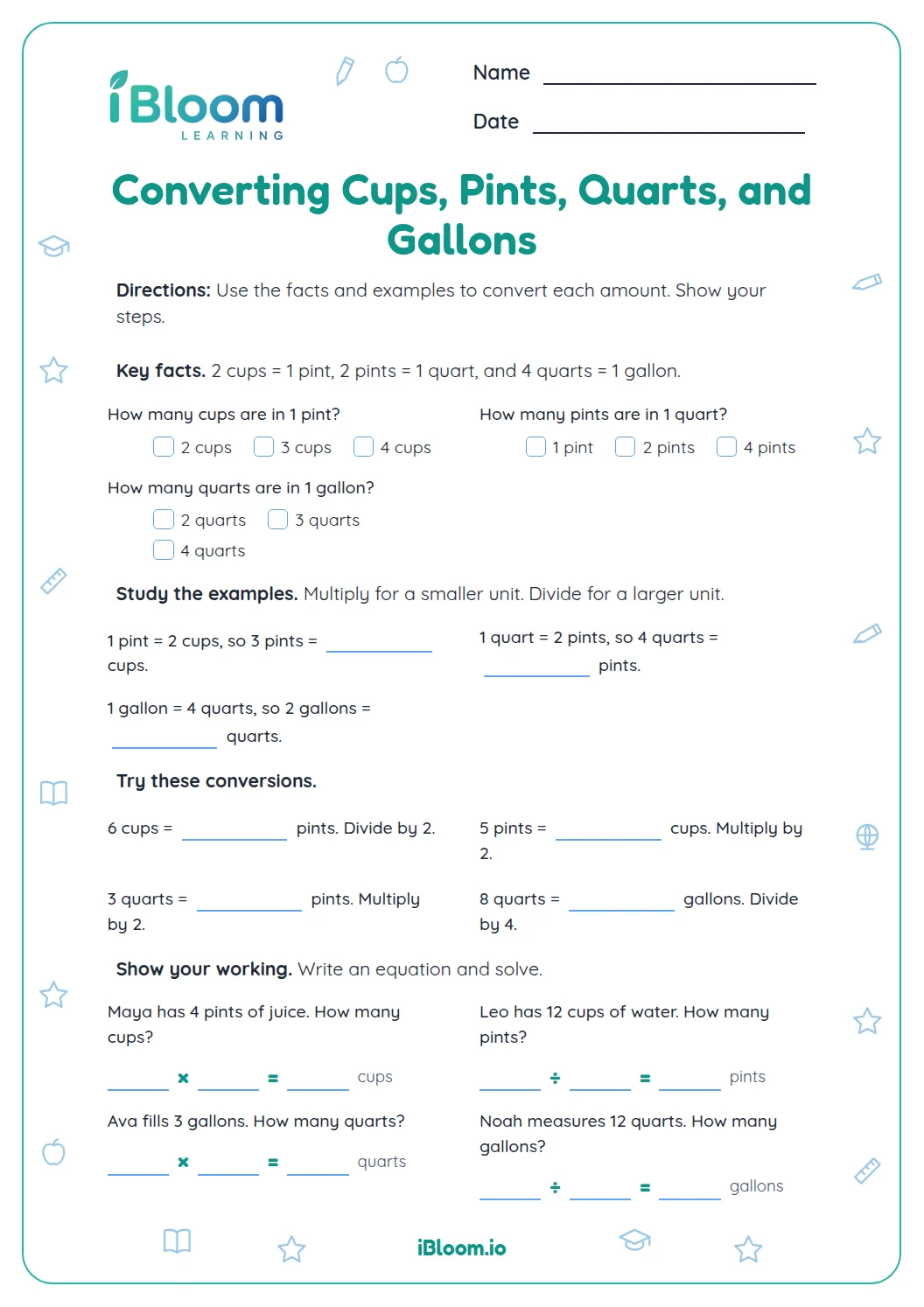
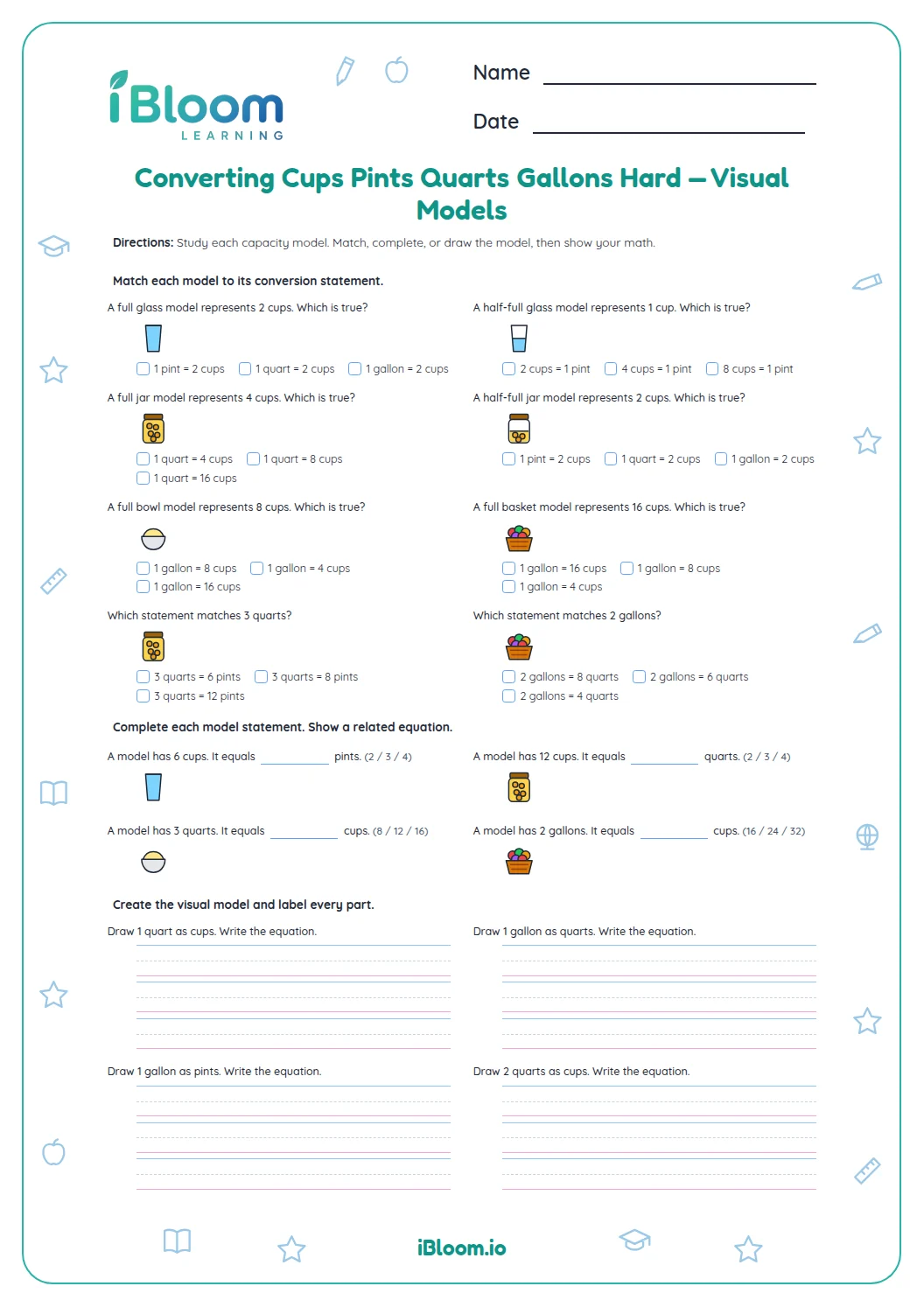
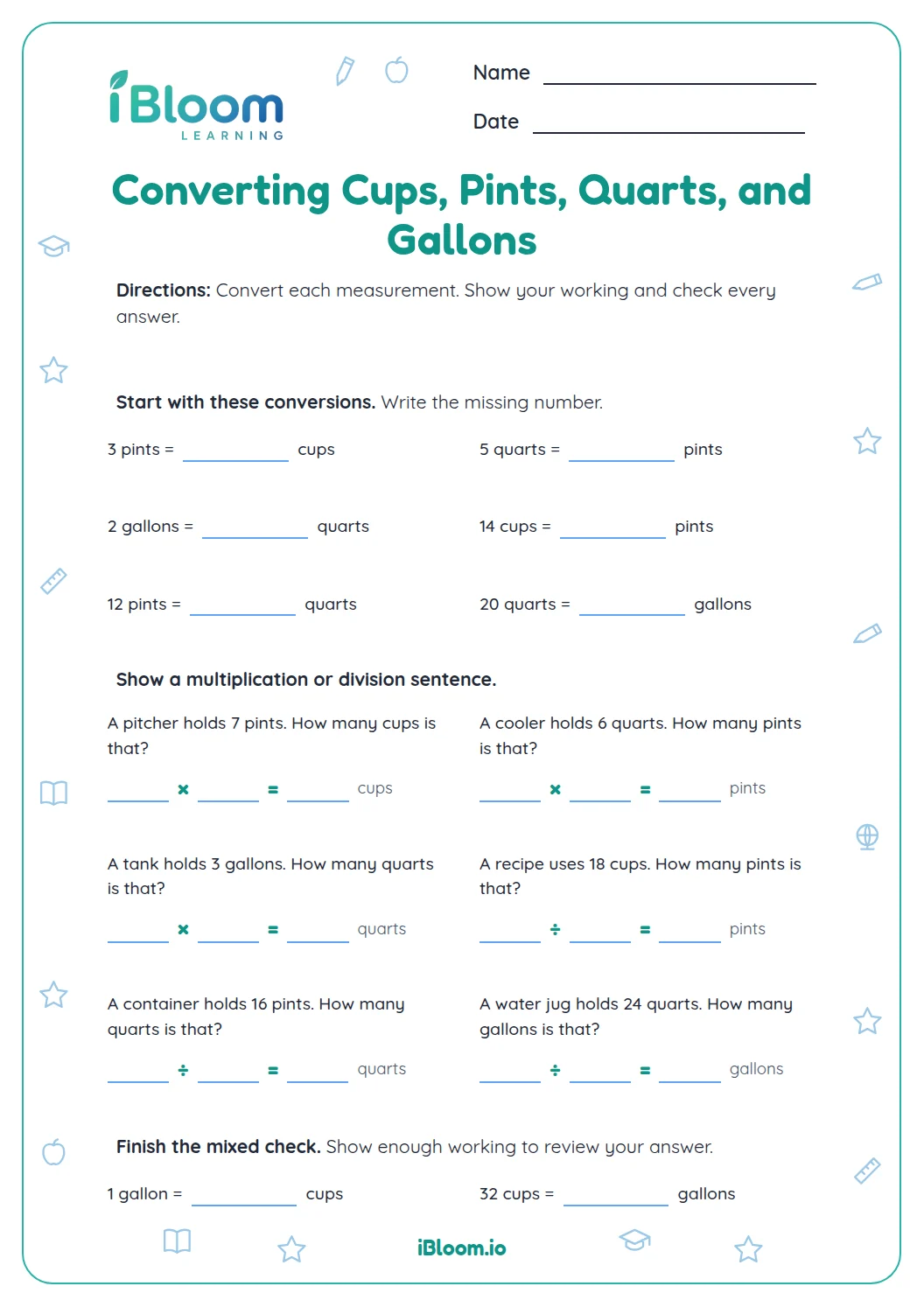
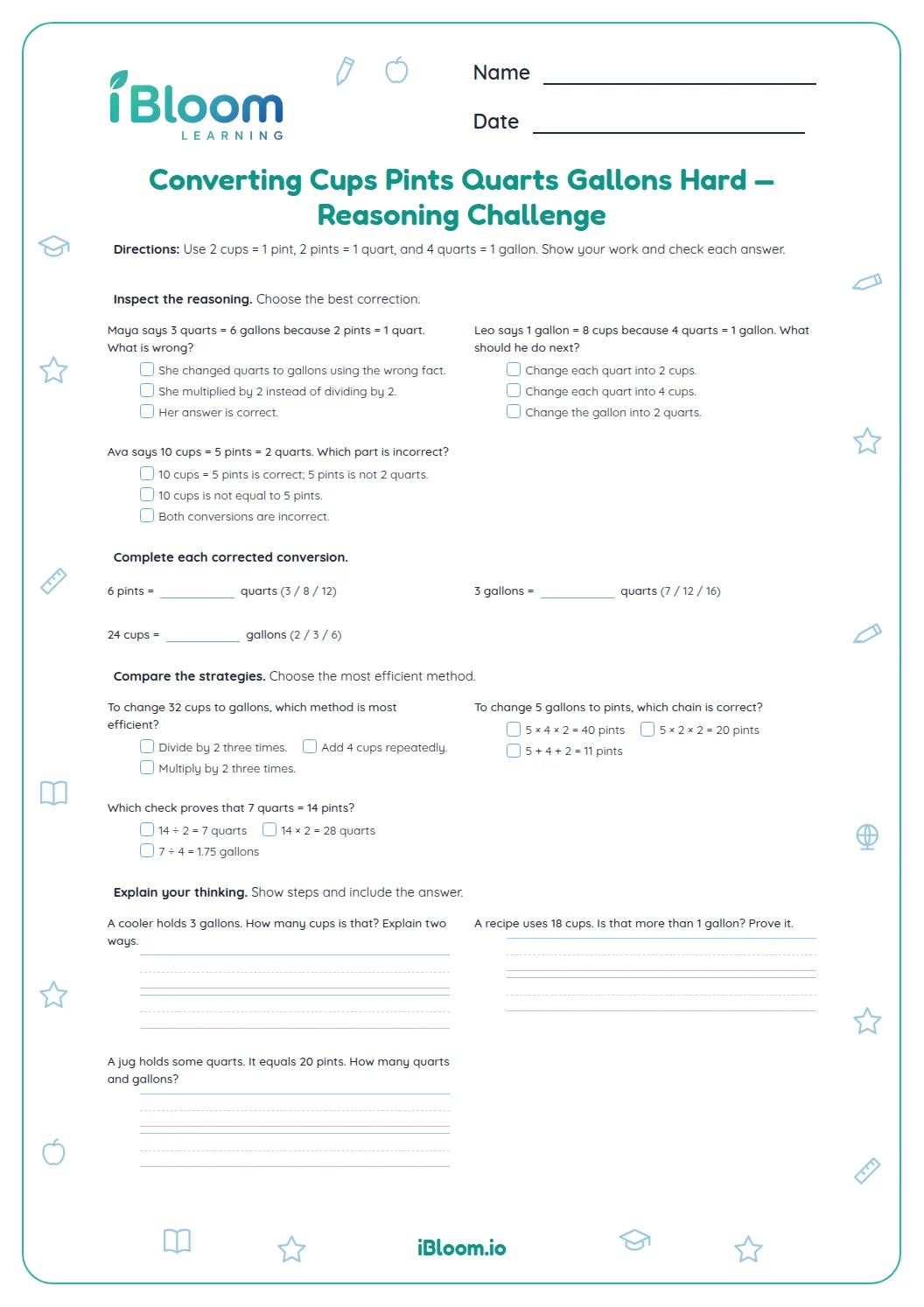
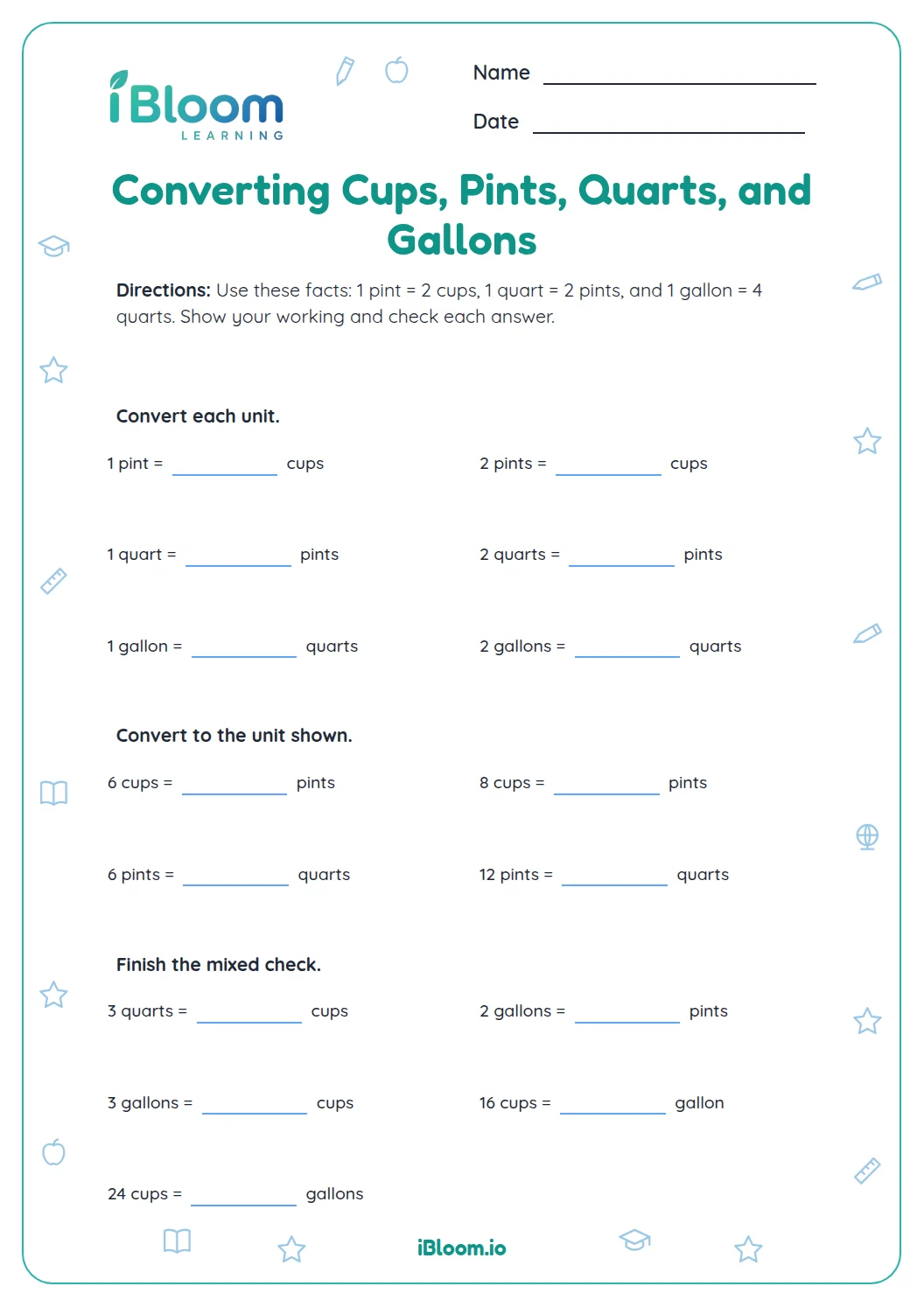
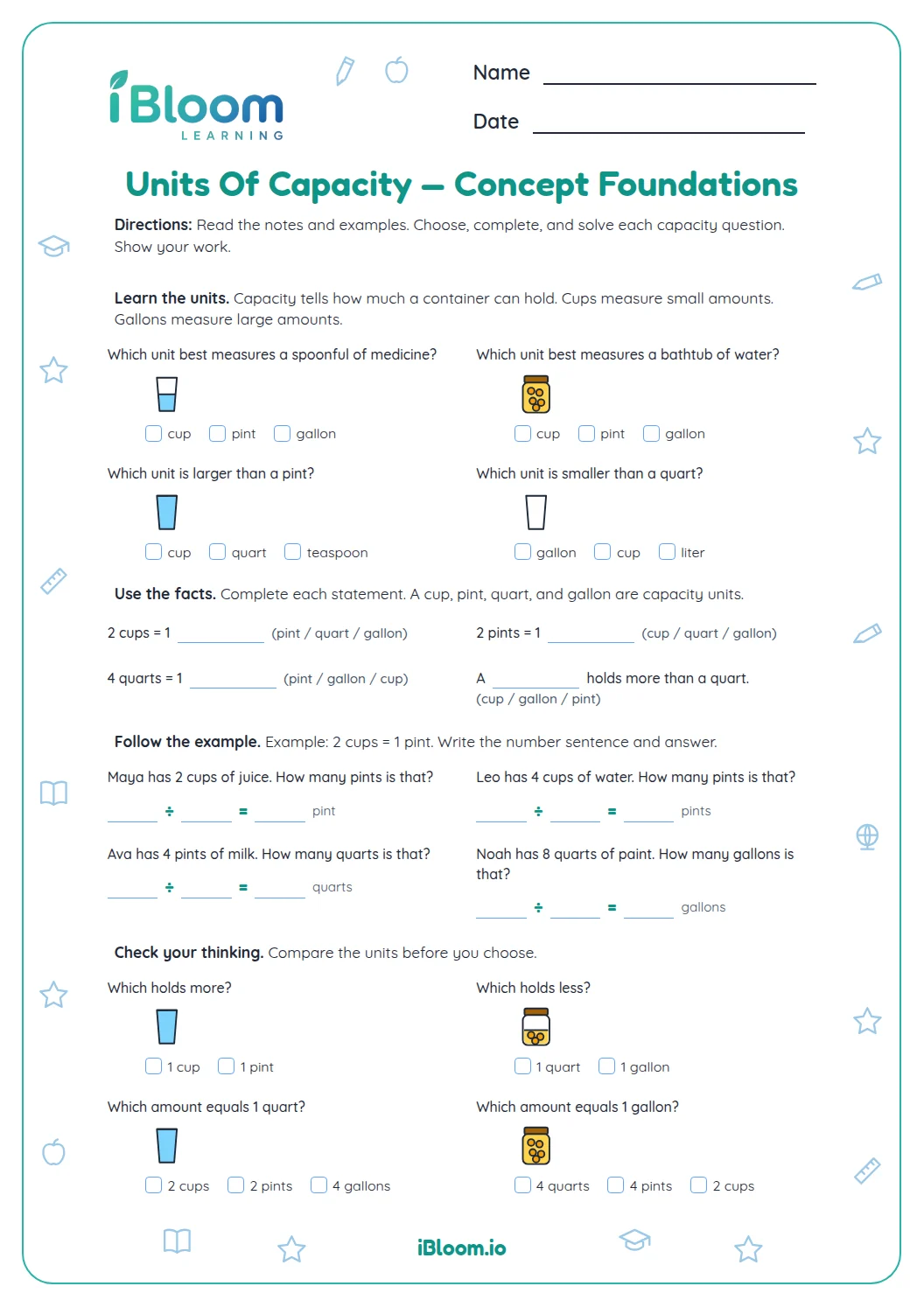
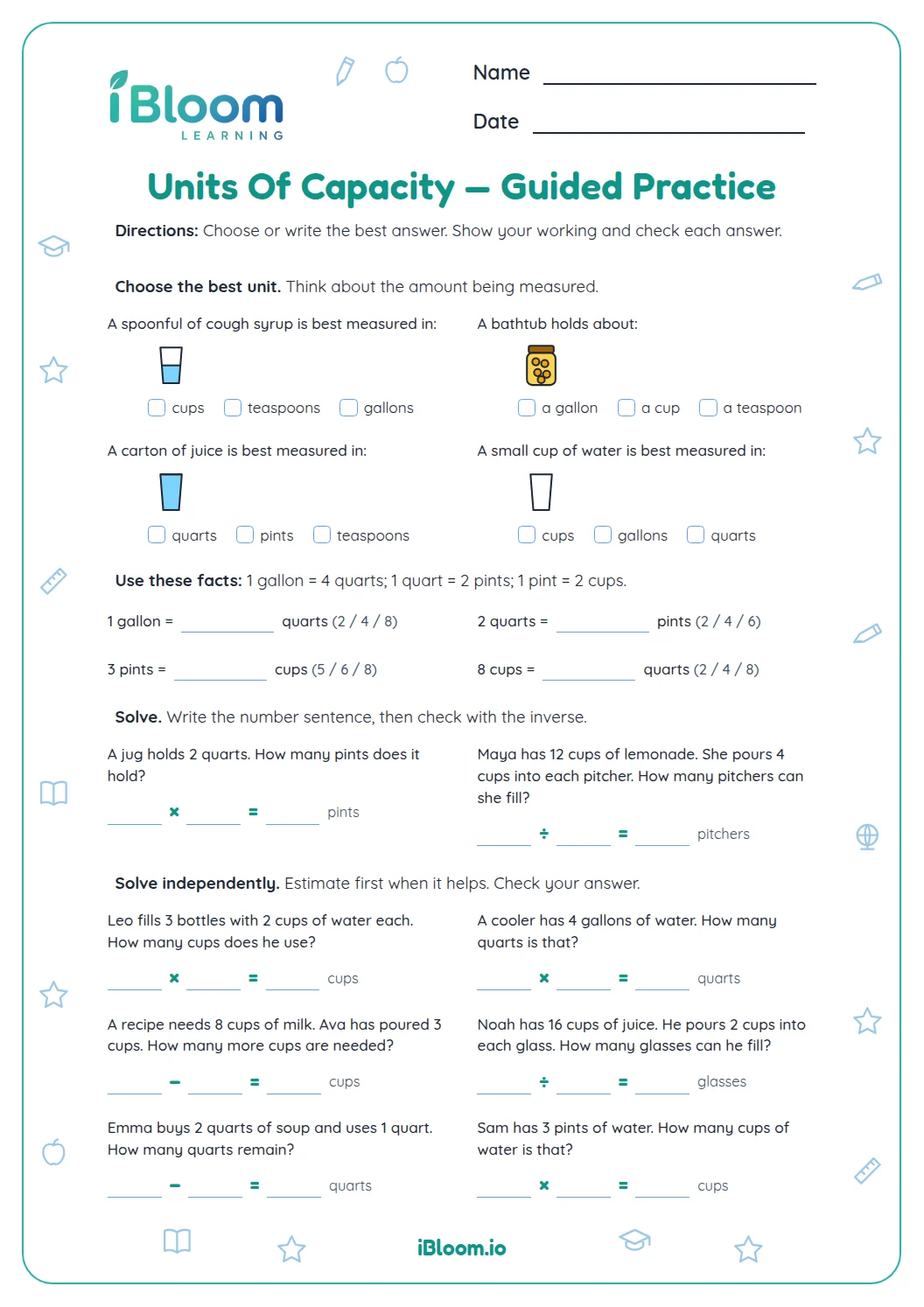
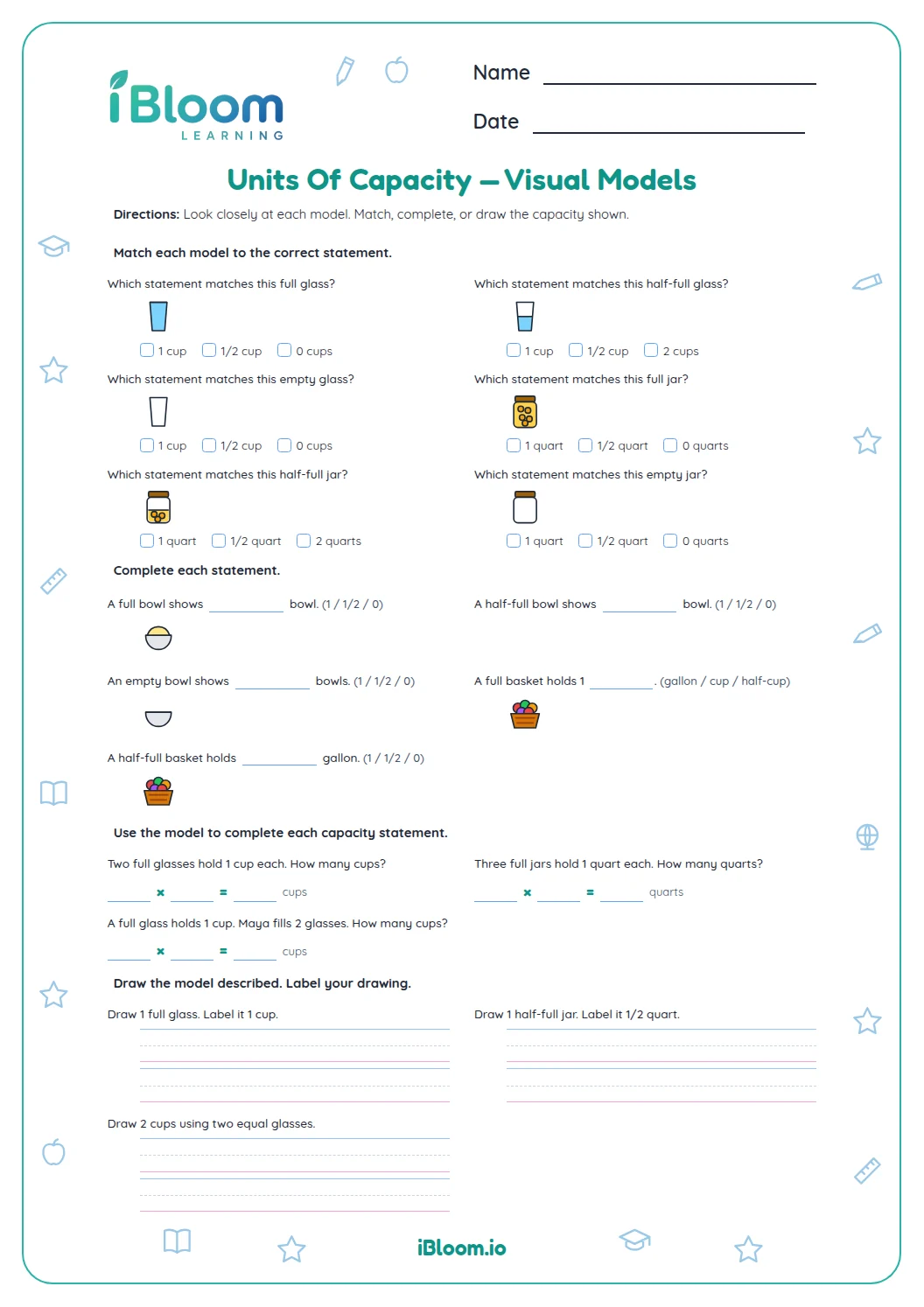
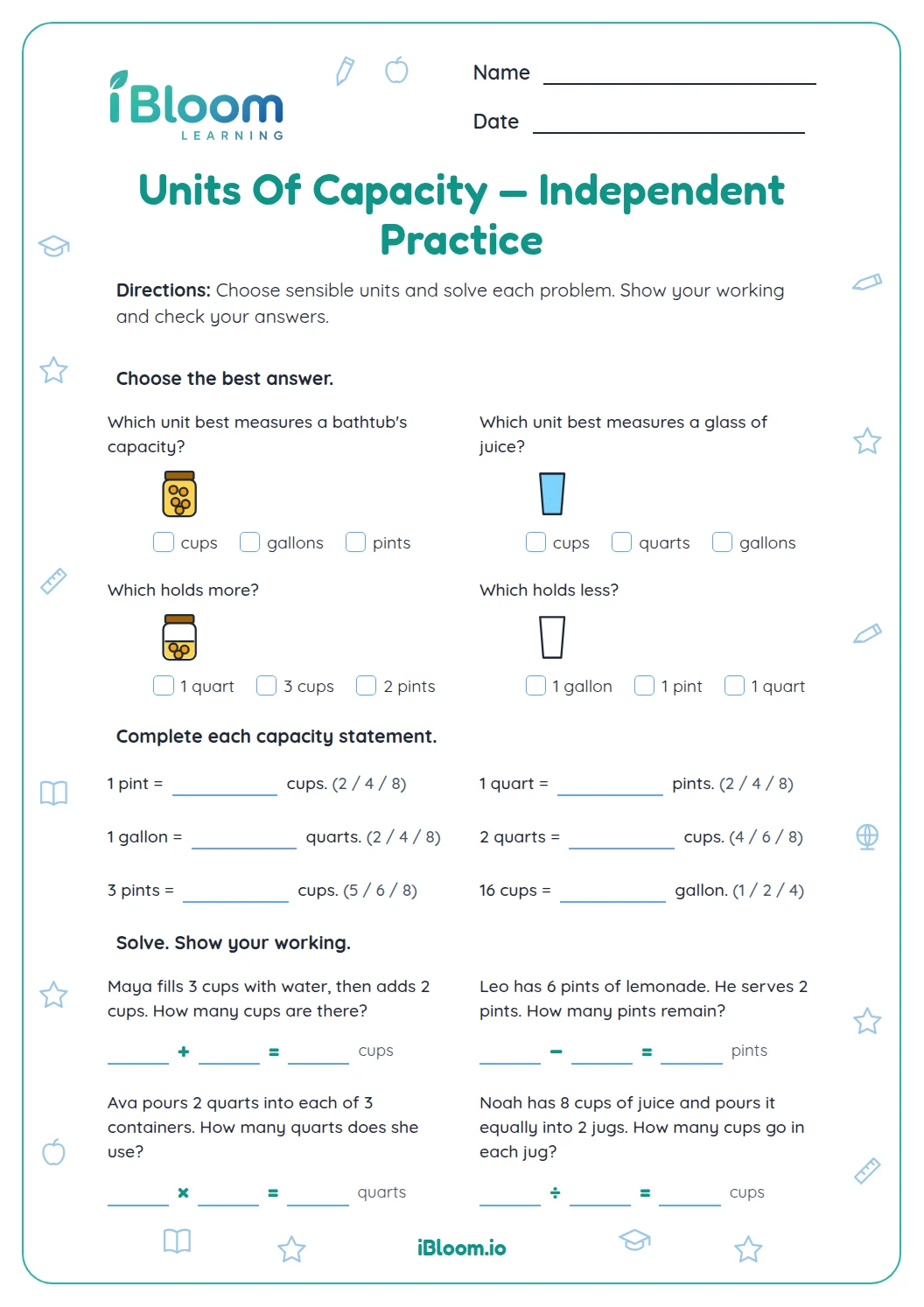
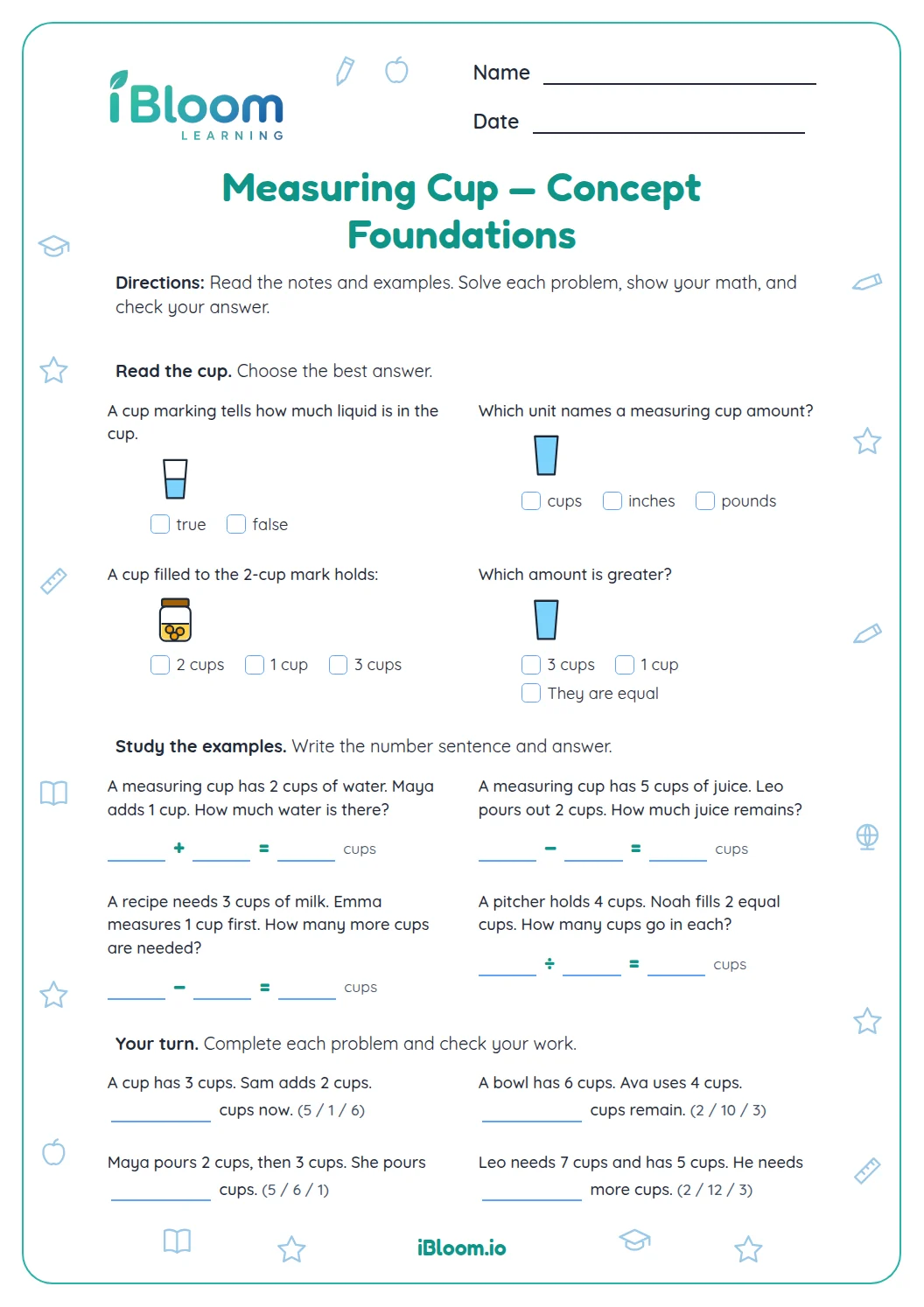
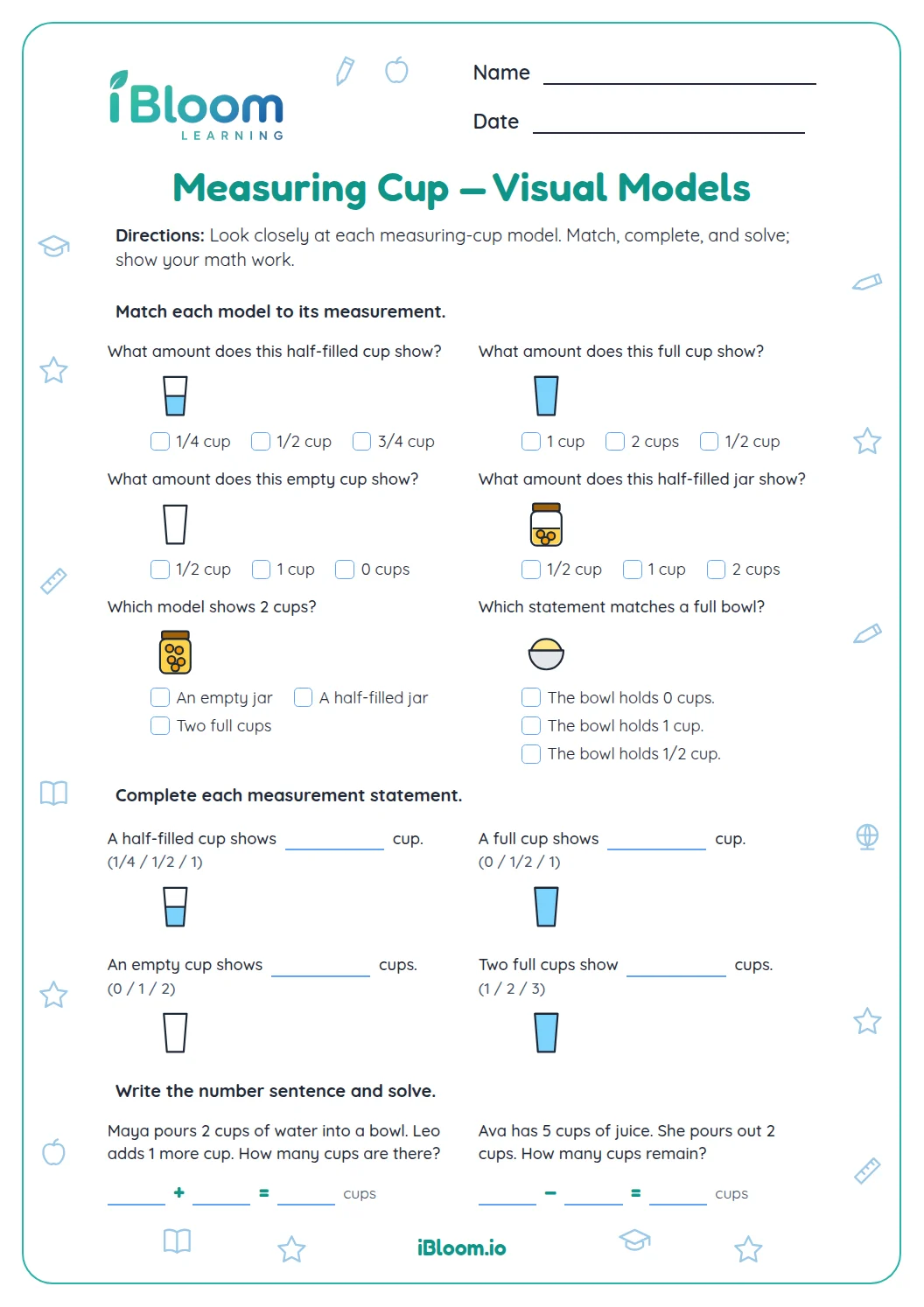
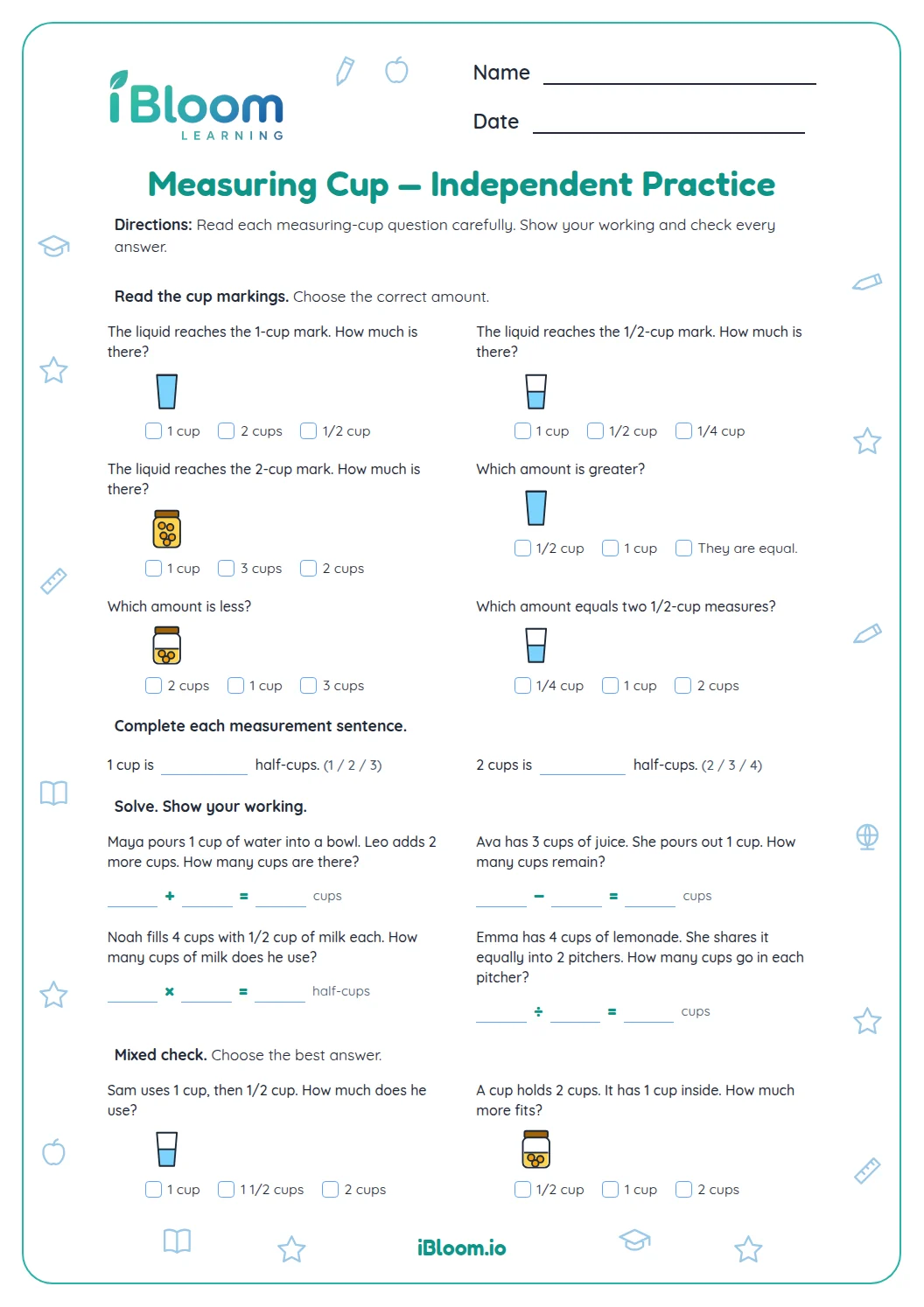
This free Grade 3 measurement worksheet practices customary capacity conversions among cups, pints, quarts, and gallons. Students begin with direct conversions, apply the relationships in short situations, and finish by comparing equivalent amounts. The 16 questions include fill-in-the-blank, word problems, and multiple choice. A separate answer key is included. The work connects to CCSS 4.MD.A.1 by expressing measurements in a larger unit in smaller units and recording equivalent amounts.
Aligned to 4.MD.A.1
How are cups, pints, quarts, and gallons related?
In customary capacity, 2 cups equal 1 pint, 2 pints equal 1 quart, and 4 quarts equal 1 gallon. Each step to a larger unit combines a set number of smaller units. Keep the unit labels attached while converting.
How can you convert a larger unit to smaller units?
Break the larger amount into groups. Since 1 gallon equals 4 quarts and each quart equals 4 cups, 1 gallon equals 16 cups. For a smaller amount, use the reverse relationship and divide by the number of smaller units in each larger unit.
- 112 cups = ___ quarts
- 2There are 4 cups in 1 quart.
- 312 ÷ 4 = 3.
- 4Answer: 3 quarts.
What kinds of conversions are on this worksheet?
Part A asks for direct conversions. Part B uses the relationships in three cooler, recipe, and pitcher situations. Part C asks students to compare amounts and choose true equivalents.
- Part A: 6 conversion blanks
- Part B: 3 short word problems
- Part C: 5 comparisons and conversion choices
How can children check a conversion?
Convert back to the starting unit. If 3 quarts become 12 cups, divide 12 cups into groups of 4 to return to 3 quarts. A conversion is easier to check when the unit names are written at every step.
How to use this worksheet
- 1Recall the equal-unit relationships: 2 cups per pint, 2 pints per quart, and 4 quarts per gallon.
- 2Write the given amount and unit before converting.
- 3Multiply when changing to a smaller unit.
- 4Divide when changing to a larger unit.
- 5Check one answer by converting back to the starting unit.
Common conversion mistakes and fixes
The mistake
Using 2 instead of 4 when converting quarts to cups.
The fix
Use 4 cups for each quart, then multiply by the number of quarts.
The mistake
Treating 1 gallon as 4 cups because 4 quarts make a gallon.
The fix
Convert each quart to 4 cups: 4 × 4 = 16 cups per gallon.
The mistake
Keeping the number but changing the unit label.
The fix
Write the relationship beside the calculation so the count of smaller units is clear.
Common Core alignment
The conversions record equivalent measurements within one customary system.
Express gallons, quarts, pints, and cups as equivalent smaller-unit amounts.
On this sheet: Students express customary capacity units in smaller units and identify equivalent amounts.
Show the official wordingHide the official wording
Know relative sizes of measurement units within one system of units including km, m, cm; kg, g; lb, oz.; l, ml; hr, min, sec. Within a single system of measurement, express measurements in a larger unit in terms of a smaller unit. Record measurement equivalents in a two-column table. For example, know that 1 ft is 12 times as long as 1 in. Express the length of a 4 ft snake as 48 in. Generate a conversion table for feet and inches listing the number pairs (1, 12), (2, 24), (3, 36), …
What to practice next
Make more practice
Further reading
Questions parents and teachers ask
How many cups are in a pint, quart, and gallon?
There are 2 cups in a pint, 4 cups in a quart, and 16 cups in a gallon. The worksheet also uses the links between pints and quarts and between quarts and gallons to solve larger conversions. These connected facts let students convert through more than one unit.
How many questions are on the worksheet?
There are 14 questions in three parts: six direct conversion blanks, three word problems, and five multiple-choice comparisons or conversions. The answer key is separate and lists the correct amount with its unit. Students can mark the unit relationship used beside each calculation.
When should a student multiply?
Multiply when changing a larger unit into smaller units, such as converting 3 quarts to cups. Since each quart has 4 cups, calculate 3 × 4 to get 12 cups. Keep the unit label beside the calculation as you multiply.
When should a student divide?
Divide when regrouping smaller units into larger units. For instance, 12 cups make 3 quarts because 4 cups fit in each quart. Students can use the answer key to check the final unit as well as the number. Writing the unit in the answer helps verify the direction of the conversion.
Does the key accept answers without a unit?
For the word problems, the model answers include units such as “8 quarts.” Keeping a unit with the number helps show what was counted. For direct blanks, the unit is already printed in the prompt, so only the missing number is needed. Keeping a unit with the number makes the amount easier to interpret.