



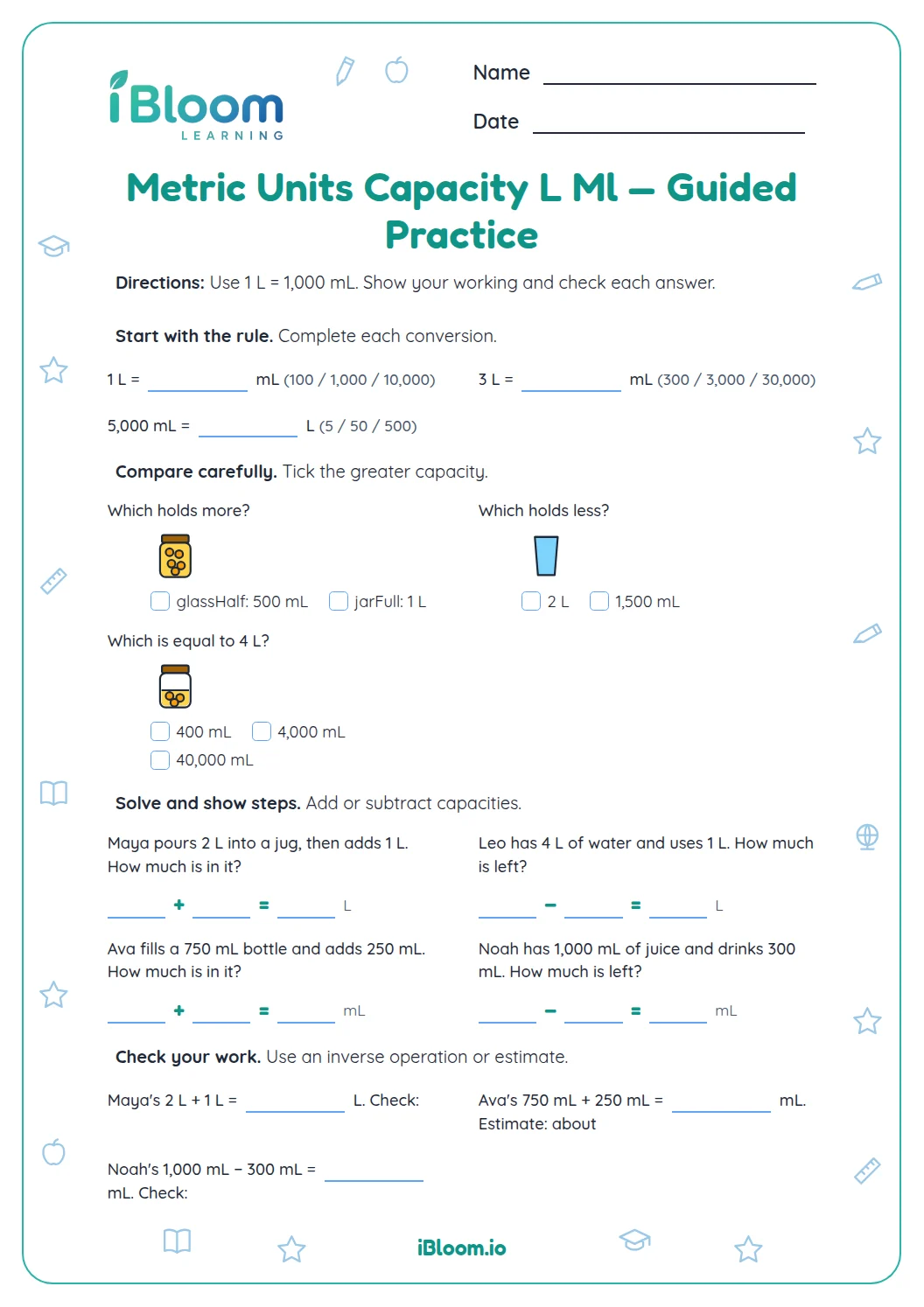
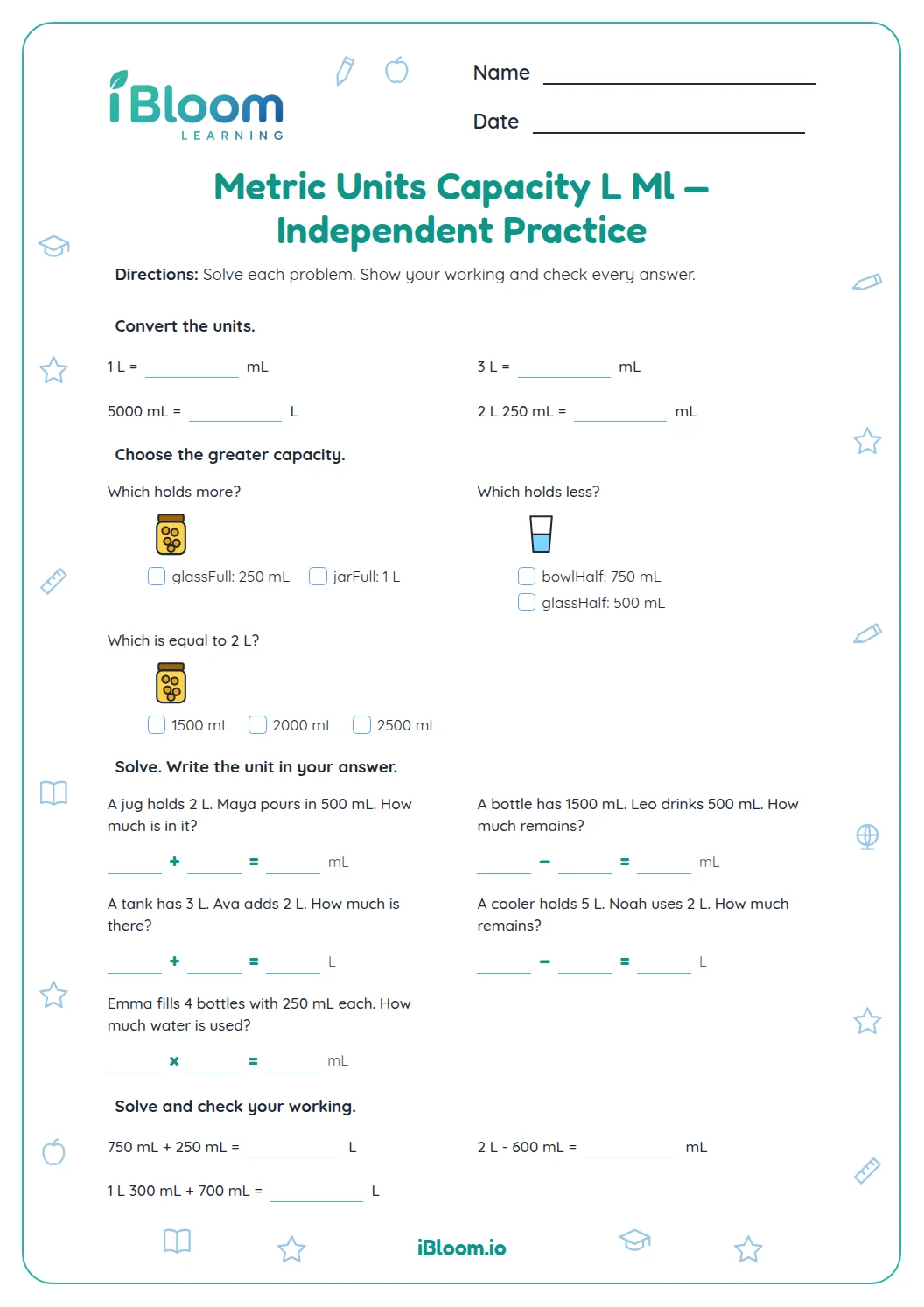
About this worksheet
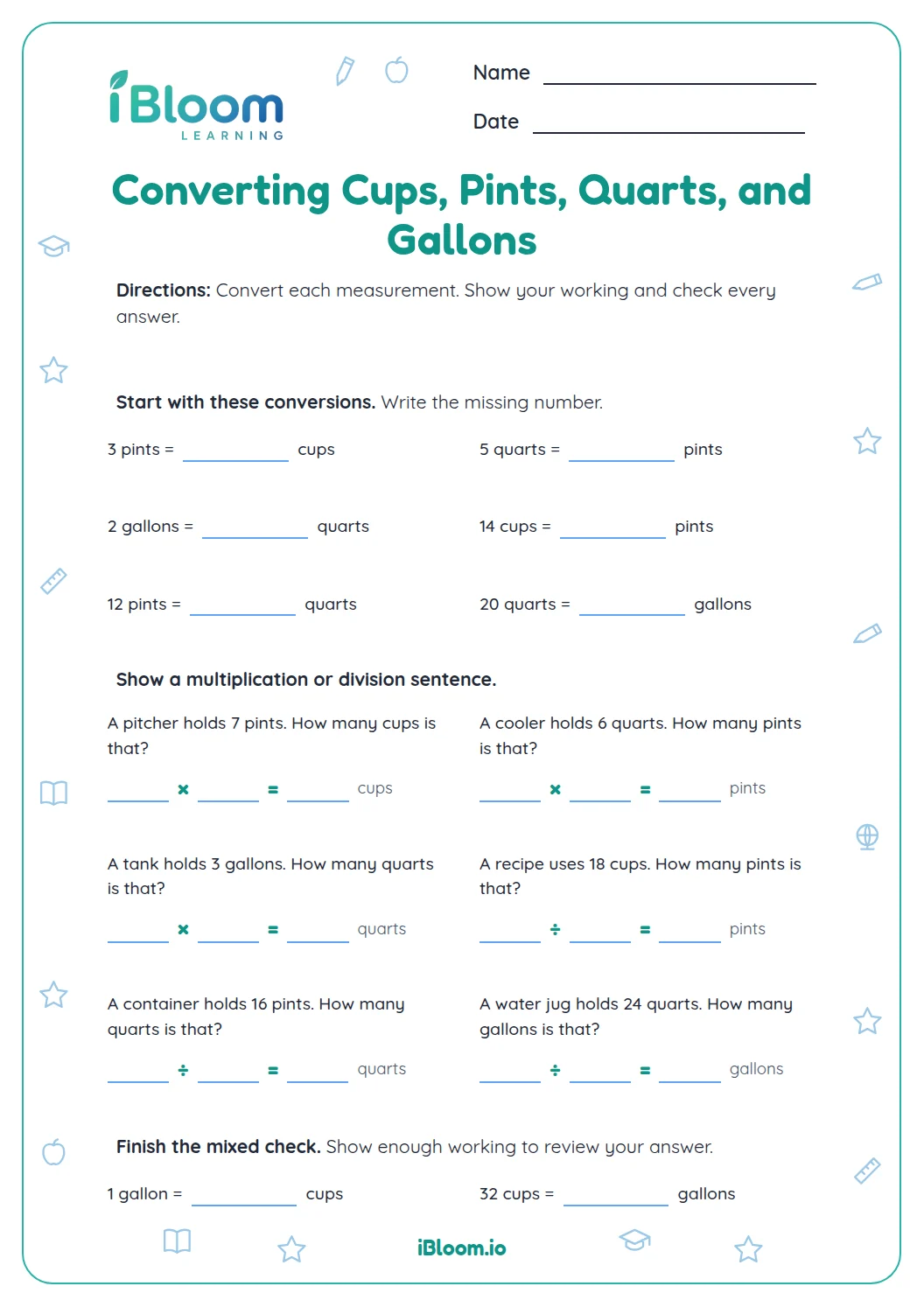
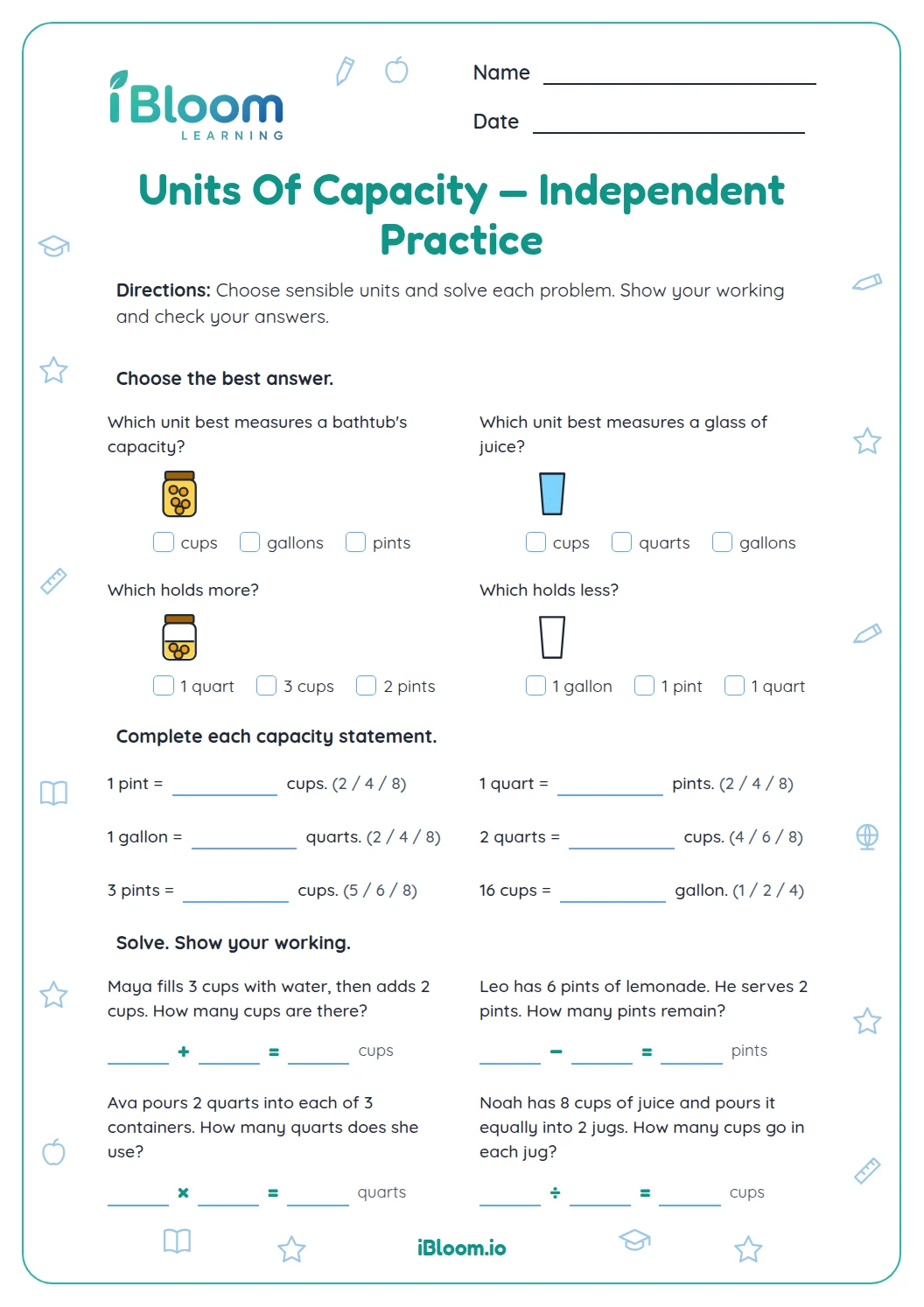
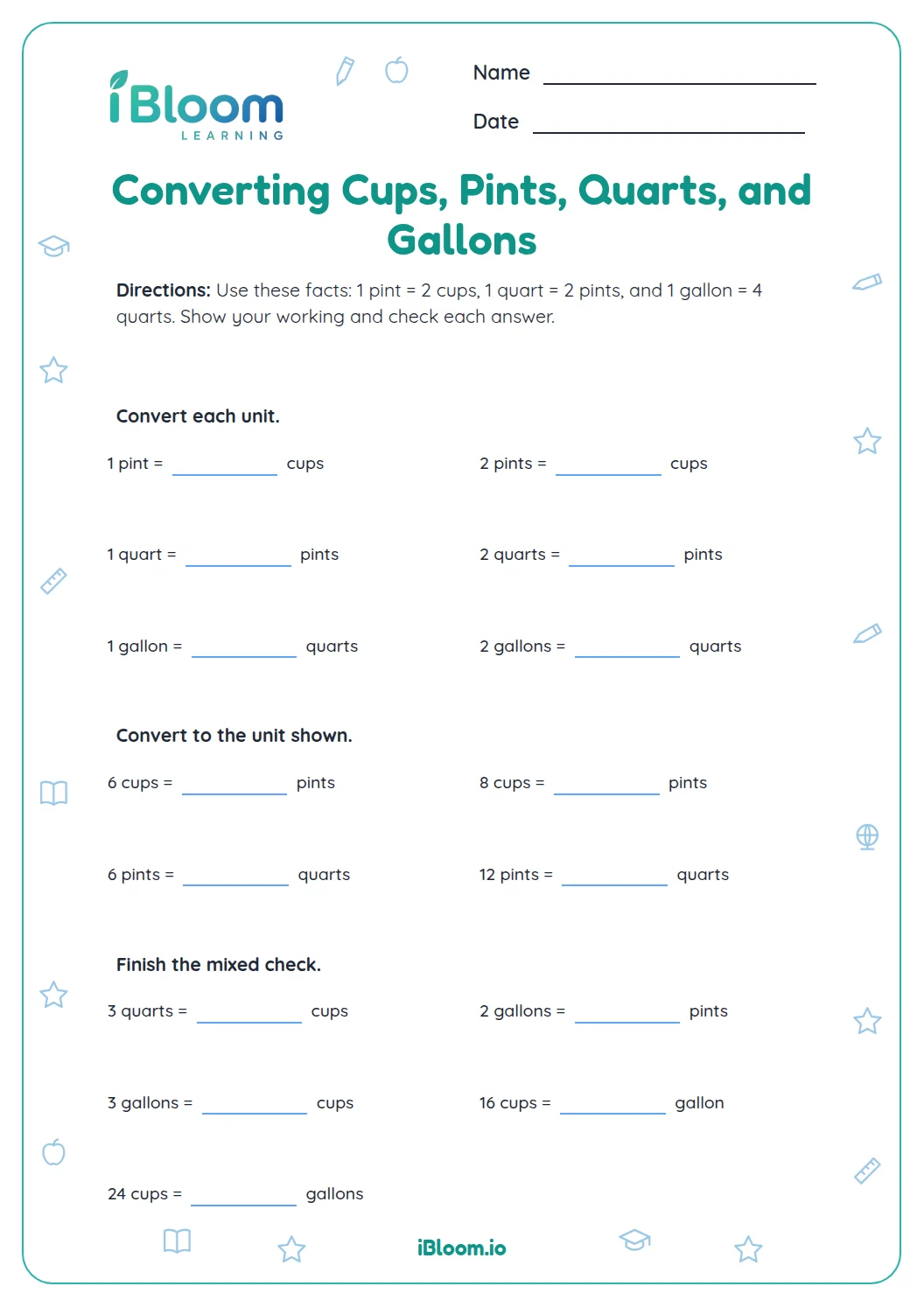
This free printable capacity worksheet practices US customary conversions among cups, pints, quarts, and gallons. It has 16 real-world problems: 10 direct conversions followed by six multistep situations, plus a separate answer key. The work applies CCSS 4.MD.A.2 through unit conversions and operations with liquid volumes.
Aligned to 4.MD.A.2
Which capacity facts are used?
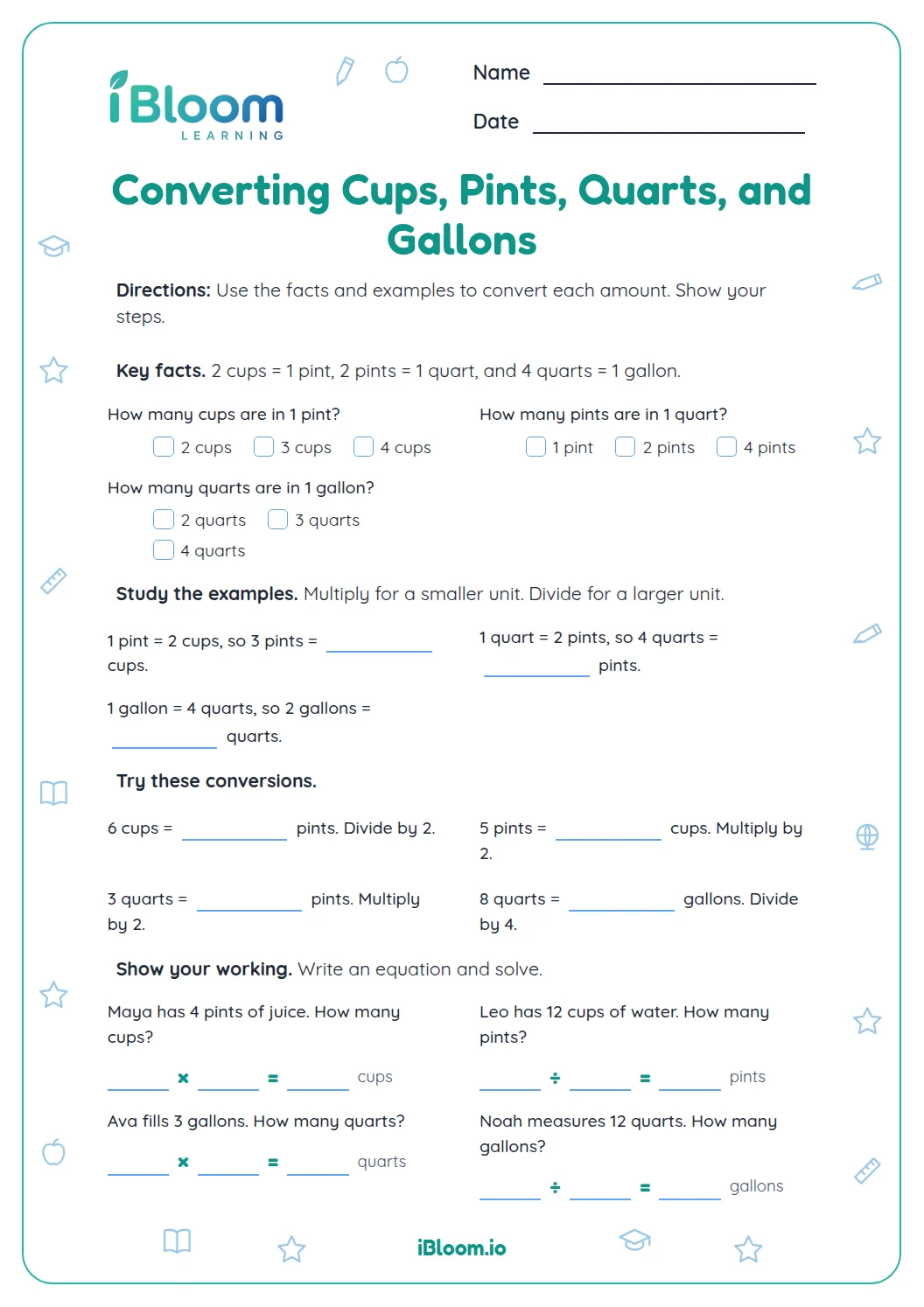
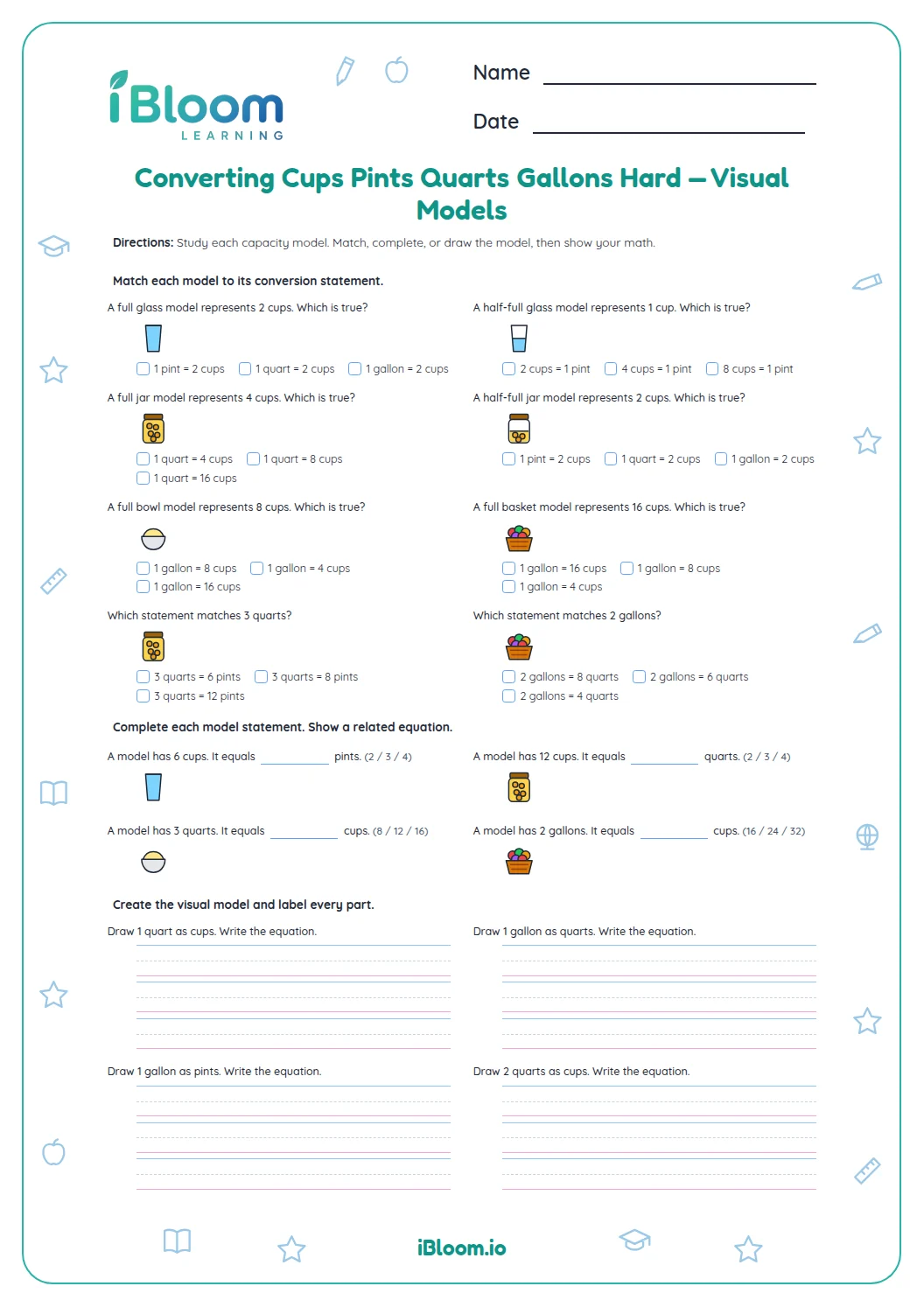
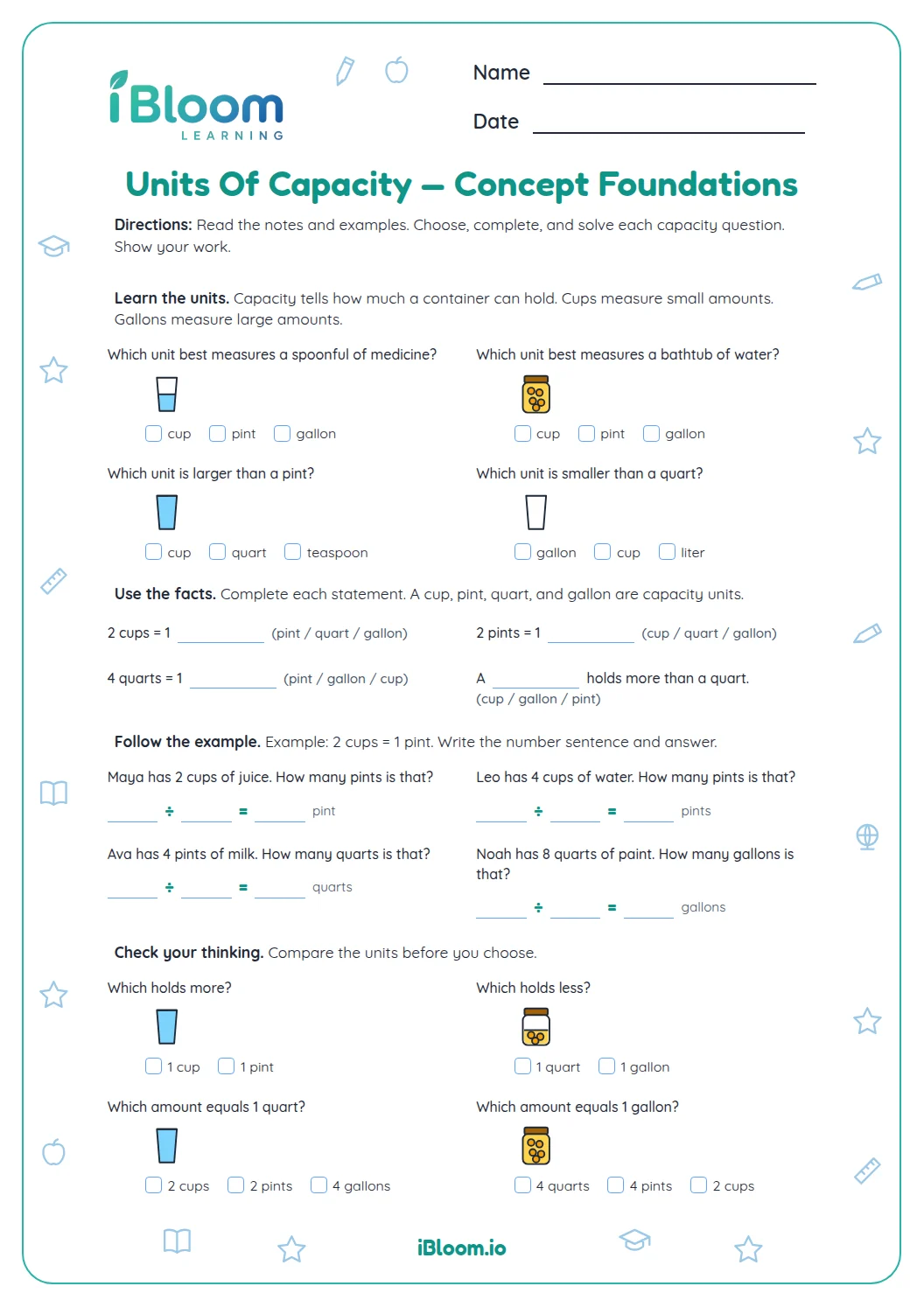
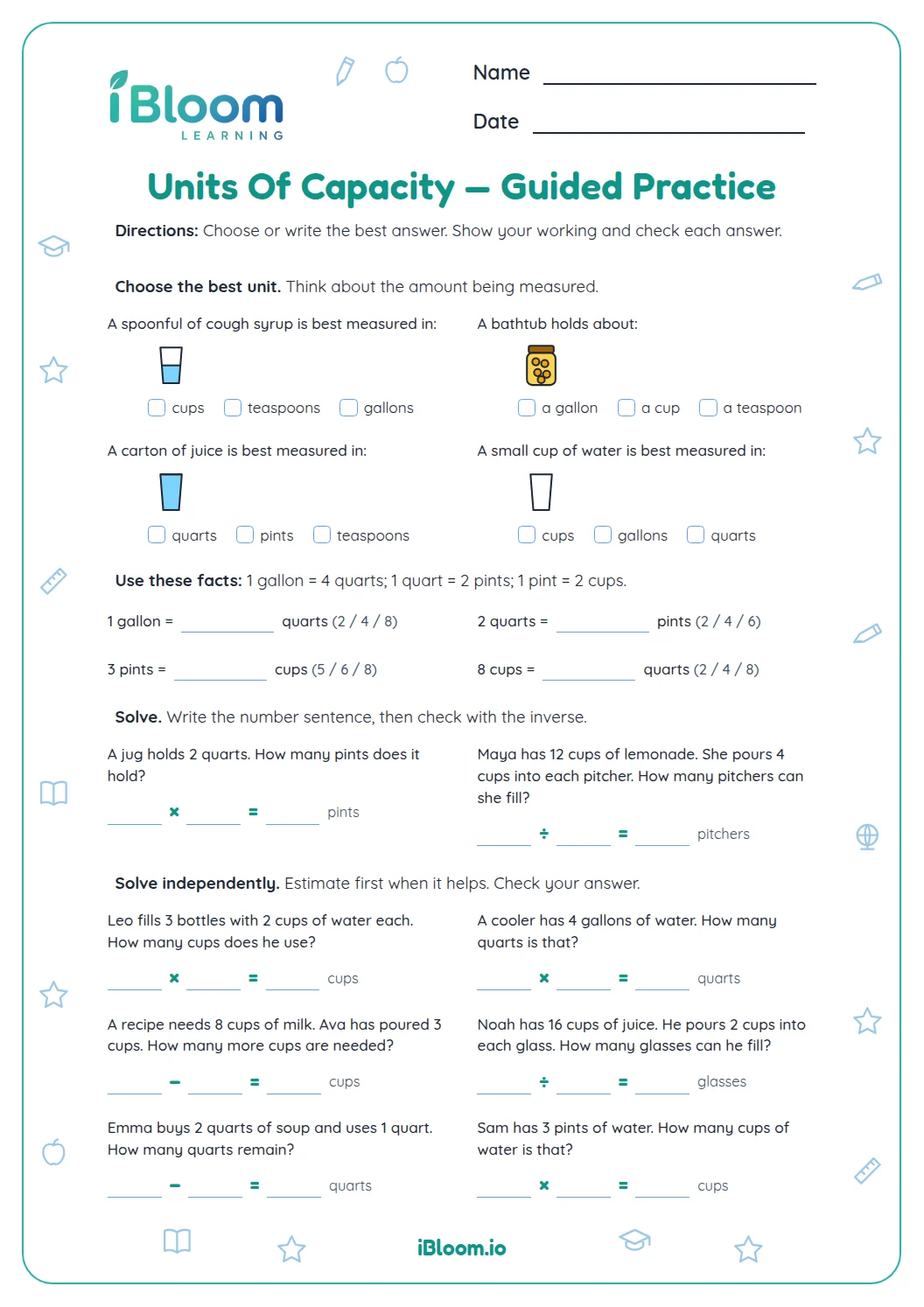
Use US liquid measures: 1 pint = 2 cups, 1 quart = 2 pints = 4 cups, and 1 gallon = 4 quarts = 8 pints = 16 cups. The directions give the three neighboring-unit facts; children can multiply them to find the longer conversions.
Moving from gallons to cups increases the number because each gallon contains many cups. Moving from cups to gallons means grouping cups into sets of 16. Keep the unit beside each number to make that change visible.
How can we solve a leftover problem?
Question 11 starts with 2 gallons of lemonade and takes away 10 cups. Convert the starting amount to cups before subtracting. The result must be less than the original 32 cups.
- 11 gallon = 16 cups
- 22 × 16 = 32 cups
- 332 − 10 = 22 cups left
- 4Check: 22 + 10 = 32 cups
How do the two parts build the skill?
Part A gives ten everyday amounts to convert in either direction. Part B adds another operation: find leftovers, combine liquids, fill pitchers, find a shortfall, or compare two supplies.
For question 15, children first rename 2 quarts as 8 cups. They subtract that from the 24 cups needed, then rename the missing 16 cups as 8 pints. Accept different correct equations when the quantities and final unit agree.
Use the sheet to practice choosing units
- 1Read the three conversion facts together and derive 1 gallon = 16 cups.
- 2Complete question 1 together, explaining why 3 pints equals 6 cups.
- 3Let children finish Part A and explain one conversion aloud.
- 4In Part B, underline the unit after the blank and decide which amounts need converting.
- 5For questions 11–16, convert all amounts to a useful common unit before the next operation.
- 6Use the key to check results, then check one answer by reversing the operations.
Conversion mistakes to discuss
The mistake
Multiplying 12 cups by 2 to get the number of pint bottles in question 4.
The fix
Group the cups in pairs. Twelve cups makes six groups, so 12 ÷ 2 = 6 pints.
The mistake
Subtracting 10 directly from 2 in the lemonade problem because the units are ignored.
The fix
Rename the 2 gallons as 32 cups first. Now 32 cups − 10 cups uses matching units.
The mistake
Stopping at 16 cups for question 15 even though the question asks for pints.
The fix
The shortfall is 16 cups. Divide by 2 cups per pint to finish with 8 pints.
Common Core alignment
These problems apply conversion facts and arithmetic to everyday liquid volumes.
Use operations and unit conversions to solve liquid-volume word problems.
On this sheet: Children multiply and divide to convert liquid measures, then add, subtract or divide to solve real-world problems.
Show the official wordingHide the official wording
Use the four operations to solve word problems involving distances, intervals of time, liquid volumes, masses of objects, and money, including problems involving simple fractions or decimals, and problems that require expressing measurements given in a larger unit in terms of a smaller unit. Represent measurement quantities using diagrams such as number line diagrams that feature a measurement scale.
What to practice next
Make more practice
Further reading
Questions parents and teachers ask
Which conversion facts are printed on the worksheet?
The directions give 1 pint = 2 cups, 1 quart = 2 pints, and 1 gallon = 4 quarts. Combining them gives 4 cups per quart and 16 cups per gallon. These US customary relationships support the conversion and multistep questions on the worksheet.
What makes questions 11–16 harder than the earlier questions?
Questions 11–16 ask children to use a converted amount in another calculation. For example, question 14 changes 3 gallons into 12 quarts, then divides by 2 quarts per pitcher to find 6 pitchers. Children must keep track of what the intermediate number measures before choosing the next operation.
Can my child use real containers while working?
Yes, labeled US measuring cups and containers can help children check the relationships. Fill a pint container with two measured cups of water, then connect that action to question 1. For larger amounts, repeat the relationship on paper so you can discuss gallons without needing a large container.
Why does question 15 need an answer in pints?
The question asks how many more pints of juice the class needs, so the final answer is 8 pints. The class has 2 quarts, or 8 cups, toward its 24-cup goal. Subtract to find a 16-cup shortfall, then divide those cups into groups of two.
How should I check the working as well as the answers?
Check that each equation uses quantities in matching units and that the final unit answers the question. In question 16, both supplies can be converted to cups: 32 cups and 24 cups. Their difference is 8 cups. The separate answer key provides the missing numbers in context for all 16 questions.