





About this worksheet
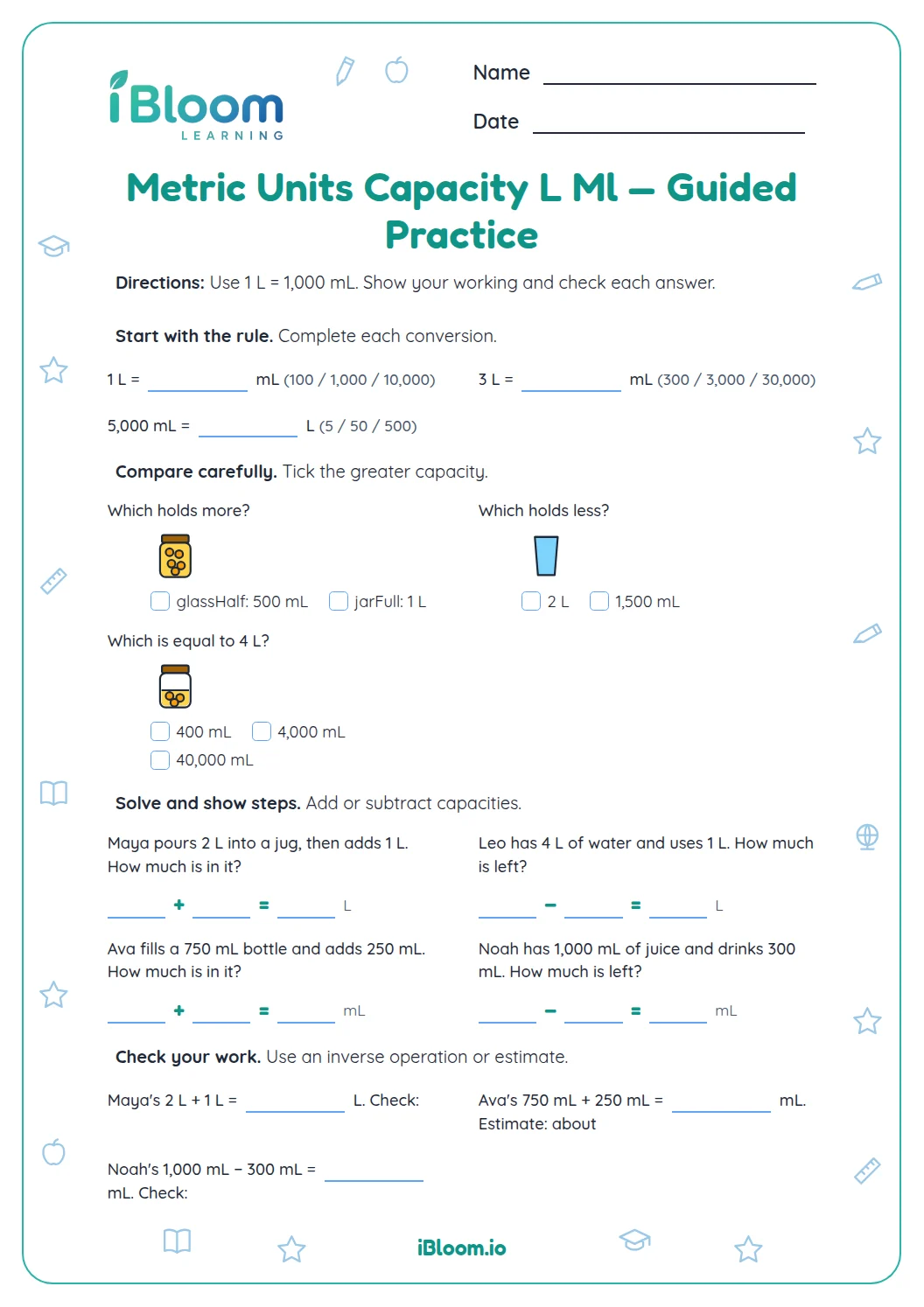
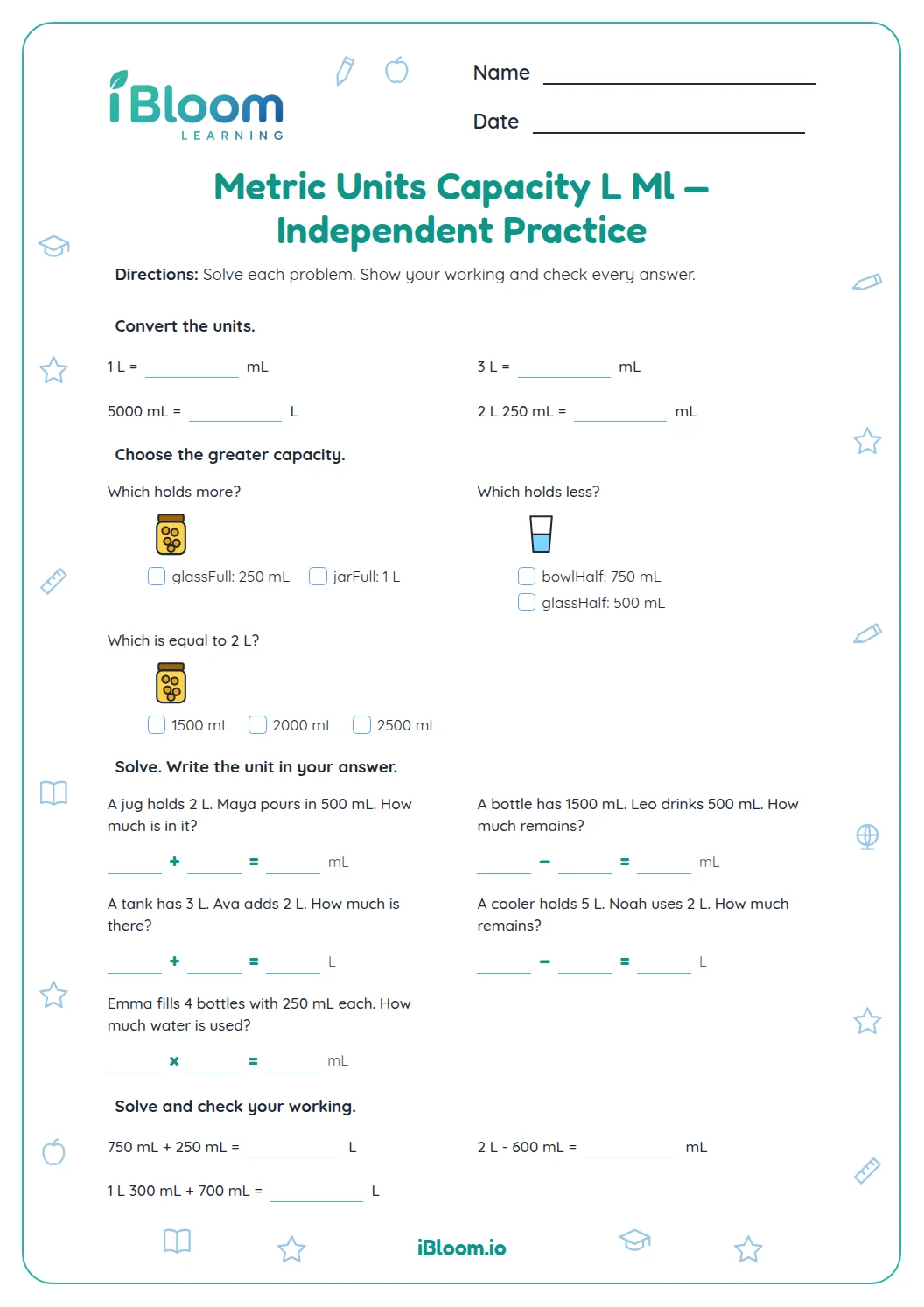
This printable worksheet introduces liquid capacity in liters and milliliters. Children choose sensible units, use 1 liter = 1,000 milliliters, compare amounts and solve short capacity situations. The sheet is labeled Grade 3 in the source collection; its liter-to-milliliter conversion practice aligns with the Grade 4 measurement skill in CCSS 4.MD.A.1. A separate answer key is included.
Aligned to 4.MD.A.1
How do liters and milliliters compare?
A liter is a larger capacity unit. One liter equals 1,000 milliliters, so small amounts may be described in milliliters and larger containers may be described in liters.
- 11 L = ___ mL → 1,000 mL. Multiply the number of liters by 1,000.
How can children choose a sensible capacity unit?
Think about the size of the container. A spoonful is a small amount measured in milliliters; a bottle or pitcher may hold liters. Compare the amount with 1 L when a question asks which is larger.
What steps help with a capacity word problem?
First identify the units in the question. Convert using 1 L = 1,000 mL when needed, then answer in the unit requested. For 1,500 mL to reach 2 L, compare 2,000 mL − 1,500 mL = 500 mL.
How to use this worksheet
- 1Keep the unit next to each number as you read.
- 2Recall that 1 L equals 1,000 mL.
- 3For liters to milliliters, multiply by 1,000.
- 4For milliliters to liters, count groups of 1,000.
- 5In a story problem, write the requested unit in your answer.
Common mistakes and quick fixes
The mistake
Thinking a milliliter is larger because 1,000 is a big number.
The fix
The count of milliliters is larger because each milliliter is a smaller unit.
The mistake
Changing 3 L to 300 mL.
The fix
Use 1,000 mL per liter, so 3 L is 3,000 mL.
The mistake
Leaving a conversion answer in the wrong unit.
The fix
Reread the question and include the unit it asks for.
Common Core alignment
The questions practice equivalent measurements in liters and milliliters.
Express measurements in larger units using smaller units within the same system.
On this sheet: Children express whole-liter amounts in milliliters and milliliter amounts in liters using equivalent measurements.
Show the official wordingHide the official wording
Know relative sizes of measurement units within one system of units including km, m, cm; kg, g; lb, oz.; l, ml; hr, min, sec. Within a single system of measurement, express measurements in a larger unit in terms of a smaller unit. Record measurement equivalents in a two-column table. For example, know that 1 ft is 12 times as long as 1 in. Express the length of a 4 ft snake as 48 in. Generate a conversion table for feet and inches listing the number pairs (1, 12), (2, 24), (3, 36), …
What to practice next
Make more practice
Further reading
Questions parents and teachers ask
What is the relationship between L and mL?
One liter is equal to 1,000 milliliters. Multiply liters by 1,000 to find milliliters, and count groups of 1,000 milliliters to find the equivalent number of liters in a capacity amount or measurement problem. The answer key also keeps the unit visible, which helps children check both the number and what it measures.
When should I use liters or milliliters?
Use milliliters for smaller liquid amounts such as a spoonful or small carton. Use liters for larger amounts such as a pitcher or bathtub; the worksheet compares examples and asks children to choose sensible units for them. Children can compare the amounts with a one-liter reference to decide whether the quantity is small or large.
How many questions are included?
There are 14 questions: six unit and comparison choices, six conversion blanks, and two short application problems. A separate answer key page gives the answer and expected unit for each item in the worksheet. The answer key includes the whole-number results so children can check their conversions after finishing the practice.
What does 3 L equal in milliliters?
Three liters equal 3,000 milliliters because each liter contains 1,000 milliliters. The conversion section uses that relationship to connect whole liter amounts with their equivalent number of milliliters in the same system. The numbers are selected to make the 1,000-to-1 relationship clear in both conversion directions.
How can children check a liter-to-milliliter conversion?
Use the relationship 1 L = 1,000 mL and estimate the size of the result. For example, 3 L must be more than 3 mL because each liter contains 1,000 milliliters. The answer key gives the equivalent unit so children can check both the number and the unit.