


About this worksheet
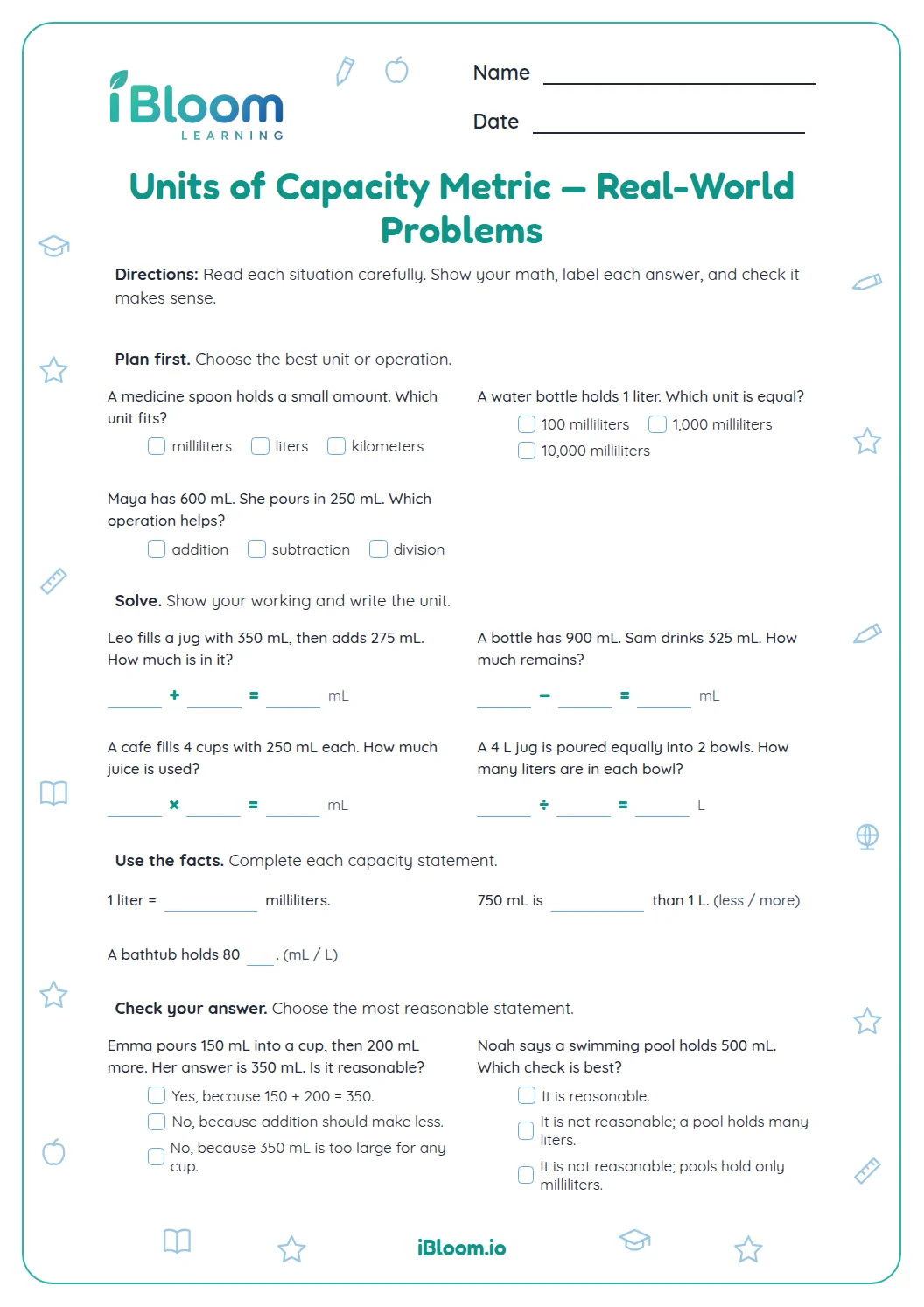
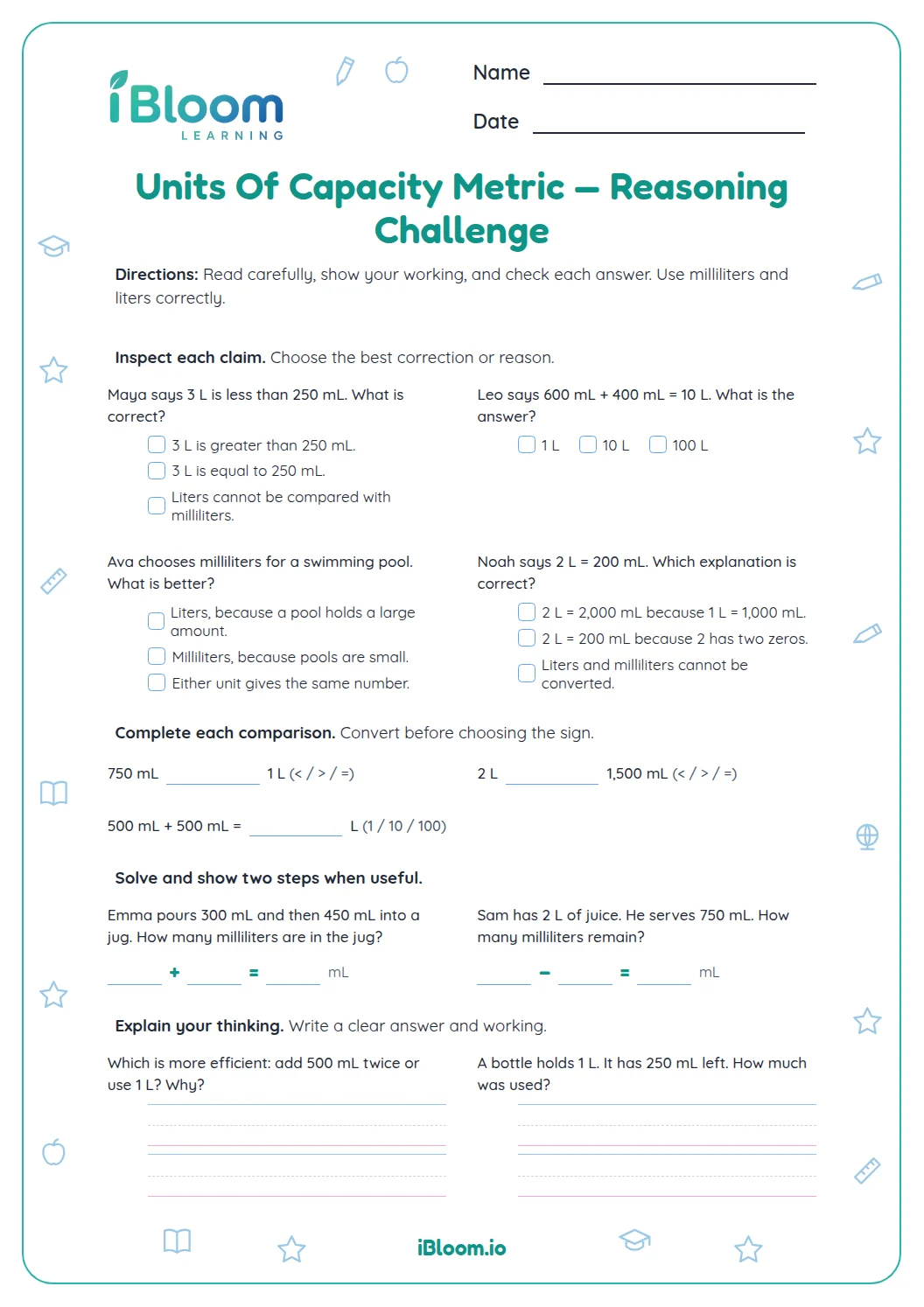
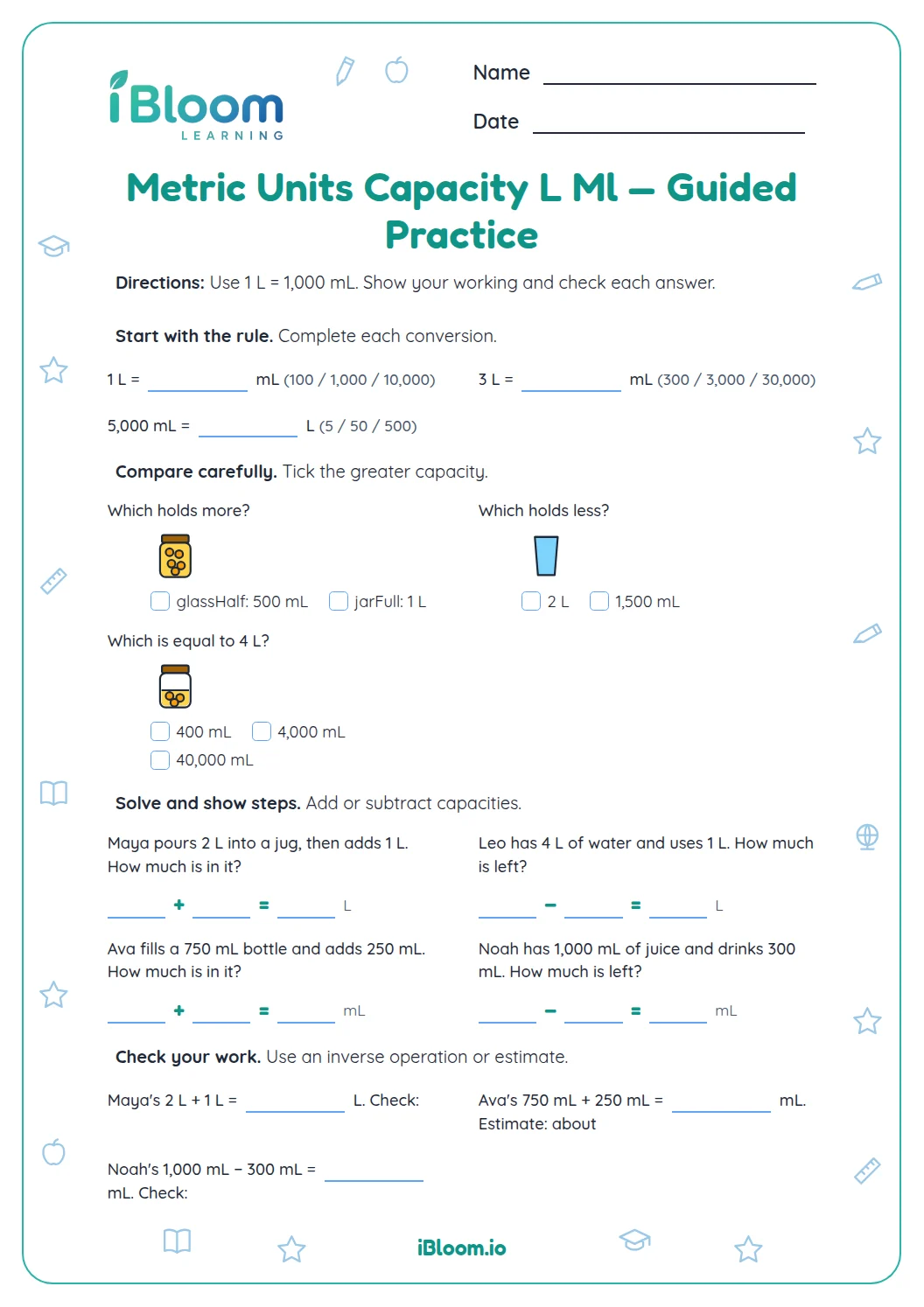
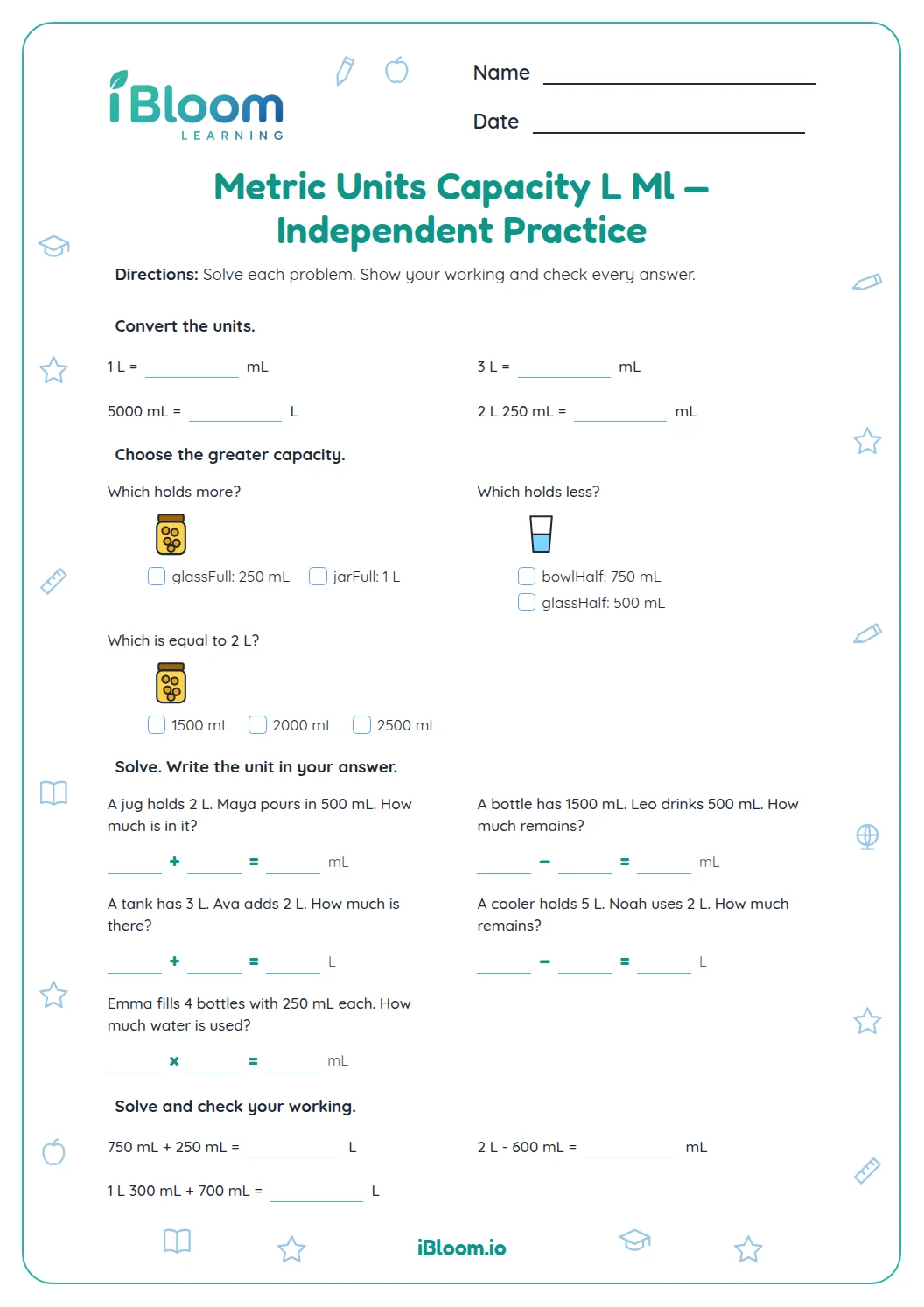
This free Grade 4 printable builds fluency with metric capacity. Children choose liters or milliliters, convert between the units, compare amounts, and solve short one-step problems. The 14 questions use the relationship 1 liter = 1,000 milliliters and practice CCSS 4.MD.A.1. The worksheet and answer key print separately.
Aligned to 4.MD.A.1
How do you convert liters to milliliters?
One liter contains 1,000 milliliters. Multiply the number of liters by 1,000 to change liters to milliliters; group thousands of milliliters to change back.
For question 4, 3 L = 3 × 1,000 = 3,000 mL. For 4 L 75 mL, combine 4,000 mL and 75 mL.
- 14 L 75 mL
- 24 × 1,000 = 4,000 mL
- 34,000 + 75 = 4,075 mL
How can children compare two capacity amounts?
Rewrite both amounts in the same unit. For question 9, 1 L is 1,000 mL, so 1,200 mL is greater. For an ordered list, convert each measure first, then place them from smallest to largest.
What does this worksheet ask children to solve?
The final questions use capacity in familiar containers and simple changes. Keep the unit attached to each number so the answer describes an amount of liquid.
How to use this worksheet
- 1Review that 1 L = 1,000 mL.
- 2Choose L for larger container amounts and mL for small amounts.
- 3Convert to one unit before comparing.
- 4For a story, identify the starting amount and the change.
- 5Check that the unit in the answer matches the question.
Common mistakes and quick fixes
The mistake
Writing 100 mL for 1 L.
The fix
Say “one thousand milliliters” and write 1,000 mL.
The mistake
Comparing 1 L directly with 1,200 mL.
The fix
Rewrite 1 L as 1,000 mL before comparing.
The mistake
Leaving off the unit.
The fix
Add L or mL to every final capacity amount.
Common Core alignment
The problems express equivalent capacities in liters and milliliters.
Convert between liters and milliliters and record equivalent capacities.
On this sheet: Convert liters and milliliters in comparison and capacity problems.
Show the official wordingHide the official wording
Know relative sizes of measurement units within one system of units including km, m, cm; kg, g; lb, oz; l, ml; hr, min, sec. Within a single system of measurement, express measurements in a larger unit in terms of a smaller unit. Record measurement equivalents in a two-column table.
What to practice next
Make more practice
Further reading
Questions parents and teachers ask
What conversion should children remember?
One liter equals 1,000 milliliters. Multiply liters by 1,000 to get milliliters, or divide milliliters by 1,000 to get liters. For example, question 8 turns 6,000 mL into 6 L. The key shows the converted number, and children should include the unit when a story asks for an amount.
When should I use liters instead of milliliters?
Liters are useful for larger amounts, such as the bathtub in question 1. Milliliters fit smaller amounts, such as a spoonful of medicine in question 2. The best unit depends on the size of the amount, so children should picture what the container or serving holds before choosing.
How do children compare liters and milliliters?
Convert one measure so both amounts use the same unit. For example, 1 L equals 1,000 mL, so 1,200 mL is greater than 1 L. The comparison section practices this strategy. Children can also convert 1 L to 1,000 mL before deciding.
Does the worksheet include word problems?
Yes. Questions 11–14 ask about a jug, a tank, cups of water, and filling a bucket. Children convert the amounts and then add or subtract. The answer key gives the result with its unit, such as 2,300 mL remaining in the tank.
How many questions are included?
There are 14 questions: two unit choices, six conversions, two comparisons, and four capacity stories. A separate answer key shows the expected answer for each prompt. Children can check the conversion relationship before using it in the short stories.