






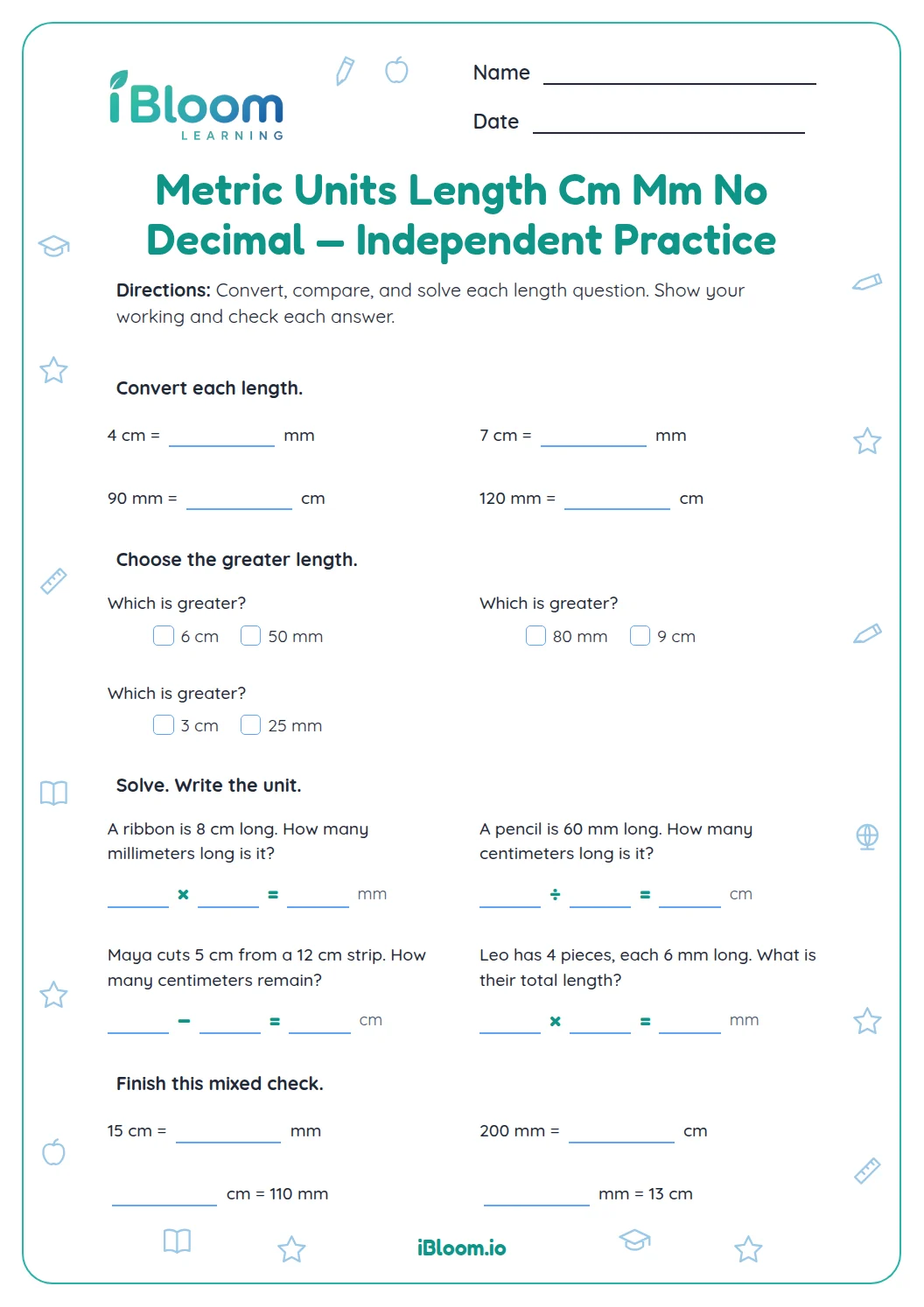
About this worksheet
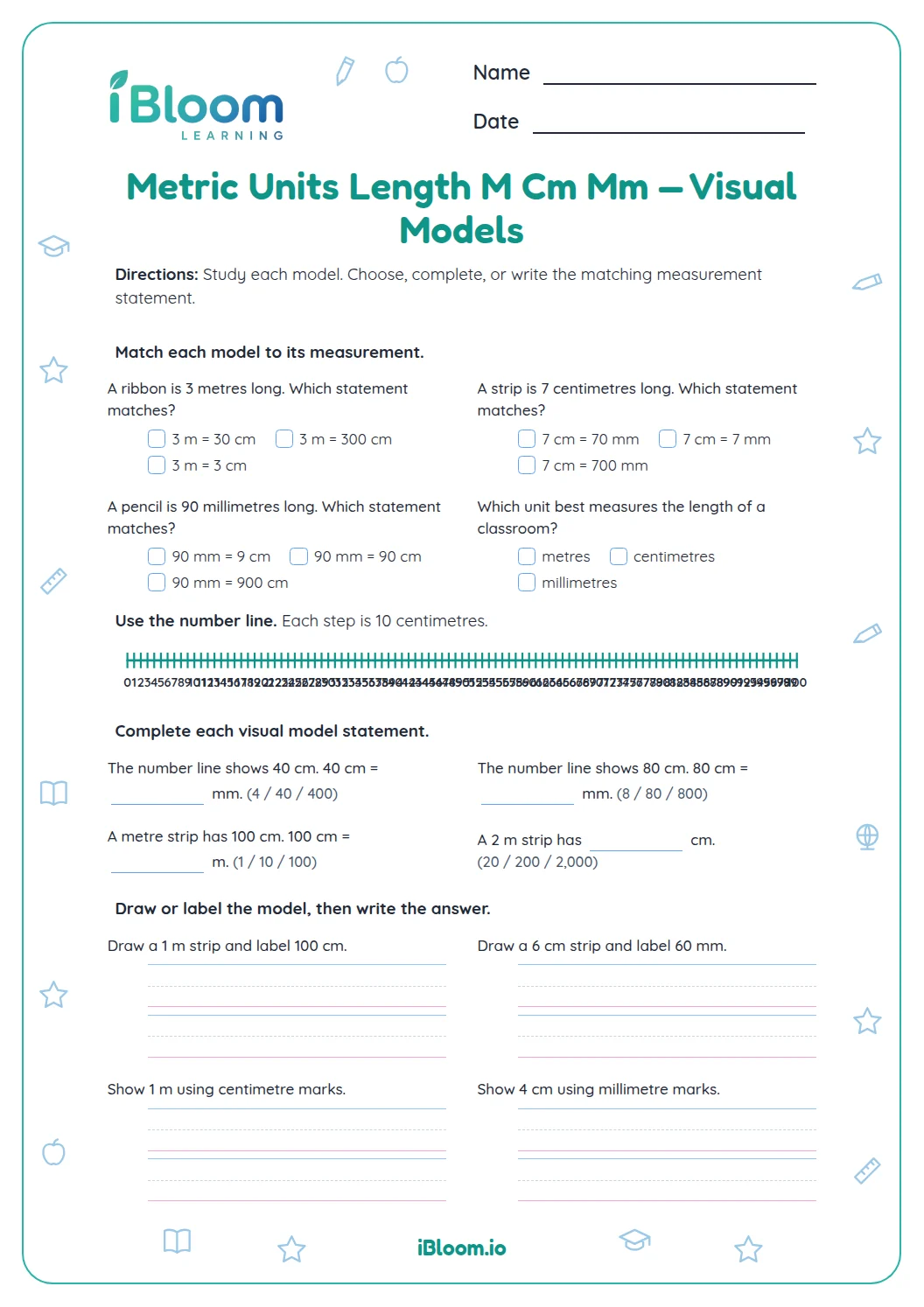
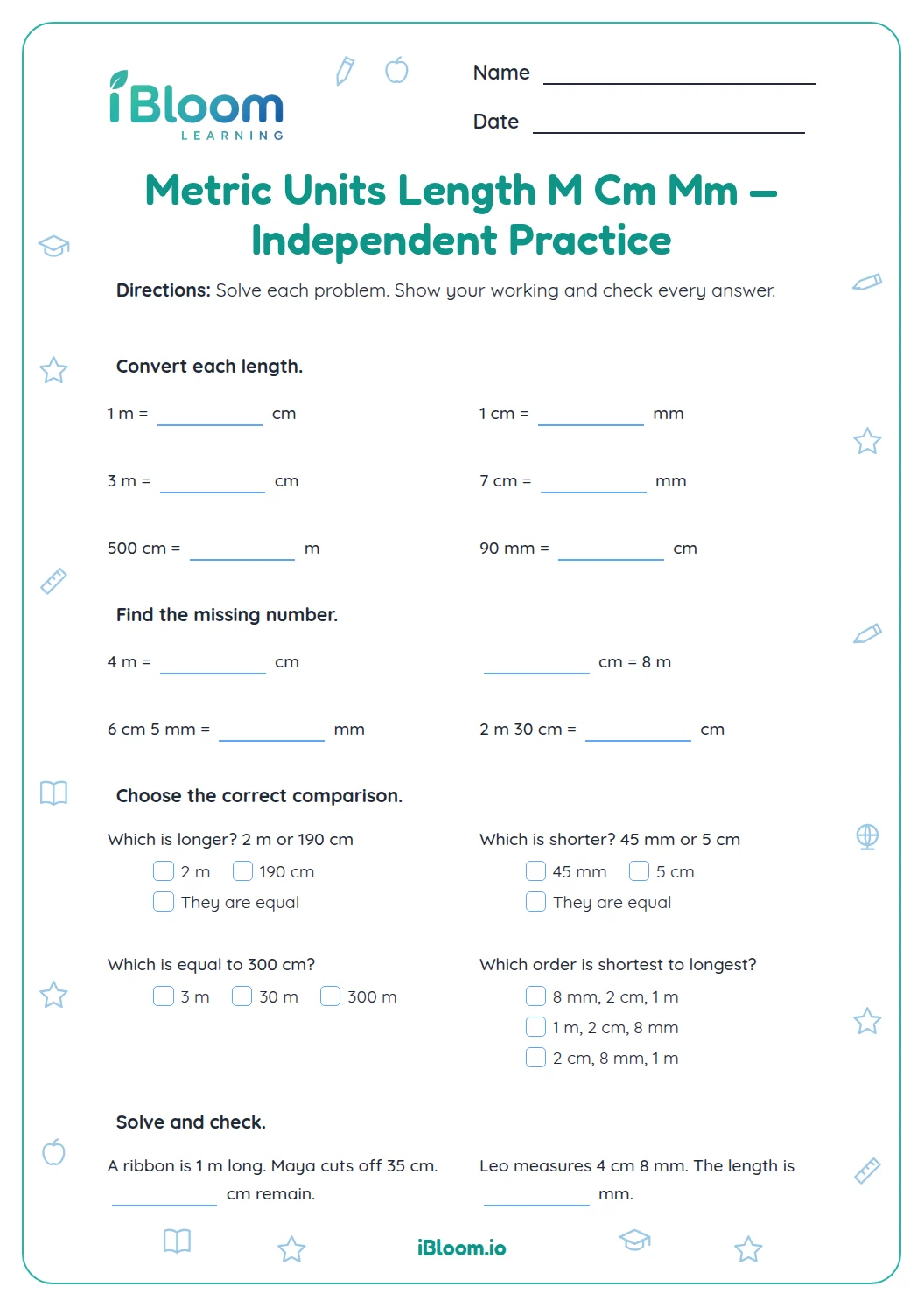
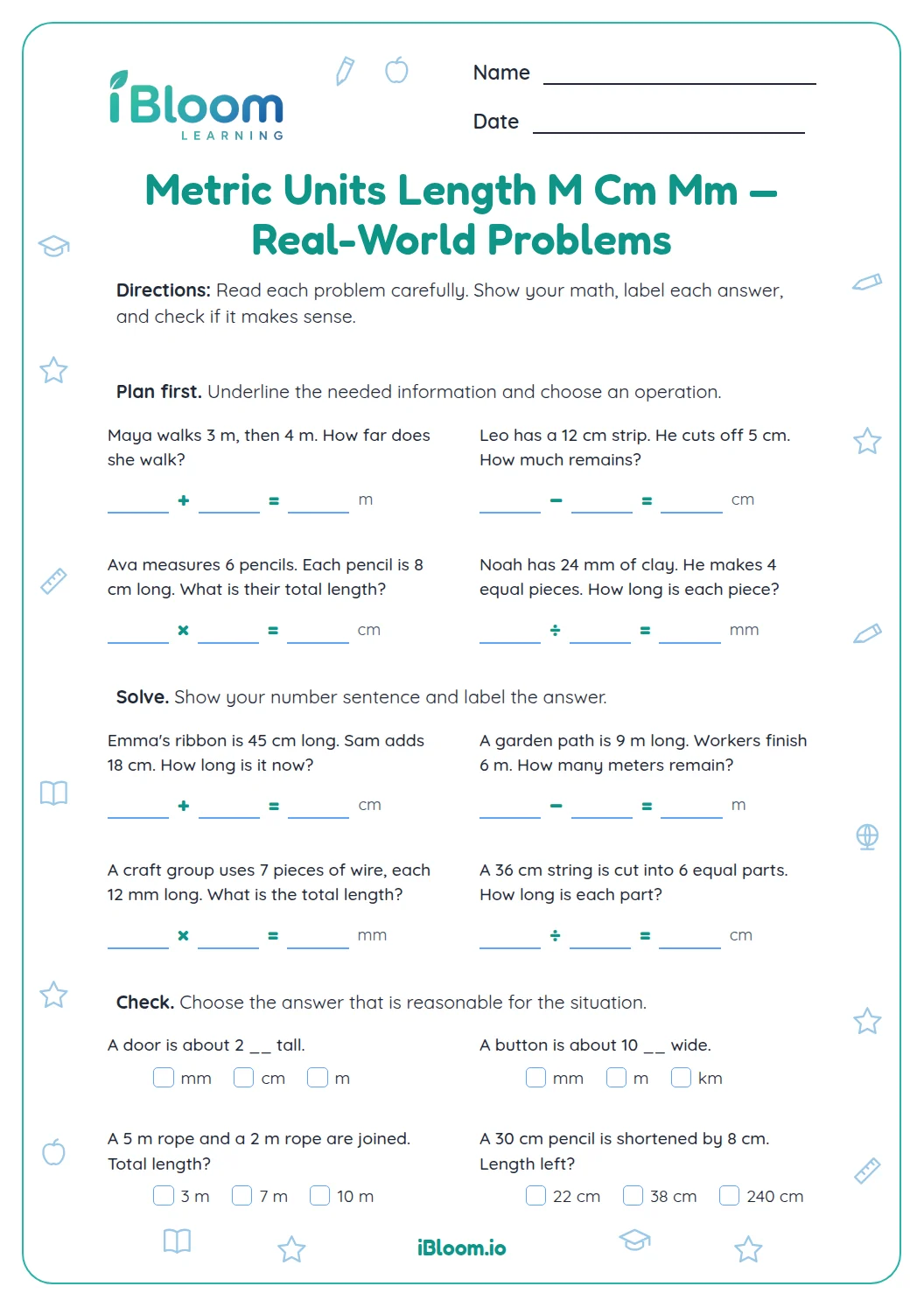
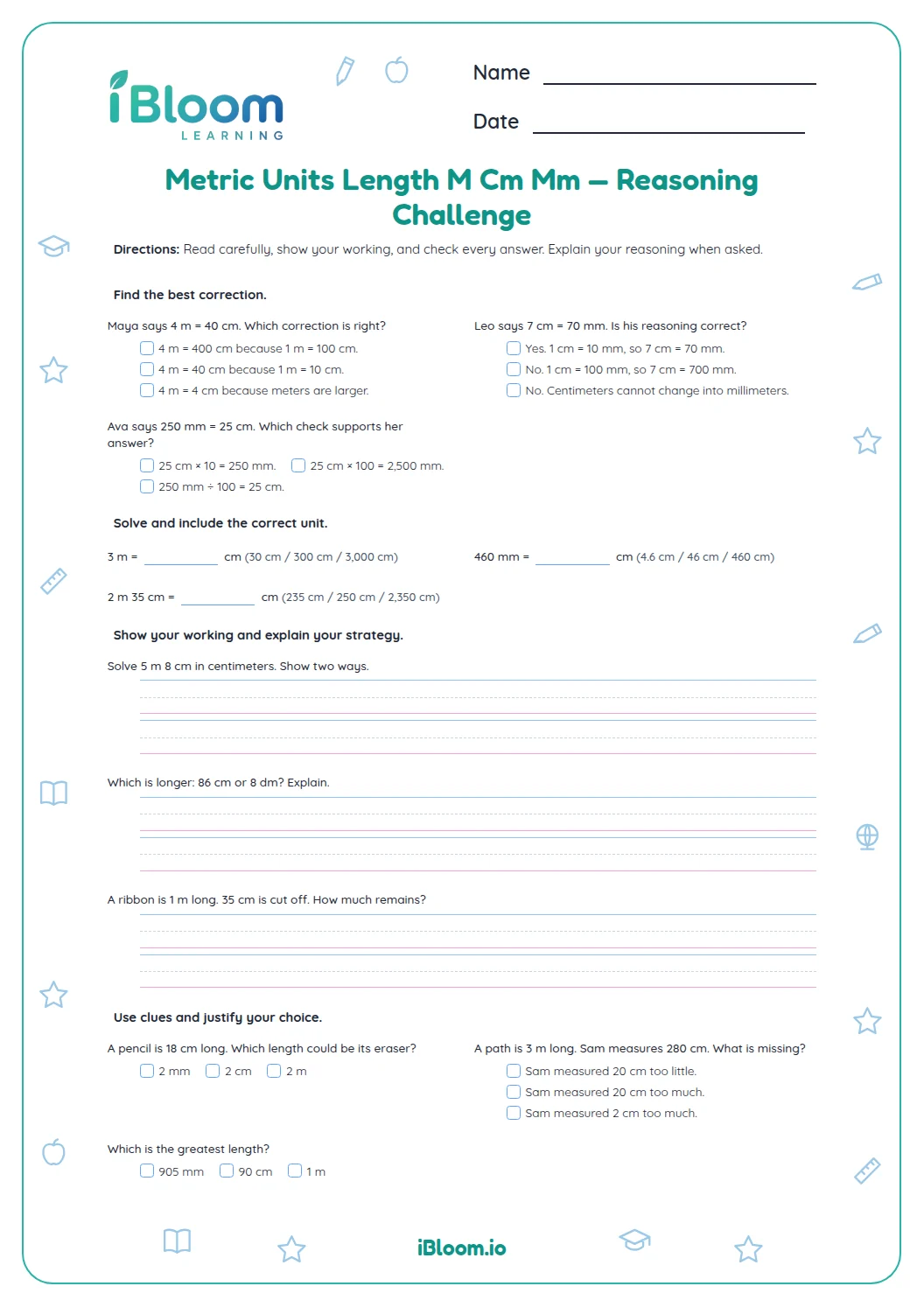
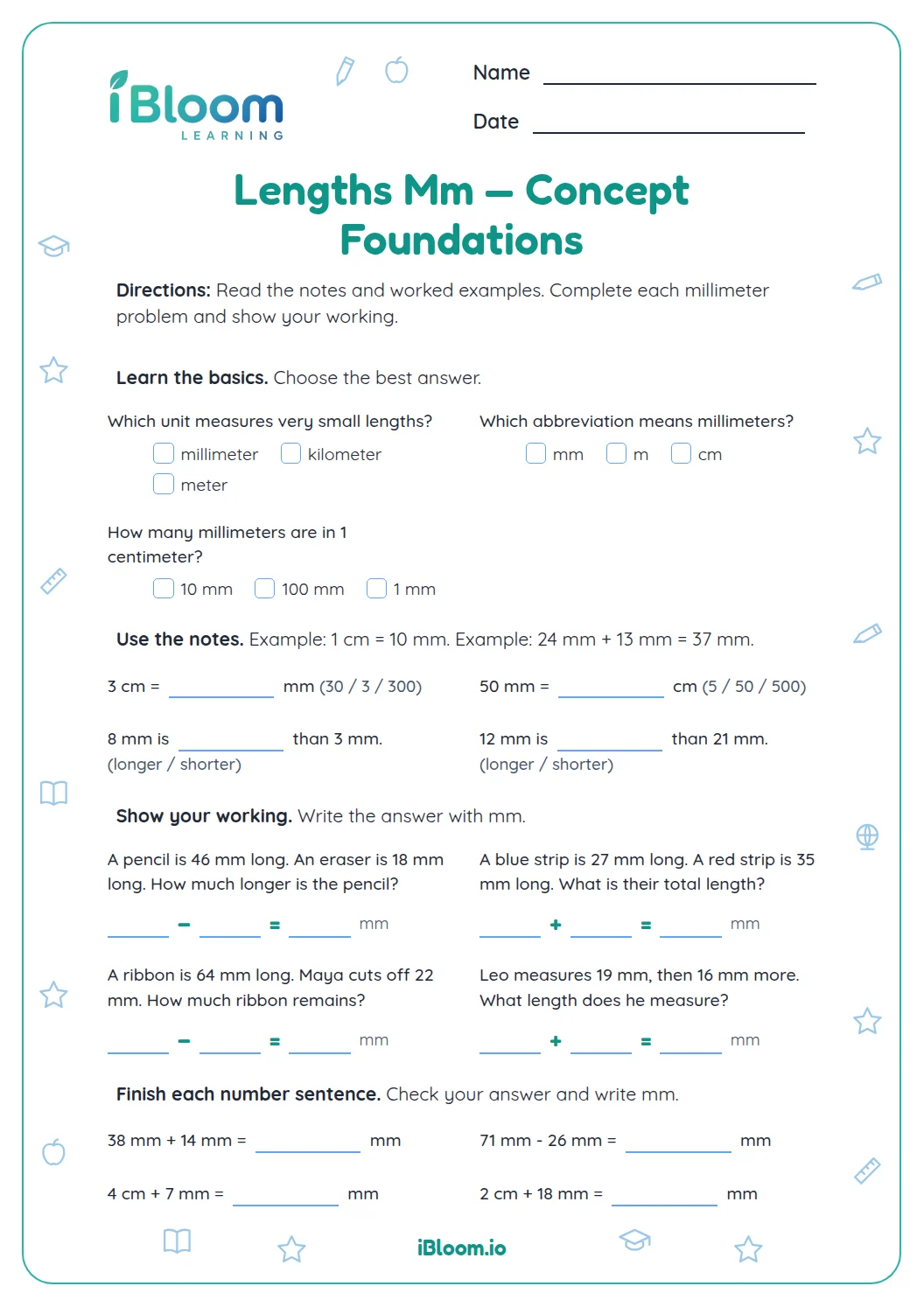
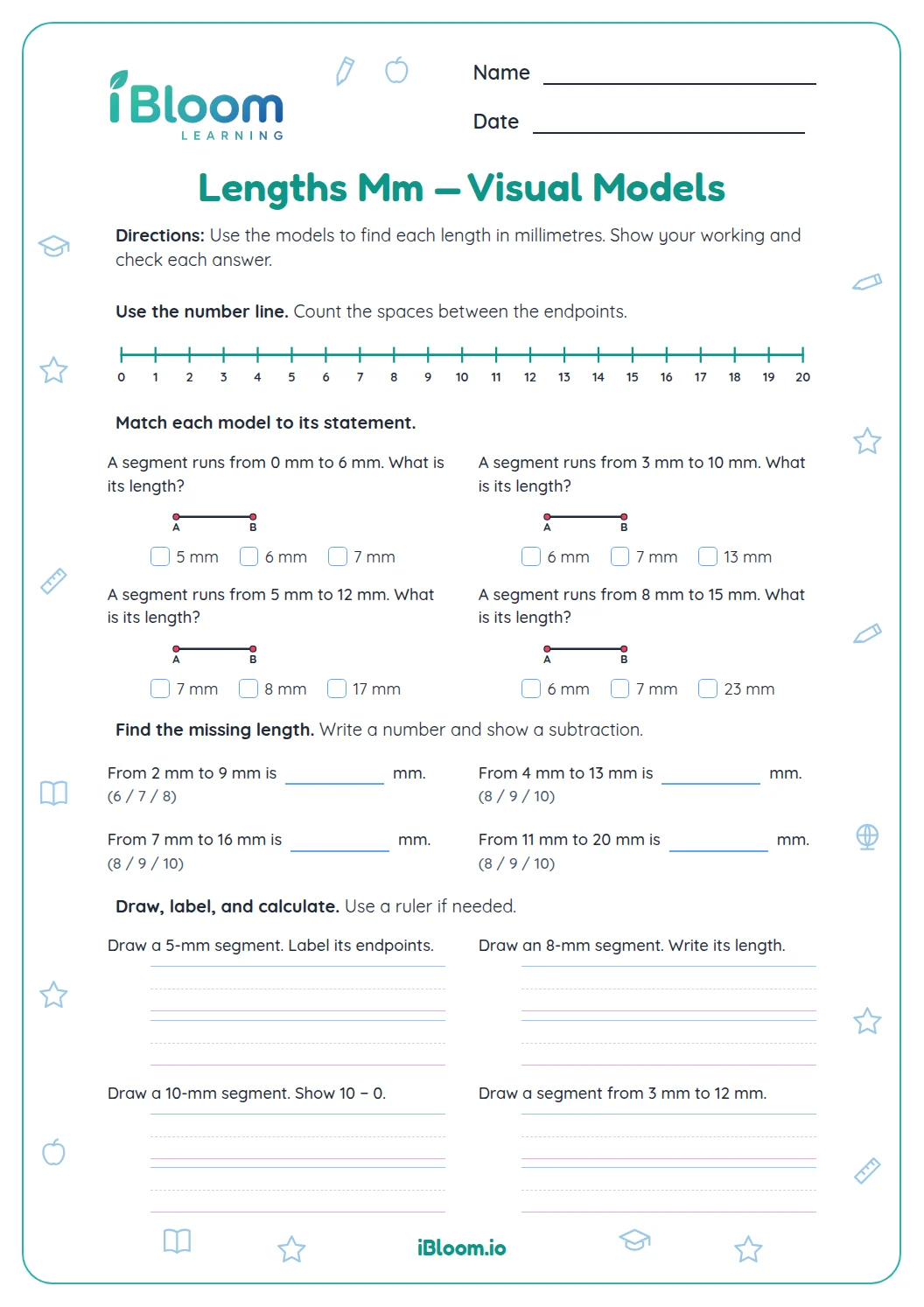
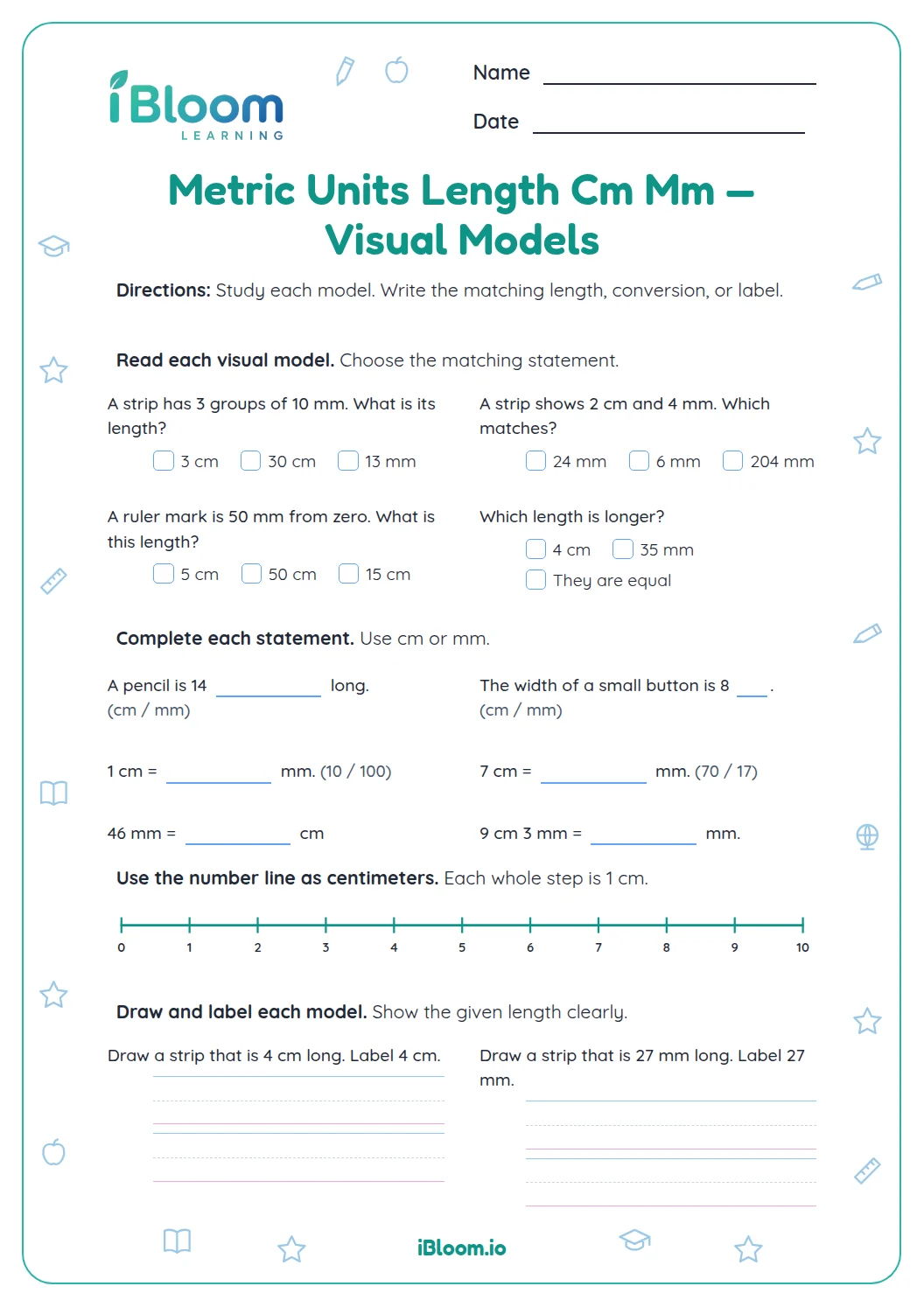
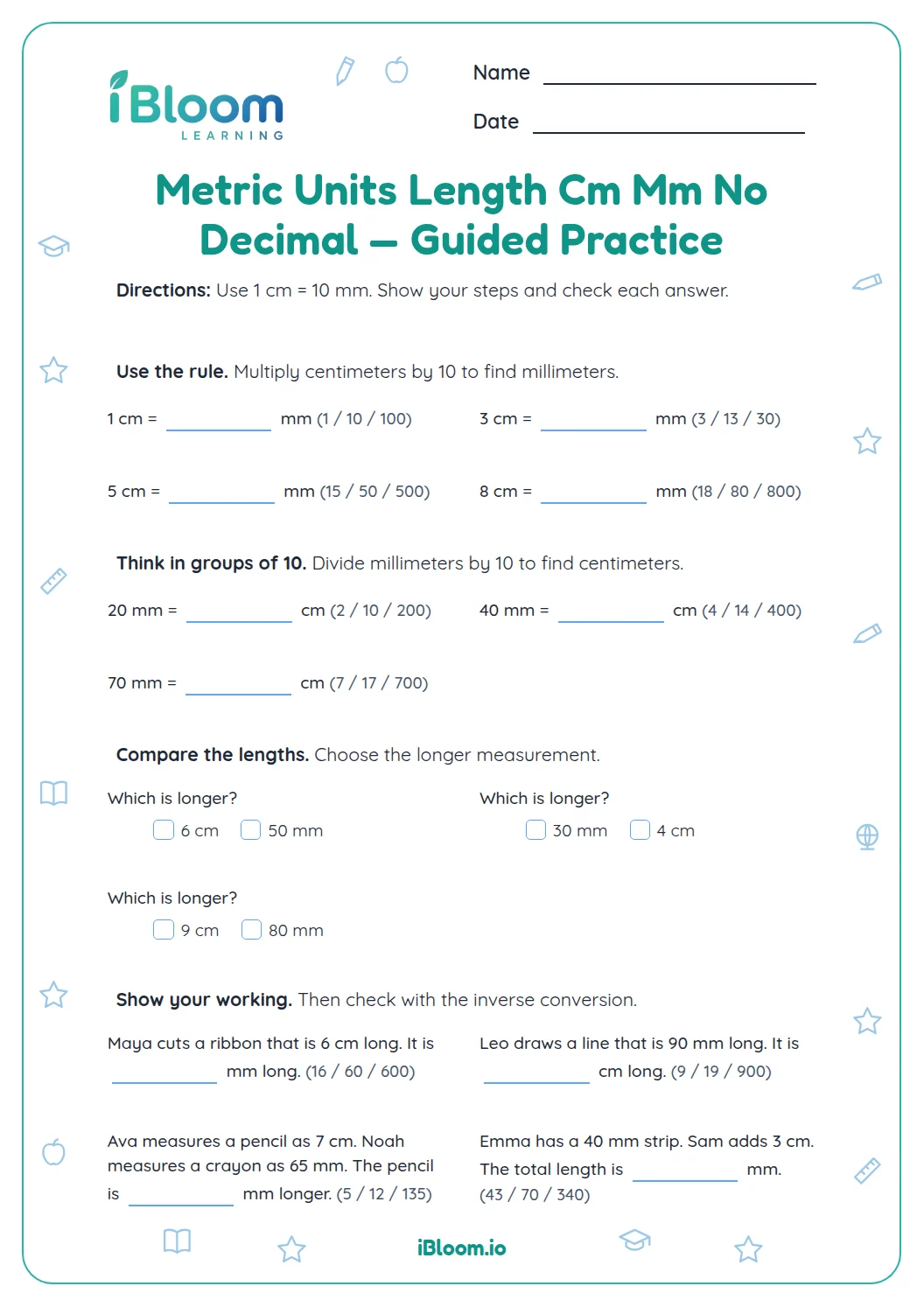
This Grade 3 guided practice page introduces meter, centimeter, and millimeter relationships using familiar objects and short length situations. Students choose a sensible unit, express a length in a smaller metric unit, and solve simple problems. It contains 14 questions in three parts and a complete answer key. The conversions practice Common Core 4.MD.A.1.
Aligned to 4.MD.A.1
How are meters, centimeters, and millimeters related?
One meter equals 100 centimeters. One centimeter equals 10 millimeters. These facts let you rewrite a length in a smaller unit.
- 11 m = 100 cm
- 21 cm = 10 mm
How do I choose a useful unit?
Think about the object before measuring. A classroom door is measured in meters, a pencil in centimeters, and the width of a fingernail in millimeters.
How do I solve a length story?
For 40 mm plus 3 cm, first rewrite 40 mm as 4 cm. Then 4 cm + 3 cm = 7 cm. Keep the unit the same throughout the calculation.
- 140 mm = 4 cm
- 24 cm + 3 cm = 7 cm
How to use this worksheet
- 1Recall the two unit relationships.
- 2Estimate the object size before choosing a unit.
- 3Use m for larger lengths, cm for familiar short objects, and mm for tiny lengths.
- 4Rewrite lengths in a common unit before adding.
- 5Include the unit in the final answer.
Common mistakes and quick fixes
The mistake
Choosing a unit too small for a large object
The fix
Estimate the size first; a door is measured in meters.
The mistake
Confusing meters and centimeters
The fix
Remember that 1 meter equals 100 centimeters.
The mistake
Adding different units directly
The fix
Convert one length so both amounts use the same unit.
Common Core alignment
This worksheet practices a named Common Core math skill through its problems and worked example.
Express metric measurements in smaller units using known unit relationships.
On this sheet: Measure and estimate lengths using standard units, then solve simple same-unit length problems.
Show the official wordingHide the official wording
Know relative sizes of measurement units within one system of units including km, m, cm; kg, g; lb, oz.; l, ml; hr, min, sec. Within a single system of measurement, express measurements in a larger unit in terms of a smaller unit. Record measurement equivalents in a two-column table. For example, know that 1 ft is 12 times as long as 1 in. Express the length of a 4 ft snake as 48 in. Generate a conversion table for feet and inches listing the number pairs (1, 12), (2, 24), (3, 36), ...
What to practice next
Make more practice
Further reading
Questions parents and teachers ask
How many centimeters are in one meter?
One meter equals 100 centimeters. This relationship lets you rewrite a meter measurement in a smaller unit: two meters equal 200 centimeters. Keep the unit with the number so the length remains clear. The separate answer key gives each result so students can check their own work.
How many millimeters are in one centimeter?
One centimeter equals 10 millimeters. So a seven-centimeter crayon is 70 millimeters long. Millimeters are useful for very small lengths, while centimeters often fit familiar classroom objects better. The separate answer key gives each result so students can check their own work.
When should a child use millimeters?
Millimeters are useful for a very short width or thickness. For familiar objects such as a pencil, centimeters are usually a better-sized unit. Think about the object before choosing a unit for a measurement. The separate answer key gives each result so students can check their own work.
Should lengths be in the same unit before adding?
Yes. Convert one length so both values use the same unit, then add. For example, 40 millimeters equals 4 centimeters, so adding a 3-centimeter strip gives a combined length of 7 centimeters. The separate answer key gives each result so students can check their own work.
What is a sensible unit for a door?
Meters are sensible for a classroom door because its height is around a few meters. Using centimeters or millimeters would produce a much larger number without making the measurement more informative. The separate answer key gives each result so students can check their own work.