











About this worksheet
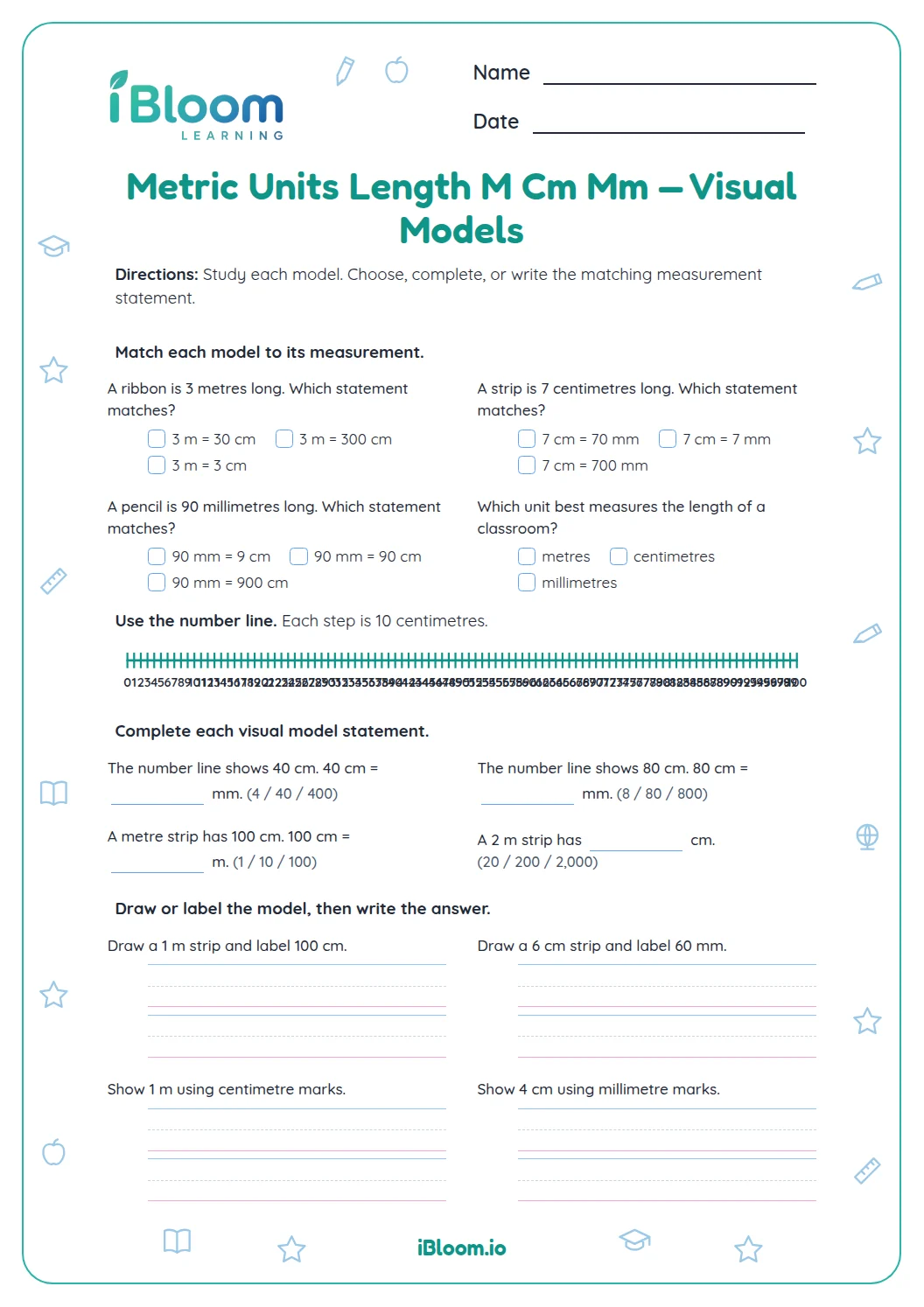
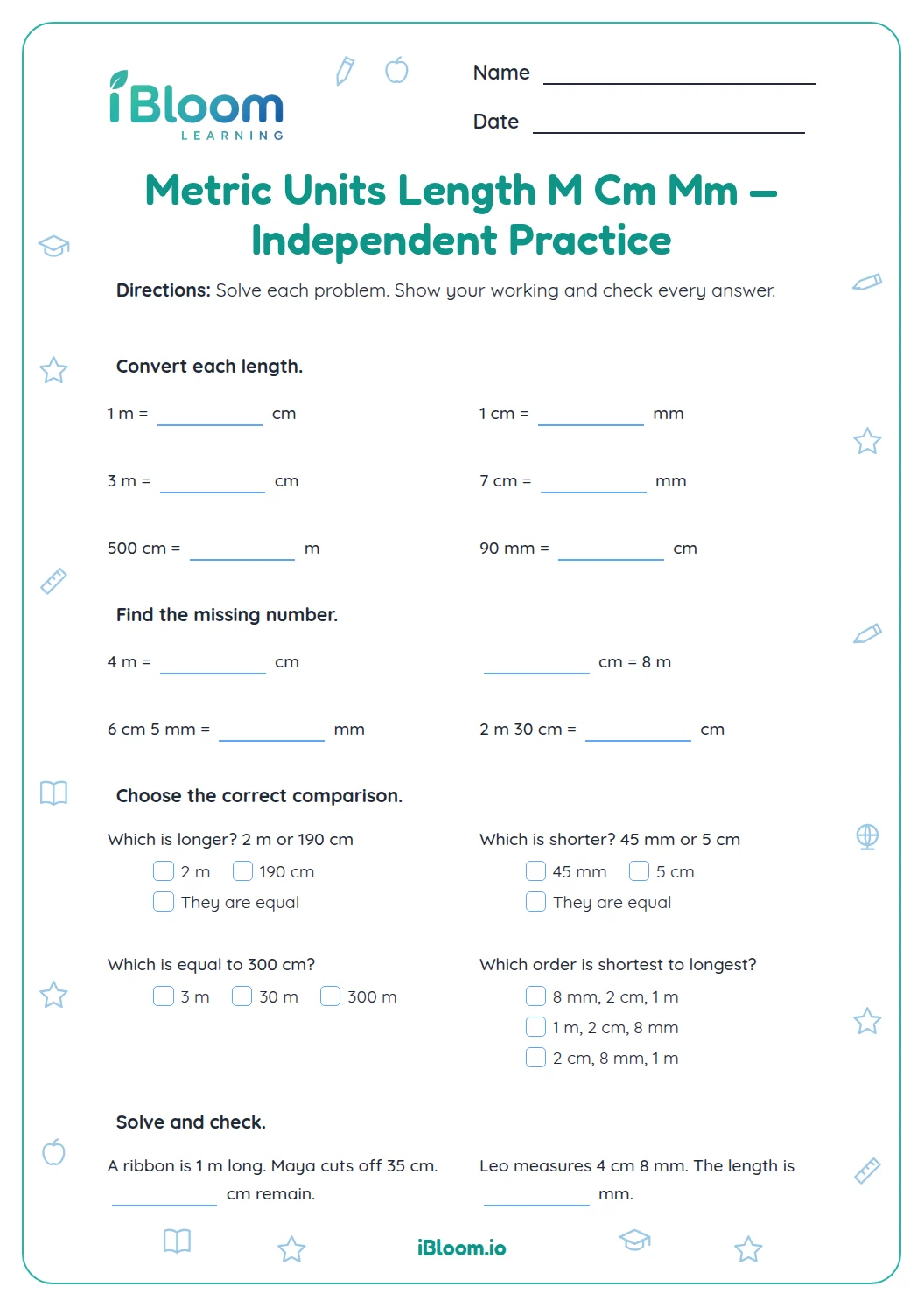
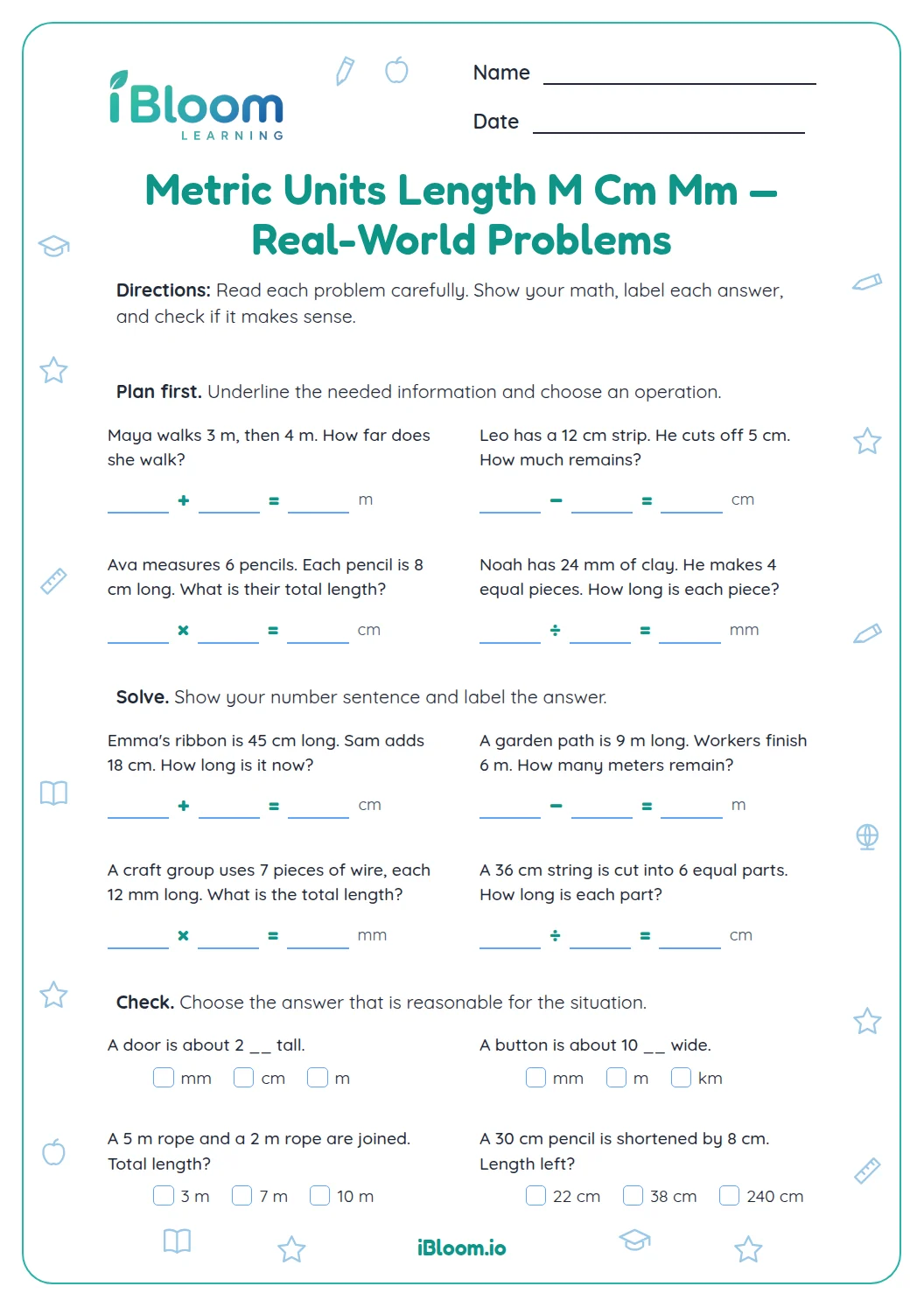
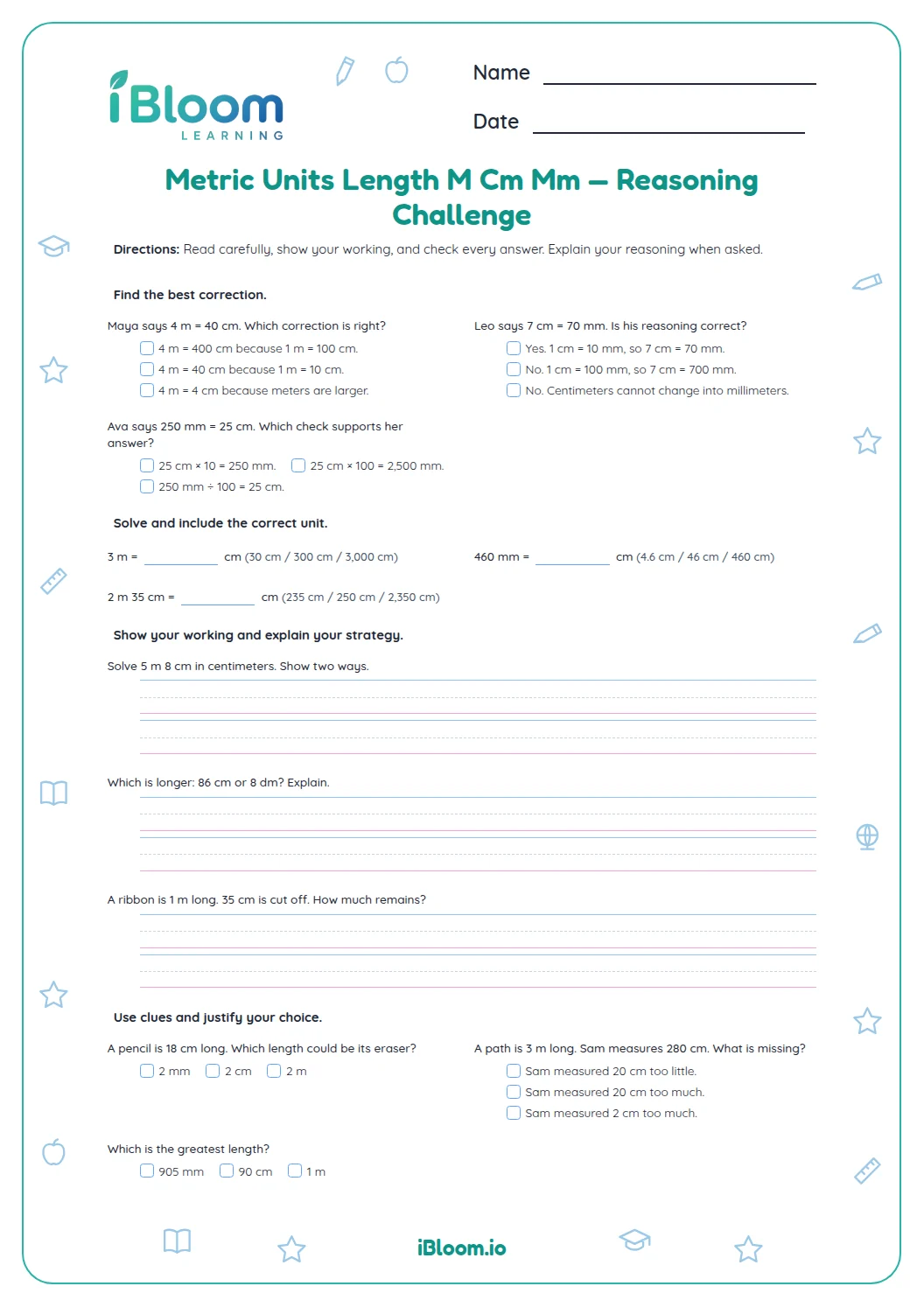
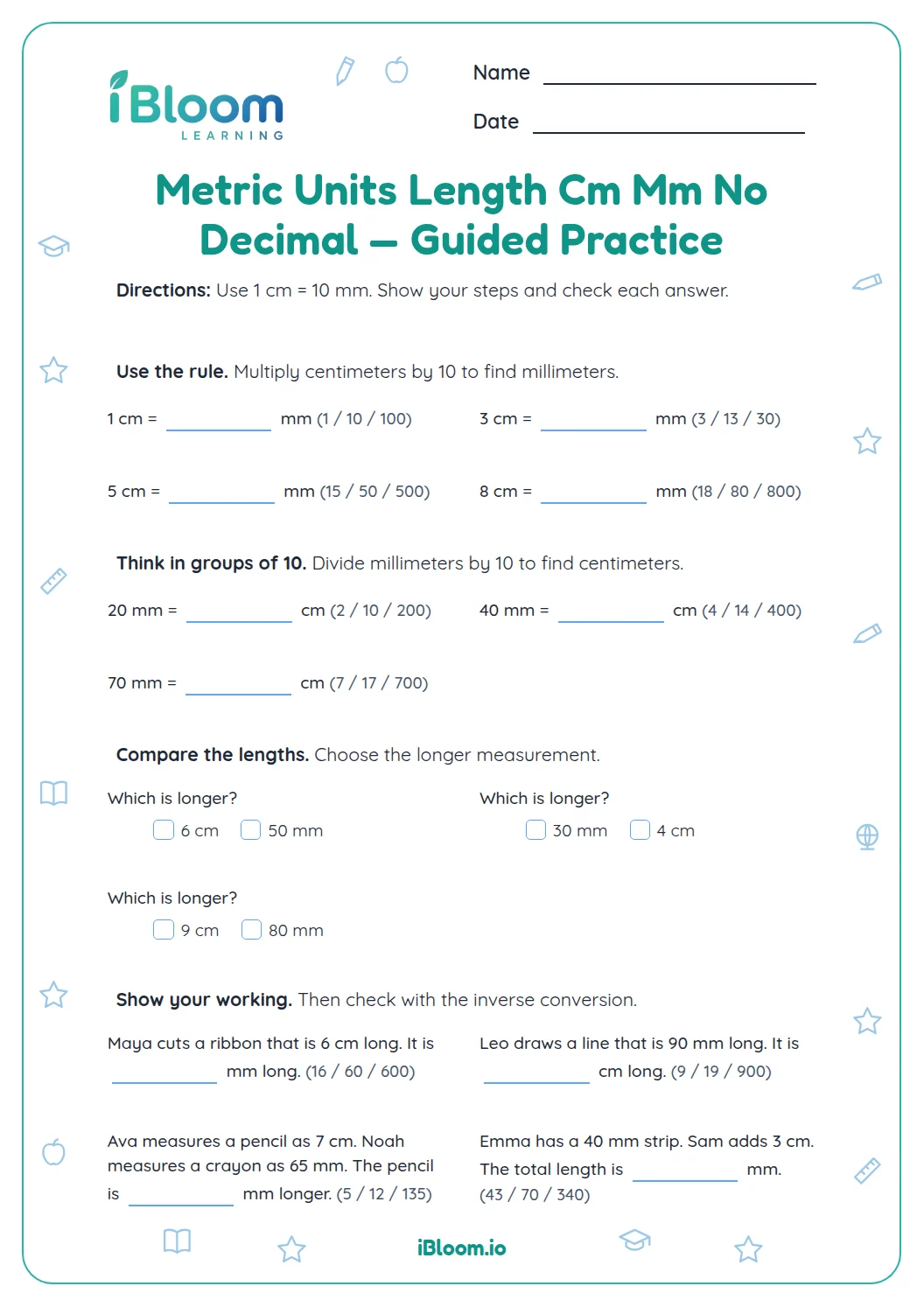
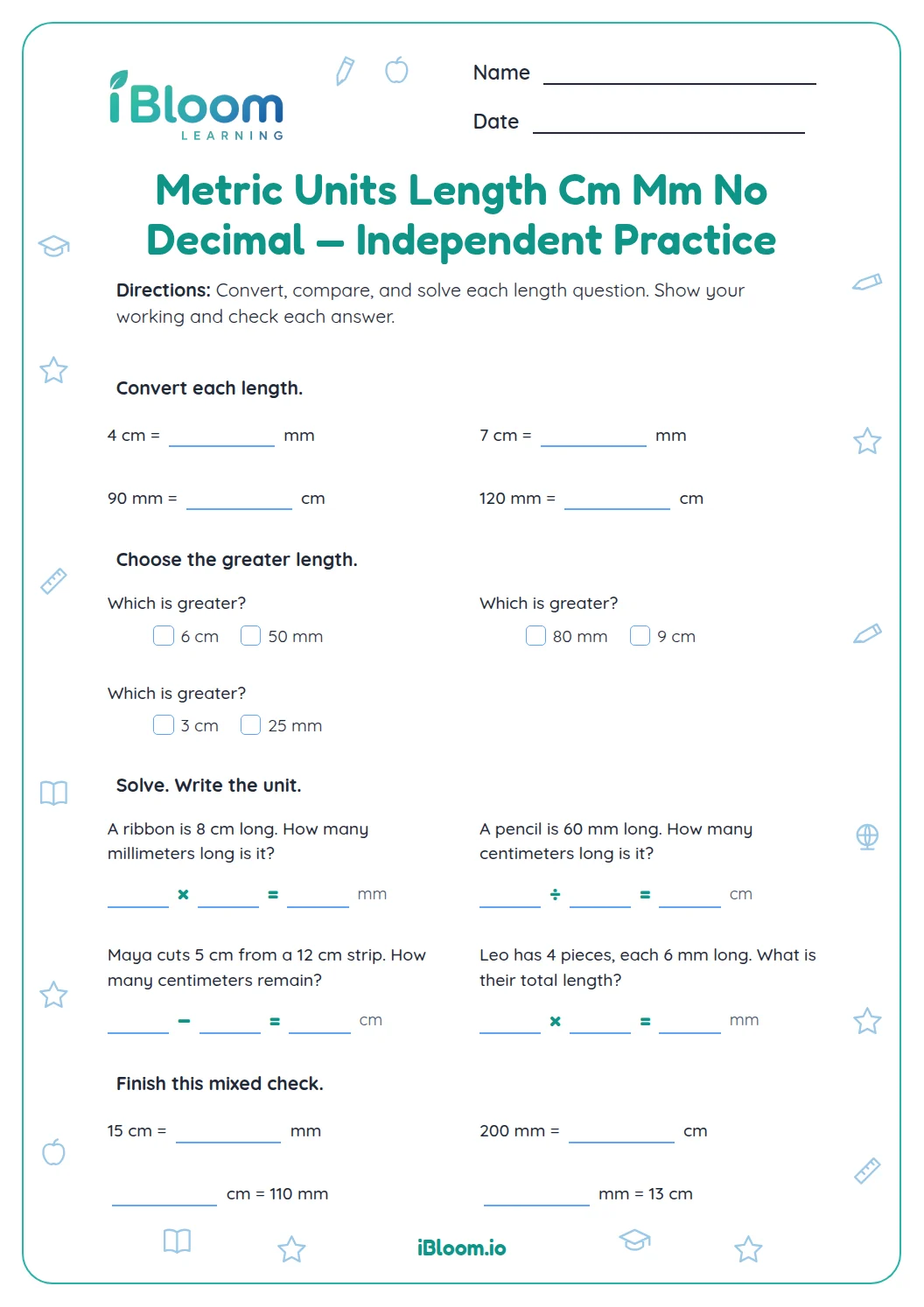
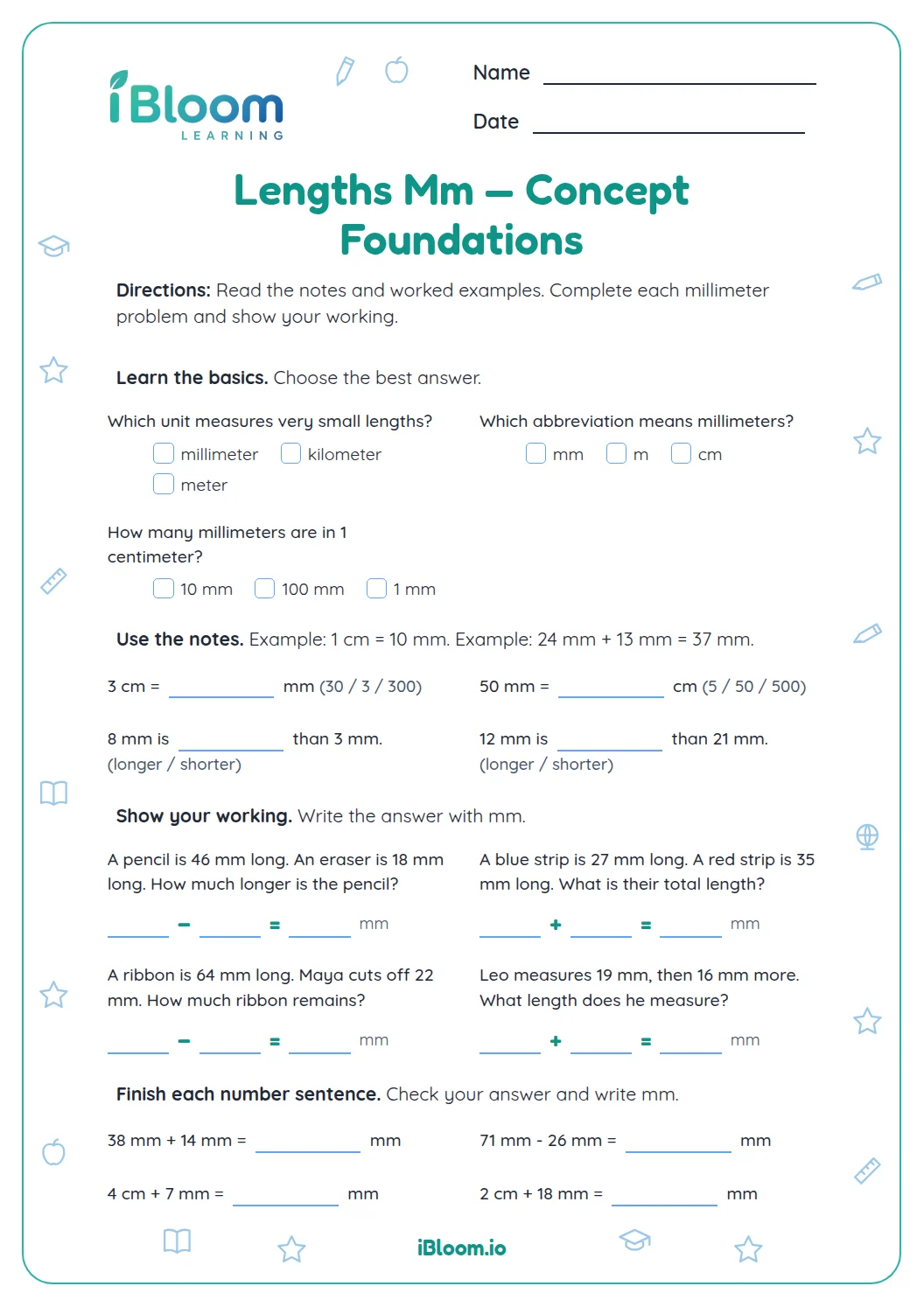
This free printable worksheet gives Grade 3 students a first, hands-on feel for the three metric units of length. In Part A, children choose meters, centimeters or millimeters for everyday objects such as a classroom door, a coin and a ladybug. In Part B, they read the length of an object lying along a ruler and change it from centimeters into millimeters. Part C practices the key facts, 1 m = 100 cm and 1 cm = 10 mm, with six conversions, and Part D is a ribbon word problem. It supports Common Core 2.MD.A.3 and 4.MD.A.1. An answer key is included.
Aligned to 2.MD.A.3 and 4.MD.A.1
What is on this worksheet?
Seventeen questions in four parts that move from picking a unit to converting between units. The sheet is built around one idea: each metric unit is a fixed number of the next smaller one.
Part A has six multiple-choice sentences, Part B has two ruler drawings with a reading and a conversion for each, Part C has six conversion sentences and Part D has one word problem with working space and an answer box.
- Part A: choose m, cm or mm (questions 1 to 6)
- Part B: read the ruler, then change cm into mm (questions 7 to 10)
- Part C: change the unit, with the facts printed under the heading (questions 11 to 16)
- Part D: one ribbon word problem (question 17)
- Answer key on its own pages
How do you choose between meters, centimeters and millimeters?
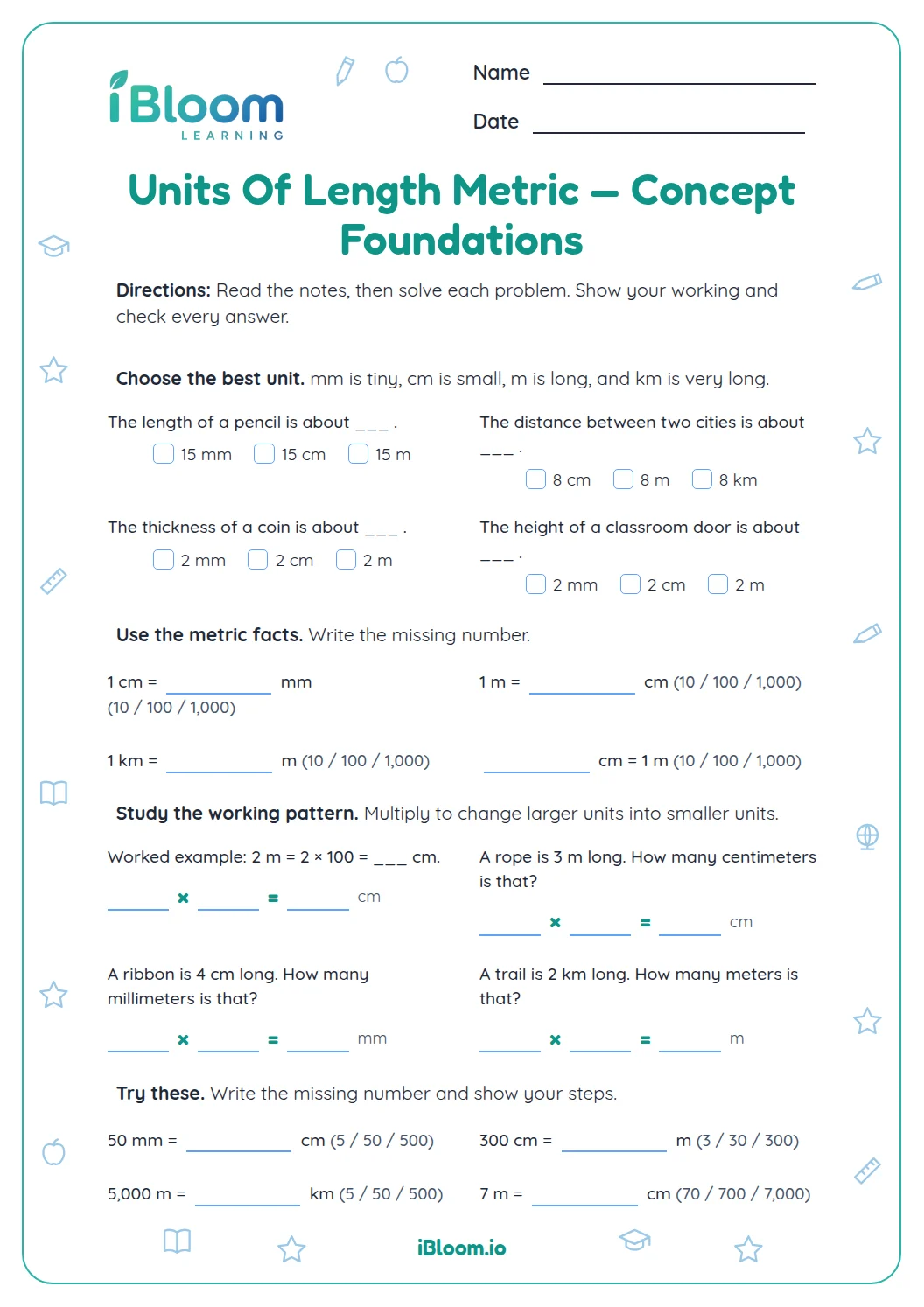
Compare the object with a few things you already know. A fingernail is about 1 cm wide, a coin is about 2 mm thick and a classroom door is about 2 m tall. If you can picture the object next to one of those, the unit follows.
A quick check is to try each unit in the sentence. A door that is 2 cm tall would be only two fingernails high, and 2 mm would be as thin as a coin.
- 12) A classroom door is about 2 ___ tall.
- 22 mm is as thin as a coin, and 2 cm is about two fingernails wide.
- 3A door is taller than a child, so the unit is m.
How do you change one metric unit into another?
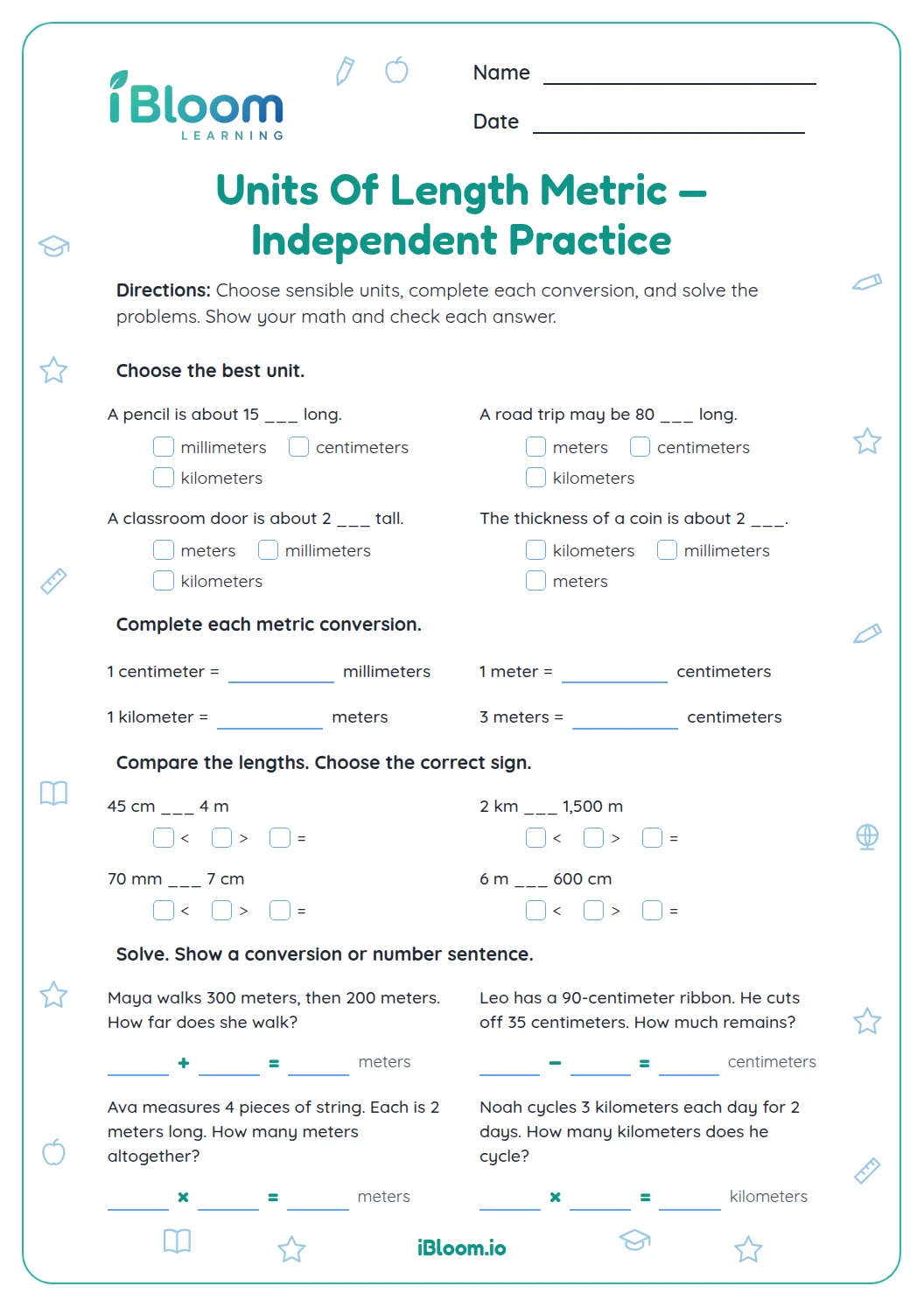
Start with the fact printed in Part C. Going to a smaller unit means more of them, so multiply: 3 m has three lots of 100 cm. Going to a larger unit means fewer, so divide: 500 cm is 500 ÷ 100 = 5 m.
Before writing the answer, ask whether it should be a bigger number or a smaller one. Centimeters are shorter than meters, so you need more of them. Meters are longer than centimeters, so you need fewer.
- 113) 3 m = ___ cm → 3 × 100 = 300 cm
- 214) 6 cm = ___ mm → 6 × 10 = 60 mm
- 316) 80 mm = ___ cm → 80 ÷ 10 = 8 cm
How does reading a ruler help with conversion?
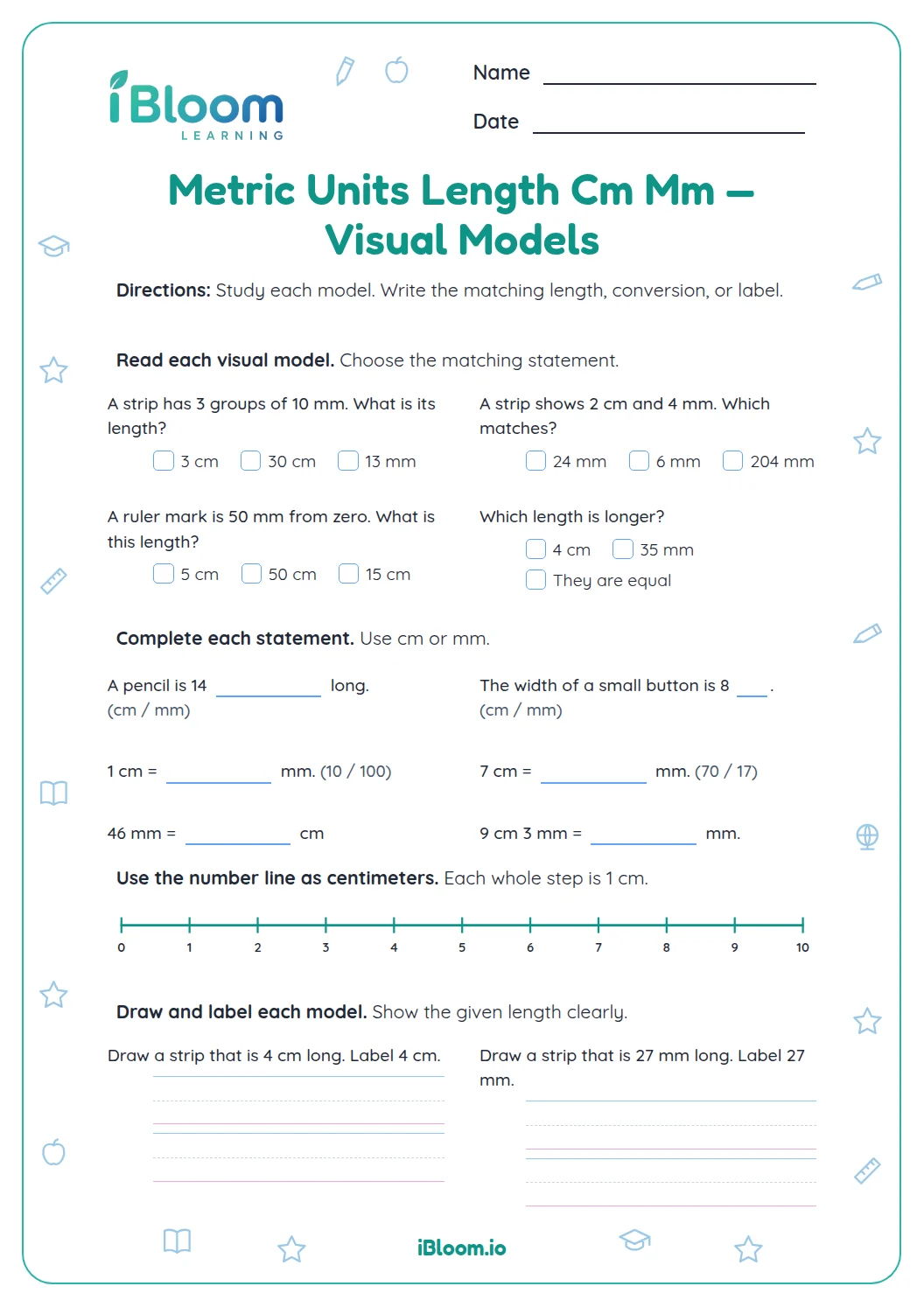
In Part B, each object starts at 0 and ends on a centimeter mark, so the length is the number at its right end. Every one of those centimeters is 10 millimeters, so the same length can be written in two units.
Reading question 7 gives 7 cm. Question 8 then turns it into millimeters: 7 × 10 = 70 mm. Pairing the two links a length children can see with the conversion fact they use in Part C.
How to use this worksheet at home or in class
- 1Before starting, hold up a ruler and find 1 cm, then show how long 10 of those are. Point out that a meter stick is 100 of them.
- 2Read the Part A sentences aloud and have your child picture each object before choosing.
- 3For Part B, check that your child starts counting at 0 on the ruler, not at 1.
- 4Read the facts under the Part C heading together. Ask, “Will the answer be a bigger number or a smaller one?” before each conversion.
- 5Let your child write what they did in the working box for question 17: 2 m is 200 cm, then 200 − 50 = 150 cm.
- 6Check with the answer key and talk through any conversion that went the wrong way.
Common mistakes and quick fixes
The mistake
Writing 3 m = 30 cm, because the child multiplied by 10 instead of 100 (question 13).
The fix
Say the fact aloud: a meter stick is 100 centimeters long. Then three meter sticks are 300 centimeters, not 30.
The mistake
Writing 80 mm = 800 cm by multiplying when going to a larger unit (question 16).
The fix
A centimeter is bigger than a millimeter, so you need fewer of them. Ask whether 800 cm could possibly be the same length as 80 mm.
The mistake
Counting tick marks instead of centimeter jumps, so the crayon in question 7 looks like 8 cm.
The fix
The first mark is 0, not 1. Count the spaces between marks, or read the number at the right end. The crayon ends at the 7 mark, so it is 7 cm long.
Common Core alignment
Most US states teach measurement with the Common Core standards or a close state version. These two standards name the skills the page practices.
Estimate lengths in centimeters and meters, and choose a sensible unit.
On this sheet: Part A asks children to estimate the length of everyday objects and choose meters or centimeters, along with millimeters.
Show the official wordingHide the official wording
Estimate lengths using units of inches, feet, centimeters, and meters.
Know the sizes of metric units and express a larger unit in a smaller one.
On this sheet: Parts B to D use 1 m = 100 cm and 1 cm = 10 mm to express meters as centimeters and centimeters as millimeters.
Show the official wordingHide the official wording
Know relative sizes of measurement units within one system of units including km, m, cm; kg, g; lb, oz.; l, ml; hr, min, sec. Within a single system of measurement, express measurements in a larger unit in terms of a smaller unit. Record measurement equivalents in a two-column table. For example, know that 1 ft is 12 times as long as 1 in. Express the length of a 4 ft snake as 48 in. Generate a conversion table for feet and inches listing the number pairs (1, 12), (2, 24), (3, 36), …
What to practice next
Make more practice
Further reading
Questions parents and teachers ask
How many centimeters are in a meter?
There are 100 centimeters in a meter. A meter stick shows this: it is marked in 100 centimeter steps. On this worksheet, the fact is printed under the Part C heading, and children use it for questions such as 3 m = 300 cm and 500 cm = 5 m.
How many millimeters are in a centimeter?
There are 10 millimeters in a centimeter. On a real ruler, each centimeter is split into 10 tiny spaces, and each space is 1 millimeter. Part B uses the fact twice, turning the 7 cm crayon into 70 mm and the 5 cm key into 50 mm, and Part C uses it again for 6 cm and 80 mm.
How do I know whether to multiply or divide?
Look at the units. Changing to a smaller unit needs more of them, so multiply. Changing to a larger unit needs fewer, so divide. On this worksheet, 3 m to cm multiplies by 100, while 80 mm to cm divides by 10. Asking “should the number get bigger or smaller?” is a quick check before writing.
Why does Part A include millimeters as well as centimeters and meters?
Millimeters are the unit for very small things, and Part A gives two of them: a coin's thickness and a ladybug's length. Having all three units in every choice means children cannot just pick the most familiar one. They have to compare each object with a known size.
Do we need a ruler to use this worksheet?
No. Part B draws a ruler beside each object, so children can read it without equipment. A real centimeter ruler or meter stick still helps, especially before Part A, so your child can see how big 1 cm, 10 cm and 1 m really are before choosing a unit.
What should my child do after this worksheet?
Ask your child to measure three things at home in centimeters and write each length in millimeters too. After that, the cm and mm worksheets give more conversions, and the mass worksheet shows the same pattern of 1,000 grams in a kilogram. The ruler generator makes extra reading practice.