



About this worksheet
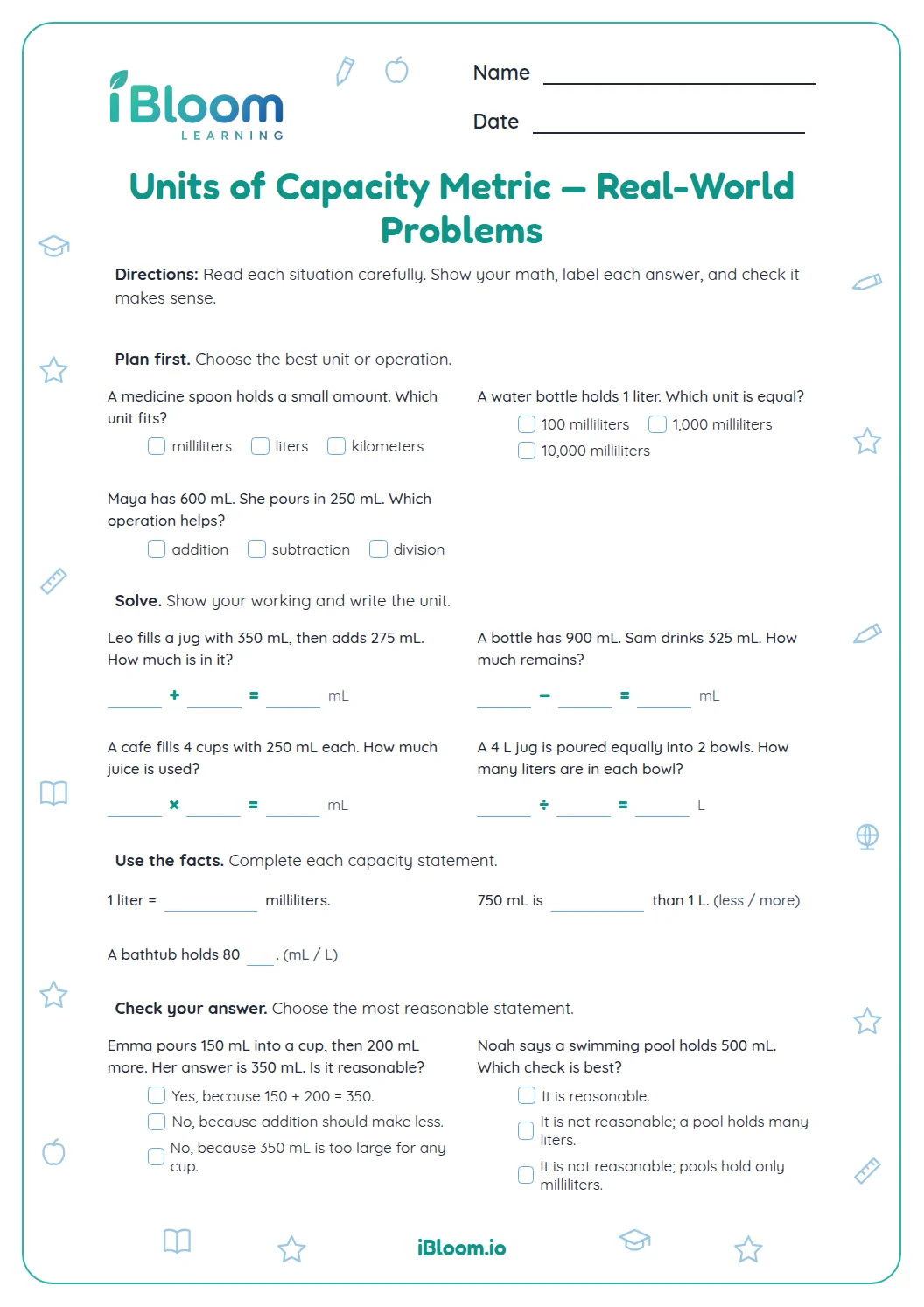
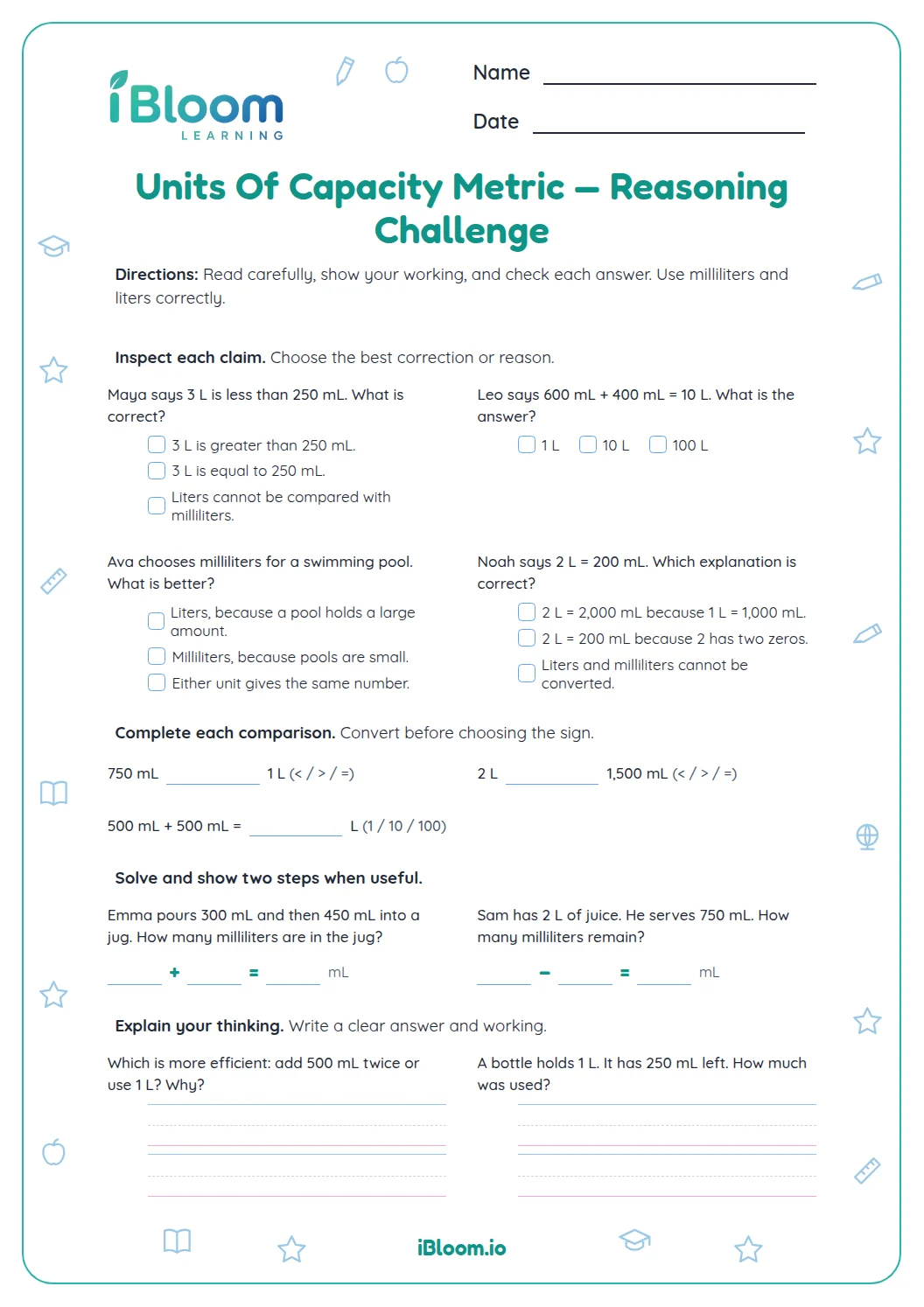
This free Grade 3 worksheet introduces metric capacity through familiar containers. Children choose liters or milliliters for five labeled amounts, convert 1 liter to 1,000 milliliters, select reasonable capacities for two containers, and solve four one-step problems with liquid volumes. The sheet connects L and mL before children use milliliters in addition, subtraction, multiplication and division. These estimates and same-unit volume problems practice Common Core 3.MD.A.2. A separate answer key gives each unit choice and calculation, making it easy to discuss why both the number and its unit matter.
Aligned to 3.MD.A.2
What do L and mL mean?
L stands for liter and mL stands for milliliter. One liter equals 1,000 milliliters. The printed examples include 5 mL in a teaspoon, 250 mL in a drinking cup and 10 L in a bucket.
A container can hold different amounts depending on its size. These questions specify a familiar container and give a number; children choose the unit that makes that particular amount reasonable.
How can children check whether a capacity is reasonable?
Part B asks children to choose between three capacities for a full bathtub and a large watering can. Imagine the container and compare it with a one-liter bottle. A full bathtub holds many bottlefuls; a large watering can holds several.
The answer is an estimate for the described container. The choices are deliberately far apart so children can use everyday size knowledge.
How do the problems use liters and milliliters?
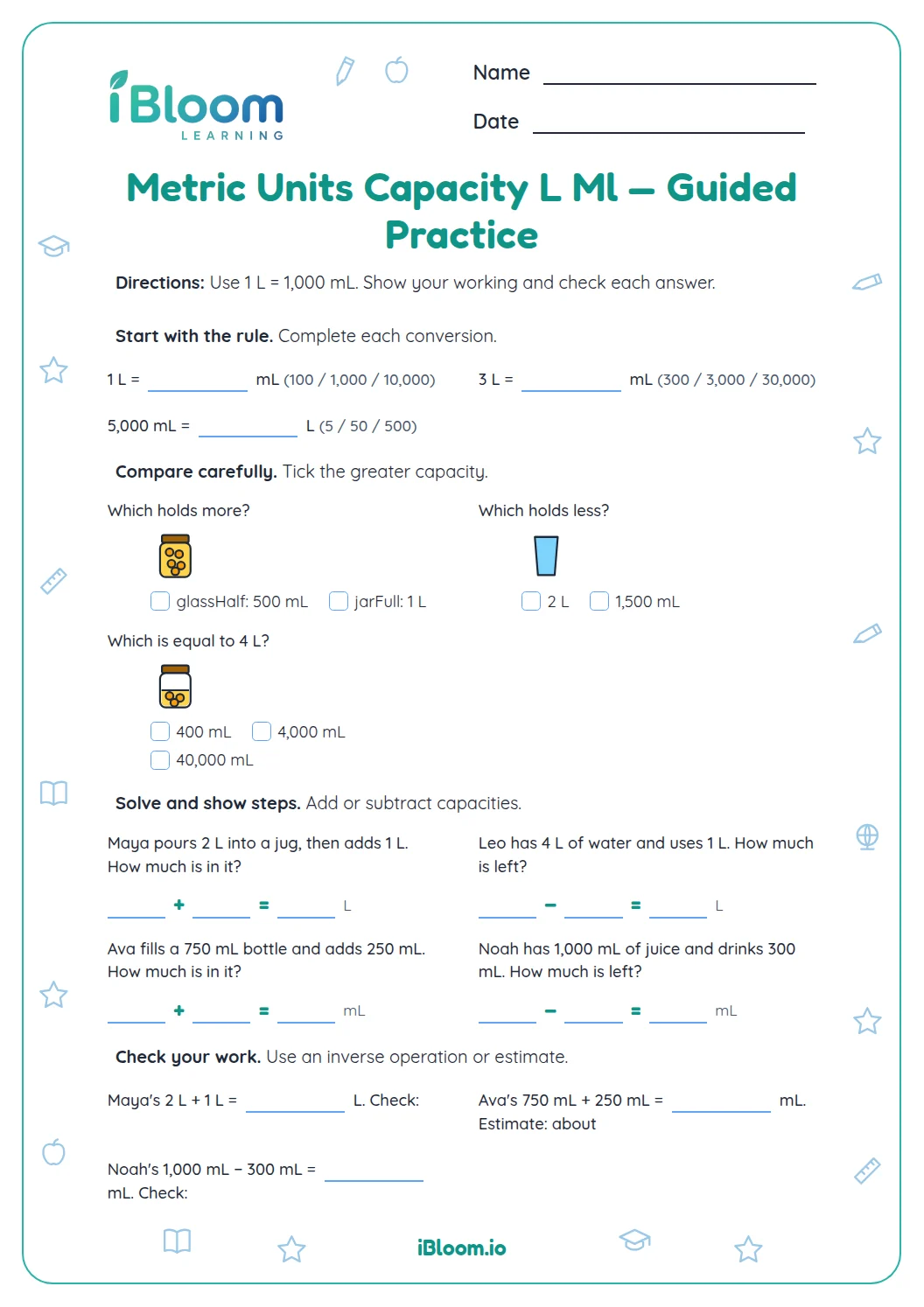
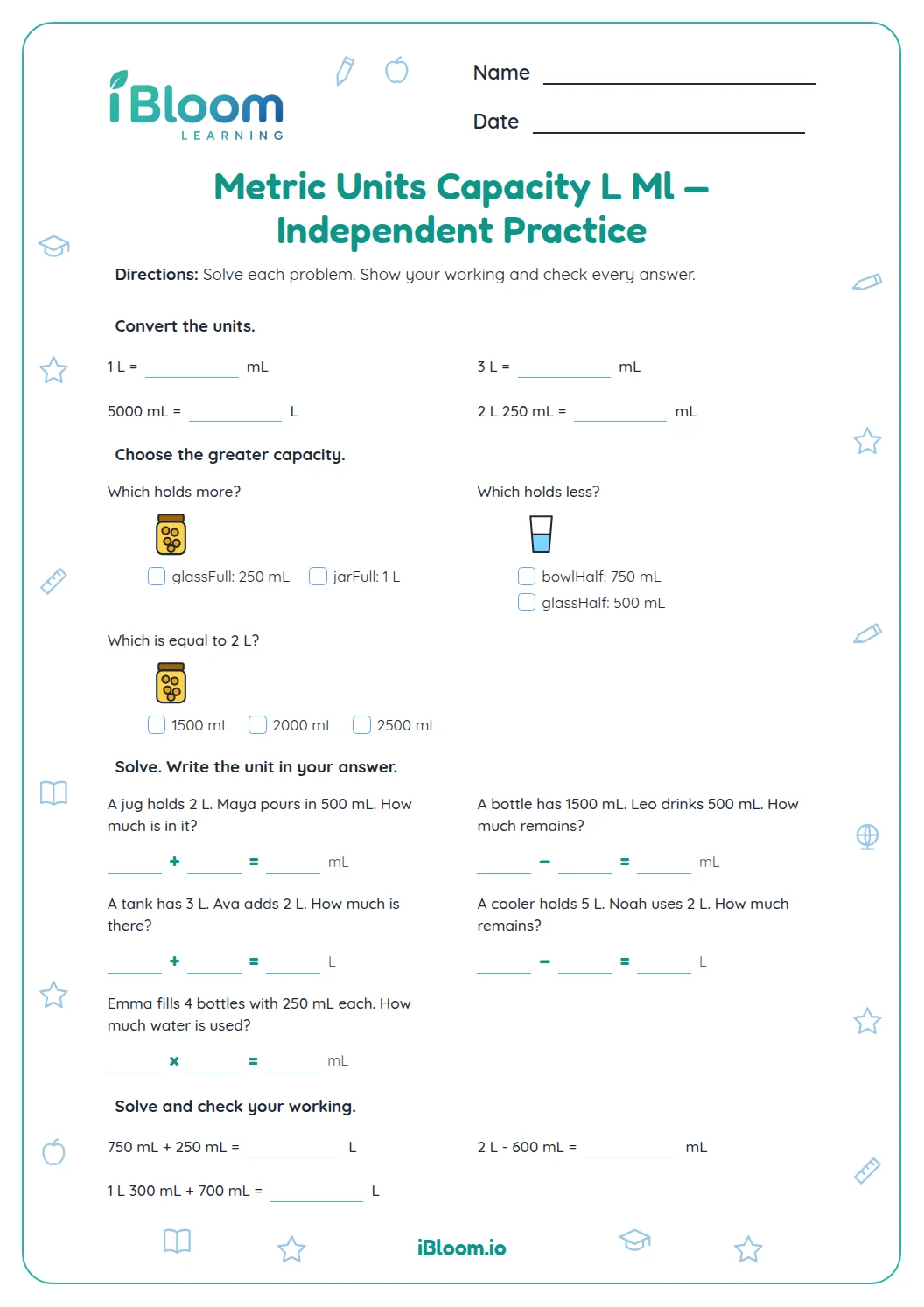
Part C begins with 1 L and asks children to reason in milliliters. The other amounts are already in mL, so children can add, subtract, multiply or divide while keeping the unit the same.
- 1Maya has 1 L of water and pours out 200 mL.
- 21 L = 1,000 mL; 1,000 − 200 = 800
- 3Maya has 800 mL left.
How to work through the sheet
- 1Read L and mL aloud; remember that 1 L equals 1,000 mL.
- 2Choose a reasonable unit for each familiar container in Part A.
- 3Use the container sizes to judge the two capacities in Part B.
- 4Convert the liter to milliliters when needed, then solve each Part C problem.
- 5Check the number sentence and include mL or L in each answer.
Mistakes to notice and how to help
The mistake
Choosing 5 L for a teaspoon.
The fix
Picture five one-liter bottles beside the spoon; 5 mL is the reasonable amount.
The mistake
Choosing a unit from the number alone.
The fix
Read the container too: 20 L can suit a small tank, while 200 mL can suit a juice box.
The mistake
Subtracting 200 from 1 without converting 1 L first.
The fix
Rename 1 L as 1,000 mL, then subtract: 1,000 − 200 = 800 mL.
Common Core alignment
Estimate liquid capacities and solve one-step volume problems with metric units.
On this sheet: Children estimate familiar capacities and solve one-step volume problems, including converting 1 L to 1,000 mL.
Show the official wordingHide the official wording
Measure and estimate liquid volumes and masses of objects using standard units of grams (g), kilograms (kg), and liters (l). Add, subtract, multiply, or divide to solve one-step word problems involving masses or volumes that are given in the same units, e.g., by using drawings (such as a beaker with a measurement scale) to represent the problem.
What to practice next
Make more practice
Further reading
Questions parents and teachers ask
What is capacity on this worksheet?
Capacity means how much a container can hold. The unit-choice questions describe approximate capacities of a teaspoon, cup, bucket, juice box and fish tank. The final problems use the liter-to-milliliter relationship and add, subtract, multiply or divide volumes.
What is the difference between L and mL?
L is the symbol for liter, and mL is the symbol for milliliter. One liter equals 1,000 milliliters. A milliliter is smaller, so the same amount has a larger number when measured in milliliters. Question 4 practices the conversion directly.
Are the capacity estimates exact measurements?
No, the capacity choices are reasonable estimates for the containers described. A bathtub’s size can vary, but 150 L is sensible among 150 mL, 150 L and 1 L. Discuss why the other choices are too small for a full bath.
Do children need to convert units in the word problems?
Question 9 starts with 1 L, so children first use 1 L = 1,000 mL. The other problems give volumes in mL, so they can calculate directly and include mL with each result. Ask your child to say the unit aloud before choosing an operation.
How can we practice the idea with real containers?
Compare a teaspoon, drinking cup and large jug before completing the sheet. Read printed capacity labels together, then use 1 L = 1,000 mL to make sense of smaller milliliter amounts. A one-liter container can help a child picture how many milliliters it holds.