





About this worksheet
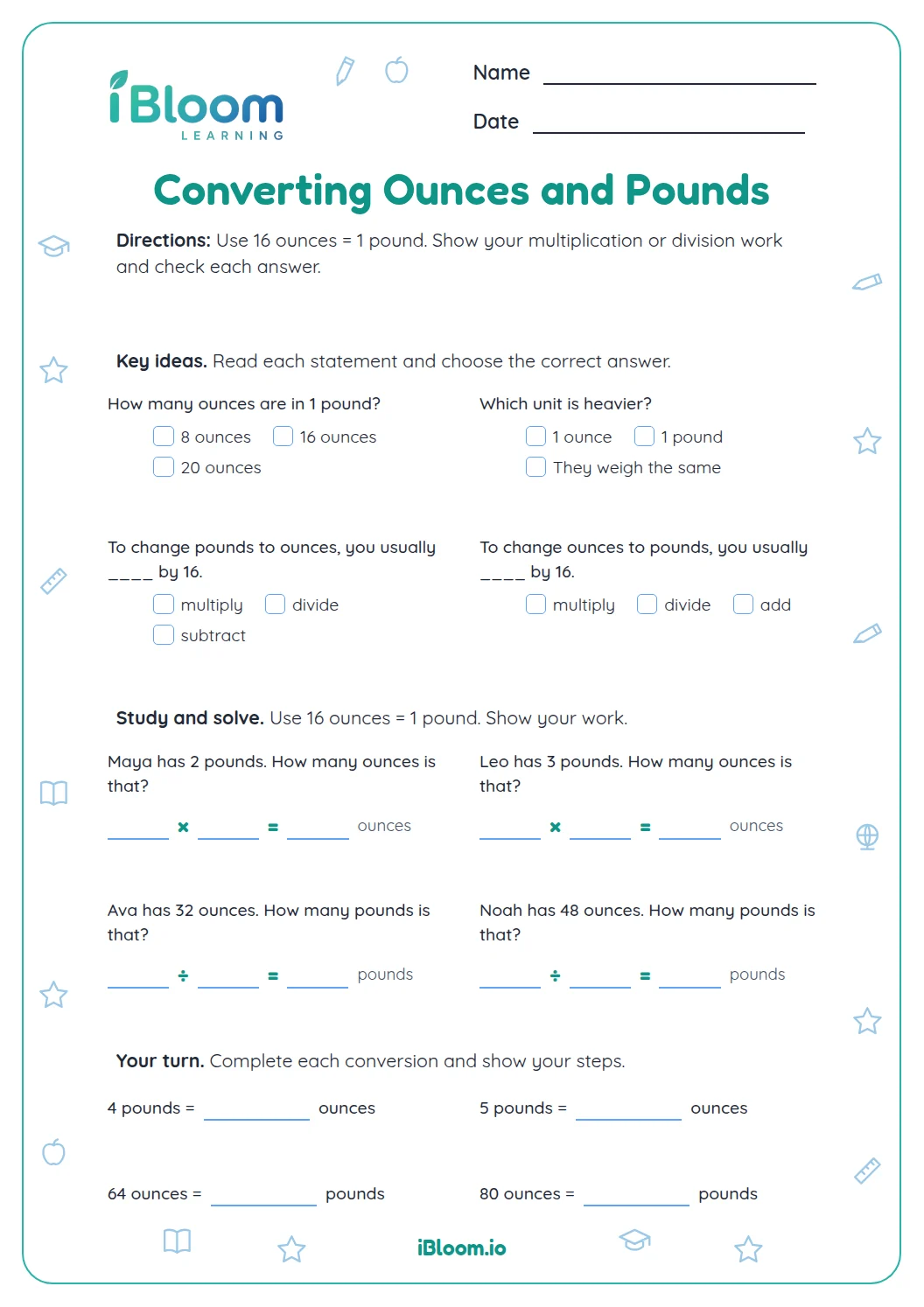
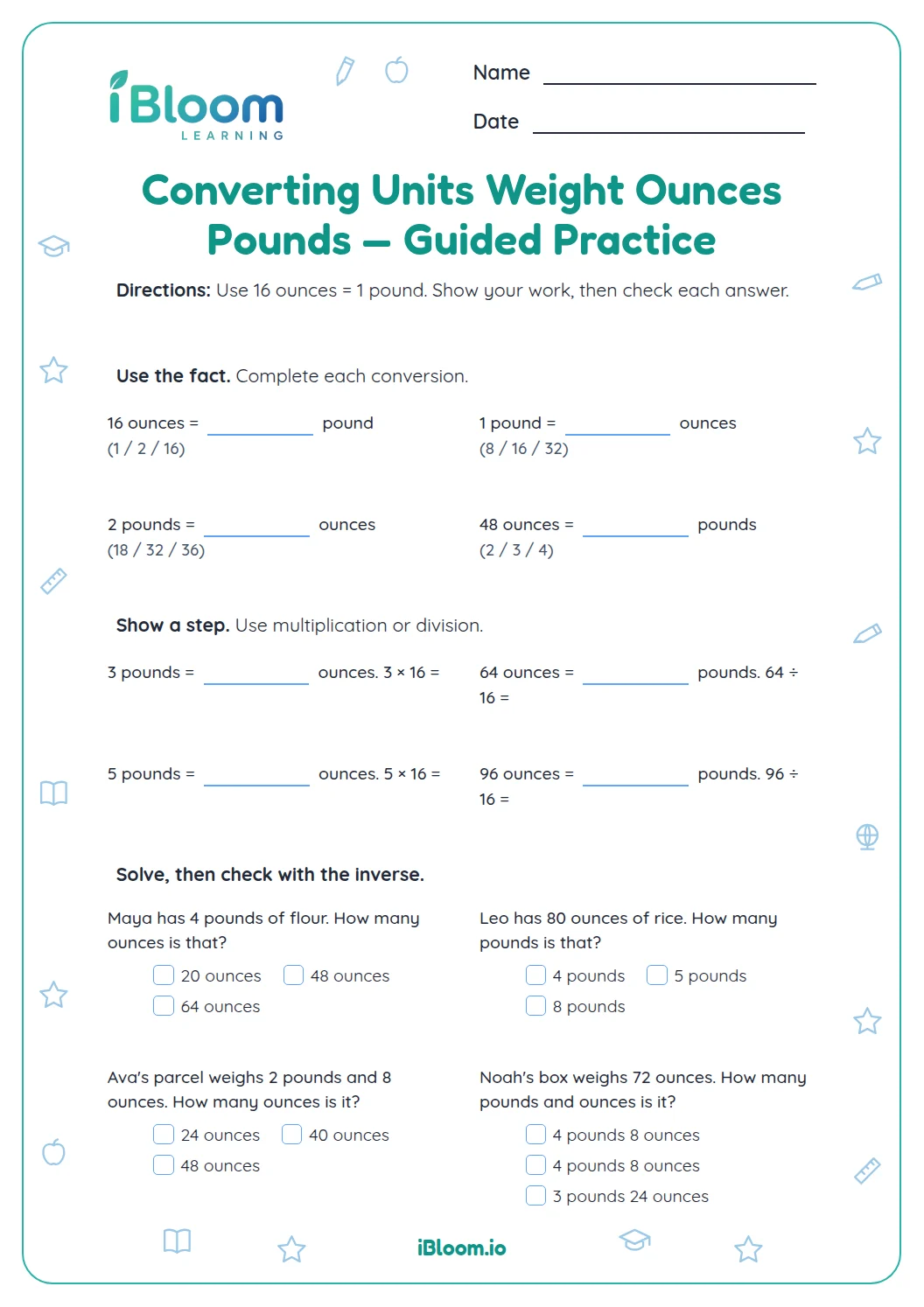
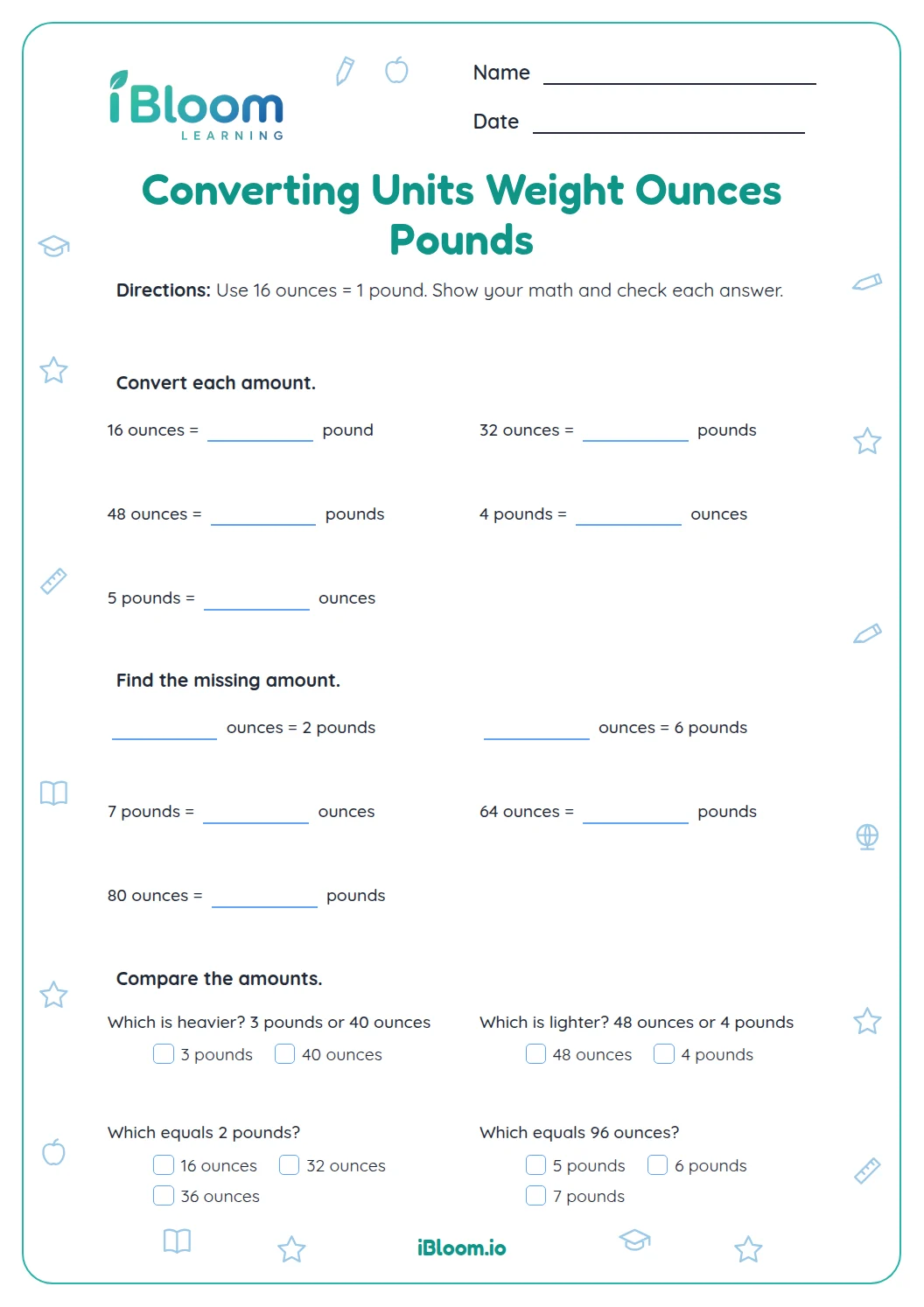
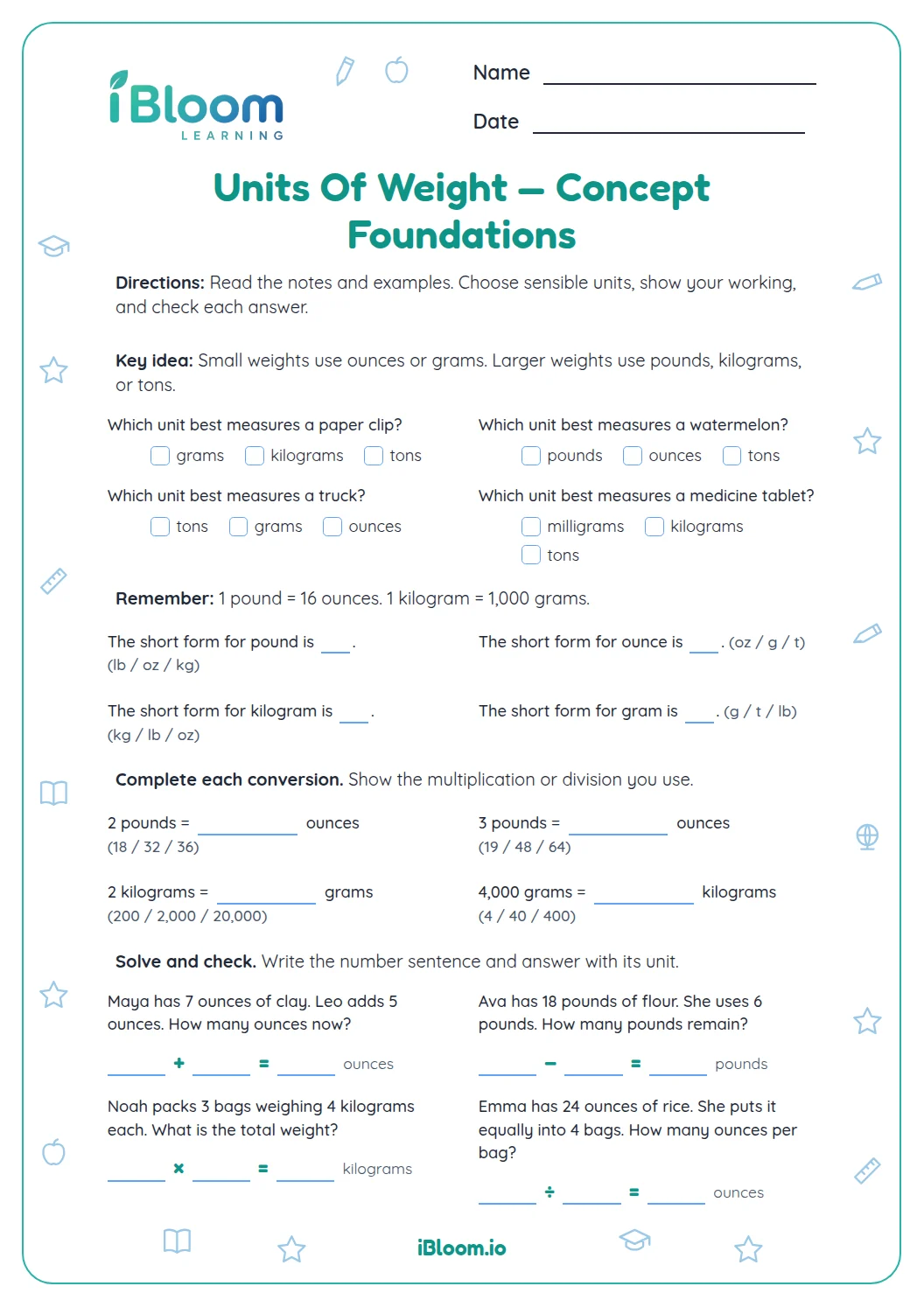
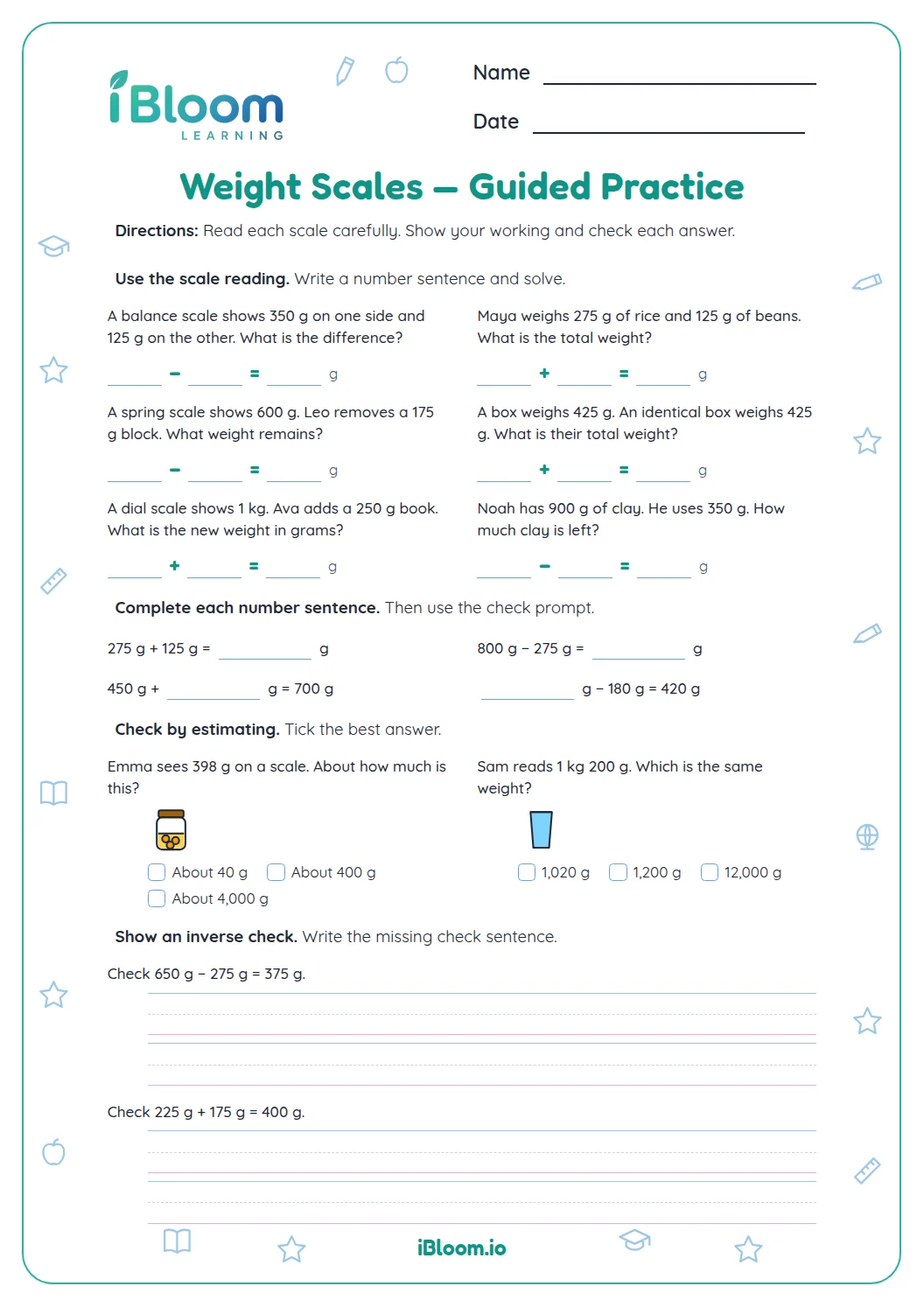
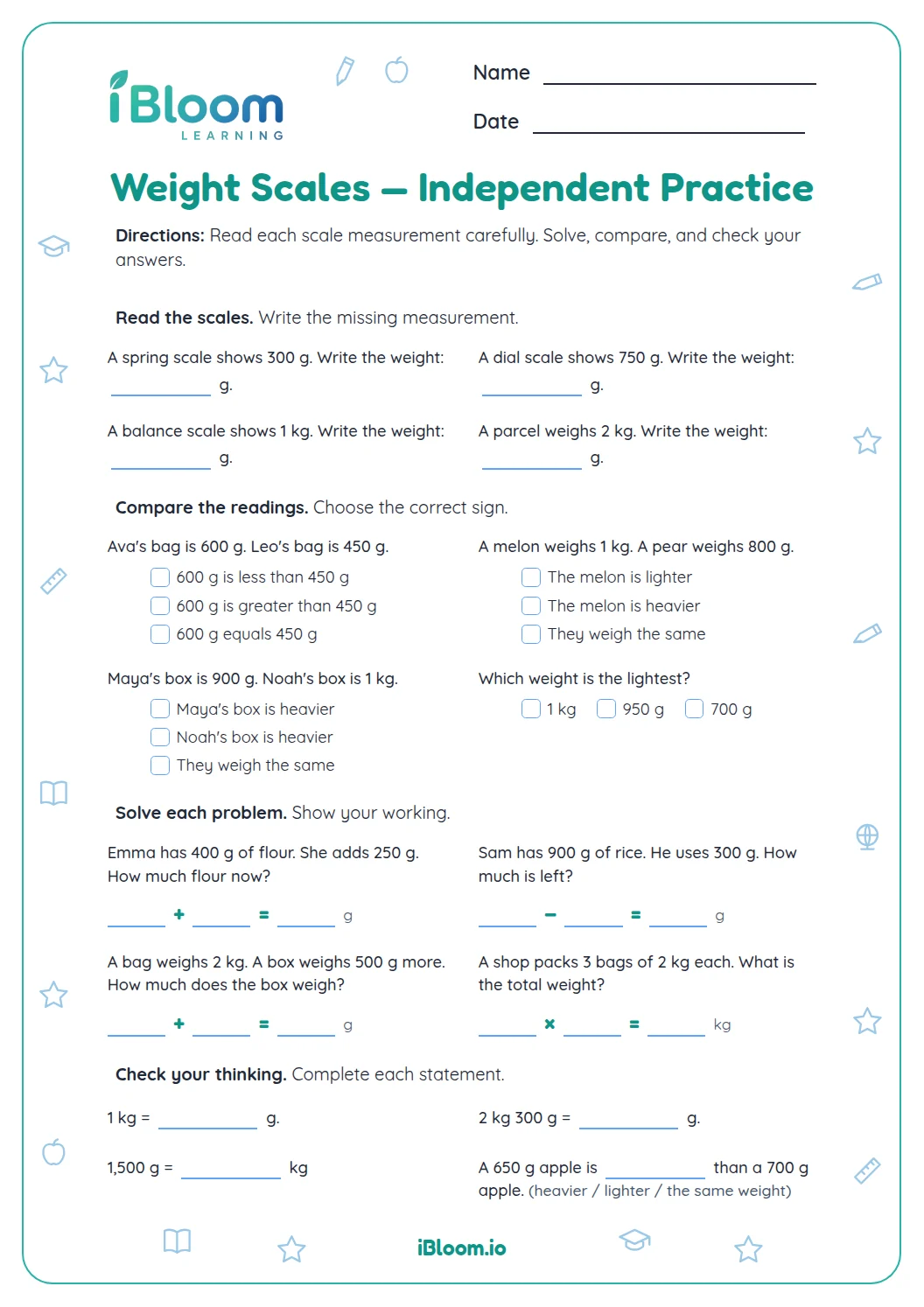
This free printable Grade 4 math worksheet makes the relationship between ounces and pounds visible: 16 ounces make 1 pound. Children count pound-sized steps on number lines, fill in conversion tables, convert ounces back to pounds, and solve four camping problems. The 16 questions use whole-pound weights from 1 to 6 pounds and practice measurement equivalence in Common Core 4.MD.A.1. The two worksheet pages include the conversion fact, with a separate answer key for checking. Repeated addition can help children find totals before they are comfortable multiplying by 16.
Aligned to 4.MD.A.1
What does one jump on these number lines mean?
Each space between neighboring tick marks represents 16 ounces, which is one pound. Start at zero and count spaces: one space reaches 16 ounces, two reach 32 ounces, and three reach 48 ounces. The zero mark is a starting point, not a pound to count.
Part A begins with two number lines. Children count the 16-ounce steps and write the equivalent number of pounds. Read the unit with the number: 48 ounces and 3 pounds describe the same weight.
- 116 oz = 1 lb
- 216 + 16 + 16 = 48 oz
- 33 jumps of 16 oz = 3 lb
- 448 oz = 3 lb
How do the tables connect pounds and ounces?
Part A also gives two conversion tables. The first row states 1 pound equals 16 ounces; the second row asks for the ounces in 4 or 5 pounds. Add another 16 for every additional pound.
For question 4, five pounds means five groups of 16 ounces. Add 16 + 16 + 16 + 16 + 16 to get 80, or multiply 5 × 16. Write 80 in the blank; the ounces column supplies the unit.
How do children convert back and use the weights?
Part B converts pounds to ounces, and Part C reverses the direction. For 80 ounces, ask how many groups of 16 fit into 80. Five groups fit, so 80 ounces equals 5 pounds. Check by multiplying 5 by 16.
Part D has four camp-packing problems about trail mix, raisins, rice and supplies. Before adding or subtracting weights, express them in the same unit. In question 14, change 1 pound of rice to 16 ounces, then subtract: 48 − 16 = 32 ounces left.
Using the ounce-and-pound models
- 1Read the fact 1 lb = 16 oz together. Say that lb means pound and oz means ounce.
- 2For Part A, count each 16-ounce space on the number lines and complete the tables with groups of 16.
- 3In Part B, multiply each pound amount by 16 to find ounces.
- 4In Part C, divide each ounce amount by 16 to find pounds. Check by multiplying back.
- 5For Part D, express the weights in the same unit before adding or subtracting. Check each blank with the key.
Three slips to check for
The mistake
Adding 16 to the pounds, so 3 lb becomes 19 oz.
The fix
Three pounds means three groups of 16: 16 + 16 + 16 = 48 oz. Point to the three number-line spaces.
The mistake
Counting the zero tick as a pound and calling 48 oz four pounds.
The fix
Count the spaces from 0 to 16, 16 to 32 and 32 to 48. There are three spaces, each worth one pound.
The mistake
Adding 2 lb and 16 oz to get 18 oz.
The fix
Rename 2 lb as 32 oz first. Then 32 oz + 16 oz = 48 oz; both numbers now use ounces.
Common Core alignment
The problems connect customary weight units and record equivalent measurements.
Use 1 lb = 16 oz to express equivalent weights and solve conversion problems.
On this sheet: Use 16 ounces per pound to convert and compare customary weights.
Show the official wordingHide the official wording
Know relative sizes of measurement units within one system of units including km, m, cm; kg, g; lb, oz; l, ml; hr, min, sec. Within a single system of measurement, express measurements in a larger unit in terms of a smaller unit. Record measurement equivalents in a two-column table.
What to practice next
Make more practice
Further reading
Questions parents and teachers ask
What do lb and oz mean on this worksheet?
The abbreviation lb means pound, and oz means ounce. One pound equals 16 ounces. Have your child say the full unit names when reading the first number line and table, then use the abbreviations to keep the later equations short and clear.
Does my child need to know the 16 times table?
No; repeated addition works for all the conversions on this sheet. To find the ounces in 3 pounds, add 16 three times to get 48. The number lines make those equal steps visible, and the tables help children connect repeated addition to multiplication.
Why does the 48-ounce number line represent 3 pounds?
It has three 16-ounce spaces from zero to 48, and each space represents one pound. Count the moves from 0 to 16, then to 32, then to 48. Counting the four tick marks instead would include the starting point and give an extra pound.
How should children solve the camp-packing problems?
They should express the weights in a common unit before adding or subtracting. In question 13, change 2 pounds of trail mix to 32 ounces, then add the 16 ounces of raisins. The answer is 48 ounces; children can record both steps on scratch paper.
What is included with the printable worksheet?
The printable includes two worksheet pages and a separate two-page answer key. Its 16 questions are grouped into four parts: visual models, pound-to-ounce conversions, ounce-to-pound conversions and four camping problems. The key fills each blank so you can check the answer alongside the unit printed in the question.