


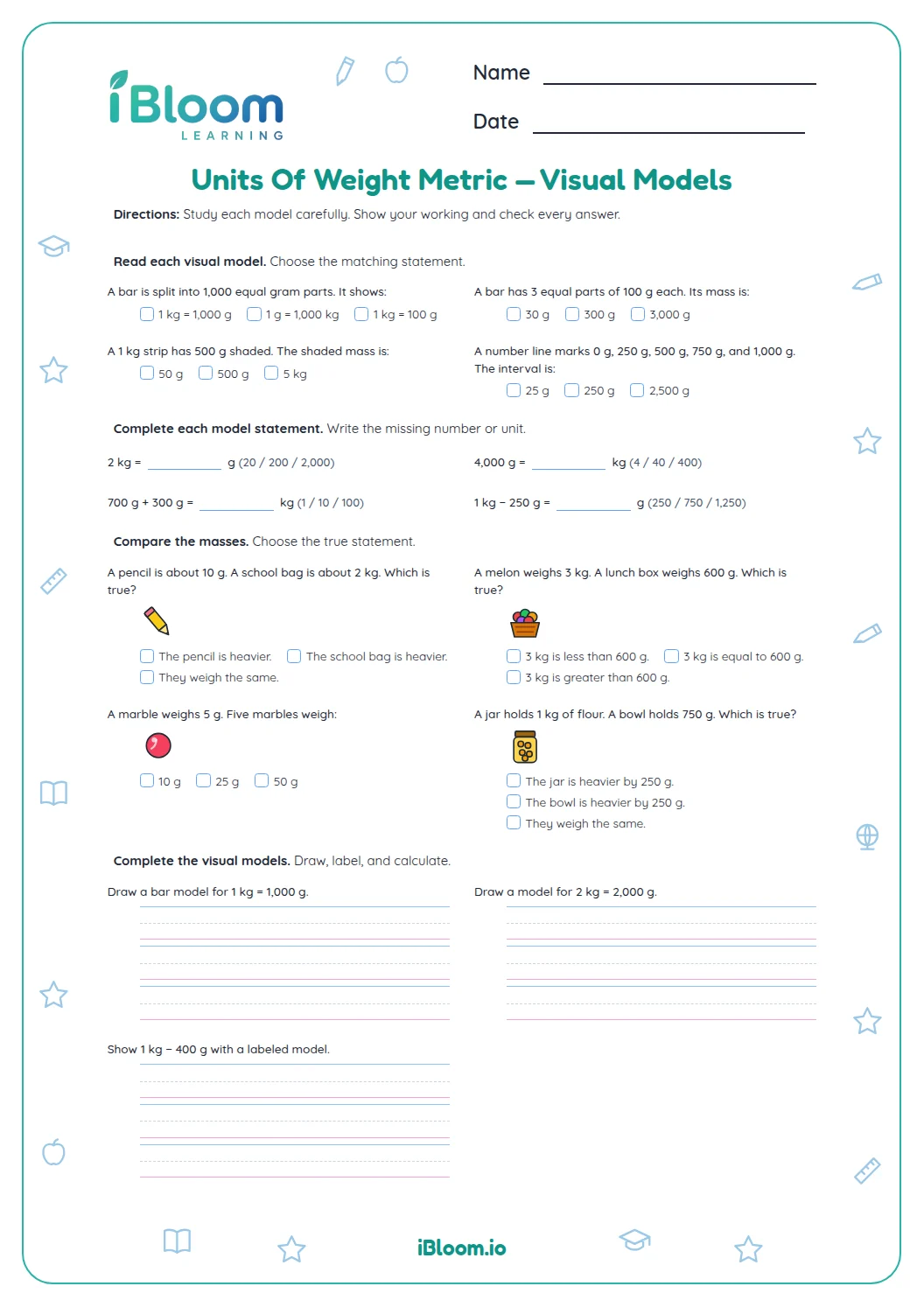
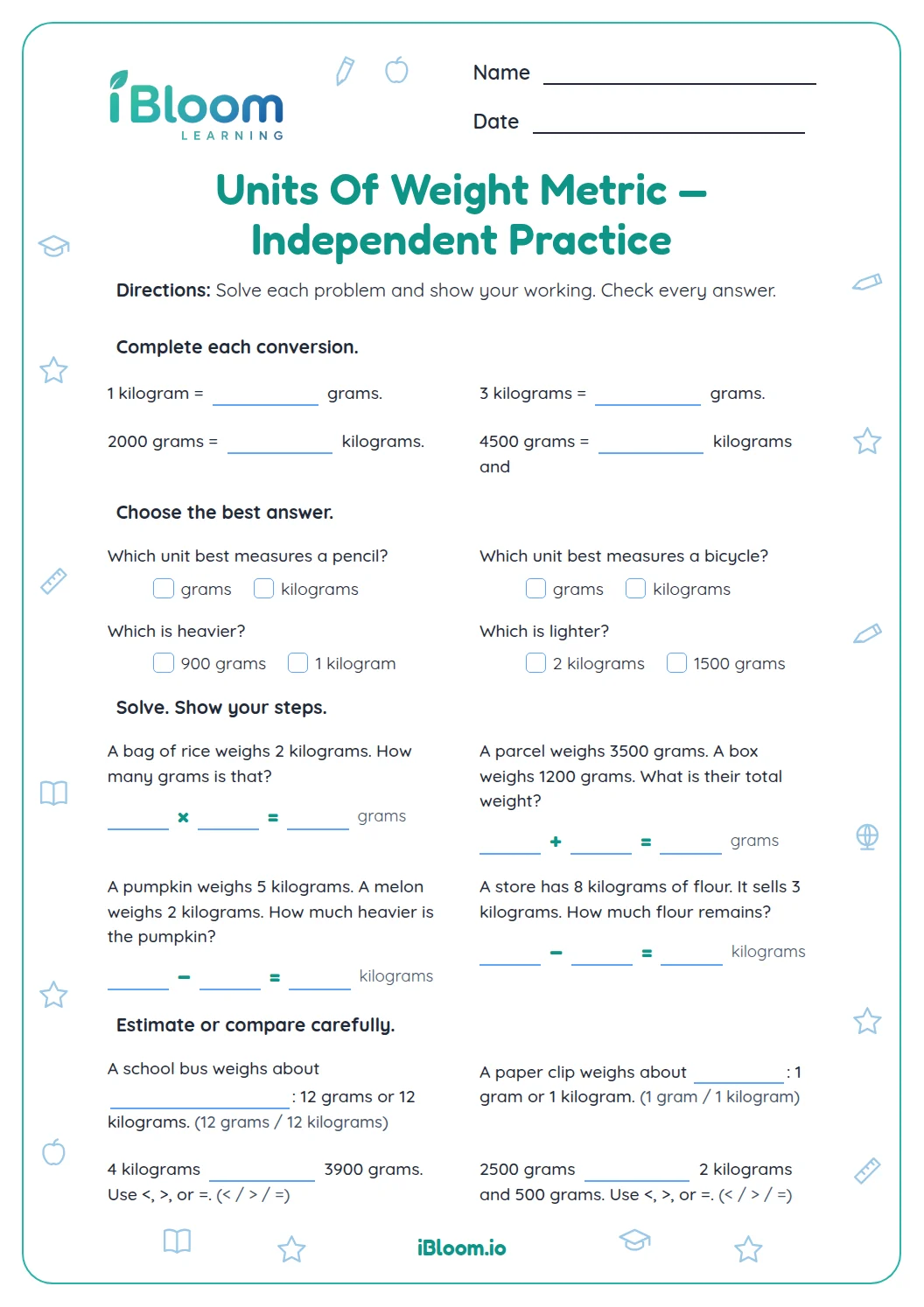
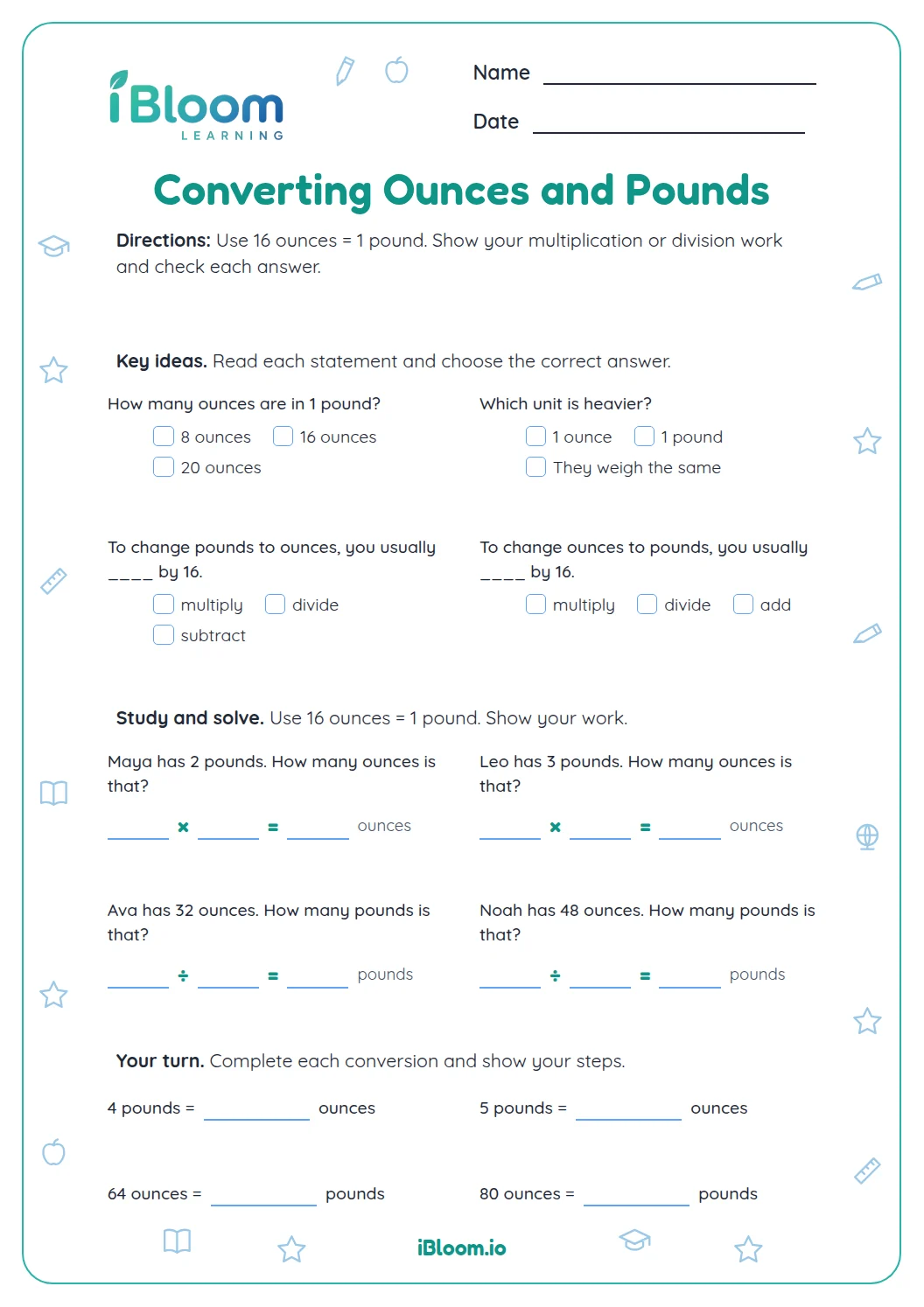
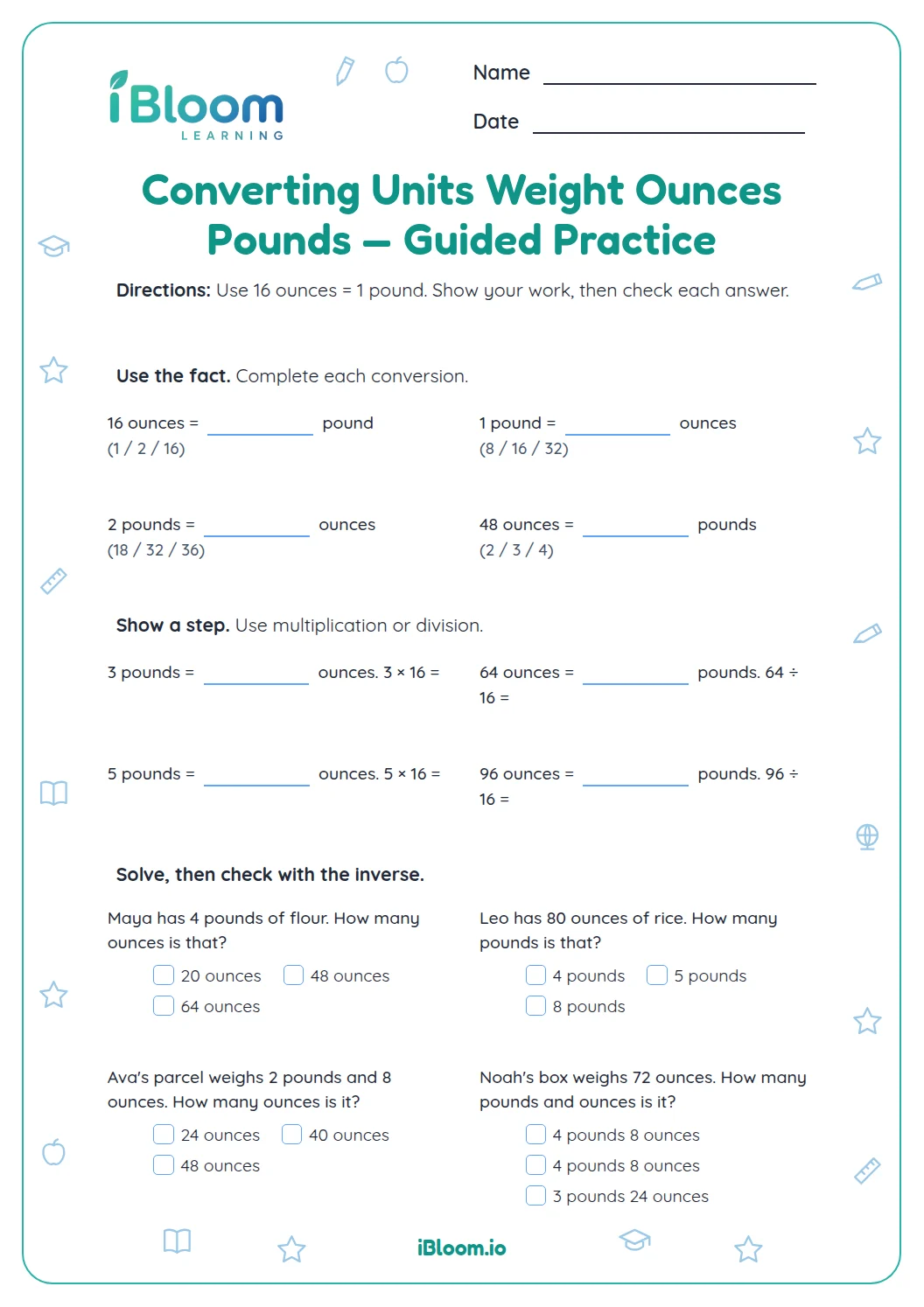


About this worksheet
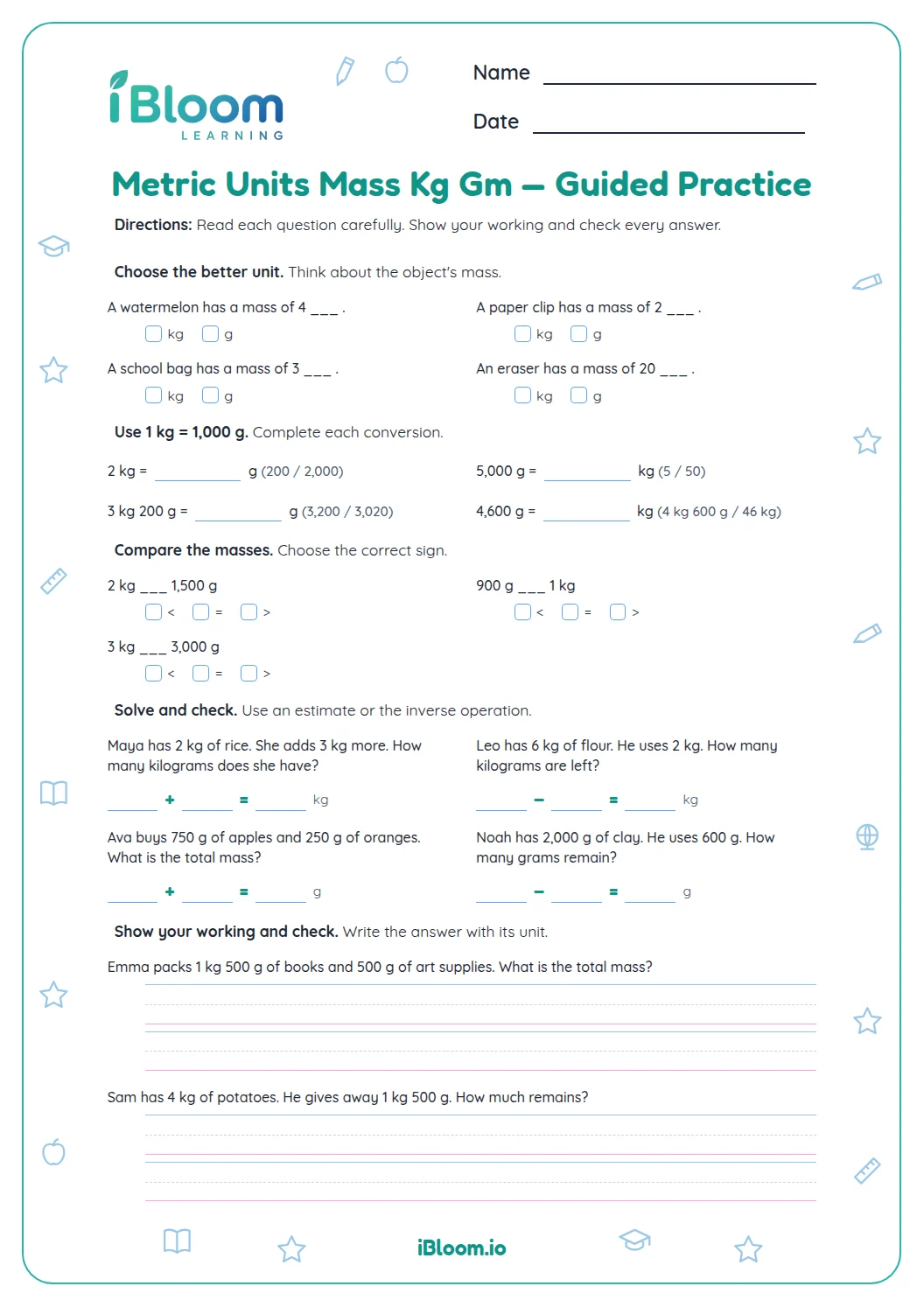
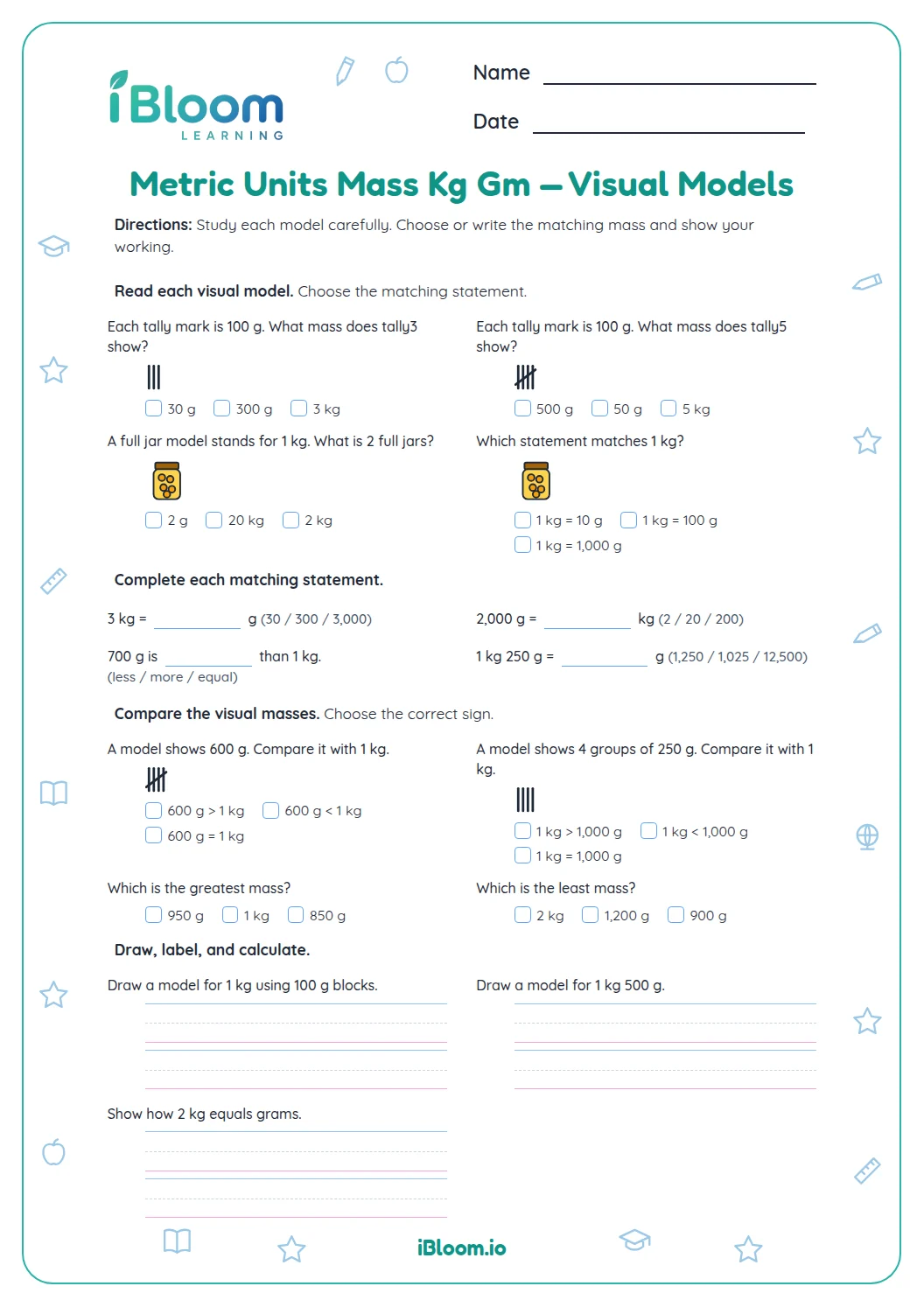
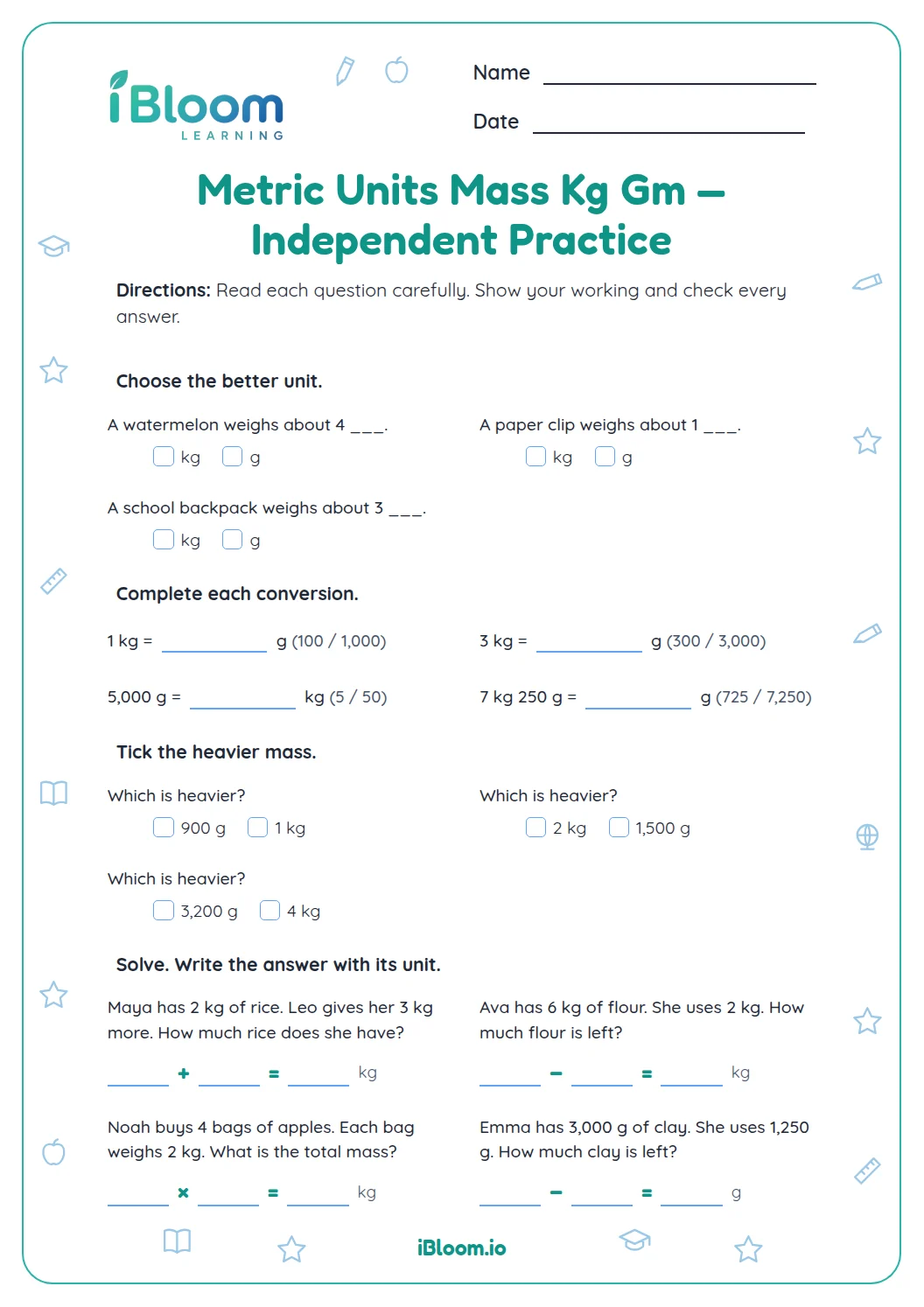
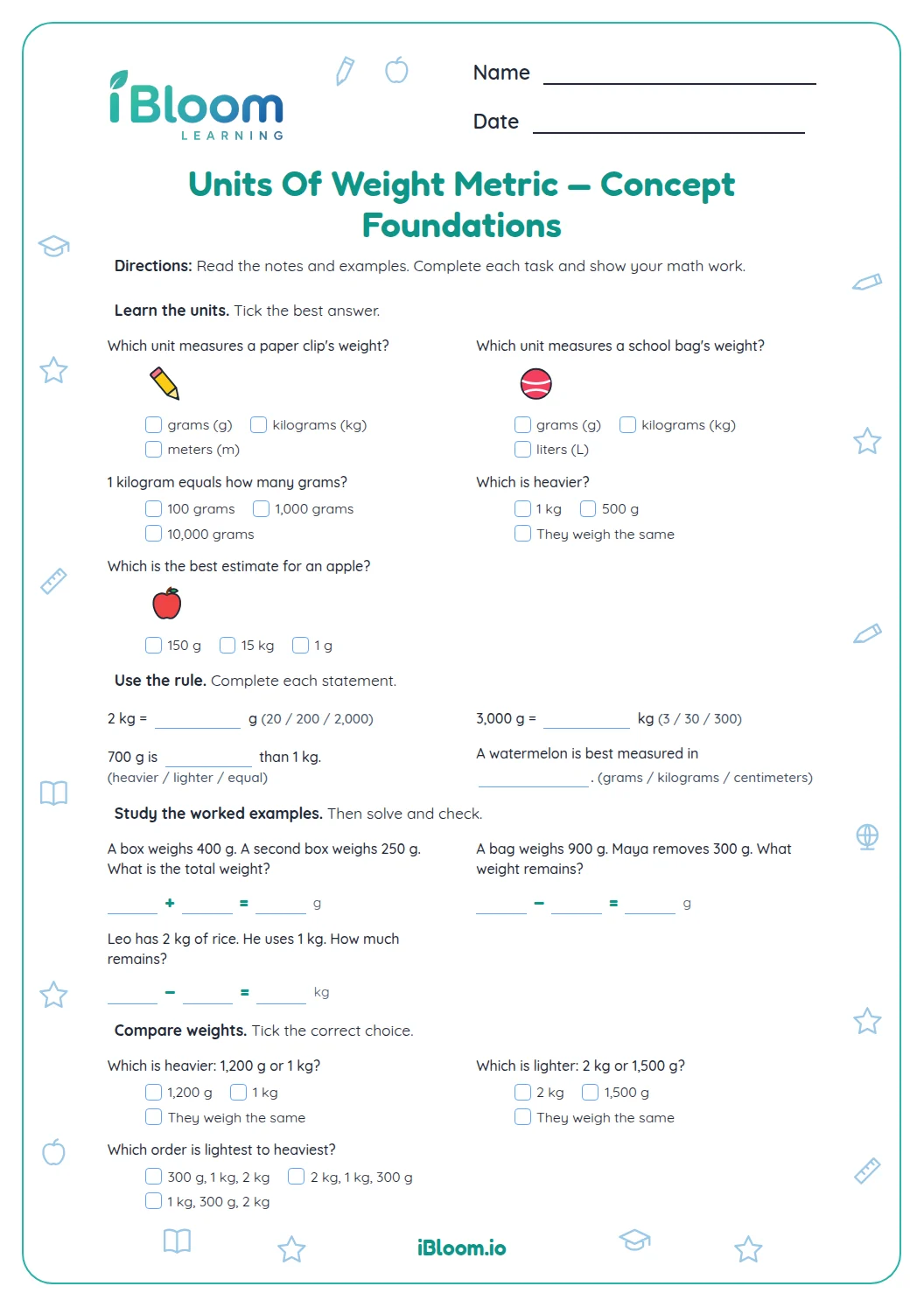
This free printable Grade 3 worksheet uses a bar graph to teach weight in grams and kilograms. Children read the weights of a book, a backpack, a lunch box and a water bottle from the bars, answer how-much-heavier questions, switch between kilograms and grams with the fact 1 kg = 1,000 g, and solve three one-step word problems with the unit in the answer. It practices Common Core 3.MD.A.2 and 3.MD.B.3. There are 11 questions in three parts on two pages, with a separate answer key.
Aligned to 3.MD.A.2 and 3.MD.B.3
How do you read weights from a bar graph?
Find the bar for the object, follow its top across to the scale on the side, and read the number. On this graph the scale counts by 500 grams, so the lunch box bar stops halfway between the 500 and 1,000 lines and reads 750 g.
To compare two bars, subtract their weights. The lunch box weighs 750 g and the book weighs 500 g, so the lunch box is 250 g heavier. Children can check by seeing that the gap between the two bar tops is half of one 500 g step.
- 1Lunch box: 750 g
- 2Book: 500 g
- 3750 g − 500 g = 250 g
- 4The lunch box is 250 g heavier.
How do you change kilograms to grams?
A kilogram is a heavier unit, so one kilogram holds 1,000 of the lighter grams. Moving from kilograms to grams, the number gets bigger: 3 kg is 3 × 1,000 = 3,000 g. Moving from grams to kilograms, it gets smaller: 6,000 g is 6 kg.
Question 1 connects the two units on the graph: the water bottle bar reaches 1,000 g, which is exactly 1 kg. Question 4 asks children to rename the backpack's 2,000 g as 2 kg.
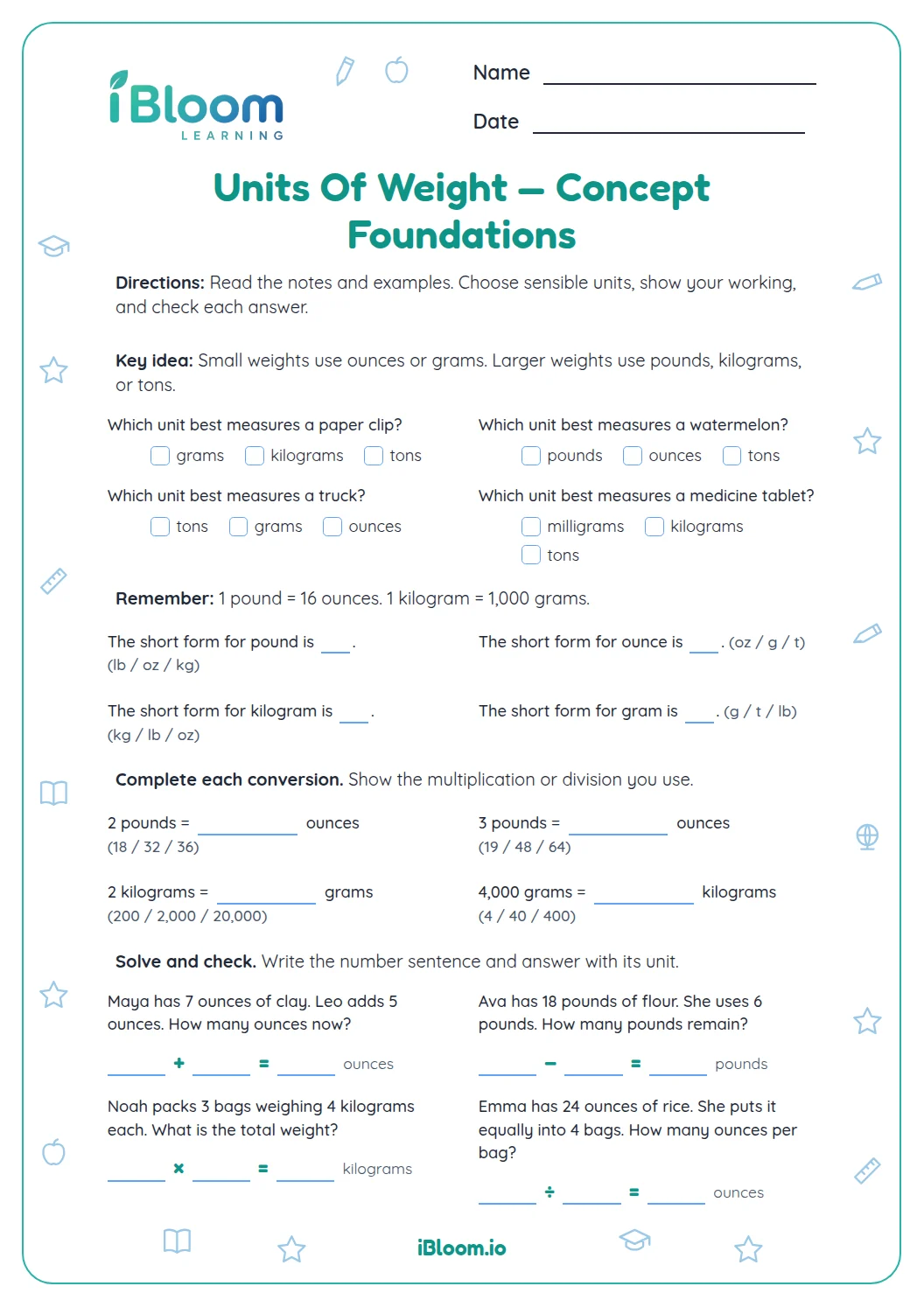
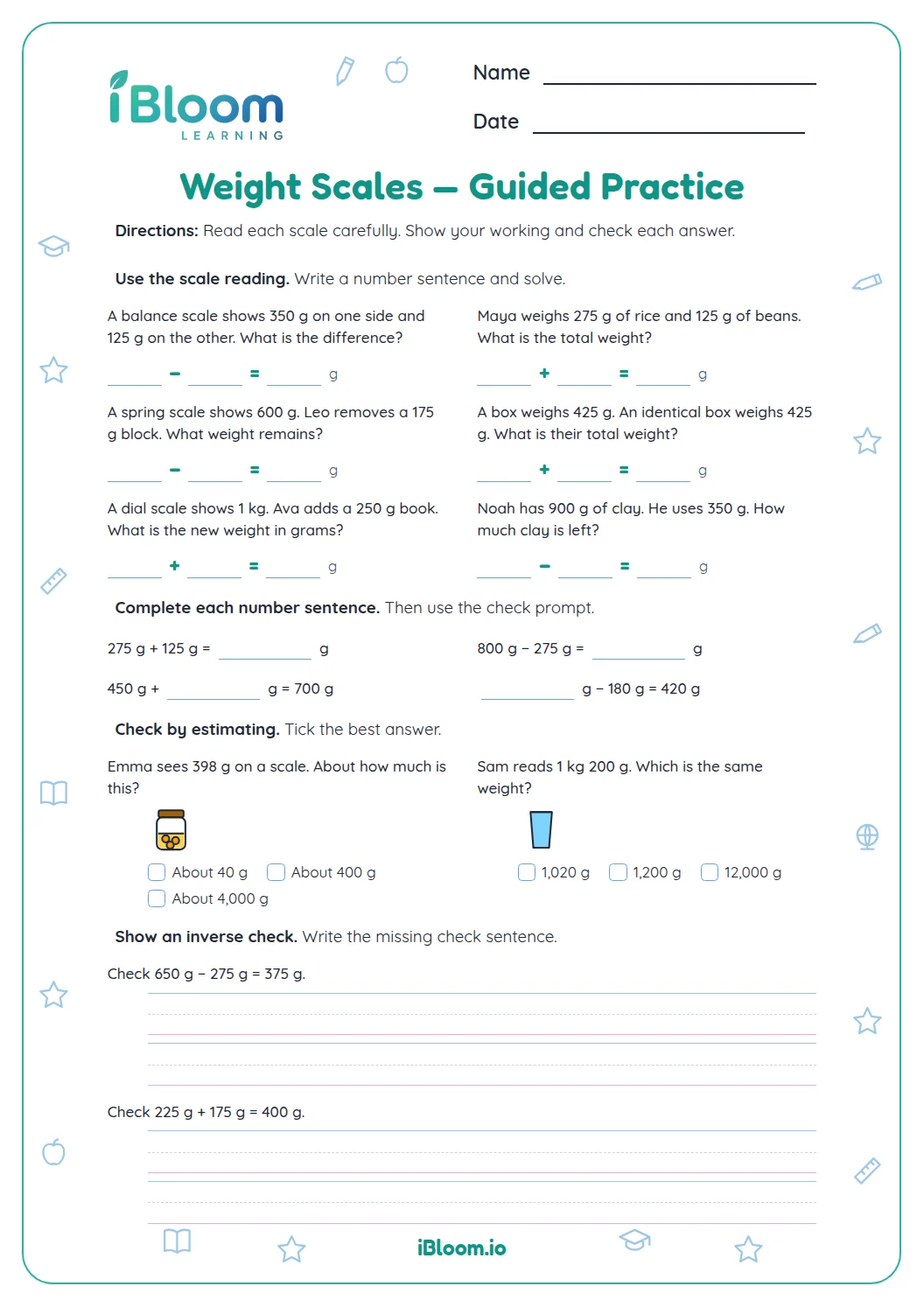
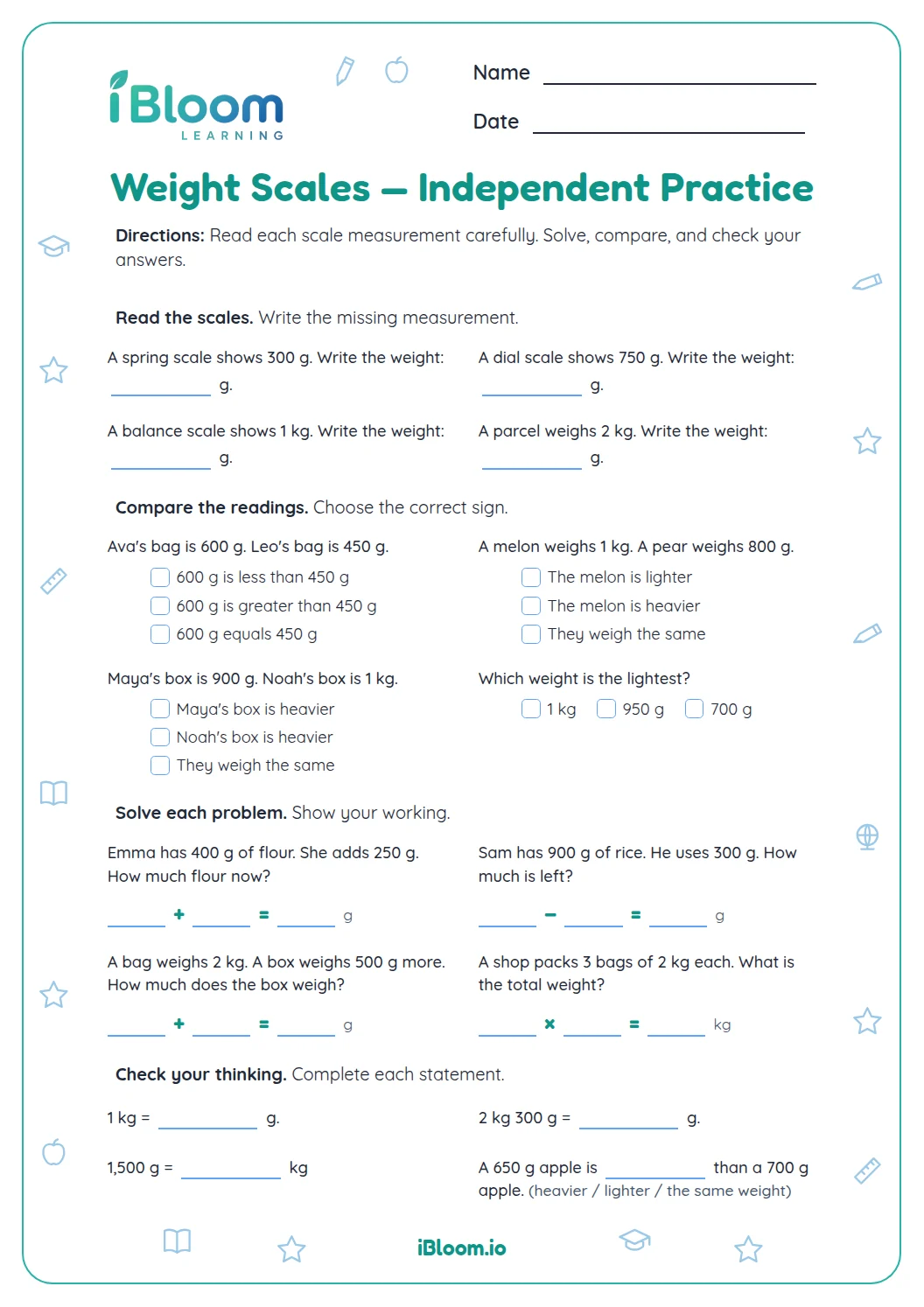
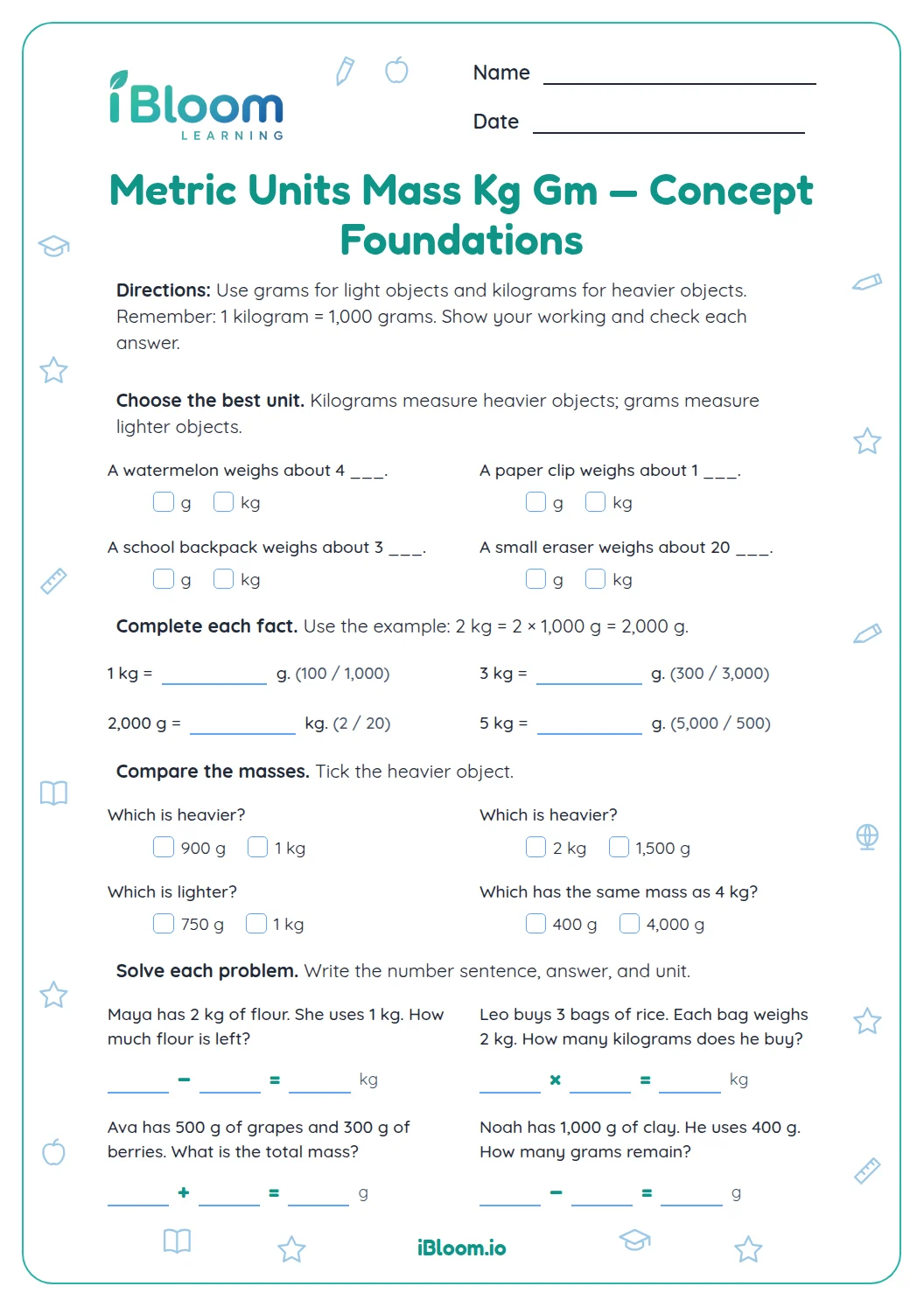
What is on this worksheet?
Eleven questions on two pages, in three parts. The graph is printed once, at the start of Part A, and the first four questions all use it.
- Part A, Read the bar graph: four multiple-choice questions about the heaviest object, a 1 kg object, a difference and a rename
- Part B, Kilograms and grams: four fill-in-the-blank conversions, two each way
- Part C, Solve the problem: three one-step word problems (add, subtract and multiply) with room for a number sentence
- Answer key on two separate pages
Why does every answer need a unit?
A weight without a unit is only a number. Writing 2,750 alone could mean grams or kilograms, and the two differ by a factor of 1,000. Part C reminds children to include the unit, and the answer key shows each answer with its unit so a missing one is easy to spot.
How to use this worksheet at home or in class
- 1Weigh a few real things first: a pack of butter is about 250 g, a liter bottle of water about 1 kg. Let your child hold them.
- 2Read the bar graph together and ask your child to say each weight aloud with its unit before answering.
- 3Do question 3 together, and ask where on the graph the 250 g difference shows up.
- 4Write 1 kg = 1,000 g on the page and let your child use it for Part B. Ask whether the number should get bigger or smaller each time.
- 5In Part C, have your child write a number sentence first, then solve it and add the unit.
- 6Check with the answer key and revisit any answer that is 1,000 times too big or too small.
Common mistakes and quick fixes
The mistake
Multiplying when the units go the other way, writing 6,000 g = 6,000,000 kg.
The fix
Ask which unit is heavier. Kilograms are bigger, so the same weight needs fewer kilograms than grams.
The mistake
Reading 750 g as 700 g or 800 g because the bar falls between two labeled gridlines.
The fix
Find the labeled lines above and below the bar. Halfway between 500 and 1,000 is 750.
The mistake
Leaving off the unit, or mixing grams and kilograms in one sum, such as 2,000 g + 750 kg.
The fix
Circle the unit in each part of the problem. Add or subtract only when the units match.
Common Core alignment
Most US states use the Common Core standards or a close state version. This sheet practices the two measurement standards below.
Use grams and kilograms, and solve one-step weight word problems.
On this sheet: Every question uses grams and kilograms, and Part C has one-step word problems by adding, subtracting and multiplying.
Show the official wordingHide the official wording
Measure and estimate liquid volumes and masses of objects using standard units of grams (g), kilograms (kg), and liters (l). Add, subtract, multiply, or divide to solve one-step word problems involving masses or volumes that are given in the same units, e.g., by using drawings (such as a beaker with a measurement scale) to represent the problem.
Read a scaled bar graph and solve how many more problems.
On this sheet: Part A reads a bar graph with a scale counting by 500 g and asks how much heavier one object is than another.
Show the official wordingHide the official wording
Draw a scaled picture graph and a scaled bar graph to represent a data set with several categories. Solve one- and two-step “how many more” and “how many less” problems using information presented in scaled bar graphs. For example, draw a bar graph in which each square in the bar graph might represent 5 pets.
What to practice next
Make more practice
Further reading
Questions parents and teachers ask
How many grams are in a kilogram?
There are 1,000 grams in 1 kilogram. The sheet gives this fact in Part B so children can focus on the direction of the change. Multiply by 1,000 to go from kilograms to grams, as in 3 kg = 3,000 g, and divide to go back.
How do I read the bar graph when a bar stops between labels?
Find the labeled lines just below and above the bar, then think halfway. The scale is labeled 0, 500, 1,000, 1,500 and 2,000 grams. The lunch box stops halfway between 500 and 1,000, so it reads 750 g, not 800 g.
Why is the water bottle the answer to question 1?
The water bottle bar reaches the 1,000 gram line, and 1,000 g is exactly 1 kg. The backpack reaches 2,000 g, which is 2 kg, and the book is only 500 g. Children match the weight on the graph to the kilogram fact.
Why do the word problems have different operations?
One problem joins two weights, one takes a weight away and one repeats the same weight four times. Children decide the operation from the story, not from a heading. The answer is 2,750 g for the backpack and lunch box, 3 kg of rice left, and 12 kg of apples.
Does the sheet use grams or ounces?
It uses metric units, grams and kilograms, which are the units named in Grade 3 standard 3.MD.A.2. Ounces and pounds are on the related worksheet about converting units of weight, linked from this page, for families who also want customary practice.
Is there an answer key for this worksheet?
Yes. Two answer key pages show the correct choice for each graph question, the missing numbers in Part B and the full answer with its unit for each word problem. Print the worksheet by itself, keep the key for checking, or download everything as a free PDF.