




About this worksheet
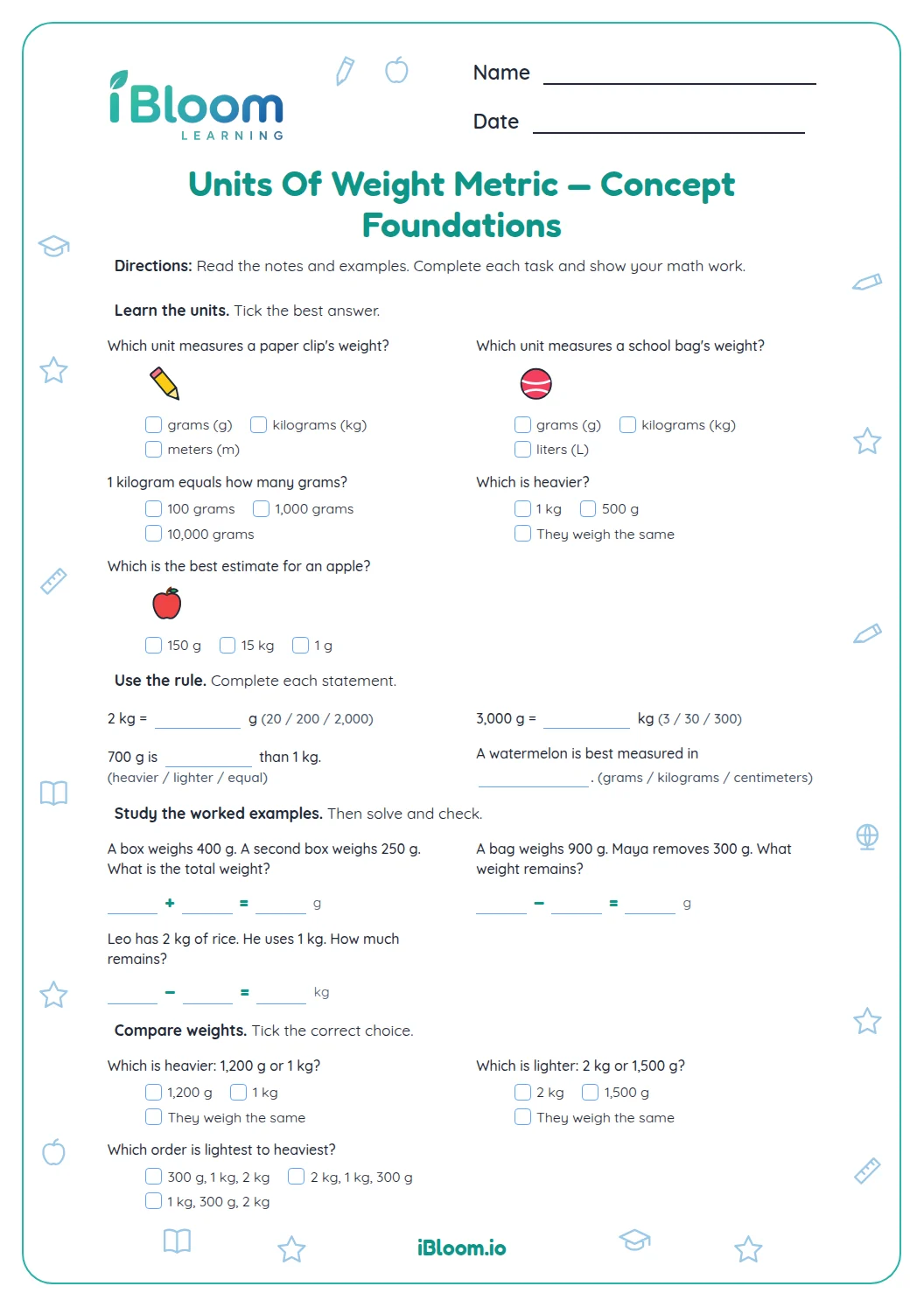
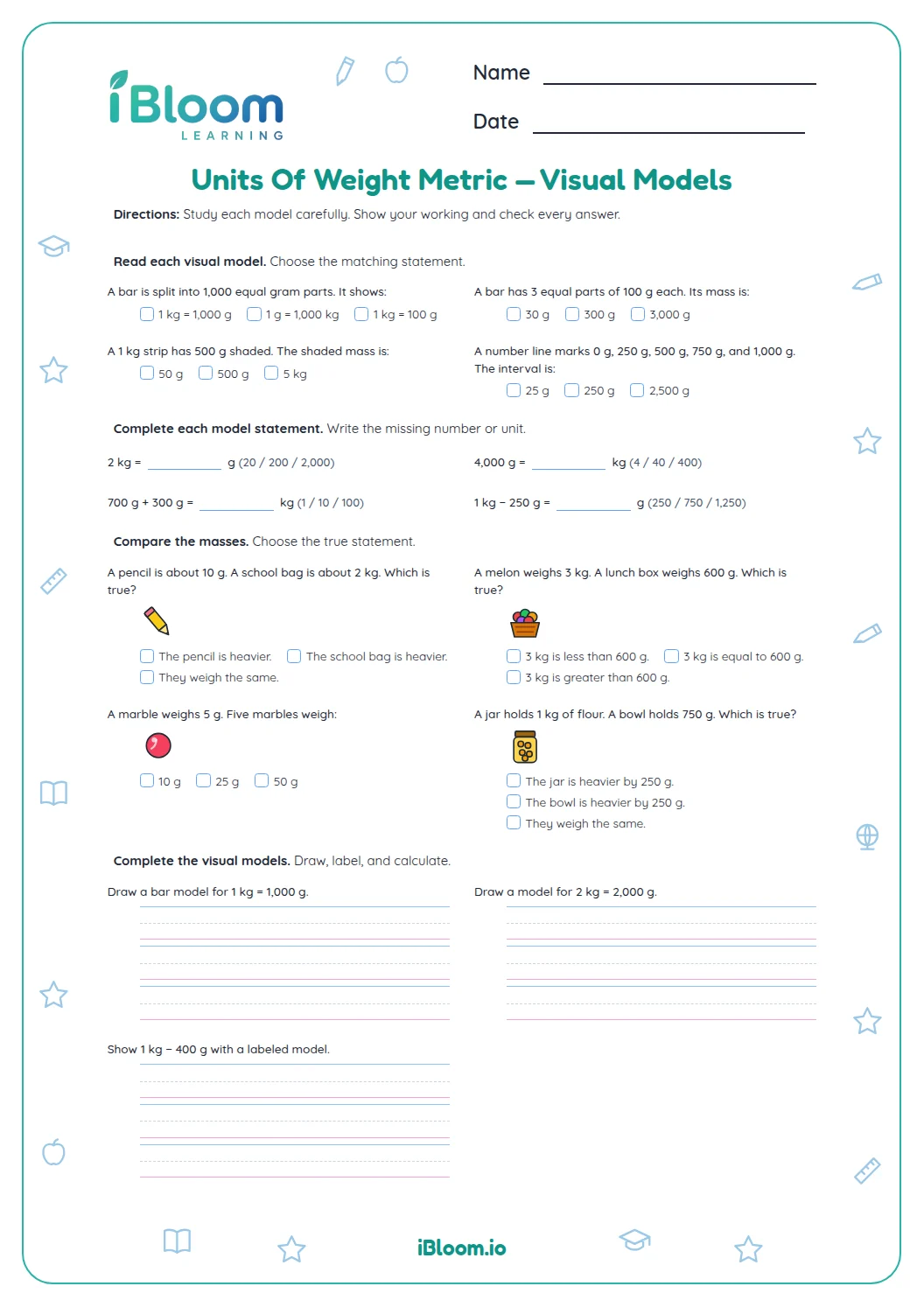
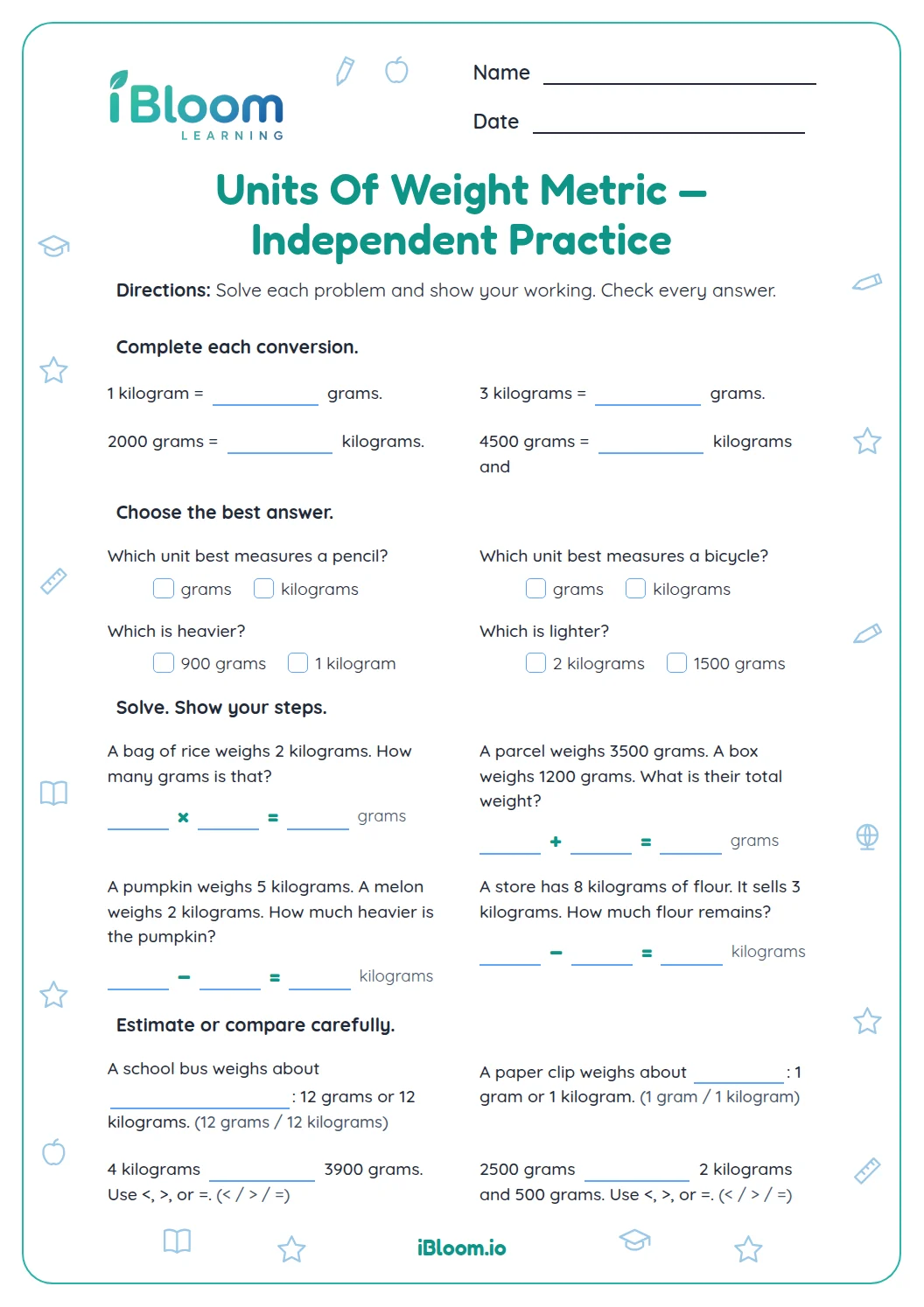
This Grade 3 worksheet builds reasoning with mass. Children choose between grams and kilograms for familiar objects, compare masses expressed in the same unit, and solve short addition and subtraction situations. The 16 questions move from unit sense to multi-step reasoning and an explanation. The practice connects to CCSS 3.MD.A.2 and includes a separate answer key.
Aligned to 3.MD.A.2
When do grams and kilograms make sense?
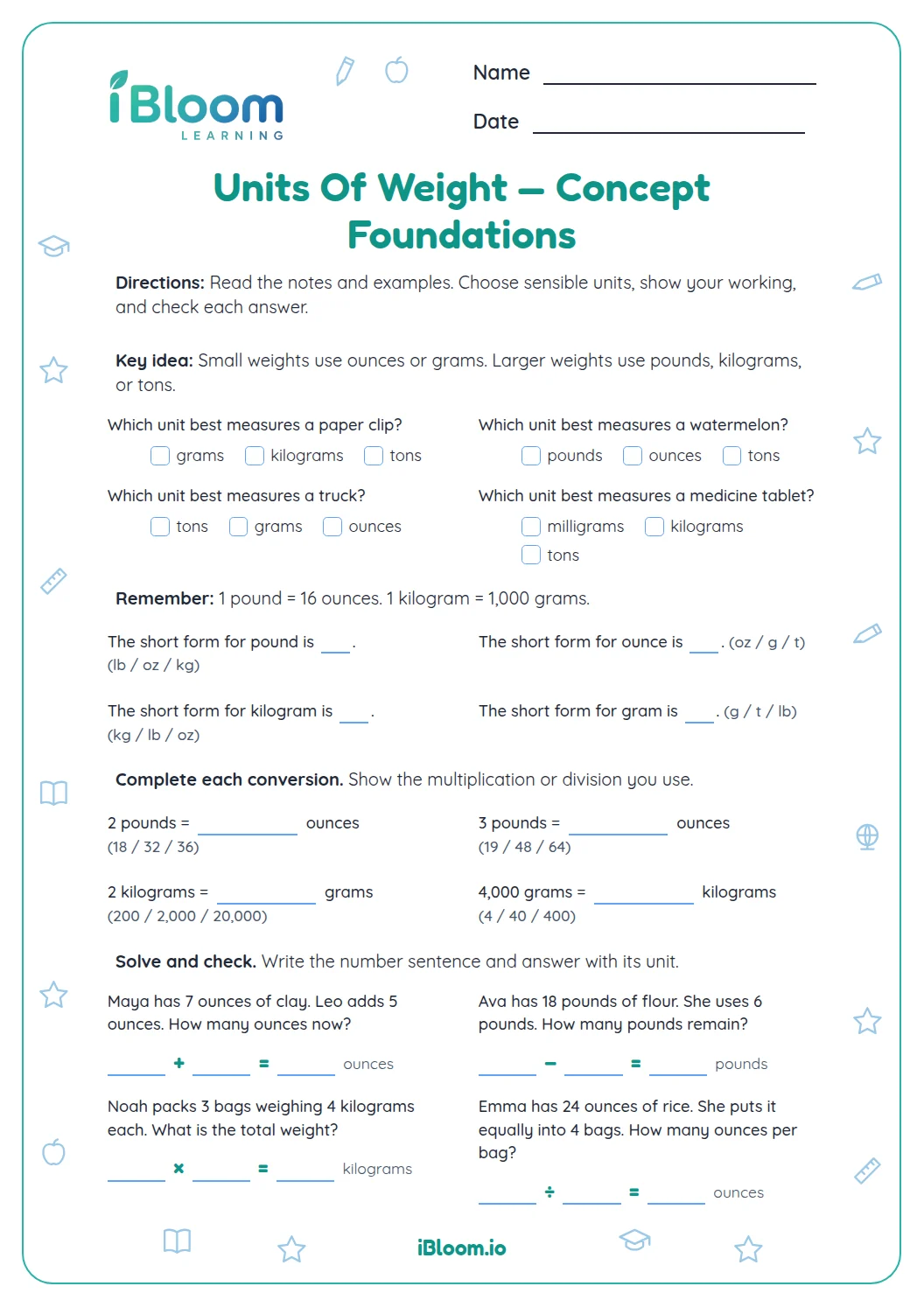
Grams fit lighter objects, such as a paper clip. Kilograms fit heavier objects, such as a backpack. The first four questions ask children to choose a sensible unit or estimate.
For example, a paper clip is measured in grams, while a backpack is more reasonably described in kilograms.
- 1Paper clip → grams
- 2A paper clip has a small mass, so grams are a sensible unit.
How can I compare masses in the same unit?
Keep the units attached as you add or subtract. If a pumpkin is 4 kg and a melon is 2 kg, compare 4 kg with 2 kg; their difference is 2 kg. Since both quantities use kilograms, the comparison is direct.
What kinds of problems are included?
The later questions combine two or three masses, ask for a missing amount, or compare a total with another package. The final prompt asks for a short explanation supported by calculations.
How to use this worksheet
- 1Read each object and choose grams or kilograms when asked.
- 2For story problems, underline the masses and keep their units.
- 3Decide whether the story asks for a total, a difference, or a missing mass.
- 4Check that your answer is sensible compared with the starting amounts.
Mistakes to watch for
The mistake
Dropping the unit in the answer.
The fix
Copy kg or g from the question into the answer.
The mistake
Adding when the question asks how much more.
The fix
Look for comparison language and subtract the smaller mass from the larger.
The mistake
Choosing kilograms for a tiny object.
The fix
Picture the object and compare it with a familiar 1 kg mass.
Curriculum alignment
This page connects the practice to the Common Core standard below.
Estimate and measure mass in grams and kilograms.
On this sheet: Questions use grams and kilograms to estimate, compare, and reason about masses.
Show the official wordingHide the official wording
Measure and estimate liquid volumes and masses of objects using standard units of grams (g), kilograms (kg), and liters (l). Add, subtract, multiply, or divide to solve one-step word problems involving masses or volumes that are given in the same units, e.g., by using drawings (such as a beaker with a measurement scale) to represent the problem.
What to practice next
Make more practice
Further reading
Questions parents and teachers ask
When should a child use grams instead of kilograms?
Use grams for light objects and kilograms for heavier objects. A paper clip is a useful example of an item measured in grams, while a backpack is more naturally measured in kilograms. Questions 1 and 2 ask children to apply this unit sense.
Does this worksheet ask children to convert units?
The problems keep the compared masses in the same unit so children can focus on choosing sensible units and reasoning with addition or subtraction. They do not need to change a mass from grams to kilograms to solve these questions.
How can a child solve “how much heavier” questions?
Compare the two masses by finding the difference. For a 4 kg pumpkin and a 2 kg melon, subtract 2 kg from 4 kg to get a difference of 2 kg. The question asks how much greater, so the result should be smaller than the larger mass.
How can I find a total when one mass is missing?
Find the missing amount before adding the masses. If one crate weighs 9 kg and the second is 4 kg lighter, the second weighs 5 kg; together they weigh 14 kg. Keep the unit in each step so the final answer stays in kilograms.
How many questions and pages are included?
There are 16 questions: four unit choices, eleven mass problems, and one written explanation. The worksheet and answer key each print on two pages. The key gives the numerical answers and a sample explanation for the final comparison.
What standard does the page practice?
The page practices CCSS 3.MD.A.2 by estimating masses in grams and kilograms and solving problems with masses in the same unit. Children choose sensible units, compare amounts, and use addition or subtraction in short situations. Encourage them to include a unit with each answer.