


About this worksheet
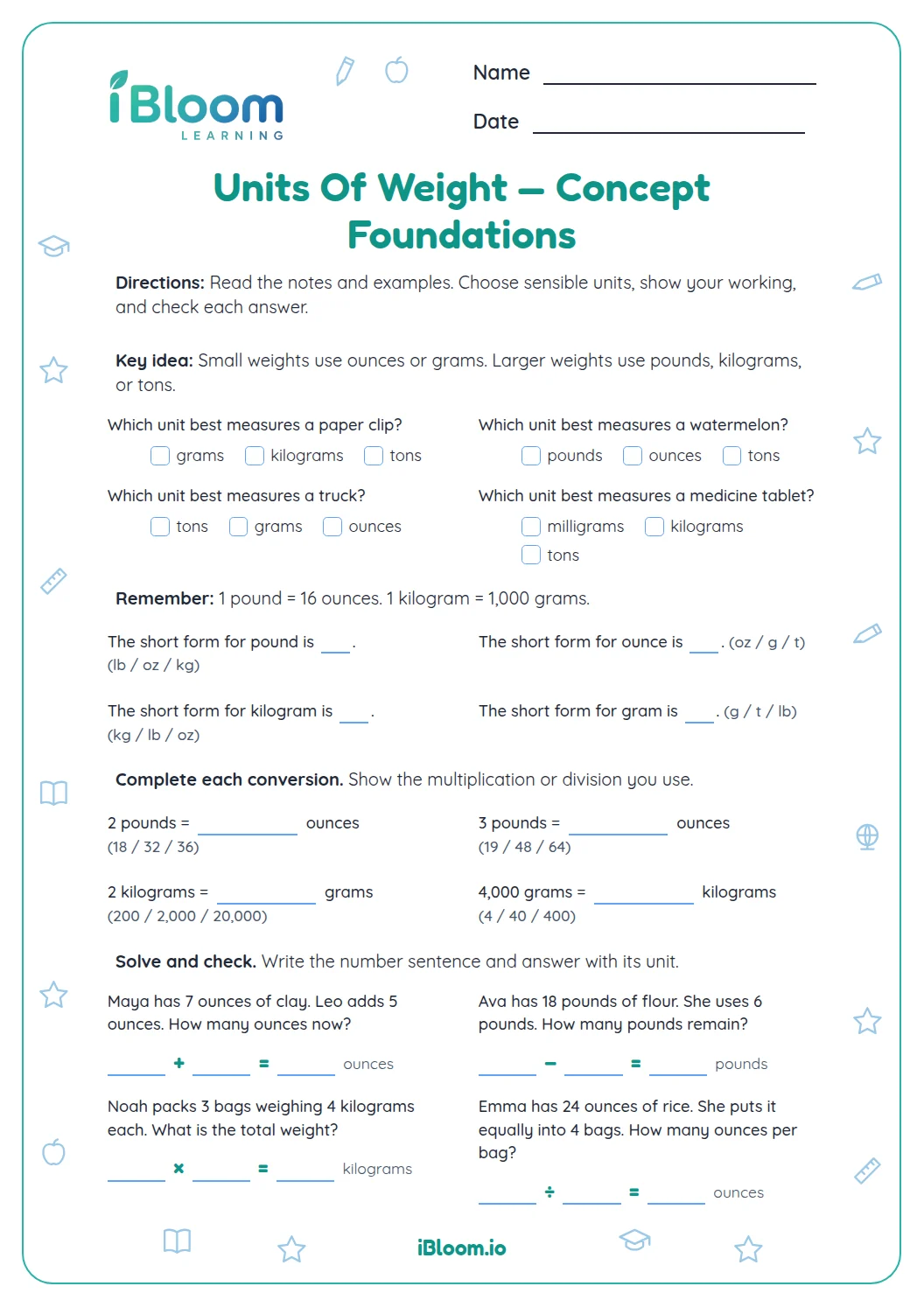
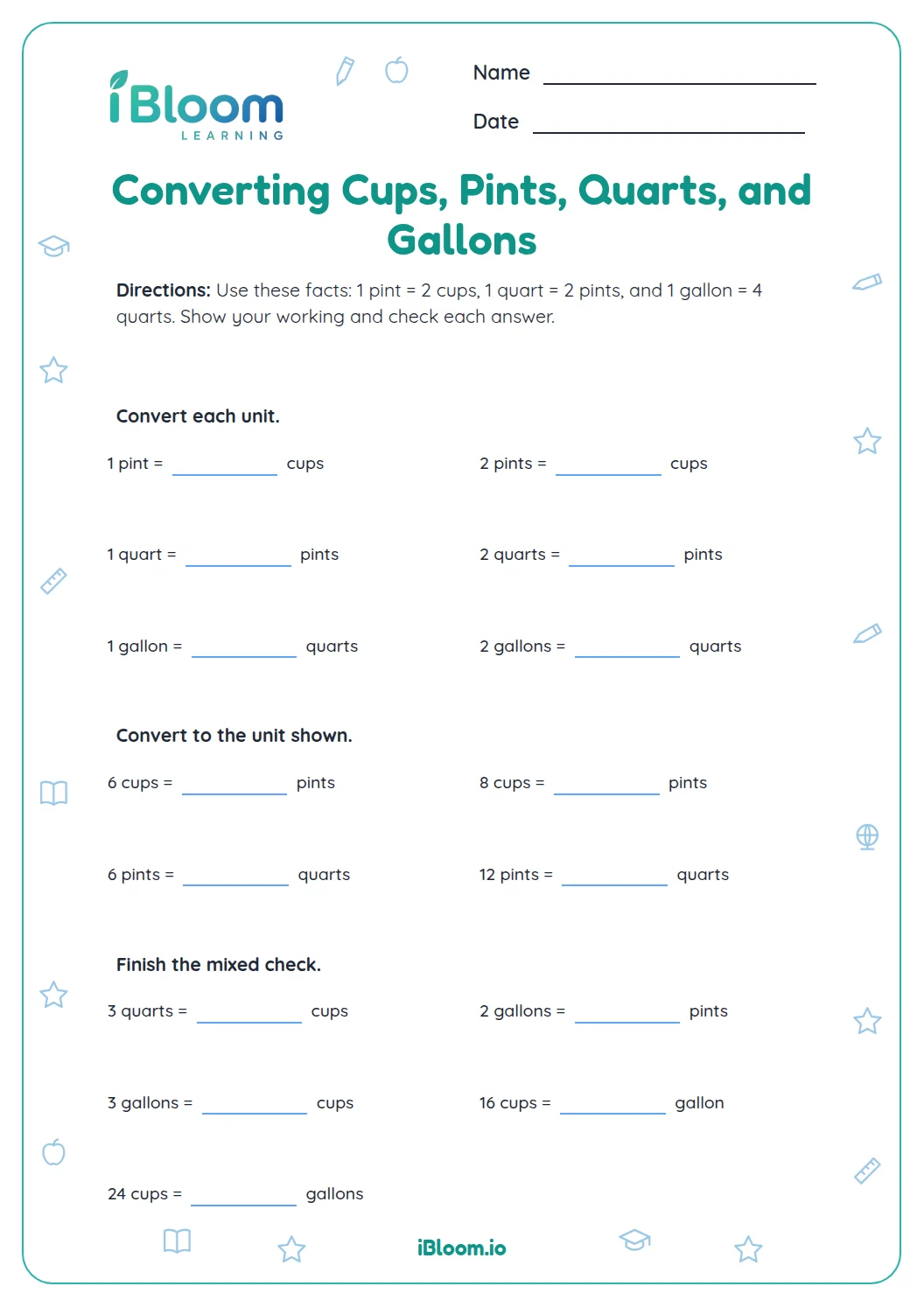
This Grade 3 printable focuses on the named skill of pounds and ounces. Learners use 16 ounces per pound to convert measures, compare weights, and solve short stories about food and packages. The worksheet includes 14 questions and a separate answer key, with alignment to CCSS 4.MD.A.1, which covers measurement-unit relationships.
Aligned to 4.MD.A.1
How do pounds and ounces connect?
One pound equals 16 ounces. Multiply pounds by 16 to find ounces. To express ounces as pounds and ounces, make groups of 16 and report the remainder.
- 12 lb 5 oz = (2 × 16) + 5
- 232 + 5 = 37 oz
What does each part practice?
Part A practices the basic equivalences. Part B uses conversions to compare or solve short weight stories. Part C combines amounts or asks learners to estimate a sensible weight.
How can learners check their work?
Check by reversing the conversion: 39 oz is 2 lb 7 oz because 2 × 16 + 7 = 39.
Common Core alignment
The worksheet practices the named customary-unit relationship through conversions and weight problems.
Know relative sizes of units and express larger units in smaller units.
On this sheet:
Show the official wordingHide the official wording
Know relative sizes of measurement units within one system of units including km, m, cm; kg, g; lb, oz.; l, ml; hr, min, sec. Within a single system of measurement, express measurements in a larger unit in terms of a smaller unit. Record measurement equivalents in a two-column table. For example, know that 1 ft is 12 times as long as 1 in. Express the length of a 4 ft snake as 48 in. Generate a conversion table for feet and inches listing the number pairs (1, 12), (2, 24), (3, 36), ...
What to practice next
Make more practice
Further reading
Questions parents and teachers ask
How many ounces make a pound?
There are 16 ounces in 1 pound. Multiply pounds by 16 to find ounces; divide ounces by 16 to express a whole number of ounces as pounds and any remaining ounces. The worksheet practices both directions with familiar weight examples.
How can I convert ounces to pounds and ounces?
Make groups of 16 ounces. For example, 40 ounces contains two full groups of 16, with 8 ounces left, so it is 2 pounds 8 ounces. Keep both units in the answer when a remainder remains in the quantity. Ask the learner to explain how the quantities in the prompt support the answer.
Why convert before comparing?
Use one unit for both measurements so the comparison is clear. For instance, 1 pound is 16 ounces, so 25 ounces is heavier than 1 pound. The questions ask learners to compare after identifying the equivalent amount first. Ask the learner to explain how the quantities in the prompt support the answer.
What is included in the printable?
The worksheet has 14 questions arranged across three practice parts. It begins with the pound-ounce relationship, then applies it in comparisons and short weight stories. A separate answer key is included for checking each response at home or in class.
How can a learner check a conversion?
Reverse the relationship. If 3 pounds is 48 ounces, divide 48 by 16 to return to 3 pounds. For a mixed amount such as 2 pounds 7 ounces, multiply 2 by 16 and add 7 to verify the ounce total.