

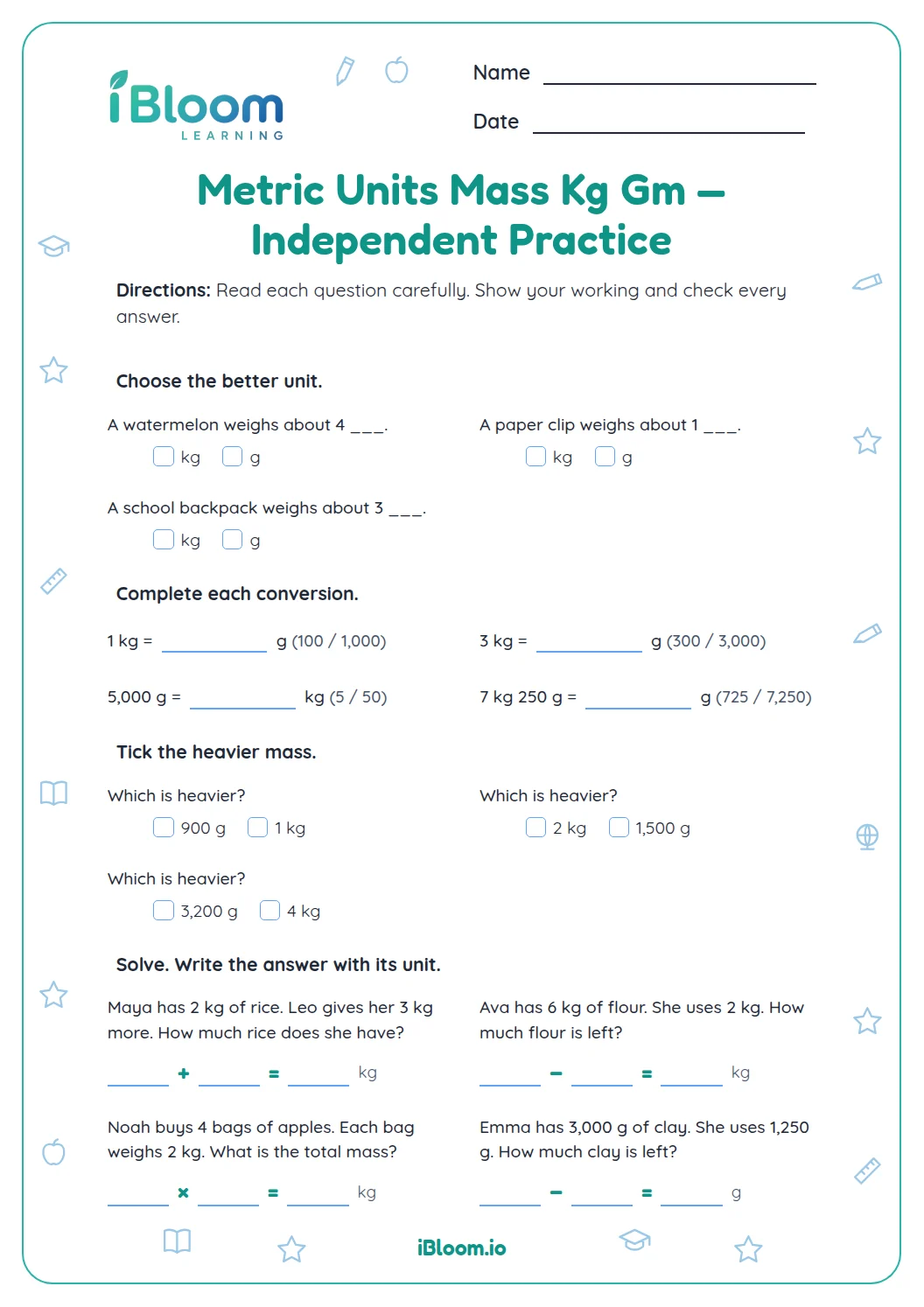
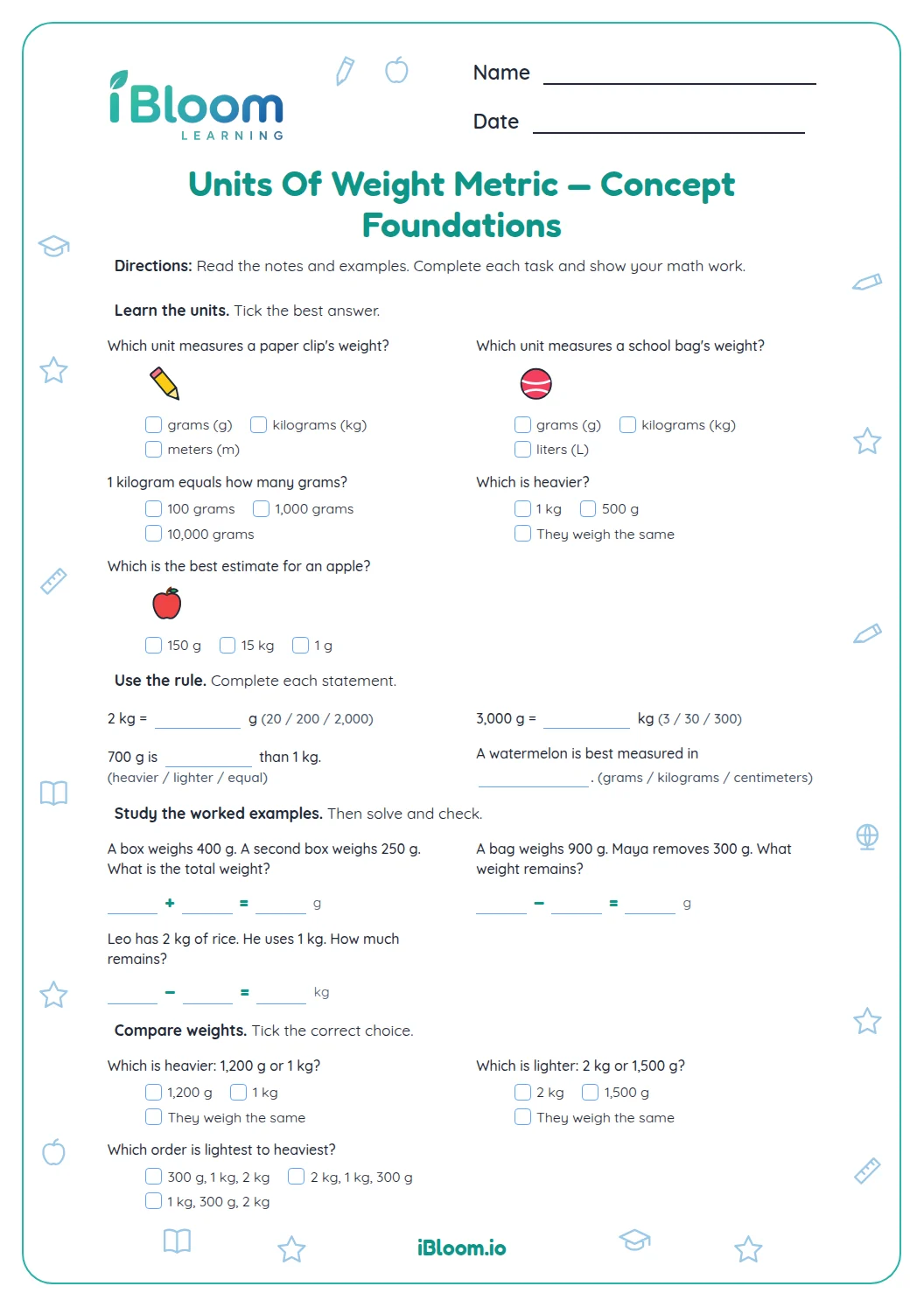
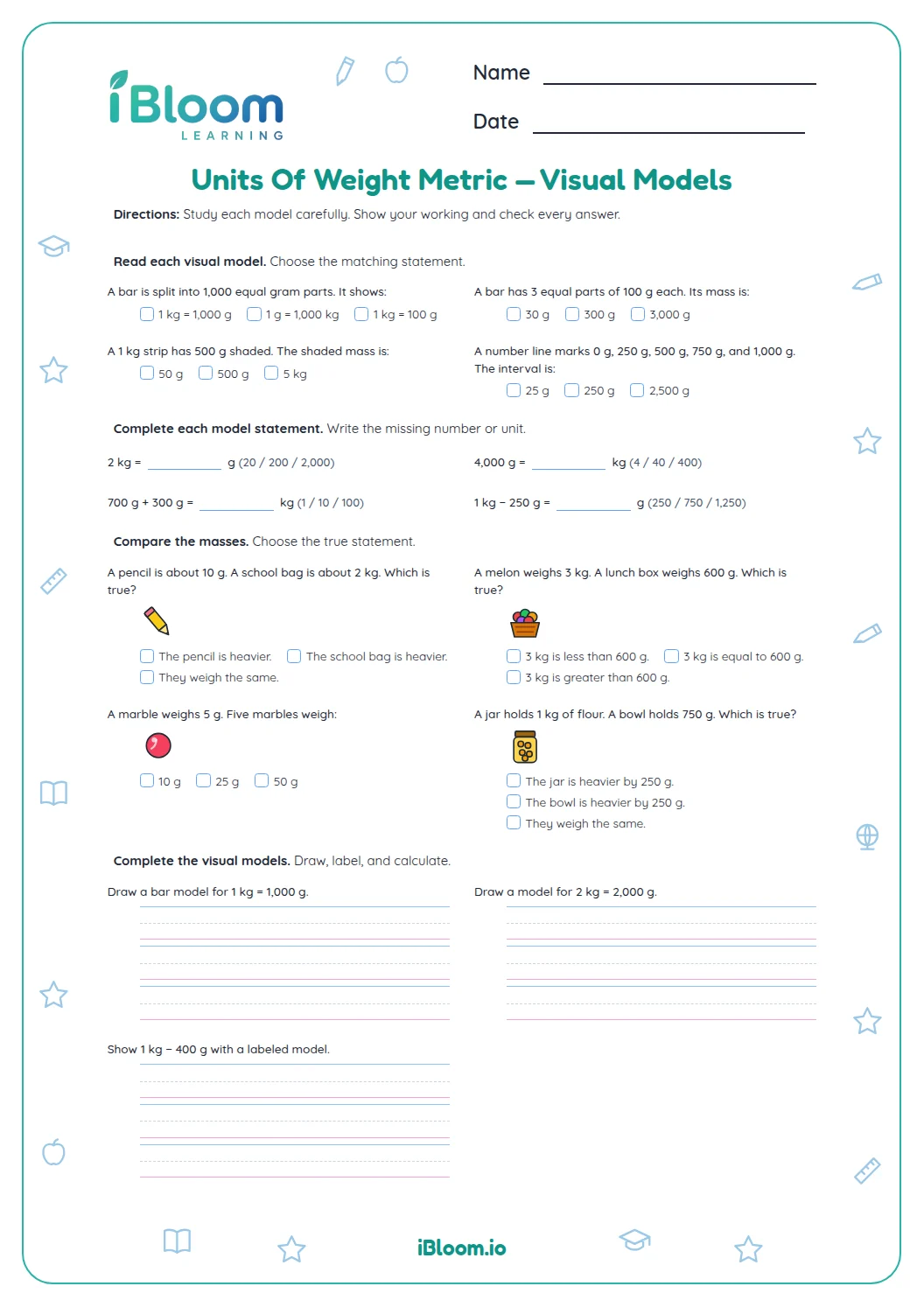
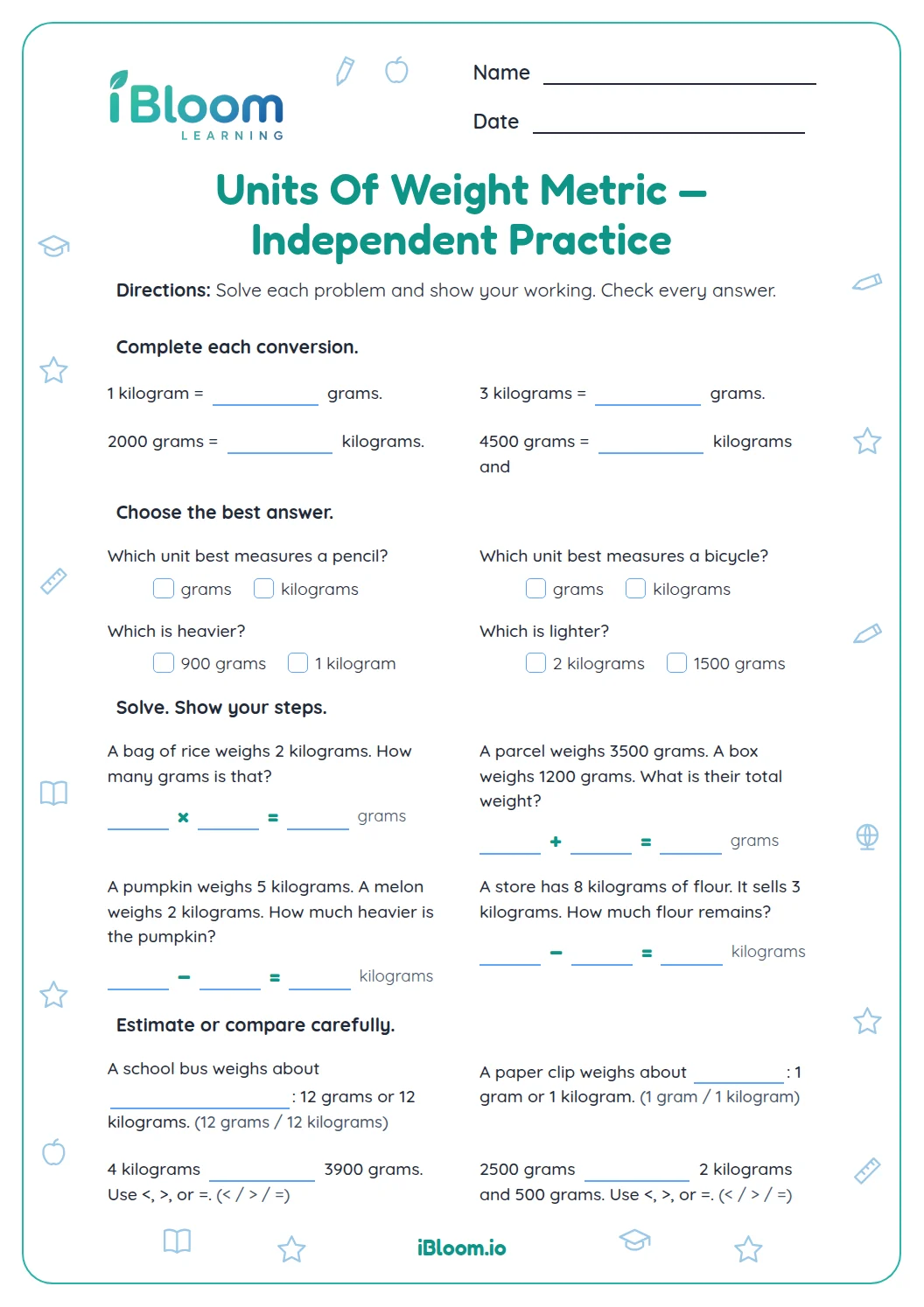

About this worksheet
This free printable worksheet introduces Grade 3 students to the ideas behind weight scales: the heavier side of a balance goes down, and a scale's pointer stops at a number of grams or kilograms. Children compare weights and choose a sensible unit, read two scales whose number lines label only 0 and the top value, and work four number sentences that keep one unit. Two word problems finish the sheet. It practices Common Core 3.MD.A.2, measuring and solving problems with masses in grams and kilograms. The 12 questions fill 2 pages, and a separate answer key gives every answer with its unit.
Aligned to 3.MD.A.2
What is on this weight scales worksheet?
The worksheet has four parts that move from ideas to calculation. Part A has four choose-the-answer questions: two balances, a comparison of 750 g, 500 g and 1 kg, and the best unit for a watermelon. Part B shows two scales as number lines, one in kilograms and one in grams, and children write the weight where the pointer stops.
Part C has four number sentences that add and subtract weights in the same unit. Part D ends with two word problems, each with an answer box and working space: how much heavier a pumpkin is than a cabbage, and how much four 2 kg bags of flour weigh.
- Part A: compare weights and choose a unit (questions 1 to 4)
- Part B: read a scale in kg and in g (questions 5 and 6)
- Part C: add and subtract weights (questions 7 to 10)
- Part D: two word problems with a unit in each answer (questions 11 and 12)
How do you read the pointer on a scale?
A scale's pointer sits somewhere between 0 and the biggest number. First read the unit, g or kg. Next look at the labeled numbers and count how many equal jumps lie between them. Then count the jumps from 0 to the pointer.
The scale in question 5 runs from 0 to 10 kg in 10 jumps, so each jump is 1 kg and the rice weighs 7 kg. The scale in question 6 also has 10 jumps, but it ends at 500 g, so each jump is worth 50 g.
- 10 to 500 g in 10 equal jumps → 500 ÷ 10 = 50 g per jump
- 2Point B is 9 jumps from 0 → 9 × 50 = 450
- 3The box of pasta weighs 450 g.
When should you use grams and when kilograms?
A gram is very small: a paper clip weighs about 1 gram. A kilogram is 1,000 grams, about as heavy as a liter bottle of water. So grams suit light things, like a paper clip or a box of pasta, and kilograms suit heavier ones, like a watermelon, a pumpkin or a bag of rice.
Question 3 uses that fact: 1 kg is the heaviest of 750 g, 500 g and 1 kg, because it is 1,000 g. Question 4 asks which unit fits a watermelon. After that, every question keeps one unit, and writing it after each answer is part of the work: 4 means little until you say 4 kg.
Why do the number sentences keep the same unit?
Questions 7 to 10 add and subtract two weights in the same unit, such as 400 g + 300 g and 9 kg − 4 kg. Because the units match, children work with the numbers and keep the unit in the answer. Adding 400 g to 300 kg would not make sense without changing a unit first.
The word problems work the same way. The pumpkin and the cabbage are both in kilograms, so the difference is in kilograms too. In question 12, four bags of 2 kg each make 4 × 2 = 8 kg.
How to use this worksheet at home or in class
- 1Show a real kitchen scale or a bag of rice, and press on it so your child sees the pointer move.
- 2Read the Part A directions aloud, then ask your child why the pan with more weight goes down in question 1.
- 3For each scale in Part B, ask your child to find the unit first, then the size of one jump, then count to the pointer.
- 4Let your child solve Part C and write the unit after each answer, then check them with the answer key.
- 5For Part D, have your child draw a quick bar for each weight, such as a long bar for the 6 kg pumpkin and a short bar for the 2 kg cabbage.
- 6Ask your child to weigh two real objects at home and say how much heavier one is than the other.
Common mistakes and quick fixes
The mistake
Choosing the right pan in question 1 because the right side holds less, so it seems it should drop.
The fix
Use a hand on each side to show the idea. The pan holding more weight is pushed down, so the 500 g bag on the left makes the left pan go down.
The mistake
Reading question 6 as 9 because the pointer is at the ninth mark, ignoring that each jump is 50 g.
The fix
Have your child work out the size of one jump first: 500 g in 10 jumps is 50 g each. Then count 50, 100, 150 and so on up to the pointer.
The mistake
Choosing 750 g in question 3 because 750 is a bigger number than 1.
The fix
Remind your child to look at the units before the numbers. 1 kg is 1,000 g, and 1,000 g is more than 750 g, so 1 kg weighs the most.
Common Core alignment
Most US states use the Common Core standards or a close state version. This Grade 3 standard covers masses in grams and kilograms.
Measure masses in grams and kilograms and solve one-step problems.
On this sheet: Children read scale pointers in grams and kilograms, choose a unit and solve one-step problems with masses.
Show the official wordingHide the official wording
Measure and estimate liquid volumes and masses of objects using standard units of grams (g), kilograms (kg), and liters (l). Add, subtract, multiply, or divide to solve one-step word problems involving masses or volumes that are given in the same units, e.g., by using drawings (such as a beaker with a measurement scale) to represent the problem.
What to practice next
Make more practice
Further reading
Questions parents and teachers ask
What is the difference between weight and mass?
Mass is how much matter an object has, and weight is how hard gravity pulls on it. In daily life, children say weight for both, and Grade 3 standards use the word mass. This worksheet says weight in its questions, but grams and kilograms measure mass, so the skill your child practices is the same.
How many grams are in a kilogram?
There are 1,000 grams in 1 kilogram. That is why kilograms are used for heavier things and grams for light ones. Question 3 uses this fact, since 1 kg is heavier than 750 g. The other questions keep one unit each, so your child sees both units without converting between them.
Why do the number lines have only two labels?
The scales in questions 5 and 6 label only 0 and the top value, so children cannot copy a number from under the pointer. They count the equal jumps between the labels and work out what one jump is worth. Both scales have 10 jumps, but one jump is 1 kg on the first and 50 g on the second.
Does my child need a real scale to do this page?
No, but a kitchen scale makes the page easier to understand. Weighing an apple and a bag of flour shows that the pointer moves further for heavier objects. Without one, children can still finish the worksheet, because the scale pointers are drawn as number lines they can read.
What should my child write as the answer to a word problem?
A number and a unit, such as 4 kg or 8 kg. The unit says what was measured, so a number alone is not a complete answer. The working space is for a number sentence or a small drawing, like a long bar for the 6 kg pumpkin and a shorter bar for the 2 kg cabbage.
What comes after this worksheet?
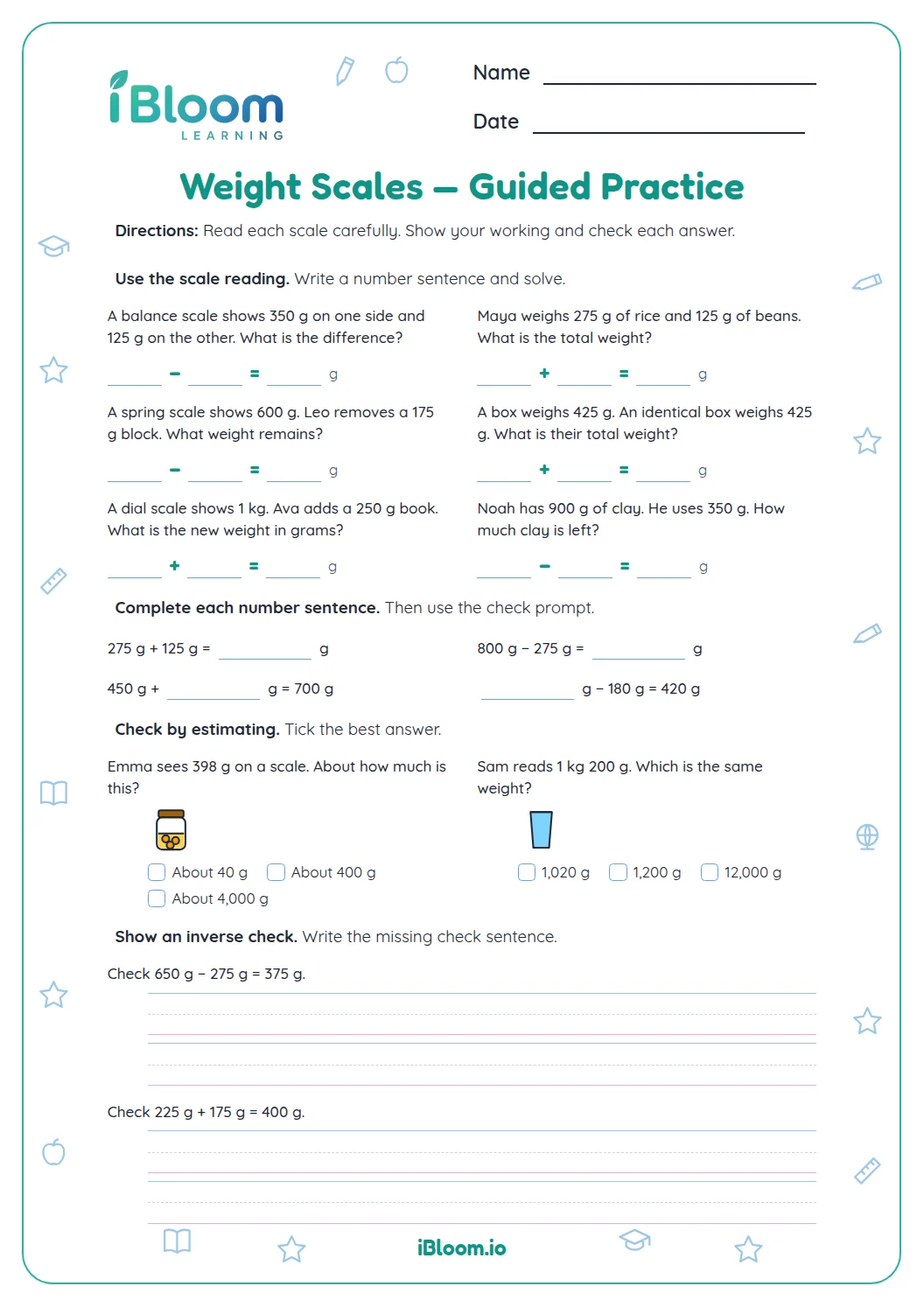
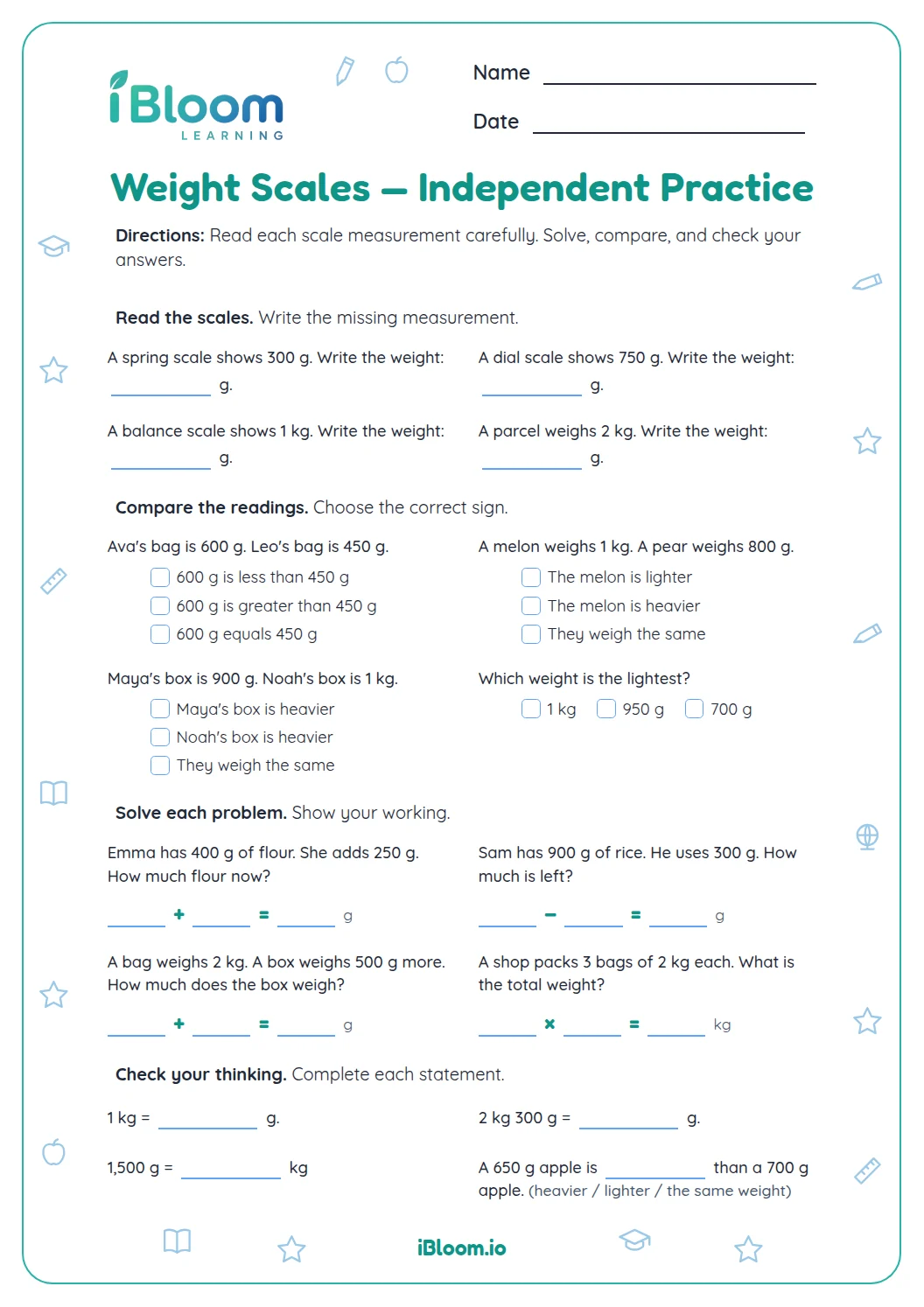
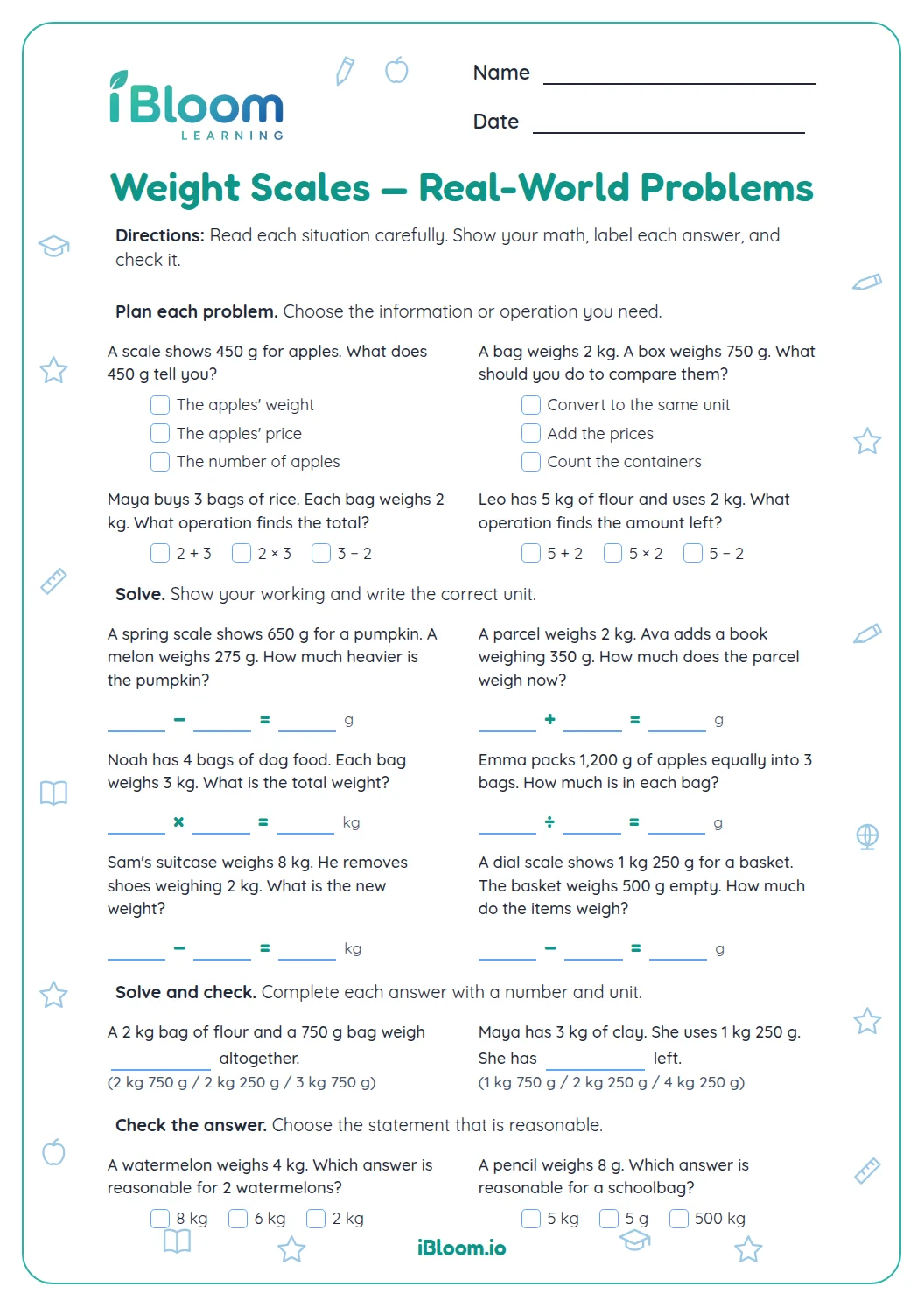
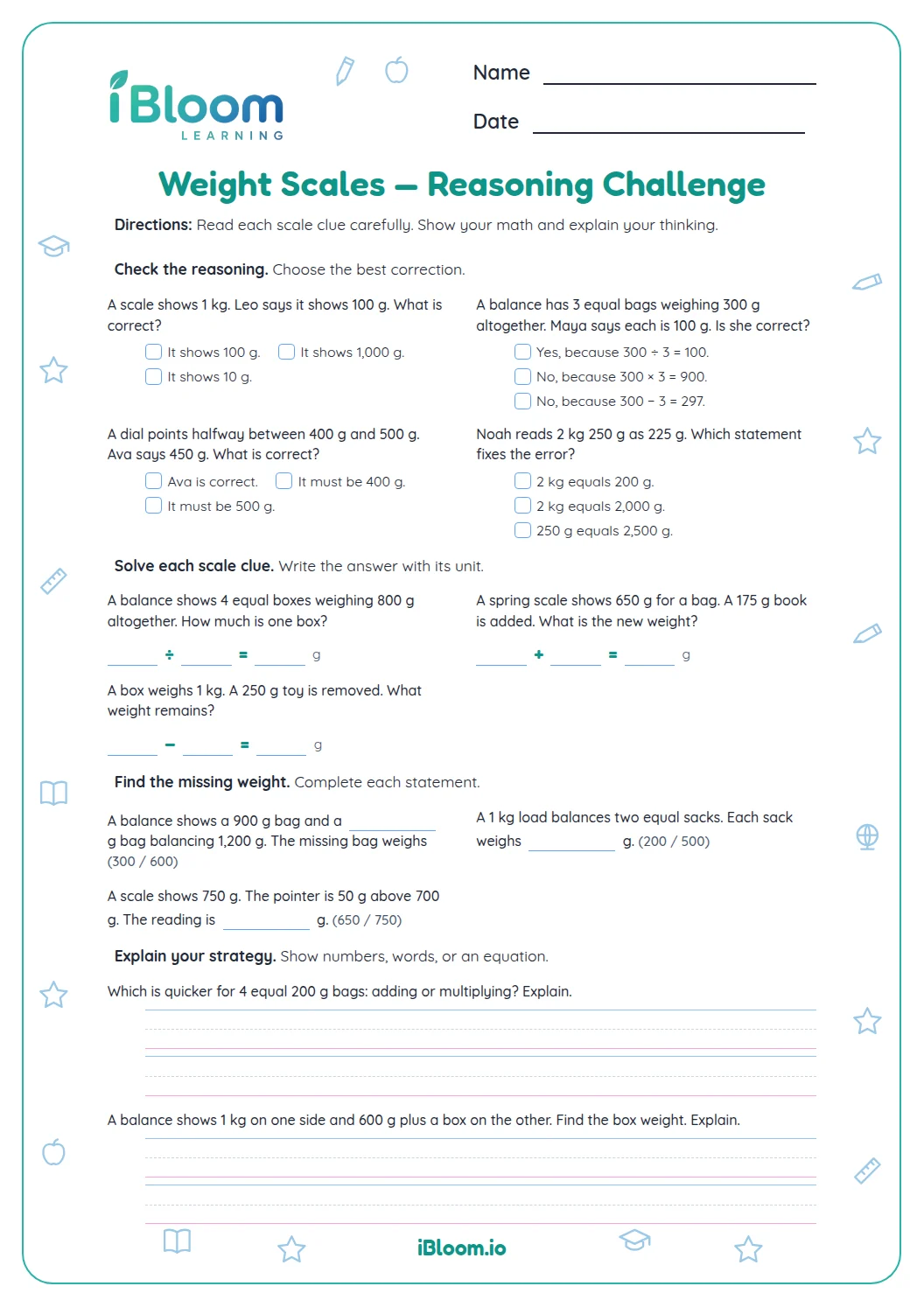
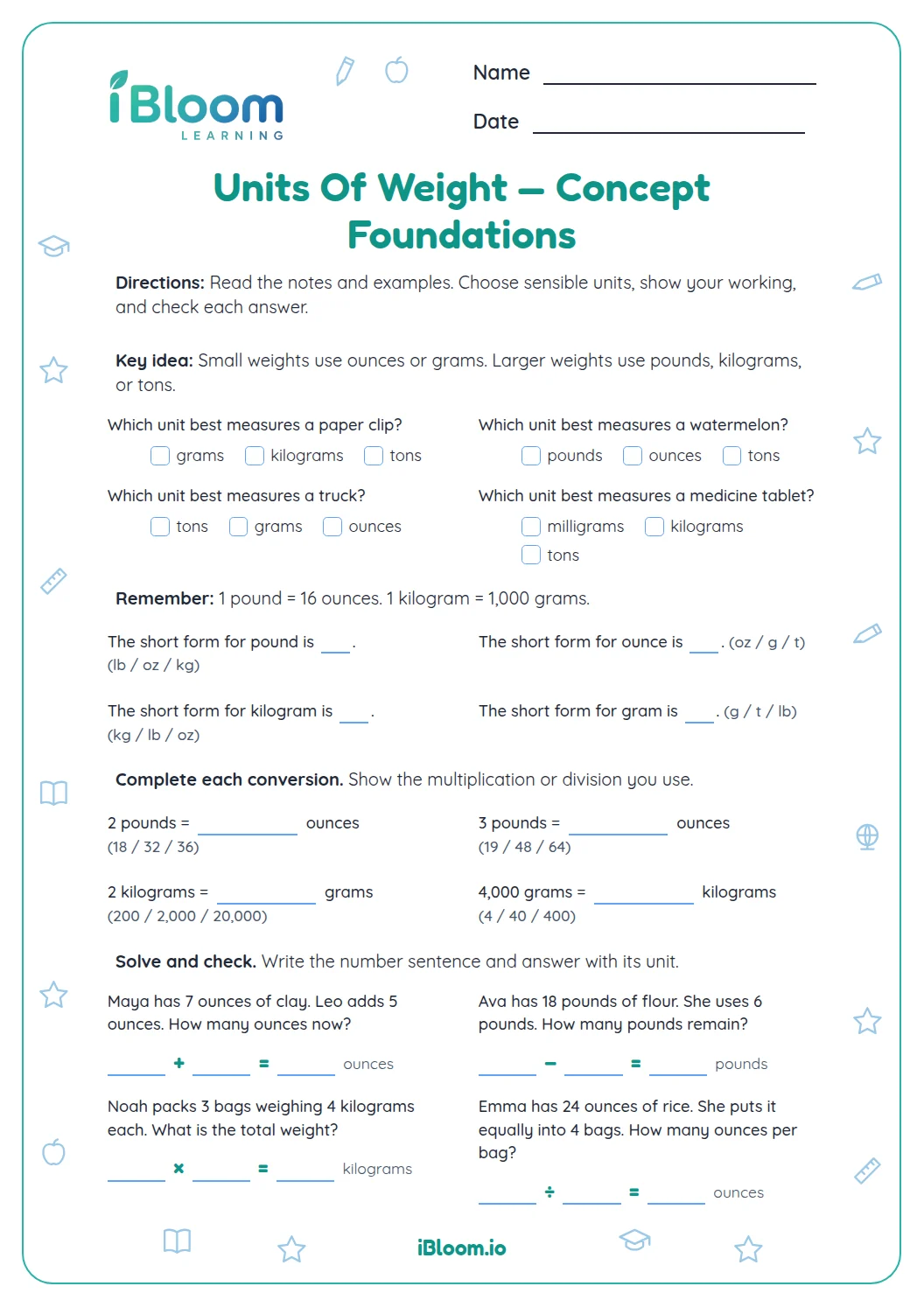
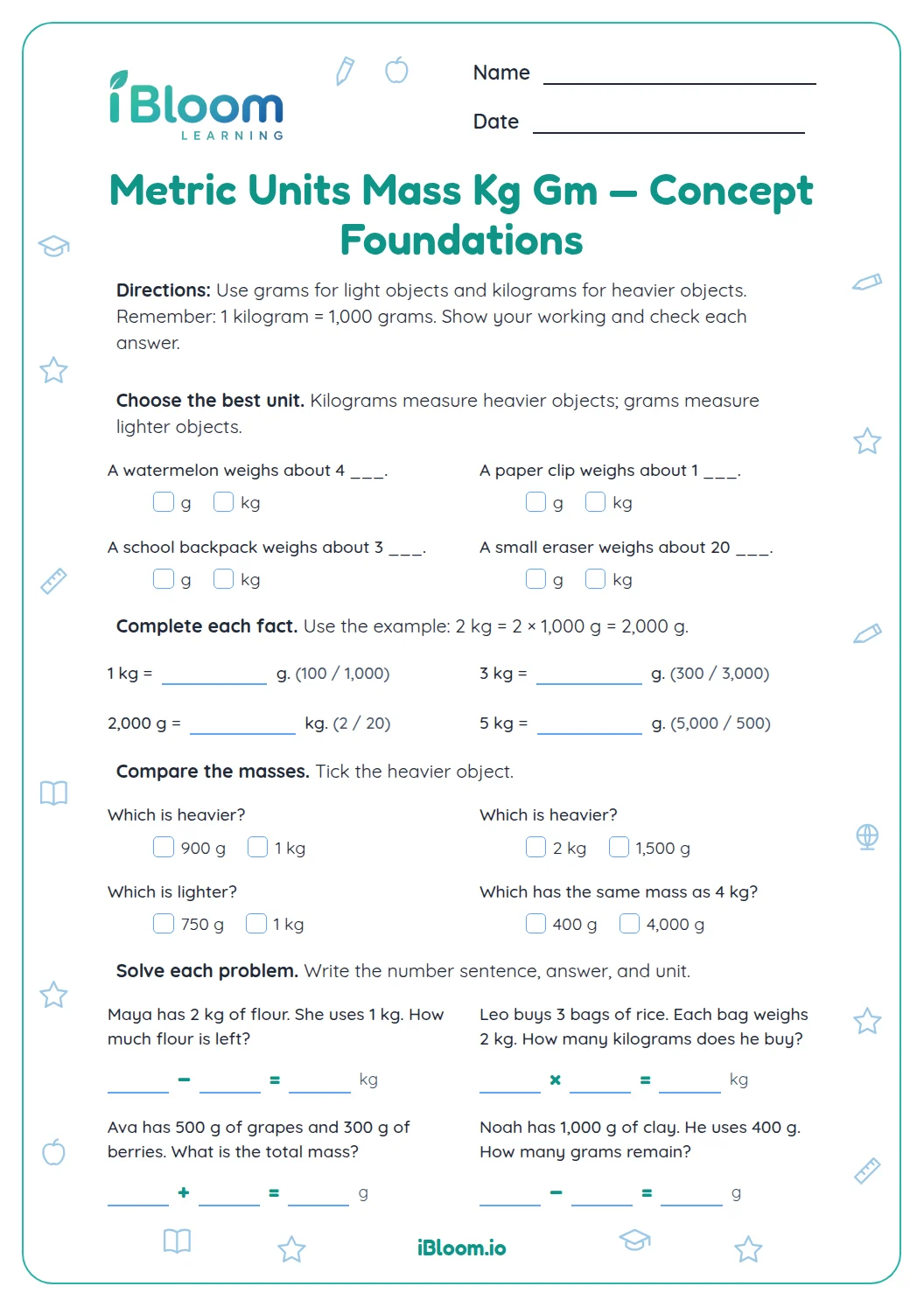
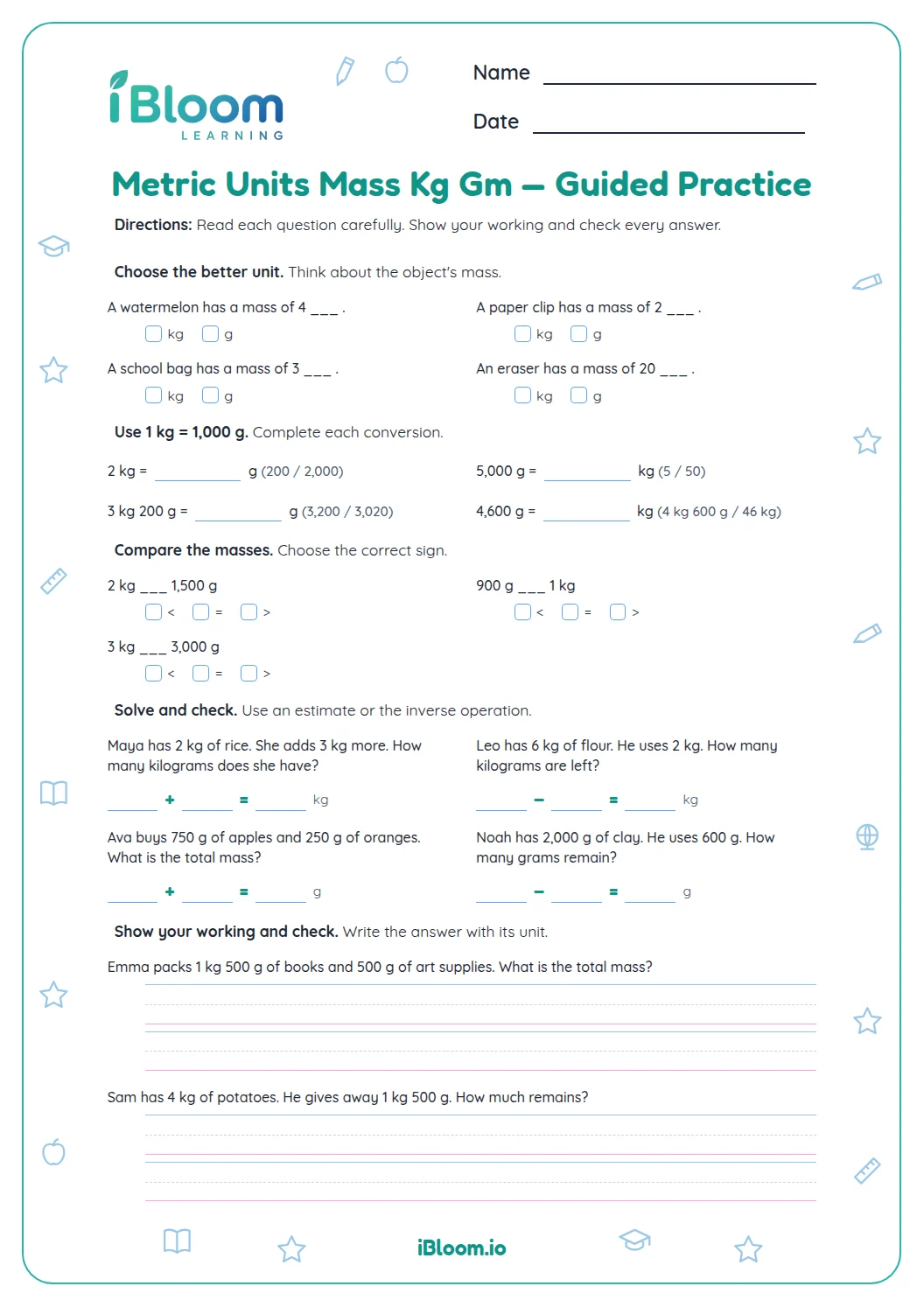
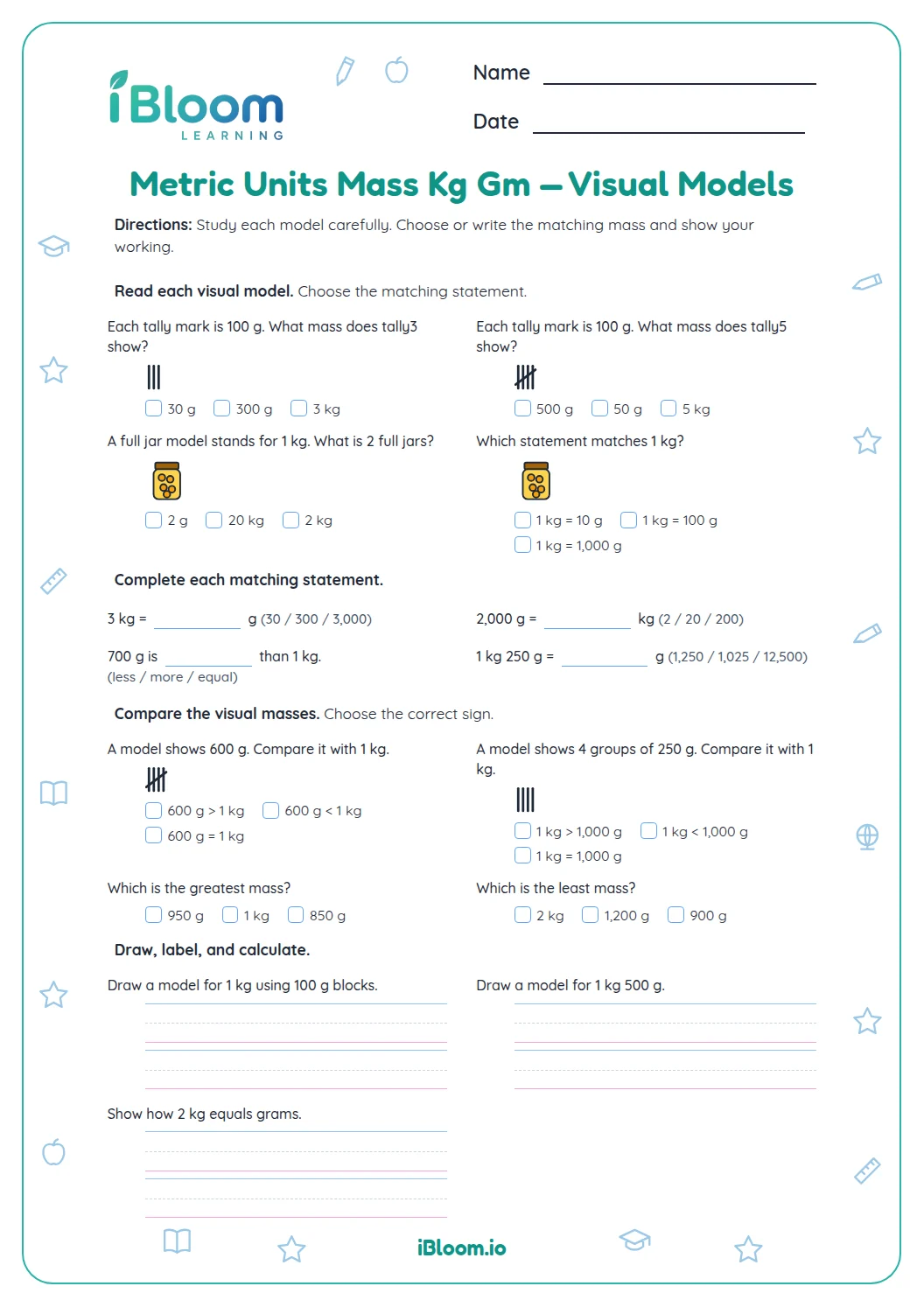
Move on to the Guided Practice worksheet in the same set, then Visual Models, Independent Practice, Real-World Problems and the Reasoning Challenge. You can also try the Units of Weight and Metric Units: Mass worksheets, which practice choosing and comparing kilograms and grams in more settings.