


About this worksheet
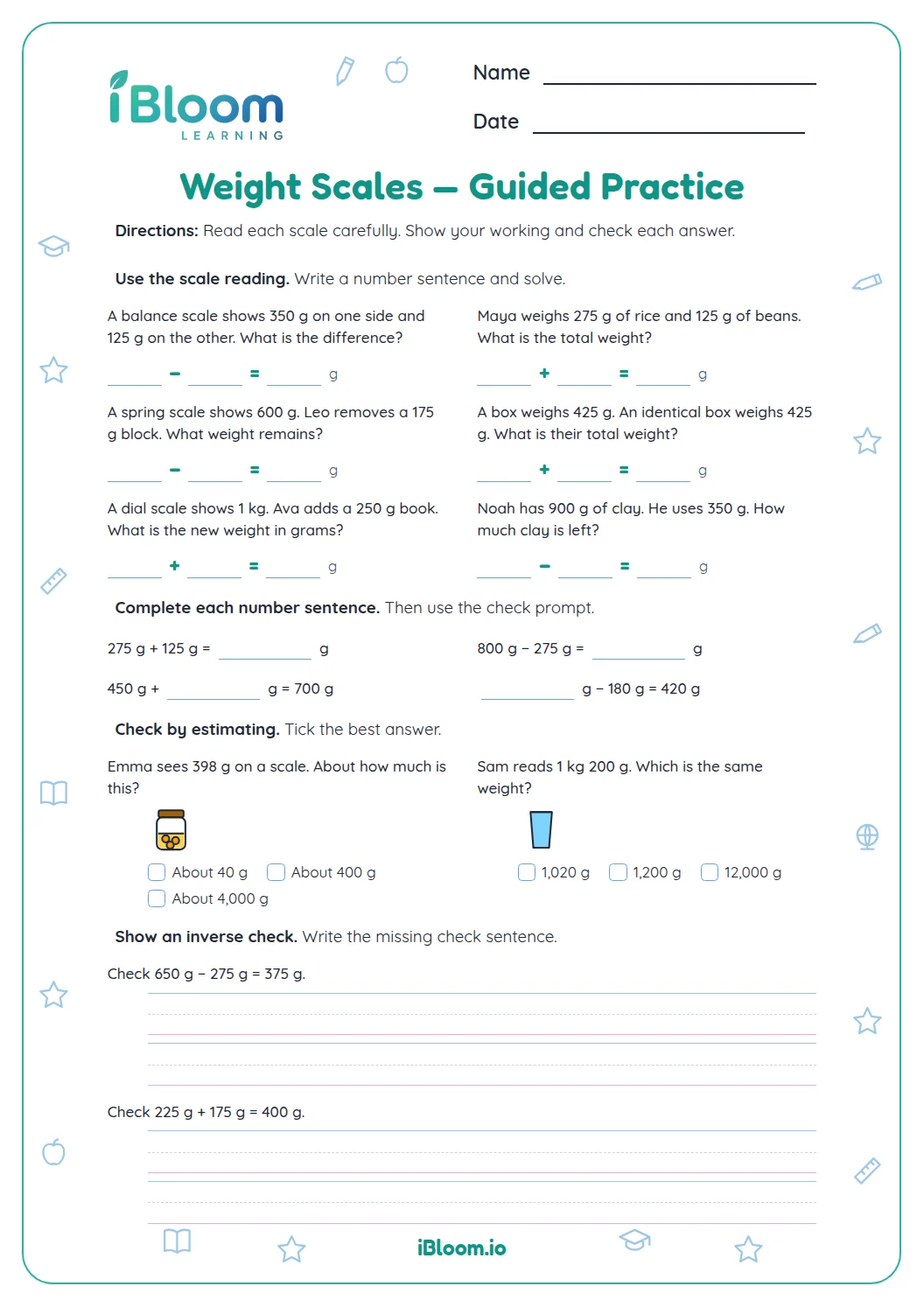
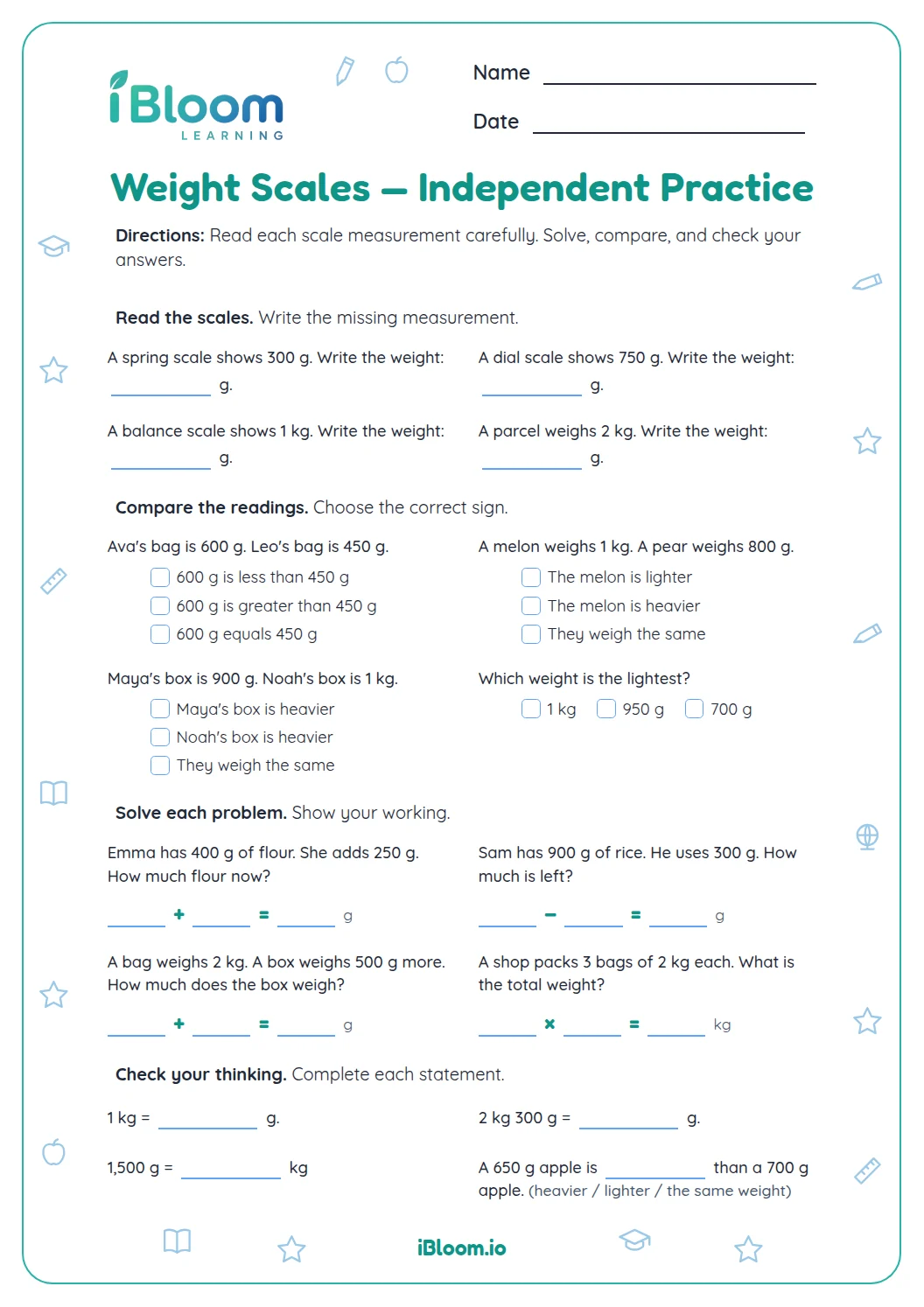
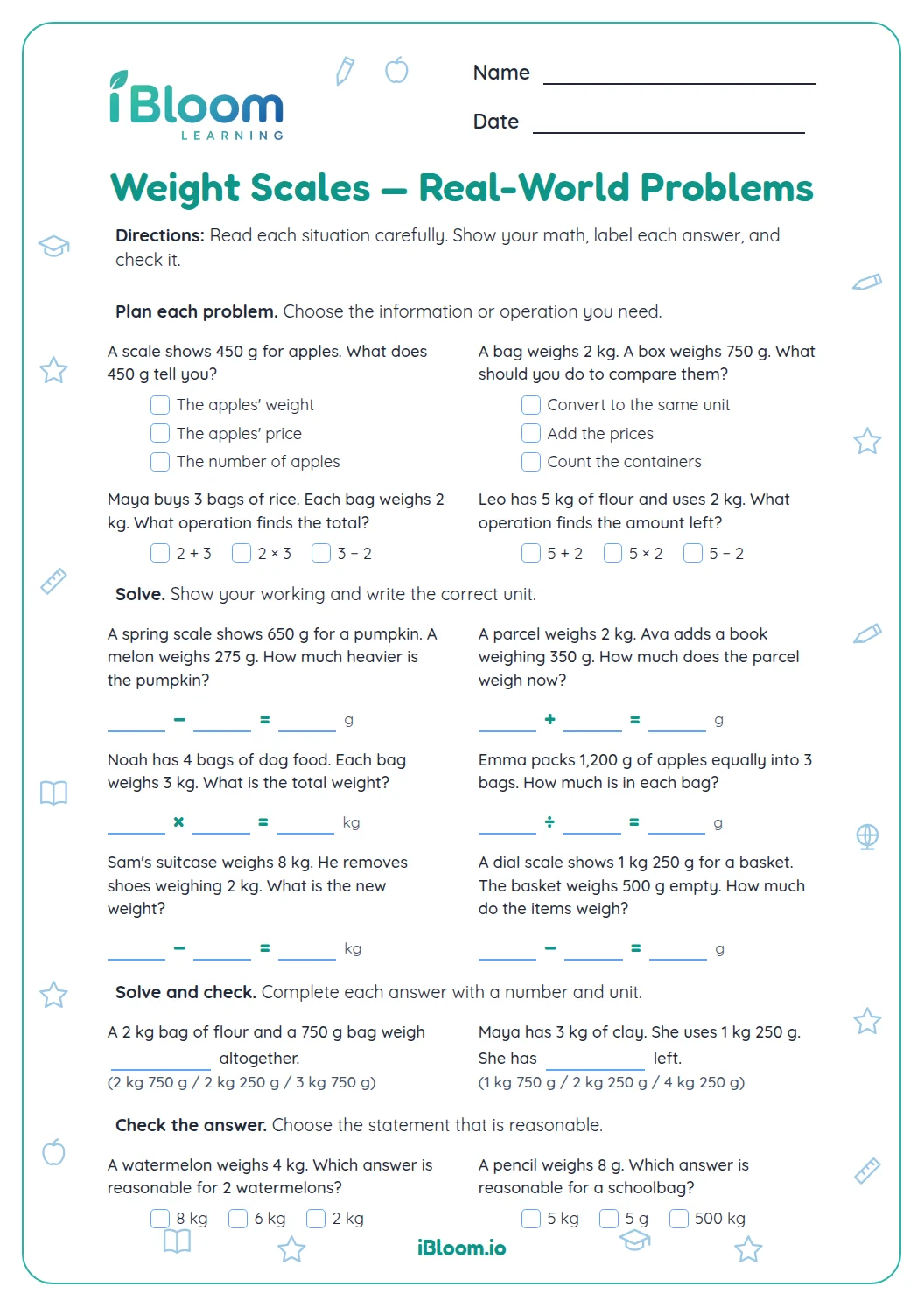
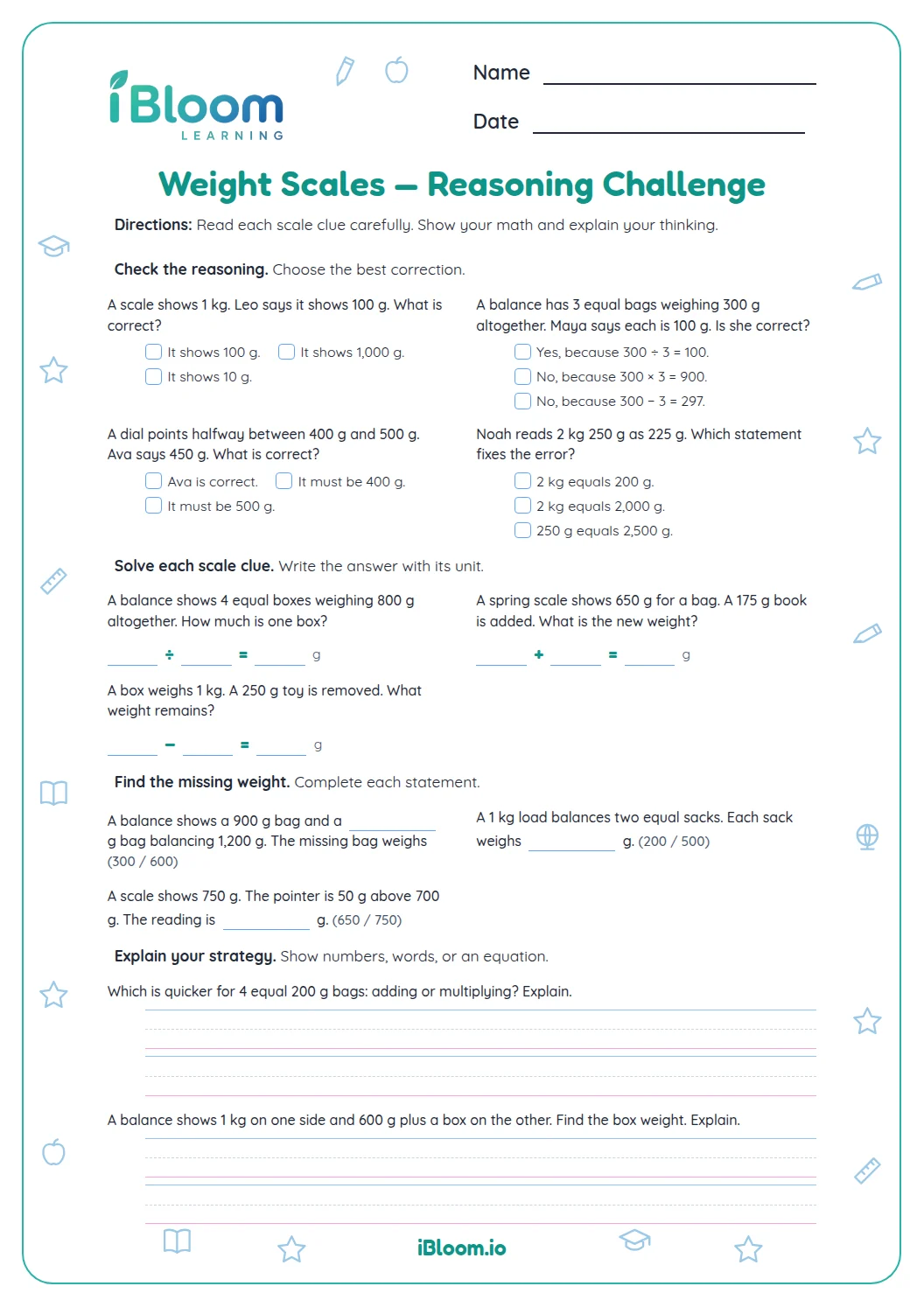
This Grade 3 worksheet presents 15 kilogram mass problems in short balance statements and table models. Learners find a bag’s total mass, determine missing parts, compare amounts, and solve equal-group problems. Because the template does not draw balance scales, the new sheet uses labeled tables and written equal-mass relationships as its visual model. The separate key lists each result. The problems practice one-step mass calculations in 3.MD.A.2.
Aligned to 3.MD.A.2
How do the mass models work?
Read each statement as a relationship between masses. If a bag balances 3 kg and 2 kg, its mass is their sum: 5 kg. In question 2, subtract the 3-kg book from the 8-kg total to find the empty box. The table gives a visual place to organize those known and missing amounts.
- 13 kg + 2 kg = 5 kg
- 2The bag has a mass of 5 kg.
How can addition and subtraction answer the scale questions?
Use addition when two masses are together, and subtraction when a total and one part are known. Questions 6–10 include a difference, combined parcels, and missing parts. Check that both amounts use kilograms before calculating.
When should learners multiply or divide?
Question 9 splits 15 kg equally among three identical jars, so divide 15 by 3. Question 14 combines four 2-kg packs, so multiply 4 by 2. The operations match the number of equal groups in the wording.
How to use this worksheet
- 1Underline each known mass and keep the kg unit beside it.
- 2Decide whether the question asks for a total, a difference, or equal groups.
- 3Write a short number sentence before calculating.
- 4For a missing part, subtract the known part from the total.
- 5Check by putting the parts back together or multiplying the group size.
Common mistakes and quick fixes
The mistake
Adding when a missing part is asked for.
The fix
Subtract the known mass from the total to find the missing part.
The mistake
Dividing the total by the wrong number of groups.
The fix
Count the identical objects named in the question before dividing.
The mistake
Comparing different units as if they matched.
The fix
This page gives every mass in kilograms; keep kg with each answer.
Common Core alignment
This worksheet gives practice with the stated skill.
Solve one-step mass problems in kilograms by adding, subtracting, multiplying, and dividing.
On this sheet: The questions use kilogram amounts to find totals, differences, equal groups, and missing masses.
Show the official wordingHide the official wording
Measure and estimate liquid volumes and masses of objects using standard units of grams (g), kilograms (kg), and liters (l). Add, subtract, multiply, or divide to solve one-step word problems involving masses or volumes that are given in the same units, e.g., by using drawings (such as a beaker with a measurement scale) to represent the problem.
What to practice next
Make more practice
Further reading
Questions parents and teachers ask
What does the weight-scale worksheet practice?
It gives 15 kilogram mass problems using equal-weight statements and small tables. Learners find totals and missing parts, compare masses, and solve equal-group questions. The scale statements stand in for balance drawings, so students can focus on how the known masses relate.
Are all the weights given in the same unit?
Yes. Every stated mass uses kilograms, so students can add, subtract, multiply, or divide the numerical amounts without converting units. Encourage learners to keep “kg” in their written answers when a question asks for a mass. The unit is consistent throughout the page.
How can I help with a missing mass?
Ask whether the unknown is part of a known total. If it is, subtract the known part from the total. For example, question 4 asks what mass joins 4 kg to make 9 kg, so 9 − 4 = 5 kg.
Does this sheet include multiplication and division?
Yes. Question 9 divides 15 kg equally among three identical jars, and question 14 combines four equal 2-kg packs. The other problems include addition, subtraction, comparison, and finding missing parts. This mix lets students choose an operation from the relationship described.
Is an answer key included?
Yes. A separate answer key lists the missing masses, comparisons, and totals. Students can write a number sentence for each relationship, then check whether the result fits the original statement. For a missed response, ask which known mass and operation were used.