





About this worksheet
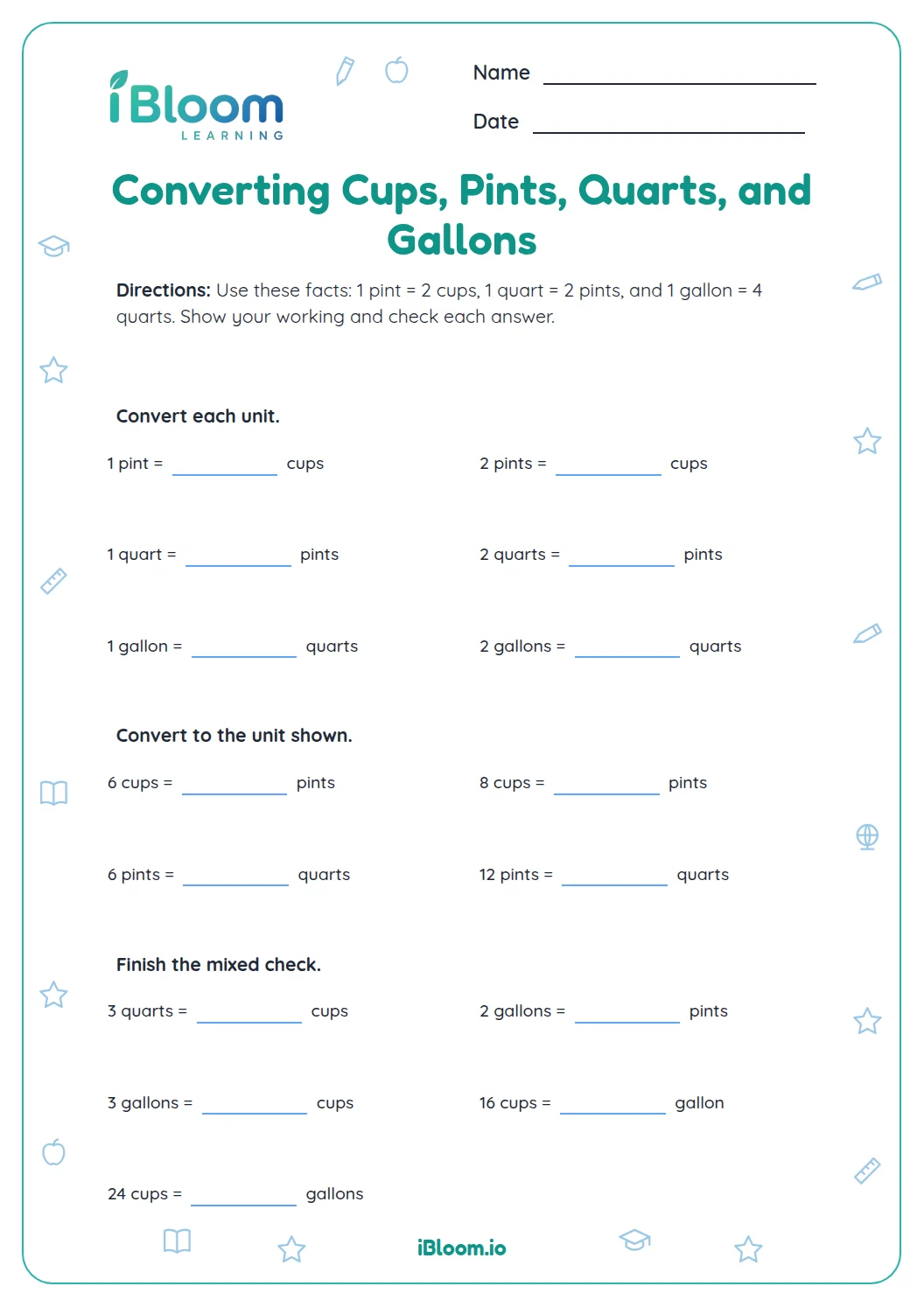
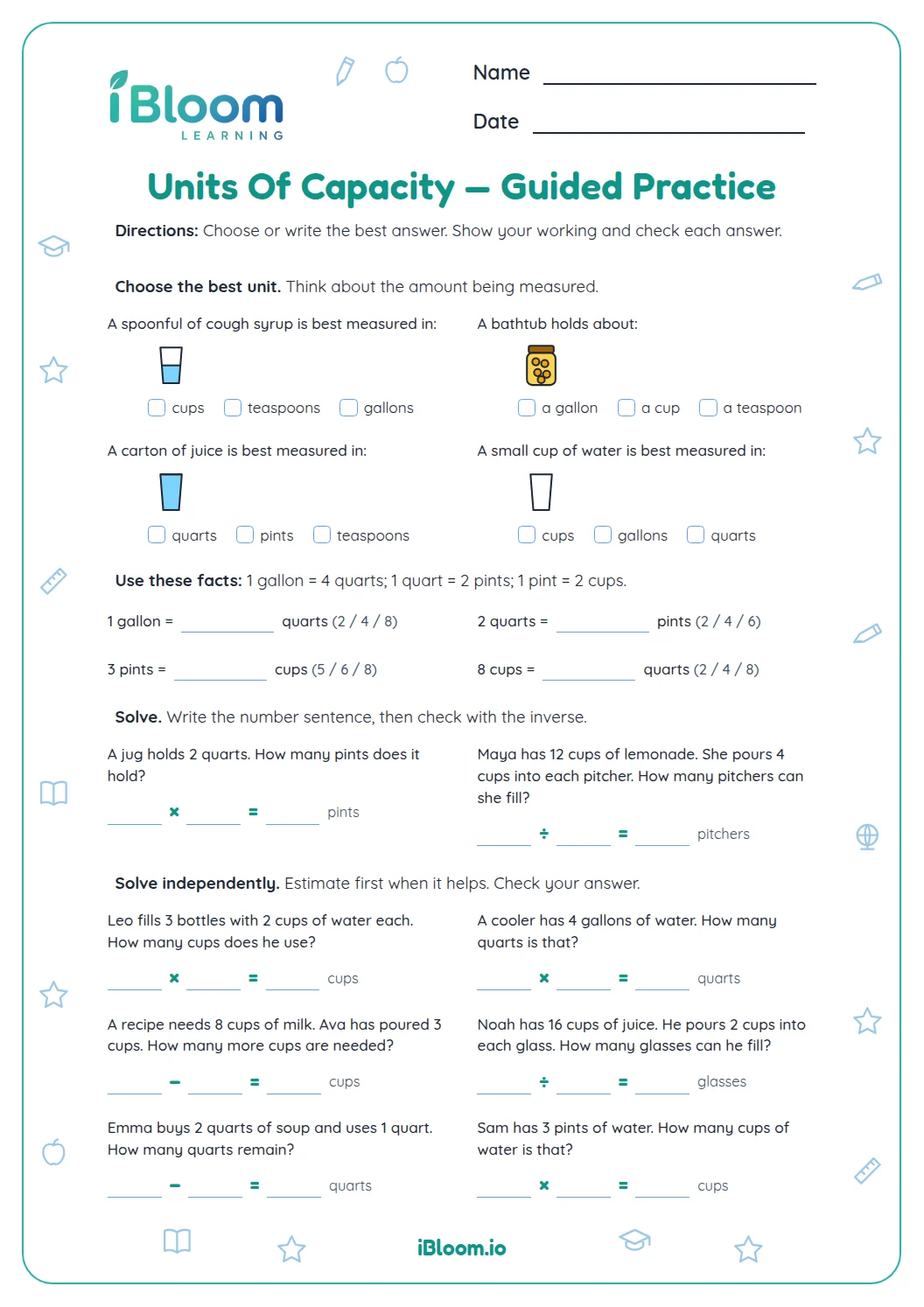
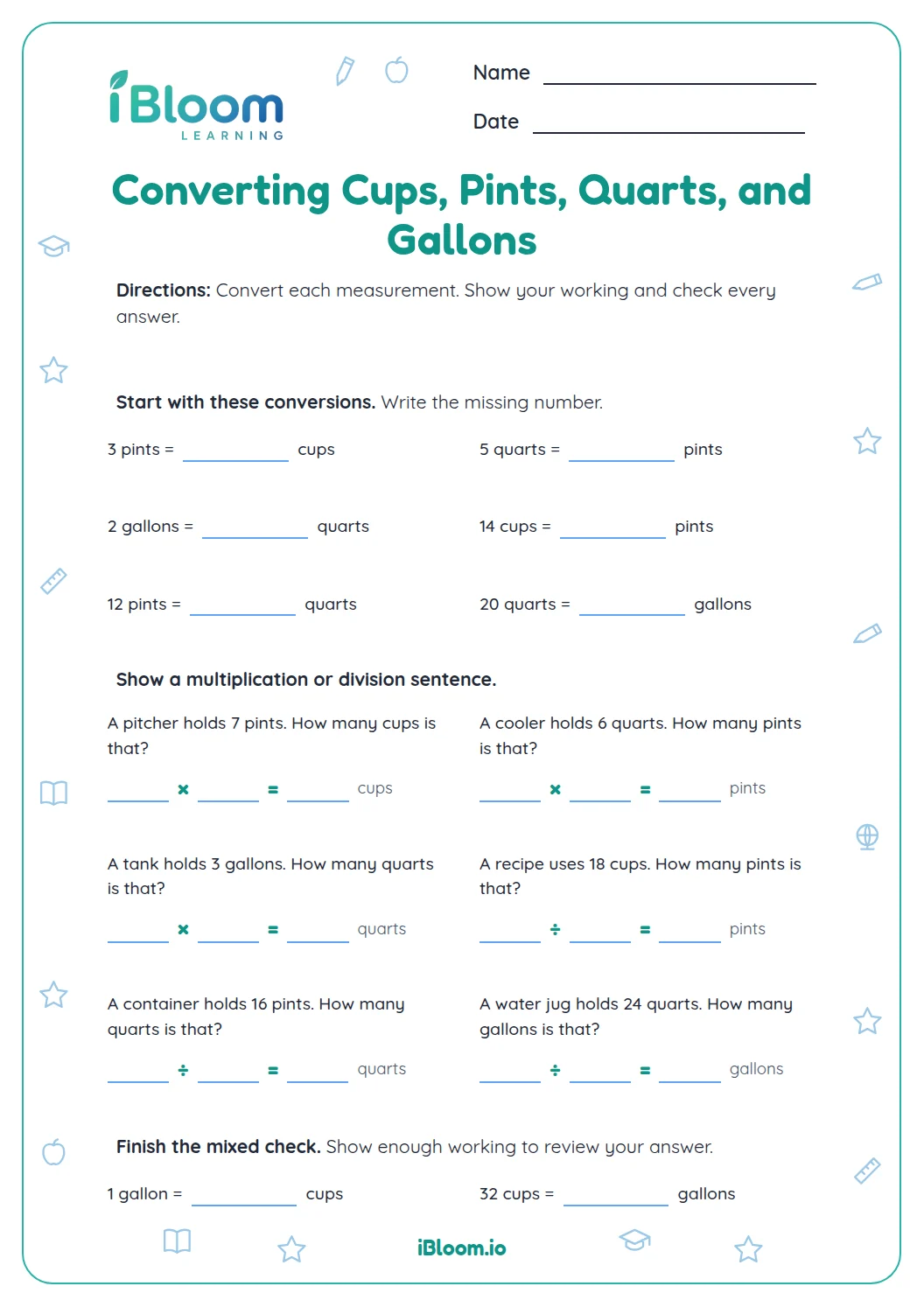
This free printable worksheet gives Grade 3 students real-world practice converting between cups, pints, quarts and gallons. Children first choose whether to multiply or divide, then solve three story problems about punch, water and lemonade, and finally fill in three two-step sentences about paint, juice and milk. The facts they need are printed at the top: 1 pint = 2 cups, 1 quart = 2 pints and 1 gallon = 4 quarts. It practices Common Core 4.MD.A.1 and 4.MD.A.2, and an answer key is included.
Aligned to 4.MD.A.1 and 4.MD.A.2
How do you change cups to pints, pints to quarts and quarts to gallons?
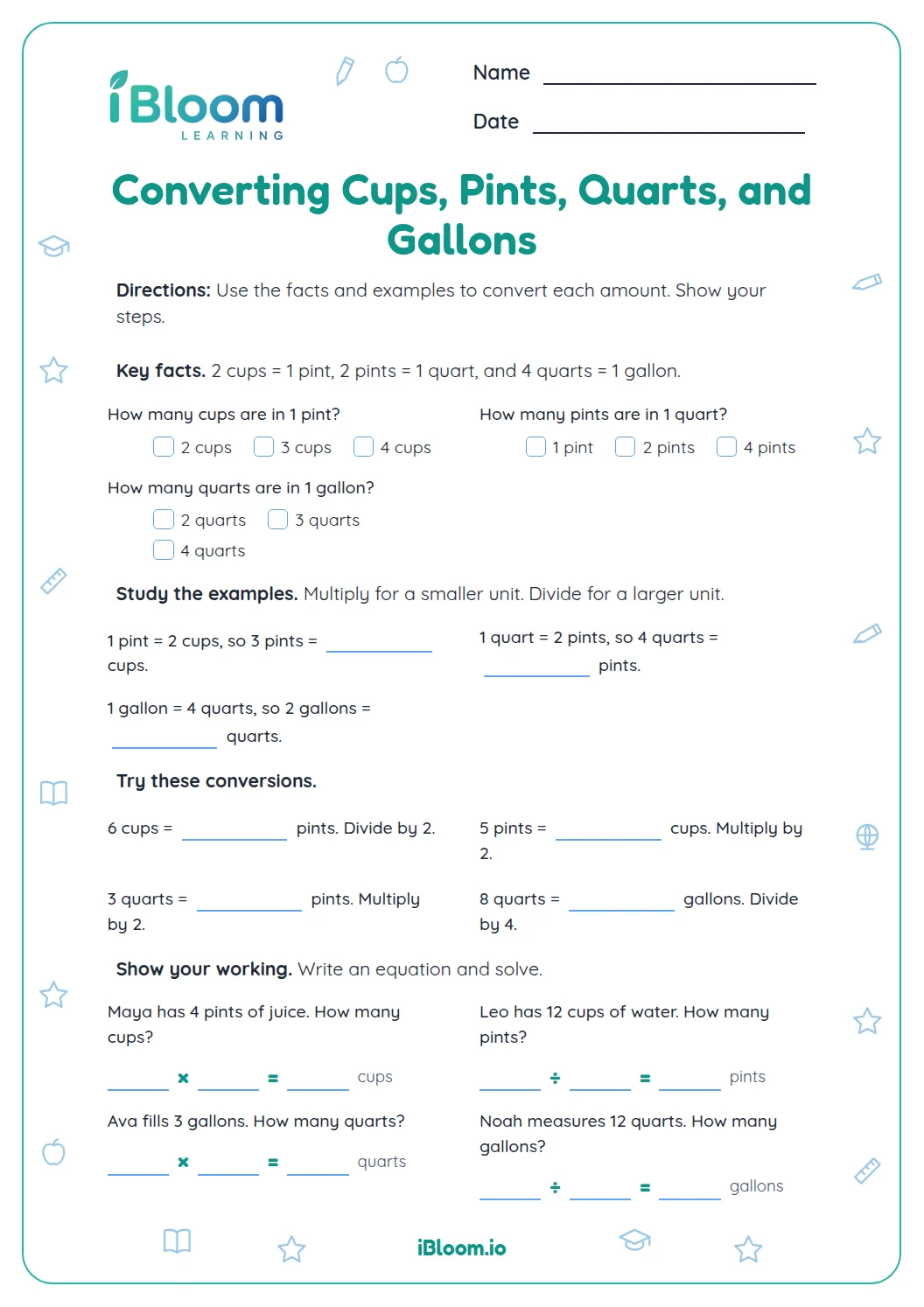
Each unit in the chain is a fixed number of the one before it. A pint holds 2 cups, a quart holds 2 pints and a gallon holds 4 quarts. Put them together and a quart is 4 cups, a gallon is 8 pints and a gallon is 16 cups.
When the new unit is smaller, there will be more of them, so multiply. When it is larger, there will be fewer, so divide. In question 1 Maya has 3 pints and wants cups, so the number gets bigger: 3 × 2 = 6.
- 112 cups of lemonade, jars hold 1 pint each
- 21 pint = 2 cups, so divide the cups by 2
- 312 ÷ 2 = 6
- 4Maya fills 6 jars
Why do the story problems help children understand conversion?
A story gives the numbers a reason. If a jug holds 5 quarts, a child can picture pouring it into pint containers and sees that there must be more pints than quarts. Asking “Should the answer be bigger or smaller?” is a quick way to catch a multiply-or-divide mix-up.
Question 6 asks for jars, not pints. Because each jar holds exactly 1 pint, children change 12 cups into 6 pints and then see that 6 pints fill 6 jars.
What is on this worksheet?
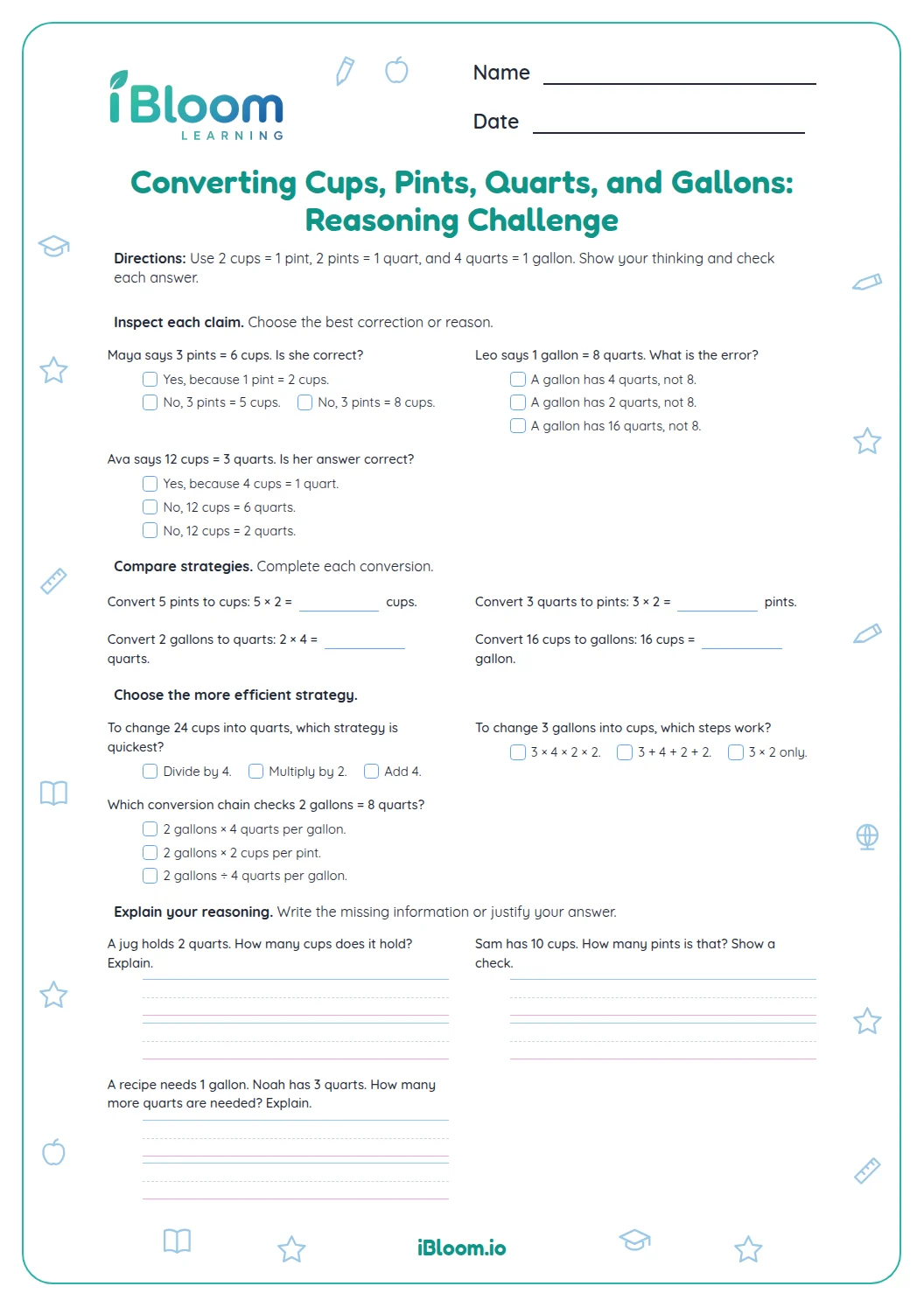
Nine questions in three parts that get more demanding. The conversion facts are printed at the top so children can focus on choosing the operation.
- Part A, Plan it: three questions that ask which operation to use (multiply or divide by 2 or 4)
- Part B, Solve it: three story problems with working space and a labeled answer
- Part C, Think again: three sentences with a missing number, each needing two steps (add, subtract or convert)
- Answer key on a separate page
How can children check a conversion answer?
Reverse it. If 3 pints is 6 cups, then 6 cups ÷ 2 should bring back 3 pints. Children can also compare size: the same amount of milk takes more cups than pints, so 6 cups is reasonable for 3 pints.
Part C rewards a second look. Questions 7 and 8 tell the story in one unit and ask for the answer in another, and question 9 mixes quarts with a gallon, so children must convert before they subtract.
How to use this worksheet at home or in class
- 1Warm up with real containers if you have them: pour 2 cups into a pint jar and see that it fills.
- 2Read the facts at the top of the worksheet aloud and ask which unit is the biggest and which is the smallest.
- 3Do question 1 together, saying “more or fewer?” before choosing multiply or divide.
- 4Let your child finish Part A alone, then solve Part B and write the unit next to each answer.
- 5For Part C, ask your child to underline the unit after each blank before working, since questions 7 and 8 switch units and question 9 mixes quarts with a gallon.
- 6Check with the answer key and have your child reverse any missed problem.
Common mistakes and quick fixes
The mistake
Multiplying when the answer should be smaller, such as 8 cups × 2 = 16 pints in question 2.
The fix
Ask whether pints are bigger or smaller than cups. Pints are bigger, so there are fewer of them: 8 ÷ 2 = 4.
The mistake
Using 2 for every conversion, including quarts to gallons, as in question 3.
The fix
Say each fact aloud: 2 cups in a pint, 2 pints in a quart, 4 quarts in a gallon. A gallon is the only one with 4.
The mistake
Answering a Part C question in the unit from the story, such as writing 4 for question 8 (6 cups − 2 cups) when it asks for pints, not cups.
The fix
Underline the unit right after the blank (cups, pints or quarts) before working, and make sure the final number counts that unit.
Common Core alignment
Most US states use the Common Core standards or a close state version. These measurement standards describe what this sheet practices.
Express a larger unit in a smaller one, such as pints in cups or gallons in quarts.
On this sheet: Questions 1, 3, 4, 5, 7 and 9 express pints in cups, gallons in quarts or quarts in pints.
Show the official wordingHide the official wording
Within a single system of measurement, express measurements in a larger unit in terms of a smaller unit.
Solve word problems about liquid volume, including changing a larger unit into a smaller one.
On this sheet: Parts B and C are story problems about punch, water, lemonade, paint, juice and milk.
Show the official wordingHide the official wording
Use the four operations to solve word problems involving distances, intervals of time, liquid volumes, masses of objects, and money, including problems involving simple fractions or decimals, and problems that require expressing measurements given in a larger unit in terms of a smaller unit.
What to practice next
Make more practice
Further reading
Questions parents and teachers ask
How many cups are in a pint, quart and gallon?
There are 2 cups in a pint, 4 cups in a quart and 16 cups in a gallon. These come from the chain printed on the worksheet: 1 pint = 2 cups, 1 quart = 2 pints and 1 gallon = 4 quarts. Because the facts are on the page, children can concentrate on choosing the operation.
When should my child multiply and when should they divide?
Multiply when changing to a smaller unit, because it takes more of them, and divide when changing to a larger unit. Question 1 changes pints to cups, so the number grows: 3 × 2 = 6. Question 2 changes cups to pints, so the number shrinks: 8 ÷ 2 = 4.
How do children solve question 6?
They change the cups into pints. Maya has 12 cups of lemonade, and 2 cups make 1 pint, so 12 ÷ 2 = 6 pints. Each jar holds exactly 1 pint, so 6 pints fill 6 jars. Asking “Will there be more jars or more cups?” helps children choose to divide.
What is the answer to question 7?
The answer is 8 cups. Maya has 3 pints and buys 1 more, so she has 4 pints, and each pint is 2 cups, so 4 × 2 = 8. Children can also change first, 3 pints to 6 cups and 1 pint to 2 cups, and add 6 + 2. Both ways give the same total.
Do children have to memorize these conversions?
Not for this worksheet, because the facts are printed under the title. Over time, children usually remember them through use, especially with real containers such as a cup, a pint jar and a gallon jug. A kitchen is a good place to practice, since recipes use these units all the time.
Is there an answer key for this worksheet?
Yes. A separate answer key shows the operation to choose in Part A, each story problem's answer with its unit in Part B, and the missing number in each Part C sentence. Print the worksheet pages by themselves and keep the key for checking once your child has finished.