







About this worksheet
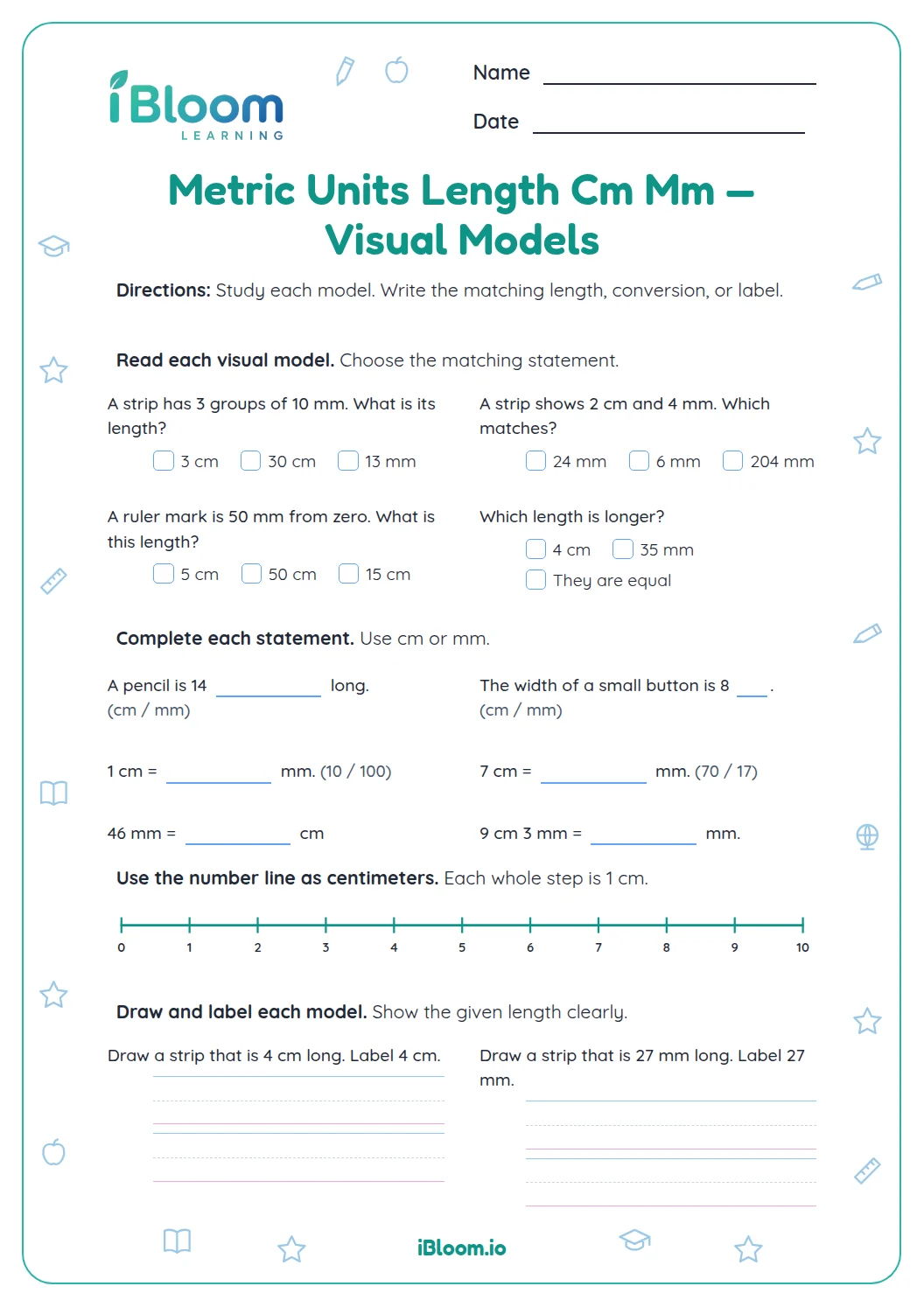
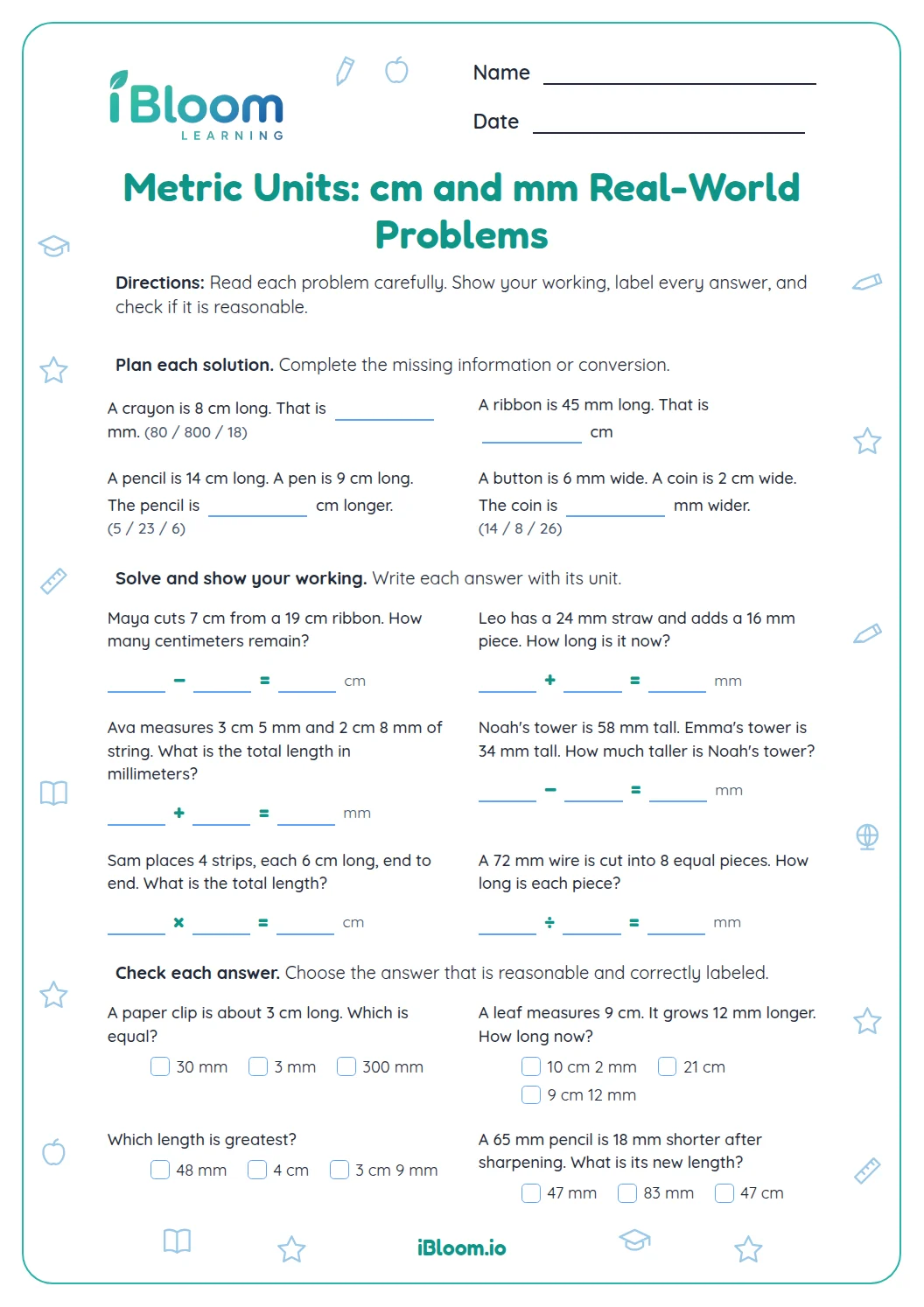
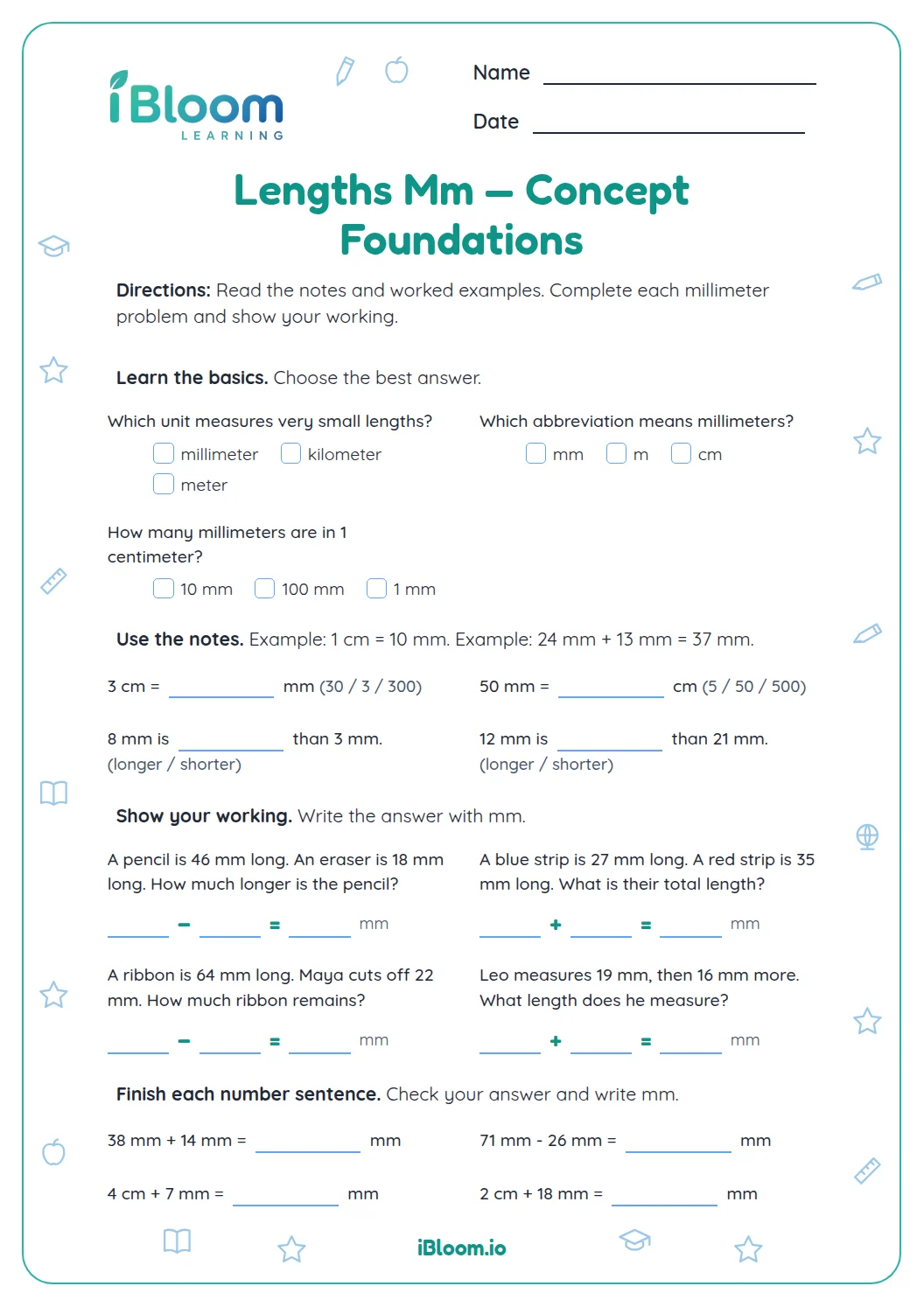
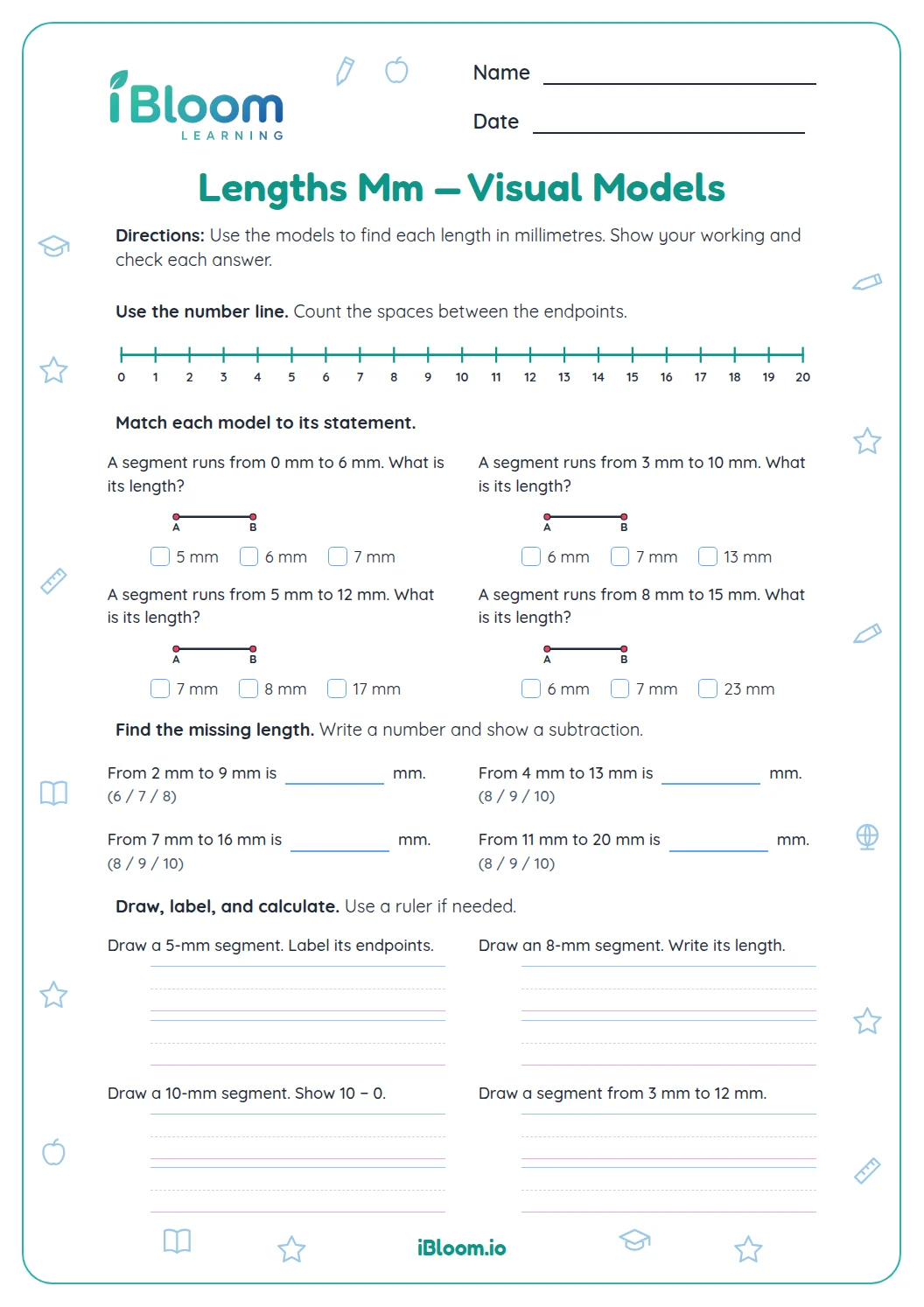
This Grade 3 worksheet focuses on reasoning about metric length in centimeters and millimeters. Learners convert between the units, compare lengths, and solve short addition and subtraction problems. The old sheet used the same conversion and comparison methods; this replacement keeps that focus in a clearer sequence. A separate answer key supports checking.
Aligned to 4.MD.A.1
How are centimeters and millimeters related?
One centimeter equals 10 millimeters. To change centimeters to millimeters, multiply by 10; to express millimeters in centimeters and millimeters, group tens of millimeters into centimeters.
How are the questions organized?
Part A checks unit relationships and equivalent lengths. Part B applies conversions to comparisons and short length problems. Each item uses centimeters, millimeters, or both.
How can a learner compare two lengths?
For 84 mm and 9 cm, rewrite 9 cm as 90 mm. Compare 84 and 90, then state that 9 cm is longer by 6 mm.
How to use this worksheet
- 1Identify the unit named in the question.
- 2Convert one length so both lengths use the same unit.
- 3Compare, add, or subtract the converted amounts.
- 4Include the requested unit with the answer.
Common mistakes and quick fixes
The mistake
Comparing centimeters directly with millimeters.
The fix
Convert one length so both amounts use the same unit.
The mistake
Multiplying by 100 instead of 10 when changing cm to mm.
The fix
Use the fact that each centimeter contains 10 millimeters.
The mistake
Forgetting to include a unit.
The fix
Write cm or mm exactly as requested in the prompt.
Curriculum alignment
This worksheet practices the stated skill through focused questions.
Convert measurements within one metric system.
On this sheet: The title names a metric conversion skill, so these problems use the cm-mm relationship and whole numbers.
Show the official wordingHide the official wording
Know relative sizes of measurement units within one system of units including km, m, cm, kg, g, lb, oz, L, ml, hr, min, sec. Within a single system of measurement, express measurements in a larger unit in terms of a smaller unit.
What to practice next
Make more practice
Further reading
Questions parents and teachers ask
How many millimeters are in 6 centimeters?
There are 10 millimeters in each centimeter, so 6 centimeters equals 60 millimeters. The first section includes this kind of conversion as well as comparisons between equivalent lengths. Have the learner name the unit first, convert to a matching unit, and check the final measurement against the original situation.
How do I compare 84 mm and 9 cm?
Convert 9 centimeters to 90 millimeters, then compare 84 mm and 90 mm. The 9 cm length is longer by 6 mm. Converting to one unit makes the comparison clear. Have the learner name the unit first, convert to a matching unit, and check the final measurement against the original situation.
What kinds of problems are in Part B?
Part B uses conversions in short situations involving a track, cord, ribbon, pencil, leaf, and other lengths. Learners may need to convert before subtracting, adding, or comparing. Have the learner name the unit first, convert to a matching unit, and check the final measurement against the original situation.
Why convert before adding or subtracting?
Centimeters and millimeters describe the same kind of length but use different-sized units. Convert one measurement so both values use centimeters or both use millimeters, then calculate and include the requested unit. Have the learner name the unit first, convert to a matching unit, and check the final measurement against the original situation.
What is the key conversion fact?
One centimeter equals 10 millimeters. Multiply a centimeter amount by 10 to express it in millimeters; group millimeters by tens to express a length in centimeters and leftover millimeters. Have the learner name the unit first, convert to a matching unit, and check the final measurement against the original situation.