


About this worksheet
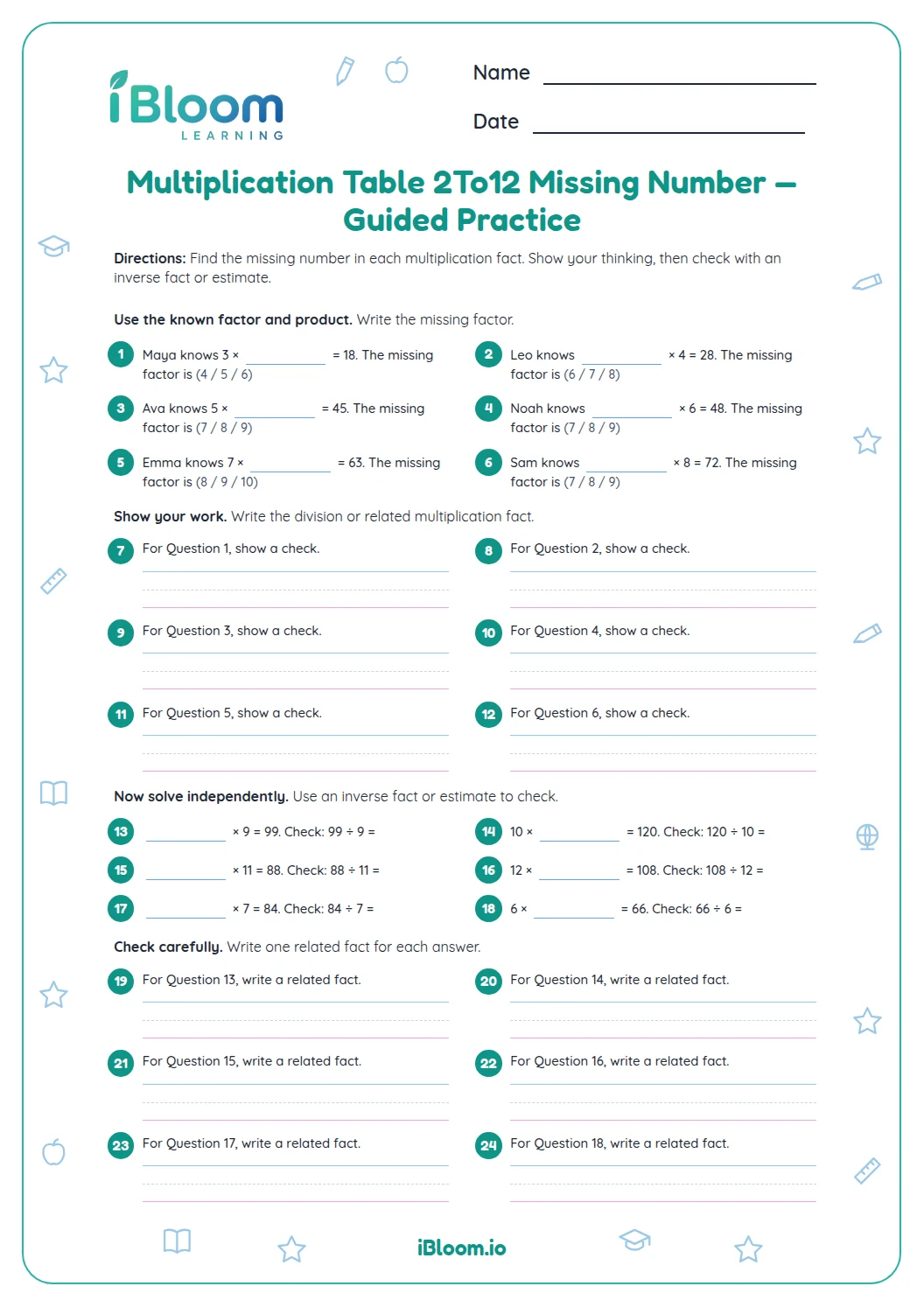
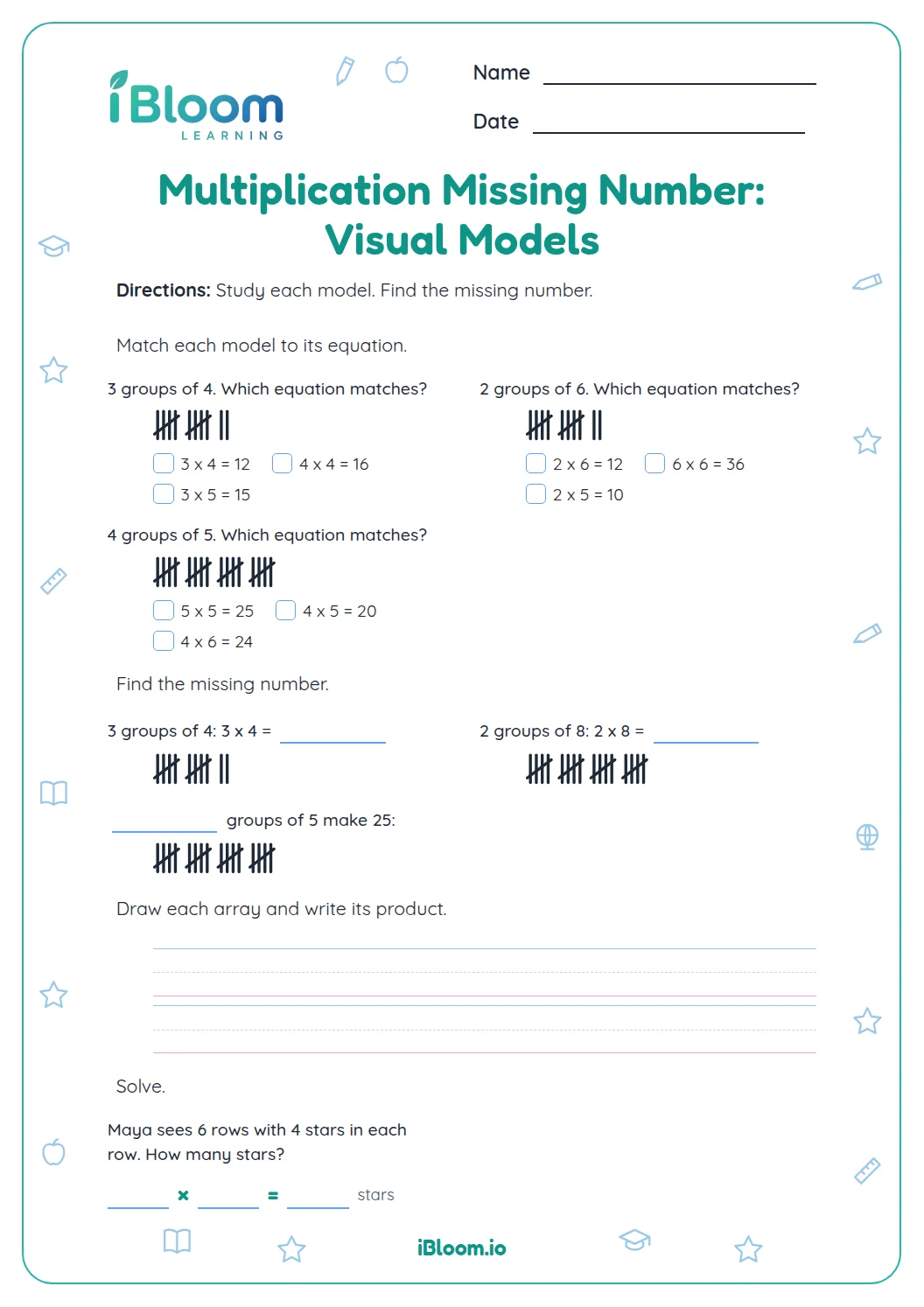
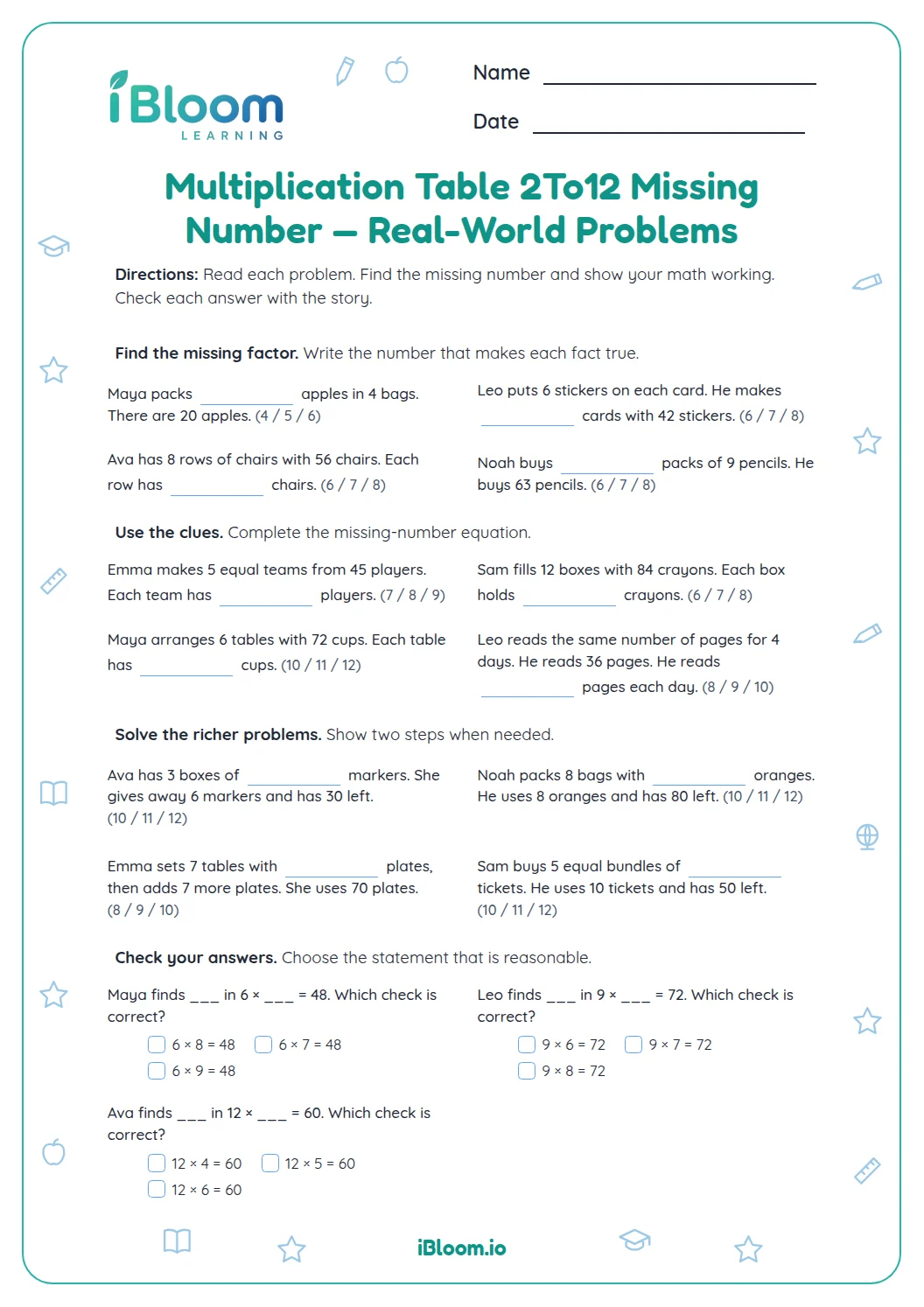
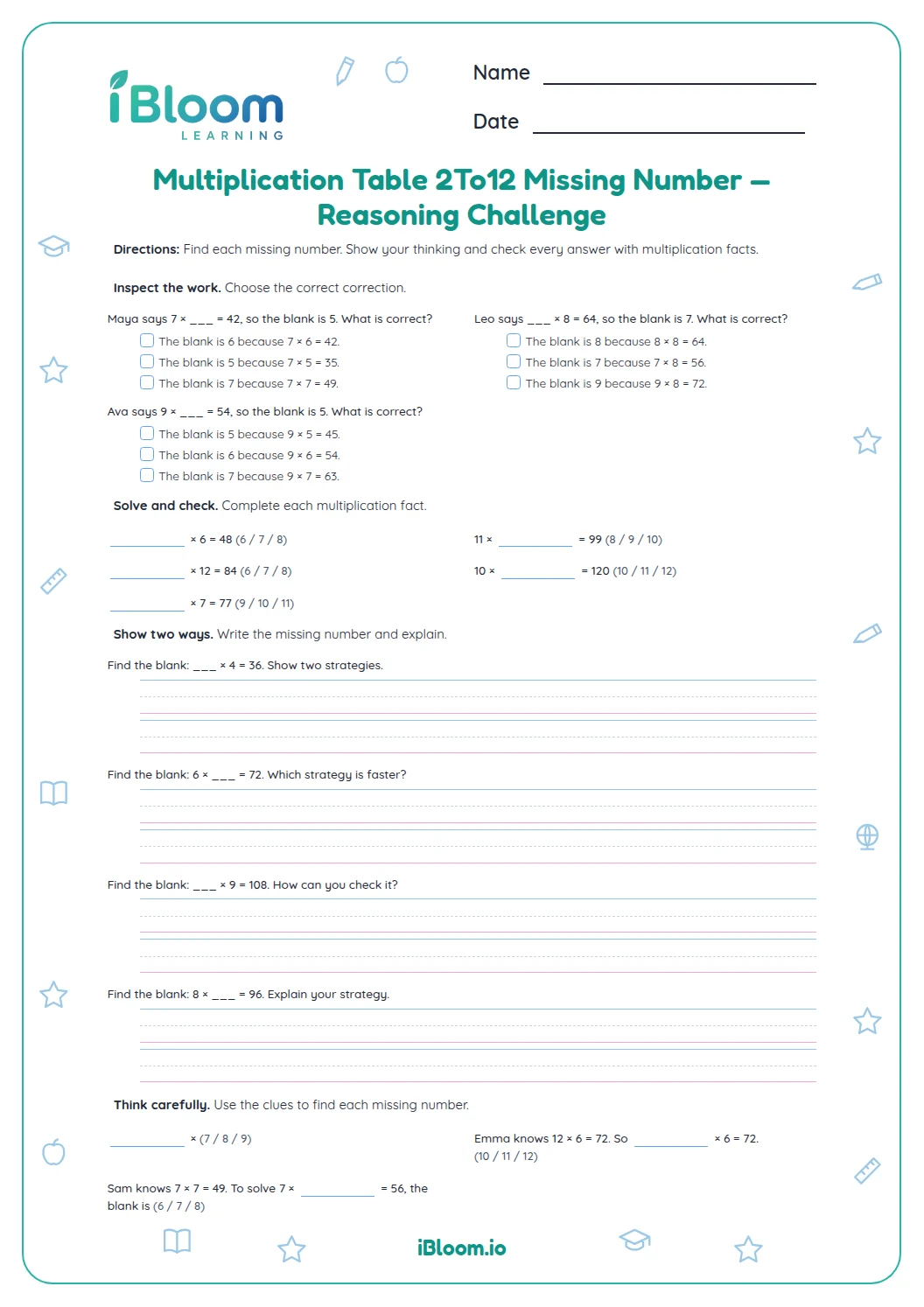
This Grade 3 printable develops missing-factor thinking across the 2 through 12 multiplication tables. Four array questions connect equal groups to an unknown factor; six number sentences build recall, and four stories ask children to write a multiplication or division equation. It practices CCSS 3.OA.A.4 and includes a separate answer key.
Aligned to 3.OA.A.4
How can an array show a missing factor?
An array organizes equal groups in rows and columns. In question 1, three rows of six make 18, so 3 × 6 = 18. The unknown number tells how many are in each row.
- 13 rows of 6 apples
- 23 × 6 = 18
- 3So 3 × ___ = 18 has a missing factor of 6.
How can a known fact help?
Turn the equation around as a question: “What number times 7 makes 63?” A related division fact, 63 ÷ 7 = 9, gives the unknown. Multiplication and division undo each other.
What should children write for a story problem?
First decide whether the unknown is the total, number of groups, or number in each group. Question 13 shares 84 stickers among 12 children, so 12 × ___ = 84 or 84 ÷ 12 = ___; each child gets 7. Four stories connect facts to equal groups and sharing.
- Part A: four factor equations with equal-group arrays
- Part B: six fact-family equations
- Part C: four word problems, including equal sharing
- Answer key on two pages
How to use this worksheet at home or in class
- 1Count rows and columns in the first array.
- 2Say the full fact aloud before writing the missing number.
- 3Use division to check a missing factor.
- 4In each story, identify what is unknown before choosing × or ÷.
- 5Check that the product or quotient matches the story total.
Common mistakes and quick fixes
The mistake
Putting the product in the factor blank.
The fix
Read the equation as groups × items in each group = total.
The mistake
Dividing by the wrong known factor.
The fix
Use the known factor from the equation, such as 63 ÷ 7.
The mistake
Multiplying in an equal-sharing story when the group size is unknown.
The fix
Divide the total into the known number of equal groups.
Common Core alignment
This worksheet practices the standard below through its printed questions.
Find an unknown whole number in a multiplication or division equation.
On this sheet: Every missing-factor sentence or equal-group story gives three related whole numbers with one unknown.
Show the official wordingHide the official wording
Determine the unknown whole number in a multiplication or division equation relating three whole numbers.
What to practice next
Make more practice
Further reading
Questions parents and teachers ask
How do arrays show a missing factor?
Rows and columns organize equal groups. In 3 × ___ = 18, the array has three rows with six apples in each row, so the missing factor is 6. The model gives a way to see the groups and check the multiplication sentence before moving to facts without a drawing.
Can division help find an unknown factor?
Yes. Divide the product by the factor you know. For 7 × ___ = 63, use 63 ÷ 7 = 9. The quotient is the missing factor, and multiplying 7 by 9 checks the answer. This inverse relationship also helps with the equal-sharing story.
Are facts from every table from 2 through 12 included?
Yes. Across the equations and stories, every multiplication table from 2 through 12 appears. The worksheet places the unknown in either factor position and includes an equal-sharing problem. Four arrays provide a visual model before children work with the number sentences and stories.
How many questions are on the worksheet?
There are 14 questions: ten missing-factor equations and four word problems. The first four equations include equal-group arrays. The remaining equations and stories extend the same unknown-factor idea to multiplication and equal sharing, with a separate two-page key for checking.
What should a child write for the story problems?
Each story has a short numeric answer space sized for the result. Encourage the child to write a multiplication or division equation first, then the answer. For example, 84 stickers shared among 12 children can be represented by 84 ÷ 12 = 7 stickers per child.